
A top-three Google ranking is the sign that an SEO campaign was working. Now, a page can shape a buying decision without receiving the first click, or any click at all.
That’s the challenge behind Answer Engine Optimization. Search engines and AI assistants produce an answer before showing the familiar list of links. Brands now need content that ranks, gets cited, and still gives people a reason to visit the website.
Most “AEO hacks” miss the last part. Winning an AI citation is helpful, while winning the customer is the actual goal.
What Is Answer Engine Optimization?
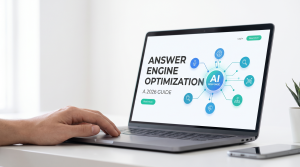
Answer Engine Optimization, or AEO, is the process of making content easier for search engines and AI systems to find, understand, trust, and use in direct answers.
These answers appear in:
- Google AI Overviews
- Google AI Mode
- Microsoft Copilot
- Bing’s AI-generated search experiences
- ChatGPT search
- Perplexity
- Featured snippets
- Voice assistant responses
- Knowledge panels and other zero-click results
Traditional SEO asks:
How do we get this webpage to rank?
AEO adds a second question:
How do we make this webpage useful enough to become part of the answer?
That difference is significant. A conventional search result gives the user multiple links to evaluate. An answer engine retrieves information from multiple pages, combines it into a response, and shows a small number of supporting sources.
Your page doesn’t always have to supply the entire answer. It gets selected because one section contains a clear definition, a useful comparison, original data, or a precise explanation that other pages lack.
AEO vs SEO vs Generative Engine Optimization
AEO, SEO, and generative engine optimization overlap, but they aren’t substitutes.
| Approach | Main Goal | Typical Outcome |
| SEO | Improve organic rankings and traffic | A higher position in traditional search results |
| AEO | Become a source for direct answers | A featured answer, citation, or voice response |
| GEO | Increase visibility in generative AI systems | A mention, recommendation or citation in an AI-generated response |
SEO remains the foundation.
A page needs to be crawlable, indexed, and eligible to appear in search before Google uses it in AI Overviews or AI Mode. AEO isn’t “the replacement for SEO”, but an additional layer of optimisation for search experiences that summarise, compare, recommend and answer follow-up questions.
Why Answer Engine Optimization Matters in 2026
At the present time, search visibility is not measured by the position of a blue link.
A company, when searched, appears in several ways:
- As a standard organic result
- As a supporting source in an AI Overview
- As a citation in an AI assistant
- As a recommended product or service
- As the source of a featured snippet
- As a brand mentioned in an answer
This results in required changes to both content strategy and reporting.
A person researching accounting software, for example, asks an AI system which features a 40-person company needs. The answer could cite one source for tax compliance, another for pricing information, and a third for integration advice.
A single website doesn’t need to dominate the whole response. Each source competes to provide the strongest part of the answer.
Being cited matters even when the user doesn’t click
Marketers think that a citation without a visit has no value.
A user sees your company cited while researching a problem, remembers the brand, and searches for it later. They may visit through a branded query, type the address directly, or mention the company to another decision-maker.
The initial AI answer influenced the journey, even though analytics credited the later session to another channel.
This doesn’t mean clicks no longer matter. They do. It means last-click organic traffic is an incomplete measure of search influence.
What Changed in AI Search During 2025–2026?
AI search has become easier to monitor and more relevant to everyday search behavior. For AEO, the biggest changes are better visibility reporting and clearer guidance on what optimization does, and does not require.
Google and Bing Added AI Visibility Reporting
Google Search Console provides reporting for visibility in generative AI features such as AI Overviews and AI Mode. At the same time, Bing Webmaster Tools offers AI Performance data including citations, cited pages, visibility trends, and sampled grounding queries.
These reports provide SEO teams with evidence of which pages are being retrieved by AI systems. They remain incomplete, however, so citation and AI-search visibility data should be evaluated alongside branded searches, engagement, and conversions.
Google Clarified What AEO Does Not Require
Google’s guidance has pushed back against common AEO assumptions. Websites don’t need llms.txt, special AI-only schema, artificially fragmented content, or separate pages for every long-tail variation to appear in generative search.
The broader principle is: technical SEO, useful content, clear information, and original value remain the foundation.
How Do Answer Engines Choose Sources?
There is no citation formula shared by Google, Bing, ChatGPT, Copilot, and other answer systems.
Their models, indexes, and retrieval methods differ. The pages that perform well have several common characteristics.
- They are technically accessible.
- They answer the question directly.
- They make important entities clear.
- They support factual claims.
- They remain current.
- They add more value than a generic summary.
Relevance can be decided at the section level
An answer engine may retrieve one paragraph from a 3,000-word guide and ignore the rest.
That means important sections make sense without requiring the reader to interpret earlier paragraphs.
Consider these two answers.
Weak answer:
AEO is important because AI is advancing, and businesses need to adapt their strategies to remain competitive.
Stronger answer:
Answer Engine Optimization helps a website become a source for direct and AI-generated search answers. It focuses on clear responses, accessible content, credible evidence, and complete coverage of the user’s question.
The stronger version is not better because it sounds formal. It is better because it provides an actual definition.
Query fan-out changes how topics should be covered
Google says AI Overviews and AI Mode can use a process known as query fan-out. The system runs related searches across subtopics and data sources before building its response.
Suppose a user asks:
Is Answer Engine Optimization worth it for a small B2B company?
The search system also explores:
- What is AEO?
- How is AEO different from SEO?
- Do AI citations generate traffic?
- How much does AEO cost?
- How can a small business measure AI visibility?
- Which content types are most likely to be cited?
A page that repeats the exact keyword doesn’t satisfy the wider research task.
Strong AEO content should answer the main question while covering the decisions that sit behind it. It means understanding what the reader needs to know before taking action.
How to Optimise Content for Answer Engines
A useful question to ask during editing is:
Could an answer engine reuse this section without changing its meaning?
If the answer is no, the content is either too vague, or too dependent on surrounding context, or is poorly supported.
Answer the Main Question Early
For a question-based heading, provide the central answer within the first one or two sentences.
A practical structure is:
- Give the direct answer.
- Explain why it is correct.
- Add supporting evidence or an example.
- Mention an important limitation when relevant.
- Tell the reader what to do next.
This gives both readers and retrieval systems a clear answer without forcing them through unnecessary context first.
Match the Complete Intent
Optimize for the user’s underlying question and not focus on creating separate pages for every keyword variation.
Searches such as “What is AEO?”, “AEO meaning,” and “What does AEO stand for?” have essentially the same intent and can be covered by one strong page. Separate pages make more sense when the task changes, such as AEO strategy, AEO audit, AEO tools, or measuring AEO performance.
Also address important follow-up questions that arise from the main query. Answer engines handle conversational queries containing additional context, conditions, or desired outcomes, so answer the complete question and do not insert conversational keywords artificially.
The goal is to cover the related questions that support the primary intent.
Add Evidence Other Sites Cannot Easily Copy
Original information gives answer engines a reason to cite the source.
Useful evidence includes:
- Survey findings
- Industry benchmarks
- Product or usage data
- Original research
- Expert commentary
- Tested methodologies
- Before-and-after results
- Calculations with explained assumptions
The strongest evidence is specific, verifiable, and difficult to reproduce by simply rewriting another page.
Make Entities Clear
Answer systems need to understand which company, product, location, person, or framework a page is discussing.
Use complete names when ambiguity is possible, describe what an entity is, and do not rely on unexplained references. Keep important descriptions consistent across the site so the same product or organization is not repeatedly assigned unrelated categories.
Keep Important Information Accessible in HTML
Make important information available as readable text, keep the page crawlable, and use internal links to connect related content. Images, videos, interactive elements, or gated documents should not have the critical answers.
Multimedia does strengthen the page, but it should not be the only place where an important answer appears.
Use Structured Data Correctly
Structured data helps search engines understand page content and make pages eligible for certain search features. It does not guarantee an AI citation, and there is no universal AEO schema.
Use structured data that represents the visible content, such as Article, Organization, Product, LocalBusiness, Breadcrumb, Event, Video, or Recipe, where appropriate. Do not add markup only because a page contains a particular type of information.
AI Search Strategies for Different Query Types
AEO should adapt to the user’s goal. A definition query, comparison, local search, and product query require different information to produce a useful answer.
| Query type | What the content should provide |
| Informational | A direct answer, clear context, examples, relevant exceptions, and reliable sources |
| Commercial comparison | Selection criteria, strengths and weaknesses, suitability by use case, current information, and transparent recommendations |
| Local | Accurate business information, service areas, hours, contact details, availability, and answers to location-specific customer questions |
| Product | Accurate pricing, availability, variants, compatibility, specifications, shipping, returns, and other decision-critical details |
The principle is simple: match the information to the decision the user is trying to make.
Common AEO Advice That Is Outdated or Overstated
AEO has attracted many pieces of advice that are presented as a rule when the evidence does not support it.
“Every website needs an llms.txt file”
Not for Google Search.
Google says it does not use llms.txt or similar AI-specific text files as requirement for visibility in its search features. Creating one for another platform serves a separate purpose, but it is not a Google ranking shortcut.
“Every paragraph must be extremely short”
Short paragraphs improve readability, but that does not mean every idea should be reduced to a one-sentence fragment. Write for understanding. Use as much structure as the subject requires rather than forcing every section into an artificial format to make it easier for an AI system to process.
“FAQ schema guarantees direct-answer visibility”
Structured data only helps search engines understand content and make a page eligible for certain search features. It cannot force Google or another answer engine to select the page.
A clear, well-supported answer matters more than adding markup to weak content.
“AI-written content is automatically penalised”
The use of AI is not the deciding factor. The important point is that the content is useful, original, accurate, and compliant with applicable spam policies. Large volumes of generated pages adding little or no value create problems, regardless of whether they were produced entirely by AI or by humans.
“You can track one universal AI ranking”
There is no stable, universal AI position.
Answer visibility varies by:
- Platform
- Location
- Date
- Prompt wording
- Conversation history
- Available source material
- Follow-up context
A page may be cited for one version of a question and absent from another.
Track visibility patterns across important topics and prompts instead of treating one number as an overall AI ranking.
How to Measure Answer Engine Optimization
AEO reporting connects three layers: visibility, engagement, and business impact. No single metric captures how answer engines influence the search journey.
| Measurement layer | What to measure | What it tells you |
| Visibility | AI-search impressions, citation frequency, cited pages, brand mentions in generated answers, visibility across high-value question groups, grounding-query samples, manual priority-prompt checks, featured-snippet ownership | Whether your content is being discovered, retrieved, and cited by answer engines |
| Engagement | AI-referred sessions, engaged sessions, returning visitors, page engagement, tool or product usage, contact or demo requests, downloads | What users do after reaching your website through AI-influenced search |
| Business impact | Qualified leads, sales enquiries, purchases, assisted conversions, assisted revenue, lead quality, branded-search growth, customer-acquisition cost, sales-cycle length | Whether AEO visibility contributes to demand, conversions, and commercial outcomes |
Google’s generative AI reporting and Bing’s AI Performance data provide useful visibility signals, but don’t give a complete picture of AI search exposure. Use them alongside manual checks and other search data.
AI-referred visitors arrive with more context as they have already received a summary from an answer engine. Test their behavior against your analytics rather than assuming AI traffic will perform differently.
Attribution will not be perfect. Ask leads how they discovered the company and include AI search among the available options, with an open-text field for platforms or sources not listed. The goal is to identify whether AI visibility contributes to brand demand, qualified traffic, and conversions, rather than relying on last-click organic sessions alone.
Practical Takeaway: AEO Mini-Checklist
Before publishing or updating an important page, check:
- Does the page answer a clear question or support a specific decision?
- Is the central answer visible near the beginning?
- Can important sections make sense without excessive surrounding context?
- Are factual claims supported by credible sources?
- Does the page provide original evidence, examples, insights, or useful distinctions?
- Are names, dates, prices, and other important details current?
- Is essential information available as readable HTML?
- Can search engines crawl and index the important content?
- Do internal links connect the page to relevant supporting content?
- Does structured data accurately match the visible content?
- Are important follow-up questions covered without unnecessary duplication?
- Does the page provide enough value or context to justify a click after an AI summary?
- Are AI visibility, citations, branded searches, and meaningful conversions being monitored?
One final test catches the weaknesses that the optimization tools miss:
Is this the source you would trust if you had to make the decision yourself?
The answer is no; more keyword research isn’t the solution.
Answer Engine Optimization Is SEO With a Wider Scoreboard
Answer Engine Optimization combines strong SEO fundamentals with content that is clear, useful, and worth citing.
Crawling, indexing, relevance, and internal linking still matter. But AEO rewards original evidence, accurate information, specialist expertise, and clear answers.
Search may answer first, but your website needs to provide the answer worth choosing.
Frequently Asked Questions
What is Answer Engine Optimization in SEO?
Answer Engine Optimization is the practice of improving website content so search engines and AI platforms can use it in direct answers, summaries, voice results, and generated responses. It builds on technical SEO, relevance, content quality and trust.
How do you rank in Google AI Overviews?
There is no separate application or guaranteed tactic. A page should be crawlable, indexed, eligible to appear in Google Search, and allowed to display a snippet. Useful content, clear answers, strong internal linking and reliable supporting evidence can improve its chances of being selected.
Is AEO the same as generative engine optimization?
The terms overlap, but their scope differs slightly. AEO covers direct answers across search engines, featured snippets, voice tools and AI platforms. Generative engine optimization focuses more specifically on mentions and citations inside generative AI responses.
Does AEO help with voice search optimization?
Yes. Voice queries are often longer and more conversational than typed searches. Pages that provide clear answers, natural wording, and complete business or product information are easier to use in spoken responses.