

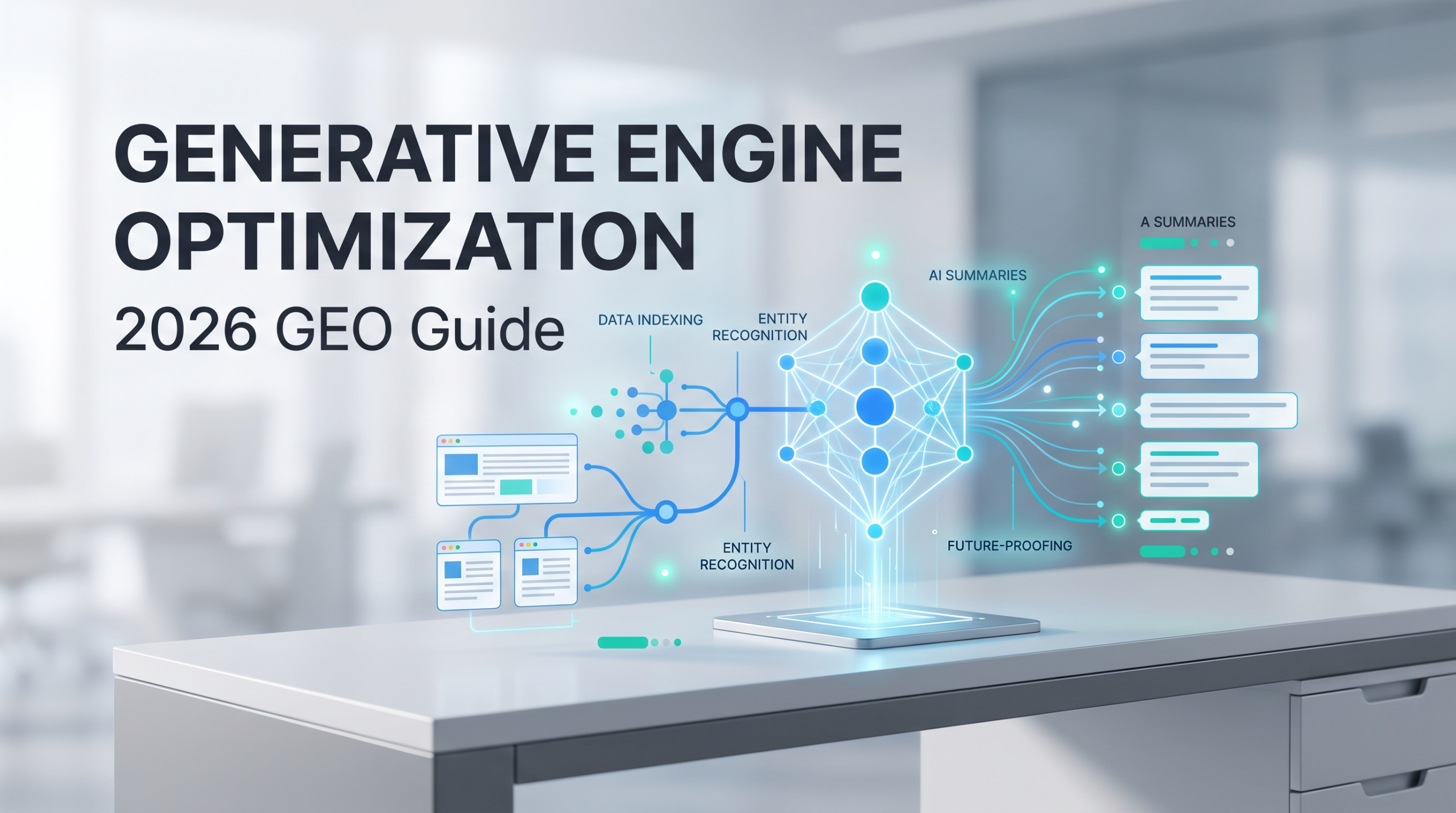
A few years ago, winning Google Search meant earning a top ranking and the click. Today, users ask questions directly in ChatGPT, Google AI Mode, AI Overviews, Perplexity, Claude, and other AI assistants.
These systems synthesize answers from multiple sources, meaning your website can rank well yet be absent from the answer. Generative Engine Optimization (GEO) helps make your content discoverable, relevant, trustworthy, retrievable, and useful in AI-powered search.
GEO doesn’t replace SEO; it expands search visibility beyond traditional rankings. This guide covers how AI search finds and uses information, what influences AI visibility, practical GEO strategies, competitor analysis, and performance measurement.
What Is Generative Engine Optimization (GEO)?
Generative Engine Optimization (GEO) is the process of optimizing your website, content, and broader digital presence so AI-powered search systems can discover, understand, retrieve, evaluate, and cite your information when generating answers.
The concept was introduced in academic research on generative engines. The original GEO study introduced GEO-Bench to evaluate visibility across generative search responses. It was found that a few optimization strategies raised the visibility by up to 40% in its experimental setting. The researchers also found that results varied across domains; this means GEO is not a universal checklist with identical results for every website.
Unlike traditional SEO, where success is measured through rankings, impressions, clicks, and organic traffic, GEO considers:
- AI-generated mentions
- citations and source links
- brand visibility within generated answers
- topic-level visibility
- competitor presence
- AI referral traffic
- how consistently a brand is represented across relevant sources
Instead of asking:
“How do I rank #1 on Google?”
Businesses are increasingly asking:
“How do I become a source AI chooses to reference?”
That’s a broader and distinct optimization challenge.
Why Generative Engine Optimization Matters
Search behaviour has changed in the present times at a fast pace.
Users now begin research inside AI assistants. Someone researching “best CRM for startups” or “how technical SEO works” receive a synthesized answer before ever clicking a website.
If your brand isn’t part of the information an AI system retrieves or represents, you lose visibility during part of the research journey.
GEO helps businesses:
- Improve AI search visibility
- Increase the likelihood of AI-generated citations
- Strengthen topical authority
- Build clearer brand and entity associations
- Identify visibility gaps against competitors
- Understand how their content performs beyond traditional rankings
- Monitor emerging AI-driven search behaviour
GEO focuses on becoming a useful and credible information source.
How AI Search Actually Works
People assume AI models simply “know everything,” but they don’t.
Search-backed generative systems use retrieval systems to obtain current information before generating an answer.
Google, for example, describes its AI search experiences as using retrieval-augmented generation (RAG), also referred to as grounding, to retrieve relevant information from its Search index before generating responses. Google also describes query fan-out, where related searches are generated to gather information from different aspects of a user’s question.
The exact process differs between platforms, but a simplified model looks like this:
- User asks a question.
- The system interprets the query and underlying intent.
- Related searches or retrieval requests may be generated.
- Relevant documents or passages are retrieved.
- Sources are evaluated for relevance and usefulness.
- Information is selected as context for the response.
- The language model generates an answer.
- Relevant sources may be displayed as citations or links.
This creates a distinction:
Ranking is not the same thing as citation.
A page needs to be discoverable and eligible for search visibility, and also its information needs to be relevant and useful enough to be selected for the generated response.
This retrieval process requires your content to be:
- Easy to discover and crawl
- Well structured
- Factually accurate
- Relevant to the query
- Clear and self-contained
- Supported by reliable evidence
- Updated when information changes
- Distinctive enough to provide information gain
A useful way to think about GEO is:
Discoverability → Relevance → Retrieval → Evidence → Citation-worthiness → Representation
This framework is more useful than treating GEO as a collection of isolated “AI ranking factors.”
Generative Engine Optimization vs Traditional SEO
GEO and SEO, despite overlap, aren’t identical.
| Traditional SEO | Generative Engine Optimization |
| Optimizes for search rankings | Optimizes for visibility in generated answers |
| Measures clicks and rankings | Measures mentions, citations, visibility and downstream impact |
| Focuses heavily on keywords | Focuses on topics, entities, questions and relationships |
| Prioritizes SERPs | Considers AI retrieval and generated responses |
| Primarily evaluates webpages | Considers webpages plus broader brand/entity signals |
| Builds search authority | Builds information and entity authority |
| Tracks ranking positions | Tracks AI visibility alongside traditional rankings |
The smartest organizations are utilizing both.
Google’s own guidance reinforces this point: SEO remains relevant because its generative search experiences are built on core Search systems and retrieve information from Google’s Search index.
What Are Generative AI Ranking Factors?
AI systems do not publish one universal ranking formula. Different platforms use different retrieval and evaluation systems.
Instead of treating the following as guaranteed “ranking factors,” consider them signals and content characteristics that can influence whether information is useful, relevant, trustworthy, and citation-worthy.
1. Topical Authority
AI systems need relevant information to answer questions accurately.
Publishing one article about cybersecurity can’t establish comprehensive topical coverage.
Publishing interconnected resources covering the following creates stronger topical relationships:
- network security
- malware
- phishing
- endpoint protection
- ransomware
- compliance
For example, a technical SEO content ecosystem covers:
- crawl budget
- indexing
- XML sitemaps
- canonical tags
- robots.txt
- JavaScript SEO
- Core Web Vitals
- log-file analysis
The goal is to build useful relationships between closely connected concepts.
2. Entity Recognition
Large language models and search systems work with concepts and relationships, not isolated keywords.
Instead of optimizing only for:
technical SEO
AI now understands related concepts such as:
- crawl budget
- canonical tags
- XML sitemaps
- robots.txt
- structured data
- Core Web Vitals
Semantic relationships matter. A strong page makes it clear:
what an entity is → what it does → what it relates to → how it differs from related entities.
3. E-E-A-T Signals
Experience, Expertise, Authoritativeness, and Trustworthiness are important concepts for evaluating content quality.
Useful signals include:
- identifiable authors
- relevant credentials
- expert review
- references
- editorial standards
- transparent methodology
- first-hand experience
However, an author bio does not guarantee AI visibility. It needs demonstrated expertise that helps produce more accurate, useful, and trustworthy information.
4. Citation Quality
AI systems need information they can use to construct answers. This makes citation optimization for AI critical.
Support important claims with:
- government sources
- academic research
- official documentation
- recognized organizations
- industry research
- original datasets
The objective is to make important information verifiable and trustworthy, and not stuff the page with excessive citations.
5. Original Information
Original information is harder to replace, while generic summaries can be easily reproduced.
Examples include:
- proprietary frameworks
- case studies
- first-party data
- original surveys
- benchmark reports
- documented experiments
- expert interviews
- original calculations
Google’s guidance for AI search emphasizes unique, valuable, non-commodity content that provides something beyond what is already available elsewhere.
This creates an important GEO principle:
If ten websites make the same statement using the same sources, the statement provides limited information gain.
The page has a stronger reason to be referenced if it contains original evidence, analysis, or a framework competitors don’t have.
6. Content Freshness
AI search evolves rapidly. Statistics from three years ago are no longer valid.
Update the articles with:
- new research
- current tools
- platform changes
- accurate statistics
- new examples
- updated documentation
This helps maintain relevance.
Freshness means updating the information, not changing the publication date.
7. Multi-Source Consensus
Generative search systems synthesize information from multiple sources.
When several reliable sources independently support a fact, that information has stronger external corroboration than an unsupported claim on a single page.
However, consensus should not be treated as proof by popularity. The quality and independence of the underlying sources still matter.
GEO Strategies That Work
Many businesses chase AI visibility by stuffing “AI,” “GEO,” and “LLM” into every heading.
That doesn’t create authority. Instead, focus on improving the quality, structure, relevance, and evidence of the information.
Build Complete Topic Clusters
Rather than publishing isolated blogs, create interconnected content hubs.
For example:
Technical SEO
↓
Crawl Budget
↓
Indexing
↓
XML Sitemaps
↓
Canonical Tags
↓
Structured Data
↓
Log File Analysis
This strengthens semantic relationships and creates a clearer information architecture.
The objective is the comprehensive coverage of the questions and entities that belong to the topic.
Write Content Worth Citing
Ask yourself:
“Would an AI assistant have a reason to reference this paragraph?”
The No as an answer means it needs improvement.
The citation-friendly content includes:
- concise definitions
- original research
- expert insights
- practical frameworks
- data-backed claims
- first-hand observations
- clear explanations of complex concepts
Think like a researcher rather than a copywriter.
Strengthen Entity Relationships
Mention related concepts naturally; don’t force the concepts. AI systems understand context better when relationships between entities are explained.
Instead of repeating:
Generative Engine Optimization
also discuss relevant concepts such as:
- semantic SEO
- retrieval systems
- query fan-out
- embeddings
- knowledge graphs
- entity recognition
- AI search
- citations
- brand mentions
The objective is semantic completeness, and not keyword expansion.
Publish Original Research
Original research creates a significant information advantage.
Examples include:
- industry surveys
- benchmark studies
- client case studies
- proprietary scoring models
- original datasets
- experiments
- first-party performance analysis
The best approach is to document the methodology as well as the findings. This makes the information credible and easier for others to reference.
Improve Author Authority
Show who created the content. Include where relevant:
- author biography
- qualifications
- professional experience
- relevant publications
- expert review
- methodology
- first-hand testing
The goal is to demonstrate why the person creating or reviewing the information is qualified to discuss the subject.
Keep Content Updated
Review important articles when their underlying information changes.
Update:
- statistics
- screenshots
- examples
- product features
- official documentation
- platform changes
- recommendations
This is important for rapidly changing subjects such as AI search.
Build Third-Party and Entity Authority
GEO isn’t limited to your website. Information about a brand exists across:
- industry publications
- reviews
- comparison sites
- forums
- news coverage
- YouTube
- professional communities
- directories
- third-party research
This creates a broader entity ecosystem.
Ahrefs’ current AI visibility research and tools track not only mentions and citations but also the web sources and domains associated with AI visibility.
Relevant third-party visibility therefore complements your own website content.
Focus on legitimate sources such as:
- digital PR
- expert contributions
- original research
- industry interviews
- reviews
- relevant publications
- useful community participation
Citation Optimization for AI
One of the biggest shifts from traditional SEO to GEO is moving from ranking optimization toward visibility within generated answers.
Being cited means the content has been used as a source for an answer.
To improve citation opportunities:
- cite authoritative sources
- include factual statements
- use descriptive headings
- define concepts clearly
- avoid unsupported claims
- reference relevant entities
- provide original information
- maintain consistent branding
- make important passages understandable on their own
How to Improve LLM Search Visibility
For better LLM search visibility, make your content easier for both people and search systems to understand, retrieve, and use.
| Optimization | What to Do | Why It Helps |
| Use descriptive headings | Use headings that clearly describe the information that follows. | Makes the topic and context easier to understand. |
| Answer questions directly | Answer first, then expand with supporting details. | Makes key information easier to identify and use. |
| Make sections self-contained | Ensure important passages can be understood without relying heavily on earlier sections. | Gives individual passages enough context to be useful in generated answers. |
| Use comparison tables | Use tables when comparing concepts, options, features, or processes. | Presents relationships and differences in a concise format. |
| Define terms clearly | Explain what a concept is, how it works, why it matters, and when it applies. | Reduces ambiguity and clarifies relationships between concepts. |
| Include useful FAQs | Answer relevant questions that the main content does not fully address. | Expands coverage of specific user questions without keyword stuffing. |
| Use structured data appropriately | Implement valid structured data when it accurately represents the page. | Helps search engines understand eligible content, but does not guarantee AI citations. |
| Create interconnected internal links | Link related topics such as GEO, semantic SEO, entities, topical authority, and AI visibility. | Reinforces topical relationships and strengthens site information architecture. |
GEO Competitor Analysis
Traditional competitor analysis asks:
“Who ranks above us?”
GEO analysis should also ask:
“Who is being mentioned or cited instead of us?”
Create a consistent set of prompts around the core topics.
For example:
- What are the best tools for technical SEO?
- How should a small business improve technical SEO?
- What are the most common technical SEO mistakes?
- How does technical SEO affect AI search?
- What should a business look for in a technical SEO agency?
Run the same prompts across the AI platforms relevant to your audience.
Then record:
| Metric | Your Brand | Competitor A | Competitor B |
| Mentions | — | — | — |
| Citations | — | — | — |
| Cited pages | — | — | — |
| Topic coverage | — | — | — |
| Recommendation frequency | — | — | — |
| Missing topics | — | — | — |
The objective is to identify your AI visibility gap.
If a competitor repeatedly appears for a topic where your brand is absent, investigate:
- Which sources AI cites
- What those sources say
- What evidence they provide
- Which entities they associate with the competitor
- What questions their content answers
- What unique information they contribute
Then determine whether the gap is a content gap, evidence gap, entity gap, or broader authority gap.
How to Measure GEO Performance
Traditional rankings still matter, but they don’t show the full picture of AI search visibility. Measure mentions, citations, competitive visibility, topic-level performance, and AI-driven traffic alongside traditional SEO metrics.
| Metric | What to Measure | Why It Matters |
| AI Mentions | Total mentions, mentions by platform, topic, prompt, and competitor. | Shows how often your brand appears in AI-generated answers. |
| AI Citations | Citation frequency, cited URLs, cited domains, topics, and competitor sources. | Shows whether AI systems are using your content as a source. |
| AI Share of Voice | Your visibility compared with competitors across the same prompt set. | Reveals how strongly your brand competes for AI-generated visibility. |
| Topic-Level Visibility | Mentions and citations across individual topic clusters. | Identifies content and authority gaps at the topic level. |
| AI Referral Traffic | Visits from ChatGPT, Perplexity, Gemini, Copilot, and other identifiable AI sources. | Connects AI visibility with measurable website traffic and conversions. |
For AI Share of Voice, a simple conceptual calculation is:
AI Share of Voice = Your tracked visibility ÷ Total tracked competitor visibility × 100
The exact calculation varies by platform. Treat it as a comparative metric, not a measure of every AI-generated answer.
Example:
| Topic | Mentioned | Cited | Competitor Dominates |
| Technical SEO | Yes | Yes | No |
| Local SEO | Yes | No | Yes |
| Semantic SEO | No | No | Yes |
| AI Search | Yes | Yes | No |
This makes it easier to identify where your GEO visibility is strong, where competitors have an advantage, and which topics need stronger content or authority.
GEO Tools Worth Using in 2026
Use different tools for different parts of GEO: technical health, competitive research, AI visibility, and performance measurement. No single platform provides a complete picture.
| Tool / Category | Primary Use | What to Monitor |
| Google Search Console | Search and AI performance | AI visibility, impressions, clicks, indexing, search queries |
| Bing Webmaster Tools | Search performance and technical SEO | Crawling, indexing, search visibility |
| Screaming Frog | Technical SEO auditing | Crawlability, internal links, status codes, metadata |
| Google Analytics | Traffic and conversions | AI referral traffic, engagement, conversions |
| Ahrefs | SEO and AI visibility | Mentions, citations, competitor visibility, AI Share of Voice |
| Semrush | SEO and competitive research | Rankings, competitors, content gaps, visibility |
| Moz | SEO research | Rankings, links, domain authority, competitive insights |
| Google Trends | Search and topic research | Topic interest, trends, emerging queries |
| AI search testing | Manual visibility analysis | Mentions, citations, competitors, answer accuracy |
| Custom prompt tracking | Ongoing GEO monitoring | Visibility changes across a consistent prompt set |
The key is not the number of tools you use. Use them to answer specific questions: Can search systems access my content? Where do competitors outperform me? Is my brand being mentioned or cited? And is AI visibility producing meaningful business results?
Tools support your measurement process and not become the strategy itself.
Recent Developments Shaping GEO in 2026
Generative search is moving at a fast pace. A few developments stand out.
Google’s AI search experiences continue to expand
Google’s current documentation describes AI Overviews and AI Mode as generative search experiences that use core Search systems, retrieval, and techniques such as query fan-out to provide more comprehensive answers.
This reinforces the importance of strong SEO foundations rather than treating GEO as an entirely separate technical discipline.
Search Console is adding dedicated generative AI reporting
In June 2026, Google announced dedicated Search Console reports for visibility within generative AI features on Search, including AI Overviews and AI Mode. The rollout initially covered a subset of websites.
This is important because GEO measurement is moving from third-party estimation toward more direct platform-level reporting.
AI visibility platforms are becoming more sophisticated
Platforms such as Ahrefs now track metrics including mentions, citations, impressions, AI Share of Voice, competitor visibility, and cited sources.
These tools make it possible to treat AI visibility as something that can be monitored and benchmarked rather than simply observed manually.
Common GEO Mistakes
Avoiding these common mistakes helps ensure GEO efforts improve actual AI visibility rather than simply adding AI-related language to existing SEO practices.
| Mistake | Why It Doesn’t Work | What to Do Instead |
| Treating GEO as keyword stuffing | Repeating terms such as “GEO” and “AI search” does not establish authority or relevance. | Build useful concepts, entities, and relationships around the topic. |
| Publishing thin AI-generated content | Generic AI summaries often provide little differentiation or original value. | Use AI for research or drafting where appropriate, then add human judgment, evidence, original analysis, and editorial review. |
| Assuming schema guarantees AI visibility | Structured data has legitimate SEO uses but does not guarantee AI Overviews, AI Mode, or AI citations. | Use valid structured data when it accurately represents the content, while focusing on content quality and search fundamentals. |
| Ignoring author credibility | Content on specialist topics can be weaker when relevant expertise and experience are unclear. | Clearly demonstrate relevant expertise, experience, authorship, and review processes where appropriate. |
| Failing to update outdated information | Old statistics, obsolete tools, and outdated platform information reduce content usefulness. | Review and update information when the underlying facts or recommendations change. |
| Optimizing only your website | AI systems can draw on information from the broader web when forming answers. | Build legitimate third-party visibility through original research, expert contributions, digital PR, reviews, and relevant publications. |
| Making unsupported claims | Unsupported information gives AI systems and users less reason to trust or reference the content. | Support important claims with reliable evidence or clearly identify opinions and interpretations. |
| Measuring only rankings | Rankings don’t show whether your brand is being mentioned or cited in AI-generated answers. | Track AI mentions, citations, topic visibility, competitor presence, and AI referral traffic alongside SEO metrics. |
| Treating one AI answer as a ranking | Generative responses can vary between queries, platforms, and time periods. | Test a consistent prompt set repeatedly and compare visibility over time. |
| Chasing every AI trend | Optimizing for every new platform can create scattered effort without business value. | Prioritize the AI platforms, topics, and queries that matter to your audience and goals. |
Practical GEO Checklist
Before publishing your next article, ask yourself:
- Does it answer the main question immediately?
- Is the information factually accurate and up to date?
- Have I included the important entities and relationships?
- Have I included original insights or data?
- Are important claims supported by reliable sources?
- Is the author clearly identified where relevant?
- Are important sections understandable independently?
- Is the page easy to scan?
- Does it include helpful internal links?
- Is the page technically eligible for search?
- Is structured data implemented where appropriate?
- Does the brand have consistent information across important third-party sources?
- Have I identified competitor citation gaps?
- Am I tracking AI mentions and citations?
- Would an AI assistant have a clear reason to reference this content?
If you can answer “yes” to most of these questions, you’re moving in the right direction.
The Future of Generative Engine Optimization
SEO is evolving. Traditional rankings, AI citations, brand mentions, topical authority, and entity visibility are beginning to work together rather than compete.
As AI assistants become a routine starting point for research, businesses that consistently publish trustworthy, original, and well-structured content will have a stronger foundation for visibility.
The goal isn’t simply to rank higher. It’s to become a source that both people and AI systems rely on.
The original GEO research demonstrated that optimization can improve visibility in generative responses, but also found that the effectiveness of strategies varies across domains.
That suggests the future of GEO will be less about universal hacks and more about testing, measurement, original information, strong entities, and domain-specific optimization.
Frequently Asked Questions
What is Generative Engine Optimization (GEO)?
Generative Engine Optimization (GEO) is the practice of optimising content so AI-powered search engines and large language models can retrieve, understand, and cite it in generated responses.
Is GEO replacing traditional SEO?
No. GEO complements traditional SEO. Strong technical SEO, quality content, and authority remain essential, while GEO adds a focus on AI retrieval and citations.
What is LLM search visibility?
LLM search visibility refers to how often your content is surfaced, referenced, or cited by large language models such as ChatGPT, Google AI, Perplexity, or Claude when answering user queries.
How can I improve citation optimization for AI?
Create original, accurate, and well-structured content, support claims with credible references, build topical authority, use structured data, and maintain consistent updates to improve the chances of being cited by AI systems.
Conclusion
Generative Engine Optimization is more than another marketing buzzword, it’s the next stage of search. As AI assistants become central to how people discover information, brands need to think beyond rankings and focus on earning trust, authority, and citations.
The businesses that succeed won’t necessarily publish the most content. They’ll publish the most useful, verifiable, and comprehensive content. If you start building that foundation now, you’ll be better positioned not only for Google’s evolving search experience but also for the broader ecosystem of AI-powered discovery that continues to grow.