


White label SEO services let agencies sell SEO under their own brand while an external provider handles agreed fulfilment. This model helps an agency increase delivery capacity, expand its SEO offering, and serve more clients without immediately hiring a larger internal team. Its value depends on the provider’s quality. Poor technical work, unclear reporting, missed deadlines, weak communication, or risky link practices can affect client performance and damage the agency relationship.
Agencies should therefore evaluate a white label SEO partner as an extension of their delivery team, not simply as a lower-cost supplier. A strong selection process assesses technical expertise, work quality, reporting transparency, industry experience, pricing, scalability, contract terms, and delivery reliability before assigning client accounts.
What Are White Label SEO Services for Agencies?
White label SEO services are SEO activities completed by an external provider and resold by an agency under its own brand. The agency normally manages the client relationship, commercial agreement, positioning, and pricing. The fulfilment provider performs agreed services such as technical SEO, keyword research, content strategy, on-page optimization, local SEO, link acquisition, or reporting. The exact responsibility of each party should be documented before work begins.
How White Label SEO Partnerships Work
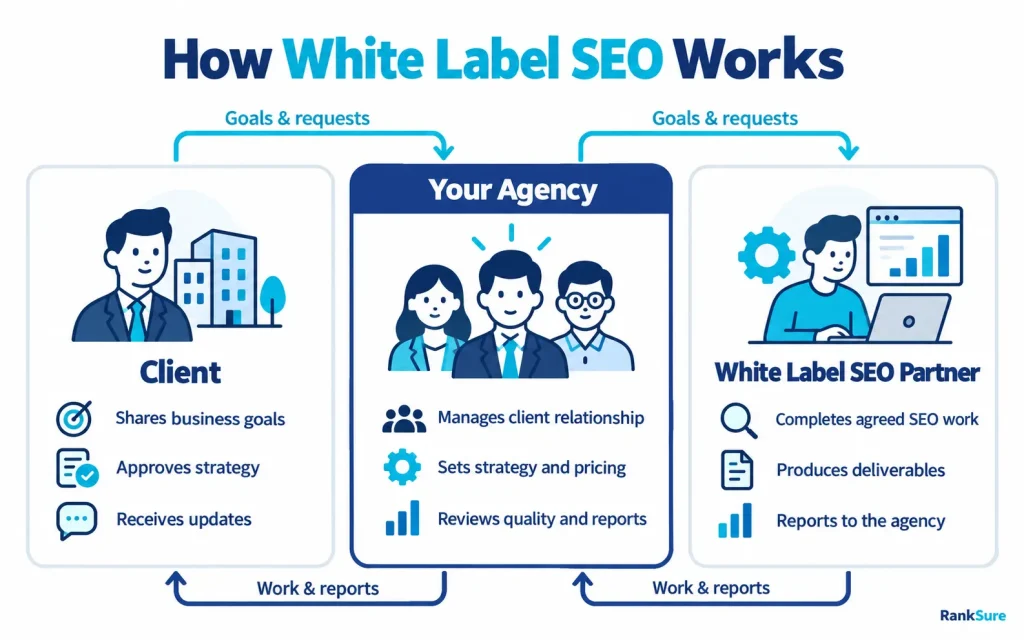
The arrangement involves three roles.
- The client purchases SEO from the agency.
- The agency manages the relationship and defines what the client receives.
- The white label provider completes agreed fulfilment work behind the agency brand.
Some providers operate entirely behind the scenes. Others prepare branded reports, attend client meetings, or communicate directly with clients while representing the agency. The important factor is clarity. An agency should know who performs research, produces recommendations, implements changes, reviews deliverables, prepares reports, handles revisions, and responds to urgent client issues.
White Label SEO vs In-House SEO vs Freelancers
Agencies can fulfil SEO through an internal specialist, a freelancer, or a white label provider. The best model depends on required control, delivery capacity, flexibility, management effort, and total cost.
| Factor | In-House SEO Specialist | Freelancer | White Label SEO Provider |
| Control | High direct control over priorities, processes, and execution | Moderate control depending on availability and scope | Lower direct control because fulfilment is managed externally |
| Capacity | Limited by the size of the internal team | Limited by individual availability | Broader capacity through an established team and delivery process |
| Flexibility | Lower because of fixed staffing commitments | High for defined projects or specialist tasks | High for recurring fulfilment and changing client volume |
| Typical strengths | Consistent internal knowledge, direct collaboration, easier oversight | Specialist expertise, flexible engagement, lower commitment | Scalable delivery, wider service coverage, structured fulfilment |
| Common costs | Recruitment, salary, training, management, software, and unused capacity | Project fees, hourly fees, coordination time | Provider fees, account management, quality control, and oversight |
| Main risk | Fixed overhead and limited scalability | Capacity, continuity, and dependency on one individual | Reduced direct operational control and provider dependency |
| Best fit | Agencies with stable demand and enough volume to support internal hiring | Agencies needing specific expertise or temporary support | Agencies needing scalable SEO fulfilment across multiple clients |
How to Evaluate a White Label SEO Partner
A reliable white label SEO partner provides evidence of its expertise, delivery process, reporting standards, communication practices, and risk controls. Google Search Central recommends reviewing previous work, business references, industry experience, measurement methods, communication practices, and proposed changes when evaluating an SEO provider.
Assess Technical SEO and Content Capabilities
A strong provider explains how it identifies, prioritizes, and resolves SEO issues. Technical capabilities include crawling, indexing, canonicalization, redirects, internal linking, site architecture, structured data, page rendering, mobile usability, and Core Web Vitals. The quality of an audit matters more than the number of issues it contains. Useful technical recommendations identify the problem, explain its impact, provide evidence, assign priority, and specify an appropriate action.
Content evaluation covers keyword mapping, search intent analysis, content briefs, page recommendations, internal linking, and finished content. The provider should account for the client’s products, services, audience, competitors, existing pages, conversion goals, subject expertise, and search demand before recommending content.
Verify Case Studies, References, and Industry Experience
Case studies should provide enough context to evaluate the claimed results. Useful evidence includes:
- Starting performance
- Campaign objectives
- Work completed
- Measurement period
- Relevant search metrics
- Conversion or lead outcomes
- External factors that affected performance
A traffic graph without context provides limited evidence. Client and agency references reveal operational details that case studies may omit. Ask about delivery reliability, communication, revision handling, technical accuracy, account management, and performance as workload increased.
Industry experience should also reflect the agency’s client portfolio. Dental practices, healthcare organizations, ecommerce businesses, professional services, and local companies require different search strategies, content controls, technical knowledge, and conversion approaches. The provider should demonstrate a research process and relevant expertise that match the clients your agency plans to outsource.
Review Link Building Methods and SEO Risk
Agencies should understand how links are acquired before approving a provider’s link building process. Ask how websites are selected, how relevance is assessed, whether payment is involved, how anchor text is chosen, how placements are reviewed, and what evidence is provided after publication.
Google Search spam policies identify manipulative link practices created primarily to influence rankings as link spam. Examples include purchasing links for ranking purposes, excessive link exchanges, and automated link creation. A fixed monthly backlink target does not demonstrate quality. Agencies should evaluate the source, relevance, acquisition method, and potential search risk of each placement.
Evaluate Reporting Transparency and Communication
A white-label SEO report should explain performance, completed work, findings, and priorities. Google Search Console provides search data such as impressions, clicks, queries, and page performance. Google Analytics 4 provides user behaviour and conversion data when tracking is configured correctly. Effective reporting connects those metrics to completed SEO work.
For example, increasing impressions after content improvements may indicate stronger search visibility, while weak conversions may point to a landing page or offer problem. The report should make that distinction clear. Reporting should not rely only on keyword rankings. Agencies should also define communication standards before onboarding. Confirm reporting frequency, expected response times, meeting responsibilities, revision procedures, project management processes, and escalation contacts.
Evaluate Industry-Specific SEO Expertise
Industry expertise matters when client requirements differ from standard SEO execution.
- A dental practice may require treatment pages, local landing pages, Google Business Profile optimization, review strategy, local search visibility, and careful handling of healthcare content.
- An ecommerce business may require category architecture, product indexing, faceted navigation analysis, structured product information, and scalable content processes.
A provider should demonstrate that it understands the client’s search environment, business model, audience, competition, and content requirements before developing strategy.
Check AI Search and GEO Capabilities
AI search capability should be evaluated through specific methods rather than terminology. Ask the provider to explain what it means by AI search optimization, answer engine optimization, and generative engine optimization. A credible approach should connect these practices with established SEO fundamentals such as crawlability, indexability, useful content, entity clarity, information structure, source credibility, and accessible web content. Measurement should also be transparent.
Google Search Console provides reporting for eligible visibility within supported generative search experiences, including AI Overviews and AI Mode. This gives agencies a first-party source for evaluating some Google AI search visibility. Visibility across Google, ChatGPT, Perplexity, and other AI systems cannot be represented by one universal ranking metric. Agencies should therefore be cautious of providers promising guaranteed AI citations or fixed AI rankings.
What Should a Reliable White Label SEO Package Include?
A white label SEO package should describe exactly what the provider will deliver and what remains the agency’s responsibility. The term SEO is too broad to function as a complete scope of work.
Define Technical, Content, and On-Page Deliverables
A package may include:
- Technical site reviews
- Crawl and indexing analysis
- Keyword research
- Topic mapping
- Search intent analysis
- Content briefs
- New page recommendations
- Existing content optimization
- Internal linking recommendations
- Implementation support
Each item should have a defined frequency, quantity, or trigger. For example, a package should state whether technical reviews occur during onboarding, every quarter, or throughout the campaign. The provider should also clarify whether recommendations are implemented or simply delivered to the agency.
Define Local SEO, Link, and Reporting Deliverables
Local SEO packages may include Google Business Profile work, location research, local landing pages, citation management, review strategy, and local performance analysis. Link services should document the acquisition process, qualification standards, reporting requirements, and approval rules.
Reporting deliverables should specify data sources, reporting frequency, commentary, branding, and whether client meetings are included. This level of detail makes competing proposals easier to compare.
Establish Quality Assurance Before Client Delivery
Quality assurance should happen before work reaches the client. Ask who reviews technical recommendations, edits content, validates reports, checks implementation, and approves link placements. The provider should also have a clear revision process. An agency that repeatedly rewrites content, corrects technical recommendations, or repairs reports is absorbing hidden fulfilment costs even if the provider’s invoice appears inexpensive.
How Much Do White Label SEO Services Cost?
White label SEO pricing depends on service scope, website complexity, content volume, expertise, implementation responsibility, account support, and reporting requirements. Agencies should compare total delivery cost rather than provider fees alone.
Compare Retainer, Project-Based, and Custom Pricing
- Monthly retainers suit recurring SEO fulfilment with predictable responsibilities.
- Project-based pricing can work for technical audits, migrations, content projects, keyword research, or strategy development.
- Custom pricing may be appropriate for websites with large inventories, multiple locations, competitive markets, complex technology, or unusual content requirements.
Before signing, ask what causes the quoted price to increase. Extra locations, pages, articles, calls, revisions, technical implementation, developer work, tools, or expedited delivery can materially change actual campaign cost.
Calculate Agency Profit Margin Before Reselling SEO
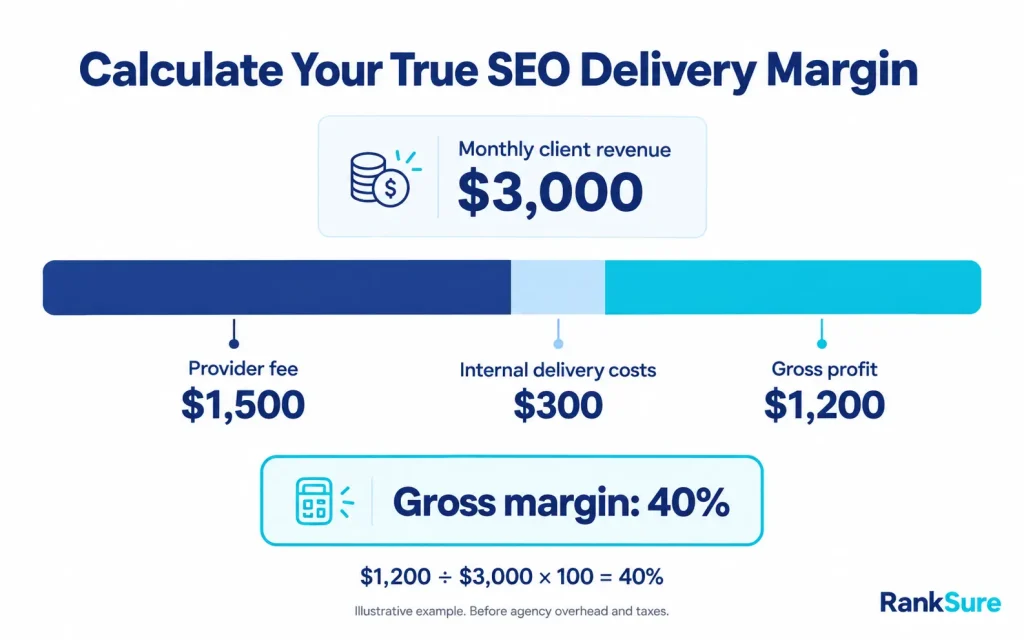
Agency margin should include every direct fulfilment expense. Assume an agency sells SEO for $3,000 per month. The white label provider charges $1,500. Internal account management and quality review cost another $300. Total delivery cost equals $1,800. Gross profit equals $1,200. Gross margin equals gross profit divided by revenue, multiplied by 100.
In this example, the gross margin is 40 percent. The calculation matters because comparing the $3,000 selling price only with the $1,500 provider invoice would overstate profitability. There is no universal target margin for every agency. The required level depends on overhead, acquisition costs, account management, client retention, risk, pricing strategy, and growth objectives.
Identify Costs Outside the Base Package
Before comparing providers, check whether the quoted fee excludes:
- Onboarding
- Additional content
- Revisions
- Developer work
- Software
- Reporting platforms
- Client meetings
- Link outreach
- Additional locations
- Urgent requests
- Strategy changes
- Cancellation costs
Pricing transparency makes profitability easier to forecast and prevents scope disputes after onboarding.
How to Test a White Label SEO Provider Before Signing a Long-Term Agreement
A controlled pilot verifies operational performance before multiple client accounts depend on the provider. The purpose of a short pilot is to test work quality, communication, process, accuracy, and reliability.
Request a Sample SEO Audit and Reporting Dashboard
Review representative work before assigning a live account. A useful SEO audit should:
- Identify specific problems
- Provide supporting evidence
- Explain business or search impact
- Prioritize recommendations
- Suggest practical actions
- Separate critical problems from optional improvements
Google Search Central also advises businesses to provide limited Search Console access during an initial technical and search audit rather than unnecessary account control. A reporting sample should receive similar scrutiny. Look for interpretation and decisions.
Run a 30 Day Pilot With Defined Acceptance Criteria
Choose a controlled project with measurable deliverables. A pilot could include a technical audit, keyword map, page recommendations, two content briefs, and a reporting sample. Define quality expectations before work begins. At the end of the pilot, answer five questions:
- Were deliverables completed on time?
- Were recommendations technically sound?
- Did the work meet the agency’s quality standard without extensive correction?
- Was communication clear and consistent?
- Were problems resolved professionally?
A 30-day test can answer those operational questions. It should not be treated as proof of future rankings because meaningful organic results may require considerably more time and depend on factors outside the provider’s control.
Compare Providers With a Weighted Scorecard
A weighted scorecard converts vendor selection into a structured decision. A practical model is:
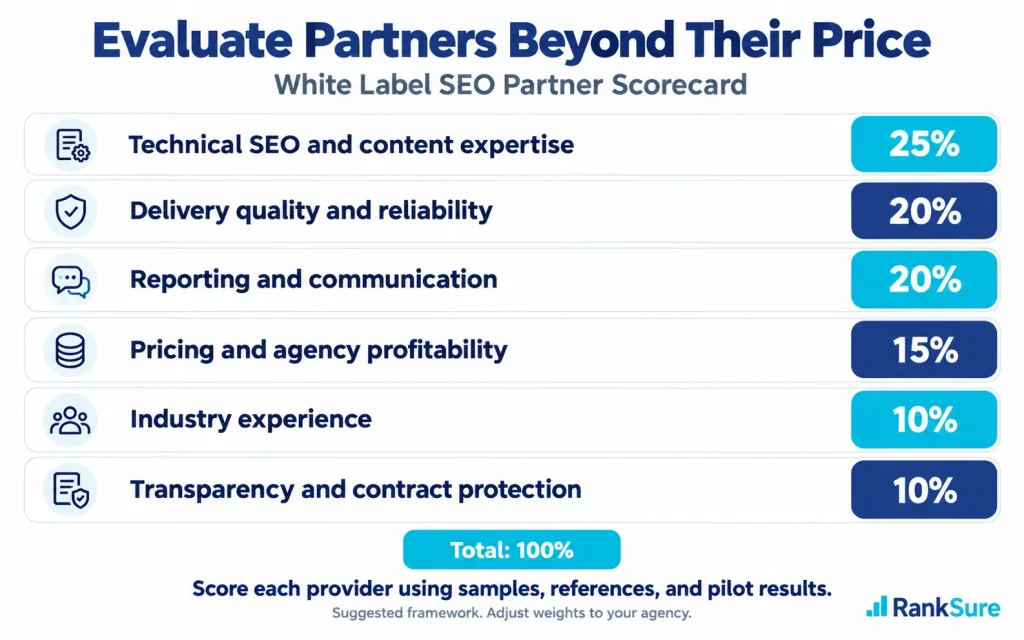
These weights are an editorial evaluation framework rather than an industry standard. Agencies can adjust them according to their service model. Score each provider using evidence from samples, references, contracts, pricing, meetings, and pilot work. Applying the same criteria to every candidate reduces the influence of persuasive sales presentations.
What Contract Terms Protect Your Agency and Clients?
The service agreement should define commercial responsibilities and ownership before client work begins. Contract terms become particularly important when a provider receives access to client data, websites, analytics platforms, content, strategies, and confidential business information.
Clarify Client Relationships and Confidentiality
The agreement should state which party owns and manages the client relationship. Confidentiality provisions cover client information, credentials, strategies, pricing, campaign data, reports, and internal agency information. Agencies also consider appropriate restrictions relating to direct client solicitation. Contract requirements and enforceability vary by jurisdiction, so important clauses should be reviewed by qualified legal counsel.
Define Account, Data, and Intellectual Property Ownership
The agreement should state who owns:
- Website content
- Keyword research
- Content briefs
- Technical documentation
- Reports
- Dashboards
- Outreach records
- Creative assets
- Campaign data
- Other intellectual property produced during fulfilment
Access to Google Search Console, Google Analytics 4, Google Business Profile, content management systems, and other platforms should follow the level of permission required for the work. The agency should also know which assets are to be transferred if the provider relationship ends.
Document Cancellation and Handover Procedures
The contract should explain what happens when either party terminates the relationship. Define:
- Required notice
- Final deliverables
- Outstanding fees
- Account access changes
- Data exports
- Content transfers
- Documentation handover
- Unfinished work
- Client transition support
An effective exit process reduces disruption and prevents the agency from becoming operationally dependent on one provider.
Red Flags to Avoid When Choosing a White Label SEO Agency
Warning signs usually appear in a provider’s promises, evidence, delivery process, link methods, or pricing terms. The table below highlights the main risks agencies should check before signing an agreement.
| Red Flag | What to Look For | Why It Matters |
| Guaranteed rankings | Promises of first-place rankings or fixed organic positions | Google rankings cannot be guaranteed because providers do not control search algorithms, competitors, or ranking systems |
| Unverifiable performance claims | Traffic graphs, ranking screenshots, or case studies without baselines, dates, work completed, or measurement sources | Results without context do not prove that the provider caused the reported growth |
| Undisclosed link acquisition | Refusal to explain link sources, relevance, payment, placement methods, or review standards | The agency cannot assess link quality or potential search risk |
| Excessive correction work | Frequent content rewrites, inaccurate recommendations, incomplete reports, repeated revisions, or missed deadlines | Internal correction time increases the true cost of outsourced fulfilment |
| Unclear service scope | Vague limits for content, revisions, implementation, reporting, meetings, or technical support | Unclear responsibilities can create delivery disputes and unexpected costs |
| Unexpected charges | Additional fees that were not clearly disclosed during evaluation | Unplanned costs reduce agency margins and make client pricing harder to forecast |
Resolve these warning signs before assigning client accounts. A provider should be able to explain its claims, methods, deliverables, responsibilities, and costs clearly before the partnership begins.
How to Make the Final White Label SEO Partner Selection
The right partner is the provider that best matches the agency’s client portfolio, service standards, economics, and operating model. Review the scorecard, pilot results, references, contract, pricing, and deliverable samples together. A slightly more expensive provider may create better agency economics if it reduces correction time, improves reliability, protects client retention, and handles greater account volume. The final decision should answer four questions.
- Can this provider deliver the SEO work our clients require?
- Can our team rely on its process without constant supervision?
- Can we resell the service at a sustainable margin?
- Can we protect our clients and transition away cleanly if the relationship ends?
A provider that cannot satisfy all four creates unnecessary long-term risk. Agency owners exploring outsourced SEO fulfilment can also discuss their requirements with RankSure, including technical SEO, content strategy, local SEO, reporting expectations, and potential collaboration. RankSure should be evaluated using the same criteria described in this guide.
Choosing an SEO Fulfilment Partner With Confidence
White-label SEO works best when the agency treats outsourcing as a structured operational decision. Evaluate technical expertise before price. Inspect real deliverables before trusting case studies. Understand link methods before accepting backlink promises. Calculate margins using total delivery cost.
Test the provider through a controlled pilot. Protect client relationships and intellectual property through clear contract terms. The objective is not simply to find someone who can perform SEO tasks. It is to find a fulfilment partner that can consistently deliver work your agency is comfortable putting its own name on.
Frequently Asked Questions About White Label SEO Services
What is the difference between white label SEO and SEO reselling?
White label SEO focuses on fulfilment under the agency’s brand. SEO reselling is a broader model where an agency purchases SEO services and resells them to clients.
Can a white label SEO provider communicate directly with agency clients?
Yes. Some providers offer client-facing support, while others communicate only with the agency. The arrangement should be defined before work begins.
Can an agency use more than one white label SEO provider?
Yes. Agencies can use different providers for technical SEO, content, local SEO, outreach, or specific client segments.
What access should a white label SEO provider receive?
Only the access needed to complete the work. This may include Search Console, Google Analytics 4, Google Business Profile, a content management system, or SEO tools.