


Healthcare SEO services should attract relevant prospective patients, not just increase rankings or traffic. The right specialist should understand patient search behaviour, local competition, medical content accuracy, practitioner credibility, conversion tracking, privacy requirements, and healthcare advertising standards.
SEO needs vary by practice type. Dental clinics, physiotherapy practices, family medicine clinics, and specialist practices serve different patients and compete in different search markets.
This guide explains how Canadian healthcare practice owners can evaluate SEO specialists based on healthcare expertise, patient acquisition, accountability, and sustainable organic growth.
Why Healthcare Practices Need Specialised SEO Services
Healthcare SEO services combine search optimisation with the accuracy, credibility, privacy, and local visibility requirements that affect how patients find and evaluate healthcare providers.
Patients use search engines to research symptoms, compare treatment options, evaluate practitioners, check locations, and decide whether to request an appointment. An SEO strategy therefore needs to support both discovery and trust.
How Healthcare SEO Differs From General SEO
Healthcare SEO requires stronger controls around medical accuracy, credibility, privacy, and professional advertising than most general SEO campaigns.
Google uses experience, expertise, authoritativeness, and trust, known as E E A T, to describe qualities associated with helpful and reliable content. Trust receives particular attention for topics that can affect health or safety. E E A T is a quality framework, not a single direct ranking factor.
| Healthcare SEO requirement | What it involves |
| Practitioner identity | Clearly identify practitioners, qualifications, and relevant professional credentials |
| Medical accuracy | Provide accurate service, treatment, and clinical information |
| Clinical review | Use appropriate professional review for medically significant content |
| Supporting evidence | Reference reliable sources where clinical claims require support |
| Practice transparency | Clearly explain providers, services, locations, and practice information |
| Content maintenance | Review and update medical information as needed |
| Privacy | Handle patient information and tracking according to applicable privacy requirements |
| Advertising standards | Follow professional advertising rules that apply to the practice and jurisdiction |
A healthcare SEO provider should understand these boundaries and recognise when legal, regulatory, or clinical review is required.
Why Higher Rankings Do Not Always Mean More Patients
Higher rankings create visibility. They do not automatically create patient acquisition. A clinic may increase organic traffic by attracting people researching broad health topics while generating few enquiries from patients seeking services it actually provides. A smaller number of visits from people searching for a relevant service in the clinic’s geographic market may have greater commercial value.
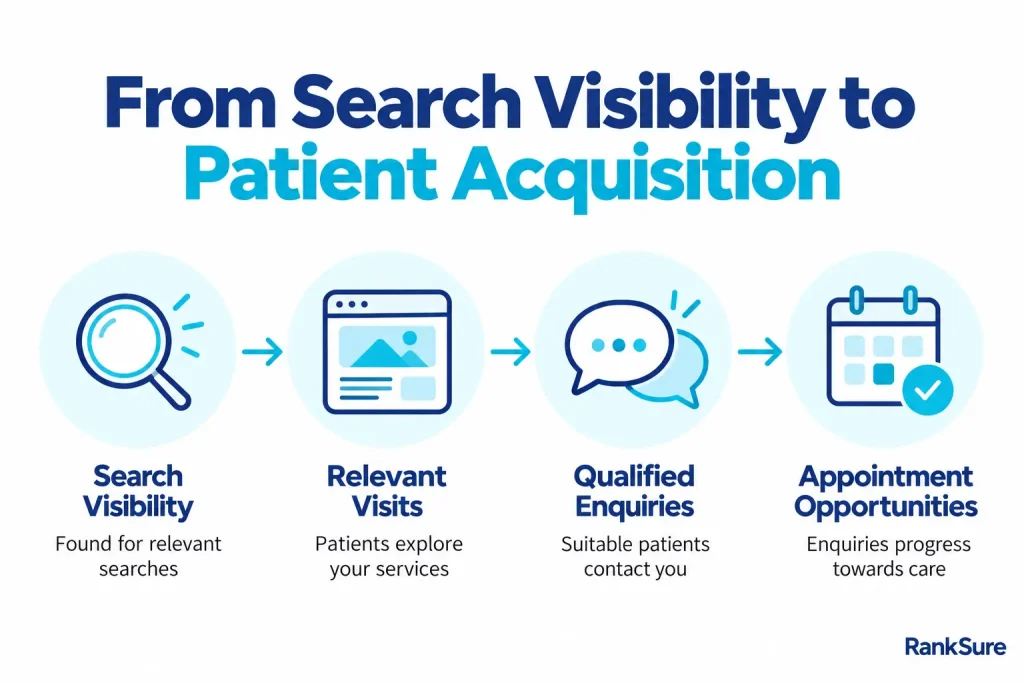
Healthcare practices should separate four stages of performance:
- Search visibility
- Relevant website visits
- Qualified patient enquiries
- Appointment opportunities
An SEO agency should explain how its work supports movement through these stages. Traffic remains useful, but it should not be presented as the final measure of success.
What Should a Healthcare SEO Specialist Understand About Patient Acquisition?
A healthcare SEO specialist should understand how people move from researching a health concern to evaluating treatment options, comparing providers, and contacting a practice. That journey depends on specialty, location, urgency, service type, referral requirements, and patient knowledge.
How Patients Search for Symptoms, Treatments and Healthcare Providers
Patient search intent changes as the person becomes informed.
- Early searches may focus on symptoms, causes, or general health questions.
- Later searches may focus on a treatment, procedure, practitioner, clinic, or location.
- A person closer to choosing a provider may search for terms related to a specific service in a specific geographic area.
Healthcare SEO should map website content to these different stages.
- Informational content can address relevant patient questions.
- Service pages can explain available care.
- Practitioner pages can establish professional credentials.
- Location pages can help patients understand where services are offered.
Pages intended to support enquiries should make the next action easy to understand. Contact details, appointment information, service availability, practitioner information, and locations should be easy to find.
SEO Strategies for Different Healthcare Specialties
Healthcare SEO is required to reflect the search behaviour and commercial priorities of the specific practice.
- A dental clinic may compete for searches related to routine dentistry, emergency care, implants, cosmetic services, or specific neighbourhoods.
- A physiotherapy practice may need visibility for conditions treated, rehabilitation services, practitioner expertise, and individual clinic locations.
- A family medicine clinic may have different priorities because patient intake, physician availability, funding models, and registration processes can influence access.
- A specialist clinic may depend more heavily on referrals, specific procedures, diagnostic services, clinical expertise, or a wider geographic service area.
An effective healthcare SEO agency should adjust keyword research, page strategy, local optimisation, and conversion goals to the practice model.
Turning Organic Website Visitors Into Appointment Requests
SEO creates limited business value when appropriate visitors cannot understand the service or complete the next step. A strong service page should answer practical questions quickly:
- What service is available?
- Who provides it?
- Who may be appropriate for the service?
- Where is it offered?
- What should the patient expect?
- How can the patient contact the practice?
Conversion improvements include clearer appointment options, visible phone numbers, simpler forms, better mobile usability, stronger internal navigation, and more direct service information. These improvements will support informed decisions without using misleading urgency, exaggerated outcomes, or unsupported treatment claims.
How to Evaluate a Healthcare SEO Agency’s Experience and Capabilities
A healthcare SEO agency should demonstrate relevant healthcare experience, technical competence, local search expertise, strong content processes, and a credible approach to patient acquisition. Claims of expertise should be supported by evidence.
Verify Healthcare Experience and Patient Acquisition Results
Ask potential agencies for healthcare case studies that match your practice type or business model as closely as possible. Do not evaluate case studies only by traffic increases.
Ask:
- What type of practice was involved?
- Which services or locations were targeted?
- What was the starting position?
- Which organic enquiries increased?
- Were appointment actions measured?
- How was organic performance separated from paid campaigns?
- What attribution limitations existed?
A useful case study explains the starting point, work completed, measurement method, and business outcome. An agency should also protect client confidentiality. Detailed case studies do not require disclosure of sensitive business or patient information.
Assess Technical SEO and Local Search Expertise
Technical SEO helps search engines discover, understand, and index important pages. A capable agency should be able to evaluate:
- Crawling
- Indexation
- Internal linking
- Site architecture
- Page performance
- Mobile usability
- Redirects
- Duplicate content
- Structured data
- Important technical errors
Local SEO is important for clinics serving defined geographic markets. The agency should understand Google Business Profile optimisation, real practice locations, location pages, service information, local relevance, and business information consistency.
Creating misleading location pages for areas a practice does not serve creates poor patient experiences and unnecessary search risk.
Evaluate Medical Content Quality and Clinical Review Processes
Healthcare content needs an editorial process that protects accuracy. Ask who researches the content, who writes it, what sources are used, and how clinical claims are reviewed. The review process depends on the topic. Content about treatments, procedures, medical conditions, risks, or patient outcomes may require review by an appropriately qualified healthcare professional.
A strong editorial process includes:
- Topic research
- Source verification
- Practitioner input
- Clinical review
- Clear authorship
- Approval records
- Scheduled updates
The agency should also understand the limits of its own expertise. SEO professionals should not present themselves as clinical authorities unless they hold relevant qualifications.
Check AI Search Capabilities
Healthcare information now appears across traditional organic search and AI-powered answer experiences.
An SEO agency should understand how clear entities, useful content, practitioner information, structured data, crawlability, and authoritative references can help search systems interpret a healthcare website. Ask how the agency approaches visibility in Google AI features and AI answer platforms such as ChatGPT. Avoid providers that promise guaranteed AI citations or guaranteed inclusion in AI-generated answers.
AI visibility changes according to the query, platform, source selection, model, location, and product design. A responsible agency should treat AI search as an additional visibility channel rather than a guaranteed placement opportunity.
How Should a Healthcare SEO Agency Build Patient Trust and Protect Compliance?
A healthcare SEO agency should build trust through verifiable practitioner information, accurate content, responsible review management, and privacy-conscious measurement.
Establish Medical Credibility Through Practitioner Profiles
Practitioner profiles should help patients verify who provides their care and why that person is qualified. Useful profile information includes:
- Qualifications
- Relevant licensing information
- Areas of practice
- Clinical interests
- Professional affiliations
- Accurate professional biographies
Medical content can also identify authors and reviewers where clinical expertise is relevant. Credibility should rely on verifiable evidence. Claims such as leading expert or trusted specialist should not replace documented qualifications or experience.
Protect Patient Information in Analytics and Lead Tracking
Healthcare practices should control how patient information is collected through forms, analytics, booking systems, and marketing tools.
PIPEDA applies to many private sector organisations engaged in commercial activities in Canada. Provincial privacy laws and health information legislation may also apply depending on the jurisdiction, organisation, and information collected. A healthcare SEO agency should help the practice review these core questions:
| Privacy consideration | What to review |
| Data collection | What information each form collects and whether every field is necessary |
| Data sharing | Which analytics, booking, marketing, or other systems receive the information |
| Sensitive data | Whether personal or health information could enter analytics or tracking tools |
| Access | Who can view enquiry and patient-related data |
| Retention | How long collected information is stored |
| Consent | What notice or consent may be required before collecting or using information |
| Purpose | Whether the information collected is proportionate to its intended use |
Practices should involve qualified privacy or legal advisers where specialised interpretation is required.
Follow Healthcare Advertising and Review Guidelines
Healthcare advertising requirements vary by province and regulated profession. Practices should review testimonials, comparative claims, treatment outcomes, promotional statements, and patient reviews against the rules of the relevant professional regulator.
Agencies should never fabricate reviews, create misleading endorsements, or publish unsupported treatment claims. Public review responses should also protect patient confidentiality. A patient identifying themselves publicly does not automatically make details of their care appropriate for the practice to disclose.
How to Measure Healthcare SEO Success Beyond Keyword Rankings
Healthcare SEO performance should be measured through visibility, qualified enquiries, appointment opportunities, and business outcomes. Rankings help diagnose search performance, but they should not be the only KPI.
Track Qualified Patient Enquiries and Appointment Requests
A healthcare practice should define which actions represent meaningful patient intent. Examples include:
- Phone calls
- Contact forms
- Appointment requests
- Approved online booking actions
- Enquiries for priority services
The practice should also distinguish between total enquiries and qualified enquiries. An enquiry may be unsuitable because the person is outside the service area, needs a service the clinic does not provide, or does not meet the practice’s intake criteria.
Evaluate Google Search Console and GA4 Reporting
Google Search Console and Google Analytics 4 answer different questions. Google Search Console shows:
- Search queries
- Impressions
- Organic clicks
- Landing pages
- Search visibility changes
Google Analytics 4 shows:
- Website sessions
- Landing page behaviour
- Configured events
- Conversion actions
- Traffic source information
A useful SEO report connects these metrics to business decisions.
For example, it may explain which service pages gained visibility, which pages generated meaningful enquiries, what work was completed, what obstacles remain, and what should be prioritised next.
Attribution will not always be complete. Patients may research a clinic across several sessions, use multiple devices, receive a referral, call later, or book through another channel. Reporting should state those limitations clearly.
Understand Patient Acquisition Costs and SEO ROI
SEO return should be calculated using agreed definitions and transparent assumptions. A basic patient acquisition calculation can compare relevant SEO expenditure with the number of acquired patients attributed to organic search during the measurement period.
The calculation becomes less reliable when attribution is incomplete or when a long period exists between the original search and treatment.
Agree on what counts as:
- An enquiry
- A qualified enquiry
- An appointment request
- A booked appointment
- An acquired patient
Clear definitions prevent the practice and agency from interpreting the same campaign differently.
How Much Do Healthcare SEO Services Cost?
Healthcare SEO costs depend on the practice, geographic market, website condition, specialty, content requirements, competition, and service scope.
Factors That Affect Healthcare SEO Pricing
The pricing factors include:
- Number of services
- Number of practice locations
- Competitive intensity
- Website condition
- Technical problems
- Content volume
- Clinical review requirements
- Local SEO requirements
- Conversion tracking complexity
- Reporting expectations
- Development support
A single-location clinic with a technically sound website requires less work than a multi-location practice operating across several competitive specialties.
Compare Scope, Deliverables and Additional Costs
Healthcare SEO proposals should be compared according to the work included.
The service models include:
SEO audit
The provider identifies technical, content, local search, and measurement issues. Implementation may not be included.
Managed SEO
The provider handles ongoing strategy, technical improvements, content optimisation, local SEO, and reporting.
Content-intensive healthcare SEO
The engagement includes a larger volume of medically relevant content and requires structured clinical review.
Multi-location SEO
The strategy covers several clinic locations, local profiles, location architecture, service duplication issues, and location-specific competition.
Ask whether technical fixes are implemented or only recommended. Clarify whether content writing, clinical review, development, additional locations, software, and revisions are included. A lower monthly fee offers poor value if essential work is excluded from the scope.
What Questions Should You Ask Before Hiring a Healthcare SEO Agency?
Good due diligence questions reveal how an agency works, measures results, communicates, and protects the practice’s digital assets.
Questions About Healthcare Experience and Strategy
Ask:
- Which healthcare specialties have you worked with?
- How do you define a qualified patient enquiry?
- How do you research patient search intent?
- How do you prioritise services and locations?
- How do you evaluate local competitors?
- Can you show relevant results with proper context?
- How do you manage medical content review?
Strong answers should describe actual processes rather than rely on broad claims.
Questions About Reporting and Accountability
Ask who will manage the account and who performs the work. Clarify:
- Reporting frequency
- KPIs
- Work completed each month
- Approval responsibilities
- Communication processes
- Account access
- Conversion definitions
- Measurement limitations
Reporting should explain what changed, what work produced the change, and what happens next.
Questions About Contracts, Ownership and Exit Terms
Confirm ownership before signing. The practice should understand who controls:
- Website content
- Website access
- Google Analytics
- Google Search Console
- Google Business Profile
- Domains
- Tracking configurations
- Campaign data
Review the contract term, cancellation process, notice requirements, additional fees, and data access after termination. A practice should not lose access to essential digital assets simply because an agency relationship ends.
How to Compare Healthcare SEO Agencies Using a Weighted Scorecard
A weighted scorecard allows practice owners to compare agencies using consistent criteria rather than choosing mainly on presentation quality or price. The following weights are an editorial evaluation framework rather than an industry benchmark.
| Evaluation criterion | Weight | What a strong provider demonstrates |
| Patient acquisition strategy | 25% | Defines qualified enquiries, conversion paths, appointment actions, and attribution limits |
| Healthcare experience | 20% | Shows relevant healthcare work with appropriate context and evidence |
| Technical and local SEO expertise | 20% | Demonstrates auditing, implementation, local optimisation, and Google Business Profile capability |
| Medical content quality | 15% | Uses evidence standards, clinical review processes, and credential verification |
| Reporting transparency | 10% | Provides account access, meaningful KPIs, documented work, and measurement context |
| Commercial terms | 10% | Provides clear scope, ownership terms, costs, and exit provisions |
Use a score from 1 to 5 for each criterion.
- A score of 1 indicates weak or unclear capability.
- A score of 3 indicates acceptable capability with some limitations.
- A score of 5 indicates strong capability supported by evidence and a clear process.
Multiply each score by the relevant weight to compare providers consistently.
Identify Red Flags Before Signing an SEO Contract
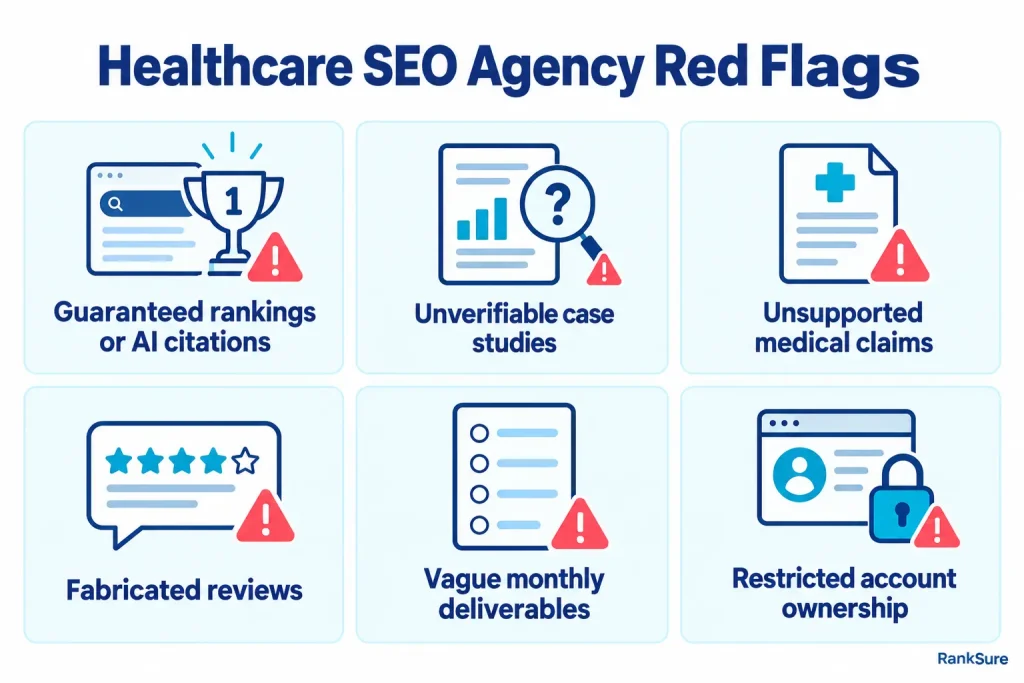
Be cautious about agencies that rely on:
- Guaranteed number one rankings
- Guaranteed AI citations
- Unverifiable case studies
- Fabricated reviews
- Unsupported medical claims
- Vague monthly deliverables
- Hidden ownership restrictions
- Unexplained additional costs
- Large volumes of low-quality medical content
- Low-quality link building
Another warning sign is an agency that discusses rankings without asking about your practice capacity, priority services, ideal patients, geographic market, enquiry quality, or appointment process.
What Should Healthcare Practices Expect in the First 90 Days of SEO?
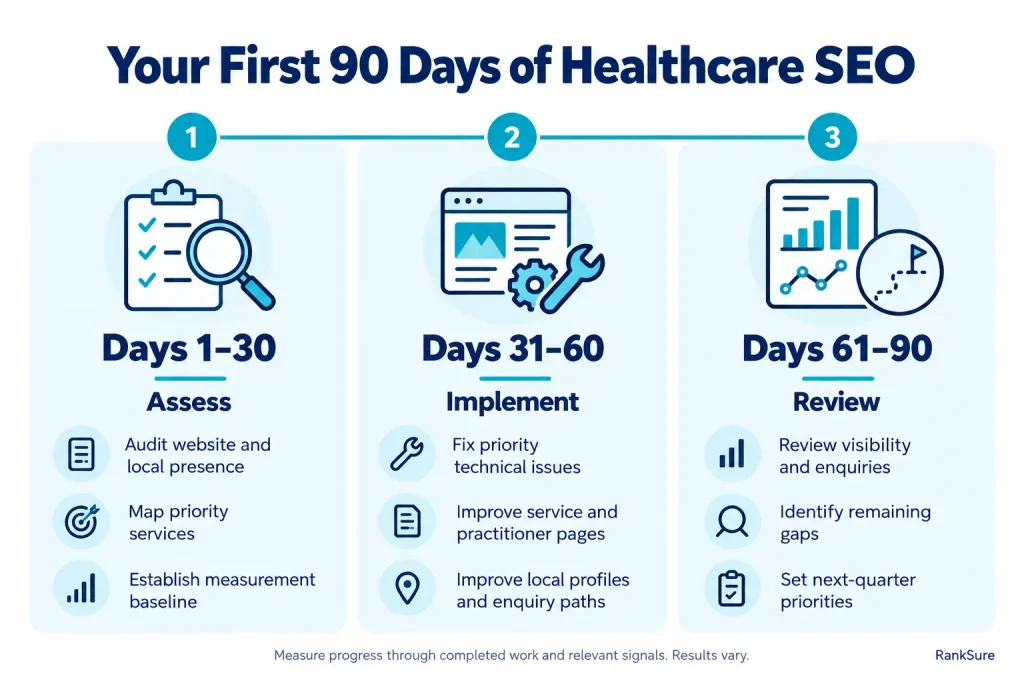
The first 90 days should establish the baseline, correct important weaknesses, improve priority pages, and create a measurable roadmap. Practices should evaluate execution quality during this period rather than expect guaranteed immediate rankings.
Days 1 to 30: Establish the Baseline
The deliverables include:
- Technical SEO audit
- Organic performance baseline
- Patient search intent research
- Priority service map
- Competitor review
- Local SEO assessment
- Conversion measurement plan
- Tracking review
The agency should also learn how the practice operates. That includes service capacity, priority locations, valuable enquiries, referral requirements, and clinical approval processes.
Days 31 to 60: Implement Priority Improvements
The deliverables include:
- Priority technical fixes
- Improved service pages
- Updated practitioner profiles
- Stronger internal linking
- Local search improvements
- Google Business Profile updates
- Location page improvements
- Approved conversion improvements
The work should focus on priorities identified during the first month rather than creating unrelated content simply to increase publishing volume.
Days 61 to 90: Review Performance and Build the Next Roadmap
This includes:
- Supporting content improvements
- Conversion testing
- Remaining technical fixes
- Search visibility comparison
- Enquiry performance review
- Outstanding issue list
- Next quarter priorities
The first quarterly review should answer five questions:
- What was completed?
- What changed?
- Which priority pages improved?
- What measurement gaps remain?
- What should receive investment next?
This makes the first 90 days useful even when significant ranking gains require more time.
Choosing the Right Healthcare SEO Partner for Long-Term Patient Growth
The right healthcare SEO partner should connect organic visibility with appropriate patient demand. Evaluate agencies on healthcare experience, patient acquisition strategy, technical and local SEO capability, medical content quality, measurement, privacy awareness, and commercial transparency. The strongest provider is not the agency promising the most traffic or the lowest monthly fee. It is the provider that can explain how search visibility supports the specific services, locations, and patients that matter to your practice.
RankSure helps organisations improve organic visibility through structured SEO strategy and measurable commercial objectives.
Healthcare practices evaluating SEO services can speak with RankSure about their current search visibility, priority services, local competition, and patient acquisition goals to determine whether there is a suitable strategic fit.
Frequently Asked Questions About Healthcare SEO Services
What are healthcare SEO services?
Healthcare SEO services improve a practice’s visibility in organic search through technical SEO, local SEO, content optimisation, practitioner information, and conversion tracking.
How much do healthcare SEO services cost in Canada?
Costs vary by competition, locations, website condition, content needs, technical complexity, and service scope. Compare deliverables, not price alone.
How long does healthcare SEO take to produce results?
There is no fixed timeline. Results depend on competition, website quality, implementation speed, search demand, and the practice’s starting position.
Does a healthcare SEO agency need medical professionals on staff?
Not necessarily. The agency should have a reliable process for obtaining qualified clinical review where medical accuracy requires it.
Should every healthcare article receive clinical review?
No. Content involving treatments, conditions, procedures, risks, or outcomes may need closer clinical review than basic administrative content.
Can one SEO agency manage multiple clinic locations?
Yes. The agency should understand location pages, Google Business Profiles, local competition, internal linking, and consistent business information.
Can healthcare SEO improve visibility in AI-powered search results?
It can improve how search systems understand a practice, but no agency can guarantee inclusion in a specific AI-generated answer.