


A promising SEO proposal outlines a convincing growth strategy while leaving important questions unanswered.
- Who implements the recommendations?
- Can your business keep the content after cancellation?
- Does monthly billing come with a longer minimum commitment?
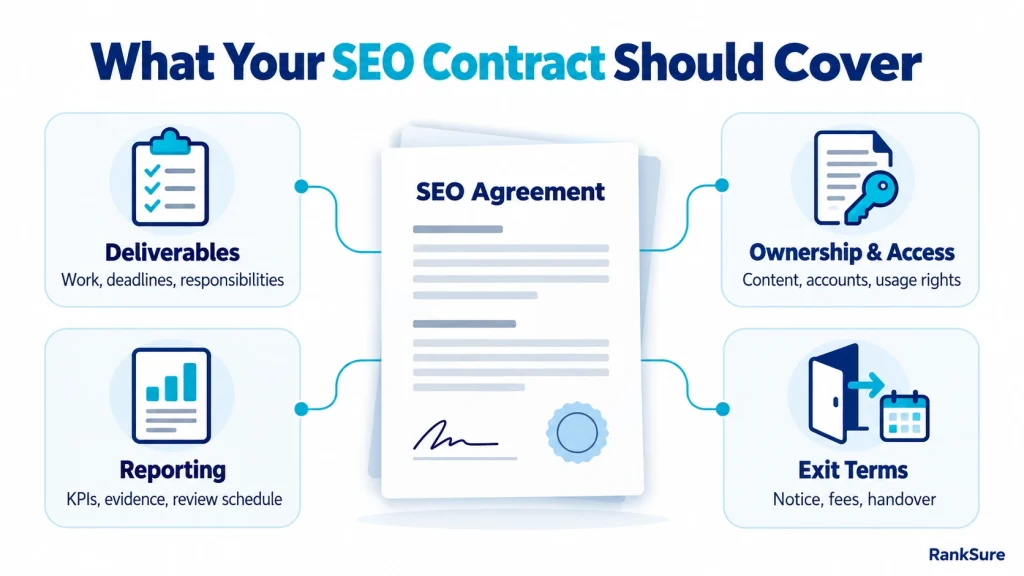
Clear SEO contract terms address these questions before they become disagreements. They connect the proposed strategy to defined responsibilities, measurable work, financial obligations, and a workable exit process. Before signing an SEO services agreement, review what the agency must deliver, what your business will control, and how you will assess progress.
This guide provides practical purchasing information. A qualified lawyer should review questions involving legal rights, enforceability, or liability.
What Is an SEO Contract?
An SEO contract establishes the terms of the relationship between a business and its SEO provider. It identifies the parties, services, fees, responsibilities, and conditions under which the engagement continues or ends.
The agreement includes several documents:
- Master services agreement: General commercial terms covering the relationship.
- Statement of work: Campaign-specific services, deliverables, timelines, and exclusions.
- Supporting schedules: Pricing, reporting arrangements, or additional service conditions.
A proposal describes the recommended approach. Whether its commitments form part of the agreement depends on how the contract incorporates that document.
Read the documents together and resolve inconsistencies. If a proposal includes content writing but the statement of work only promises content briefs, the difference affects both delivery and budget. The agreement should also identify which document takes priority when terms conflict.
SEO Deliverables: Scope, Timelines and Responsibilities
The scope of work should explain what the agency will produce, when it is due, and how completion will be verified. Descriptions such as “technical SEO” or “ongoing optimisation” identify service categories. They need supporting detail to establish the actual commitment.
Define Measurable Deliverables and Completion Criteria
A useful deliverable combines an output, a timeframe, and a standard for completion. The examples below illustrate how service descriptions become clearer. Quantities and deadlines should reflect the campaign’s requirements.
| Vague description | Better-defined deliverable |
| Technical SEO audit | Deliver a prioritised audit within the first 30 days, documenting affected URLs, recommended fixes, and implementation responsibilities. |
| Monthly page optimisation | Optimise five agreed pages per month, covering titles, headings, relevant copy changes, and internal links. |
| Keyword research | Deliver a keyword map connecting priority topics and search intent with existing or proposed landing pages. |
| Local SEO management | Review agreed business profiles, document inaccuracies, and report completed updates. |
| Link building | Specify approved outreach methods, relevance criteria, reporting evidence, and activities requiring client approval. |
Completion criteria are important when recommendations and implementation are separate services.
For a page optimisation task, completion might mean approved changes are published on the agreed URL, checked for implementation errors, and recorded in the delivery log. Sending recommendations would count as completion only if the scope defines the assignment that way.
Clarify Implementation, Approvals and Scope Changes
An agency may identify a technical problem while your developer is responsible for fixing it. Unless implementation is included, the monthly SEO fee may cover diagnosis and guidance only. The agreement should assign responsibility for website changes, content approval, testing, and publication. It should explain who provides access, business information, and specialist input.
For example, a healthcare practice may need to review clinical statements before publication. The delivery schedule should allow for that review and explain what happens when feedback is delayed.
Additional work needs a clear approval process. Before an out-of-scope task begins, the agency should describe the work, proposed fee, and effect on existing deadlines. Identify who within your business can authorise the change.
Who Owns SEO Content, Accounts and Campaign Data?
Ownership, licensing, and access provide different levels of control.
- Ownership concerns rights in an asset.
- A licence permits specified uses.
- Account access allows someone to perform actions within a platform, subject to their permissions.
The Canadian Intellectual Property Office distinguishes an assignment, which transfers rights, from a licence, which permits use under conditions while ownership remains with the rights holder. Your contract should state the intended arrangement for commissioned work.
Establish Rights to Content, Audits and Strategy Documents
The agreement should identify the rights your business receives in website copy, keyword research, audits, and campaign documentation. Relevant questions include:
- When do ownership or usage rights take effect?
- Can the business edit and republish the material?
- Can completed documents be shared with a replacement provider?
- Do any usage rights end when the contract ends?
- Are third-party materials subject to separate restrictions?
An agency may retain its templates, software, and internal methods. The practical issue is whether your business receives sufficient continuing rights to use the deliverables it commissions. Third-party dependencies also deserve attention. Stock images, fonts, plugins, and other licensed materials may require ongoing payments or replacement after the engagement ends.
Retain Appropriate Control of Essential Accounts
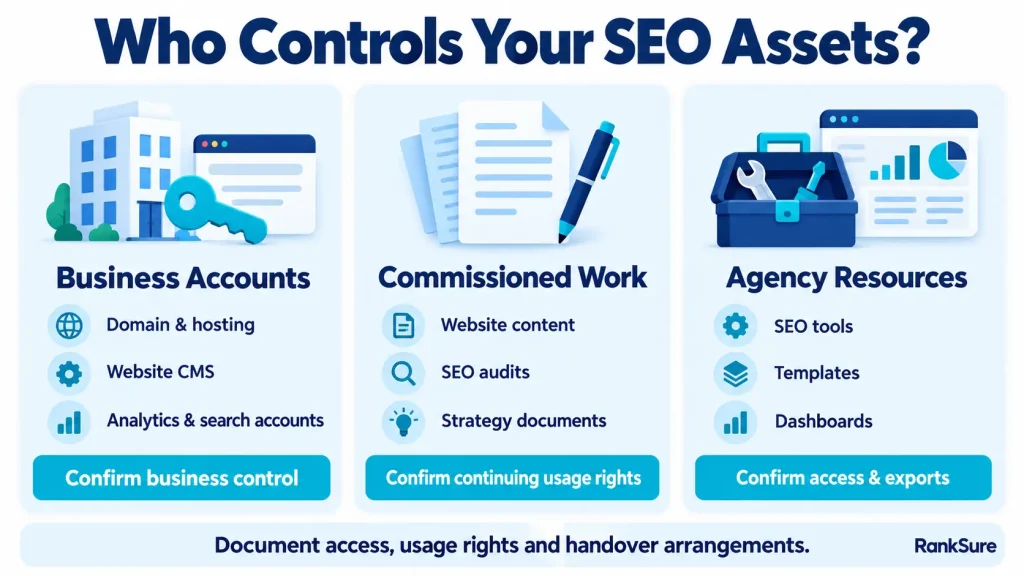
Business-controlled recovery details and suitable administrative permissions help preserve continuity. Use this ownership and access matrix when reviewing the proposed setup:
| Asset | Control or rights to establish | Detail to confirm |
| Domain and hosting | Business-controlled accounts and recovery details | Renewal responsibility and recovery procedures |
| Website CMS | Appropriate business administrator access | Features dependent on agency subscriptions |
| Google Analytics 4 | Appropriate business administrator permissions | Continued access after agency removal |
| Google Search Console | Business-controlled verification and suitable permissions | Verification methods and authorised users |
| Google Business Profile | Appropriate business ownership role | Agency access and transition arrangements |
| Commissioned content and reports | Express ownership or sufficient continuing usage rights | Editing, reuse, and sharing permissions |
| Agency tools and dashboards | Agreed access, exports, or retained reports | What becomes unavailable after cancellation |
These arrangements should be documented rather than assumed from who initially created an account.
SEO Reporting and Performance Commitments
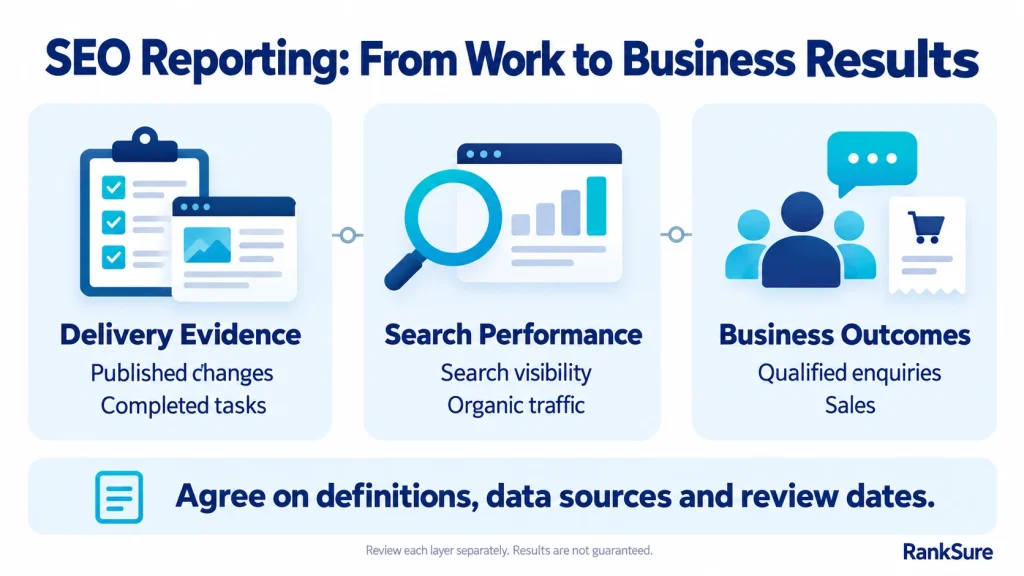
SEO reporting should show what work was completed and how campaign performance changed. Activity reporting confirms delivery, while performance analysis shows whether the strategy needs adjustment.
Choose Business-Focused KPIs
KPIs should match the business model. Local businesses may track qualified enquiries and bookings. Ecommerce stores may track organic sales and revenue. B2B companies may focus on qualified leads and sales opportunities.
For each KPI, define the data source, baseline, comparison period, tracking owner, attribution limits, and who reviews lead quality. A form submission does not always represent a qualified prospect, so businesses should review lead quality and share relevant feedback with the agency.
Set a Reporting Schedule
The agreement should define when reports are delivered, what they include, and who reviews them. A monthly report should cover completed work, agreed KPIs, important performance changes, unresolved dependencies, and next priorities.
AI search visibility should be measured separately from verified referral traffic and conversions. Define the platforms, prompts, locations, dates, and measurement method used.
Separate Delivery From Ranking Targets
An SEO agency can commit to agreed work and accurate reporting, but it cannot control search engine rankings. Google Search Central states that no one can guarantee a number one ranking.
Performance targets can still support accountability. The agreement should define the baseline, measurement period, assumptions, and what happens when results fall short, such as a strategy review, further investigation, or revised priorities.
SEO forecasts should guide decisions rather than serve as guaranteed outcomes.
SEO Pricing, Payment Terms and Additional Fees
The financial terms should make the full commitment understandable. Review currency, applicable taxes, billing dates, payment deadlines, and the conditions governing additional charges.
Monthly Retainers and Project Fees
A retainer funds recurring services or an agreed allocation of ongoing work. Establish what the fee includes, how priorities are selected, and whether unused capacity carries forward. A project fee covers a defined assignment, such as an audit or migration review. Payments may be linked to milestones, with the required outputs identified for each stage.
For either model, distinguish billing frequency from contract duration. Receiving monthly invoices does not necessarily mean you can cancel each month.
Additional Costs, Price Changes and Payment Disputes
Development, extra content, specialist design, software, and photography may sit outside the core fee. The agreement should explain how expenses are approved, whether markups apply, and who can authorise spending. Price adjustments also need a defined notice process.
Payment dispute provisions should address how concerns are raised, which amounts remain payable, and when services may be paused. If work stops, establish how that affects deadlines and outstanding deliverables.
This helps prevent an invoice disagreement from creating uncertainty across the entire campaign.
Contract Duration, Cancellation and Exit Clauses
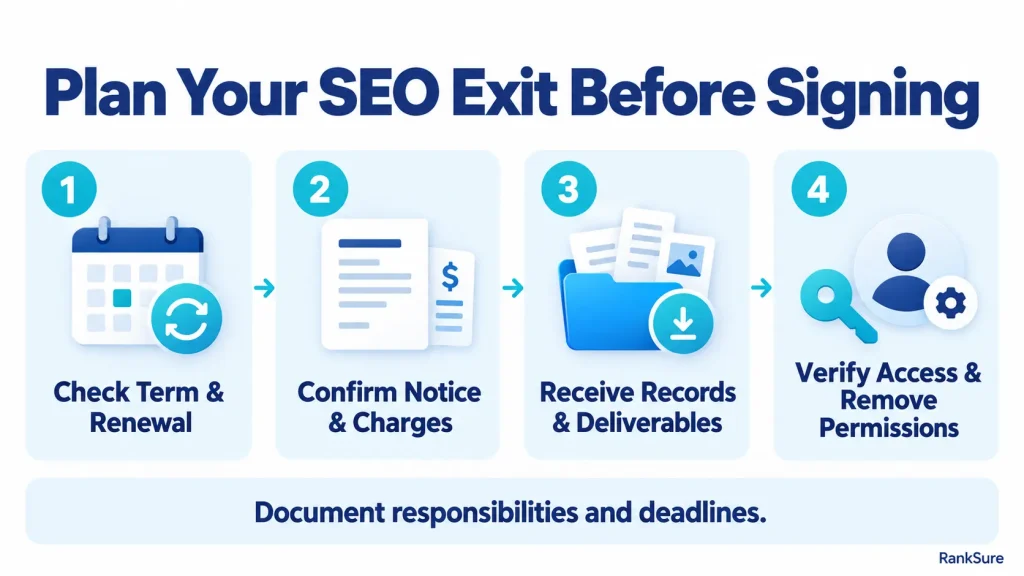
Review the initial term, renewal mechanism, and termination rights together. Each affects how much flexibility the agreement provides.
Contract Length, Renewal and Notice
SEO work often requires sustained implementation and evaluation. That does not, by itself, establish the right contractual commitment for every business. A longer term should be assessed against the planned work, review milestones, budget, and available exit rights.
Identify:
- The initial start and end dates.
- Whether renewal is monthly or for another fixed term.
- The deadline for preventing renewal.
- The required notice method and recipient.
- How the final service date is calculated.
An automatic renewal deadline may occur well before the current term ends. Record it when the agreement begins.
Early Termination and Cancellation Charges
An SEO contract termination clause may distinguish between termination for convenience and termination for breach.
- Termination for convenience permits an exit under specified conditions without establishing wrongdoing.
- Termination for breach concerns a failure to meet contractual obligations and may allow time to correct the issue.
Review the permitted triggers, notice requirements, correction periods, cancellation charges, and treatment of prepaid fees. The agreement should also explain what happens to incomplete work. Where the financial consequences are substantial, or the wording is unclear, seek legal review before signing.
Handover and Transition Requirements
The exit process should identify what must be delivered, by whom, and by what date. A practical SEO handover checklist includes:
- Confirmation of business access to essential accounts.
- Editable copies of agreed content and deliverables.
- Available campaign reports and data exports.
- Technical change logs and tracking documentation.
- Redirect records and unresolved implementation issues.
- An inventory of ongoing subscriptions.
- Outstanding tasks and approval requirements.
- The timing of agency access removal.
Separate the transfer of existing records from additional transition support. If handover meetings or assistance for a replacement provider cost extra, establish the rates and limits in advance.
Confidentiality, Liability and Other Supporting Clauses
Supporting provisions address information handling and the allocation of risk.
Confidentiality and Third-Party Access
SEO providers may access unpublished plans, commercial information, analytics, and customer enquiries. The agreement should address permitted uses, staff permissions, subcontractors, security incidents, and the return or deletion of information. It should also establish whether confidential material can be submitted to external AI tools.
For organisations subject to PIPEDA, outsourcing personal information does not remove their responsibility to protect it. The Office of the Privacy Commissioner of Canada advises businesses to assess third-party safeguards and handling practices. The requirements applicable to a particular engagement should be reviewed accordingly.
Liability, Disputes and Governing Law
A limitation of liability may restrict financial exposure. An indemnity may allocate responsibility for specified claims or losses. Their effect depends on the wording and circumstances. Legal review is particularly useful where the engagement involves significant website access, sensitive information, or intellectual property concerns.
Identify the governing law, dispute location, and escalation process. Both parties should understand how an unresolved concern moves from routine account management to a formal dispute.
Red Flags in an SEO Agency Contract
Warning signs become easier to recognise once the core obligations are understood. Pause for clarification when you encounter:
- Sales promises missing from the written scope.
- Fees without identifiable outputs or delivery evidence.
- Ranking promises that substitute for a measurable work plan.
- Additional charges without an approval process.
- Service changes permitted without meaningful notice.
- Exit provisions that leave essential business access uncertain.
These issues warrant specific questions. The agency’s willingness to explain and document its answers is part of the evaluation.
How to Review and Negotiate SEO Contract Terms
Start with the terms that affect financial exposure, operational continuity, and the ability to verify delivery.
Use a Pre-Signing Review Checklist
| Review area | Question to resolve |
| Scope | What is included, excluded, and due? |
| Responsibilities | Who implements changes and approves work? |
| Acceptance | What evidence establishes completion? |
| Rights and access | What can the business retain and continue using? |
| Measurement | Which KPIs and data sources will guide reviews? |
| Cost | What is the total commitment, including potential extras? |
| Renewal | When and how must notice be given? |
| Exit | What payments and transition duties remain? |
| Protection | How are information handling and disputes addressed? |
Mark each area as clear, needing clarification, or presenting a material unresolved issue. Resolve important questions in the final written documents.
Request Specific Clarifications
Precise questions produce more useful answers than a general request for “better terms.”
| Unclear clause | Potential business risk | Clarification to request |
| “Reports are provided regularly.” | No dependable review schedule | Delivery dates, report contents, and review responsibilities |
| “All materials remain proprietary.” | Uncertain continuing usage rights | A distinction between agency tools and commissioned deliverables |
| “Extra work is billed as required.” | Unexpected charges | Written estimates and authorised approval before work starts |
| “Advance notice is required.” | An uncertain cancellation deadline | The notice period, recipient, method, and final billing calculation |
| “Services may be revised.” | Unplanned scope changes | Notice requirements, approval arrangements, and client options |
Use these as discussion prompts. Proposed contractual wording should reflect the engagement and receive appropriate legal review.
Choose an SEO Partner That Makes Expectations Clear
A clear agreement gives the agency and client a shared basis for decisions. It connects business goals with an achievable scope, assigns responsibilities, and establishes how progress will be reviewed. Bring your budget, website constraints, approval process, and reporting needs into the conversation before committing.
Planning your next SEO investment? Discuss your business goals with RankSure and request a proposed scope covering priorities, deliverables, reporting, and implementation responsibilities.
Discuss Your SEO Goals With RankSure.
Frequently Asked Questions About SEO Contract Terms
Does Monthly Billing Mean I Can Cancel at Any Time?
No. Billing frequency and minimum commitment are separate terms. Review the contract duration, renewal provisions, and cancellation conditions before assuming the agreement is month-to-month.
Should SEO Deliverables Stay the Same Every Month?
Not necessarily. Findings and business priorities may justify changes. The agreement should establish how priorities are approved and documented while maintaining a clear delivery commitment.
Does Paying for Content Automatically Give My Business Full Ownership?
Do not assume it does. Review the assignment or licensing provisions, when rights take effect, and any restrictions affecting third-party materials.
What if My Developer Delays SEO Implementation?
The contract should identify implementation dependencies and how delays affect the schedule. Reporting should distinguish completed agency work from tasks awaiting developer action.
Can an Agency Keep Its Paid SEO Tools After Cancellation?
Agency subscriptions may remain with the provider. Your agreement should identify the reports, exports, and documentation your business receives before access ends.
When Should a Lawyer Review an SEO Services Agreement?
Legal review is useful when the agreement involves a substantial commitment, unclear ownership rights, significant cancellation charges, sensitive information, or liability provisions you do not understand.