
A page can rank well and still lose the click.
That is where meta description writing matters. Ranking creates visibility, but the search result has to show why your page deserves attention over the other options on the SERP.
The challenge is that Google does not always display the meta description you write. It can generate a different snippet from page content based on the search query.
So the goal is not to create a description Google will display word for word. It is to write an accurate, persuasive summary while giving Google strong page content to use when it generates a different snippet.
What Is Meta Description Writing?
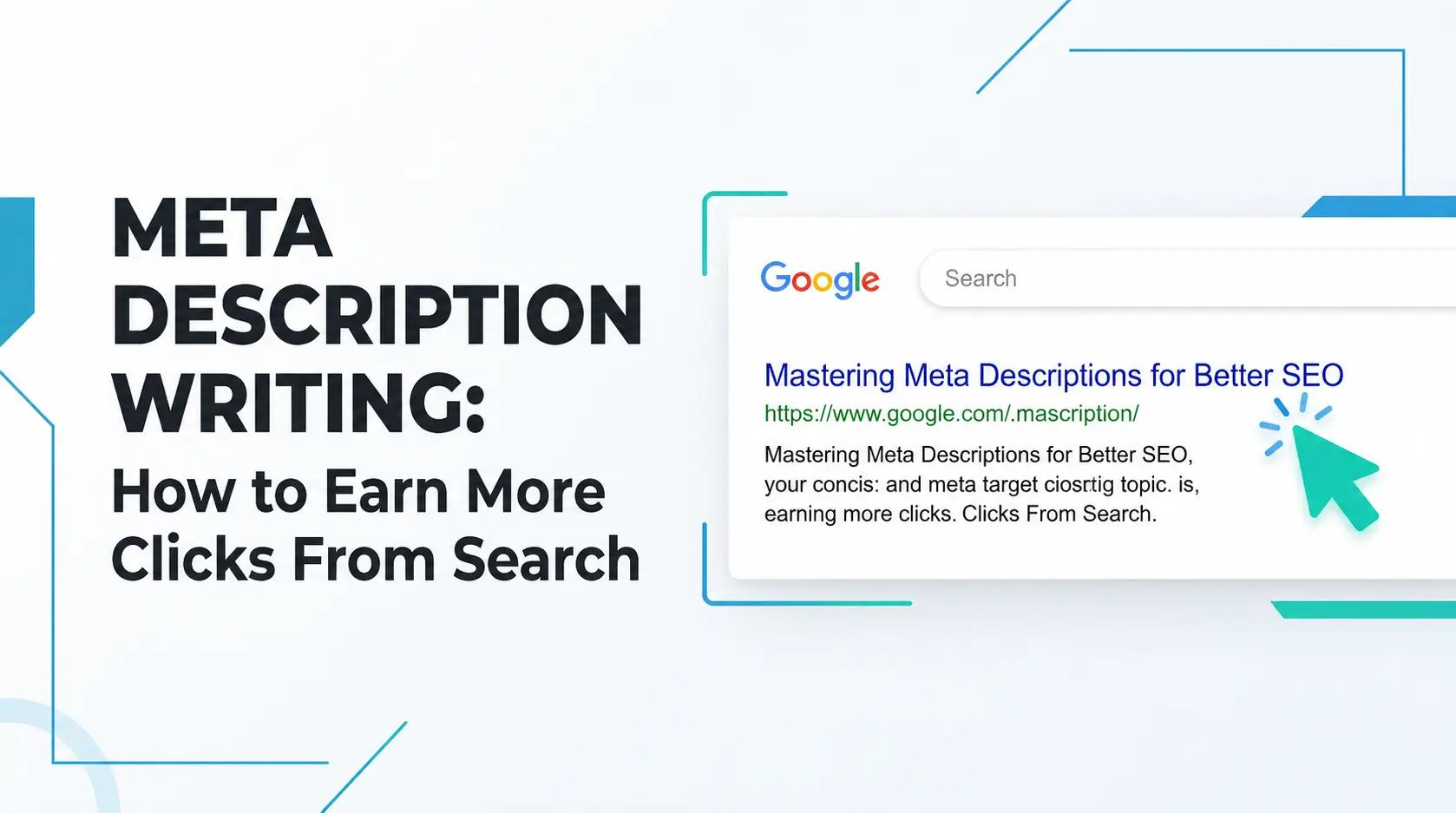
Meta description writing is the process of creating the HTML description that summarizes a webpage and gives searchers context about what they will find after clicking.
A standard meta description tag looks like this:
<meta name=”description” content=” Your page description goes here.”>
Google may use this description beneath the page title in search results, but it primarily generates snippets from page content. It uses the meta description when the tag provides a useful description of the page.
That distinction matters.
The meta description is the text supplied in your HTML. The search snippet is the descriptive text Google actually displays. They can be identical, but they do not have to be.
Meta descriptions also are not a direct Google ranking signal. Their practical value lies in how they communicate relevance and value when they appear in search results.
How Google Uses Meta Descriptions and Generates Search Snippets
Adding a meta description in WordPress, Shopify, Webflow, or another CMS does not guarantee that Google will display it. Google creates snippets automatically from page content and may show different text depending on the query.
Consider a page about technical SEO audits with this description:
“Learn how to run a technical SEO audit covering crawling, indexing, Core Web Vitals, internal links, and common site errors.”
For the query:
“technical SEO audit checklist”
that description may closely match the searcher’s intent.
For:
“how to find broken internal links”
Google could instead extract text from the page’s internal-link section if that passage provides a more relevant answer.
A rewritten snippet is therefore not evidence of a poor meta description. It reflects Google’s attempt to match the displayed text more closely to the query.
This also means SERP snippet optimization extends beyond the meta tag. Clear introductions, descriptive headings, concise answers, product details, dates, prices, and other page-specific information give Google useful material when generating snippets.
What Is the Best Meta Description Length in 2026?
Google does not specify a fixed character limit for meta descriptions. Search snippets are truncated when necessary to fit the available display width.
A practical writing target for many standard pages is roughly 140–155 characters. This is a working range, not a Google rule. The priority is not reaching an exact number. It is ensuring the essential proposition appears before potential truncation.
A concise 130-character description that communicates the page’s value is stronger than a 155-character description padded with generic phrases such as “Discover everything you need to know.”
Treat character count as an editing constraint rather than an optimization target.
Ask:
If the end of this description disappears, will the searcher still understand what the page offers?
If not, move the important information forward.
Do Meta Descriptions Affect Google Rankings?
Meta descriptions do not directly affect Google rankings as a ranking signal.
Their value appears elsewhere: search presentation and click acquisition.
Suppose two pages each receive 20,000 search impressions:
- Page A: 600 clicks = 3% CTR
- Page B: 1,000 clicks = 5% CTR
Page B generated about 67% more clicks from the same number of impressions.
That does not prove its meta description caused the difference. CTR is also influenced by ranking position, query mix, search intent, title wording, SERP features, rich results, competitors, brand recognition, and seasonality.
For that reason, meta-description performance is to be evaluated alongside clicks, impressions, position, queries, and SERP conditions, rather than CTR alone.
What Changed for Meta Descriptions and Search Snippets in 2026?
Several Google Search developments affect how SEO teams should think about snippets and their measurement.
Search Console Added Generative AI Performance Reporting
In June 2026, Google announced dedicated Generative AI performance reports in Search Console for participating sites.
The reports provide visibility data for generative AI experiences such as AI Overviews and AI Mode, including information about impressions, pages, countries, devices, and dates.
This creates additional context for search-performance analysis. Changes in how a page appears across evolving search experiences can affect impressions and user behavior, so CTR should not be interpreted without considering where and how visibility occurred.
Google Rejected the Need for a Separate “AI SEO” Formula
Google’s 2026 guidance on optimizing for generative AI features states that established SEO practices remain foundational for AI Overviews and AI Mode.
There is no separate meta-description formula for AI search.
Clear relevance, useful page content, accurate summaries, and strong technical eligibility remain more important than creating artificial keyword variations for generative systems.
Snippet Eligibility Matters for AI Search Features
Pages must be indexed and eligible to appear in Google Search with a snippet to qualify as supporting links in AI Overviews and AI Mode.
Google’s snippet controls therefore have implications beyond conventional search results. Controls such as nosnippet and max-snippet can restrict how page content is displayed or used across eligible Search experiences.
For publishers, ecommerce sites, licensed-content businesses, and sites controlling how much content Google can preview, these settings deserve deliberate handling.
How to Write Meta Descriptions That Earn More Clicks
Effective meta description writing starts with search intent. The description should quickly show what the page offers, why it is relevant, and what makes it worth choosing.
Match the Description to Search Intent
The description reflects the reason behind the query.
Someone searching “meta description length” expects a direct guideline, not a generic promise about SEO services. The information changes with intent:
| Search Intent | What to Emphasize |
| Informational | Answers, definitions, steps, comparisons, or guidance |
| Commercial | Features, differences, pricing, evidence, or selection criteria |
| Transactional | Price, availability, delivery, booking, trials, or purchase details |
Match the description to the page’s actual intent rather than applying the same copywriting formula everywhere.
Put the Strongest Value Early
Search snippets offer limited space, so generic openings such as “Welcome to our complete guide,” “Looking for the best,” or “Discover everything you need to know” waste valuable room.
Lead with the information that gives the searcher a reason to click. The benefit should remain clear even if the end of the snippet is truncated.
Give the Searcher a Specific Reason to Choose the Page
A unique value proposition (UVP) identifies what the page offers beyond a generic answer. Depending on the page, that includes:
- original data or current guidance
- a downloadable template or calculator
- expert examples or comparison data
- transparent pricing
- same-day service or free delivery
- specific product features
Surface the differentiators that exist on the destination page. The description should communicate value, not manufacture it.
Replace Marketing Adjectives With Concrete Information
Words such as best, leading, innovative, powerful, and world-class communicate little without evidence.
Instead of claiming a service is “leading,” describe what it includes. A technical SEO audit, for example, can specify crawling, indexing, site speed, internal links, schema, and prioritized fixes.
Concrete details help searchers understand the offer before clicking.
Use a CTA That Matches the Search Intent
The CTA should support the action the searcher is already trying to take.
| Page Intent | Suitable CTA Examples |
| Informational | See the examples, use the checklist, learn the steps |
| Commercial | Compare plans, view pricing, get an estimate |
| Transactional | Book online, start your trial, request a quote |
A CTA cannot compensate for an unclear description. Establish relevance and value first, then make the next step obvious.
A Practical Meta Description Writing Formula
A useful framework is:
Search relevance + useful outcome + differentiator + next step
Example:
“Learn how to write meta descriptions using practical length, keyword, UVP, and CTA examples. Use the checklist before publishing.”
For a problem-focused page:
Problem + solution + specific detail
Example:
“Low search CTR? Improve weak meta descriptions with practical examples for blogs, service pages, ecommerce categories, and local pages.”
For a service page:
Service + differentiator + commercial action
Example:
“Technical SEO audits covering crawling, indexing, site speed, schema, and internal links. Get prioritized fixes instead of a generic audit report.”
The formula provides structure. The actual proposition should still reflect the page rather than read like a template.
Should You Put Keywords in Meta Descriptions?
Include the primary keyword when it accurately describes the page and fits naturally. Repeating it provides no additional value.
For a page targeting “emergency plumber Manchester,” this works:
“Need an emergency plumber in Manchester? Get 24/7 help for leaks, burst pipes, blocked drains, and urgent plumbing repairs.”
This does not:
“Emergency plumber Manchester services from our emergency plumber Manchester company for Manchester emergency plumbing.”
Use the relevant phrase once where appropriate, then use the remaining space to communicate page-specific value. Google also generates snippets from page content, so the meta description should not be treated as a container for every keyword variation associated with the page.
Meta Description Examples: Weak vs. Click-Worthy
Strong meta descriptions replace vague promotional language with details that reflect the page’s actual content and search intent. These examples show how the approach changes across common page types.
| Page Type | Weak Meta Description | Better Meta Description | Why It Works |
| Blog Post | “Read our blog to learn all about email marketing and useful email marketing tips.” | “Build an email marketing strategy covering segmentation, automation, subject lines, testing, and campaign measurement.” | Previews the specific topics the reader will find instead of relying on generic “tips.” |
| SEO Agency Service Page | “We are a leading SEO company providing the best SEO services for businesses.” | “Grow organic traffic with technical SEO, content strategy, digital PR, and reporting tied to leads rather than vanity metrics.” | Replaces unsupported claims with specific services and a clear differentiator. |
| Ecommerce Category Page | “Shop our amazing collection of office chairs at great prices today.” | “Shop ergonomic office chairs with adjustable lumbar support, mesh and fabric options, fast delivery, and models across multiple price ranges.” | Surfaces concrete product attributes and buying information instead of promotional adjectives. |
| Local Business Page | “Looking for a dentist? Our professional dental team is here to help.” | “Book a dentist in Bristol for check-ups, hygiene appointments, fillings, whitening, and emergency care. New patients welcome.” | Adds location, services, availability, and a relevant booking action. |
The pattern is consistent: remove generic claims and use the available snippet space for information that helps the searcher understand why the page matches the query.
What Should You Check in a SERP Snippet Preview?
A SERP snippet preview is useful for editing, not predicting what Google will display.
Use it to check whether:
- the main proposition appears early
- important text risks being truncated
- the title and description unnecessarily repeat each other
- the keyword appears naturally
- the description remains readable at a glance
- the CTA or differentiator appears soon enough
Google can generate a different snippet according to the query and page content, so a preview should never be treated as an exact representation of the eventual search result.
Meta Description Writing for AI Overviews and AI Mode
Meta descriptions do not require a separate writing strategy for AI Overviews or AI Mode.
Google states that existing SEO best practices remain relevant to its generative AI Search features and that there are no additional technical requirements beyond the requirements for appearing in Google Search and being eligible for a snippet.
That creates an important distinction:
Snippet eligibility matters, but a carefully written meta description is not guaranteed to become text in an AI-generated response.
The practical approach remains focused: create an accurate meta description, maintain clear and crawlable page content, and provide useful passages that directly satisfy relevant search intents.
Common Meta Description Mistakes
Meta description mistakes occur when the tag is treated as a keyword field or character-count exercise instead of a page-specific search summary. The fixes are straightforward: make the description accurate, distinct, intent-aligned, and useful before worrying about minor wording changes.
| Mistake | Better Approach |
| Reusing one description across multiple pages | Write page-specific descriptions that reflect the individual product, category, service, location, or content of each important URL. |
| Repeating the title | Use the description to add information the title cannot fit, such as key features, differentiators, benefits, or the next step. |
| Keyword stuffing | Include relevant keywords naturally where they clarify the page topic. Use the remaining space to communicate value rather than repeat search terms. |
| Making claims the page does not support | Mention pricing, tools, templates, delivery promises, research, or other benefits only when the destination page actually provides them. |
| Using the same CTA for every intent | Match the CTA to the searcher’s goal: informational actions for guides, comparison actions for commercial pages, and purchase or booking actions for transactional pages. |
| Optimizing for a plugin score instead of the SERP | Use character indicators as editing aids, then review the actual SERP to assess competing messages, search intent, and opportunities to differentiate the page. |
Avoiding these mistakes does not guarantee that Google will display the written description, but it produces a stronger page-specific summary when the tag is used and avoids wasting limited snippet space.
Should You Use AI to Write Meta Descriptions?
AI helps generate first drafts, shorten descriptions, produce variants, and turn structured product information into readable copy. The quality depends on the input and review process.
For a small site, manually writing or substantially reviewing descriptions is practical. Large ecommerce sites and marketplaces need programmatic generation because manually producing unique descriptions for hundreds of thousands of URLs is inefficient.
Google’s guidance allows programmatically generated descriptions when they remain readable, useful, varied, and page-specific. A product-page system, for example, could build descriptions from:
Product type + key attribute + brand + price or availability + delivery proposition
Priority URLs then receive manual review.
The problem is not automation; it is generating large volumes of generic descriptions without page-specific data, intent mapping, or quality control.
How to Optimize Existing Meta Descriptions With Google Search Console
Google Search Console helps identify which meta descriptions are worth testing and provides the performance data needed to evaluate the changes.
Step 1: Find Pages With Meaningful Search Visibility
Start with URLs receiving enough impressions to provide useful data.
A page with 200 impressions offers little testing signal compared with one receiving 80,000 impressions. Prioritize pages with:
- deep or growing impressions
- relatively stable average positions
- meaningful organic clicks
- weak CTR relative to their queries and positions
Step 2: Check the Queries Driving Visibility
Review the queries generating impressions for each priority page and compare their intent with the current meta description.
If a page appears frequently for “SEO audit checklist” but its description promotes agency services, the messaging does not match the dominant informational intent.
Likewise, if a commercial page receives substantial price-related impressions but its description says nothing about pricing, there is a clear opportunity to improve relevance.
Step 3: Evaluate CTR With Position and Query Mix
Never judge CTR alone.
Suppose performance changes from:
Before
- Average position: 3.1
- CTR: 6.2%
After
- Average position: 5.8
- CTR: 4.9%
The CTR decline cannot be attributed to the description because the page also moved down in average position.
Query changes matter too. A page can begin appearing for broader searches, increasing impressions while reducing average CTR even as total clicks rise.
Compare:
- queries
- impressions
- clicks
- CTR
- average position
- search appearance
- comparable time periods
Step 4: Rewrite the Search Proposition
Make a meaningful messaging change rather than swapping individual words.
Weak:
“Read our guide to CRM software.”
Better:
“Compare CRM software by price, automation, reporting, integrations, and team size. Find the platforms that fit your sales process.”
The second version communicates what the page covers and gives the searcher a specific reason to click. Changing “Learn” to “Discover” would not meaningfully test the proposition.
Step 5: Measure the Result
After updating the description, collect enough Search Console data to compare performance over similar periods.
Check whether CTR and clicks changed while accounting for position, queries, impressions, and search appearance. If these variables changed substantially, avoid crediting the meta description alone.
The objective is to determine whether the revised description communicates the page’s relevance more effectively for the searches already generating visibility.
Meta Description Optimization Checklist
Before publishing or updating a meta description, check:
- Does it accurately represent the page?
- Is the primary search intent clear?
- Does the main keyword appear naturally where appropriate?
- Is the strongest value positioned early?
- Does it provide a specific reason to click?
- Are unsupported adjectives and promotional claims removed?
- Does the CTA match the search intent?
- Will the core message survive likely truncation?
- Is the description specific to this URL?
- Does it add information rather than repeat the title?
- Have you reviewed the live SERP rather than relying only on a plugin preview?
- For an existing page, have you checked queries, impressions, clicks, position, and CTR before changing it?
Final Thoughts
Meta description writing is not about reaching a perfect character count or forcing Google to display a specific sentence.
A strong description accurately connects the searcher’s intent with the value available on the page. Put that value early, make it specific, and measure changes using search-performance data rather than assumptions.
Google may display the description as written or generate a query-specific snippet from the page. Either way, clear and relevant copy gives both the search engine and the searcher better information to work with.
Frequently Asked Questions
Should every page have a meta description?
Important indexable pages should have useful, page-specific descriptions where practical. For very large database-driven sites, programmatic descriptions can be used when they accurately reflect each page.
Are duplicate meta descriptions bad for SEO?
Duplicate descriptions are not useful for distinguishing similar URLs in search results. Unique descriptions give Google and searchers more page-specific information about what each URL contains.
Can ecommerce sites generate meta descriptions automatically?
Yes. Programmatic descriptions are practical for large ecommerce sites when they use accurate product-specific data and produce readable, useful copy rather than repeating the same generic template.
How often should you update a meta description?
There is no fixed update schedule. Review a description when the page’s content or offer changes, its dominant search intent shifts, or Search Console data provides a clear reason to test different messaging.
Does the exact target keyword need to appear in a meta description?
No exact-match requirement exists. Include the primary phrase when it fits naturally and accurately describes the page. Avoid repeating keywords or forcing variations solely for search engines.