
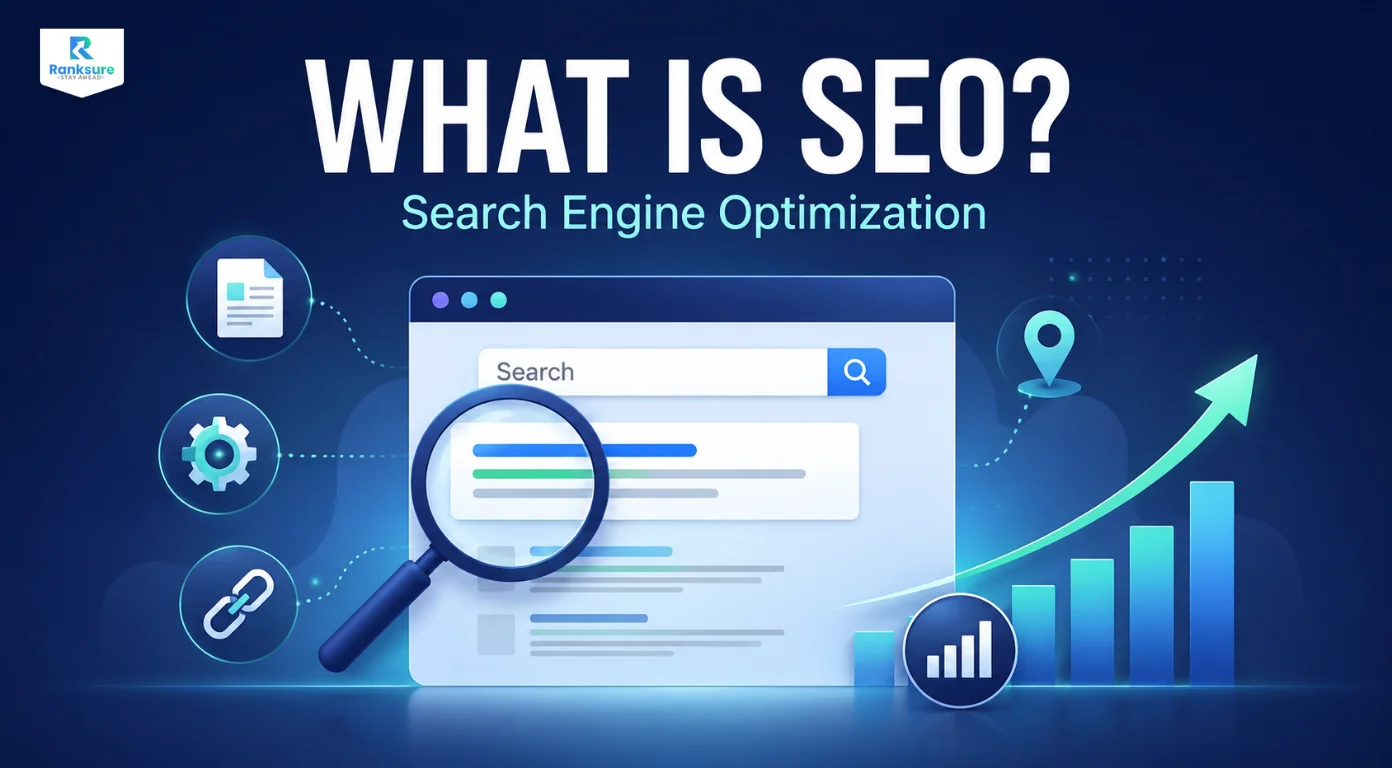
SEO (Search Engine Optimization) is the practice of improving a website’s visibility in search engines and AI-powered search experiences. By optimizing content, technical performance, website structure, and authority signals, businesses can attract qualified organic traffic without paying for every click.
Modern SEO extends far beyond keyword optimization. Search engines now evaluate content quality, user experience, expertise, trustworthiness, and topical authority to determine which pages deserve visibility. At the same time, AI-powered search systems are changing how information is discovered and presented.
To succeed in 2026, websites must create helpful, accurate, and trustworthy content that serves both users and search algorithms. This guide explains what SEO is, how it works, the different types of SEO, key ranking factors, and how SEO is evolving in the age of AI.
What Is SEO (Search Engine Optimization)?
Search Engine Optimization (SEO) is the process of improving a website’s visibility in organic search results by optimizing content, technical performance, user experience, and authority signals. The goal is to help search engines understand your content while making it more useful and accessible to users
What Is the Main Goal of SEO?
SEO’s main goal is to gain organic traffic in their field for website owners. For businesses, SEO plays a major role in lead generation. For example, if a person searches for a restaurant near me and your restaurant website appears first, this increases the sales of your restaurant, and more people come to you than the website on the second and third pages. This improves brand awareness when the site constantly appears in search results.
Why Does SEO Matter?
SEO helps search engines understand, organize, and deliver the most relevant content to users.
Improves Content Understanding
SEO uses clear titles, headings, keywords, and content structure to help search engines understand what a page is about and when it should appear in search results.
Enhances User Experience
SEO encourages websites to load quickly, work well on mobile devices, and provide a better browsing experience. These improvements help users find information more easily and can contribute to better search performance.
Supports Efficient Crawling and Indexing
Search engines process billions of webpages. Elements such as internal linking, XML sitemaps, structured data, and logical site architecture help search engines discover and organize content more efficiently.
Ultimately, SEO benefits both users and search engines by making content easier to find, understand, and access.
How Does SEO Work?
SEO helps search engines discover, understand, and rank webpages for relevant search queries. When a user performs a search, search engines evaluate billions of pages to find the most useful and relevant results.
Discovering Content
Search engines find webpages through links, sitemaps, and other sources across the web. This allows them to identify new pages and updates to existing content.
Understanding Content
Once a page is discovered, search engines analyze its content, structure, keywords, and context to understand what the page is about and whether it matches a user’s search intent.
Indexing Pages
Pages that meet quality and technical requirements may be stored in the search engine’s index, a large database of content that can appear in search results.
Ranking Search Results
When someone searches, search engines evaluate factors such as relevance, content quality, user experience, website authority, and page performance to determine which pages should rank highest.
By optimizing content, technical performance, and user experience, SEO helps websites improve their visibility and attract more organic traffic from search engines.
SEO Process at a Glance
- Crawl → Search engines discover pages.
- Understand → Content is analyzed.
- Index → Pages are stored.
- Rank → Best results are selected.
- Serve → Results appear to users.
What Are the Main Types of SEO?
SEO consists of different disciplines and actions that work together to improve search results and rankings. Each type of SEO focuses on different aspects of optimization, from improving content and website performance to building local visibility and increasing authority.
The 5 types of SEO are
- On-Page SEO,
- Technical SEO,
- Off-Page SEO,
- Local SEO, and
- E-commerce SEO.
| SEO Type | Primary Focus | Examples |
| On-Page SEO | Content optimization | Keywords, headings, internal links |
| Technical SEO | Website infrastructure | Speed, crawlability, indexing |
| Off-Page SEO | Authority building | Backlinks, brand mentions |
| Local SEO | Geographic visibility | Google Business Profile, reviews |
| Ecommerce SEO | Product visibility | Product pages, schema markup |
What Is On-Page SEO?
On-Page SEO focuses on optimizing the content and elements that appear directly on a webpage. Its goal is to help search engines understand the page while providing a better experience for users.
Common on-page SEO practices include optimizing keywords, creating high-quality content, using descriptive headings, improving internal linking, and writing compelling title tags and meta descriptions. Effective on-page SEO ensures content is relevant, well-structured, and aligned with user search intent.
What Is Technical SEO?
Technical SEO focuses on the website infrastructure that helps search engines crawl, render, index, and understand content efficiently.
Key areas include site architecture, page speed, mobile-friendliness, XML sitemaps, structured data, and crawlability. A strong technical foundation improves both search engine accessibility and user experience, helping other SEO efforts perform more effectively.
What Is Off-Page SEO?
Off-Page SEO refers to activities performed outside a website to improve its authority, trust, and reputation.
The most important off-page factor is backlinks—links from other websites that act as signals of credibility. Other signals include brand mentions, digital PR, online reviews, and social visibility. Off-page SEO helps search engines evaluate a website’s authority within its industry.
What Is Local SEO?
Local SEO helps businesses appear in search results for location-based queries and nearby customers.
It focuses on optimizing a Google Business Profile, managing customer reviews, maintaining consistent business information, and improving local citations. Local SEO is especially important for businesses that serve specific geographic areas, such as restaurants, clinics, retail stores, and service providers.
What Is E-commerce SEO?
E-commerce SEO focuses on improving the visibility of online stores and product pages in search results.
This includes optimizing product descriptions, category pages, internal linking, product schema markup, images, and customer reviews. The goal is to help shoppers discover products more easily, increase organic traffic, and drive sales.
Why Is SEO Important for Websites?
SEO is one of the most effective digital marketing strategies for businesses of all sizes. Whether you run a blog, local business, e-commerce store, or enterprise website, SEO helps increase visibility, attract qualified visitors, build brand authority, and drive long-term growth. Unlike paid advertising, which stops generating traffic when the budget runs out, SEO can continue delivering results over time.
Organic Traffic
One of the biggest benefits of SEO is its ability to generate organic traffic from search engines without paying for every click.
- Attracts users who are actively searching for relevant information, products, or services.
- Reduces reliance on paid advertising campaigns.
- Creates a sustainable source of website traffic.
- Can continue driving visitors long after content is published.
As rankings improve, organic traffic often becomes one of the most valuable and cost-effective acquisition channels for a business.
Brand Visibility and Credibility
SEO helps businesses increase their visibility across search results and build trust with potential customers.
- Improves brand exposure for relevant searches.
- Increases recognition through consistent search visibility.
- Helps establish authority within an industry or niche.
- Strengthens credibility by appearing alongside trusted sources.
Even when users do not click immediately, repeated exposure can improve brand awareness and influence future purchasing decisions.
Lead Generation
SEO attracts users with clear intent, making it an effective channel for generating qualified leads.
- Connects businesses with users actively searching for solutions.
- Reaches potential customers at different stages of the buying journey.
- Aligns content with user needs and search intent.
- Can increase conversions by attracting highly relevant visitors.
Because search traffic is intent-driven, SEO often delivers visitors who are more likely to engage, subscribe, or make a purchase.
Better User Experience
Modern SEO goes beyond rankings and focuses on creating a better experience for website visitors.
- Encourages faster page load times.
- Improves mobile usability and responsiveness.
- Makes website navigation clearer and more intuitive.
- Helps users find information quickly and easily.
A positive user experience not only benefits visitors but also supports stronger search performance and engagement metrics.
Long-Term ROI
SEO is widely considered one of the highest-return digital marketing investments.
- Continues generating traffic after content is published.
- Produces compounding results as website authority grows.
- Delivers ongoing value from existing content.
- Offers a scalable alternative to continuously increasing ad spend.
While SEO requires time and consistent effort, its long-term benefits can provide sustainable traffic, leads, and revenue growth for years.
Ultimately, SEO helps websites attract the right audience, strengthen their online presence, and achieve long-term business growth in an increasingly competitive digital landscape.
What Are the Most Important SEO Ranking Factors?
Search engines use hundreds of signals to determine which webpages should appear in search results. While ranking algorithms continuously evolve, several factors consistently influence visibility and rankings. These factors help search engines evaluate the quality, relevance, authority, and user experience of a webpage.
Helpful Content
High-quality content remains one of the most important ranking factors. Search engines prioritize content that satisfies user intent and provides clear, valuable, and accurate information.
Key characteristics of helpful content include:
- Addresses users’ questions and needs.
- Demonstrates originality and unique insights.
- Matches search intent.
- Is well-structured and easy to read.
- Provides genuine value beyond ranking for keywords.
Content created for users is likely to perform well in search results.
E-E-A-T
E-E-A-T stands for Experience, Expertise, Authoritativeness, and Trustworthiness. It is a framework used to evaluate the credibility and reliability of content, particularly for topics involving health, finance, safety, and other important decisions.
Strong E-E-A-T signals include:
- First-hand experience and practical knowledge.
- Subject-matter expertise.
- Recognition from reputable sources.
- Accurate and trustworthy information.
- Transparent author and website information.
Building trust and authority improves both user confidence and search visibility.
Backlinks
Backlinks are links from other websites that point to your content. They act as signals that other websites find your content valuable and trustworthy.
High-quality backlinks:
- Come from relevant and authoritative websites.
- Are earned naturally through valuable content.
- Strengthen website authority and credibility.
- Help improve visibility for competitive keywords.
User Experience and Core Web Vitals
Search engines aim to provide results that offer a positive user experience. Websites that are fast, responsive, and easy to use are positioned to perform well.
Important factors include:
- Fast page loading speeds.
- Stable page layouts.
- Responsive interactions.
- Clear website navigation.
- Minimal user frustration.
Mobile Friendliness
Since most searches occur on mobile devices, websites must provide a seamless experience across all screen sizes.
Mobile-friendly websites:
- Use responsive design.
- Load quickly on smartphones and tablets.
- Display content clearly without zooming.
- Provide easy navigation and interaction.
A poor mobile experience negatively affects both rankings and user engagement.
Internal Linking
Internal linking connects pages within the same website and helps both users and search engines discover content.
Effective internal linking:
- Improves website navigation.
- Helps search engines crawl pages more efficiently.
- Distributes authority across important pages.
- Supports topic clusters and content organization.
A strong internal linking structure makes content easier to find and understand.
While search engines evaluate many ranking signals, websites that consistently publish helpful content, demonstrate expertise, earn quality backlinks, provide excellent user experiences, and maintain strong site architecture are likely to achieve sustainable SEO success.
How to Do SEO Step by Step
SEO is an ongoing process that involves researching keywords, creating valuable content, optimizing webpages, improving technical performance, building authority, and measuring results. While search algorithms continue to evolve, the fundamental SEO process remains largely the same.
Step 1: Find Keywords
Keyword research is the foundation of SEO. It helps you understand what your audience is searching for and identify opportunities to attract relevant traffic. When researching keywords, consider factors such as search volume, keyword difficulty, and user intent. A balanced SEO strategy typically targets both broad keywords and long-tail keywords, allowing websites to reach larger audiences while capturing highly specific searches with lower competition.
Keyword research should also consider keyword relevance, business value, and the specific audience you want to reach.
Step 2: Understand Search Intent
Finding keywords is only the beginning. You also need to understand why users are searching. Search intent generally falls into four categories:
- Informational: Users want to learn or find answers.
- Commercial: Users are researching and comparing options.
- Transactional: Users are ready to take action or make a purchase.
- Navigational: Users are looking for a specific website or page.
Search engines prioritize content that aligns with user intent, making this step essential for creating pages that rank and satisfy visitors.
Step 3: Create Helpful Content
After identifying keywords and search intent, the next step is creating content that genuinely helps users. High-quality content should answer questions, solve problems, and provide valuable information in a clear and organized format. Many successful SEO strategies use topic clusters, where a pillar page covers a broad topic and supporting articles explore related subtopics in greater detail.
This approach helps build topical authority and makes it easier for search engines to understand relationships between content. Comprehensive content should cover related concepts, entities, and common questions users may have about the topic.
Step 4: Optimize On-Page SEO
Once content is created, it should be optimized for both users and search engines. This includes improving title tags, meta descriptions, headings, internal links, URLs, and image alt text. On-page optimization also includes creating descriptive URLs, improving content structure, and ensuring important keywords appear naturally throughout the page.
Proper on-page optimization helps search engines understand the page’s topic while improving readability and user experience.
Step 5: Improve Technical SEO
Technical SEO focuses on the infrastructure of a website and ensures search engines can efficiently crawl, render, and index content. Important areas include website speed, mobile responsiveness, XML sitemaps, structured data, site architecture, and crawlability. Technical SEO also helps prevent indexing issues, duplicate content problems, and crawl inefficiencies that can limit search visibility.
A strong technical foundation helps search engines access content more effectively and supports better overall search performance.
Step 6: Build Authority
Authority plays a major role in SEO because search engines want to rank trustworthy and credible websites. One of the most effective ways to build authority is by earning high-quality backlinks from relevant websites.
Authority is strengthened when websites consistently publish valuable content, earn industry recognition, and receive references from reputable sources. Brand mentions, digital PR, original research, expert insights, and industry recognition can also strengthen a website’s reputation and improve its visibility in search results over time.
Step 7: Monitor Performance
SEO is not a one-time task. Regular monitoring helps identify what is working and where improvements are needed. Tools such as Google Search Console and Google Analytics provide insights into organic traffic, keyword rankings, indexing issues, user engagement, conversions, and click-through rates (CTR).
Regular analysis helps identify content gaps, optimization opportunities, and changes in search behaviour that may affect rankings. By continuously measuring performance and refining strategies, businesses can adapt to changing search trends and achieve sustainable long-term growth.
Following these seven steps consistently can help websites improve visibility, attract qualified traffic, and build lasting success in organic search.
Common SEO Mistakes to Avoid
Even the best SEO strategy can fail if common mistakes are ignored. Search engines prioritize websites that provide value, maintain technical quality, and deliver a positive user experience. Avoiding these issues can help protect your rankings and support long-term SEO growth.
| SEO Mistake | Why It Hurts SEO | Best Practice |
| Keyword Stuffing | Creates unnatural content and poor user experience. | Use keywords naturally and focus on helpful content. |
| Thin Content | Provides little value and fails to satisfy user intent. | Create comprehensive, high-quality content that answers users’ questions. |
| Duplicate Content | Can confuse search engines about which page should rank. | Publish original content and use canonical tags when necessary. |
| Buying Backlinks | Violates search engine guidelines and can damage rankings. | Earn backlinks naturally through valuable content and digital PR. |
| Ignoring Technical SEO | Can create crawlability, indexing, and performance issues. | Regularly audit and optimize technical SEO elements. |
| Slow Website Speed | Reduces user satisfaction and may increase bounce rates. | Optimize images, improve server performance, and enable caching. |
| Ignoring Search Intent | Creates content that does not match user expectations. | Align content with informational, commercial, transactional, or navigational intent. |
Avoiding these common SEO mistakes helps search engines better understand your website and improves the overall user experience. By focusing on helpful content, technical quality, and user intent, websites can build stronger search visibility and achieve sustainable long-term growth.
Is SEO Still Relevant in the Age of AI?
Yes, SEO is still highly relevant in the age of AI. While the way people search is evolving, search engines and AI systems still rely on high-quality, trustworthy content to generate answers and recommend sources. Rather than replacing SEO, AI is changing how SEO works.
What Is AI Search?
AI Search refers to search experiences where artificial intelligence generates direct answers instead of simply displaying a list of links. Examples include AI Overviews, AI-powered search assistants, and generative search experiences that provide conversational responses to user queries.
As AI Search becomes more common, websites must focus on creating accurate, well-structured, and authoritative content that AI systems can easily understand and reference.
What Is Generative Engine Optimization (GEO)?
Generative Engine Optimization (GEO) is the practice of optimizing content for visibility within AI-generated answers. While traditional SEO focuses on ranking webpages, GEO focuses on increasing the likelihood that AI systems will cite, reference, or use your content when generating responses.
Strong GEO often relies on:
- Original research and unique insights.
- Clear content structure.
- Topical authority.
- Strong E-E-A-T signals.
- Accurate and trustworthy information.
GEO is not a replacement for SEO. Instead, it extends traditional SEO into AI-driven search environments.
SEO vs AEO vs GEO
As search evolves beyond traditional search results, businesses increasingly optimize for multiple search experiences.
| Approach | Primary Goal |
| SEO (Search Engine Optimization) | Improve visibility and rankings in traditional search results |
| AEO (Answer Engine Optimization) | Help content appear in featured snippets, voice search, and direct answers |
| GEO (Generative Engine Optimization) | Increase visibility within AI-generated responses and generative search experiences |
While each approach has a different focus, they share the same foundation: creating accurate, trustworthy, and well-structured content that helps users find answers quickly.
SEO remains the foundation. AEO builds on SEO by optimizing for direct answers, while GEO extends SEO principles into AI-powered search systems.
Can AI Replace SEO?
AI cannot replace SEO because AI systems still depend on external sources of information. Search engines and generative AI platforms need reliable content, expert knowledge, and real-world experience to generate accurate responses.
Factors such as E-E-A-T, backlinks, authority, and trust remain important because they help search engines and AI systems identify credible sources. Websites that consistently publish valuable content are more likely to maintain visibility across both traditional and AI-powered search experiences.
How SEO Is Changing in 2026
SEO is expanding beyond keyword rankings and adapting to new search behaviors. Modern SEO strategies increasingly focus on:
- Creating content that answers questions comprehensively.
- Optimizing for AI Search and AI Overviews.
- Building topical authority through content clusters.
- Strengthening E-E-A-T signals.
- Using Entity SEO to establish topic relationships.
- Providing accurate, trustworthy, and experience-driven information.
The future of SEO is not about choosing between search engines and AI. It is about creating valuable content that can perform across traditional search results, AI-generated answers, and emerging generative search platforms.
As long as people use search engines and AI systems need trustworthy sources, SEO will remain an essential part of online visibility.
Conclusion
SEO remains one of the most effective ways to grow online visibility, attract qualified traffic, and build long-term business value. While AI-powered search is changing how users discover information, the fundamentals remain the same: create helpful content, demonstrate expertise, build trust, and provide an excellent user experience.
Whether your goal is generating leads, growing an ecommerce store, building a personal brand, or increasing organic traffic, SEO continues to be a critical digital marketing skill in 2026 and beyond.
FAQs
Is SEO Free?
SEO does not require paying search engines for rankings. However, businesses often invest in content creation, SEO tools, technical improvements, or professional services. The benefit of SEO is that it can continue generating organic traffic long after the initial investment.
How Long Does SEO Take?
SEO takes three to six months to show noticeable results. The timeline depends on competition, website authority, content quality, and the effectiveness of the SEO strategy.
Is SEO Difficult to Learn?
SEO is relatively easy to learn at a basic level. However, mastering SEO requires ongoing learning because search engines, algorithms, and AI-powered search experiences continue to evolve.
Can AI Replace SEO?
No. AI can assist with research, content creation, and analysis, but search engines still rely on trustworthy, experience-driven, and authoritative content. SEO remains essential for improving visibility and credibility.
Does SEO Still Work in 2026?
Yes. SEO remains highly effective in 2026. Modern SEO now includes optimization for AI-powered search, AI Overviews, and generative search experiences in addition to traditional search rankings.
What Is the Difference Between SEO and SEM?
SEO focuses on earning organic traffic from search engines. SEM includes both SEO and paid search advertising. SEO provides long-term traffic, while paid search delivers immediate visibility through ads.
What Is the Difference Between SEO and PPC?
SEO generates organic traffic without paying for each click. PPC (Pay-Per-Click) advertising places paid ads in search results and charges advertisers whenever users click on them.
Is SEO a Good Career?
Yes. SEO is a growing digital marketing career with opportunities in agencies, businesses, consulting, and freelancing. Demand continues to increase as search and AI technologies evolve.
What Are the 4 Pillars of SEO?
The four pillars of SEO are On-Page SEO, Technical SEO, Off-Page SEO, and Content SEO. Together, they help improve visibility, authority, user experience, and organic traffic.
What Is the Difference Between SEO and GEO?
SEO focuses on improving rankings in traditional search engines. GEO (Generative Engine Optimization) focuses on increasing visibility within AI-generated answers and AI-powered search experiences.