
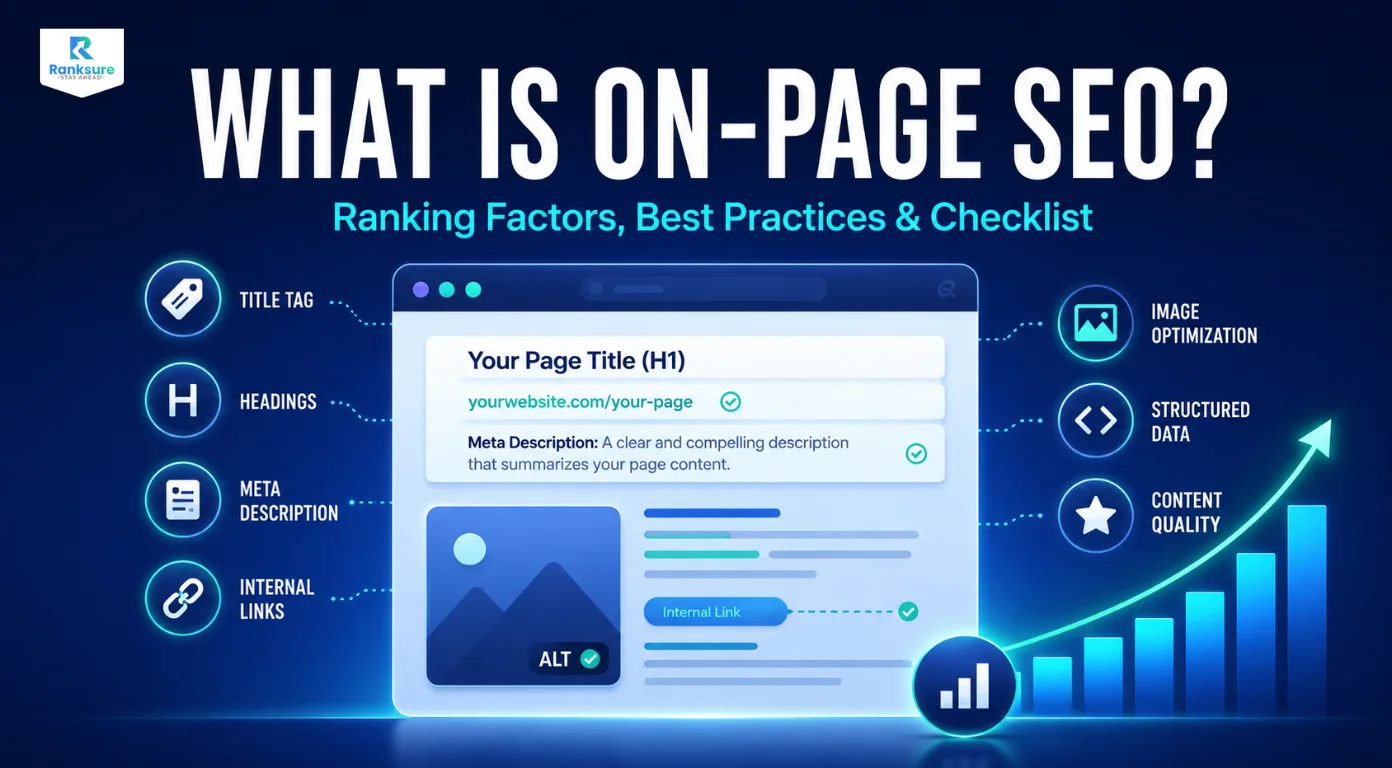
On-page SEO is the process of optimizing content, HTML elements, and page structure to help search engines understand a webpage and rank it for relevant searches. When determining whether a page fulfills search intent, search engines consider elements like user experience, metadata, internal links, topical relevance, and content quality.
Poorly optimized pages make it harder for search engines to interpret content and can limit ranking potential. On-page SEO focuses on elements that website owners can directly control, including title tags, headings, URLs, content, images, and internal linking.
Modern on-page SEO extends beyond keyword usage, emphasizing semantic relevance, content quality, and user satisfaction to improve organic visibility and search performance.
What Is On-Page SEO?
Definition of On-Page SEO
On-page SEO refers to optimizing a website’s content and page-level elements. This allows accurate interpretation of the page’s topic, its usefulness, and whether it should appear in search results for particular queries.
It focuses on factors that exist directly on a webpage, including:
- Content quality
- Search intent alignment
- Keywords and entities
- Title tags
- Meta descriptions
- Heading structure
- URL optimization
- Internal linking
- Image optimization
- Structured data
- User experience signals
The purpose of these optimizations is to make a page more relevant to specific searches while providing a better experience for visitors.
What Does On-Page SEO Include?
There are three categories of On-page SEO.
- Content Optimization
Content optimization is about the information available for users on a page.
This includes:
- Matching search intent
- Covering topics comprehensively
- Answering user questions
- Demonstrating expertise
- Maintaining content freshness
The content is the foundation of on-page seo. It is a primary way through which search engines understand a page.
- HTML Optimization
The additional context of the page is obtained through HTML elements. These elements show how the information is organized on the page and enhance the interpretation of the content.
Important examples include:
- Title tags
- Meta descriptions
- Headings
- URLs
- Schema markup
- User Experience Optimization
The interaction of users with the content is evaluated by the search engines. The pages with easy navigation have increased engagement and satisfaction.
User experience optimization includes:
- Internal linking
- Mobile usability
- Image optimization
- Readability
- Page experience signals
On-Page SEO vs Off-Page SEO vs Technical SEO
SEO is typically divided into three areas, each serving a different purpose.
- Technical SEO improves accessibility by helping search engines crawl, render, and index content efficiently.
- On-page SEO improves relevance by optimizing content, keywords, headings, metadata, internal links, and other page elements.
- Off-page SEO builds authority through external signals such as backlinks, brand mentions, reviews, and digital PR.
Together, they form the foundation of organic search performance. Technical SEO ensures content can be accessed, on-page SEO helps search engines understand what the content is about, and off-page SEO helps establish trust and credibility. While all three are important, on-page SEO directly influences how search engines interpret and rank a page for relevant searches.
Why Is It Called “On-Page” SEO?
It is called on-page SEO because the optimization takes place directly on the webpage itself. This includes improving content, headings, title tags, meta descriptions, internal links, images, and other elements that site owners can control on a page.
The term distinguishes these optimizations from off-page SEO, which focuses on external signals such as backlinks and brand mentions, and technical SEO, which focuses on the website’s underlying infrastructure. Since the changes are made “on the page,” the practice is known as on-page SEO.
Why On-Page SEO Matters
The pages get ranked when the search engines can clearly understand the purpose of content, its relevance, and the quality. It is necessary to provide useful results as per the user intent.
Improves Search Visibility
Search engines need to determine how a page will rank depending on the query. This is made easier by:
- Clear titles,
- descriptive headings,
- well-structured content, and
- relevant entities
The additional context achieved by the optimization helps the search engine gain understanding of a page.
Helps Match Search Intent
On-page SEO helps to design the content around the user intent. The ranking is determined on the basis of user satisfaction, i.e., whether the user query was answered or not. For example, when someone searches, “What is On-page Seo”
The user wants to find out:
- A definition
- An explanation of how it works
- Key ranking factors
- Practical optimization guidance
The page that satisfies all the queries ranks faster than those that focus on irrelevant information.
Increases Organic Traffic
On-page SEO is a high-impact practice for website owners and marketers. This is because:
On-Page SEO increases the relevance, hence increasing the rankings and visibility. The increased visibility leads to more organic traffic.
Supports User Experience
On-page SEO optimization practices help improve the experience for human visitors.
Examples include:
- Clear page structure
- Easy-to-read content
- Descriptive headings
- Helpful internal links
- Faster page interactions
- Mobile-friendly design
The quick Information finding and easy navigation of the page improve the engagement.
Strengthens Topical Relevance
Search engines evaluate the topics of content rather than isolated keywords.
A well-optimized page covers a topic comprehensively and connects related concepts naturally.
For example, a page about on-page SEO may also discuss:
- Search intent
- Title tags
- Meta descriptions
- Internal links
- Schema markup
- Core Web Vitals
These related concepts establish topical relevance and improve search engines’ confidence in the page’s subject matter.
Future-Proof Content for AI Search
AI-powered search systems rely on content that is structured, authoritative, and easy to understand. Pages with clear organization, direct answers, logical headings, easy scanability, and comprehensive topic coverage are easier for AI systems to interpret and summarize.
As AI-generated search experiences expand, strong on-page SEO becomes important for maintaining visibility across multiple search environments.
On-page SEO has become more about making content understandable, useful, and trustworthy. It ensures content is accessible for both users and modern search systems.
How On-Page SEO Works
Search engines use on-page signals to understand a webpage’s topic, purpose, and relevance to a search query. These signals help determine whether a page should appear in search results and for which searches.
Key on-page signals include:
- Content and keywords
- Title tags
- Meta descriptions
- Headings
- URL structure
- Internal links
- Image attributes
- Structured data
Together, these elements provide context about the page and help search engines interpret its content more accurately.
Search Intent and Relevance
Every search has an underlying goal, known as search intent. Search engines analyze content to determine whether it satisfies that intent.
| Search Intent | Purpose | Example Query |
| Informational | Learn something | What is on-page SEO |
| Navigational | Find a website or page | Google Search Console |
| Commercial | Research before buying | Best SEO tools |
| Transactional | Take an action | Buy SEO software |
Pages that closely match user intent are more likely to rank because they provide the information users expect to find.
Topic Understanding
Modern search engines evaluate topics, not just keywords. They analyze related concepts, content structure, and contextual signals to understand a page comprehensively.
For example, a page about on-page SEO may naturally reference search intent, title tags, internal linking, schema markup, and user experience. These related concepts help search engines build confidence in the page’s subject matter.
In simple terms, on-page SEO works by providing clear signals that help search engines understand what a page is about, who it is for, and how well it satisfies a user’s search intent.
Core Elements of On-Page SEO
On-page SEO consists of multiple optimization factors that work together to improve relevance, usability, and search visibility.
While individual tactics vary, most on-page SEO activities fall into three categories:
- Content Optimization
- HTML Optimization
- User Experience Optimization
Each category contributes differently to how search engines understand and evaluate a webpage.
Content Optimization
Content is the foundation of on-page SEO.
Search engines cannot evaluate relevance without content, and users cannot find answers without it. Every other optimization supports the content itself.
Search Intent Alignment
Search intent is the reason behind a search query. Before optimizing a page, it is important to understand what users expect to find.
For example, someone searching “what is on-page SEO” typically wants a definition, an explanation of how it works, and practical optimization guidance—not a sales page or service landing page.
Pages that closely match user intent are more likely to rank because they satisfy user expectations. Reviewing the top-ranking results for a target keyword can reveal the preferred content format, level of detail, and topics users expect to see.
E-E-A-T and Content Quality
Google’s Search Quality Evaluator Guidelines emphasize E-E-A-T:
- Experience – Demonstrates first-hand knowledge of a topic.
- Expertise – Shows subject matter knowledge and accuracy.
- Authoritativeness – Reflects credibility and industry recognition.
- Trustworthiness – Ensures content is accurate, transparent, and reliable.
Although E-E-A-T is not a direct ranking factor, it provides a useful framework for evaluating content quality. Pages that demonstrate first-hand experience, subject expertise, credibility, and trustworthiness are more likely to satisfy users and earn visibility in competitive search results.
Keywords and Topical Relevance
Keywords remain important because they help search engines identify the primary topic of a page. Now, search engines evaluate topical relevance. Topical coverage is more valuable than keyword repetition. A page about on-page SEO should naturally discuss concepts such as:
- Search intent
- Title tags
- Meta descriptions
- Internal links
- Structured data
- Core Web Vitals
These supporting concepts help establish context and reinforce relevance.
Rather than asking:
“How many times should I use this keyword?”
A better question is:
“Have I covered this topic comprehensively?”
Keyword Placement Best Practices
While keyword stuffing is ineffective, strategic keyword placement still helps search engines understand a page’s topic.
Important locations include:
- Title tag
- H1 heading
- URL
- Opening paragraph
- Relevant subheadings
- Image alt text
- Internal anchor text
Keywords should always be used naturally and in context. The goal is to reinforce topical relevance rather than repeat phrases unnecessarily.
Entity Optimization
Search engines increasingly rely on entities to understand topics and relationships between concepts. An entity is a distinct concept that can be clearly identified.
Examples include:
- Google Search Console
- Core Web Vitals
- Schema markup
- Search intent
- Meta descriptions
When related entities appear naturally throughout content, they help search engines better understand the page’s subject matter. Entity optimization improves semantic relevance and strengthens topical depth.
Content Freshness
Some topics evolve rapidly. As content becomes outdated, rankings may decline.
Refreshing content helps maintain relevance by:
- Updating statistics
- Revising examples
- Adding new insights
- Expanding coverage
- Addressing emerging topics
Regular updates help preserve search visibility and improve long-term performance.
HTML Optimization
HTML elements provide additional context that helps search engines interpret content more accurately. Although users may not always notice these elements, they remain important on-page signals.
Title Tags
The title tag is one of the strongest on-page SEO signals. It communicates the primary topic of a page and often appears as the clickable headline in search results.
An effective title tag should:
- Include the primary keyword
- Clearly describe the page
- Encourage clicks
- Remain concise
Example:
What Is On-Page SEO? A Complete Guide to Modern Page Optimization
Meta Descriptions
Meta descriptions summarize page content within search results. While they are not direct ranking factors, they influence user behavior.
A strong meta description should:
- Explain what the page covers
- Communicate value
- Include the primary topic
- Encourage clicks
Meta description is taken as an advertisement for the page within search results.
Heading Structure
Headings help organize content for both users and search engines.
A clear heading hierarchy improves readability and makes information easier to understand.
Best practices include:
- One H1 heading
- Logical H2 sections
- Supporting H3 and H4 headings when necessary
Well-structured headings help search engines understand content relationships while improving the user experience.
URL Optimization
URLs provide another contextual signal. SEO-friendly URLs are:
- Short
- Descriptive
- Easy to read
- Relevant to the page topic
Example:
yourdomain.com/on-page-seo
Avoid unnecessary parameters, dates, or complex folder structures whenever possible.
Structured Data
Structured data, often called schema markup, helps search engines interpret content more effectively. Schema provides additional context about information on a page.
Common schema types include:
- Article
- FAQ
- How-To
- Product
- Organization
While schema does not guarantee enhanced search results, it can improve eligibility for rich results and help search engines better understand content.
User Experience Optimization
Search engines increasingly evaluate how users interact with webpages. Pages that provide positive experiences often perform better over time.
Internal Linking
Internal links connect pages within the same website. They help users discover related information and help search engines understand relationships between content. Strategic internal linking helps establish topic clusters and strengthens website architecture.
Benefits include:
- Improved navigation
- Better content discovery
- Stronger topical relationships
- More efficient crawling
Internal links also help distribute authority across a website.
For example, if a high-performing SEO guide links to a newer article about keyword research, some of the page’s authority and visibility signals can flow through those links. This helps search engines identify important pages and understand how topics relate to one another.
Image Optimization
Images contribute to both user experience and SEO. Proper optimization includes:
- Descriptive file names
- Relevant alt text
- Compression
- Appropriate sizing
- Modern image formats
Optimized images improve accessibility while reducing page load times.
Mobile Usability
Most searches now occur on mobile devices. As a result, mobile usability has become essential.
Mobile-friendly pages should:
- Display properly on smaller screens
- Use readable text
- Maintain intuitive navigation
- Avoid intrusive elements
Poor mobile experiences negatively affect engagement and user satisfaction.
Page Experience and Core Web Vitals
Users expect webpages to load quickly and respond smoothly. Google evaluates page experience through several metrics known as Core Web Vitals.
| Metric | Measures |
| LCP | Loading performance |
| INP | Responsiveness |
| CLS | Visual stability |
These metrics help assess whether users can interact with content efficiently. While content relevance remains the primary ranking consideration, strong page experience supports engagement and overall usability.
Accessibility and Readability
Effective on-page SEO benefits all users. Accessibility improvements include:
- Descriptive alt text
- Clear navigation
- Logical heading structure
- Readable typography
- Adequate contrast
Similarly, readability improvements such as shorter paragraphs, descriptive headings, and scannable formatting help users consume content more easily. When content is easier to access and understand, it tends to perform better for both users and search engines.
How to Optimize a Page for On-Page SEO
Effective on-page SEO follows a structured process that helps search engines understand your content while improving the user experience.
1. Understand Search Intent
Analyze the top-ranking pages for your target keyword to identify the content format, depth, and information users expect. Your content should align with the intent behind the search.
2. Research Keywords and Topics
Identify a primary keyword, related terms, common questions, and relevant subtopics. Focus on covering the topic comprehensively rather than repeating keywords.
3. Create High-Quality Content
Develop content that answers the user’s questions, provides accurate information, and delivers clear value. Use examples, definitions, visuals, and practical insights where appropriate.
4. Optimize Key On-Page Elements
Review and optimize:
- Title tag
- Meta description
- Headings
- URL
- Internal links
- Images and alt text
- Structured data
- Mobile usability and page experience
These elements help search engines understand your content and improve the user experience. This ensures readers don’t think UX and page experience were skipped.
5. Monitor and Improve
Track rankings, organic traffic, and user engagement. Regularly update content, improve internal linking, and refresh outdated information to maintain relevance and performance.
A Simple On-Page SEO Workflow
For most pages, the process can be simplified into five stages:
- Understand search intent.
- Research keywords and entities.
- Create helpful content.
- Optimize page elements and user experience.
- Monitor performance and update regularly.
The most successful pages combine strong content, clear structure, relevant metadata, effective internal linking, and a positive user experience into a cohesive strategy.
On-Page SEO Checklist
The following checklist summarizes the most important on-page SEO tasks discussed throughout this guide.
Research Checklist
Before creating or updating content:
- Define a primary target keyword
- Identify search intent
- Analyze competing pages
- Research related entities and subtopics
- Identify common user questions
Content Checklist
Review content quality and relevance:
- Fully satisfy search intent
- Cover the topic comprehensively
- Answer important questions
- Demonstrate expertise and experience
- Include relevant entities naturally
- Keep information accurate and current
- Improve readability with clear formatting
HTML Optimization Checklist
Review page-level optimization elements:
- Optimize the title tag
- Write a compelling meta description
- Use a clear heading hierarchy
- Create a descriptive URL
- Implement structured data where appropriate
User Experience Checklist
Review usability factors:
- Add helpful internal links
- Optimize images and alt text
- Ensure mobile friendliness
- Improve page speed
- Review Core Web Vitals
- Improve navigation and readability
Publishing Checklist
Before publishing or updating content:
- Verify factual accuracy
- Test mobile usability
- Check internal links
- Validate schema markup
- Confirm indexability
- Review metadata
Consistently applying these optimizations can significantly improve a page’s ability to compete in search results.
Common On-Page SEO Mistakes
Even well-optimized pages struggle to rank when they overlook fundamental SEO best practices. The following mistakes are among the most common and can negatively impact both rankings and user experience.
| Common Mistake | How to Prevent It |
| Keyword Stuffing | Use keywords naturally and focus on covering the topic comprehensively. |
| Ignoring Search Intent | Match content to what users are actually looking for when they search. |
| Thin Content | Provide complete, valuable information that fully answers the query. |
| Poor Content Structure | Use clear headings, short paragraphs, and logical organization. |
| Weak Internal Linking | Link to relevant pages to improve navigation and content discovery. |
| Outdated Content | Review and update content regularly to maintain accuracy and relevance. |
| Poor User Experience | Improve page speed, mobile usability, navigation, and overall readability. |
On-Page SEO for AI Search
AI-powered search systems increasingly generate answers and summaries directly from web content. To improve visibility in these experiences, content should be easy to understand, extract, and trust.
Key best practices include:
- Answer questions clearly and directly.
- Use descriptive headings to organize topics logically.
- Cover related entities and subtopics to demonstrate topical depth.
- Structure content with lists, tables, and FAQs for easier interpretation.
- Demonstrate E-E-A-T (Experience, Expertise, Authoritativeness, and Trustworthiness).
- Prioritize usefulness over keyword optimization alone.
As search evolves, the most successful content remains content that is clear, comprehensive, accurate, and genuinely helpful to users.
Conclusion
On-page SEO is the practice of optimizing content and page elements to improve relevance, user experience, and search visibility. It helps search engines understand your content and determine which queries it should rank for.
Effective on-page SEO goes beyond keywords. It requires high-quality content, search intent alignment, clear page structure, optimized metadata, internal linking, and a positive user experience. The best way to improve results is through continuous optimization. Regularly update content, address information gaps, strengthen internal links, and ensure pages remain accurate and useful.
As search continues to evolve, the goal remains the same: create content that clearly answers user questions and delivers genuine value. When users and search engines can easily understand your content, stronger rankings are more likely to follow.
Frequently Asked Questions
What Is the Difference Between On-Page SEO and Off-Page SEO?
On-page SEO focuses on optimizing elements within a webpage, including content, metadata, internal links, and page structure.
Off-page SEO focuses on external signals such as backlinks, brand mentions, reviews, and digital authority.
Which Is an Example of On-Page SEO?
Optimizing title tags, headings, content, internal links, images, and structured data are all examples of on-page SEO.
What Is the Most Important On-Page SEO Factor?
Search intent alignment is often considered the most important factor because content must satisfy user expectations before other optimizations can have a meaningful impact.
Can You Do On-Page SEO Without Coding?
Yes.
Most on-page SEO tasks can be performed using content management systems such as WordPress, Shopify, Webflow, or other website platforms without advanced coding knowledge.
Does Word Count Matter for On-Page SEO?
There is no ideal word count.
Content should be long enough to satisfy search intent, answer important questions, and cover the topic thoroughly.
Quality and usefulness matter more than length alone.
How Long Does It Take to See Results from On-Page SEO?
Results vary depending on competition, website authority, crawl frequency, and the extent of optimization.
Some improvements may become visible within a few weeks, while competitive topics may require several months.
How Often Should On-Page SEO Audits Be Performed?
Most websites benefit from reviewing important pages at least quarterly.
High-traffic websites or rapidly changing industries may require more frequent audits and updates.