
Search engines evaluate websites based on how the rest of the web perceives and references those websites.
This is the foundation of off-page SEO. While on-page SEO focuses on optimizing content and website elements, off-page SEO focuses on building authority, trust, and reputation through signals that originate outside your website. These signals help search engines determine whether your content deserves visibility in search results.
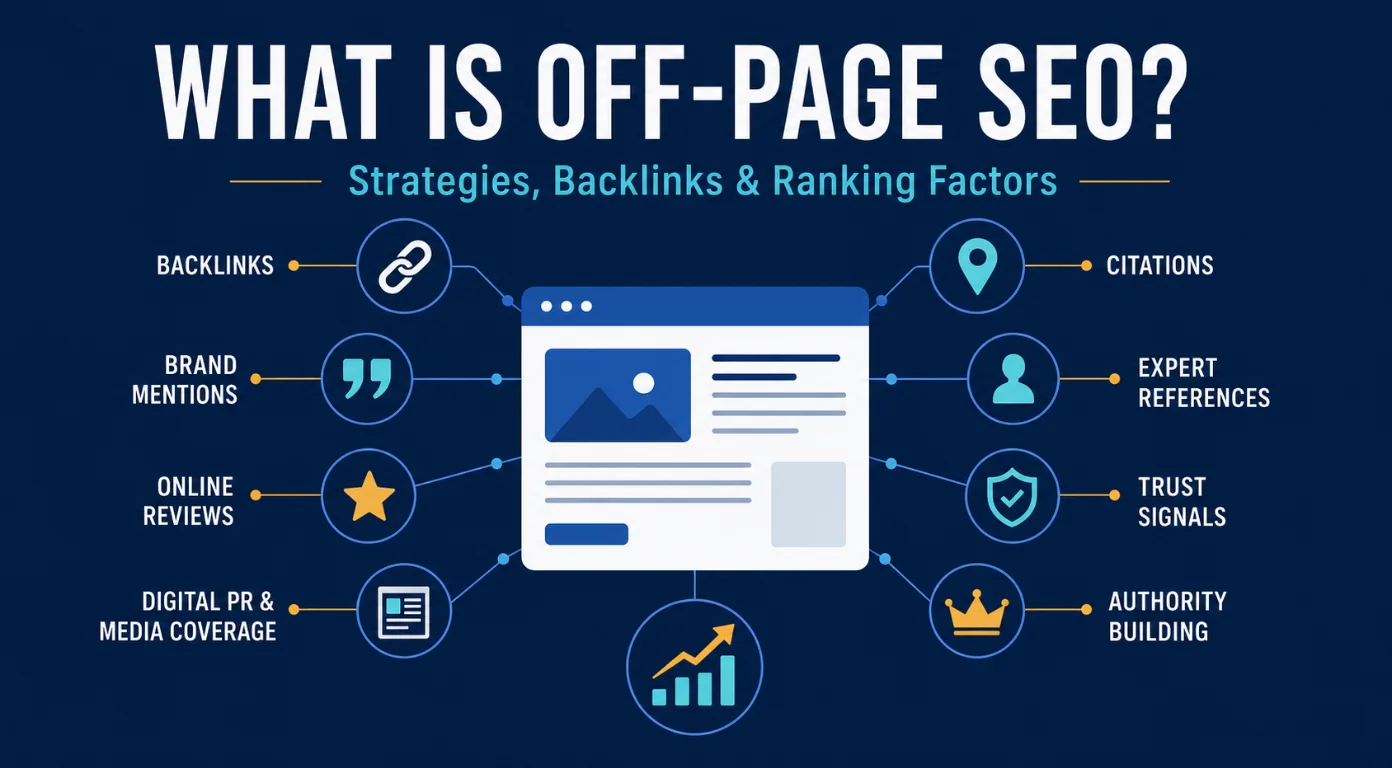
Although backlinks remain important, modern off-page SEO extends far beyond link building. Search engines now analyze a broad range of authority signals, including brand mentions, reviews, citations, media coverage, expert references, and entity relationships.
What Is Off-Page SEO?
Off-page SEO is the practice of improving a website’s search visibility through activities and signals that occur outside of the website itself.
Its primary purpose is to strengthen a website’s authority, credibility, and relevance by demonstrating that other trusted sources across the web recognize and reference it.
Common off-page SEO signals include:
- Backlinks from authoritative websites
- Brand mentions
- Online reviews and ratings
- Digital PR coverage
- Business citations
- Expert references
- Industry recognition
- Branded searches
Definition of Off-Page SEO
Off-page SEO refers to all activities performed outside a website that influence its ability to rank in search engine results pages (SERPs).
The goal is to strengthen signals related to:
- Authority
- Trustworthiness
- Relevance
- Popularity
- Brand recognition
- Expertise
Off-Page SEO vs. On-Page SEO vs. Technical SEO
Although all three disciplines contribute to search visibility, they serve different purposes.
| SEO Type | Primary Focus | Main Goal | Key Activities |
| On-Page SEO | Content and page optimization | Improve relevance for target keywords and user intent | Content optimization, keyword placement, title tags, meta descriptions, internal linking, image optimization, and UX improvements |
| Technical SEO | Website infrastructure and performance | Improve crawlability, indexability, and site accessibility | Site speed optimization, XML sitemaps, structured data, crawl management, mobile-friendliness, HTTPS, canonicalization |
| Off-Page SEO | Authority, trust, and reputation | Increase credibility through external signals | Link building, digital PR, brand mentions, reviews, influencer outreach, social amplification, citation building |
How They Work Together
| Discipline | Contribution to SEO Success |
| On-Page SEO | Creates relevance by helping search engines understand what a page is about. |
| Technical SEO | Creates accessibility by ensuring search engines can crawl, render, and index content efficiently. |
| Off-Page SEO | Creates authority by demonstrating that other websites and users trust the content. |
In simple terms:
- On-Page SEO = Relevance
- Technical SEO = Accessibility
- Off-Page SEO = Authority
Strong search rankings require all three disciplines working together as part of a comprehensive SEO strategy.
Why Content Alone Is Not Enough
Publishing high-quality content is essential, but content alone rarely guarantees rankings in competitive search results.
When multiple websites provide similarly valuable information, search engines rely on authority signals to determine which source deserves greater visibility.
A website that earns references from respected publications, experts, communities, and users typically has a better chance of ranking than one with little external recognition.
For this reason, content marketing and off-page SEO work together:
- Content creates value.
- Off-page SEO builds credibility.
- Together, they create sustainable search visibility.
Why Off-Page SEO Matters
Search engines do not rank content based solely on relevance. They also evaluate whether the source behind that content is trustworthy and authoritative.
In competitive search results, many pages satisfy user intent. Off-page SEO helps search engines determine which websites, brands, and authors have earned recognition beyond their own domains.
External Validation and Digital Reputation
Search engines rely on external signals as independent evidence of credibility.
These signals include:
- Backlinks
- Brand mentions
- Reviews
- Citations
- Media coverage
- Author reputation
- Brand search demand
- Entity associations
Rather than evaluating these signals individually, search engines analyze them collectively to understand a website’s authority, trustworthiness, and relevance.
A brand that is consistently referenced by respected publications, experts, customers, and industry communities typically develops stronger authority than one with little external recognition.
Business and SEO Benefits
Strong off-page SEO benefits both rankings and overall business growth.
Common benefits include:
- Improved search visibility
- Increased referral traffic
- Greater brand awareness
- Higher customer trust
- More direct traffic
- Better conversion opportunities
Ultimately, off-page SEO transforms a website from simply publishing content into becoming a recognized authority within its industry.
How Off-Page SEO Works
Off-page SEO works by strengthening the external signals search engines use to evaluate authority, trust, relevance, and reputation.
Rather than assessing webpages in isolation, search engines map relationships between websites, brands, authors, organizations, products, and topics.
Modern off-page SEO primarily operates through two interconnected systems:
- The Link Graph
- The Entity Graph
Together, these systems help search engines determine which sources are trusted and how they relate to specific topics.
The Link Graph
The link graph is the network of hyperlinks connecting websites across the web.
Search engines use this network to discover content, understand relationships between websites, and evaluate authority.
Link Equity and Authority Flow
Link equity refers to the authority that may be transferred through hyperlinks.
In general, links from trusted and relevant sources carry more value than links from unknown or unrelated websites.
Factors influencing link value include:
- Authority of the linking page
- Authority of the linking domain
- Topical relevance
- Anchor text
- Link placement
- Link attributes
- Number of outgoing links
Editorial links placed naturally within relevant content typically provide the strongest signals.
Relevance and Context
Modern search engines evaluate more than link quantity.
They also analyze:
- Topic relationships
- Semantic context
- Surrounding text
- Industry relevance
- Content themes
As a result, a relevant backlink from an industry-specific source is generally more valuable than a similar link from an unrelated website.
The Entity Graph
Alongside links, search engines increasingly rely on entities and their relationships.
An entity is a uniquely identifiable thing, such as a:
- Person
- Company
- Product
- Organization
- Location
- Event
- Concept
The entity graph helps search engines understand how these entities are connected across the web.
Brand Mentions and Implied Links
Search engines can recognize brand mentions even when no hyperlink exists.
These mentions help algorithms understand:
- Which brand is being discussed
- The context of the discussion
- The source making the reference
- The sentiment surrounding the mention
Repeated mentions from trusted sources can strengthen a brand’s authority profile, making digital PR and media coverage valuable even when backlinks are not included.
Brand Sentiment and Trust Signals
Authority is not only about visibility but also about credibility.
Positive signals include:
- Expert recommendations
- Positive reviews
- Industry recognition
- Thought leadership mentions
- Favorable media coverage
Together, these signals help reinforce trust and reputation across the web.
Knowledge Graphs and Entity Recognition
Search engines increasingly organize information around entities and their relationships.
Authority can be reinforced through:
- Consistent brand information
- Industry citations
- Media coverage
- Professional profiles
- Expert contributions
- Structured entity references
A strong entity footprint helps search engines associate a brand with specific topics and areas of expertise.
How Search Engines Combine Off-Page Signals
Search engines do not rely on any single off-page factor.
Instead, they combine backlinks, mentions, reviews, citations, trust signals, and brand awareness indicators to build confidence in a source.
The stronger and more consistent these signals are across the web, the more likely a website is to be viewed as authoritative.
The Authority Flywheel
The most effective off-page SEO strategies create a compounding cycle:
Content → Mentions → Backlinks → Visibility → Brand Searches → Awareness → Additional Mentions → Greater Authority
Over time, these signals reinforce one another, creating a self-sustaining authority flywheel that strengthens rankings, reputation, and brand visibility.
Off-Page SEO and E-E-A-T
Modern off-page SEO is closely aligned with E-E-A-T:
- Experience
- Expertise
- Authoritativeness
- Trustworthiness
Although E-E-A-T is not a direct ranking factor, it reflects how search engines evaluate content quality and source credibility.
Many of the strongest E-E-A-T signals originate outside a website.
Experience
Experience is demonstrated through:
- Case studies
- Product testing
- Real-world implementation
- Industry participation
Expertise
Expertise is reinforced through:
- Professional credentials
- Research and publications
- Certifications
- Expert citations
- Industry recognition
Authoritativeness
Authoritativeness is built through:
- High-quality backlinks
- Media coverage
- Industry awards
- Speaking engagements
- Podcast appearances
- Expert references
Trustworthiness
Trustworthiness is strengthened by:
- Positive reviews
- Accurate business information
- Transparent authorship
- Consistent brand presence
- Reliable citations
Together, these signals help search engines determine whether a source deserves visibility for important topics.
Off-Page SEO and AI Search
The rise of AI-powered search has expanded the importance of off-page SEO.
While traditional search engines primarily ranked webpages, AI systems increasingly evaluate consensus across multiple trusted sources.
Brands that are consistently referenced across the web are more likely to appear in AI-generated responses, recommendations, and summaries.
Consensus-Based Authority
AI systems often analyze recurring references across:
- Industry publications
- Reviews
- Community discussions
- Expert roundups
- News coverage
- Third-party resources
The more frequently a brand appears across trusted sources, the stronger its perceived authority becomes.
GEO, LLMO, and Entity SEO
This shift has increased interest in concepts such as:
- Generative Engine Optimization (GEO)
- Large Language Model Optimization (LLMO)
- Entity SEO
- Consensus-based authority
As AI search evolves, visibility depends not only on rankings but also on how widely a brand is recognized across the broader web ecosystem.
Brands that consistently earn trusted mentions across publications, communities, newsletters, podcasts, reviews, and industry resources are likely to gain a competitive advantage in both traditional and AI-driven search environments.
The Four Core Pillars of Modern Off-Page SEO
Many marketers still associate off-page SEO primarily with backlinks.
While backlinks remain one of the most influential ranking signals, modern search engines evaluate a much broader range of authority indicators. Today’s off-page SEO is built on four interconnected pillars: link signals, brand signals, content amplification, and local trust signals.
Together, these pillars create the digital footprint search engines use to evaluate authority, trustworthiness, and relevance.
Link-Based Signals
Link-based signals remain the foundation of off-page SEO because they provide direct evidence that other websites consider a resource valuable enough to reference.
Backlinks
A backlink is a hyperlink from one website to another. Search engines interpret backlinks as endorsements, particularly when they originate from trusted and relevant sources.
High-quality backlinks typically contribute more authority than large numbers of low-quality links and can also generate referral traffic, brand exposure, and industry recognition.
Anchor Text and Link Quality
Search engines evaluate backlinks based on both context and quality.
Important factors include:
- Anchor text
- Topical relevance
- Semantic context
- Link placement
- Authority of the linking page
- Authority of the linking domain
- Link attributes
Editorial links placed naturally within relevant content generally provide stronger signals than links found in footers, sidebars, author bios, or sitewide navigation.
Brand and Entity Signals
Search engines increasingly evaluate brands as entities rather than simply analyzing individual webpages.
Brand Recognition, Search Demand, and Reputation
Authority is influenced by how often a brand is recognized, discussed, searched for, and trusted across the web.
Important signals include:
- Brand mentions
- Branded searches
- Customer reviews
- Third-party ratings
- Editorial coverage
- Industry recognition
- Professional credentials
Consistent recognition across publications, communities, review platforms, and industry resources helps strengthen both authority and trust.
Content Amplification Signals
Publishing great content is only part of the equation. Off-page SEO also involves increasing visibility so content can attract attention, engagement, mentions, and backlinks.
Digital PR, Media Coverage, and Influencer Exposure
Digital PR is one of the most effective off-page SEO strategies because it generates multiple authority signals simultaneously.
Common tactics include:
- Original research
- Industry surveys
- Data studies
- Trend reports
- Expert commentary
- Newsworthy campaigns
Successful campaigns often lead to media coverage, backlinks, brand mentions, social sharing, and industry recognition.
Social Media, Communities, and Content Syndication
While social signals are not direct ranking factors, they help distribute content and increase visibility.
Channels such as social media platforms, industry forums, professional communities, and syndicated publications can expand reach and create additional opportunities for mentions, citations, backlinks, and brand awareness.
Local and Citation Signals
For businesses serving specific geographic areas, local trust signals play an important role in establishing legitimacy and credibility.
Citations, Directories, and Reviews
Search engines use citations and reviews to verify business information and evaluate trustworthiness.
Key signals include:
- Business citations (Name, Address, Phone Number)
- Industry directories
- Local business listings
- Chamber of Commerce websites
- Professional association directories
- Customer reviews and ratings
Consistency across these sources helps reinforce legitimacy and trust.
Google Business Profile
A well-maintained Google Business Profile supports local visibility by providing accurate business information, customer reviews, updates, and opportunities for engagement.
For many local businesses, it serves as a foundational local SEO asset.
How These Pillars Work Together
The most effective off-page SEO strategies do not rely on a single signal.
Strong brands earn authoritative backlinks, generate brand recognition, amplify content across multiple channels, and build trust through citations and reviews.
Together, these four pillars create the authority, credibility, and visibility that search engines use to determine whether a website deserves to rank.
The Anatomy of a High-Quality Backlink
Not all backlinks provide the same SEO value.
Modern search engines evaluate backlinks based on the authority, relevance, context, and placement of the linking source rather than simply counting the number of links pointing to a page. The most valuable backlinks are earned naturally because another website considers the content useful, credible, or worth referencing.
What Makes a Backlink Valuable?
High-quality backlinks typically share four characteristics:
- They come from authoritative websites.
- They are topically relevant.
- They are placed naturally within the content.
- They appear in a meaningful context.
Links from trusted and relevant websites generally carry more weight than links from low-quality or unrelated sources. Search engines also evaluate the surrounding content, semantic relationships, and the role a link plays within the page.
Editorial links that function as genuine recommendations usually provide the strongest signals.
Anchor Text and Link Context
Anchor text is the clickable text used in a hyperlink. It helps search engines understand the topic and context of the linked page.
A natural backlink profile typically contains a mix of:
- Branded anchors
- Partial-match anchors
- Generic anchors
- Naked URLs
Modern search engines favor natural anchor diversity over aggressive keyword optimization. Excessive use of exact-match anchor text can appear manipulative, while varied anchor patterns more closely reflect natural linking behavior.
Link Attributes
Link attributes provide additional information about the relationship between the linking page and the linked page.
The most common attributes include:
- Follow links – Standard links that may pass authority and relevance signals.
- Nofollow links – Indicate that the publisher does not necessarily endorse the linked page.
- Sponsored links – Identify paid placements, sponsorships, or advertisements.
- UGC links – Identify links created through user-generated content such as comments, forums, and community discussions.
While these attributes can influence how search engines interpret links, all may contribute to visibility, traffic, brand awareness, and a natural backlink profile.
Editorial Links vs. Manipulative Links
Modern off-page SEO focuses on earning links rather than acquiring them through artificial tactics.
Editorial links are earned because content provides value and deserves to be referenced. Manipulative links are created primarily to influence rankings and may include:
- Link schemes
- Purchased links
- Private Blog Networks (PBNs)
- Automated link generation
- Excessive link exchanges
Search engines have become increasingly effective at detecting these tactics through systems such as Penguin and SpamBrain.
As a result, sustainable off-page SEO focuses on earning relevant, editorially placed backlinks that reflect genuine authority, trust, and recognition.
Off-Page SEO Strategies That Work
Understanding off-page SEO is one thing. Executing it successfully is another.
Modern off-page SEO is less about acquiring individual backlinks and more about building authority, visibility, and trust across the web.
The most effective strategies generate multiple authority signals simultaneously, including backlinks, brand mentions, media coverage, reviews, referral traffic, and industry recognition.
Digital PR and Authority Building
Digital PR is one of the most effective off-page SEO strategies because it helps brands earn visibility from trusted sources.
Common approaches include:
- Journalist outreach
- Expert commentary
- Newsworthy campaigns
- Original research
- Industry surveys
- Data-driven content
- Guest contributions
- Podcast appearances
- Speaking engagements
These activities can generate backlinks, brand mentions, media coverage, thought leadership signals, and stronger E-E-A-T.
Strategic Link Building
Link building remains an important part of off-page SEO, but modern strategies focus on earning links through value rather than manipulation.
Common tactics include:
- Broken link building
- Resource page outreach
- Link reclamation
- Competitor backlink analysis
The goal is to create and promote content that genuinely deserves to be referenced.
Brand and Entity Building
Search engines increasingly evaluate brands as entities rather than simply counting links.
Authority can be strengthened through:
- Brand mentions
- Unlinked citations
- Topical authority
- Industry recognition
- Awards and certifications
Consistent visibility across trusted sources helps reinforce expertise, trust, and relevance.
Community, Reputation, and Local Authority
Many authority signals originate from communities, customer interactions, and local trust indicators.
Examples include:
- Reddit and forum participation
- Industry communities
- User-generated content
- Influencer collaborations
- Reviews and reputation management
- Local citations
- Community partnerships
- Sponsorships
These signals help strengthen credibility, visibility, and brand recognition across both traditional and local search environments.
Focus on Sustainable Authority Building
The most successful off-page SEO strategies create value before seeking visibility.
Rather than pursuing isolated links or mentions, focus on building expertise, earning recognition, contributing to your industry, and creating resources that others naturally want to reference.
Over time, these activities strengthen authority, trust, brand visibility, and search performance across both traditional and AI-powered search environments.
A Simple Off-Page SEO Framework
Off-page SEO is most effective when approached as a long-term authority-building system rather than a collection of isolated tactics.
The following framework provides a practical roadmap for building authority, trust, and visibility over time.
1. Assess Your Current Authority
Start by evaluating your existing off-page presence and understanding how it compares to competitors.
Review factors such as:
- Backlinks and referring domains
- Brand mentions
- Online reviews
- Citation consistency
- Referral traffic
- Media coverage
This helps establish a baseline and identify the authority signals that matter most within your industry.
2. Create Assets Worth Referencing
Authority is easier to earn when valuable resources exist for others to cite, share, and discuss.
Examples include:
- Original research
- Industry reports
- Data studies
- Interactive tools
- Comprehensive guides
Strong assets create opportunities to earn backlinks, brand mentions, media coverage, citations, and industry recognition.
3. Promote Through Outreach and Digital PR
Even exceptional content often requires promotion.
Focus outreach efforts on:
- Journalists
- Publishers
- Industry websites
- Influencers
- Community leaders
The goal is to earn visibility by providing value, insights, or expertise rather than simply requesting links.
4. Measure Authority Growth
Monitor both SEO performance and broader authority indicators, including:
- Backlinks
- Referring domains
- Brand mentions
- Review growth
- Brand search demand
- Share of voice
Authority signals often improve before rankings fully respond.
5. Scale What Works
Identify the activities generating the strongest results and invest more heavily in those channels.
For example, if original research consistently earns media coverage and backlinks, produce more research. If podcast appearances increase visibility and brand recognition, pursue additional speaking opportunities.
Focus on Building an Authority Engine
The most successful off-page SEO campaigns are not built around isolated tactics. They are built around systems that consistently generate authority, trust, visibility, and recognition.
Rather than focusing on acquiring individual backlinks, focus on creating assets, relationships, and experiences that naturally earn references across the web.
Over time, these activities form an authority engine that strengthens rankings, brand visibility, and presence across both traditional and AI-powered search environments.
Measuring Off-Page SEO Success
Off-page SEO results rarely appear overnight. Building authority takes time because search engines must discover, evaluate, and trust new signals before they influence rankings.
Rather than focusing solely on rankings, track a combination of authority, visibility, traffic, and brand-growth metrics.
| Metric Category | What to Measure | Why It Matters |
| Authority | Referring domains, backlinks, editorial links, brand mentions | Indicates growing trust, recognition, and authority across the web |
| Visibility | Media coverage, industry mentions, share of voice, community discussions | Measures how frequently your brand appears across trusted sources |
| Traffic & Business Impact | Referral traffic, leads, conversions, direct traffic | Connects off-page SEO efforts to business outcomes |
| Brand Growth | Brand search volume, branded traffic, review growth | Reflects increasing awareness and demand for your brand |
| AI & Search Visibility | AI Overview mentions AI citations, knowledge panels, and recommendation engines | Measures visibility across emerging AI-driven search experiences |
Understanding Authority Metrics
SEO tools often provide authority metrics such as:
- Domain Authority (DA)
- Domain Rating (DR)
- Trust Flow
- Citation Flow
- Authority Score
These metrics can help compare websites and evaluate link opportunities, but they are third-party estimates rather than Google’s actual ranking signals.
Use them as directional indicators, not absolute measures of authority.
Focus on Trends, Not Individual Metrics
No single metric can accurately measure off-page SEO success.
Instead, look for positive trends across authority, visibility, traffic, brand recognition, and search performance.
When backlinks, mentions, referral traffic, branded searches, and overall visibility improve together, it is usually a strong indication that your off-page SEO efforts are building long-term authority.
Auditing and Improving Your Off-Page SEO
Building authority is important. Maintaining authority is equally important.
Regular off-page SEO audits help identify opportunities, weaknesses, and potential risks within your authority profile.
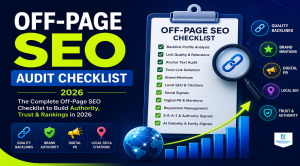
Off-Page SEO Audit Checklist
Review the following areas:
| Audit Area | What to Check | Why It Matters |
| Backlink Quality | Authority and trustworthiness of referring domains | High-quality links strengthen authority signals |
| Topical Relevance | Alignment between linking websites and your industry | Relevant links typically carry stronger contextual value |
| Link Growth | Consistency of backlink acquisition over time | Natural growth patterns indicate genuine authority development |
| Brand Mentions | Linked and unlinked references across the web | Mentions help strengthen brand and entity recognition |
| Reviews and Reputation | Review volume, sentiment, and consistency | Reviews contribute to trust and credibility signals |
| Local Citations | Accuracy and consistency of business information | Important for local trust and visibility |
| Referral Traffic | Traffic generated from external websites | Measures the business impact of off-page efforts |
Managing Link Risks
Modern search engines ost low-quality backlinks are ignored by m. However, certain patterns may indicate potential issues, including:
- Link farms
- Automated link networks
- Spam directories
- Malware-infected websites
- Obvious paid link schemes
Rather than obsessing over individual links, focus on maintaining a natural, relevant, and editorially earned backlink profile.
When to Consider the Disavow Tool
The Google Disavow Tool is rarely needed.
It should generally be considered only when:
- A manual action exists
- Artificial link building has occurred
- Link removal efforts have failed
- Significant spam creates a legitimate risk
For most websites, modern spam-detection systems can identify and ignore low-value links without intervention.
Turning Audit Insights Into Action
After completing an audit, prioritize improvements that strengthen authority and trust.
Common opportunities include:
- Reclaiming unlinked brand mentions
- Earning links from relevant publications
- Improving review acquisition
- Strengthening citation consistency
- Expanding digital PR efforts
- Building topical authority
The goal is not to create a perfect backlink profile. The goal is to build a stronger authority profile than competing websites.
Over time, consistent improvements in authority, trust, and brand recognition create sustainable off-page SEO growth.
Common Off-Page SEO Mistakes to Avoid
Off-page SEO is most effective when authority is earned naturally through trust, recognition, and value creation. However, many websites limit their results by relying on outdated or low-quality tactics.
The following mistakes are among the most common:
| Mistake | Why It’s a Problem | Better Approach |
| Buying Links and Link Schemes | Creates artificial authority signals and may violate search engine guidelines | Earn editorial links through valuable content, digital PR, and industry relationships |
| Over-Optimized Anchor Text | Creates unnatural linking patterns that can appear manipulative | Maintain a natural mix of branded, generic, URL, and descriptive anchor text |
| Low-Quality Guest Posting | Prioritizes link acquisition over audience value and expertise | Contribute original insights to relevant, reputable publications |
| Ignoring Brand Reputation | Strong backlinks cannot compensate for weak trust signals | Focus on reviews, customer satisfaction, brand mentions, and industry credibility |
| Prioritizing Quantity Over Quality | Large volumes of low-value links or mentions rarely build meaningful authority | Focus on earning relevant, authoritative references from trusted sources |
Focus on Earning Authority, Not Manufacturing It
Most off-page SEO mistakes stem from trying to accelerate authority through artificial tactics.
The most sustainable approach is to create value, build relationships, earn recognition, and contribute expertise within your industry.
Over time, these activities generate the backlinks, mentions, trust signals, and visibility that support long-term search performance.
The Future of Off-Page SEO
Off-page SEO is evolving beyond traditional link building.
While backlinks remain an important authority signal, search engines increasingly evaluate entities, brand reputation, expertise, trust, and relationships across the web.
Modern search systems do not simply analyze webpages and keywords. They also analyze how brands, people, organizations, products, and topics are connected through mentions, citations, reviews, media coverage, and other forms of external validation.
Several trends are shaping the future of off-page SEO:
| Trend | Why It Matters |
| Entity-Based Search | Search engines increasingly understand brands and topics through entity relationships rather than keywords alone. |
| E-E-A-T Signals | Experience, Expertise, Authoritativeness, and Trustworthiness are often reinforced through off-site recognition and reputation. |
| Brand Mentions | Unlinked mentions help establish brand awareness, entity associations, and authority. |
| Consensus-Based Authority | Repeated references across trusted sources strengthen credibility and recognition. |
| AI-Powered Search | AI systems rely heavily on external signals when identifying trustworthy sources and recommendations. |
As AI-driven search experiences continue to evolve, visibility will depend not only on rankings but also on how widely a brand is recognized across trusted sources.
Brands that consistently earn mentions, citations, reviews, media coverage, expert references, and industry recognition are likely to build stronger authority in both traditional and AI-powered search environments.
Ultimately, the future of off-page SEO is not about acquiring more links. It is about building a trusted digital reputation that search engines, AI systems, and users recognize as authoritative.
Essential Off-Page SEO Tools
While tools cannot replace strategy, they can help identify opportunities, monitor authority signals, and measure off-page SEO performance.
| Tool Category | Purpose | Popular Tools |
| Backlink Analysis | Analyze backlinks, referring domains, anchor text, and competitor link profiles | Ahrefs, Semrush, Moz Pro, Majestic |
| Digital PR & Outreach | Manage journalist outreach, media relationships, and PR campaigns | HARO alternatives, media databases, outreach platforms |
| Brand Monitoring | Track brand mentions, media coverage, and online discussions | Google Alerts, Brand24, Mention |
| Local SEO & Citations | Manage business listings and citation consistency | BrightLocal, Whitespark, Yext |
Choosing the Right Tools
The ideal tool stack depends on your goals, industry, and business model.
For example:
- Local businesses often prioritize citation and review management tools.
- Content publishers typically focus on backlink analysis and brand monitoring.
- SaaS and enterprise brands often combine backlink, PR, and outreach platforms.
The most important principle is to use tools to support a strategy—not to let the tools become the strategy.
Conclusion
Off-page SEO is the process of building authority, trust, and credibility beyond your website. While backlinks remain important, modern off-page SEO also includes brand mentions, reviews, digital PR, citations, and entity signals.
Search engines use these external signals to evaluate expertise, reputation, and trustworthiness. As a result, sustainable rankings are earned through genuine recognition and industry authority rather than manipulative tactics.
Whether for traditional search or AI-powered search experiences, the goal is the same: build a brand that people and search engines trust and recommend.
Frequently Asked Questions
What Does Off-Page SEO Do?
Off-page SEO helps build a website’s authority, trust, and reputation through external signals such as backlinks, brand mentions, reviews, citations, and media coverage. These signals help search engines determine whether a website deserves to rank prominently in search results.
What Are Some Examples of Off-Page SEO?
Common off-page SEO activities include earning backlinks, digital PR, guest posting, brand mention building, review management, local citation building, podcast appearances, influencer collaborations, and participation in industry communities. All of these help strengthen a website’s authority beyond its own domain.
Why Is Off-Page SEO Important?
Off-page SEO is important because search engines use external validation to assess credibility. When trusted websites, publications, customers, and industry experts reference a brand, it signals authority and trustworthiness, which can improve search visibility and rankings.
Which Is More Important: On-Page SEO or Off-Page SEO?
Neither is more important on its own. On-page SEO helps search engines understand your content, while off-page SEO helps them trust it. Strong rankings typically require both relevance (on-page SEO) and authority (off-page SEO), supported by a solid technical foundation.
How Long Does Off-Page SEO Take to Show Results?
Off-page SEO is a long-term strategy. While some improvements may be visible within a few weeks, meaningful gains in authority, rankings, and visibility often take several months. The timeline depends on factors such as competition, website authority, and the quality of acquired signals.
Do Brand Mentions Help SEO Without Links?
Yes. Search engines can recognize brand mentions even when no hyperlink is present. Repeated mentions across trusted publications, communities, reviews, and industry resources help strengthen entity recognition, brand authority, and overall trust signals.