
Technical SEO is a process of optimizing technical elements such as mobile friendliness, crawlability, and indexability of a website to reduce data retrieval cost for search engines. Google consumes 90% of its resources to crawl, understand, and index your site.
Any technical error, such as a slow server, broken or duplicate link, or missing canonical tags, increases Google’s crawl processing cost. When the retrieval cost is high, Google indexes fewer pages, which leads to a drop in site ranking. Technical SEO involves basic site speed to establish structural authority and entity clarity.
Why is Technical SEO Important?
Technical SEO helps minimize the gap between Google’s algorithms and your website by reducing the computational cost of retrieval for search engine crawlers. This process aligns website code with search engine algorithms during sequential phases of crawling, rendering, and indexing. Google has a finite budget for crawling websites, also known as the crawling budget. High processing burden consumes a significant amount of crawling budget, resulting in a limited number of pages being indexed and causing a decline in organic rankings.
Without strong technical SEO, even a well-written article struggles to reach its audience. Technical SEO helps to ensure a smooth, crawlable website without having any technical glitches, allowing search engines to identify high-quality information to answer user queries.
What are the Core Areas of Technical SEO?
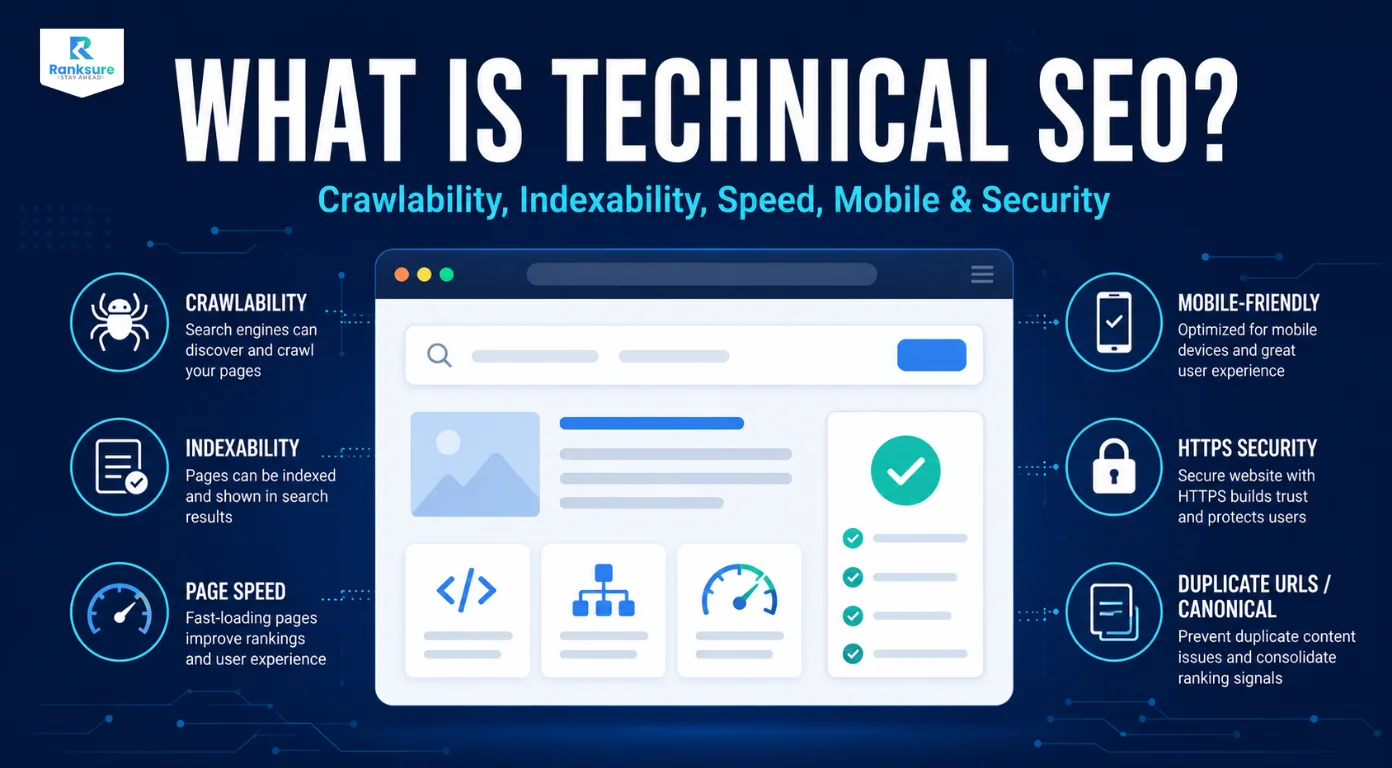
For a website to perform well in search engine results pages (SERPs), the website should be able to be crawled, rendered, and indexed by crawlers. Core technical SEO areas that cover this process include crawlability, indexability, duplicate URLs, responsiveness, secure web protocols, and page speed.
Crawlability
What is a crawler?
A search engine like Google consists of three components: crawling, indexing, and ranking systems. A crawler is an automated bot like Googlebot, which discovers web pages by following links, reading XML, and using other methods.
Crawlability is the ability of search engine bots to crawl a website. In simple words, crawlability is about how easily crawlers discover your website. It is important for SEO because if a crawler is not able to crawl, then the website will not show in search engines, which will minimize traffic and revenue.
Why does crawlability matter?
Crawlability is the first step that a Google crawler performs. Without crawlability, Google will not be able to index, and the site will completely disappear from users’ queries.
Indexability
Indexability is the ability of a website to be found and added to a database by search engines like Google. In simple terms, indexing is the ease with which a search engine searches, browses, and categorizes the content of a website.
What is the difference between crawlability and indexability?
“Crawlability” and “indexability” are usually used interchangeably, but both are distinct processes with different purposes. Crawlability answer: Can a search engine bot access your page? While indexing, a search engine stores a website page in a database.
Duplicate URLs
Duplicate content is the most overlooked topic in SEO. Before answering the question “How do duplicate URLs affect indexing and ranking in SEO?” let’s figure out what duplicate content means.
“Duplicate content” refers to identical or substantially similar content appearing on multiple URLs, either within the same website or across different websites.
What are the drawbacks of duplicate content?
Duplicate content does not usually result in a direct penalty by Google. However, it can waste crawl budget, dilute ranking signals, create indexing inefficiencies, and cause an unwanted URL to rank in search results. These issues can be resolved by using canonical tags, implementing redirects where appropriate, and removing unnecessary duplicate URLs.
Responsiveness
Responsiveness refers to the ability of a website to open and run smoothly even on devices with different resolutions. As of 2026, up to 65% of website traffic originates from mobile phones. So, responsiveness is no longer optional for website owners; it is mandatory. And Google officially uses mobile-first indexing.
Secure Web Protocols
HTTPS, standing for Hypertext Transfer Protocol, is a more secure version of HTTP. Its main purpose is to maintain a secure path between the user and the server. Google officially said in 2014 that HTTPS is mandatory from now on and will be used as a ranking signal. HTTPS contributes to building trust between the user and Google’s crawler. Most browsers block insecure websites that don’t use HTTPS, especially when they collect sensitive information.
Page load speed
Page load speed refers to the amount of time required by a website to load resources like HTML documents, CSS stylesheets, JavaScript files, and images. It is an important aspect in SEO; as of Google’s update in 2010, Google considers page speed a ranking factor. The main factors that directly affect site speed are the following:
The time taken by the server to deliver website resources(elaborate). The second one is that rendering those resources by the browser to show the graphical user interface (GUI) also consumes time.
Other factors such as image optimization, caching, and JavaScript execution also influence the loading speed of a website.
What types of tools and techniques are used for technical SEO?
There are many techniques used for technical SEO. The 3 major techniques are fixing orphan pages, resubmitting not indexed pages in Google, and optimizing large contentful paint (LCP).
Screaming Frog SEO is a desktop app that helps to find broken links, missing meta descriptions, duplicate content, and redirect chains in a single report by crawling a website like Google bots.
Google Search Console is a free dashboard to monitor website performance. It shows exactly which pages Google has indexed, which have errors, and which show a valid CTR (click-through rate).
PageSpeed Insights is a performance testing tool that provides scores of mobile and desktop speed and code fixes to improve the overall speed of a website.
Conclusion
Technical SEO is a fundamental component of a successful SEO strategy. Every optimization measure, including managing duplicate URLs, enhancing mobile responsiveness, and facilitating efficient crawling, contributes to a more optimized environment.
Understanding technical SEO reveals that website ranking is not solely determined by content quality but also by a website’s ability to communicate with crawlers.
As search technologies are continuously evolving, we now have artificial intelligence (AI), but the fundamental requirements will remain unchanged, as a website should be crawlable, indexable, and mobile-friendly. AI has transformed how information is interpreted. Technical SEO will play a major role in ensuring that information remains visible in search engines and AI overviews.
FAQs:
What is technical SEO?
Technical SEO refers to optimizing website technical elements like mobile responsiveness, crawling, and indexing of a website to reduce data retrieval costs.
Why is technical SEO important?
Without strong technical SEO, even a well-written article struggles to reach its audience. Technical SEO helps to ensure a smooth, crawlable website without having any technical errors.
What tools are best for technical SEO?
The most renowned tools of technical SEO are Screaming Frog SEO, Google Search Console, and PageSpeed.
Is technical SEO replaceable by AI?
No, SEO basics will remain unchanged. AI just revolutionized the way of information interpretation. Websites will always need to be crawlable, indexable, and user-friendly. Technical SEO always plays a major role and ensures the search engine visibility of websites.