
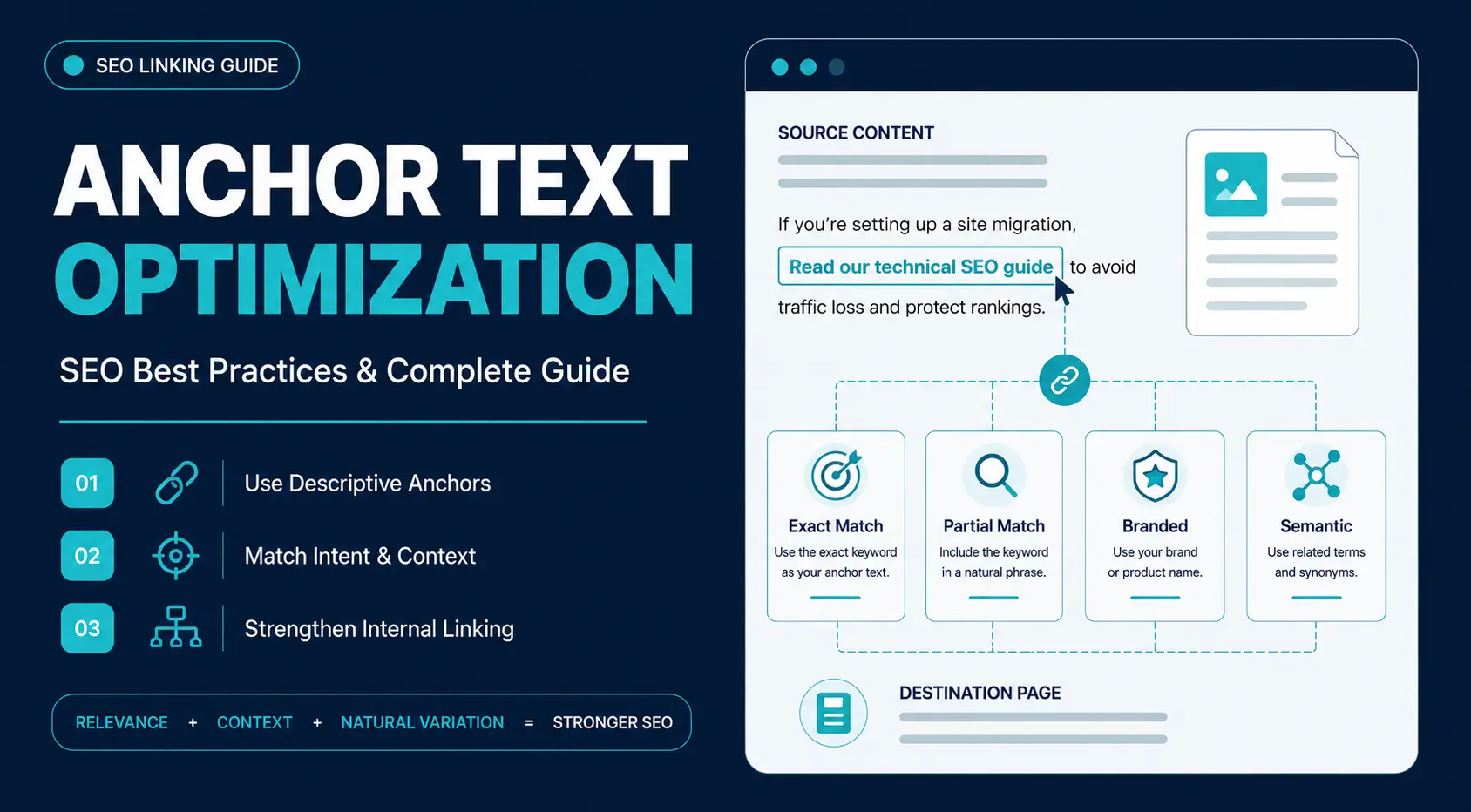
Anchor text optimization is the practice of using descriptive, contextually relevant clickable text that helps users and search engines understand a link’s destination. While anchor text remains an important ranking signal, modern search engines also evaluate the surrounding content, page topic, entity relationships, and link placement to determine relevance and authority.
Rather than relying on exact-match keywords alone, today’s algorithms use natural language processing, semantic understanding, and entity recognition to interpret links. As a result, descriptive anchors supported by relevant context create stronger topical connections, improve internal linking, and help AI-driven search systems better understand content.
This guide explains how anchor text works, its role in modern SEO, the different types of anchor text, optimization best practices, and common mistakes to avoid.
What Is Anchor Text?
Definition
Anchor text is the visible, clickable text in a hyperlink. It describes the destination page, helping users understand what they’ll find and giving search engines topical context.
Example
<a href=”https://example.com/technical-seo-guide”>technical SEO guide</a>
Here, the technical SEO guide is the anchor text, while the URL is the destination. Descriptive anchors set clear expectations, whereas generic text like Read more provides little context.
Anchor Text vs. Hyperlink
| Anchor Text | Hyperlink |
| Visible, clickable text | Complete HTML link element |
| Describes the destination | Connects one URL to another |
| Provides topical context | Contains the destination URL and attributes |
Every anchor text is part of a hyperlink, but not every hyperlink contains descriptive text. Image links, for example, rely on alt text instead.
How Anchor Text Works
Hyperlinks are created with the HTML <a> element:
<a href=”https://example.com/internal-linking-guide”>
Internal Linking Guide
</a>
The href attribute specifies the destination, while the visible text becomes the anchor. Search engines crawl these links to discover pages and use the anchor as a contextual signal about the linked content.
How Search Engines Interpret Anchor Text
Modern search engines evaluate far more than the anchor itself. They consider:
- The anchor text
- Surrounding words and sentences
- Source and destination page topics
- Related entities and concepts
- Link placement within the page
- Overall internal and external linking patterns
For example, an anchor like structured data gains stronger meaning when surrounded by terms such as products, search visibility, and schema markup. Context helps algorithms understand intent even when keywords vary.
From PageRank to Semantic Search
Early search algorithms relied heavily on exact-match anchor text because links were a primary indicator of page relevance. Today, search engines use natural language processing, entity recognition, and semantic embeddings to understand relationships between pages.
As a result, a page about internal linking can be reinforced by anchors such as website structure, content hub, topical clusters, or internal navigation without repeating the exact keyword. Modern anchor optimization prioritizes topical relevance over keyword repetition.
Why Surrounding Context Matters
Anchor text works best when supported by relevant surrounding content. Search engines analyze the sentence and the nearby paragraph to understand the relationship between the source and destination pages.
For example:
- Strong context: Learn how PageRank flows through a website in our internal linking strategy guide.
- Weak context: Looking for marketing tips? Visit our SEO guide.
Search engines also recognize nearby entities, technologies, brands, and concepts to strengthen semantic relationships. Effective anchor text optimization combines descriptive anchors with contextually relevant content rather than relying on exact-match keywords alone.
Why Anchor Text Matters for SEO
Helps Search Engines Understand Content
Anchor text gives search engines valuable context about a linked page. Rather than relying on a single keyword, modern algorithms combine descriptive anchors, surrounding text, and related entities to understand a page’s topic.
For example, links using phrases such as technical SEO checklist, website crawl audit, crawlability guide, and indexation best practices all reinforce the same subject without repeating identical keywords. This semantic variety builds stronger topical relevance than an exact-match-only approach.
Transfers Link Equity & Topical Authority
Links pass authority between pages, while anchor text helps search engines interpret that authority. Descriptive internal links strengthen topical relationships and distribute PageRank from high-authority pages to supporting content.
For example, a Technical SEO pillar page reinforces related articles on crawl budget, canonical tags, structured data, XML sitemaps, and log file analysis.
Link placement also matters. Contextual links within the main content generally carry more weight than repetitive navigation, sidebar, or footer links because they have more chances to be clicked.
Improves Crawling, Internal Linking & User Experience
Descriptive anchor text helps search engines discover related pages and understand a site’s structure. A logical internal linking strategy connects pillar pages with supporting content, improving crawlability while reducing orphan pages.
For users, meaningful anchors clearly communicate what to expect after clicking. Labels such as technical SEO audit checklist are far more informative than generic phrases like click here. They also improve accessibility, as screen readers rely on descriptive link text. For image links, the alt attribute serves the same purpose.
Supports AI Search
AI-powered search relies on semantic relationships rather than exact keyword matching. Descriptive anchor text, relevant surrounding content, and well-connected internal links help AI systems understand how pages, entities, and topics relate to one another.
A semantic SEO guide that naturally links to content about entity optimization, knowledge graphs, topical authority, and internal linking architecture creates a stronger topical cluster than isolated pages. In modern SEO, anchor text is not a standalone ranking factor. It strengthens the semantic relationships that support search visibility across both traditional and AI-driven search.
Types of Anchor Text
Different anchor text types send different contextual signals. The strongest link profiles use a natural mix of anchor types rather than relying on a single format.
| Anchor Type | Description | Example | SEO Consideration |
| Exact Match | Uses the target keyword exactly. | anchor text optimization | Strong relevance signal, but overuse—especially in backlinks appears manipulative. |
| Partial Match | Includes the target keyword with additional words. | beginner’s guide to anchor text optimization | More natural while maintaining keyword relevance. |
| Phrase Match | Describes the destination without using the exact keyword. | optimize descriptive link text | Improves semantic diversity and supports modern search understanding. |
| Branded | Uses only the brand name. | Ahrefs, Semrush, Moz | Common in editorial backlinks and builds trust. |
| Brand + Keyword | Combines a brand with the topic. | Ahrefs anchor text guide | Reinforces both brand recognition and topical relevance. |
| Semantic (Related) | Uses synonyms or closely related concepts. | internal linking strategy, descriptive hyperlink text | Expands topical coverage and strengthens semantic relationships. |
| Generic | Uses non-descriptive phrases. | Learn more, read this article, click here | Natural in moderation, but it provides little topical or accessibility value. |
| Naked URL | Displays the URL itself as the anchor. | https://example.com | Common in citations and forums but offers minimal contextual relevance. |
| Page Title | Uses the destination page’s title. | Technical SEO Audit Checklist | Clearly identifies the referenced resource and is common in editorial content. |
| Image Anchor | An image acts as a clickable link. | <img alt=”Technical SEO audit checklist”> | Search engines primarily rely on the alt attribute to understand the destination. |
Best Practice
No single anchor type is ideal for every link. A natural mix of exact, partial, semantic, branded, and contextual anchors creates a healthier link profile, improves user experience, and provides stronger semantic signals for both traditional and AI-powered search.
Choosing the Right Anchor Type
Anchor selection depends on the relationship between the linking page and the destination—not on fixed ratios.
A practical framework looks like this:
| Situation | Recommended Anchor |
| Primary internal link | Partial match or descriptive keyword |
| Supporting internal content | Semantic variation |
| Homepage reference | Branded anchor |
| Editorial backlink | Branded or Brand + Keyword |
| Citation or source | Page title or Naked URL |
| Image link | Descriptive alt text |
Exact-match anchors should support an overall strategy rather than dominate it. Diversity produces stronger semantic coverage and reduces repetitive linking patterns that algorithms interpret as artificial.
Anchor Text Optimization Best Practices
1. Match Search Intent with the Destination
Anchor text should accurately reflect the page users will reach. Aligning intent builds trust and improves the user experience.
| Anchor | Best Destination |
| Technical SEO checklist | Checklist article |
| Enterprise SEO services | Service page |
| XML sitemap guide | Educational guide |
| Request an SEO audit | Contact or conversion page |
2. Write Natural, Descriptive Anchors
Use anchors that fit naturally within the sentence and clearly describe the destination.
- Poor: Click here for more information.
- Better: Download the technical SEO migration checklist before launching your new website.
Descriptive anchors improve usability, accessibility, and topical clarity.
3. Use Semantic Variations
Avoid repeating the same keyword across every link. Instead, alternate related phrases such as descriptive hyperlink text, contextual linking strategy, internal anchor strategy, or optimized link labels. Semantic variation creates a more natural link profile and strengthens topical relationships.
4. Maintain a Natural Anchor Distribution
A healthy anchor profile typically includes:
- Branded anchors have the largest share
- Partial-match and semantic anchors for topical relevance
- Generic anchors in moderation
- Limited exact-match anchors
- Occasional page titles and naked URLs
Internal links are more descriptive, while external backlinks naturally benefit from greater variation.
5. Optimize Link Context
Search engines evaluate the anchor together with its surrounding text, related entities, and link placement. Contextual links embedded within the main content generally carry more value than links repeated in navigation, sidebars, or footers.
For example:
- Weak: Read our SEO guide.
- Strong: Learn how crawl budget, canonical tags, and XML sitemaps affect indexing in this technical SEO guide.
Effective anchor optimization combines descriptive anchors, relevant context, and natural placement rather than relying on keywords alone.
Anchor Text for Internal & External Linking
Internal Link Optimization
Internal anchor text helps define your site’s topical structure by connecting related pages and distributing authority across content clusters.
For example:
Technical SEO
├── Crawlability
├── Indexability
├── Site Architecture
├── Log File Analysis
└── Structured Data
Use descriptive, varied anchors rather than repeating the same phrase throughout the site. If multiple links on a page point to the same URL, place the most descriptive anchor in the first contextual link, as search engines have historically given greater weight to the first anchor encountered.
External Link & Backlink Optimization
Natural backlink profiles typically contain a mix of:
- Branded anchors
- Partial-match anchors
- Article titles
- Naked URLs
- Generic anchors
- Occasional exact-match anchors
Editorially earned links from authoritative, relevant websites provide more long-term SEO value than large numbers of keyword-rich backlinks from low-quality sources. Modern algorithms evaluate link quality, topical relevance, and anchor diversity—not just keyword usage.
Navigation vs. Contextual Links
Navigation and contextual links serve different purposes.
| Navigation Links | Contextual Links |
| Menus, breadcrumbs, categories, footers | Links within the main content |
| Improve site navigation and discovery | Reinforce topical relationships |
| Appears across many pages | Surrounded by relevant context |
| Provide broad structural signals | Carry stronger SEO value |
An effective internal linking strategy uses both. Navigation links improve usability, while contextual anchors strengthen semantic relevance and topical authority.
Common Anchor Text Mistakes
| Mistake | Why It’s a Problem | Better Approach |
| Keyword Stuffing | Repeating the same keyword across many anchors creates unnatural patterns and appears manipulative. | Use semantic and descriptive variations instead of identical anchors. |
| Excessive Exact-Match Anchors | Overusing exact-match anchors limits semantic diversity and increases optimization risk, especially in backlinks. | Balance them with branded, partial-match, semantic, and page-title anchors. |
| Generic or Misleading Anchors | Phrases like click here or read more provide little context, while misleading anchors create poor user experiences. | Use descriptive anchors that accurately reflect the destination page. |
| Poor Context & Repetitive Linking | Search engines evaluate the surrounding text as well as the anchor. Repeating the same sentence structure weakens natural linking patterns. | Place anchors within relevant content and vary both wording and sentence structure. |
| Ignoring Accessibility | Generic anchors make navigation difficult for screen reader users and reduce clarity. | Use meaningful anchors such as Download the technical SEO checklist or View the crawl budget guide that make sense on their own. |
The most effective anchor text is descriptive, contextually relevant, naturally varied, and accurately aligned with the destination page. Avoid repetitive keyword patterns, generic labels, and misleading links to create a stronger user experience and a healthier SEO profile.
How to Audit Anchor Text
An anchor text audit helps identify over-optimization, weak internal linking, and missed opportunities to strengthen topical relevance. The goal isn’t to match a fixed anchor ratio but to spot unnatural patterns and improve semantic diversity.
1. Audit Internal Anchors
Export your internal links using tools like Screaming Frog or Sitebulb, then group anchors by destination URL.
Check for:
- Repeated exact-match anchors
- Generic anchors (Learn more, Click here)
- Important pages with few internal links
- Orphan pages
- Navigation links replacing contextual links
Use descriptive variations rather than repeating the same keyword. For example, a Technical SEO page might receive anchors such as technical SEO guide, crawl optimization techniques, website technical audit, and indexing best practices.
2. Analyze Backlink Anchors
Review your backlink profile and classify anchors by type.
| Anchor Type | Purpose |
| Branded | Trust and authority |
| Brand + Keyword | Brand relevance |
| Partial Match | Topic reinforcement |
| Exact Match | Strong keyword signal |
| Generic | Natural editorial language |
| Naked URL | Citations and references |
Natural backlink profiles contain a diverse mix of these anchor types. Large concentrations of exact-match commercial anchors indicate manipulative link building.
3. Evaluate Anchor Distribution
There is no ideal anchor ratio, but healthy profiles generally follow these patterns:
| Anchor Type | Typical Pattern |
| Branded | Largest share |
| Partial Match | Common |
| Semantic Variations | Frequent |
| Exact Match | Limited |
| Generic | Moderate |
| Naked URL | Occasional |
For internal links, descriptive anchors are more common because you control the site architecture. External backlinks should vary naturally across different referring websites.
4. Identify Over-Optimization
Look for patterns such as:
- Large clusters of identical exact-match anchors
- Keyword-stuffed footer or sidebar links
- Links from irrelevant or low-quality pages
- Multiple backlinks using identical anchor text
- Automated sitewide links
When over-optimization exists, diversify anchors instead of adding more exact-match links.
| Instead of | Use |
| Exact Match | Partial Match |
| Exact Match | Brand + Keyword |
| Exact Match | Semantic Variation |
| Exact Match | Branded Anchor |
5. Recommended Tools
| Tool | Primary Use |
| Google Search Console | Internal links and top linked pages |
| Ahrefs | Backlink anchors and referring domains |
| Semrush | Backlink audits and anchor distribution |
| Screaming Frog | Crawl and export internal anchor text |
| Sitebulb | Visualize internal linking and orphan pages |
An effective audit combines crawl data, backlink analysis, and manual review to identify patterns rather than focusing on a specific anchor text ratio.
Anchor Text Examples
Good vs. Bad Anchor Text
| Poor Anchor | Better Anchor |
| Click here | Technical SEO checklist |
| Learn more | Internal linking architecture guide |
| Read this | XML sitemap optimization tutorial |
| SEO | Enterprise SEO Migration Guide |
| This article | Crawl budget optimization strategies |
Descriptive anchors clearly communicate the destination, improving both user experience and search engine understanding.
Before vs. After Optimization
| Before | After |
| We discuss SEO in this article. Click here for more information. | Learn how descriptive link labels strengthen rankings in this anchor text optimization guide. |
| Read our SEO guide. | Explore our technical SEO guide covering crawlability, indexation, and Core Web Vitals. |
The optimized examples provide meaningful context while surrounding the anchor with relevant entities, creating stronger semantic signals without relying on keyword repetition.
Internal vs. External Anchor Examples
| Internal Links | External Links |
| Build stronger topic clusters using our internal linking architecture guide. | Google’s Search Central documentation explains how search engines discover and interpret links. |
| Focus on connecting related content, strengthening topical authority, and distributing internal PageRank. | Focus on citing authoritative, relevant sources rather than targeting keywords. |
Anchor Text Optimization Checklist
Use this checklist before publishing new content or auditing existing pages.
- Use descriptive anchors that accurately reflect the destination.
- Match anchor text with user search intent.
- Prefer partial matches and semantic variations over repeated exact matches.
- Build topic clusters through contextual internal links.
- Place important links within the main body content.
- Avoid keyword stuffing and repetitive anchor patterns.
- Keep branded anchors as the dominant category in backlink profiles.
- Use meaningful alt text for linked images.
- Check for orphan pages and weak internal linking.
- Review anchor distribution regularly with crawl and backlink tools.
- Replace generic anchors when clearer alternatives exist.
- Update over-optimized anchors gradually rather than changing everything at once.
Key Takeaways
Anchor text helps search engines understand page relationships and gives users clear navigation cues. Modern algorithms evaluate anchor text alongside surrounding context, entities, page relevance, and link placement rather than relying on keywords alone.
A strong strategy uses descriptive anchors, balances branded, partial-match, and semantic variations, and strengthens topical authority through contextual internal linking. Regular audits help identify generic anchors, repetitive patterns, and over-optimization, supporting stronger crawlability, AI-driven search, and long-term organic visibility.
Frequently Asked Questions
What is anchor text?
Anchor text is the visible, clickable text within a hyperlink. It describes the destination page and helps users and search engines understand what the linked content is about.
What is an example of anchor text?
In the sentence Read our technical SEO guide, the words technical SEO guide are the anchor text, while the hyperlink points to another page.
What are the different types of anchor text?
The primary categories include:
- Exact match
- Partial match
- Phrase match
- Branded
- Brand + keyword
- Semantic or related
- Generic
- Naked URL
- Page title
- Image anchor (alt text)
Each serves a different purpose within a natural linking strategy.
Does anchor text still matter for SEO?
Yes. Search engines still use anchor text to understand linked pages, but they now evaluate it alongside surrounding context, entity relationships, topical relevance, and user behavior instead of relying solely on keyword matching.
How does anchor text affect rankings?
Descriptive anchors strengthen semantic relevance, improve internal linking, distribute PageRank, and help search engines associate destination pages with specific topics. Poor or manipulative anchors weaken those signals or contribute to spam detection.
How do you optimize anchor text?
Write descriptive, intent-aligned anchors that naturally fit the surrounding content. Use semantic variations, maintain anchor diversity, avoid excessive exact-match repetition, and place important links within relevant body content.
What is over-optimized anchor text?
Over-optimization occurs when the same keyword-rich anchor appears repeatedly across internal links or backlinks. These repetitive patterns resemble manipulative link building rather than natural editorial references.
Should internal links use exact-match anchors?
Occasional exact-match anchors are perfectly acceptable, especially for cornerstone pages. Relying exclusively on exact matches limits semantic diversity. Mixing partial-match, branded, and contextual anchors produces a stronger internal linking strategy.
Can image links have anchor text?
Yes. When an image functions as a hyperlink, its alt attribute acts as the descriptive anchor signal. Clear alt text improves both accessibility and search engine understanding.
What is the ideal anchor text length?
There is no fixed character limit. The best anchor text is concise, descriptive, and specific enough to communicate the destination without unnecessary wording. Most effective anchors naturally range from two to seven words, depending on the context.