
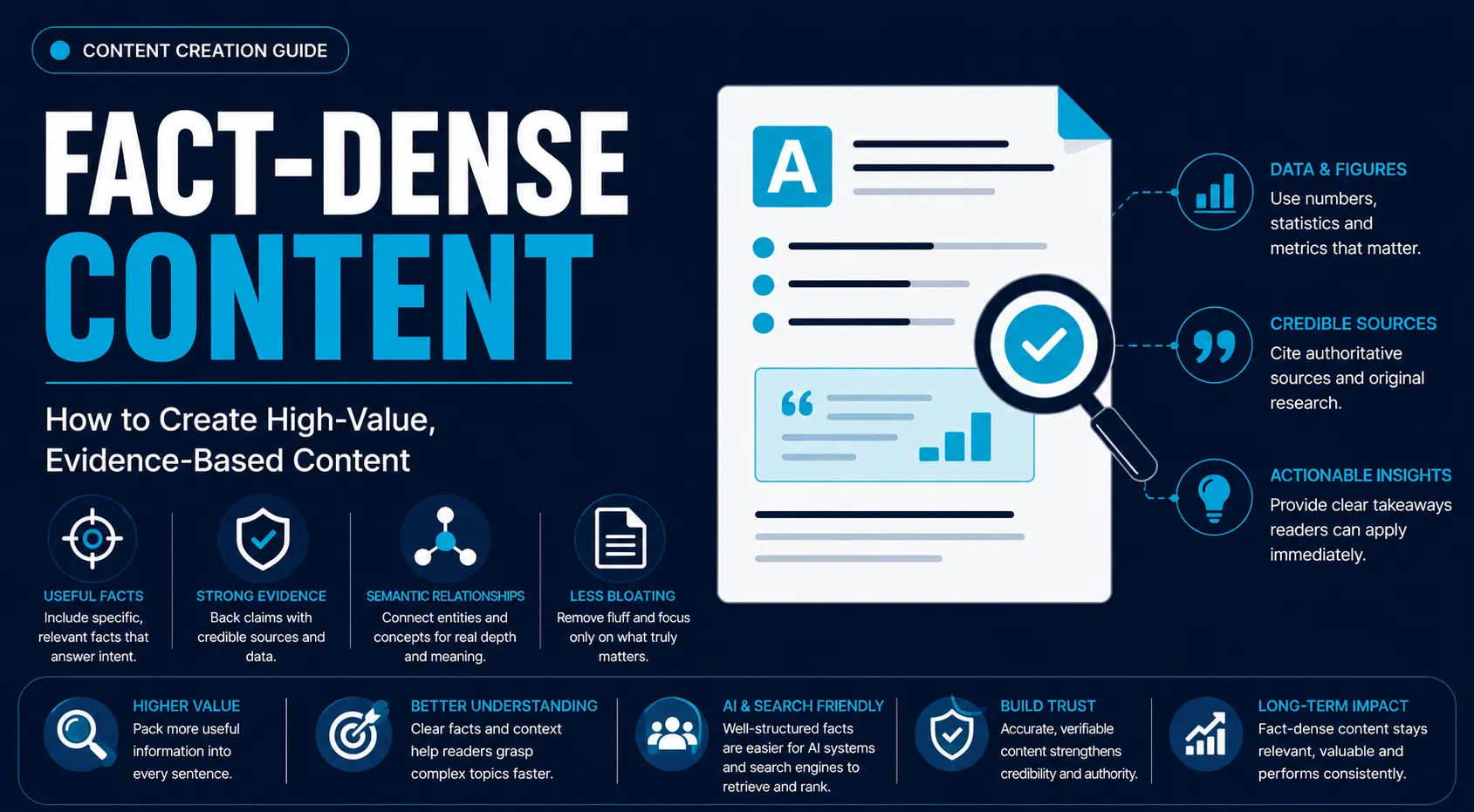
The content on most sites is wordy but fails to provide enough information. Long introductions, repeated explanations, generic advice, and keyword variations make the article look long, covering all the points, but still leave the reader with little information to use.
The fact-dense content solves this issue. Instead of making an article unnecessarily long to meet a word count, this strategy prioritizes specific, verifiable facts, relevant evidence, meaningful context, and information that satisfies the reader’s intent.
This approach helps writers produce content that is easier to evaluate, easier to understand, and useful for both readers and search systems. The key is knowing which facts matter, how to verify them, and how to present them without creating information overload.
What Is Fact-Dense Content?
Fact-dense content maximizes the useful, specific, and verifiable information relative to the length of content. It prioritizes relevance, evidence, context, and information gain over word count or the number of facts.
Defining Fact Density
Fact density measures how much of the useful factual information is delivered within a given amount of text or per unit of content. High-density content includes:
- Precise definitions and distinctions
- Dates, figures, thresholds, and measurements
- Named entities and their attributes
- Documented relationships
- Source-backed claims
- Original observations or data
- Comparisons, conditions, and exceptions
For example, saying “SEO helps businesses gain visibility” doesn’t provide much information. Explaining which search feature is discussed, under what conditions it appears, and what factors affect eligibility delivers more information.
Useful, Specific, Verifiable Information Within a Piece of Content
A valuable fact:
- Answer the information need: supports the reader’s question or decision.
- Be specific: reduces ambiguity with concrete details.
- Be verifiable: checks the facts against credible sources, datasets, research, experiments, or documented observations.
- Have context: explains what the fact means and when it applies.
Information Value Relative to Content Length
Fact density is evaluated as the useful information relative to text volume, not the fact count.
Fact Density = Useful Verified Claims ÷ Relevant Word Count
This is an internal editorial metric. Claims are also weighted by specificity, evidence quality, information gain, and originality. An original dataset, for example, provides more value than a repeated statistic.
Why Fact Density Is About Useful Facts, Not the Number of Facts
More facts do not make content valuable. Twenty unrelated industry statistics increase factual volume without helping someone choose an accounting platform.
The better question is:
Which facts materially improve the reader’s understanding or decision?
This relevance constraint prevents statistic dumping, information overload, and unnecessary topical expansion.
Fact Density vs. Related Content Concepts
Number of concepts overlap but measure different aspects of content quality. The distinction helps separate factual value from text volume, topical coverage, semantic relevance, and overall depth.
| Concept | What It Measures | How It Differs From Fact Density |
| Fact density | Useful, specific, verifiable facts relative to content volume | Focuses on factual value, evidence, context, and information gain. |
| Word count | Total amount of written text | Measures volume, not informational value. |
| Information density | Meaningful information across facts, concepts, instructions, examples, and relationships | Broader than fact density, which focuses on useful factual claims and evidence. |
| Content depth | How thoroughly a topic is explored | Depth does not guarantee a high concentration of useful facts. |
| Keyword density | Frequency of specific terms | Measures term usage, not factual value or information gain. |
| Comprehensiveness | Coverage of the relevant scope of a topic | A comprehensive article can still contain repetition or low-value information. |
What Makes a Fact Valuable?
A valuable fact combines the following qualities:
- Relevance: serves the information need.
- Specificity: provides concrete information.
- Verifiability: supported by credible evidence.
- Context: explains meaning, conditions, or limitations.
- Information gain: adds information rather than repeating known points.
- Freshness: reflects the current state of time-sensitive subjects.
An accurate fact still has low value if it is outdated, irrelevant, repetitive, or presented without necessary context.
What Makes Content Fact-Dense?
Fact-dense content combines specific claims, credible evidence, meaningful context, and original insights. Facts become valuable when they can be verified, connected to relevant entities, and explained to show what they mean.
Specific and Verifiable Claims
Fact-dense writing replaces vague statements with claims that are checked and understood.
For example:
Many websites experience indexing problems.
is weaker than:
A URL can be crawled but remain excluded from Google’s index because of factors such as canonicalization or other indexing decisions.
Useful specificity comes from:
- Dates and timeframes
- Percentages, figures, and thresholds
- Measurements and specifications
- Definitions and distinctions
- Named organizations and entities
- Geographic boundaries
- Technical conditions
- Cause-and-effect relationships
Qualifiers such as according to, as of [date], under these conditions, and in the tested sample prevent accurate facts from becoming misleading due to overgeneralization.
Evidence Behind the Claims
Important factual claims require defensible evidence. A practical source hierarchy is:
| Source type | Examples |
| Primary sources | Official documentation, regulations, filings, datasets, original records |
| Original research | Studies, experiments, surveys, proprietary analysis |
| Government & institutions | Statistical agencies, universities, public bodies |
| Expert sources | Qualified subject-matter specialists |
| Industry research | Research firms, trade associations, established publications |
Source quality depends on the claim type. Attribution makes the origin and scope of consequential claims clear.
Context and Relationships Between Facts
Accurate facts become useful when their relationships are explicit.
A useful structure is:
Entity → Attribute → Value → Relationship → Context
For example:
- Entity A launched in 2019.
- Entity B has 40 employees.
- Entity A acquired Entity B.
The acquisition establishes the relationship that gives the other facts greater meaning.
The same principle applies to statistics. Saying “conversion rate increased by 18%” leaves important questions unanswered: compared with what, during which period, and from what baseline? Context turns isolated data into usable information.
Original and First-Hand Evidence
Original evidence gives content information that competitors can’t obtain by paraphrasing existing pages.
It includes:
- Original observations
- Product or process tests
- Controlled experiments
- Client or campaign data
- Case data
- Interviews
- Expert contributions
- Surveys
- Proprietary datasets
- Documented implementation results
First-hand evidence reveals failure conditions, edge cases, implementation details, unexpected outcomes, and practical trade-offs that secondary sources miss.
How to Research and Select the Facts Your Content Needs
Fact-dense research starts with the information need, then maps the claims, entities, evidence, and gaps required to satisfy it. The objective is to identify and verify the high-value information.
Start With the Information Need
Define what the reader needs to understand, decide, or solve, then start collecting the keywords.
Ask:
- What is the primary question?
- Which questions need to be answered by the content?
- What related questions appear in search?
- What information do competing pages cover?
- Which facts are missing, outdated, weak, or poorly explained?
- What evidence is required for a complete answer?
People Also Ask (PAA) reveals related information needs, and competitor gap analysis exposes missing facts and evidence in the existing content.
The objective is to identify the minimum factual set required to satisfy the intent, then add the genuinely useful information that competitors lack.
Build a Fact and Evidence Map
A fact map connects each important claim to the entities, attributes, relationships, evidence, and relationships.
| Element | What It Is | Example |
| Entity | A distinct person, organization, product, system, place, concept, or other identifiable subject | Google Search |
| Attribute | A characteristic or property that describes an entity | Ranking systems |
| Value | The specific measurement, type, state, or characteristic assigned to an attribute | Multiple systems and signals |
| Claim | A factual statement the content intends to establish or communicate | Helpful content is evaluated through multiple systems |
| Evidence | Information or a source that supports or verifies a claim | Google Search Central |
| Relationship | The connection between two or more entities, attributes, values, or claims | Helpful content → people-first content |
| Original Evidence | Evidence produced through first-hand observation, testing, research, surveys, or proprietary analysis | Site-level content audit |
For each major section, map:
Entities → Attributes → Values → Claims → Evidence → Relationships → Original Evidence
This exposes evidence gaps before drafting. The absence of credible support is the problem that belongs in the research stage, not the writing stage.
Find and Compare Sources
Evaluate the sources by:
- Authority
- Relevance
- Publication or update date
- Methodology
- Scope
- Underlying dataset
- Potential conflicts of interest
- Whether the source is primary or repeating another source
Trace the claim back to its source whenever possible.
Source triangulation strengthens claims by comparing them across multiple credible sources, especially in case of disputed, time-sensitive, or consequential information.
Verify Before a Fact Enters the Content
Verify important claims before publication:
- Confirm the source.
- Check the exact figure, definition, or statement.
- Verify the publication date and applicable timeframe.
- Check the conditions or limitations attached to the claim.
- Separate the source’s stated fact from your interpretation.
- Record the source and relevant limitations.
A fluent AI-generated statement is not evidence; it needs to be independently verified.
How to Write Fact-Dense Content Without Overloading the Information
Fact-dense writing increases useful information without increasing cognitive load. It is done by prioritizing high-value claims, connecting them to evidence and context, compressing unnecessary language, and structuring dense information for easy comprehension.
Step 1: Prioritize High-Value Facts
Start with the information that satisfies the reader’s query. Put important facts first and remove details that don’t help the reader understand, compare, decide, or act.
Use this editorial test:
If this sentence disappeared, would the reader lose meaningful information?
The NO as an answer means remove or revise it.
Prioritize facts that provide:
- Direct answers
- New information
- Important distinctions
- Decision-making value
- Necessary conditions or qualifications
- Evidence for important claims
Step 2: Connect Claims, Evidence, and Context
Build factual passages around:
Claim → Evidence → Explanation
The claim states the fact, the evidence supports it, and the explanation clarifies what it means or why it matters.
Keep evidence close to the claim it supports. Separate factual statements from interpretation when the distinction matters.
Step 3: Compress Information Without Losing Meaning
Remove language that only takes space and does not add information.
Instead of:
It is important to understand that one of the main reasons why this issue can sometimes occur is because the page may potentially have been affected by…
Write:
The issue occurs when the page is affected by…
Remove:
- Meta-announcements
- Repetitive definitions
- Generic introductions
- Unnecessary caveats
- Keyword repetition
- Obvious conclusions
- Duplicate examples
- Bloated transitions
Prefer precise verbs and direct constructions where they improve clarity.
Researchers measured the response.
is more concise than:
The response was measured by researchers.
Step 4: Structure Dense Information for Readability
Dense content becomes difficult to process when every idea is presented as prose. Match the format to the information:
| Format | Best Used For |
| Tables | Comparisons, specifications, thresholds, attributes |
| Lists | Discrete facts, conditions, criteria, steps |
| Examples | Concrete application and interpretation |
| Short paragraphs | Connected factual explanations |
| Micro-sections | Distinct claims within a broader topic |
Keep heading relationships logical. An H3 represents a genuine subtopic of its H2, and avoid repeating the same concept under different wording.
Step 5: Prevent Statistic Dumping
A large number of statistics does not make content fact-dense. Numbers become useful only when their meaning, scope, and relevance are clear.
For each important statistic, establish:
- What it measures
- Who or what was measured
- When it was measured
- Where it applies
- Compared with what
- Why the number matters
A single well-interpreted statistic provides more value than several disconnected figures.
How does Fact Density Create Search and Information Value
The value is created when information is new, relevant, connected, and useful to the searcher’s need. It is related but not directly to information gain, semantic relationships, AI retrieval, and E-E-A-T.
Fact Density and Information Gain
Information gain means the information adds something new to the reader’s understanding.
An editorial framework is:
Information Gain = New, Relevant Information − Redundant Information
The practical rule is simple: add information that improves or changes the reader’s understanding rather than restating the available information.
Facts, Entities, and Semantic Relationships
Entity-rich content does not mean stuffing the content with all the entities. Mentioning Google, Search Console, indexing, canonicalization, and robots.txt in the same paragraph does not create semantic depth.
Entities are to be connected through attributes and relationships to deliver the full meaning.
URL → crawlability → crawler access → robots.txt
URL → canonicalization → canonical URL → index selection
These relationships explain how the concepts interact. Entity salience identifies which entities need emphasis; the attributes and relationships establish their contextual meaning.
Fact-Dense Content and AI Retrieval
AI search and retrieval systems need to identify the relevant information. Fact-dense writing supports this process when important claims are explicit, specific, self-contained, and scoped.
Easy-to-retrieve passages have:
- A clear subject
- A specific claim
- Relevant context
- Precise terminology
- Clear scope or conditions
- Evidence or attribution where appropriate
Compare:
The policy changed.
with:
Google incorporated the former Helpful Content System into its core ranking systems in March 2024.
The second passage identifies the entity, event, system, and date, making the information substantially clearer and easier to interpret.
Fact density works when well-defined factual passages are easier to understand and can be extracted accurately.
Fact Density and E-E-A-T
Fact density supports E-E-A-T, but the concepts are not interchangeable.
| E-E-A-T Dimension | How Fact-Dense Content Can Support It |
| Experience | First-hand testing, observations, and implementation results |
| Expertise | Accurate analysis, technical distinctions, and qualified interpretation |
| Authoritativeness | Credible sources, recognized expertise, and documented evidence |
| Trustworthiness | Accurate, verifiable, transparent, and appropriately attributed claims |
Fact density strengthens the evidence behind content, but it does not establish E-E-A-T. A page containing hundreds of accurate facts might still lack first-hand experience, subject expertise, authoritative sourcing, or trustworthy presentation.
How to Evaluate and Improve the Fact Density
Fact density is evaluated through a combination of quantitative signals and qualitative editorial judgment that measures factual value, evidence, information gain, and readability.
Quantitative Fact-Density Signals
The internal measures that are useful for evaluation include:
- Verifiable claims per 1,000 words
- Useful data points per section
- Citation density for evidence-dependent claims
- Primary-source ratio
- Original data points
- Entity coverage
- Information-bearing sentences per paragraph
- Information per Sentence (IPS)
Review every sentence and determine if it adds at least one of the following:
- A new fact
- A meaningful qualification
- A relationship
- An example
- Evidence
- An actionable instruction
A sentence contributing to none is to be removed. These measures remain diagnostic, not the strict SEO targets.
Qualitative Fact-Density Signals
Quantitative measures don’t determine if the information is valuable. Evaluate:
| Signal | What to Check |
| Claim specificity | Is the exact assertion clear? |
| Evidence quality | Is the supporting source credible and appropriate? |
| Source relevance | Does the evidence actually support the claim? |
| Information gain | Does the content add useful information rather than repetition? |
| Entity coverage | Are important entities and relevant attributes represented? |
| Factual accuracy | Can consequential claims be verified? |
| Context | Are claims, figures, and conditions properly qualified? |
| Redundancy | Does the content repeat information unnecessarily? |
The thorough evaluation combines these qualitative signals with quantitative measures.
Fact-Density Audit
Audit the complete content section by section:
Step 1: Identify unsupported claims.
Highlight the factual statements and locate the evidence that is supporting each consequential claim.
Step 2: Find repeated facts.
Mark the definitions, statistics, examples, and explanations that are repeated.
Step 3: Remove low-value information.
Delete the generic statements that don’t satisfy the information need and also don’t provide necessary context.
Step 4: Identify evidence gaps.
Prioritize the unsupported claims that affect the reader’s understanding or decision.
Step 5: Compare information coverage.
Review the competitors’ content to identify useful information provided and valuable gaps left unanswered.
Step 6: Check readability.
Avoid dense passages. Prefer a structure for the content that is scannable through concise paragraphs, lists, tables, and logical headings.
Problems That Make Content Less Fact-Dense
The common failures for the content despite having facts are: excessive length, unsupported claims, outdated evidence, keyword-driven writing, and unverified AI-generated information.
| Problem | What It Looks Like | Why It Reduces Fact Density |
| Mistaking length for factual value | Long introductions, repeated definitions, generic “why it matters” sections, duplicated advice, padded conclusions | Increases word count without increasing useful information |
| Adding facts without evidence or context | Unsupported claims, statistic dumping, weak attribution, unexplained figures | Creates apparent precision without making the information reliable or interpretable |
| Using outdated or low-quality information | Old statistics, obsolete documentation, changed product specifications, outdated regulations or terminology | Makes otherwise factual content inaccurate or less useful |
| Optimizing for keywords instead of information | Repeated keywords, unnecessary entity mentions, semantic clutter | Adds terminology without adding meaningful entities, attributes, relationships, or evidence |
| Publishing unverified AI-generated facts | Fabricated statistics, incorrect dates, altered quotations, conflated entities, unsupported citations | Introduces factual errors and can undermine the reliability of the entire page |
What to Check During an Audit
For every problem, ask:
- Length: Does every section contribute information the reader needs?
- Evidence: Can important claims be verified?
- Freshness: Is the information still current?
- Semantic relevance: Does each entity contribute to the topic?
- AI verification: Has every AI-assisted factual claim been independently checked?
The objective of this audit is to remove the information that is redundant, unsupported, outdated, irrelevant, or unverifiable while preserving high-value facts and context.
Fact-Dense Content Creation and Maintenance Workflow
A workflow keeps factual quality part of the research, writing, auditing, and maintenance process and not as a final task during proofreading.
- Define the information need.
State the primary question, problem, or decision the page must satisfy. - Identify questions and information gaps.
Map related queries, PAA patterns, competitor gaps, and unresolved subtopics. - Build the factual architecture.
Map entities, attributes, values, claims, relationships, and required evidence before drafting. - Research and verify sources.
Prioritize primary and authoritative sources. Check dates, definitions, figures, methodology, and conflicting information. Triangulate consequential claims when appropriate. - Select high-value information.
Prioritize relevance, specificity, information gain, and evidence quality over volume. - Add original or first-hand evidence.
Include testing, observations, proprietary data, expert contributions, surveys, or case evidence where available. - Organize claims around factual relationships.
Structure information according to the user’s intent and the underlying ontology of the subject. - Write claim-evidence-context passages.
Make important claims explicit, place supporting evidence nearby, and explain relevant conditions or implications. - Compress and structure the content.
Remove filler, repetition, unnecessary keyword variants, and low-value facts. Use tables, lists, examples, and concise paragraphs where appropriate. - Audit factual quality and readability.
Check accuracy, evidence, information gain, entity coverage, redundancy, and readability before publication. - Publish and monitor.
Track user feedback, content performance, information gaps, and changes affecting the topic. - Revalidate and improve.
Recheck time-sensitive claims, replace outdated evidence, and add genuinely new information. An update should increase the page’s information value, not merely change its publication date.
This workflow supports semantic-first publishing by building the content based on the underlying information structure and not through the collection of keywords.
Key Takeaways
- Fact-dense content maximizes the useful, verifiable information and is not focused on word count or raw fact volume.
- Valuable facts are relevant, specific, supportable, contextualized, and capable of providing information gain.
- Fact-dense creation starts with the information need and maps the entities, attributes, claims, relationships, and evidence required.
- Primary sources, original research, first-hand observations, expert contributions, and proprietary data provide information that competitors’ search alone cannot reproduce.
- Density comes from prioritization, compression, and meaningful relationships created between the entities.
- Fact density supports search relevance and retrievable content, but it is not a Google ranking metric, an SEO substitute, or another name for E-E-A-T.
- A fact-density audit evaluates quantity and quality of content altogether, including claim specificity, evidence, source relevance, information gain, entity coverage, accuracy, context, and redundancy.
Frequently Asked Questions
What is an example of fact-dense content?
A fact-dense article provides specific, useful information such as verified figures, dates, comparisons, definitions, and evidence without unnecessary filler.
How do you increase information density in content?
Use specific claims, remove repetition, combine related facts, add meaningful context, and replace vague statements with precise information.
What is the information-to-noise ratio in content?
It measures the amount of useful information compared with filler, repetition, vague statements, and other low-value content.
What is entity density in SEO content?
Entity density refers to how thoroughly relevant entities, attributes, and relationships are represented in content without unnecessary entity mentions.
How do you remove fluff from an article?
Delete repetitive, generic, obvious, or unnecessary sentences while keeping facts, evidence, context, examples, and essential explanations.