
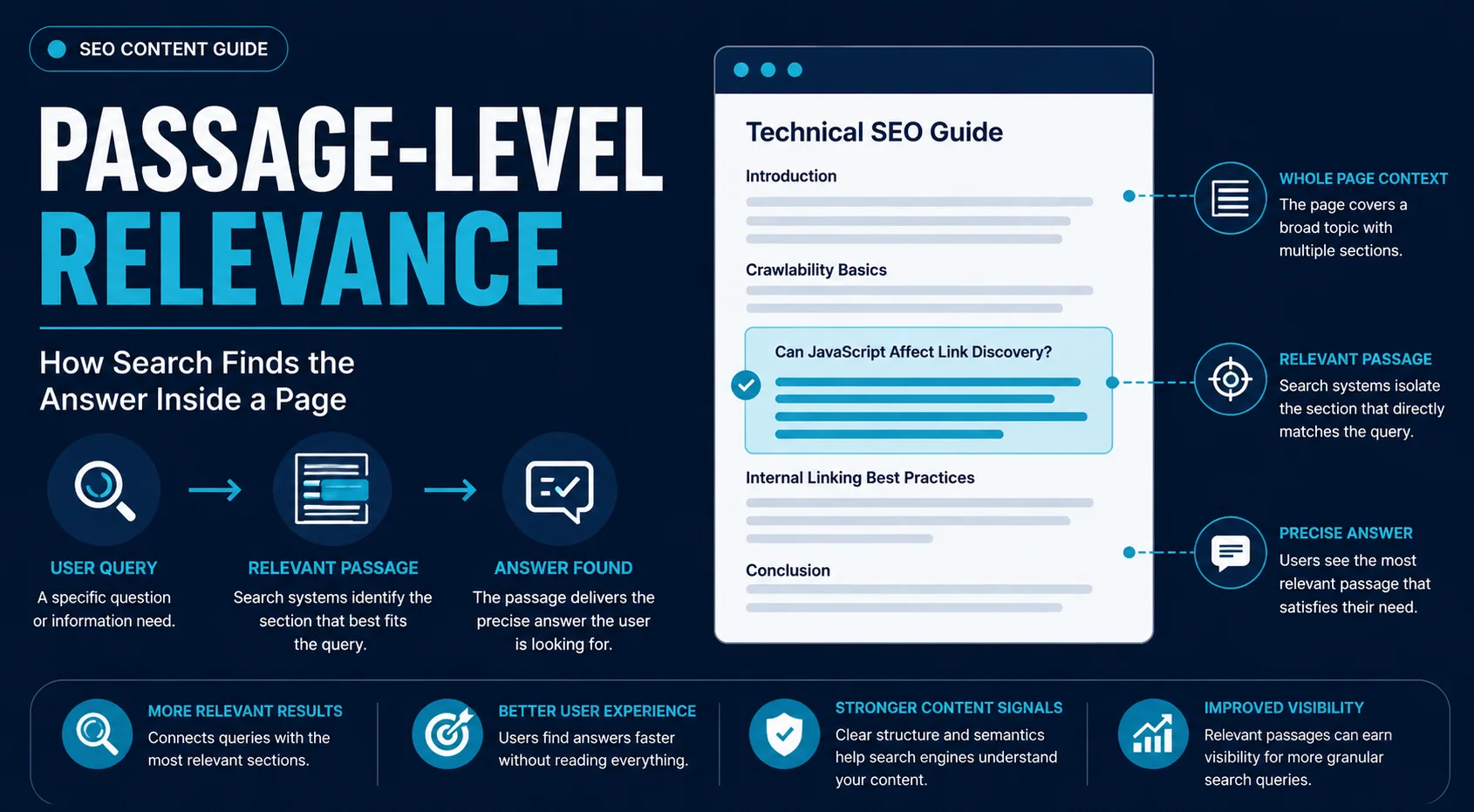
Searchers don’t need an entire webpage. They need an answer buried inside it.
A 3,000-word guide might cover definitions, implementation, examples, limitations, and troubleshooting while the user’s query asks one specific question. Search systems therefore need more than document-level understanding. They need to determine whether a particular section contains information that satisfies the specific need.
Passage-level relevance is the degree to which a specific section of a document satisfies a particular query or information need, rather than relying only on the relevance of the document as a whole.
A page at the broad level can be relevant while containing weak sections. The reverse also happens: a broad page contains one highly relevant passage that directly resolves a granular query.
Google’s documented passage ranking system reflects this distinction. Google describes it as an AI system that identifies individual sections or passages of a webpage to better understand how relevant the page is to a search. This does not mean every paragraph becomes an independently indexed webpage.
What Is Passage-Level Relevance?
A passage is a coherent textual unit inside a larger document. It might be one paragraph, several adjacent paragraphs, a list with supporting explanation, or another bounded section serving one information need.
Passage-level relevance asks:
How well does this particular section satisfy this particular information need?
Suppose a technical SEO guide covers crawlability, indexability, JavaScript rendering, XML sitemaps, internal linking, and log-file analysis.
A user searches:
“Can JavaScript affect whether Google discovers links?”
The entire guide belongs to technical SEO. Only one section might directly resolve that query.
That local relationship is the core concept:
Query → information need → relevant passage
The page provides the broader context. The passage provides the precise answer.
Passage-Level Relevance vs Page-Level Relevance
Page-level and passage-level relevance operate at different granularities.
Page-level relevance asks whether the document as a whole corresponds to the query.
Passage-level relevance asks whether a particular section itself resolves the information needed.
| Page relevance | Passage relevance | Meaning |
| High | High | The page fits the broader query and contains a strong answer-bearing section. |
| High | Weak | The page covers the topic, but the relevant section is vague or incomplete. |
| Broad/Moderate | High | A broad resource contains a highly specific section that resolves a granular query. |
| Low | Low | Neither the document nor its passages adequately satisfy the information needs. |
Useful information is not always distributed evenly throughout a document. A broad resource can contain a small section that is more relevant to a specific query than everything surrounding it.
Google documents its ranking systems as primarily working at the page level while also describing passage ranking as a system that identifies sections to improve its understanding of page relevance.
Why Passage-Level Relevance Matters for Search
A single webpage can contain several related information needs.
A technical SEO article might answer:
- What is crawlability?
- How does robots.txt affect crawling?
- Can blocked resources affect rendering?
- How can orphan pages be identified?
- Does an XML sitemap guarantee indexing?
All five belong to technical SEO.
They are not the same question.
Document-level relevance alone obscures that distinction. One page may be a strong resource overall, while its individual sections vary sharply in how well they satisfy specific queries.
Long articles make this more visible, but passage relevance is not exclusive to long-form content. Any document containing distinct semantic units exhibit different levels of local relevance.
Granular Queries and Micro-Intents
Micro-intent is a useful editorial concept for describing a subordinate information need within a broader topic.
A page about passage-level relevance might separately answer:
- What does passage-level relevance mean?
- Is passage ranking the same as passage indexing?
- How do headings affect passage clarity?
- How long should a passage be?
- Can passage performance be measured in Search Console?
These questions occupy the same conceptual territory but require different answers.
A useful architecture is:
Broad topic → related information needs → distinct answer-bearing sections
Micro-intent is a content-planning concept, not a documented Google ranking signal.
The objective is not to cram every possible long-tail variation into one page. Each section should earn its position by resolving a distinct information need that fits under the broader topic.
How Search Systems Use Passage-Level Relevance
Search is an information-retrieval issue.
Given a query and a vast collection of documents, the system determines which information corresponds to the request and which candidates deserve to surface.
Passage-level processing adds finer granularity to that problem.
Google’s Passage Ranking System
Google documents passage ranking among its ranking systems and describes it as an AI system that identifies individual sections or passages of a webpage to understand how relevant that page is to a search.
The wording creates an important boundary. Google does not describe the process as:
paragraph → separate URL → independent indexed asset
The passage contributes information about the relevance of the page.
Passage optimization therefore focuses on semantic clarity and information alignment rather than invented rules about paragraph counts, heading frequency, or fixed passage lengths.
Passage Ranking vs Passage Indexing
“Passage indexing” is common SEO terminology, but it can create the wrong mental model.
Passage indexing can imply that individual passages become independently indexed resources.
Passage ranking is Google’s documented terminology.
The distinction is simple:
Understanding a passage separately for relevance does not mean the passage becomes a separate webpage.
The URL remains the document-level resource.
Passage Ranking vs Passage Retrieval
Retrieval and ranking are related but different processes.
- Retrieval identifies candidate information that might satisfy a query.
- Ranking determines how relevant those candidates are relative to one another.
- Passage retrieval operates on smaller textual units rather than relying exclusively on entire documents.
- Passage ranking evaluates passage-level information or uses it to support relevance decisions.
Passage-based retrieval has been studied because relevant information is unevenly distributed within documents.
That research establishes the broader information-retrieval problem that passage-level relevance addresses.
Passage Ranking vs Featured Snippets
Passage ranking and featured snippets solve different problems.
- Passage ranking concerns relevance understanding.
- Featured snippets concern search-result presentation.
Google can understand a section as highly relevant without displaying it as a featured snippet.
Likewise, seeing extracted text in a SERP does not prove that an observable independent passage-ranking event occurred.
Relevance assessment and answer presentation are not the same mechanism.
What Makes a Passage Relevant to a Search Query?
Passage relevance is not keyword density wearing a nicer hat.
A passage becomes useful when its meaning aligns with what the searcher is actually looking for.
Query-Passage Alignment
Strong query-passage alignment exists when the subject, specificity, and information supplied by a section correspond directly to the query.
Consider:
“Is passage ranking the same as passage indexing?”
A paragraph could repeat “passage ranking” six times and still fail if it never explains the difference.
A better test is:
Does this passage satisfy the information needs represented by the query rather than merely resemble its wording?
Terminology establishes topical correspondence. The answer establishes usefulness.
Search Intent Satisfaction
Query wording identifies what was typed. Intent identifies what information would resolve it.
Take:
“How does passage ranking differ from passage indexing?”
A section explaining that Google uses AI to understand passages contains related terminology but leaves the comparison incomplete.
A stronger section immediately explains that passage ranking is Google’s documented terminology, while “passage indexing” can misleadingly imply independent webpage indexing.
Same topic. Different intent satisfaction.
Entity and Attribute Alignment
A focused passage revolves around an entity and the attributes needed to understand it.
For example:
Entity: Passage ranking
Attribute: Relationship to indexing
Value: Passage understanding does not mean each passage becomes an independently indexed webpage.
A useful editorial pattern is:
Entity → attribute → explanation → evidence
Keeping these relationships contextually close reduces ambiguity and prevents the reader from reconstructing one idea across several distant sections.
Semantic Similarity and Context
Exact terminology represents only one layer of relevance.
Google documents systems such as RankBrain that help it understand relationships between words and concepts beyond simple exact-match wording.
A passage describing “Google’s system for understanding individual sections of a page” can therefore be conceptually related to a query about “passage ranking” even when the phrase is not repeated constantly.
Context also resolves ambiguity.
“Indexing” could mean web indexing, database indexing, informal passage-indexing terminology, or another technical process.
A strong passage establishes the intended entity and relationship clearly.
Semantic Completeness
A passage does not need to be long, but needs enough information to resolve the query.
Depending on the information need, completeness requires:
- a direct answer;
- a definition;
- a necessary qualification;
- an explanation;
- an example;
- evidence for a consequential claim.
Concise ≠ incomplete.
Long ≠ comprehensive.
A two-sentence passage might completely resolve a narrow query. A 400-word section may still fail to provide an answer.
Passage Granularity
Passage size should follow meaning rather than an arbitrary word count.
- Make the unit too narrow and essential context disappears.
“It was integrated into the system.”
What was integrated? Which system?
- Make the passage too broad and several intents begin competing:
Definition → history → implementation → pricing → troubleshooting
The practical target is a coherent semantic unit: enough information to satisfy the query without pulling unrelated subject matter into the same passage.
Contextual Independence
Important answer-bearing passages benefit from enough local context to preserve meaning.
A reader should be able to identify:
entity → relationship → answer → necessary qualifier
without reconstructing the explanation from distant sections.
This does not mean every paragraph should behave like a miniature webpage. Several adjacent passages can build one answer.
Local clarity and sequential coherence can coexist.
What Research Shows About Passage-Level Relevance
Passage-based retrieval predates modern SEO advice.
Information-retrieval research has examined situations where only part of a document is highly relevant to a query and whether passage-level evidence can improve retrieval or document-ranking decisions.
These findings help explain passage relevance conceptually. They should not be converted into undocumented claims about Google’s internal ranking implementation.
Relevant vs Irrelevant Passage Distribution
Documents are not uniformly relevant.
One may be tightly aligned with a query throughout. Another might contain one exceptional answer surrounded by broader background material.
Passage-oriented retrieval matters because highly relevant information occupies only a small portion of a larger document. The practical implication is straightforward:
Important sections need a clear information purpose.
This is an information-retrieval principle, not a disclosed Google metric called “relevant passage distribution.”
Passage Position
Passage position has been studied in information retrieval, but that does not establish a rule that Google automatically rewards answers appearing near the top of a page.
Answering early improves clarity and reduces user friction. Treat that as an information-design advantage, not an undocumented positional ranking factor.
Passage Length and Granularity
There is no Google-prescribed passage word count. A definition might need 35 words. A technical explanation might require 150. A complicated process could need several connected paragraphs.
Passage length should follow semantic completeness and topical concentration rather than an arbitrary 50-, 100-, or 200-word target.
Query Similarity
Lexical and semantic similarity can both establish correspondence between a query and passage. Neither alone guarantees satisfaction.
A passage can use identical vocabulary while answering the wrong question. Another can use different wording while supplying exactly the information requested.
The stronger model is:
terminological alignment + semantic alignment + intent satisfaction
Sequential Passage Relevance
A complete answer does not always live inside one paragraph.
A section might progress:
Paragraph 1: Define passage ranking.
Paragraph 2: Distinguish it from passage indexing.
Paragraph 3: Explain the SEO implication.
These passages work sequentially. Forcing each paragraph to repeat the complete context would create redundancy. The better principle is:
Local clarity + sequential coherence
How Content Structure Influences Passage-Level Relevance
Structure can make semantic relationships easier to interpret.
Align Each Section With One Primary Information Need
Think:
Heading → information need
not:
Heading → keyword
A heading titled “Passage Ranking vs Passage Indexing” promises a comparison.
Repeating both phrases without explaining their relationship fulfills a keyword pattern, not the information need.
Keep Entity Relationships Contextually Close
When comprehension depends on a relationship, keep its components nearby.
For example:
Passage ranking → Google ranking system → identifies sections → helps understand page relevance
The reader should not need to cross several unrelated subsections to reconstruct that relationship.
This is a comprehension principle, not evidence of a published Google proximity score.
Align the Heading With the Passage
Every heading makes an information promise.
Under:
What Is Passage Ranking?
the reader should encounter a definition quickly.
Opening instead with several paragraphs about the history of Google Search delays fulfillment of the heading.
Accurate information can still be contextually irrelevant.
Use Clear Semantic Boundaries
Create a new section when the information need changes materially.
Useful boundaries occur when:
- the central entity changes;
- a new attribute group begins;
- search intent changes;
- the content moves from explanation to implementation;
- a distinct problem requires treatment.
Headings organize information.
They are not automatic passage-ranking switches.
Maintain Semantic Continuity
Strong sections tend to progress like this:
Answer → explanation → relevant attributes → evidence/example → qualification
Weak sections zigzag:
Answer → generic SEO advice → historical aside → unrelated entity → original answer
That is semantic drift.
Do Headings, Lists, Tables, and Short Paragraphs Improve Passage Relevance?
Formatting improves clarity. It does not create relevance by itself.
Headings establish topic boundaries and communicate the information a section should resolve. A heading such as “Passage Ranking vs Featured Snippets” creates more semantic clarity than “Other Things to Know.”
Lists work well for sequences, requirements, and grouped attributes. Tables clarify comparisons across consistent dimensions. Their value comes from exposing relationships, not functioning as ranking shortcuts.
Short paragraphs improve readability when they reflect natural semantic breaks. Google does not prescribe a paragraph length for passage ranking.
Format supports relevance. It does not manufacture it.
What Weakens Passage-Level Relevance?
Most passage problems start with one mismatch:
The section promises one thing and delivers another.
Semantic Drift
Semantic drift occurs when a section begins by serving one information need and gradually moves into another.
A passage answering “How long should a passage be?” should not wander into backlinks, site speed, or keyword density.
Those topics might belong elsewhere.
They do not belong in that answer.
Relevance Dilution
Relevance dilution is a useful editorial term for a correct answer surrounded by excessive tangential material.
It is not an official Google metric.
The diagnostic question is simple:
Could several sentences disappear without removing information needed to satisfy the query?
If yes, the passage is carrying unnecessary semantic weight.
Fragmented Entity Information
Fragmentation occurs when connected attributes are scattered unnecessarily.
The definition, the qualification, and the supporting evidence are not next to each other.
Keep related information together unless the article’s architecture gives a genuine reason to separate it.
Passage Redundancy
Repetition creates volume without equivalent information gain. If several sections explain the same distinction, one should own the detailed explanation. Other sections reference it briefly. Each passage should contribute a new:
attribute, relationship, example, qualification, process, or information need.
Overlapping Passage Intent
Several headings sometimes attempt to answer essentially the same question. Results in duplicated intent.
For editorial auditing, this can be described as passage competition. It is not an official Google ranking term.
For example:
- What Is Passage Ranking?
- Understanding Passage Ranking
- Passage Ranking Explained
Merge them or give each a distinct job.
Excessive Context Dependence
Pronouns become a problem when their referents disappear outside the surrounding text.
“This system uses it to understand that relationship.”
says very little independently.
A clearer alternative is:
“Google’s passage ranking system identifies individual sections to improve its understanding of page relevance.”
Not every sentence needs to repeat the primary entity. Critical answer-bearing statements should remain locally understandable.
How to Optimize Content for Passage-Level Relevance
Passage optimization works best as an editorial and information-architecture workflow.
Step 1: Define the Information Need
Ask:
What exactly must this section resolve?
If the requirement cannot be stated clearly, the section is probably too broad.
Step 2: Identify the Primary Entity
Determine exactly what the section discusses.
Passage ranking, passage indexing, featured snippets, Search Console, passage retrieval, and chunking are related concepts, not interchangeable entities.
Step 3: Identify the Required Attributes
Determine what the reader will learn for the query to be satisfied.
A definition requires:
entity + function + distinction
A comparison requires:
entity A + entity B + common dimension + difference
A troubleshooting answer requires:
problem + cause + diagnostic step + remedy
Step 4: Write the Minimum Complete Answer First
Answer before expanding. Do not chase a passage word count.
Use the shortest complete answer, then add context where it improves understanding, precision, qualification, or evidence.
Step 5: Add Only Supporting Context
Additional material should:
- clarify meaning;
- establish a relationship;
- add necessary precision;
- explain a qualification;
- provide evidence;
- demonstrate an example.
If it performs none of those jobs, reconsider it.
Step 6: Keep Entity Relationships Explicit
Replace ambiguous references when they reduce clarity.
Instead of:
“This affects how it is evaluated.”
use:
“Passage granularity affects how a retrieval system can interpret the information unit.”
A few extra words remove substantial ambiguity.
Step 7: Add Evidence Near Verifiable Claims
Algorithm claims, research findings, statistics, experiments, and statements about Search Console capabilities deserve appropriate evidence.
Use primary documentation when available.
Place evidence close to the claim it supports rather than leaving readers to connect a source list to statements scattered throughout the article.
Step 8: Remove Semantic Drift
Read every sentence and ask:
Does this help resolve this section’s information need?
Move or remove material whose primary job belongs under another heading.
Step 9: Check Adjacent Sections for Redundancy
Ask:
What does this section add that another section has not already supplied?
If the answer is “almost nothing,” consolidate or differentiate it.
Step 10: Test Context Sufficiency
Read the passage independently. Can you identify the:
entity + question + answer + qualifier?
If not, strengthen the local context.
How to Audit Passage-Level Relevance
Use the H-Q-E-I-A-C-E framework to turn passage relevance into a repeatable editorial test.
H — Heading
What information promise does the heading make?
Q — Query
What realistic query or subordinate question could lead a searcher here?
E — Entity
Which exact entity is being discussed?
I — Intent
What does the user need to understand, compare, solve, or verify?
A — Answer
Does the section actually supply that information without unnecessary delay?
C — Context
Is enough local context available to interpret the answer correctly?
E — Evidence
Are consequential or externally verifiable claims appropriately supported?
Two additional checks catch the remaining issues.
Drift Test
Does any sentence primarily satisfy another section’s information need?
If yes, move, rewrite, or remove it.
Redundancy Test
Has this information already been communicated elsewhere?
If yes, remove the duplicate or give the section a new semantic purpose.
Weak vs Strong Passage-Level Relevance: Example
Consider a section intended to answer:
“Is passage ranking the same as passage indexing?”
- Weak Passage
Understanding Passage Ranking
Google has developed many search technologies over the years, and SEO has changed considerably. Passage ranking is useful for long-form content because Google wants to give users relevant answers. Passage indexing is another term frequently used in SEO. Content creators should also use headings, keywords, tables, and readable paragraphs because good structure helps search engines understand webpages.
The terminology appears.
The answer doesn’t.
The heading is vague, the comparison remains unresolved, generic SEO advice intrudes, and several information needs compete inside one passage.
- Strong Passage
Is Passage Ranking the Same as Passage Indexing?
No. Passage ranking is Google’s documented terminology for an AI ranking system that identifies individual sections or passages of a webpage to better understand the page’s relevance to a search. “Passage indexing” can create the misleading impression that each passage becomes an independently indexed webpage. Google’s documentation does not describe the system that way.
The difference becomes clear through H-Q-E-I-A-C-E:
| Element | Weak passage | Strong passage |
| Heading | Broad | Matches the query |
| Query | Poorly defined | Explicit |
| Entity | Mixed | Clear |
| Intent | Unresolved | Direct comparison |
| Answer | Missing | Immediate |
| Context | Generic | Locally sufficient |
| Evidence | Missing | Primary Google documentation |
The stronger passage does not win because it is shorter. Almost every sentence performs a necessary semantic job.
Should You Split a Passage Into a Separate Page?
Not every useful subsection deserves its own URL. Keep the section on the same page when:
- the information need remains subordinate to the main topic;
- substantial contextual overlap exists;
- the section is not independently broad enough;
- separation would duplicate explanations;
- the same audience and search intent still apply.
Consider a separate page when:
- the information need becomes materially different;
- substantially deeper treatment is required;
- audience or search intent changes;
- the subject develops its own substantial entity-and-attribute structure;
- retaining it creates topical drift in the parent page.
URL boundaries should follow meaningful differences in information need, not every long-tail keyword variation.
Can You Measure Passage-Level Relevance in Google Search Console?
Google Search Console does not provide a dedicated report identifying which exact passage of a page ranked for a query.
Standard Search performance reporting exposes dimensions such as queries and pages, alongside clicks, impressions, CTR, and average position. Passage-level analysis is therefore inferential rather than directly observable.
Useful proxies include:
- long-tail query impressions;
- emerging query variations;
- page-query combinations;
- clicks and impressions;
- average position changes;
- query clusters associated with a revised section;
- performance before and after tightly scoped edits.
A practical test looks like this:
Baseline → identify query cluster → revise target passage → allow reassessment → compare relevant page-query performance
Suppose a technical SEO page receives little visibility for orphan-page queries. One H3 is rewritten to answer that information need precisely, and related long-tail impressions subsequently rise.
It does not prove Google’s passage ranking system caused the change.
Search visibility depends on many variables, including competitors, algorithm changes, indexing, search demand, SERP features, links, and broader ranking signals.
What About Google’s Generative AI Reports?
Google introduced Generative AI performance reports in Search Console in June 2026 for a subset of sites, including visibility data associated with generative Search experiences such as AI Overviews and AI Mode.
These reports provide additional URL-oriented performance information.
They still do not expose an exact passage-ranking dimension identifying which paragraph or passage produced the visibility.
Passage-level attribution therefore remains inferential.
Passage-Level Relevance in Vector Search and Generative AI
Passage relevance extends beyond conventional web search.
Retrieval systems used with generative AI also need to locate small, highly relevant pieces of information inside much larger document collections.
The shared challenge is granularity.
Passage Retrieval and Embeddings
Modern retrieval systems can represent smaller textual units and compare their semantic relationship to queries.
Embeddings are one mechanism for representing semantic information mathematically, allowing conceptually related queries and text to match even when wording differs.
The same granularity trade-off appears:
Too small → important context disappears.
Too large → irrelevant information contaminates the retrieved unit.
This resembles the passage-relevance problem.
It does not establish that Google’s passage ranking system uses any specific embedding architecture.
Chunking and RAG
Retrieval-augmented generation commonly follows a simplified pipeline:
Document → chunks/passages → retrieval → selected context → language model → response
Chunk quality matters.
A retrieved chunk saying:
“This method improves accuracy.”
contains little independent semantic value.
A stronger chunk preserves the entity and relationship:
“Passage-level retrieval can improve answer generation when the retrieved unit preserves the entity, its relationship to the query, and necessary qualifications.”
Chunking therefore creates an information-architecture problem similar to passage relevance: the information unit needs enough context to remain meaningful without becoming bloated.
Search Passage Ranking vs RAG Retrieval
The two concepts share the problem of:
finding the right information at the right granularity.
Their purposes differ.
- Google passage ranking contributes to understanding page relevance within Search.
- RAG retrieval selects external information to supply as context to a generative model.
Different retrieval systems use different indexes, embeddings, rerankers, chunking strategies, thresholds, and context windows.
The transferable principles are simpler:
Clear entities. Explicit relationships. Complete local answers. Logical boundaries. Minimal ambiguity.
Passage-Level Relevance Checklist
Use this checklist when reviewing an important section:
- Does it satisfy one clear information need?
- Is the primary entity explicit?
- Does the heading accurately describe the answer?
- Is the core answer supplied early?
- Are the required attributes present?
- Are entity relationships clear?
- Is enough local context included?
- Does every supporting sentence remain relevant?
- Is substantial information duplicated elsewhere?
- Has the passage drifted into another intent?
- Are consequential factual claims supported?
- Are semantic boundaries logical?
- Would the section remain understandable if encountered independently?
A perfect checklist indicates clearer information architecture and lower semantic friction.
Frequently Asked Questions About Passage-Level Relevance
Can passage ranking help a low-quality page rank?
No. Passage ranking does not replace the need for useful, reliable content. A highly relevant section still exists within the quality and context of its parent page.
Does adding more headings improve passage ranking?
Not by itself. Headings help organize information and establish semantic boundaries, but adding H2s or H3s purely for SEO does not make a passage more relevant.
Can updating one section improve a page’s rankings?
It can. A section-level improvement may make a page more useful for specific queries, but ranking changes cannot be attributed to that edit alone because multiple search and competitive factors can change simultaneously.
Should every long-tail keyword have its own passage?
No. Closely related long-tail queries can often be addressed by one comprehensive passage. Create a distinct section when the underlying information need, entity, or answer materially changes.
Does passage relevance affect voice search and direct answers?
Potentially, because concise, clearly structured answers are easier for retrieval and answer-generation systems to identify. Passage relevance itself, however, should not be treated as a separate “voice search ranking factor.”
Conclusion
Passage-level relevance is a granular relationship between a query and a meaningful section of content.
It is not another name for passage indexing.
It is not a fixed-word-count SEO formula.
It is not the same as a featured snippet.
The practical model is:
Query → information need → entity → required attributes → coherent passage → supporting context → evidence
Build sections around that chain.
A comprehensive page can answer several subordinate information needs without becoming semantically chaotic. Headings can establish genuine boundaries. Adjacent passages can work together without relying on vague context. Evidence can support consequential claims without burying the answer.
Passage optimization is not a formatting trick. It is disciplined information architecture.
Give each important section one clear job. Answer that job completely. Keep the necessary entities, relationships, qualifications, and evidence together. Stop when the information need has been satisfied.