
App Store SEO used to sound simple: find keywords, put them into metadata, and wait for rankings. That approach is showing its age.
Apple now uses AI-supported App Tags to classify apps and allow custom product pages to be associated with specific search keywords. Google Play increasingly connects discovery with intent, app quality, engagement, and personalized experiences.
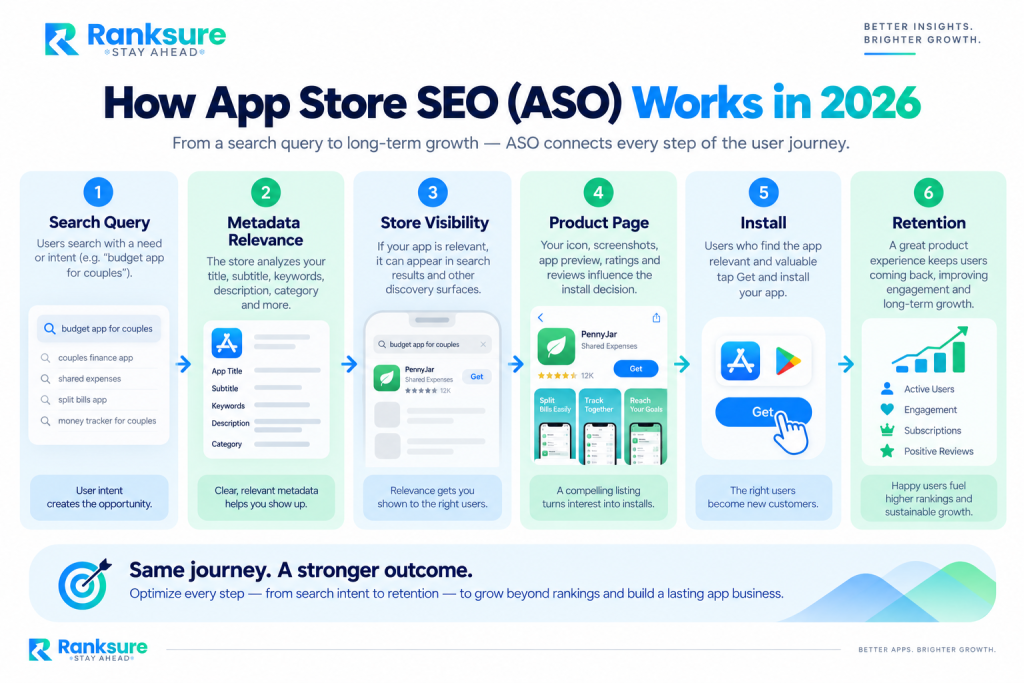
Modern App Store SEO (ASO) connects relevance with what happens after the app’s discovery.
Visibility gets you considered. Relevance gets you shown. Conversion proves you deserve the visibility.
What Is App Store SEO (ASO)?
App Store SEO, also called App Store Optimization (ASO), is the process of improving an app’s visibility and conversion performance across app-store discovery surfaces.
Keyword optimization remains part of it. That includes choosing relevant search terms, optimizing app titles and subtitles, using Apple’s keyword field, and writing Google Play metadata around user intent.
But visibility alone doesn’t produce growth.
Icons, screenshots, app previews, ratings, reviews, localization, experiments, and product quality all contribute to whether discovery turns into an install. Apple says App Store search considers text relevance across fields such as the app title, subtitle, keywords, and primary category alongside user-behavior signals such as downloads, ratings, and reviews.
Google Play also uses metadata, user feedback, engagement, and app-quality signals to understand and organize apps.
What Changed in App Store SEO in 2025 and 2026?
Some of the biggest ASO changes are happening beyond traditional keyword optimization.
Keyword-Targeted Custom Product Pages
Apple allows developers to publish up to 70 custom product pages and associate keywords with them.
Imagine a fitness app offering running plans, strength training, mobility exercises, and home workouts. Instead of forcing one default listing to speak to every searcher, a running-focused product page targets relevant running searches while another page emphasizes strength training.
The search intent and conversion message finally align.
Apple App Tags
Apple’s App Tags add another classification and discovery layer. Apple says search-result tags are generated using large language models based on metadata supplied through App Store Connect.
That makes clear metadata even more important.
Vague:
“The easiest way to live your best life.”
Clear:
“Guided sleep stories, breathing exercises and meditation for stress.”
The second version gives both the platform and the user concrete information about the product.
Google Play Is Becoming More Intent-Driven
Google Play uses metadata such as titles, descriptions, and categories alongside user feedback, engagement, and quality signals to organize and surface apps.
That matters for searches such as:
“A budget app for couples who share expenses but keep separate bank accounts.”
Simply repeating “budget app” doesn’t explain whether a product satisfies that need.
ASO requires semantic clarity: what the app does, who it serves, and which problem it solves.
App Store SEO vs. Traditional SEO
ASO and traditional SEO both depend on understanding search intent, but their mechanics differ.
| Traditional SEO | App Store SEO |
| Optimizes web pages | Optimizes app listings and discovery surfaces |
| Search engines crawl pages and links | Stores rely heavily on metadata, behavioral and quality signals |
| Backlinks can influence authority | No traditional backlink-based store ranking system |
| SERP snippets influence clicks | Icons, ratings, screenshots and video influence installs |
| Conversion may happen later | Search-to-install can happen within seconds |
Another important distinction is metadata.
Apple identifies fields including the app title, subtitle, keywords, and primary category as text-relevance factors. Google Play uses information including titles, descriptions, and categories to understand which apps address a query.
Same discipline. Different index.
How to Optimize App Store Keywords and Metadata
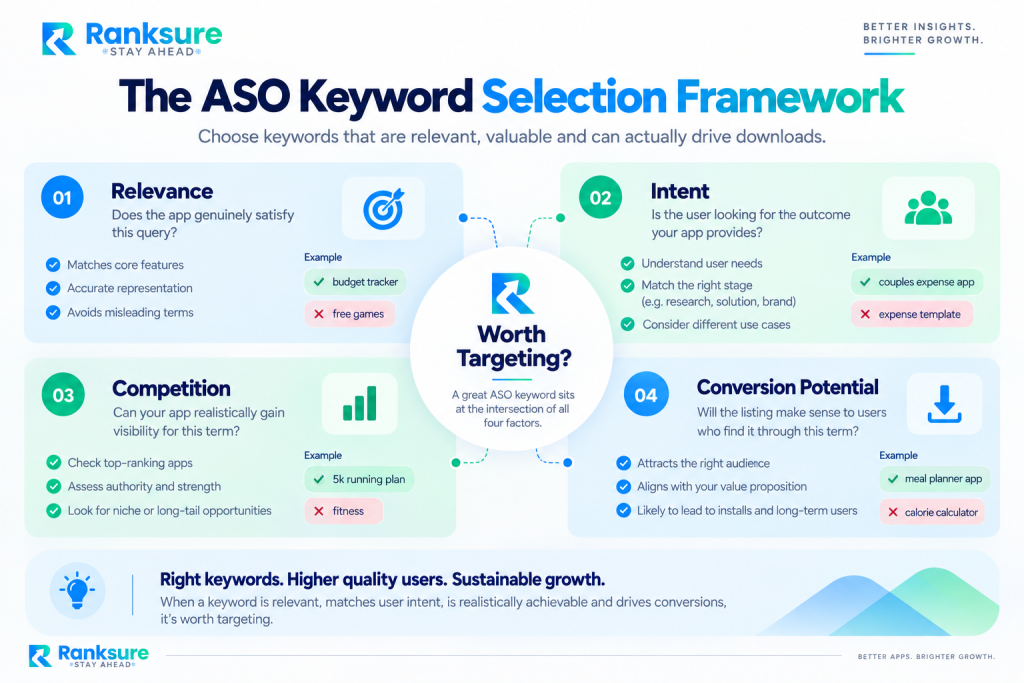
Start with relevance, not search volume. I prefer evaluating ASO keywords through four questions:
- Relevance: Does the app genuinely satisfy the query?
- Intent: Is the user looking for the outcome the app provides?
- Competition: Can the app realistically gain visibility?
- Conversion potential: Will the listing make sense when that searcher sees it?
A running app, for example, might struggle to gain meaningful visibility for “fitness.”
A term such as “5k running plan” has lower breadth but clearer intent.
Optimize the App Title
Both Apple and Google Play limit app names to 30 characters, making prioritization important.
Compare:
PennyJar – Better Money
with:
PennyJar: Budget Tracker
The second version explains the product’s core function.
Strong brands may not need category language in the same way. Smaller apps can’t assume users already know what the product does.
Use Apple’s Keyword Field Efficiently
Apple provides 100 characters for its keyword field.
Don’t treat those characters as a place to dump every high-volume phrase from an ASO tool. Use them to expand relevant search coverage.
For example:
expense, money planner, bills, couples, finance, monthly goals
The exact terms depend on relevance, demand, competition, and existing visibility.
Use limited metadata space to expand meaningful coverage, not to chase unrelated volume.
CRO: Turning App Store Visibility Into Installs
Ranking is useful if the listing persuades the right users to act. Apple’s Product Page Optimization lets developers test alternate product-page treatments, including icons, screenshots, and app previews.
Apple’s published experiments show why testing matters.
For Simply Piano, placing an app preview video first did not improve performance. Apple reported that the original page produced a 3% conversion-rate increase over the treatment with 100% confidence.
For Peak Brain Training, an icon experiment produced an 8% conversion-rate increase, with Apple reporting greater than 98% confidence. The lesson isn’t “never use video” or “change your icon.”
It’s simpler:
Test instead of assuming.
Make Screenshots Sell the Outcome
Screenshots aren’t a product tour. They’re a sales sequence. Instead of:
“Plan Your Week”
a meal-planning app could use:
“Build a 7-Day Meal Plan in Minutes.”
The second version communicates the feature, outcome, and scope.
The first screenshots should communicate the strongest user benefit, show recognizable product functionality, and remain understandable on a small screen.
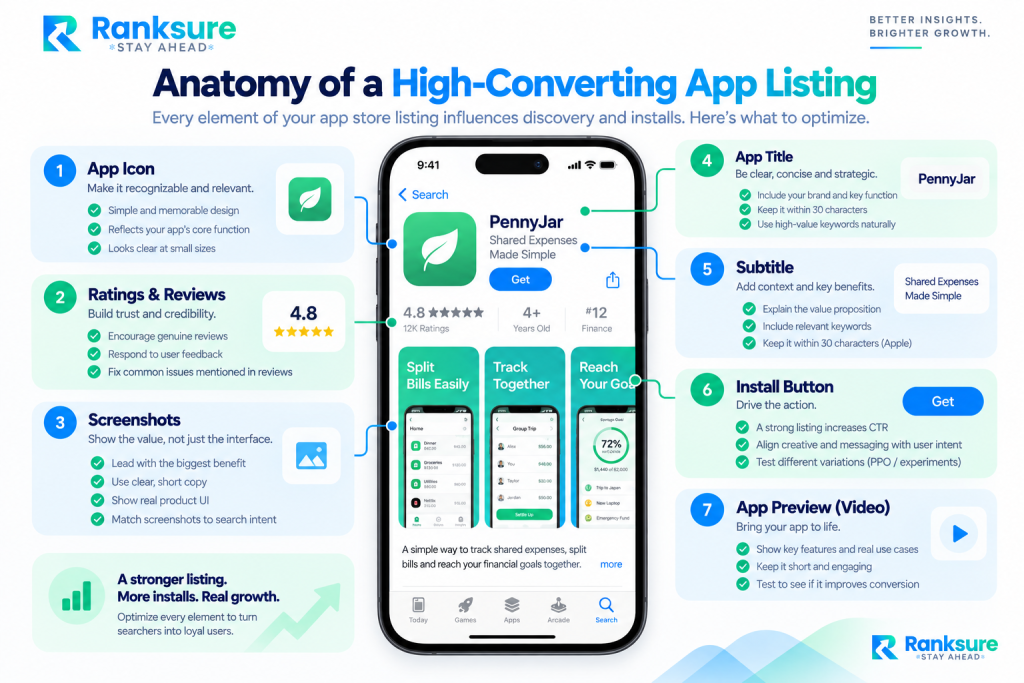
Custom product pages take this further by letting apps align creative and messaging with different search intents rather than asking one default listing to persuade everyone.
Ratings, Reviews, and Localization Matter Too
Apple says ratings and reviews influence App Store search rankings. Google Play also uses user feedback, engagement, and app-quality signals when organizing apps.
But review management isn’t about asking for five stars. Timing matters.
Request feedback after meaningful success: completing a workout, finishing a lesson, exporting a video, or repeatedly using a core feature. Negative reviews are also product research.
If users complain that account setup is confusing, generating positive reviews doesn’t solve the underlying problem. Localization requires similar thinking.
Translating English metadata word-for-word isn’t enough. Search behavior, terminology, currency, cultural references, screenshots, and even feature priorities differ by market.
Prioritize markets where existing users, revenue, impressions, acquisition data, or category demand justify the investment.
ASO Metrics That Matter
Keyword rankings shouldn’t be reported in isolation. Connect visibility with what happens next:
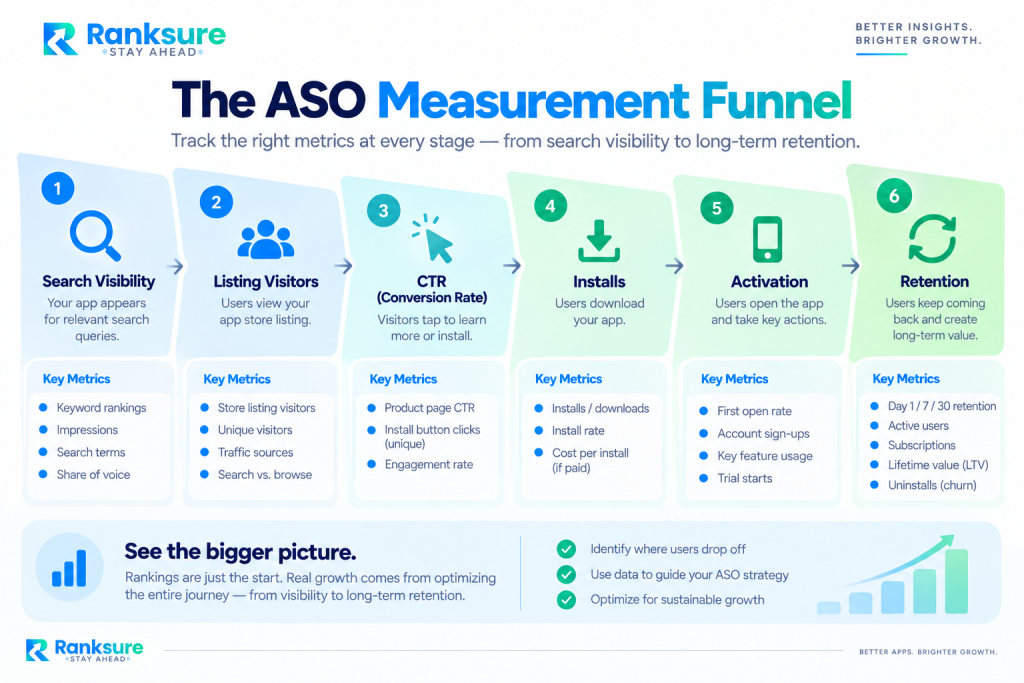
Useful metrics include:
- Keyword/search visibility
- Store-listing visitors
- CTR or conversion rate
- Installs/downloads
- Ratings and reviews
- Crashes and ANRs
- Activation
- Retention
- Trial or subscription conversion
An app that ranks but loses users because the product crashes isn’t winning ASO. It’s borrowing traffic.
Common App Store SEO Mistakes
| Mistake | Why It Fails | Better Approach |
| Keyword stuffing | Creates weak or irrelevant metadata | Optimize around real search intent |
| Ignoring creative | Visibility doesn’t guarantee installs | Improve icons, screenshots and positioning |
| Changing everything at once | Makes attribution impossible | Test one meaningful hypothesis |
| Translating instead of localizing | Search behavior varies by market | Localize keywords, messaging and creative |
| Chasing rankings alone | Rankings don’t equal valuable users | Measure installs, activation and retention |
A Practical ASO Workflow
ASO works better as a repeating optimization cycle than as an occasional metadata rewrite.
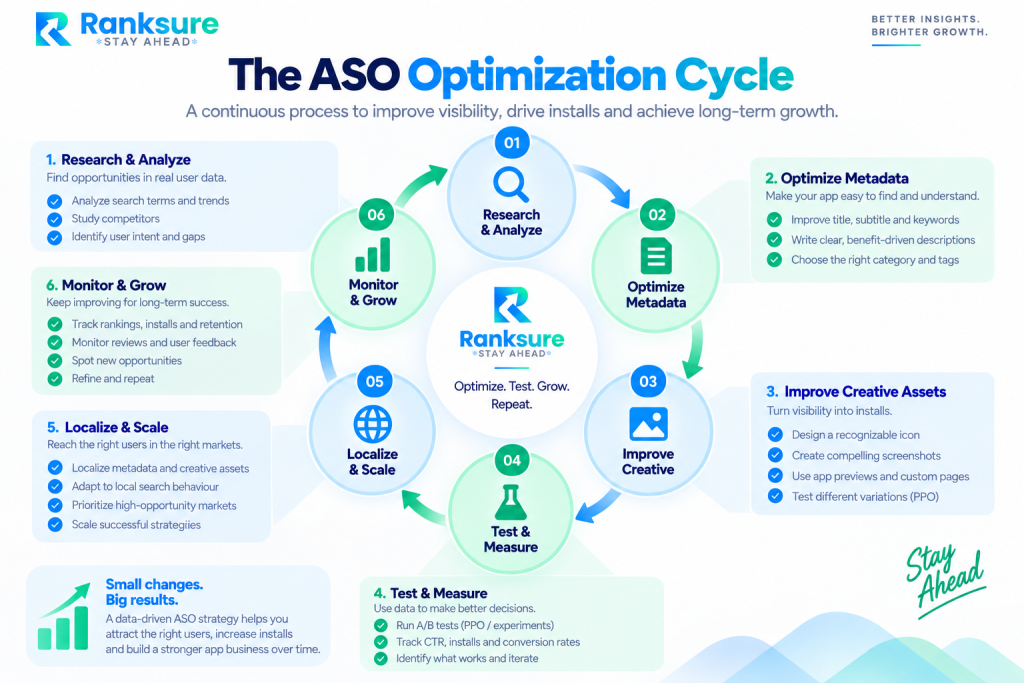
Start with existing search visibility and user intent. Optimize metadata around relevant opportunities, then review the icon, screenshots, and listing message.
Run controlled experiments where traffic allows. Feed ratings, reviews, conversion data, and product-quality signals back into the next optimization cycle.
Once the default listing performs well, expand into priority markets and intent-specific product pages.
ASO isn’t finished when metadata is published. That’s when the new dataset begins.
Conclusion: Modern ASO Goes Beyond Keywords
The strongest App Store SEO strategy in 2026 isn’t the one with the longest keyword spreadsheet.
Modern ASO connects search intent, metadata, visibility, creative, conversion, localization, and product quality.
Keywords still matter. But the real objective is to connect the right searcher with the right app, communicate its value quickly, and deliver an experience good enough to keep the user after the install.
Frequently Asked Questions About App Store SEO
What is App Store SEO?
App Store SEO, or ASO, improves an app’s visibility and conversion performance through keywords, metadata, creative assets, ratings, reviews, localization, testing, and product quality.
How long does ASO take to work?
Metadata changes may affect visibility relatively quickly, but meaningful ASO growth usually requires multiple iterations. Competitive rankings and reliable conversion experiments need enough data to evaluate.
Do App Store description keywords affect rankings?
Apple emphasizes fields such as the title, subtitle, keywords, and primary category for text relevance. Google Play works differently and uses metadata including titles, descriptions, and categories when understanding relevant apps.
How often should ASO keywords and screenshots be updated?
Update them when data gives you a reason: new keyword opportunities, product changes, declining conversion, seasonal demand, localization evidence, or a testable hypothesis.