
Broken link building is a link acquisition strategy that finds unavailable resources on other websites and offers a relevant working page as a replacement. The publisher fixes an outdated citation, while the replacement website can earn an editorial backlink.
The process has six stages: discover, verify, qualify, replace, outreach, and measure.
The strongest opportunities are not simply dead pages with many backlinks. They are broken resources where your page can satisfy the same information need that caused publishers to link to the original resource.
What Is Broken Link Building?
Broken link building is the process of finding external links that point to unavailable webpages and suggesting a relevant live resource as a replacement.
A broken link usually involves two elements:
- A referring page that contains the hyperlink.
- A destination URL that no longer provides the expected resource.
An HTTP 404 response is a common example. The referring page still contains the citation, but visitors cannot access the intended destination.
Broken link building focuses on links controlled by other publishers. The publisher decides whether to keep the broken link, remove it, replace it with another source, or use your suggested resource.
How Does Broken Link Building Work?
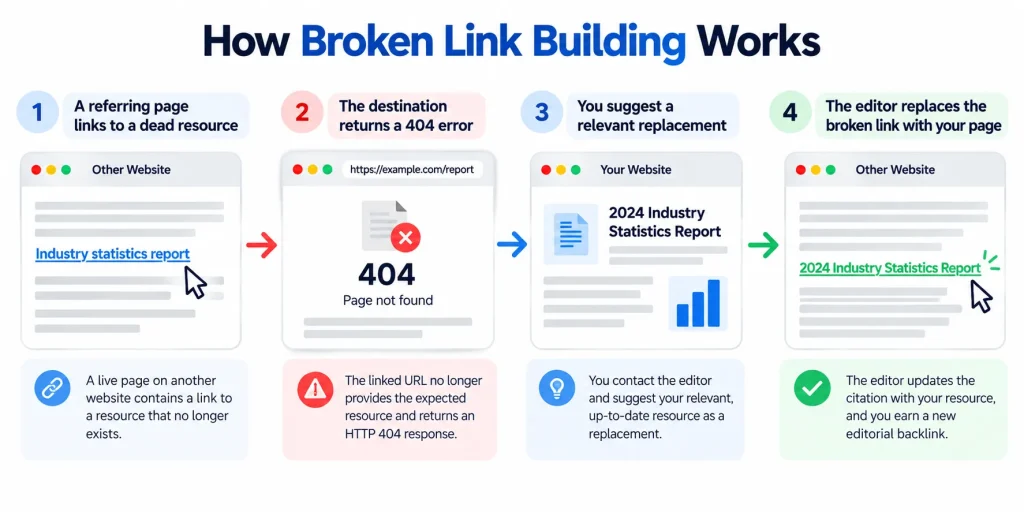
Broken link building works by matching an unavailable citation with a relevant replacement. Consider a marketing article that links to a deleted industry statistics report. The original page no longer works. You publish a current report covering the same subject and data need.
You contact the editor, identify the unavailable citation, and suggest your report as a possible replacement. The process is:
- Find a broken destination.
- Identify pages that still link to it.
- Understand why those pages cited the original resource.
- Select or create a suitable replacement.
- Contact the relevant publisher.
- Verify any acquired backlink.
The link is earned only when the publisher independently decides that your resource improves the page.
Broken Link Building vs. Broken Backlink Reclamation
Broken link building and broken backlink reclamation both address broken links, but they differ in their objectives, link ownership, and recovery methods. The table below highlights their key differences.
| Comparison | Broken Link Building | Broken Backlink Reclamation |
| Primary goal | Acquire new backlinks | Recover previously earned backlinks |
| Link destination | A broken page on another website | A deleted or unavailable page on your website |
| Link ownership | The broken backlink points to another domain | The broken backlink already points to your domain |
| Main approach | Offer relevant replacement content to the referring publisher | Restore the missing page or redirect to a relevant existing page |
| Action required | Contact the publisher and request a link replacement | Fix the destination URL or request a link update |
| Level of control | Limited; depends on the publisher’s decision | Greater; you control your website’s URLs |
| SEO objective | Backlink acquisition and authority growth | Backlink recovery and preservation of existing link equity |
Key takeaway: Broken link building focuses on acquiring new backlinks, while broken backlink reclamation focuses on recovering the value of backlinks your website has already earned.
Does Broken Link Building Still Work for SEO?
Broken link building remains useful because websites continue to remove, move, and replace content while old referring pages often remain live. Major SEO platforms such as Ahrefs and Semrush still include broken page and broken backlink research within their link building workflows.
The tactic can generate relevant editorial backlinks, referral traffic, and new referring domains. It does not guarantee rankings. Search performance depends on many signals, and Google treats manipulative link creation as spam.
The safest approach is to earn links through useful replacement content and independent editorial choice.
Benefits and Limitations of Broken Link Building
Broken link building can help websites earn relevant editorial backlinks, but its effectiveness depends on the quality of opportunities, replacement content, and publisher responsiveness. The table below summarizes its main benefits and limitations.
| Benefits | Limitations |
| Relevant editorial backlinks: Earn links from contextually relevant content. | Weak link opportunities: Some broken pages have low-quality or irrelevant backlinks. |
| New referring domains: Expand your website’s backlink profile. | Inactive publishers: Some websites no longer update older content. |
| Referral traffic: Attract visitors through relevant external links. | Uncertain link replacement: Editors may prefer alternative resources. |
| Audience visibility: Increase exposure among relevant audiences. | Link removal: Publishers may delete broken citations rather than replace them. |
| Content promotion: Promote useful guides, research, tools, templates, and data resources. | Low outreach response rates: Many publishers may ignore replacement requests. |
Key takeaway: Broken link building works best when a relevant broken citation, a suitable replacement resource, and an active publisher align. Backlink acquisition is never guaranteed.
How to Find Broken Link Building Opportunities
Strong campaigns start with dead resources that already have relevant referring pages. Finding random 404 pages is not enough. A useful opportunity combines an unavailable destination with a live referring page and a realistic replacement fit.
Three discovery methods are especially useful.
Find Broken Outbound Links on Relevant Websites
Start with websites that publish content closely related to your topic. Good targets include:
- Resource collections.
- Educational guides.
- Research summaries.
- Industry directories.
- Reference articles.
- Older evergreen content.
- Documentation hubs.
A crawler such as Screaming Frog SEO Spider can inspect external links and report response codes. Use this process:
- Choose a relevant website or content section.
- Crawl pages containing external links.
- Review destinations returning possible error responses.
- Verify each suspected broken URL manually.
- Record the referring page, destination URL, anchor text, and surrounding context.
- Remove opportunities that do not match your content.
The purpose of this method is not to collect as many errors as possible. It is to identify broken citations that your content can replace naturally.
Find Competitor Broken Backlinks
Competitor backlink profiles reveal deleted pages that once attracted links. Platforms such as Ahrefs and Semrush can identify broken competitor pages and show websites that still link to them. Review:
- Relevant referring domains.
- Referring page quality.
- Anchor text.
- Surrounding link context.
- Original resource type.
- Replacement feasibility.
Do not choose a dead page only because it has many referring domains. A deleted glossary page, calculator, research study, template, statistics report, and tutorial each serve different purposes. The value of the opportunity depends on how closely your resource can satisfy the same need.
Find Dead Pages With Existing Referring Domains
Prospecting should extend beyond direct competitors. Dead resources can come from universities, associations, software companies, publishers, government websites, discontinued projects, and inactive organizations.
Useful examples include:
- Deleted research reports.
- Retired tools.
- Removed statistics pages.
- Archived educational resources.
- Discontinued documentation.
- Expired resource collections.
- Deleted templates.
Once you identify a dead resource, analyze its referring domains and determine which linking pages are still live and relevant. This method can uncover topic-wide opportunities that competitor research misses.
How to Verify and Evaluate Broken Link Opportunities
A crawler error is only a potential opportunity, not proof that a link is broken. Before pursuing a prospect, verify that the destination is genuinely unavailable, assess the quality of the referring page, and determine whether your content satisfies the original citation purpose.
Verify That the Target URL Is Actually Broken
Different HTTP status codes indicate different accessibility issues. Not every error means a resource has been permanently removed.
| HTTP Status | Meaning | Recommended Action |
| 404: Not Found | The requested resource cannot be found. | Open the URL manually and confirm the expected content is unavailable. |
| 410: Gone | The resource has been intentionally removed and is likely permanently unavailable. | Consider it a strong candidate if the referring page is relevant. |
| 403: Forbidden | The server denies access to the resource. | Check in a normal browser to rule out crawler restrictions. |
| 429: Too Many Requests | The server is rate-limiting requests. | Recheck later; rate limiting does not confirm a broken resource. |
| 5xx: Server Error | The server failed to process the request. | Recheck to determine whether the error is temporary or persistent. |
Key rule: Never contact a publisher about a broken link without confirming that the destination is genuinely unavailable.
Assess Topical Relevance and Original Linking Context
The referring page helps explain why the publisher linked to the original resource. Review the anchor text, surrounding sentence and paragraph, supported claim, and likely purpose of the citation.
| Citation Purpose | What to Evaluate |
| Statistic | Does your content provide equivalent, current, and verifiable data? |
| Definition | Does your resource accurately explain the same concept? |
| Tool recommendation | Does your tool offer comparable functionality? |
| Original research | Does your resource provide credible evidence supporting the same claim? |
| Template | Does your content offer a practical replacement template? |
| Tutorial | Does your guide address the same task or problem? |
A replacement should satisfy the reader’s original information need rather than merely cover a similar topic.
Evaluate Referring Page Quality and Link Value
Prioritize editorial relevance and audience value before relying on third-party authority metrics.
Review these factors:
- Editorial purpose: Does the page serve a legitimate informational need?
- Topical relevance: Is the content closely related to your resource?
- Content quality: Is the information useful, accurate, and maintained?
- Source credibility: Is the author or publisher identifiable and trustworthy?
- Citation context: Would your resource fit naturally into the existing content?
- Audience value: Could the link attract relevant readers?
- Link attributes: Is the link editorial, nofollow, sponsored, or ugc?
Metrics such as Ahrefs Domain Rating (DR), Moz Domain Authority (DA), and Semrush Authority Score can help prioritize prospects, but none independently establishes link quality.
A relevant citation from a respected specialist publication may be more valuable than an unrelated link from a domain with a higher third-party authority score.
Prioritize Prospects Using a Broken Link Opportunity Score
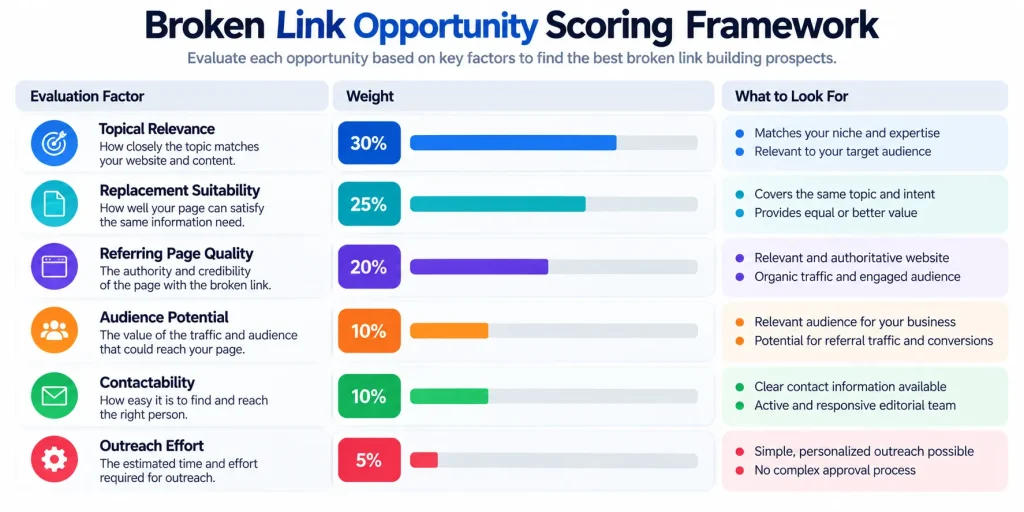
A weighted scoring framework helps compare prospects consistently. The following illustrative model assigns 100 possible points across six evaluation criteria.
| Evaluation Factor | Maximum Points | Example Score |
| Topical relevance | 30 | 28 |
| Replacement suitability | 25 | 24 |
| Referring page quality | 20 | 16 |
| Audience and traffic potential | 10 | 7 |
| Contactability | 10 | 8 |
| Outreach effort and feasibility | 5 | 4 |
| Total | 100 | 87 |
Example opportunity score
87/100
An illustrative high-scoring prospect with strong topical relevance and replacement suitability.
A website with a higher authority score may still rank lower if its citation context is weak or the proposed replacement is unsuitable.
Adjust the scoring weights to match campaign objectives. Referral traffic campaigns may emphasize audience potential, while research-focused campaigns may prioritize source credibility and citation quality. These scores are practical prioritization tools, not universal SEO standards or guarantees of backlink acquisition.
How to Create Replacement Content for Broken Links
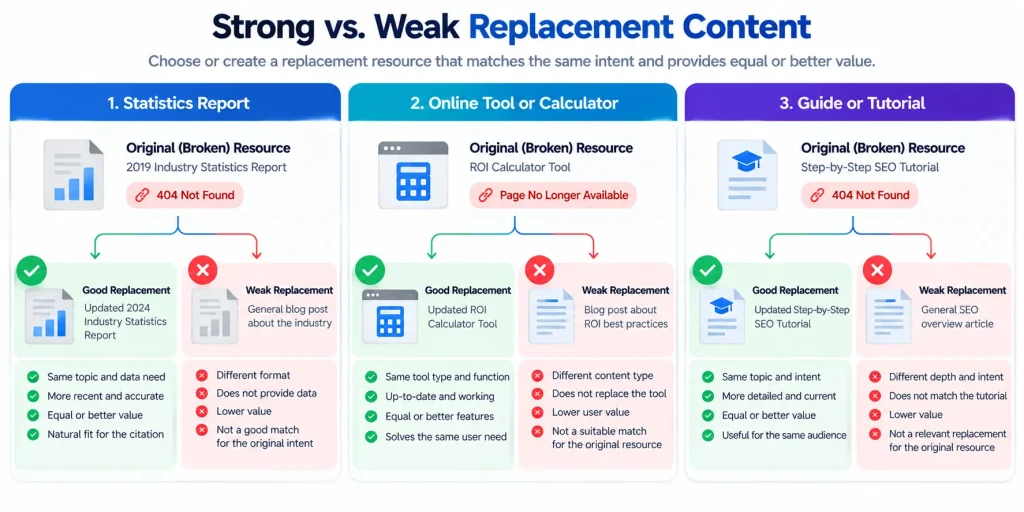
Effective replacement content should address the same information need as the original broken resource while offering accurate, relevant, and updated information. Rather than copying the deleted page, identify why publishers cited it and create a resource that serves the same editorial purpose.
Analyze the Original Broken Page
Start by investigating what previously existed at the broken URL. The Wayback Machine can help recover archived versions, including page titles, content structure, data, visuals, and functionality.
Analyze the original resource using the following checklist:
| Element | What to Identify |
| Original topic | The main subject addressed by the deleted resource |
| Resource format | Article, calculator, research report, template, or tool |
| Intended audience | The readers or users the resource originally served |
| Key sections | Important topics, explanations, or components |
| Data or functionality | Statistics, interactive features, or downloadable resources |
| Citation purpose | Why other publishers referenced the page |
| Anchor text | How referring websites described the original resource |
Backlink context can reveal missing details when archived content is unavailable. For example, if several referring pages describe a deleted URL as a mortgage affordability calculator, the replacement likely needs comparable calculation functionality rather than general mortgage advice.
Match the Original Resource’s Search Intent and Context
A suitable replacement must align with the original resource’s topic, format, and citation purpose.
| Original Resource | Suitable Replacement | Weak Replacement |
| Statistics report | Updated statistics with verifiable sources | General informational article |
| Calculator | Functional calculator with comparable features | Guide without calculations |
| Research study | Original or authoritative research supporting the same claim | Opinion-based article |
| Template | Usable template addressing the same task | Article describing templates |
| Tutorial | Step-by-step instructions for the same process | Commercial product page |
| Definition page | Clear reference resource explaining the concept | Broad article with a brief definition |
Key principle: Match the original citation’s purpose, not merely its broad subject.
Improve the Replacement Resource With Original Value
A replacement becomes more compelling when it provides additional value through updated information, stronger evidence, clearer explanations, or improved functionality. Potential improvements include:
- Content accuracy: Current data, verified facts, and primary sources.
- Research quality: Original findings, transparent methodology, and credible references.
- Content usefulness: Practical examples, clearer explanations, and more complete coverage.
- User experience: Helpful visuals, interactive tools, and accessible resource formats.
Choose the appropriate content development approach based on how closely your existing resources match the broken citation.
| Approach | When to Use | Recommended Action |
| Use an existing page | Topic, format, citation purpose, freshness, and evidence already align | Verify accuracy and use the resource for outreach. |
| Update an existing page | The resource is relevant but lacks current data, sufficient evidence, or complete coverage | Improve the content before contacting publishers. |
| Create a new resource | Existing pages cannot satisfy the original information need or required format | Develop a dedicated resource matching the citation purpose. |
Avoid promoting commercial landing pages as replacements for informational citations unless they genuinely fulfill the original resource’s purpose.
The objective is to provide publishers with a credible, useful alternative that improves the experience of readers following the original citation.
How to Conduct Broken Link Building Outreach
Effective outreach makes the publisher’s decision easier. The message should identify a real problem, show that you understand the page, and offer a useful replacement without implying that the publisher owes you a backlink.
Find the Right Website Owner or Editor
Contact the person most likely to maintain the page. Possible contacts include:
- Article author.
- Content editor.
- Website owner.
- Content manager.
- Webmaster.
- Resource librarian.
Check article bylines, editorial team pages, company directories, professional profiles, and contact pages. Avoid sending the same message to several employees at the same organization at once.
Write a Personalized Broken Link Building Email
Subject: Broken resource in your content research guide
Hi Maya,
I was reading your guide to content research and noticed that the resource linked in the industry data section is no longer available. We recently published a current report covering the same topic, including updated figures, source data, and methodology.
It may be a useful replacement if you decide to update the broken reference.
Resource: [replacement page]
I thought the broken link was worth flagging either way.
Best,
Alex
The message identifies the problem, offers a relevant alternative, and leaves the decision with the publisher.
Personalize Outreach Based on the Original Link Context
Different link types require different messages.
- For a statistics citation, explain which claim your data supports.
- For a tool link, explain what the tool does and whether it provides comparable functionality.
- For a research citation, mention methodology, source data, or findings relevant to the original claim.
- For a resource collection, explain briefly what the resource provides and who it helps.
- For a tutorial citation, explain which task your guide teaches.
Personalization should follow citation purpose rather than superficial details such as the recipient’s first name.
Follow Up and Track Outreach Responses
Track each prospect through the campaign. Useful statuses include:
- Qualified.
- Contact found.
- Message sent.
- Replied.
- Interested.
- Declined.
- No response.
- Link added.
- Link removed later.
A short follow-up can be reasonable after the first message receives no response. Avoid repeatedly contacting publishers who decline or remain uninterested.
How to Measure Broken Link Building Success
Broken link building success should be measured across the entire acquisition funnel, from qualified prospects to verified backlinks. Outreach volume and reply rates alone do not indicate campaign effectiveness. Focus on link quality, acquisition efficiency, referring domain growth, and long-term performance.
Track Acquired Backlinks and Referring Domains
Every acquired backlink should be verified to confirm its placement, relevance, and continued availability.
| Verification Factor | What to Check |
| Referring page status | The linking page is live and accessible. |
| Backlink presence | The backlink appears on the published page. |
| Destination accuracy | The link points to the intended URL. |
| Editorial relevance | The link fits naturally within the surrounding content. |
| Link attributes | Record whether the link is standard, nofollow, sponsored, or ugc. |
| Link retention | Confirm the backlink remains active over time. |
| Referring domains | Track unique linking domains separately from total backlinks. |
Ten backlinks from one domain represent a different acquisition pattern than ten backlinks from ten independent publishers.
Measure Outreach Conversion and Campaign Efficiency
Three core metrics help evaluate outreach performance and resource efficiency.
| Metric | Formula | What It Measures |
| Acquisition Rate | (Verified Links ÷ Emails Delivered) × 100 | Percentage of delivered emails resulting in verified links |
| Cost per Link | Total Campaign Cost ÷ Verified Links | Average cost of acquiring each backlink |
| Qualified Prospect Conversion Rate | (Verified Links ÷ Qualified Prospects) × 100 | Percentage of qualified prospects converted into acquired links |
For example, consider a campaign with 80 delivered emails, 12 verified backlinks, 110 qualified prospects, and a total cost of $2,400.
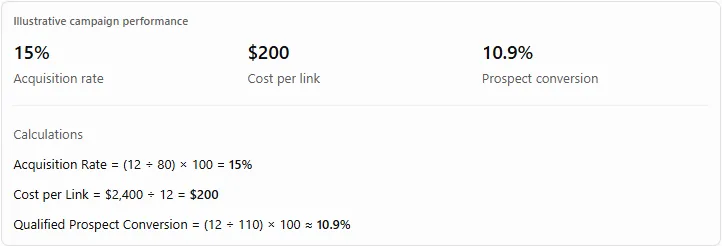
These metrics indicate campaign efficiency, not direct SEO impact. Measure referral traffic, conversions, backlink retention, and organic search performance separately.
Example of a Broken Link Building Campaign
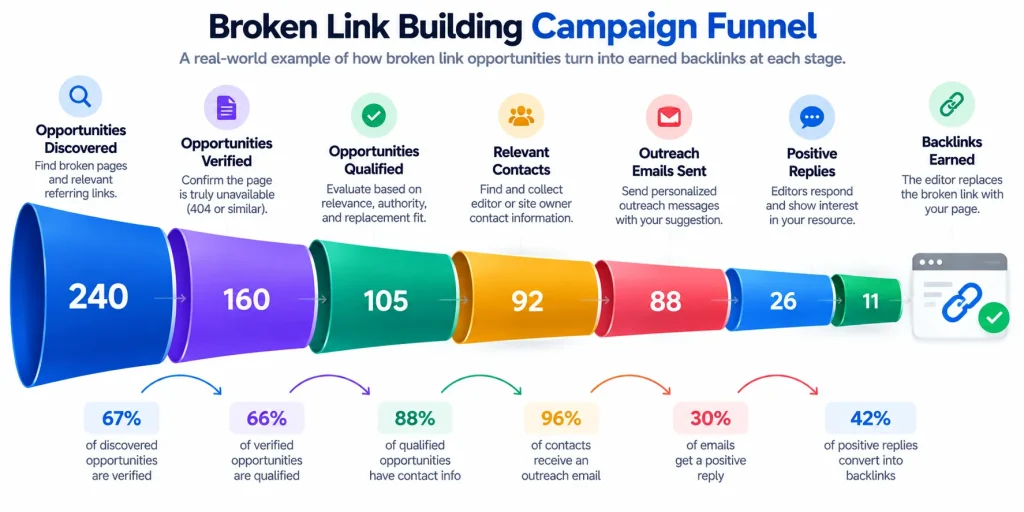
Consider a hypothetical broken link building campaign for a software analytics website.
| Campaign Stage | Results |
| Broken link opportunities discovered | 240 |
| Technically verified prospects | 160 |
| Qualified prospects after relevance review | 105 |
| Valid contacts identified | 92 |
| Emails delivered | 88 |
| Replies received | 26 |
| Positive responses | 16 |
| Verified backlinks earned | 11 |
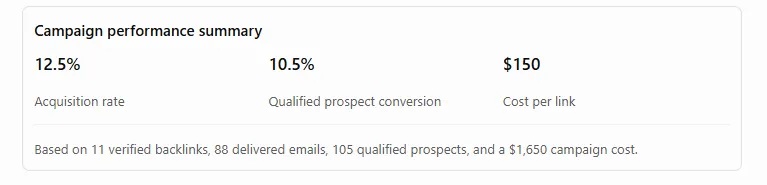
The campaign excluded 135 of the original 240 opportunities during verification and qualification because of irrelevant linking contexts, temporary errors, weak referring pages, unsuitable citation purposes, or other quality concerns.
An additional 17 qualified prospects did not result in delivered emails.
Key takeaway: Effective broken link building prioritizes qualified opportunities and verified editorial placements over outreach volume. Filtering unsuitable prospects reduces wasted effort and helps teams focus on links with meaningful relevance and audience value.
Best Tools for Broken Link Building
Broken link building requires tools for backlink discovery, technical verification, historical content research, and outreach tracking. Paid platforms support large-scale prospecting, while free and lower-cost tools are useful for targeted campaigns and manual verification.
Paid Tools for Broken Backlink Prospecting
Paid backlink analysis platforms help identify broken competitor pages, evaluate referring domains, and discover relevant link acquisition opportunities.
| Tool | Primary Use | Key Capabilities |
| Ahrefs Site Explorer | Broken backlink discovery | Find dead competitor pages with backlinks, analyze referring domains, review anchor text, and identify linking pages. |
| Semrush Backlink Analytics | Competitor backlink research | Analyze competitor backlink profiles, investigate referring domains, and identify potential broken-link opportunities. |
These platforms are particularly useful when comparing multiple competitors, researching large backlink indexes, and exporting prospects for qualification.
Limitation: Backlink databases and third-party authority metrics may be incomplete or outdated. Always verify broken destinations and referring pages before outreach.
Free and Lower-Cost Broken Link Building Tools
Free and lower-cost tools support targeted prospect discovery, link verification, historical research, and campaign organization.
| Tool | Primary Use | Key Capabilities |
| Screaming Frog SEO Spider | Website crawling | Identify broken outbound links and the source pages containing them. |
| Wayback Machine | Historical content research | Examine archived versions of deleted resources to understand their original topic, format, and content. |
| Browser link checkers | Individual page verification | Detect potentially broken external links on specific webpages. |
| Google Search operators | Manual prospect discovery | Find relevant resource pages, reference articles, and industry-specific link collections. |
| Google Sheets or Excel | Campaign tracking | Organize broken URLs, referring pages, anchor text, opportunity scores, contacts, outreach, and placements. |
Lower-cost workflows generally require more manual research but can work well for smaller campaigns and niche-specific prospect lists.
Common Broken Link Building Mistakes and How to Avoid Them
Broken link building campaigns often underperform because of poor prospect qualification, unsuitable replacement content, and ineffective outreach practices. Identifying these mistakes early helps improve campaign efficiency and backlink quality.
| Common Mistake | Why It Happens | How to Avoid It |
| Treating temporary HTTP errors as broken links | Crawlers encounter access restrictions, rate limits, or temporary server issues. | Manually verify that the destination is genuinely unavailable before outreach. |
| Relying heavily on authority metrics | Prospects are prioritized using domain scores rather than editorial value. | Evaluate topical relevance, referring page quality, citation context, and replacement suitability. |
| Using weak replacement content | Content covers a similar topic but fails to satisfy the original citation purpose. | Match the original resource’s format, search intent, and information need. |
| Sending irrelevant mass outreach | Outreach volume takes priority over prospect qualification. | Contact publishers only when your resource genuinely fits their broken citation. |
| Requesting keyword-focused anchor text | Outreach attempts to influence ranking signals through specific anchor wording. | Allow publishers to choose natural anchor text and editorial placement. |
| Counting unverified backlinks | Positive responses are recorded as successful placements without checking the live page. | Verify the backlink, destination URL, linking context, and link attributes before reporting success. |
Successful broken link building depends on accurate verification, relevant replacement content, selective outreach, and confirmed editorial placements, not the number of prospects contacted.
Broken Link Building vs. Other Link Building Strategies
Different link building strategies use distinct acquisition methods, content requirements, and editorial processes. The table below compares broken link building with five other approaches to help identify when each strategy is most appropriate.
| Strategy | Acquisition Mechanism | Resource Requirement | Best Use Case | Main Limitation |
| Broken Link Building | Replace an unavailable external resource with a relevant alternative. | Live content matching the original citation purpose. | Replacing dead resources on relevant referring pages. | Depends on replacement suitability and publisher response. |
| Resource Page Link Building | Suggest content for inclusion in a curated resource collection. | Valuable guides, tools, templates, or educational resources. | Promoting useful evergreen content. | High competition from other outreach requests. |
| Guest Posting | Contribute original content to an external publication. | High-quality articles relevant to the publisher’s audience. | Building topical authority and audience visibility. | Requires content production and editorial coordination. |
| Link Reclamation | Recover previously earned backlinks or correct existing references. | Restored content, existing pages, or relevant destinations. | Recovering lost backlink value. | Limited to existing references associated with your website. |
| Unlinked Mention Outreach | Request a link where a brand, product, or research resource is already mentioned. | Relevant official pages or supporting resources. | Brands with existing editorial mentions. | Opportunity volume depends on existing mentions. |
| Digital PR | Earn editorial coverage through newsworthy information. | Original research, data, expert insights, or timely stories. | Gaining broader editorial exposure and brand awareness. | Requires strong news value and production resources. |
Frequently Asked Questions
Is Broken Link Building a White Hat SEO Strategy?
Yes, broken link building can be a white hat SEO strategy when it involves relevant replacement content, genuine editorial decisions, and compliance with Google’s link spam policies.
Can You Do Broken Link Building Without Paid Tools?
Yes. Free tools such as Screaming Frog, the Wayback Machine, browser link checkers, and Google Search operators can support smaller campaigns. Paid tools mainly improve speed and scalability.
How Long Does Broken Link Building Take to Produce Results?
Backlinks may be acquired within days or several weeks, depending on publisher responsiveness, content relevance, and outreach quality. Organic ranking improvements are not guaranteed.
Final Takeaways: Earn Backlinks Through Relevant Resource Replacement
Broken link building is an editorial outreach strategy focused on replacing unavailable resources with relevant, useful alternatives. The process involves discovering and verifying broken links, evaluating referring pages, understanding citation intent, creating suitable replacement content, contacting publishers, and tracking verified backlinks.
The most valuable opportunities are not necessarily those with the most backlinks, but those where your content provides the strongest editorial fit and genuine value to readers.