
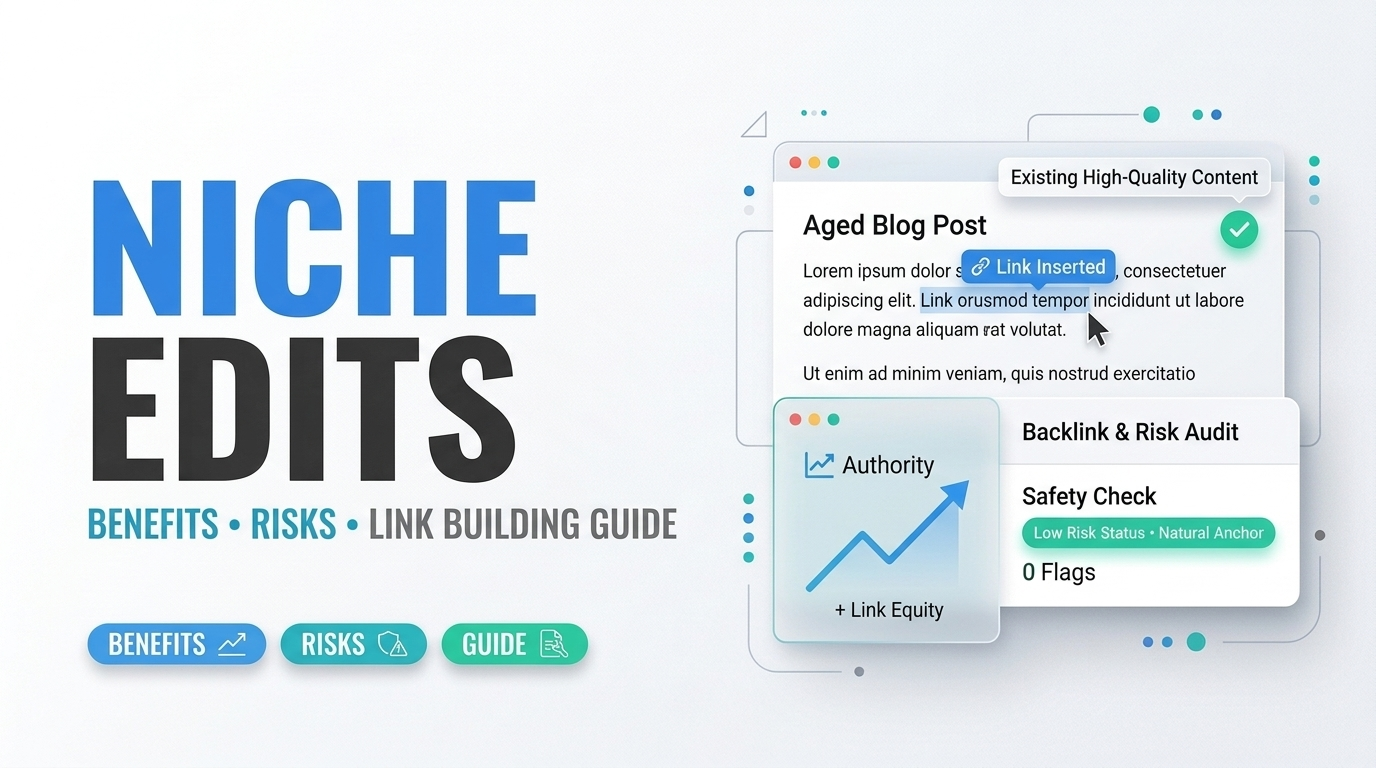
Niche edits are backlinks added to webpages that have already been published. Instead of creating a new guest article, a publisher updates an existing page and adds a relevant link to another useful resource.
The placement method alone does not determine link quality. A niche edit can be an editorial reference, a qualified sponsored placement, or a manipulative link created mainly to influence search rankings. Quality depends on the source page, destination page, surrounding context, publisher standards, audience relevance, and reason for adding the link.
This guide explains how niche edits work, how to assess individual opportunities, how Google treats paid and manipulative links, what affects campaign cost, and how to decide whether a placement deserves your time or budget.
What Are Niche Edits and Link Insertions in SEO?
Niche edits are contextual links inserted into existing published content. SEO professionals also commonly call them link insertions or contextual link insertions. A publisher updates a relevant sentence or paragraph and links to a resource that adds evidence, explanation, data, or another form of reader value.
Every niche edit involves four core elements:
- A source page containing the backlink
- A destination page receiving the backlink
- Anchor text that users can select
- Surrounding content that explains why the link belongs there
Niche edits are a placement method rather than a unique type of ranking signal. Their value depends on the relationship between the source, destination, context, and editorial process.
How Do Niche Edit Backlinks Work?
A niche edit adds a contextual reference to an article that is already live. Consider a page about ecommerce checkout optimization.
Before the edit:
Reducing unnecessary checkout steps can make purchasing easier for customers.
After the edit:
Reducing unnecessary checkout steps and applying proven checkout optimization practices can make purchasing easier for customers.
The phrase “checkout optimization practices” could link to a detailed guide, study, or technical resource covering checkout usability. The relationship is simple:
Source topic → relevant paragraph → descriptive anchor → useful destination
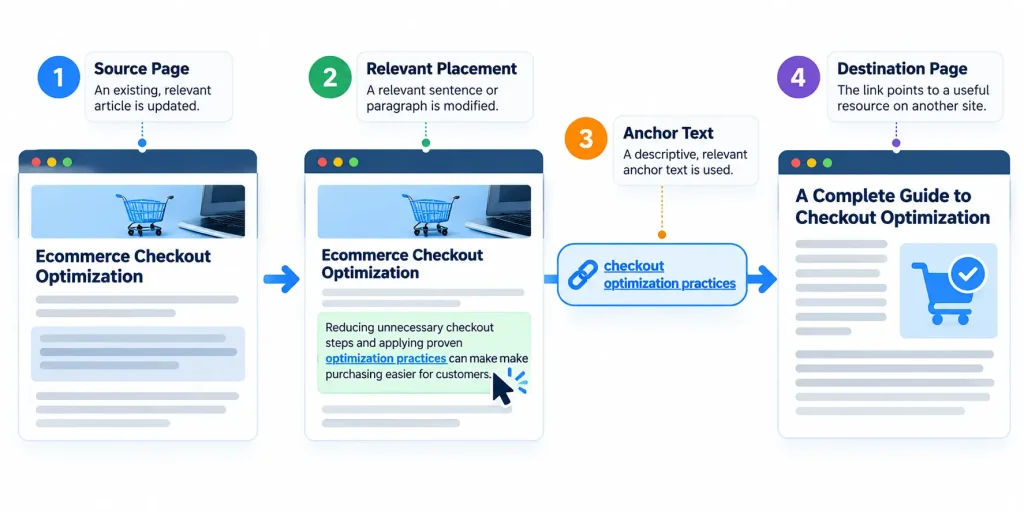
A weak niche edit breaks this relationship. Linking the same phrase to an unrelated agency homepage would provide less contextual value because the destination does not directly support the paragraph.
Niche Edits vs. Contextual Backlinks vs. Editorial Links
These terms overlap but are not interchangeable.
A contextual backlink is not always a niche edit because contextual links can be included when an article is first published. A niche edit is not always an independently earned editorial link because it may result from sponsorship, a commercial arrangement, a partnership, or link selling.
| Term | What It Describes | Where or How It Appears | Editorial Independence |
| Niche edit | How the link was added | Inserted into content that was already published | May be editorial, sponsored, commercially arranged, or sold |
| Contextual backlink | Where the link appears | Placed inside relevant written content rather than a menu, footer, or unrelated page element | Can be earned, sponsored, or otherwise arranged |
| Editorial link | Why the publisher selected the destination | Added because the publisher considers the destination useful or relevant to the content | Depends on genuine publisher judgment |
The key distinction is not what the backlink is called. It is why the publisher added it and whether the placement reflects genuine editorial value.
How Do Niche Edits Differ From Other Link Building Methods?
Niche edits use existing content. Guest posting creates new content. Broken link building replaces unavailable references. Digital PR earns citations through research, data, expertise, or newsworthy information.
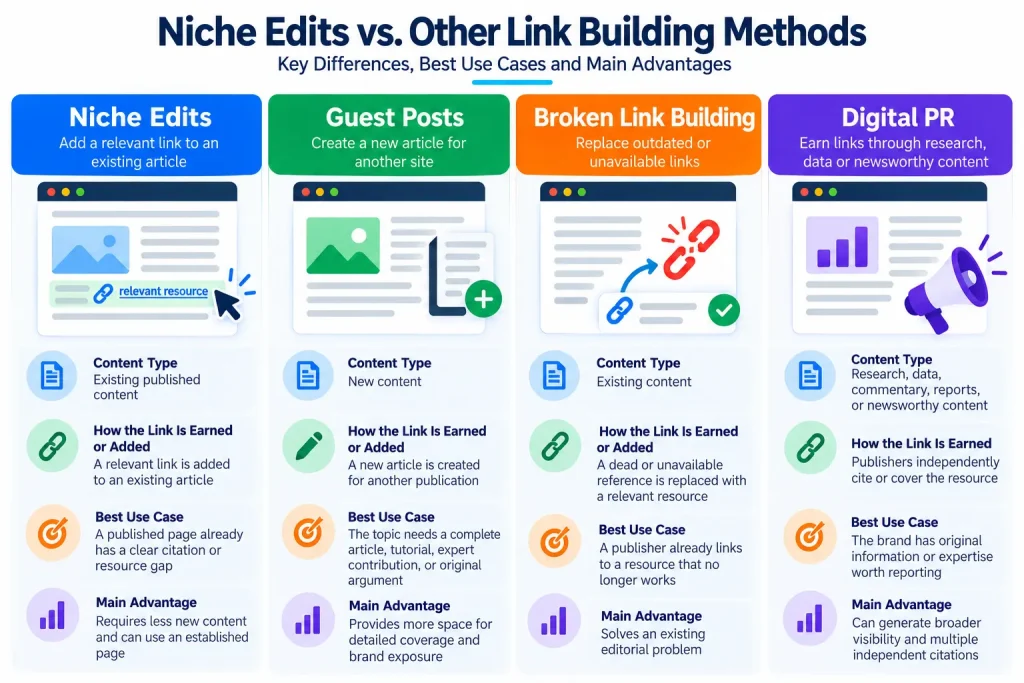
Niche edits are broader than broken link building because the source article does not need to contain a dead link. Guest posts require more content production because the publisher is creating a new page rather than updating an existing one.
Digital PR differs in acquisition method. It starts with information worth reporting or citing, while niche edit outreach usually starts with a specific article that could benefit from a better reference.
No method is automatically superior. Publisher quality, audience relevance, editorial standards, resource value, and placement context matter more than the format alone.
What Are the Potential SEO Benefits of Niche Edits?
Relevant niche edits can support referral traffic, content discovery, contextual relevance, and brand visibility.
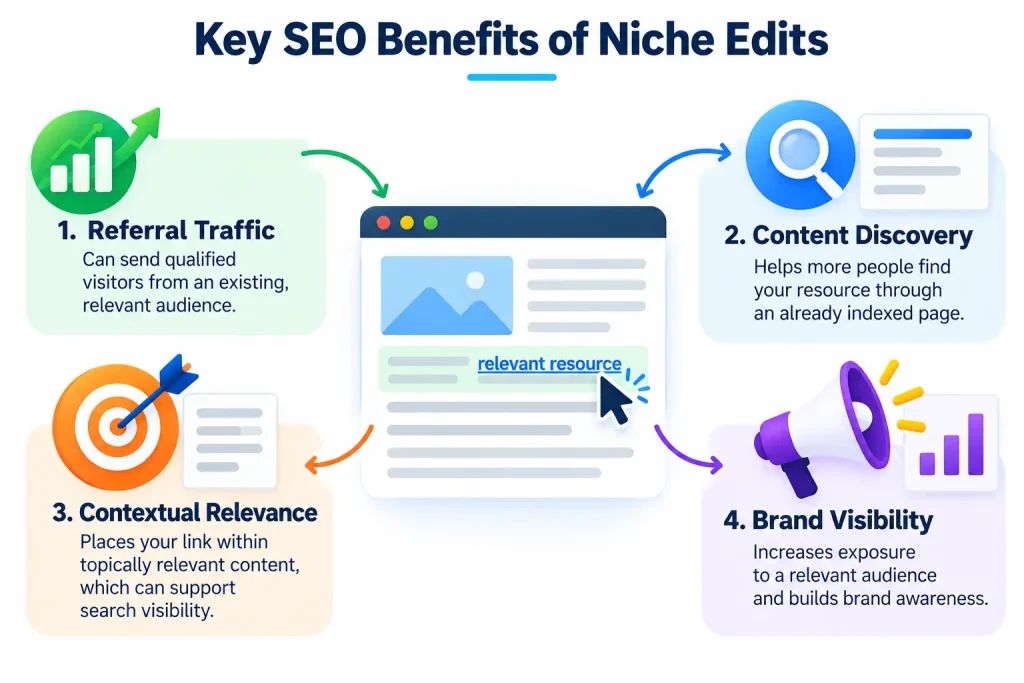
These characteristics make an existing article commercially attractive, but they do not guarantee ranking improvements.
Referral Traffic From Relevant Existing Content
A niche edit can send qualified visitors when the source page already attracts readers interested in the destination topic. A link from an article about enterprise payroll systems to a payroll compliance guide has clear audience alignment. Referral potential depends on:
- Source page readership
- Link visibility
- Topic relevance
- Reader intent
- Destination usefulness
Links placed where readers naturally need more information have the strongest reason to receive clicks.
Existing Visibility and Contextual Relevance
An established page may already have search visibility, inbound links, and clear topical context. Those characteristics can make the placement more useful than a link on a newly created page with no audience.
Context still matters more than age or authority. An old page with weak content, no real readers, and unrelated commercial links may offer little value.
Editorial Efficiency
Publishers routinely update existing content because facts change, sources disappear, research improves, and better references become available. A useful niche edit can improve an article without requiring a completely new page.
The editorial test is simple:
Does the reference make the article more accurate, complete, or useful?
What Makes a High Quality Niche Edit Backlink?
A high quality niche edit combines topical relevance, credible source content, useful context, natural anchor text, and clear editorial justification. No single SEO metric can determine link quality.
| Quality Factor | What to Evaluate | Strong Signal | Warning Sign |
| Topical relevance | Relationship between the source page and destination page | The publication, article, and surrounding paragraph closely match the destination topic | The source and destination belong to unrelated subjects |
| Source page quality | Accuracy, usefulness, authorship, maintenance, and editorial purpose | The page contains reliable information, credible references, and serves a genuine audience | Thin, outdated, inaccurate, or commercially overloaded content |
| Paragraph relevance | Whether the destination improves the specific section containing the link | The link provides research, statistics, evidence, documentation, or deeper explanation | The link is inserted without adding useful information |
| Anchor text | How naturally the clickable text describes the destination | Descriptive wording fits naturally within the sentence | Forced commercial keywords or awkward wording |
| Publisher credibility | Editorial standards and consistency across the publication | Clear subject focus, meaningful editorial review, and relevant external references | The site publishes unrelated topics mainly to sell backlinks |
| Organic visibility | Whether the page appears to attract relevant search traffic and readers | Stable visibility for queries related to the source topic | Traffic appears unrelated, unstable, or absent from the relevant page |
| Outbound link quality | Types of websites and resources the publisher references | Links point to credible and contextually relevant sources | Numerous unrelated commercial links or repeated optimized anchors |
| Domain metrics | Ahrefs Domain Rating, Semrush Authority Score, and similar metrics | Metrics support other evidence of page and publisher quality | High scores are used to justify an otherwise irrelevant placement |
A site with a Domain Rating of 75 is not automatically a better opportunity than a specialist site with a Domain Rating of 35. The smaller publication may provide stronger topical relevance, better editorial standards, and a more appropriate audience.
The best test is simple: does the link make the specific paragraph more useful to the reader?
Are Niche Edits Safe? Google’s Link Spam Policies Explained
Niche edits are not inherently against Google guidelines.
Google Search Central identifies links created primarily to manipulate search rankings as link spam. Examples include buying or selling links for ranking purposes, excessive link exchanges, automated link creation, and certain paid advertorial links that pass ranking credit.
Advertising and sponsorship can still be legitimate when paid links are appropriately qualified.
Editorial Link Insertions vs. Paid Ranking Links
An editorial link exists because a publisher decides that another resource improves its content. A paid ranking link exists because compensation is exchanged primarily to obtain ranking benefit through the backlink.
These are different relationships. Publishers can sell advertising or sponsored exposure legitimately. Google recommends qualifying paid links with sponsored or nofollow.
When Should Links Use Sponsored, Nofollow, or UGC Attributes?
Google recommends sponsored for advertisements, sponsorships, and other compensated placements. nofollow is also acceptable for paid links. ugc is intended for links within user generated content such as community posts and comments.
A genuine editorial reference does not require one of these values simply because it points to another website.
Link Farms, Private Blog Networks, and Manipulative Placements
A network is not automatically manipulative because one organization operates multiple sites. The concern arises when websites are created or used mainly to manufacture ranking links rather than serve real audiences.
Warning signs include:
- Unrelated industries published on the same site
- Large numbers of commercial outbound links
- Repeated keyword focused anchors
- Thin pages created mainly to host backlinks
- Networks repeatedly linking to the same clients
- Guaranteed followed links without meaningful editorial review
Can Google Penalize or Ignore Manipulative Niche Edits?
Manipulative links may fail to deliver the ranking value buyers expect. Google uses automated spam detection systems and can also apply manual actions in relevant cases. A bad backlink therefore does not always produce a visible penalty.
How to Evaluate a Niche Edit Opportunity Before Accepting It
Evaluate every niche edit by checking relevance, publisher quality, editorial legitimacy, and policy compliance before considering authority metrics.
| Evaluation Factor | What to Check | Accept | Investigate | Reject |
| Source and destination relevance | Topic, search intent, audience, and paragraph purpose | Both pages address the same information need | Topics are broadly related but paragraph fit is weak | Source and destination are unrelated |
| Paragraph relevance | Whether the destination adds evidence, explanation, data, or another useful resource | The link clearly improves the paragraph | The link is relevant but adds limited value | The link is forced into unrelated text |
| Publisher credibility | Editorial focus, content quality, authorship, maintenance, and audience authenticity | Publisher shows consistent editorial standards | Quality or standards are inconsistent | Site appears to exist mainly for selling backlinks |
| Outbound link quality | External destinations, anchor patterns, commercial links, and editorial consistency | External links are credible and contextually relevant | Some commercial patterns need further review | Numerous unrelated commercial links or repeated optimized anchors appear |
| Editorial independence | Whether the publisher can reject links, change anchors, or edit surrounding text | Publisher retains final editorial control | Approval process is unclear | Placement is guaranteed regardless of relevance |
| Commercial relationship | Payment, sponsorship, disclosure, and link qualification | Relationship is editorially legitimate or appropriately qualified | Commercial terms need clarification | Arrangement depends on passing paid ranking credit |
| Policy compliance | Alignment with Google Search Central link spam guidance | No clear manipulation concern | Intent or qualification needs review | Link is created primarily to manipulate rankings |
Worked Niche Edit Evaluation Example
An accounting software company wants a link to its guide about small business tax record retention.
The source is an established bookkeeping article discussing how long businesses should retain invoices, receipts, and tax records. The destination provides a detailed retention guide supported by tax authority references.
The source and destination address the same information needed. The paragraph benefits from deeper evidence. The publisher specializes in accounting and business finance, uses relevant external references, and independently reviews suggested sources.
Decision: Accept.
Now consider the same destination offered a link from a celebrity news article on a high authority site that sells following links across unrelated industries.
The authority metric cannot compensate for weak topical relevance, poor paragraph fit, and limited editorial legitimacy.
Decision: Reject.
How to Find and Earn Legitimate Niche Edit Opportunities
Strong niche edit outreach starts with a real content improvement. Find existing articles where your resource supplies missing evidence, updated information, deeper explanation, or a better citation.
Find Existing Articles With Missing or Outdated References
Look for:
- Old statistics
- Dead citations
- Unsupported claims
- Outdated tools
- Missing primary sources
- Incomplete explanations
- Discontinued resources
Match each issue with a resource that genuinely solves it.
Analyze Competitor Backlinks and Citation Opportunities
Ahrefs Site Explorer and Semrush Backlink Analytics can reveal pages that reference competing sites. Do not simply copy competitor backlinks. Study why the competitor earned the citation.
A useful process is:
- Find relevant referring pages
- Group links by citation reason
- Identify resource types that attract references
- Find publishers repeatedly covering the topic
- Target pages where your asset adds stronger information
The citation reason matters more than the backlink URL alone.
Create a Resource Worth Linking To
Different assets solve different editorial problems.
- Statistics support numerical claims.
- Research reports support evidence based arguments.
- Calculators support practical decisions.
- Technical documentation supports implementation claims.
- Definitions support explanatory sections.
- Templates support actionable instructions.
The asset should solve a specific information need.
Write a Personalized Editorial Outreach Request
A strong outreach request focuses on improving the publisher’s article. Mention the exact page, identify the relevant section, explain the missing or outdated information, introduce your resource, and leave the final decision to the publisher.
Example:
I was reading your guide to small business bookkeeping and noticed the section about retaining financial records. We recently published a detailed resource explaining common retention periods and supporting tax authority guidance. It may be useful for readers who want more detail. Please use it only if you feel it improves the section.
Verify the Final Link Placement
After publication, confirm the source URL, destination URL, anchor text, surrounding paragraph, redirect behavior, and appropriate link attributes. A live backlink is not useful if it points to the wrong destination or appears in an irrelevant context.
What Determines the Cost of Niche Edit Campaigns?
Niche edit costs vary because campaigns may include research, prospecting, content analysis, outreach, publisher communication, asset creation, sponsorship fees, agency management, and monitoring. A single universal price would be misleading. The useful question is what the buyer is paying for.
Cost drivers include:
- Industry competition
- Publisher quality
- Audience size
- Prospecting difficulty
- Editorial standards
- Outreach effort
- Content requirements
- Sponsorship fees
- Agency involvement
- Ongoing monitoring
A more expensive placement is not automatically better. Evaluate cost against relevance, editorial quality, audience fit, compliance, and measurable business value.
How to Evaluate Niche Edit Vendors and Placement Packages
Ask vendors:
- Can I review and reject publishers?
- How are websites selected?
- Does the publisher review my destination page?
- Are paid relationships disclosed?
- What link attributes are used for sponsored placements?
- What happens if the link disappears?
Be cautious with services selling large inventories of guaranteed followed links without meaningful editorial review.
Why High Domain Rating Does Not Guarantee Link Value
Domain Rating, Authority Score, and similar metrics can assist prospect research. They cannot replace page level evaluation.
A high scoring general site with weak relevance and excessive commercial linking may be a worse opportunity than a smaller specialist publication with real readers and strong editorial standards.
How to Track and Measure Niche Edit Performance
Measure performance at three levels:
- Placement health
- Audience impact
- Organic visibility
Monitor Placement Health
Track the source URL, destination URL, anchor text, link attributes, current status, redirects, and surrounding context. Publishers can update, consolidate, redirect, or remove content.
Measure Audience Impact
Use Google Analytics to monitor referral visits and relevant business outcomes such as enquiries, registrations, downloads, purchases, or other configured key events. A small number of qualified visitors can create more value than a large volume of irrelevant traffic.
Evaluate Organic Visibility Without Assuming Causation
Google Search Console can help monitor impressions, clicks, queries, and page visibility over time. Do not assume that one backlink caused a ranking change.
Content updates, technical changes, competition, new links, seasonality, internal linking, and search system changes can influence the same performance period.
Common Niche Edit Mistakes and Red Flags
| Mistake or Red Flag | Risk | Corrective Action |
| Buying links based only on authority metrics | Can lead to irrelevant or low quality placements | Evaluate the actual source page, publisher, audience, and context |
| Forcing commercial anchor text | Makes the placement look unnatural and weakens readability | Use descriptive anchor text that fits the sentence naturally |
| Accepting links from unrelated pages | Reduces contextual relevance and reader value | Require clear alignment between the source page and destination |
| Ignoring outbound link patterns | Can expose link selling networks or weak editorial standards | Review several articles and their external destinations before accepting a placement |
| Paying specifically for ranking credit | Creates Google policy risk | Treat paid exposure as sponsorship and use appropriate link qualification |
| Assuming every backlink improves rankings | Leads to poor attribution and unrealistic expectations | Measure referral traffic, business outcomes, link persistence, and organic trends separately |
| Sending generic outreach | Gives publishers little reason to review or accept the resource | Suggest a specific editorial improvement and explain how the resource helps readers |
What Are the Best Alternatives to Paid Niche Edits?
Choose the method that best matches the reason a publisher might legitimately reference your resource.
Original Research and Digital PR
Choose digital PR when you have original data, studies, expert analysis, or newsworthy information that could earn independent citations from multiple publishers.
Broken Link Building
Choose broken link building when a relevant page already contains an unavailable reference and your resource can satisfy the same information need.
Link Reclamation
Choose link reclamation when publishers already mention your brand, cite an outdated URL, or reference research without an appropriate link.
Editorial Niche Edit Outreach
Choose niche edit outreach when an existing article has a clear information gap and your resource directly improves that section.
Frequently Asked Questions About Niche Edits
Are Niche Edits Against Google’s Guidelines?
No. The placement method itself is not prohibited. Google focuses on links created mainly to manipulate rankings. Compensated placements should be appropriately qualified.
Are Niche Edits Better Than Guest Posts?
Not universally. Niche edits suit existing articles with clear citation opportunities. Guest posts suit topics that require new content.
Do Niche Edits Help SEO Rankings?
Relevant backlinks can contribute to a wider SEO strategy, but no individual niche edit can guarantee ranking improvement.
Should You Buy Niche Edit Backlinks?
Do not buy the following links specifically to manipulate rankings. Paid exposure can be legitimate as sponsorship when the relationship and link qualification are handled appropriately.
How Long Do Niche Edit Backlinks Last?
There is no guaranteed lifespan. Publishers can edit articles, remove references, change URLs, or remove pages entirely.
Final Checklist: Are Niche Edits Worth Pursuing?
A niche edit is worth considering when you can answer yes to these five questions:
- Is the source page closely relevant to the destination?
- Does the link improve the article for readers?
- Does the publisher demonstrate credible editorial standards?
- Is the placement consistent with Google link policies?
- Can you measure audience, placement, or business value?
The core principle is simple.
A niche edit should make sense as an editorial reference before it is evaluated as an SEO opportunity. That standard filters out weak placements and keeps the focus on relevance, reader value, publisher credibility, transparency, and measurable results.