
Citation-worthy content gives journalists, publishers, researchers, and AI search systems a specific reason to reference your page. Its value comes from evidence. Original research, verified statistics, firsthand observations, expert analysis, useful tools, and transparent datasets can support claims that other content creators need to make.
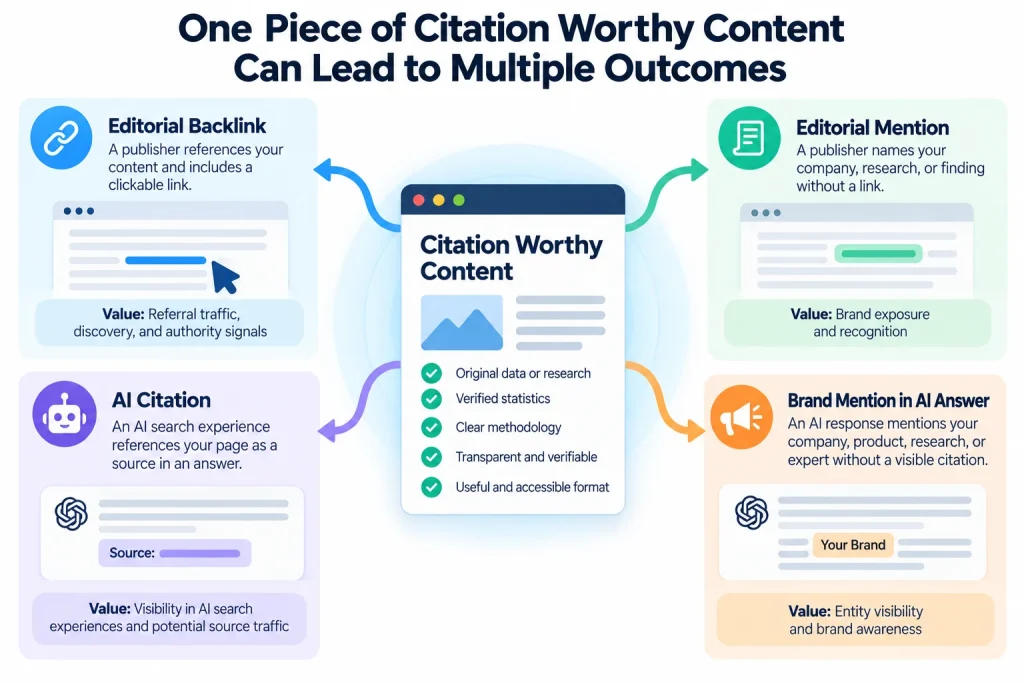
That reference value can produce different outcomes. A publisher may add an editorial backlink. A journalist may mention your research without linking. An AI search system may cite your page as a supporting source.
None of these outcomes is guaranteed.
The objective is to create information that deserves to be referenced, make its evidence easy to verify, publish it in an accessible format, and measure each citation outcome separately.
What Is Citation-Worthy Content?
Citation-worthy content is information with enough independent reference value that another publisher, researcher, journalist, or search system can use it to support a claim. Strong citation-worthy resources provide at least one of these elements:
- Original data
- Verified statistics
- Primary research
- Firsthand evidence
- Expert interpretation
- Transparent methodology
- A useful framework
- A practical reference tool
A normal article may answer a question accurately. A citation-worthy resource goes further by contributing evidence that another person can reference.
A survey report can reveal how businesses allocate marketing budgets. A case study can document the results of a repeatable process. A data analysis can identify patterns inside a public dataset. A calculator can solve a recurring problem that publishers prefer to reference instead of recreating.
Citation Worthy Content vs. Link Worthy Content
Citation-worthy content and link-worthy content can overlap, but they serve different purposes and create different outcomes.
| Aspect | Citation Worthy Content | Link-Worthy Content |
| Primary purpose | Provides evidence, data, analysis, or information worth referencing | Gives publishers a reason to add a hyperlink |
| Main value | Supports claims and improves source credibility | Attracts links through usefulness, utility, or interest |
| Common formats | Research reports, surveys, statistics, case studies, expert analysis | Calculators, tools, guides, templates, visual assets |
| Hyperlink required | No | Yes |
| Typical outcome | Citation, mention, or source attribution | Editorial backlink |
| Example | A study cited for its original findings | A calculator linked because it performs a useful task |
| Relationship | Can earn links when publishers reference the evidence | Can also become citation-worthy when it contains reliable evidence |
| Core requirement | Independent reference value | Strong reason to link |
Key distinction: Citation-worthy content is designed around reference value, while link-worthy content is designed around link attraction. The strongest resources often achieve both.
Why Publishers and AI Search Systems Reference Sources
Human publishers cite sources to support claims, provide evidence, establish context, and help readers verify information. Their decisions depend on factors such as relevance, credibility, originality, recency, and methodological quality.
AI search systems use different retrieval and answer generation processes. A source may be considered because its information is accessible and relevant to a particular request A page that contributes distinct and verifiable information gives others more reason to reference it.
Editorial Backlinks vs. AI Citations
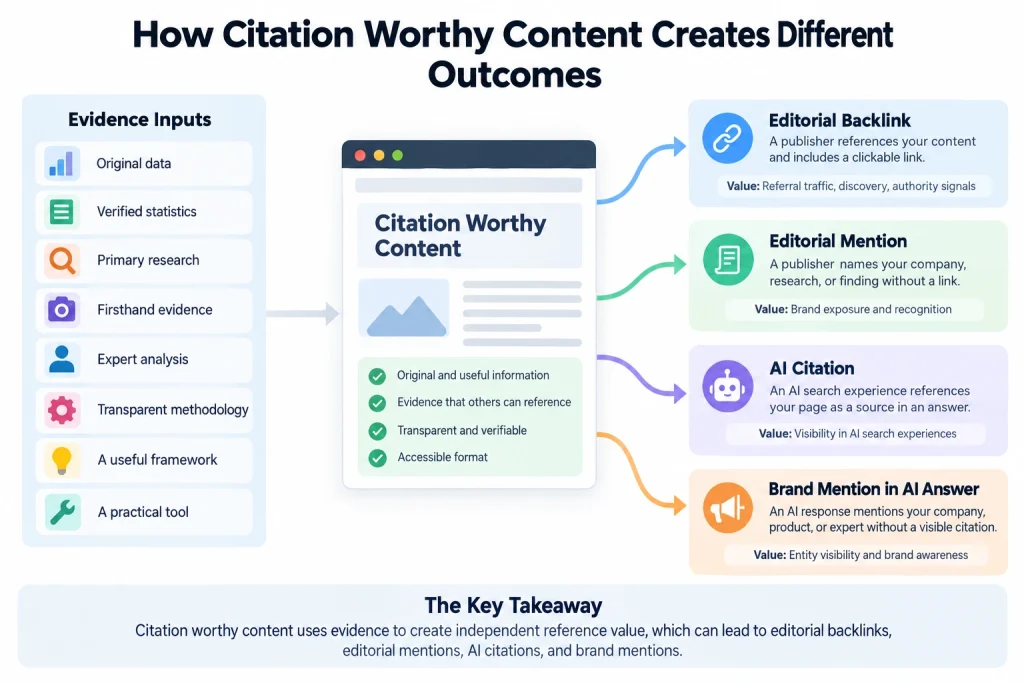
Editorial backlinks, editorial mentions, AI citations, and AI brand mentions create different visibility outcomes and should be measured separately.
| Outcome | What It Means | Primary Value | Selection Process |
| Editorial backlink | A publisher references your content with a clickable link | Referral traffic, discovery, and link authority | Human editorial judgment |
| Editorial mention | A publisher references your company, research, expert, or finding without a link | Brand recognition and exposure | Human editorial judgment |
| AI citation | An AI search system references your page as a visible source for an answer | AI search visibility and potential referral traffic | Automated retrieval and answer generation |
| AI brand mention | An AI answer mentions your company, product, research, or expert without citing your page | Entity visibility and brand awareness | Automated retrieval and answer generation |
These outcomes can overlap, but one does not guarantee another. A page can earn editorial backlinks without appearing in AI answers, while an AI cited source may have relatively few backlinks. Track backlinks, mentions, and AI citations as separate performance metrics.
What Makes Content Worth Citing?
Citation worthiness depends on five qualities: originality, evidence quality, transparency, verifiability, and utility. Together, these qualities determine whether a resource provides enough independent value for publishers, researchers, and AI search systems to reference.
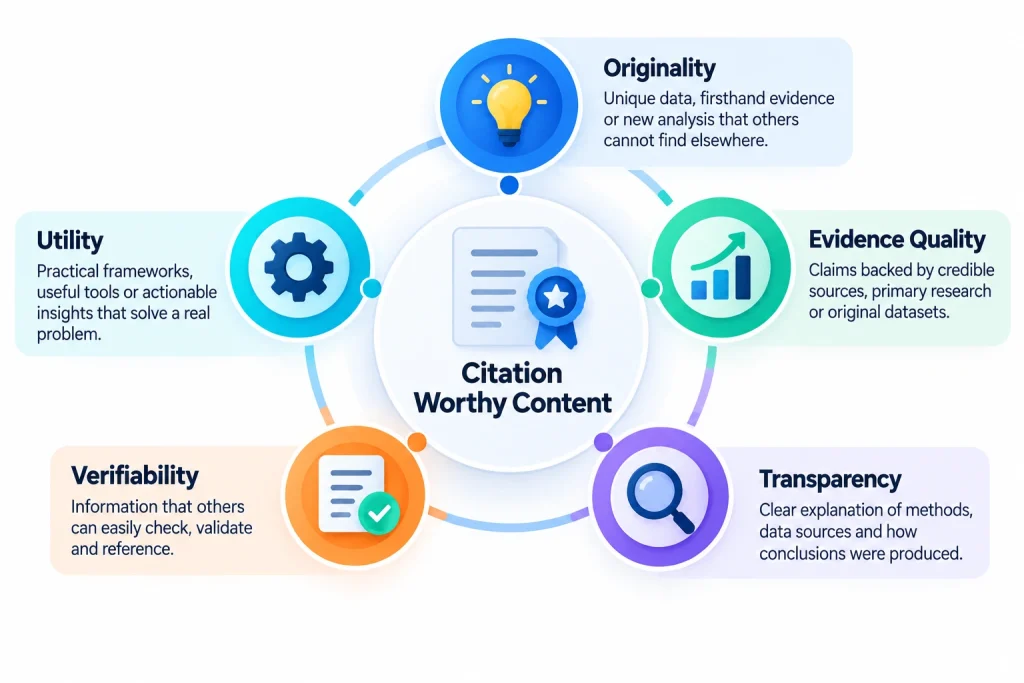
While these qualities establish the foundation, their implementation determines how useful and credible the resource becomes.
| Quality | Weak Implementation | Strong Implementation |
| Originality | Repeats existing information | Contributes original data, firsthand evidence, or new analysis |
| Evidence Quality | Relies on unsupported claims | Uses primary research, official sources, or verifiable datasets |
| Transparency | Provides no research context | Documents methodology, data sources, and limitations |
| Verifiability | Makes claims without traceable evidence | Allows readers to independently verify important claims |
| Utility | Repeats generic advice | Helps readers make decisions, conduct research, or solve problems |
A resource does not need to achieve the strongest level in every category. It should provide enough independent value to justify referencing the original page.
Original Information and Firsthand Evidence
Original information gives publishers a reason to cite the source that produced it. Useful forms include:
- Surveys
- Experiments
- Observational studies
- Proprietary datasets
- Public data analysis
- Expert interviews
- Case studies
- Field observations
- Original frameworks
Originality does not require discovering something revolutionary.
A local SEO agency could analyze Google Business Profiles for dental practices across selected Canadian cities. A software company could analyze anonymized product usage patterns. A consultant could document results from the same process across multiple client projects.
Each project can create evidence that did not previously exist in the same form.
Reliable Sources and Evidence to Claim Accuracy
Every important factual claim should be supported by evidence that actually proves the claim being made. A source discussing increased mobile usage does not prove that mobile conversion rates increased.
A study of consumers in one country does not automatically support a claim about global consumers. A correlation between two variables does not prove that one caused the other. Evidence must match the scope of the claim.
Prefer primary sources where practical. Examples include:
- Government datasets
- Academic research
- Regulatory publications
- Official documentation
- Original surveys
- Primary datasets
- Direct expert statements
Secondary reporting can add context, but the source provides stronger provenance when it is available.
Author Expertise, E E A T, and Research Transparency
Readers should be able to understand who created a resource, how it was produced, and why its evidence should be trusted. Google Search Central describes E E A T as experience, expertise, authoritativeness, and trustworthiness. Google also states that E E A T itself is not one specific ranking factor.
Useful transparency signals include:
- Clear authorship
- Relevant author credentials
- Expert review where appropriate
- Research methodology
- Data sources
- Research dates
- Study limitations
- Correction history
- Update history
Transparency allows readers to evaluate the research accurately.
What Types of Content Attract Citations?
Different content formats create different kinds of reference value. The best choice depends on whether your audience needs new evidence, interpretation, recurring data, practical utility, or a reusable visual resource.
| Content Type | Best For | Main Strength | Main Requirement |
| Original research and surveys | Producing new statistics, benchmarks, opinions, or behavioral findings | High originality | Clear sampling, methodology, and limitations |
| Public data analysis | Finding new patterns in government, academic, regulatory, or industry datasets | Original interpretation without collecting a new dataset | Accurate analysis and clear data provenance |
| Statistics resources | Topics where journalists and writers repeatedly need numerical evidence | Recurring research utility | Primary sourcing, contextual explanation, and regular updates |
| Case studies | Documenting a process and its observed results | Firsthand evidence | Clear baseline, intervention, measurement, outcome, and limitations |
| Expert research and frameworks | Explaining complex problems through specialist knowledge | Interpretive value | Demonstrable expertise and practical applicability |
| Tools and calculators | Solving recurring calculations or practical tasks | Functional utility | Accurate logic and dependable maintenance |
| Charts and data visualizations | Making complex evidence easier to interpret and reuse | Communication value | Visible data provenance and enough context to prevent misinterpretation |
The strongest format matches the evidence need. Original research works well for new findings, statistics resources support recurring fact-checking, and tools or visual assets become valuable when they help people solve or explain a specific problem.
How to Create Citation-Worthy Content Step by Step
The strongest citation-worthy resources begin with an evidence gap rather than a keyword target.
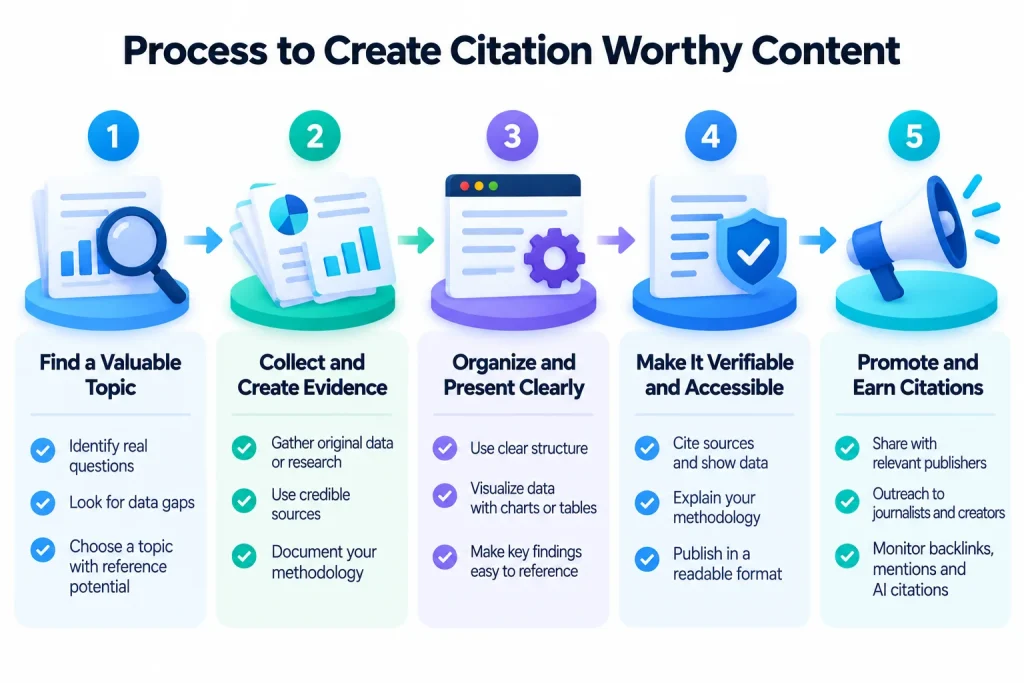
Step 1: Find a Topic That Needs Better Evidence
Look for recurring questions that currently rely on weak, old, conflicting, or unsupported information. Good opportunities include:
- Frequently repeated statistics with unclear origins
- Outdated industry benchmarks
- Conflicting claims
- Common assumptions without evidence
- Questions journalists repeatedly investigate
- Comparisons without reliable data
- Topics dominated by anecdotal advice
The best opportunities combine information demand with inadequate existing evidence.
Step 2: Analyze Existing Citations
Use backlink research tools such as Ahrefs or Semrush to identify competitor resources that publishers already reference. Study the reason behind each citation.
Record:
- The cited claim
- The source page
- The publication citing it
- The age of the evidence
- The research method
- The context of the citation
- Weaknesses in the existing evidence
The goal is to understand what evidence publishers need and determine whether you can create something more useful.
Step 3: Choose the Right Research Method
Match the method to the question.
- Use a survey to measure reported opinions, preferences, experiences, or behaviors.
- Use observational research to record visible characteristics without asking participants.
- Use an experiment to test the effect of controlled changes where the research design supports causal analysis.
- Use public data analysis to answer a new question using an existing dataset.
- Use interviews to capture qualified expert experience.
- Use a case study to document what happened during a specific process.
The method should determine what conclusions you can make.
Step 4: Collect and Document the Evidence
Record methodological details during the research process. Document:
- Research dates
- Data sources
- Sample criteria
- Inclusion rules
- Exclusion rules
- Data cleaning methods
- Analytical methods
- Missing observations
- Potential bias
- Research limitations
Do not hide inconvenient observations simply because they weaken the desired conclusion. The research should determine the conclusion.
Step 5: Find the Information Gain
Information gain means contributing useful information that competing resources do not already provide adequately. It comes from:
- Original data
- Firsthand experience
- New analysis
- Better synthesis
- A previously unexplored comparison
- Clearer interpretation
- A useful framework
- A practical tool
Do not treat information gain as a publicly documented numerical Google ranking score.
The practical question is simpler: What can someone learn from this resource that they could not learn as effectively from the existing alternatives?
Step 6: Map Every Important Claim to Evidence
Create an evidence map before publication so every material claim can be traced to its supporting evidence.
| Element | What to Record |
| Claim | The statement you plan to publish |
| Evidence | The data, observation, or source that supports the claim |
| Original source | Where the evidence originated |
| Limitation | The condition that affects how broadly the claim can be interpreted |
For example:
| Element | Example |
| Claim | A defined proportion of sampled dental practices met a particular local search condition |
| Evidence | Observations recorded during the study |
| Original source | The research dataset |
| Limitation | The result applies only to the selected locations, sample criteria, research period, and measured variables |
This process exposes unsupported claims, weak evidence, and overextended conclusions before publication.
Step 7: Turn Findings Into Citation-Ready Sections
Structure each section so the finding, supporting evidence, practical meaning, and limitation appear together. This makes the information easier to verify, quote, and reference accurately.
| Element | Purpose |
| Finding | States what the research discovered |
| Evidence | Shows the data or observation supporting the finding |
| Meaning | Explains why the finding matters |
| Limitation | Defines where the conclusion stops |
This structure helps journalists, publishers, researchers, and readers understand exactly what the evidence supports and what they can responsibly reference.
Step 8: Publish an Accessible Research Asset
A useful source still needs to be discoverable and usable. Provide:
- A stable page address
- Clear authorship
- Publication information
- Update information
- Visible methodology
- Accessible text
- Search crawl accessibility where appropriate
- Relevant internal links
- Accurate canonical signals where necessary
- Clear attribution rules for reusable charts or datasets
Important information should not exist only inside images.
How to Make Content Easier for AI Search Systems to Reference
AI citation visibility depends on four stages: access, understanding, retrieval, and citation display.
| Stage | What It Means | What Helps |
| Access | The system must be able to access the relevant content | Allow appropriate crawler access and avoid blocking important pages |
| Understanding and processing | The page must communicate its subject, entities, and evidence clearly | Use descriptive headings, accessible text, accurate structured data, and clear source attribution |
| Retrieval | The source must be relevant to the specific query | Keep sections tightly focused, answer specific questions directly, and provide contextual evidence |
| Citation display | An accessible and relevant source may still not appear as a visible citation | Improve source quality and reference value without assuming placement is guaranteed |
OpenAI states that publishers seeking inclusion in ChatGPT search should allow its search crawler and relevant published crawler traffic. Google also provides crawl and indexing controls for site owners and explains that structured data can help its systems understand page information.
Relevance remains query-specific. A study about Canadian dental practices may be useful for a question about Canadian dental marketing but less relevant to a broader question about international healthcare marketing.
The goal is to improve accessibility, relevance, and reference value rather than attempt to guarantee an AI citation.
How to Structure Content for Easier Retrieval and Citation
Important passages should make sense within their immediate context.
- Start with the answer.
- Provide the evidence.
- Explain what it means.
- State material limitations.
For example, do not write:
Our analysis produced an interesting result that changes how businesses should think about this issue.
Write:
Our analysis found a specific pattern across a defined sample during a stated research period. The finding applies to that sample and does not establish causation.
The second version contains information that can be understood and evaluated independently.
Use descriptive headings such as:
- Research Methodology
- Sample Definition
- Key Findings
- Results by Market
- Study Limitations
- Data Sources
- Research Updates
Clear labels help both readers and automated systems locate relevant passages.
How to Earn Editorial Citations Through Distribution
Publishing useful research creates citation potential. Relevant distribution creates discovery.
Identify Relevant Journalists and Publishers
Find writers who already cover the subject your evidence addresses. Evaluate:
- Their publication topics
- Their recent articles
- Their audience
- The statistics they currently cite
- The research organizations they reference
- Gaps your evidence can fill
Lead With the Strongest Finding
A research pitch should communicate the evidence quickly. Include:
- The main finding
- Why it matters
- Who the research covers
- How the data was collected
- Where the full methodology is available
Preserve Editorial Independence
Do not frame legitimate research distribution as a demand for backlinks. Share useful evidence.
Allow the publisher to decide whether and how to reference it. Relevant industry communities, professional networks, newsletters, conferences, and platforms such as LinkedIn can also help appropriate audiences discover the research.
Practical Example: Turning Generic SEO Content Into a Citation Worthy Resource
Consider a Canadian SEO agency creating content about local search visibility for dental practices.
Before: Generic SEO Content
The agency publishes an article recommending that dentists optimize Google Business Profile information, earn reviews, improve their websites, and create relevant local pages.
The advice may be useful, but it offers little original evidence for journalists, publishers, or researchers to reference.
After: A Research Based Resource
The agency turns the topic into a defined research project.
Research question:
What observable characteristics commonly appear among dental practices visible for selected local search queries in chosen Canadian cities?
Before collecting data, the researchers define the cities, queries, collection dates, sample criteria, and variables. They could record:
- Review counts
- Review recency
- Primary categories
- Profile completeness
- Website characteristics
- Local page availability
- Selected visibility observations
The final report presents the methodology, sample, findings, and limitations. It distinguishes observed relationships from causal conclusions and avoids claiming that a characteristic causes higher rankings unless the research design can support that conclusion.
The finished resource now provides evidence that a dental publication, marketing journalist, or relevant AI search system could reference. The difference is not content length. It is the presence of original, verifiable evidence.
How to Measure Citation-Worthy Content Performance
Do not combine every citation signal into one visibility metric.
Measure Editorial Backlinks
Track:
- New referring pages
- New referring domains
- Publication relevance
- Citation context
- The finding being cited
- Repeat citations
Measure Brand Mentions
Track linked and unlinked references separately. Record:
- Publication
- Mention context
- Research or expert referenced
- Link presence
- Audience relevance
This reveals whether the research is building recognition even when a hyperlink is absent.
Measure AI Citation Visibility
Create a controlled prompt sample around the target topic. Record:
- Platform
- Prompt
- Prompt category
- Test date
- Brand appearance
- Page cited
- Citation context
- Competing sources
- Relevant geographic context
- Variation across repeated observations
Do not use one successful prompt as evidence of broad AI visibility. AI citation monitoring is an observational measurement process.
Connect Citations to Business Results
Use Google Search Console, GA4, backlink platforms, and internal conversion reporting to evaluate business impact. Useful measures include:
- Organic clicks
- Referral visits
- Engaged sessions
- Qualified leads
- Signups
- Sales opportunities
- Assisted conversions
Not every citation generates measurable traffic. Some citations primarily improve discovery, recognition, or future reference potential.
Common Mistakes That Prevent Citations
Citation potential drops when content lacks original value, reliable evidence, methodological clarity, or ethical distribution. These mistakes weaken credibility and make the resource less useful as a source.
| Mistake | Consequence | Correction |
| Recycled statistics | The article adds little independent value and may repeat outdated information | Trace statistics to the source, verify them, and add useful analysis |
| Unverifiable claims | Readers cannot confirm whether the statement is accurate | Connect material claims to accessible and reliable evidence |
| Weak sampling | Findings may be presented more broadly than the research supports | Define the sample, selection criteria, and limitations |
| Overstated conclusions | Correlation, observation, or anecdotal evidence may be presented as causation | Match every conclusion to what the research design can support |
| Generic AI-produced content | The resource may repeat existing information without adding reference value | Add verified evidence, firsthand experience, expert interpretation, or original analysis |
| Manipulative outreach | Research promotion becomes a backlink solicitation campaign | Lead with relevant evidence and preserve editorial independence |
| Combining backlinks and AI citations | Performance reporting becomes misleading | Measure editorial links, brand mentions, AI citations, traffic, and conversions separately |
Avoiding these mistakes improves accuracy, traceability, and independent reference value, which are the qualities publishers and other information systems need from a dependable source.
How to Maintain Citation-Worthy Content
Reference resources lose value when their evidence becomes inaccurate or inaccessible. Review important pages according to how quickly their underlying information changes.
Check:
- Statistics
- Source availability
- Methodology descriptions
- Broken references
- Research limitations
- Publication information
- Correction history
- Major changes in the underlying topic
Do not silently rewrite historical research findings. A new dataset can be published as an update while preserving enough information for readers to understand what changed.
Clear correction and update records strengthen traceability.
Frequently Asked Questions
Can You Create Citation-Worthy Content Without Original Research?
Yes. Expert analysis, case studies, technical guides, calculators, and well-sourced reference pages can still provide strong citation value.
Can AI-Generated Content Earn Backlinks and Citations?
Yes, but only if the final content is accurate, useful, well verified, and adds independent value. Human review is still important.
Does Schema Markup Help Content Earn AI Citations?
It can help search systems understand page information, but it does not guarantee AI citations. Content quality and relevance still matter.
How Long Does It Take to Earn Citations?
There is no fixed timeframe. Results depend on topic demand, distribution, competition, source quality, and discovery.
How Often Should Citation-Worthy Content Be Updated?
Update it whenever the underlying data, sources, or conclusions may no longer be accurate. Fast-changing topics need more frequent review.
17. Final Citation Worthy Content Checklist
Before publishing, confirm that the resource passes these checks.
- It addresses a real evidence gap.
- The research question is clearly defined.
- The research method matches the question.
- Important claims have supporting evidence.
- Primary sources are used where practical.
- The methodology is documented.
- Sample criteria are explained.
- Research limitations are visible.
- Correlation is not presented as causation.
- The page contributes original evidence, analysis, experience, or utility.
- Important findings appear in accessible text.
- Tables and visuals identify their data sources.
- The author and relevant expertise are clear.
- Publication and update information is available.
- The page is technically accessible to intended search systems.
- Important passages make sense in their immediate context.
- Reusable assets have clear attribution terms where needed.
- Distribution targets relevant journalists and publishers.
- Outreach preserves editorial independence.
- Editorial backlinks and AI citations are measured separately.
- Citation monitoring uses a repeatable process.
- Traffic and business outcomes are evaluated independently.
- Sources and statistics are reviewed as the topic changes.
Citation-worthy content is an evidence product.
Find a question that needs stronger evidence. Collect or identify reliable information. Match every important claim to its source. Explain the methodology and limitations. Present findings clearly enough for others to verify and reference.
Backlinks, mentions, and AI citations are possible outcomes of that work. The foundation is simpler: publish information worth citing.