
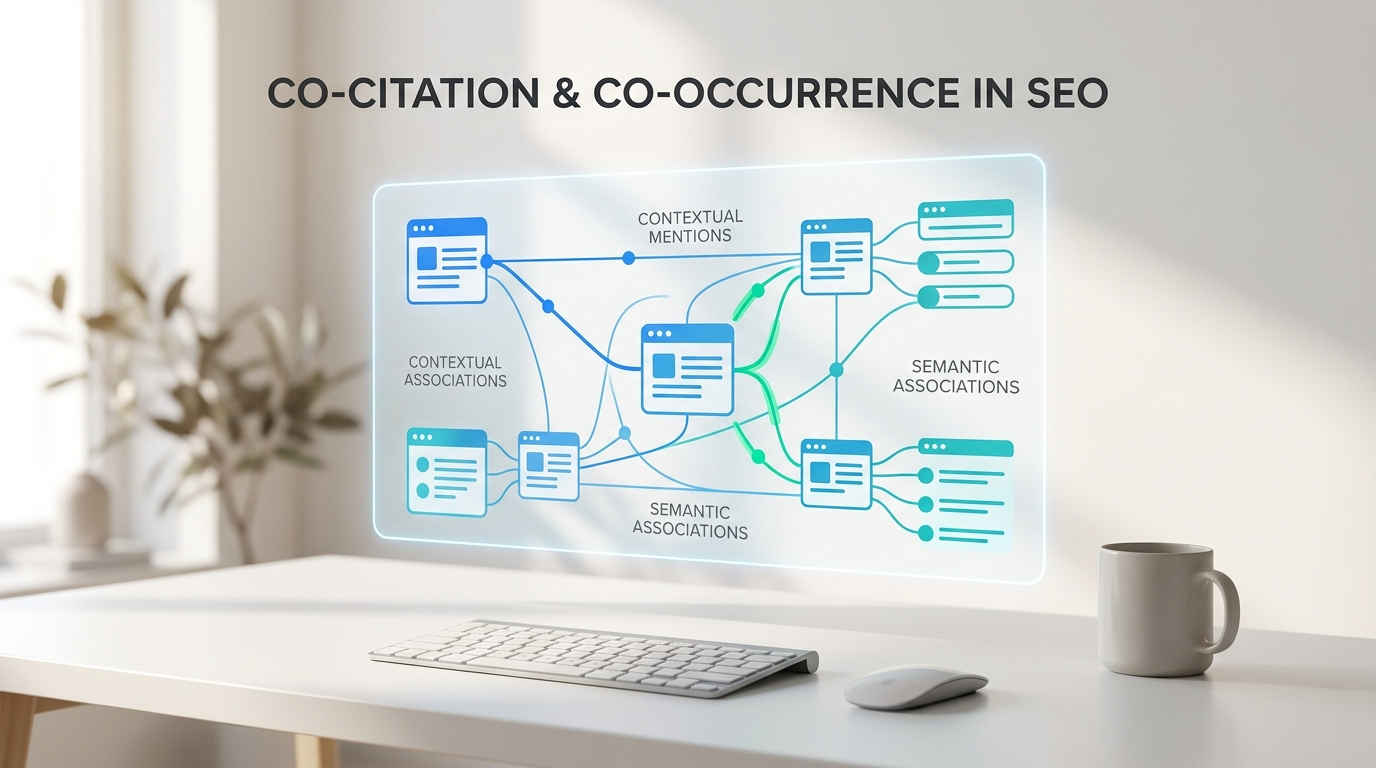
The old SEO habit of counting keywords and backlinks misses part of how modern search systems understand a page. A site can earn links and still look semantically thin if it doesn’t connect the right entities, concepts, sources, and context around a topic.
Why Backlinks Alone No Longer Explain Search Authority
Backlinks still matter. Google does list link analysis systems, including PageRank, among its ranking systems. But Google also describes systems such as BERT, neural matching, RankBrain, passage ranking, and other mechanisms designed to understand concepts, relationships, and meaning rather than simply matching repeated keywords.
For a page to become authoritative, search systems need to understand what the page is actually about. Does it cover crawling, indexing, canonicalization, redirects, XML sitemaps, rendering, structured data, and other concepts naturally associated with the subject?
This is where co-citation and co-occurrence in SEO become useful concepts.
Google does not publish a formula saying, “Mention Entity A beside Entity B five times and rankings will improve.” Treating them that way is just keyword stuffing with newer vocabulary.
The more useful interpretation is that co-citation and co-occurrence explain how search engines and information-retrieval systems identify relationships between entities, concepts, brands, and topics.
What Is Co-Citation in SEO?
Co-citation occurs when two entities, brands, websites, people, or resources are referenced together by another source.
A simplified example:
An industry article discusses Ahrefs, Semrush, and Moz as established SEO platforms.
The article may not link to all three websites. Yet their repeated appearance within the same topical context creates an association between those entities.
The traditional SEO version of co-citation focuses on websites. Imagine several respected digital marketing publications repeatedly mentioning:
- Your agency
- Semrush
- Ahrefs
- Google Search Console
within discussions about SEO audits.
The repeated contextual association contributes to how people, and search systems, understand the entity’s topical neighborhood.
How Co-Citation Works Without a Direct Link
A hyperlink is an explicit connection. Co-citation is a contextual connection created because another source references two or more entities together.
| Signal | What creates the relationship? | Requires a hyperlink? |
| Backlink | One page links to another | Yes |
| Co-citation | Multiple entities or sources are referenced together | No |
| Co-occurrence | Terms or entities repeatedly appear in related contexts | No |
This is why the claim that “an unlinked mention is the same as a backlink” is misleading.
It isn’t.
Google has documented link analysis as part of its ranking systems. An unlinked brand mention should not automatically be treated as a replacement for an editorial backlink.
Links, mentions, entity associations, and topical context can all contribute to a broader picture of relevance.
Brand and Website Mentions as Contextual Signals
Suppose an emerging SEO software company appears in:
- expert roundups about keyword research,
- comparison articles covering established SEO platforms,
- conference coverage,
- podcast transcripts,
- original industry research,
- discussions about entity-based SEO.
Over time, those references create a recognizable association between the brand and a particular topic.
The relationship matters more than the raw mention count.
What Is Co-Occurrence in SEO?
Co-occurrence refers to terms, phrases, concepts, or entities appearing together across a document or larger collection of documents.
The simplest example is a page about international SEO that discusses:
- hreflang
- ccTLDs
- subdomains
- subfolders
- language targeting
- regional targeting
- canonical tags
- duplicate content
Those concepts co-occur because they belong to the same semantic environment.
A Google patent describing ranking based on entity metrics discusses determining relatedness based, in part, on the co-occurrence of words or entity references across webpages, including how frequently related entities appear together.
A patent is not proof that every described method is used in Google’s live ranking system. It does show that entity co-occurrence is a legitimate information-retrieval concept rather than an SEO invention.
Keywords, Entities, and Contextual Proximity
Co-occurrence isn’t just about whether two words exist somewhere on the same 4,000-word page. Context and proximity matter. Consider these two sentences:
Google Search Console and crawl budget analysis can help identify inefficient crawling patterns.
Now compare that with:
Google Search Console is useful for SEO. A crawl budget is also important for large websites.
Both contain similar words. The first establishes a much clearer conceptual relationship.
Modern search systems are built to understand rather than keyword matching. Google describes BERT as helping it understand how word combinations express meaning, while neural matching and RankBrain help connect concepts and related language.
That doesn’t mean every semantically related word must appear on every page. It means a strong page demonstrates an understanding of the conceptual territory surrounding its main subject.
Co-Citation vs. Co-Occurrence: What’s the Difference?
 The two terms are used interchangeably because both involve relationships without requiring a traditional hyperlink.
The difference is straightforward.
Co-citation focuses on association between entities or sources.
Example:
Google Search Console, Screaming Frog, and Semrush are frequently discussed together in technical SEO workflows.
Co-occurrence focuses on concepts or entities appearing together within relevant contexts.
Example:
A technical SEO audit may involve crawling, indexation analysis, canonicalization, redirect validation, and structured data checks.
How Modern Search Engines Use Entities and Relationships
Search engines work with representations of concepts rather than treating every query as a disconnected string of keywords.
An entity is something identified within context: a person, company, product, location, organization, event, or concept.
For example, “Apple” can be ambiguous. Is it the company or the fruit?
Context resolves the entity:
- Apple + iPhone + Tim Cook: technology company
- apple + orchard + fruit tree: food/agriculture
That ability to understand relationships is central to semantic SEO.
The Role of Entity-Based SEO
Entity-based SEO isn’t about sprinkling famous company names into content. Instead, it involves identifying the entities genuinely needed to explain a topic.
For a page targeting co-citation and co-occurrence in SEO, relevant entities and concepts might include:
- Google Search
- Knowledge Graph
- BERT
- neural matching
- RankBrain
- PageRank
- structured data
- semantic search
- topical authority
- entity relationships
- backlinks
- search intent
- internal linking
Not every one needs to appear, and none should be inserted simply to tick a box.
The question should be:
Would a knowledgeable reader expect this concept to appear in a complete explanation?
Google’s people-first content guidance asks creators whether content provides original information or analysis and a substantial, complete description of the topic. That’s a much better standard than trying to reach an arbitrary entity count.
Knowledge Graphs, Semantic Relationships, and Topic Context
A useful mental model is a graph.
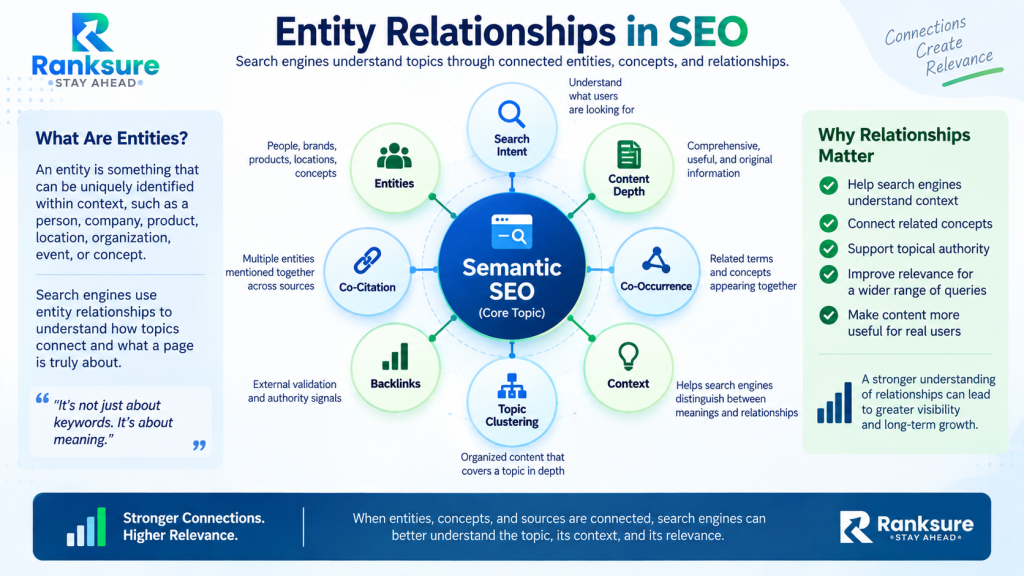
Your primary topic sits in the center. Around it are directly related concepts, entities, questions,  processes, and supporting topics.
The purpose isn’t to publish one page containing every possible node. A stronger approach is to decide:
- Which concepts deserve detailed coverage on the main page.
- Which deserve their own supporting articles.
- How those pages should connect internally.
- Which external entities and sources add genuine context or evidence.
That’s the foundation of a useful SEO topic clustering strategy.
Why Traditional Keyword-Focused Content Can Look Thin
Older SEO workflows confuse optimization with repetition. A writer sees a keyword with a recommended density range and starts forcing it into:
- every heading,
- every second paragraph,
- image alt text,
- the conclusion,
- FAQ answers.
The result reads like someone trying to convince a machine that the article is relevant.
Thin Content Identification Through Missing Entity Coverage
Thin content isn’t defined solely by word count. A 3,000-word article can still be thin if it circles the same basic idea without adding useful context.
Take two pages targeting a technical SEO audit.
Page A:
The keyword repeats everywhere, but the article barely explains what gets audited.
Page B:
The second page has greater semantic depth because it addresses the components that define the topic. That doesn’t guarantee a number-one ranking. But it gives readers and search systems context for understanding what the page actually covers.
Why Keyword Density Is an Outdated Optimization Metric
Keyword density had some practical value as a crude check against completely forgetting the target phrase.
There is no universal “perfect” keyword density that improves rankings.
I’ve seen content teams damage good drafts because they were trying to push a phrase from 0.8% to 1.5%. The finished article rarely became useful.
A better review asks:
- Does the page clearly establish its main topic?
- Are the important subtopics present?
- Are relevant entities explained accurately?
- Does the page answer the next logical questions?
- Are concepts connected naturally rather than listed randomly?
- Does the article offer something beyond what ten competing pages already say?
That’s content depth analysis, not keyword counting.
How to Analyze Co-Occurrence Patterns in Top-Ranking Pages
You don’t need a proprietary entity graph to begin. Start with the SERP.
Search your primary topic and analyze a meaningful sample of top-ranking pages. Look for recurring concepts rather than simply copying headings.
 Competitor SERP Benchmarking for Shared Entities and Terms
Create a simple benchmark.
Look for shared patterns. If nearly every credible page discusses entities, semantic relationships, information retrieval, and contextual relevance, those are strong candidates for your content model.
If one competitor mentions an unrelated buzzword once, ignore it.
Identifying Secondary Entities and Supporting Concepts
A useful method is to classify findings into three groups:
Core entities
The concepts essential to the page’s primary topic.
Supporting entities
Concepts required to explain, apply, or validate the main topic.
Peripheral entities
Interesting but non-essential concepts that may deserve separate content.
For this article:
- Core: co-citation, co-occurrence, entities, semantic relationships
- Supporting: backlinks, topical authority, semantic search, BERT, neural matching
- Peripheral: knowledge graphs, information-retrieval patents, AI search experiences
This prevents a common mistake in semantic SEO: trying to cover the entire internet on one URL.
Comparing Internal and External Entity Citation Patterns
Also inspect how strong competitors support their claims. Do they:
- cite primary documentation?
- reference research or patents where appropriate?
- link to authoritative definitions?
- connect the article to related internal resources?
- mention tools only when they help solve a specific task?
This matters because entity relationships should exist in a useful information architecture, not just inside the body copy.
Google continues to recommend making content discoverable through internal links and ensuring structured data accurately matches visible content. It also states that no special markup or technical requirement is needed for AI Overviews or AI Mode.
That last point is worth emphasizing because current SEO advice has drifted toward imaginary “AI SEO schema.”
Building an SEO Topic Clustering Model Around Entities
A topic cluster should represent how the subject actually works. Let’s use semantic SEO as an example.
Core Topic: Semantic SEO
Your pillar page explains:
- what semantic SEO means,
- how entities differ from keywords,
- topical relationships,
- search intent,
- content structure,
- internal linking.
Supporting content can then cover individual areas in greater depth:
- Entity-based SEO
- Co-citation and co-occurrence
- Topic clustering
- Content depth analysis
- SERP competitor benchmarking
- Thin content identification
- Internal linking for topical authority
The pillar shouldn’t repeat the full explanation from every supporting page. It should introduce the relationship and link users toward the deeper resource.
Mapping Core Entities and Related Concepts
A simple planning model looks like this:
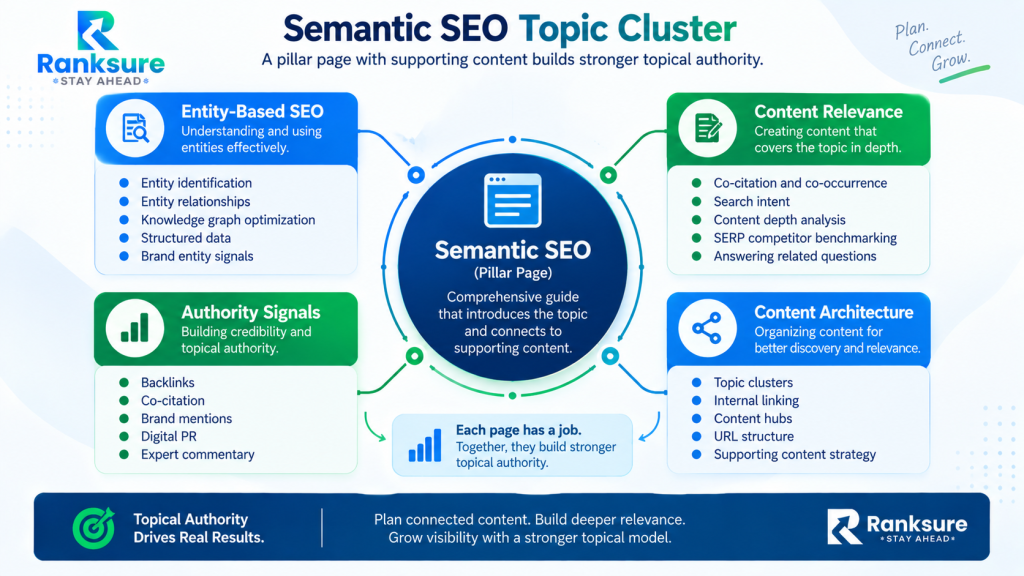
That’s much stronger than publishing 15 loosely related posts that all target variations of the same keyword.
Using Brand Co-Occurrences to Build Associations
Brand association should be earned, not manufactured. For example, for an SEO agency to become associated with:
- technical SEO,
- international SEO,
- semantic SEO,
- content strategy,
its content, research, expert commentary, partnerships, and industry mentions should support those associations.
Publishing one article that lists the agency next to Google, Semrush, and Ahrefs won’t accomplish much. Repeated relevance across credible contexts is the required strategy.
A Practical Example of Co-Citation and Co-Occurrence in Action
Imagine a company publishing an in-depth guide to international SEO. A weak version may repeat international SEO strategy throughout the page while offering generic advice.
A stronger version connects the topic with concepts such as:
- hreflang implementation,
- language and region targeting,
- ccTLDs,
- subdomains,
- subfolders,
- duplicate content,
- canonicalization,
- localized keyword research,
- server location misconceptions.
It also references relevant primary documentation and links internally to deeper guides. The stronger page represents the topic completely because the concepts appear in meaningful relationships.
That’s where co-occurrence becomes useful as a content-analysis framework rather than another optimization score.
Recent Developments Shaping Semantic Search and Entity Signals
Helpful Content Is Part of Google’s Core Ranking Systems
The standalone Helpful Content system was folded into Google’s core ranking systems in March 2024. Google’s ranking documentation still describes multiple systems and signals, while its people-first guidance emphasizes original, useful, and substantial content.
For content teams, the practical lesson is to focus less on superficial keyword variations and more on whether a page genuinely satisfies its purpose.
AI Overviews and AI Mode Don’t Require Special SEO Markup
Google’s guidance says there are no additional technical requirements or special optimizations needed specifically for AI Overviews or AI Mode. The fundamentals remain familiar: crawlable content, useful information, internal discoverability, visible text, and structured data that accurately represents the page.
Semantic clarity is more defensible than chasing mythical AI-specific markup.
Scaled AI Content Raises the Value of Original Context
Google’s guidance on generative AI warns that using automation to create many pages without adding value can violate its scaled content abuse policy. The issue isn’t simply whether AI was involved.
Content becomes weak when it is interchangeable, repeating familiar information without useful analysis, evidence, experience, or context.
How to Optimize Content for Co-Citation and Co-Occurrence
Optimize for co-citation and co-occurrence by covering the concepts that define the topic, explaining how relevant entities connect, earning contextual mentions, and linking related content logically.
Write Around Topics, Not Repeated Keywords
Start with the user’s problem and identify the concepts needed to solve it.
Ask:
If I removed the primary keyword, would a knowledgeable reader still understand what this page is about?
If not, the content relies heavily on keyword repetition instead of topical coverage.
Build Meaningful Entity Relationships
Don’t just mention relevant entities. Explain how they connect.
Weak:
Google, BERT, RankBrain, and semantic SEO are important.
Stronger:
Google’s systems such as BERT and RankBrain illustrate the shift toward understanding language and conceptual relationships, which is why semantic SEO focuses on meaning and context rather than exact keyword repetition.
The stronger version explains why the entities belong together.
Earn Relevant Mentions
Use original research, expert commentary, digital PR, useful tools, or proprietary insights to give relevant publications a reason to mention your brand.
Instead of asking:
How do we get mentioned beside famous companies?
Ask:
What can we contribute that makes an industry publication naturally mention us when discussing this topic?
The objective is relevant contextual association, not more mentions.
Strengthen Internal Links Between Related Topics
Connect pages that support one another.
For example:
Semantic SEO → Entity SEO → Co-Occurrence → Co-Citation → Topic Clustering
Use descriptive anchor text and link where the destination helps the reader understand the topic further.
Internal links clarify your site’s content relationships and architecture, but they don’t create topical authority by themselves.
Common Misunderstandings About Co-Citation and Co-Occurrence
| Misunderstanding | What to Know Instead |
| “Co-citation replaces backlinks.” | Google still documents link analysis and PageRank as part of its ranking systems. Co-citation is better understood as a contextual association concept, not a replacement for editorial links. |
| “More entities always mean better SEO.” | Randomly inserting entities creates noise. Relevance and meaningful relationships matter more than quantity. |
| “Keyword density doesn’t matter at all.” | Exact density targets aren’t a useful optimization strategy, but the page still needs to make its topic clear. |
| “There’s a co-occurrence score you need to hit.” | Third-party tools can identify recurring entities and semantic gaps, but they cannot provide Google’s exact internal threshold or formula. Use their data for research, not as an artificial target. |
Practical Takeaway: Co-Citation and Co-Occurrence Checklist
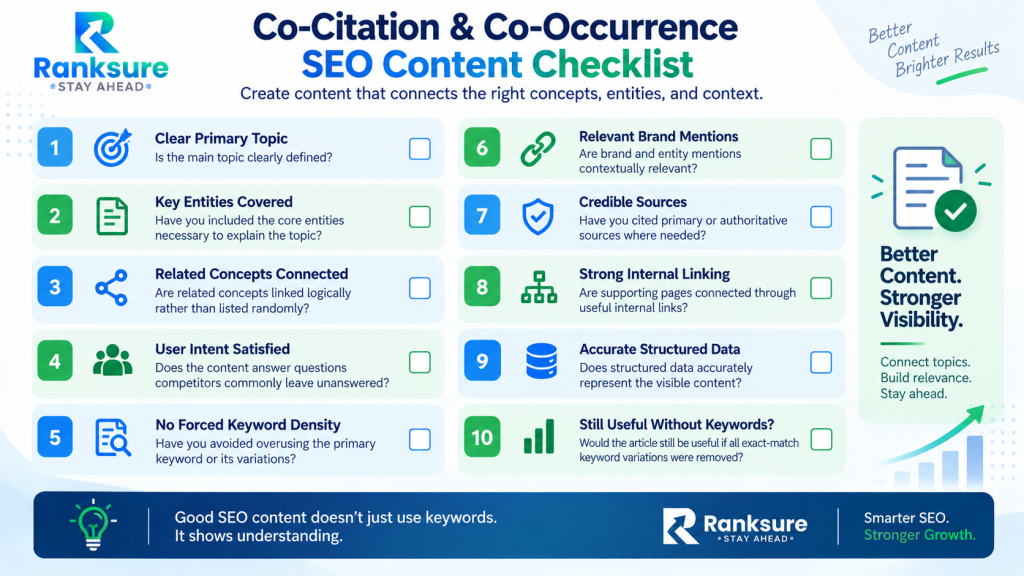
If several answers are “no,” adding 500 words of generic copy probably won’t solve the problem. Revisit the topic model first.
Conclusion: Why Co-Citation and Co-Occurrence in SEO Matter
Co-citation and co-occurrence in SEO are most useful as research and content-analysis frameworks, not metrics to optimize directly.
Identify the entities, concepts, sources, and relationships that genuinely define a topic. Then build content that explains those connections clearly, accurately, and with enough depth to solve the reader’s problem.
Keywords and backlinks still matter. The difference is that strong SEO content gives them meaningful context rather than treating either as a numbers game.
FAQs
Does Co-Citation Help SEO Without a Backlink?
Co-citation describes contextual associations that emerge when entities are repeatedly referenced together in relevant sources. However, it shouldn’t be treated as equivalent to a backlink or as a confirmed standalone Google ranking factor.
Is Co-Occurrence the Same as Keyword Density?
No. Keyword density measures repetition of a phrase. Co-occurrence examines how related words, concepts, and entities appear together within meaningful contexts.
How Do You Find Important Entities for SEO Content?
Start with the SERP, authoritative documentation, expert resources, related searches, and the questions users need answered. Then separate essential entities from merely related or peripheral ones.
Can a Small Brand Benefit From Co-Citation?
A small brand can build stronger topical associations by earning relevant mentions through useful content, original research, expert commentary, or products worth discussing. Artificially placing a brand beside established companies isn’t the same thing.
Is Co-Occurrence a Confirmed Google Ranking Factor?
Google does not publicly document a standalone “co-occurrence ranking factor” or an optimization score that websites need to reach. Co-occurrence is better treated as an information-retrieval concept and a useful framework for analyzing whether content establishes meaningful topical relationships.