
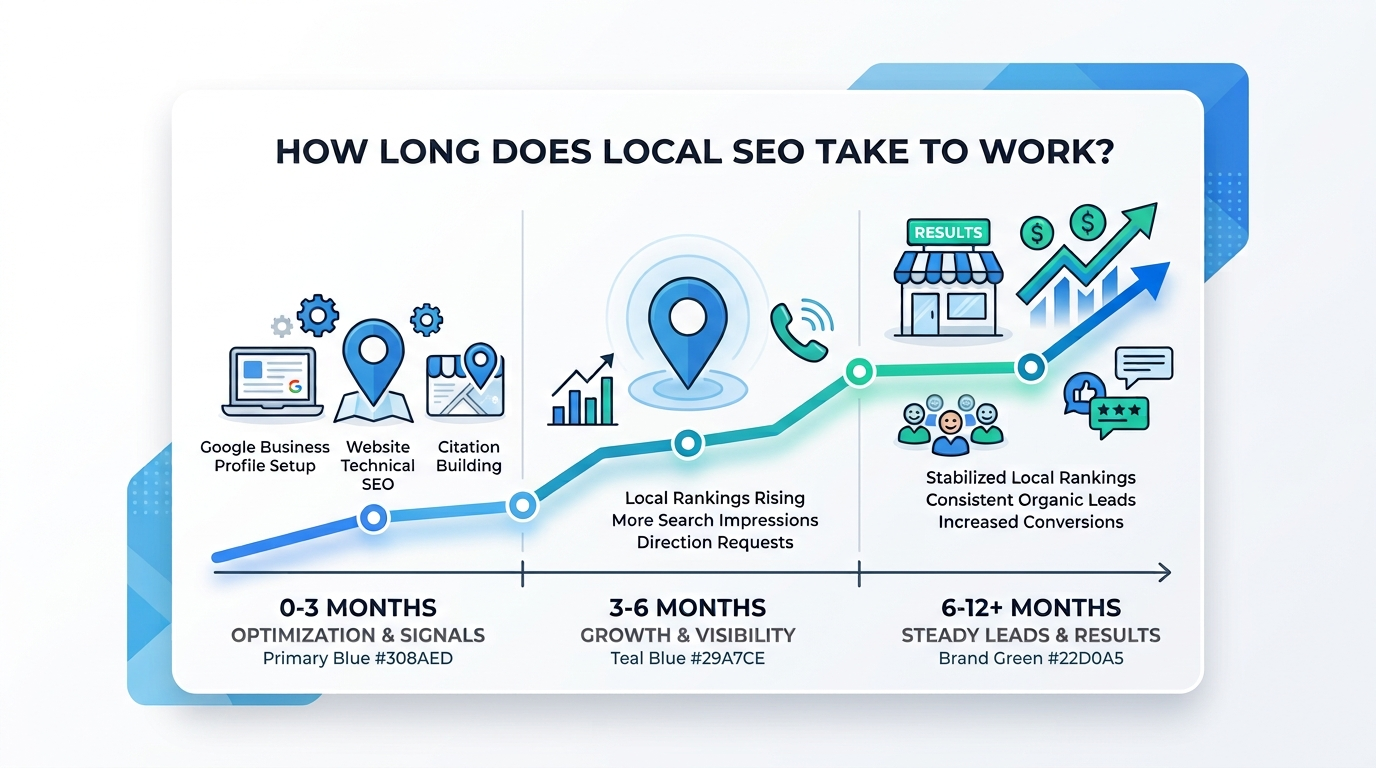
Local SEO does not move in a straight line. A business might gain more Google Maps visibility within weeks while its valuable commercial keywords barely move. Another may improve after fixing an inaccurate Google Business Profile but still need months to compete in local search.
That’s why the usual “local SEO takes 3-6 months” answer isn’t useful on its own.
Profile corrections, indexing, citations, reviews, local content, links, rankings, and leads don’t develop at the same speed. Your starting point and local competition also affect how soon the progress becomes visible.
The better question isn’t simply how long local SEO takes. It’s what should improve at each stage and how you know the work is actually producing results.
What Is a Realistic Local SEO Timeline?
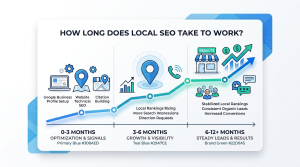
For many businesses, early movement can appear within 4-8 weeks, meaningful progress may develop around 3-6 months, and competitive markets can take 6 – 12 months or longer to establish strong, consistent visibility.
These are practical working ranges, not guarantees.
Google doesn’t publish a fixed timeline for local ranking improvements. Its local ranking guidance focuses on relevance, distance, and prominence.
Starting position matters too.
An established plumber in a smaller market may already have an accurate Google Business Profile, indexed service pages, citations, reviews, links, and branded searches. A new law firm entering a competitive city, however, needs to establish those signals while competing against firms that have built local visibility for years.
I’ve seen this pattern repeatedly in local SEO work: businesses asking for a ranking date have a foundation problem, not a patience problem.
Local SEO Timeline: What to Expect Month by Month
Local SEO becomes easier to evaluate when the timeline is tied to specific work and measurable progress rather than an arbitrary ranking deadline.
Month 1: Build the Foundation
The first month should focus on removing obvious weaknesses.
Start with the Google Business Profile (GBP). Verify the business, select appropriate categories, complete the required fields, correct hours, add relevant services, upload useful photos, and ensure the website supports the information presented on the profile.
Audit the website at the same time.
Look for:
- Slow-loading pages
- Poor mobile usability
- Missing location information
- Weak service pages
- Duplicate location pages
- Incorrect NAP information
- Indexing problems
- Missing internal links
- Thin local content
- Poor title tags and headings
Don’t expect a dramatic ranking jump simply because the profile has been completed. The objective is to make the business accurate, understandable, and technically accessible.
Month 2: Strengthen Local Signals
Once the foundation is clean, reinforce the information Google and customers use to understand the business.
Check important local and industry citations for incorrect or inconsistent business information. Correct duplicate listings and outdated names, addresses, phone numbers, URLs, or hours.
Review generation should also become an ongoing process. Ask genuine customers for honest feedback instead of trying to manufacture a sudden spike.
By this stage, important service and location pages should also be crawlable and indexed.
If nothing is moving at all after the foundational work, don’t decide to wait another four months. Check whether something is still blocking progress.
Month 3: Build Local Relevance
Month three is where campaigns become more strategic.
A generic service page saying “We provide quality plumbing services” gives little evidence about why that business is relevant to a particular local search.
A stronger page might explain the services offered, customer needs, service coverage, common local problems, pricing considerations where appropriate, and legitimate regional factors. Hyper-local content shouldn’t mean inserting city names into every paragraph.
It should demonstrate real local relevance.
A roofing company, for example, might create useful content around regional roofing problems, emergency repair coverage, local commercial projects, or questions customers in that market frequently ask.
Months 4 – 6: Evaluate Visibility
By this stage, enough work should have accumulated to evaluate the campaign more seriously.
Look for:
- Greater Google Maps visibility
- Growth in non-branded search impressions
- Movement for relevant local queries
- More website interactions
- Increased calls or enquiries
- More qualified organic traffic
Don’t expect every keyword to move together.
Distance is part of Google’s local ranking system, so visibility varies depending on where the search happens. A business may perform better from one part of a city and much worse from another.
One manual Google search therefore isn’t a reliable local rank-tracking system.
Months 6 – 12+: Build Competitive Authority
Competitive businesses need more than profile optimization and basic local relevance.
Longer-term work may involve:
- Earning relevant local links and mentions
- Expanding useful service and location content
- Improving topical coverage
- Growing reviews naturally
- Strengthening internal linking
- Building brand recognition
- Improving conversion performance
This is where the difference between temporary ranking movement and durable local visibility becomes clearer.
If competitors have spent years establishing their local presence, a handful of citations or GBP posts won’t automatically close the gap.
Why Some Local SEO Changes Work Faster Than Others
Fixing a weak signal and building a strong signal are different jobs.
Correcting an inaccurate business category, inconsistent NAP information, an indexing problem, or a broken internal link removes an existing obstacle. Those changes produce early movement.
Building prominence is slower.
Reviews have to accumulate naturally. Useful content needs to earn visibility. Relevant links and mentions have to be acquired. A new business may also need to establish signals that older competitors already possess.
A useful way to think about the process is:
Correct → Establish → Strengthen → Compete → Convert
Correct existing problems. Establish local relevance. Strengthen reputation and authority. Compete for harder searches. Then turn that visibility into calls, enquiries, bookings, or sales.
What Determines How Fast Local SEO Works?
There isn’t one universal local SEO clock. Several variables affect how much work is required before stronger visibility becomes realistic.
Local Competition
Competition is the biggest variable.
Ranking for a local service in a small town is fundamentally different from competing for a high-value legal or home-service query in a major city.
The stronger the existing competitors, the more relevance and prominence a business may need to establish.
Website History and Existing Visibility
An established website with useful content, relevant links, indexed pages, and historical search visibility starts with an advantage.
A new website has more groundwork to complete.
That doesn’t mean a new business can’t rank. It means it starts with fewer established signals.
Google Business Profile Quality
The profile should accurately represent the business, including appropriate categories, hours, location or service area, services, and other relevant information.
Completeness isn’t a magic ranking switch.
It’s part of the foundation Google uses to understand the business.
Citation Accuracy
Incorrect addresses, phone numbers, business names, duplicate listings, and outdated information should be corrected.
Citation work should prioritize accuracy and relevance, not the number of directories a business can join.
Reviews and Reputation
Reviews help customers evaluate a business and can contribute to local prominence.
But review count isn’t the entire ranking system.
A business with more reviews can still perform worse than a competitor that is more relevant to the query, closer to the searcher, or stronger in other prominence signals.
Technical Website Health
Local SEO still depends on a functioning website.
If important pages aren’t indexed, internal links are broken, mobile usability is poor, or service information is difficult to understand, local visibility becomes harder to build.
Search Intent and Local Content
Content should match what the searcher actually wants.
Someone searching for “emergency electrician near me” has a different need from someone asking “how much does electrical panel replacement cost?”
The goal isn’t to insert more local keywords. It’s to create the right page for the query.
How Long Do Different Local SEO Activities Take?
Not every part of local SEO is evaluated on the same schedule.
Google Business Profile Optimization
The optimization work itself can be completed within days.
That includes correcting categories, hours, services, business information, photos, and other profile details.
The ranking impact is less predictable.
A completed profile doesn’t automatically outrank established competitors. Think of GBP optimization as fixing the storefront sign. The business still needs relevance, reputation, prominence, and a credible web presence.
Citation Cleanup and Building
Citation cleanup shows value early when you’re correcting inaccurate existing information.
A sensible process is:
Audit → Clean → Standardize → Build → Monitor
Start with the business name, address, phone number, website, hours, and categories. Then review relevant industry and local directories.
A medical practice, restaurant, contractor, and software company won’t need identical citation sources.
The objective is relevant corroboration, not a directory-count competition.
Review Growth
Reviews affect how potential customers perceive a profile relatively quickly, while their broader SEO value depends on the competitive environment.
Don’t chase a review target simply because a competitor has more. Build a repeatable process for requesting genuine feedback from real customers.
Avoid buying reviews, creating fake customer accounts, posting reviews for customers, or pressuring them to use particular wording.
Hyper-Local Content
Hyper-local content creates opportunities for specific searches that broader service pages don’t satisfy.
But creating dozens of thin city pages isn’t a shortcut.
A useful location page might include:
- Services actually offered in the area
- Common customer needs
- Legitimate service boundaries
- Relevant local considerations
- Local project examples
- Area-specific FAQs
If “City A” can be replaced with “City B” without changing anything meaningful, the page isn’t local enough.
Local Link Building
Relevant local links and mentions belong to the longer-term side of the strategy because they have to be earned rather than switched on.
Useful opportunities come from local organizations, partnerships, publications, sponsorships, industry associations, suppliers, community resources, or genuinely newsworthy business activity.
The objective isn’t to increase link volume. It’s to strengthen the business’s connection to its market and industry.
Google Maps Visibility
Google Maps visibility depends on relevance, distance, and prominence, so there isn’t one Maps-specific countdown.
A business may become visible for its brand relatively quickly while remaining weak for competitive non-branded searches.
Location also means rankings vary across the same city. The goal should therefore be broader qualified visibility, not a single Map Pack position measured from one search location.
Local SEO Timeline by Business Type
Different starting conditions produce different expectations.
| Business Type | Working Expectation | Why |
| New local business | 3–6+ months for meaningful traction | Profile, reviews, citations, content, and search visibility are being established |
| Established business in a lower-competition market | Early improvements may appear in 1–3 months | Existing reviews, indexed pages, citations, links, and branded demand provide a stronger starting point |
| Competitive city or service market | 6–12+ months may be required | Established competitors already hold stronger relevance and prominence |
| Multi-location business | 3–12+ months depending on location | Each location has its own competition, profile, reviews, citations, and local visibility |
These are planning ranges, not ranking promises.
What Can Speed Up or Delay Local SEO Results?
The amount of SEO activity matters less than whether the right problems are being addressed.
What Can Speed Up Results?
Prioritize:
- Accurate Google Business Profile information
- Technical and indexing problems
- Clear service and location relevance
- Important citation inconsistencies
- Genuine review generation
- Useful local content
- Relevant local links and mentions
- Reliable rank and conversion tracking
The fastest campaigns usually aren’t the ones doing the most tasks.
They’re the ones fixing the highest-impact problems first.
What Can Delay Results?
| Problem | Why It Delays Progress |
| Incorrect GBP category | Weakens relevance for important searches |
| Duplicate or inconsistent listings | Creates conflicting business information |
| Weak service pages | Limits relevance for commercial queries |
| Technical or indexing problems | Prevent important pages from performing properly |
| No review process | Slows reputation development |
| Thin location pages | Add URLs without meaningful local value |
| Strong competition | Requires more work to close the prominence gap |
| Poor tracking | Makes genuine progress difficult to identify |
| Frequent strategy changes | Prevent enough data from accumulating for useful evaluation |
Consistency matters because a campaign needs enough data to distinguish genuine progress from short-term movement.
How to Measure Local SEO Progress
One reason local SEO timelines are misunderstood is that different outcomes appear at different stages.
A simplified progression is:
Visibility → Rankings → Interactions → Leads → Revenue
More impressions don’t automatically mean more customers. Better rankings don’t automatically mean qualified leads either.
Measurement should therefore change as the campaign matures.
First 30 Days: Establish the Baseline
Track:
- GBP accuracy
- Indexing health
- Technical problems
- Citation accuracy
- Baseline local rankings
- Existing reviews
- Organic visibility
The purpose is to establish where the business started.
Days 30 – 90: Look for Early Movement
Watch:
- Search and Maps visibility
- Website clicks
- Calls
- Review growth
- Local keyword movement
- Indexed service and location pages
At this stage, you’re looking for evidence that the foundational work is being reflected in search.
Months 3 – 6: Connect Visibility to Leads
Evaluate:
- Map Pack visibility
- Local organic rankings
- Non-branded traffic
- Qualified enquiries
- Conversion rate
- Local link growth
Visibility matters more when it starts producing commercially useful actions.
Months 6 – 12: Measure Business Outcomes
The question should become:
Is local search producing qualified leads and revenue?
Rankings matter because of what they can produce, not because position #1 is an end goal by itself.
Local SEO Timeline: Quick Comparison
| SEO Activity | Possible Early Signal | Better Evaluation Window |
| GBP optimization | 1–4 weeks | 1–3 months |
| Citation cleanup | 2–8 weeks | 2–4 months |
| Review generation | Weeks | 3–6 months |
| Local content | 1–3 months | 3–6+ months |
| Local link building | 2–4 months | 4–12+ months |
| Google Maps visibility | 1–3 months | 3–6+ months |
| Competitive local SEO | 3–6 months | 6–12+ months |
Local SEO Timeline Myths
Some common timeline claims make local SEO sound more predictable than it is.
“Local SEO Always Takes Six Months”
There is no universal six-month deadline.
A business with a strong foundation and limited competition may improve sooner, while a new business in a competitive market may need considerably longer.
“You Can Rank in 30 Days”
Early movement can happen within a month.
Stable visibility for competitive commercial searches is a different standard.
“More Citations Mean Better Rankings”
Citation accuracy and relevance matter more than blindly accumulating directory listings.
“More Reviews Guarantee the #1 Position”
They don’t.
Reviews contribute to the wider local search environment, but they don’t override relevance, distance, competition, and other prominence signals.
“GBP Optimization Is Enough”
GBP optimization establishes the foundation.
Sustained local visibility can also depend on the website, reviews, citations, content, links, reputation, and competitive environment.
Local SEO Progress Checklist
Before deciding a campaign is taking too long, check whether:
- The Google Business Profile is verified and accurate
- Primary and secondary categories make sense
- Services are clearly described
- Important service pages exist
- Location pages provide unique value
- NAP information is consistent
- Important citation problems have been corrected
- Genuine reviews are being requested
- Reviews are monitored and answered
- Rankings are tracked across relevant locations
- Search visibility and profile interactions are monitored
- Organic conversions are measured
- Relevant local links and mentions are being earned
- Strategy changes are based on evidence
If several of these are missing, the problem may not be the timeline.
Final Takeaway
For planning purposes, 3–6 months is a reasonable window for meaningful local SEO progress, while competitive campaigns may require 6–12 months or longer.
But time alone doesn’t tell you whether a campaign is working.
The better question is:
“What should be measurably better after 30, 60, 90, and 180 days?”
If visibility begins turning into qualified traffic, calls, enquiries, and conversions, the campaign is moving in the right direction.
If those signals remain flat after sustained work, investigate what’s holding the campaign back rather than simply adding more time.
Frequently Asked Questions
Can a Business Rank Locally Without a Physical Storefront?
Yes. Eligible service-area businesses can appear in local search without serving customers at a storefront, but they must follow Google Business Profile eligibility and service-area guidelines.
Does Changing a Google Business Profile Category Affect Rankings?
It can. Categories help Google understand what a business does, so choosing an accurate primary category can affect relevance for local searches.
Do Local SEO Rankings Vary by Searcher Location?
Yes. Distance is a core local ranking factor, so the same business can rank differently across neighborhoods, ZIP codes, or different parts of a city.
Can Multiple Business Locations Rank for the Same Local Keywords?
Yes. Each legitimate location can build its own local visibility, but performance depends on that location’s relevance, competition, profile, reviews, and supporting website content.
Do Local SEO Results Continue After the Campaign Ends?
They can, but visibility isn’t permanent. Competitors, reviews, business information, content, and search results continue changing, so established rankings still need monitoring and maintenance.