
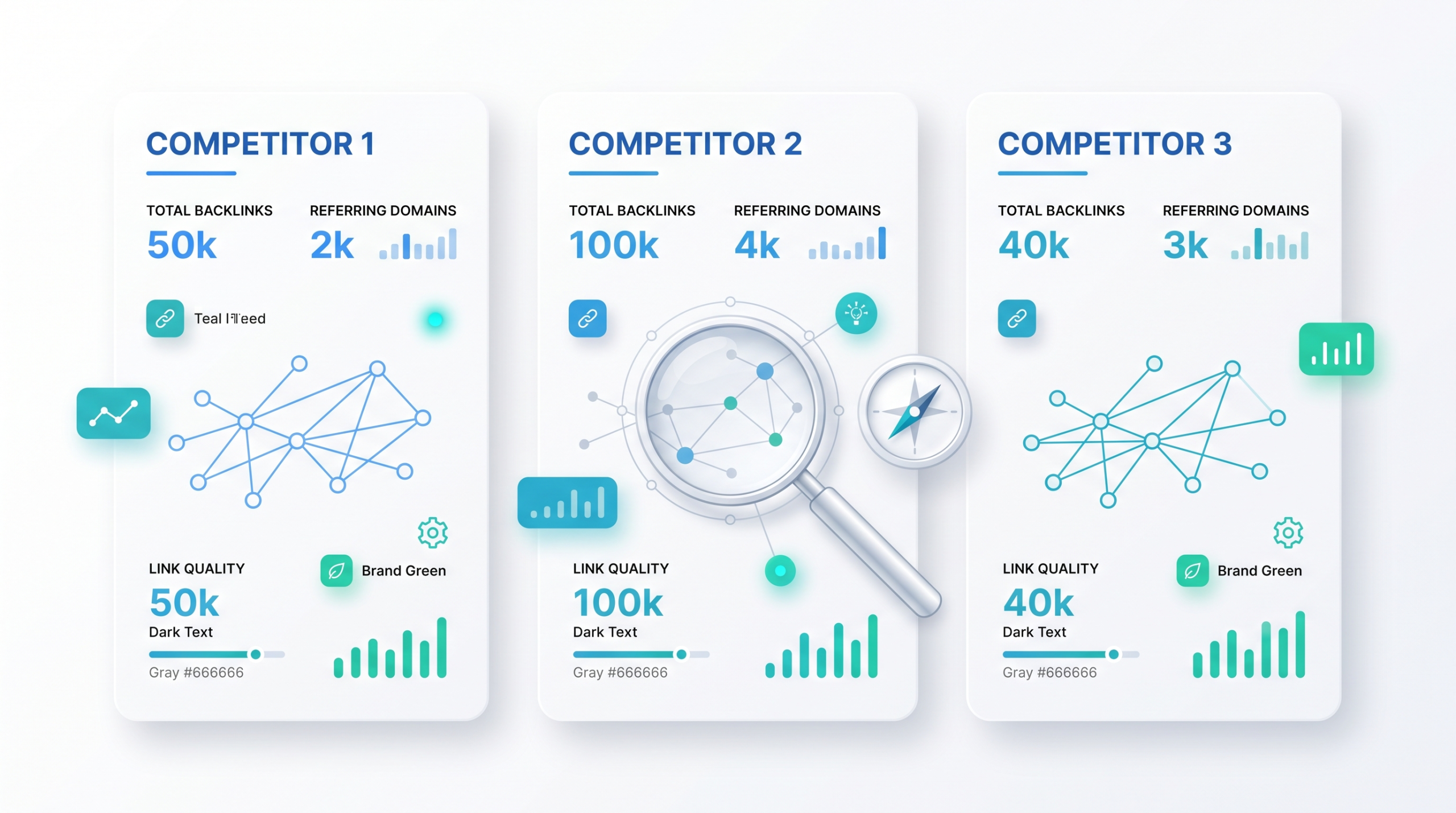
A competitor might rank above you with fewer backlinks. Another can have thousands of links that do nothing. That’s why counting backlinks is not a good starting point for serious competitor backlink analysis.
The useful question is: which links are helping competitors earn visibility, and what pattern connects those links to their content, authority, and rankings?
A proper analysis goes beyond exporting a backlink list and sorting by Domain Rating or Authority Score. You need to understand which pages attract links, where those links come from, how competitors earned them, what anchor text surrounds them, and which opportunities are worth pursuing.
As of August 2026, that analysis has become vast. Traditional backlinks do matter, but competitive research now overlaps with brand mentions, cited sources, and AI search visibility. Ahrefs’ Brand Radar, for example, now tracks competitor visibility across AI platforms and surfaces cited domains and pages alongside traditional search data.
This guide breaks down how to turn a competitor link profile into a practical SEO and link-building strategy rather than another spreadsheet nobody revisits.
Why Competitor Backlink Analysis Still Matters for SEO
Backlink review is a strong way to understand why a competitor has accumulated authority around a topic. They reveal relationships that keyword research alone can’t show.
A keyword gap might tell you that a competitor ranks for “enterprise payroll software.” A backlink analysis can tell you that their ranking page is supported by:
- Editorial links from HR publications
- Links from comparison articles
- Citations from industry reports
- University or research resources
- Guest contributions from company executives
- Resource page links
- Digital PR coverage
Those are very different signals.
I’ve seen backlink strategies fail because teams focused on reproducing the final list of links. They found the same websites, sent similar outreach emails, and wondered why the campaign produced little.
The better approach is to reverse-engineer why the competitor earned the link in the first place.
Was it a useful statistic? A free tool? Original research? A guest article? A relationship with a journalist? Or simply an old resource that accumulated links before the market became competitive?
That distinction changes your strategy.
What Is Competitor Backlink Analysis?
Competitor backlink analysis is the process of examining the backlinks and referring domains pointing to competing websites or pages to identify:
- High-authority and relevant referring domains
- Backlink gaps between your site and competitors
- Linkable content formats
- Competitor link-building tactics
- Pages attracting the most authority
- Anchor text distribution
- Low-quality or spammy link patterns
- Lost or broken link opportunities
The goal isn’t to copy every backlink, but to identify patterns that can produce realistic link-building opportunities for your own website.
For example, imagine three competing websites rank on page one for the same commercial keyword:
| Competitor | Referring Domains | Strongest Linked Asset | Likely Opportunity |
| Competitor A | 1,200 | Industry statistics report | Create better original research |
| Competitor B | 650 | Free calculator | Build a useful interactive tool |
| Competitor C | 900 | Expert contributor articles | Target relevant editorial publications |
All three may have strong backlink profiles, but the acquisition strategy behind each one is completely different.
That’s why competitor backlink analysis should operate at both the domain level and page level.
How to Identify the Right SEO Competitors to Analyze
Don’t automatically analyze the biggest brands in your industry. Your real competitors are the websites competing with you for the same search visibility.
Start with a group of three to five competitors that repeatedly appear for your target keyword cluster. Then separate them into categories:
Direct business competitors
These sell a similar product or service to the same audience.
SERP competitors
These may not sell the same thing but compete for organic traffic. A SaaS company, for example, might compete with:
- Another SaaS platform
- A review website
- An industry publication
- A major media site
- A government or educational resource
Link competitors
These are sites earning links from relevant publications and websites in your niche.
This category is overlooked.
A competitor may not outrank you for your main keyword, yet its content marketing team could be earning links from the publications you want to reach. That makes it valuable for competitor backlink analysis.
How to Analyze a Competitor Link Profile
After selecting a competitor, resist the temptation to export everything immediately. Start by understanding the shape of each profile.
Referring Domains vs. Total Backlinks
One domain can create hundreds or thousands of backlinks.
For example, a sitewide footer link can generate 5,000 backlinks from one referring domain. That doesn’t make it equivalent to 5,000 independent editorial endorsements.
In most competitive analyses, unique and relevant referring domains provide more insight than raw backlink totals.
Compare:
Competitor A:
10,000 backlinks from 8,000 referring domains
Competitor B:
50,000 backlinks from 900 referring domains
Competitor B has a larger backlink count, but Competitor A has a diverse link profile.
Neither number alone determines who has the stronger SEO profile. You still need to evaluate relevance, placement, target pages, and link quality.
Evaluating Link Quality and Relevance
A high authority metric isn’t enough. A backlink from an authoritative but completely unrelated website may have less strategic value than an editorial link from a respected publication within your niche.
Review each promising domain for:
- Topical relevance
- Editorial standards
- Organic visibility
- Traffic trends
- Link placement
- Whether the page is indexed and active
- Whether the site appears built primarily for selling links
- The number of outbound commercial links
Google’s spam systems continue to target manipulative link practices through SpamBrain and broader spam enforcement. Google’s documentation is clear that when systems neutralize spammy links, the ranking benefit those links produced can disappear.
That makes the old “get as many backlinks as possible” approach outdated.
Tracking Domain Authority and Link Growth
Metrics such as Domain Rating, Authority Score, and Trust Flow are useful for comparison, but they’re third-party estimates.
They are not Google ranking factors. Use domain authority tracking as a sorting mechanism, not as your final decision-maker.
The useful questions include:
- Is the competitor gaining relevant referring domains?
- Which content is attracting those domains?
- Is link growth steady or caused by one PR campaign?
- Are new links concentrated around one topic?
- Has the competitor recently launched a successful linkable asset?
A sudden increase in referring domains reveals a campaign worth investigating. It could be digital PR. It could also be a viral tool, a major product announcement, or a controversial study.
The number tells you that something happened. The underlying pages tell you what.
Analyzing Anchor Text Distribution
Anchor text distribution provides another layer of competitive insight. Group competitor anchors into categories such as:
- Branded
- Exact-match commercial
- Partial-match
- URL anchors
- Generic anchors
- Topic-related descriptive anchors
Suppose a competitor’s strongest category page receives links with anchors such as:
- payroll software guide
- employee payment platform
- best payroll tools
- company brand name
That suggests the page has built topical relevance naturally across several related phrases.
Be careful with this analysis. Trying to engineer a replica of a competitor’s anchor text distribution is a mistake. Natural editorial links don’t arrive according to a spreadsheet target.
Use anchor text to understand how the web describes the competitor, not as a formula for manipulation.
How to Perform a Backlink Gap Analysis
A backlink gap analysis compares the domains linking to competitors against the domains linking to your own website. The most useful result is simple:
Which relevant websites link to multiple competitors but don’t link to us?
Those domains are not guaranteed opportunities, but they deserve investigation.
Finding Domains That Link to Competitors but Not to You
Most major SEO platforms provide variations of backlink comparison and gap analysis.
Build a comparison between your domain and several competitors. Then look for domains that link to:
- Two or more competitors
- Multiple competitors’ relevant pages
- Similar content assets
- Competitors within your exact industry
A domain linking to all three competitors is more interesting than one linking to only a single competitor.
Why? Because it may already have a demonstrated interest in your topic.
Prioritizing Realistic Link Building Opportunities
Don’t contact every website in the gap report. Score opportunities based on four factors:
- Relevance: Does the website cover your topic?
- Evidence: Has it linked to similar resources?
- Authority and visibility: Is it a credible, active website?
- Fit: Do you have something genuinely useful to offer?
A backlink gap with 5,000 domains isn’t a strategy. A prioritized list of 50 relevant opportunities is.
Which Pages Attract the Most Backlinks?
This is where competitor backlink analysis becomes valuable. Sort competitor pages by referring domains and look for patterns.
You discover that their most-linked pages are not their homepage or commercial landing pages. Instead, they might be:
- Original research
- Industry statistics
- Free tools
- Templates
- Calculators
- Comprehensive guides
- Definitions
- Interactive resources
- Visual reports
Identifying Competitors’ Linkable Assets
Let’s say a cybersecurity company has a product page with 20 referring domains but an annual threat report with 1,500. The lesson isn’t necessarily to create another threat report.
Look deeper. Which sections of the report attract links? Are journalists citing original statistics? Are industry blogs referencing a visual chart? Are university resources linking to a specific dataset?
You may find that one small part of a large asset drives most of its authority.
That insight saves months of content production.
Finding Content You Can Improve, Update, or Replace
Look for assets that are:
- Several years old
- Missing recent data
- Poorly structured
- No longer maintained
- Thin compared with current search expectations
- Referenced by many websites despite being outdated
Suppose a competitor’s “2022 Email Marketing Statistics” page still has 300 referring domains.
Instead of copying it, create a current version with:
- Updated data
- Clear methodology
- Original findings
- Downloadable charts
- Expert commentary
- Better source attribution
The goal is to create something worth replacing the old resource with.
Spotting Outdated Assets With Lost Backlinks
Lost backlink reports are useful here. When a competitor loses links to a discontinued page, check why.
Common reasons include:
- The page was removed
- The resource became outdated
- The URL changed
- The website stopped updating it
- The competitor’s replacement page isn’t as useful
This can create a strong opportunity for content-led broken link building. You don’t need to tell publishers, “My competitor lost this backlink.”
Instead, identify the broken or outdated resource and offer a stronger alternative.
Reverse-Engineering Competitor Link-Building Tactics
Not every backlink appears naturally. Some reveal clear acquisition patterns.
Guest Posting and Contributor Links
Look for repeated author pages and publications where competitor employees contribute articles. If a company founder has written for five industry websites, that suggests relationship-driven editorial outreach.
Don’t copy their article titles.
Study the publications, contributor requirements, topics, and content standards.
Resource Page and Listicle Links
A competitor may repeatedly appear in:
- Best tools lists
- Industry resource pages
- Recommended software collections
- Educational guides
These links are often easier to categorize because the intent of the linking page is clear. The real question becomes: what would make your resource worthy of inclusion?
Simply emailing, “Please add us too,” rarely works.
Digital PR and News Mentions
A sudden spike in referring domains points to a PR event. Look at the pages earning links during that period.
Possible triggers include:
- Original research
- Surveys
- Industry reports
- Data visualizations
- Product launches
- Executive commentary
Industry Directories and Associations
Directories are not bad. A respected professional association, local chamber, industry organization, or niche software marketplace can provide a relevant citation and referral traffic.
The problem is the old mindset that every directory link has value. It doesn’t.
Evaluate the directory as a real website. Would your audience ever find or use it? Does it maintain listings? Does it have editorial standards?
If the answer is no, skip it.
How to Group Competitor Backlinks by Topic and Link Type
Raw backlink exports are difficult to interpret. Create clusters.
Industry and Niche Clusters
Group referring domains into categories such as:
- Marketing
- SaaS
- Finance
- Education
- Technology
- Healthcare
- Local business
- News and media
This reveals where a competitor has built the strongest relationships.
A SaaS competitor with hundreds of links from marketing publications but very few from technology websites may have stronger authority in marketing than in the broader software space.
Target Landing Page Themes
Group linked pages by topic.
For example:
| Page Topic | Referring Domains | Likely Authority Value |
| Beginner guides | High | Top-of-funnel authority |
| Statistics | Very high | Strong link attraction |
| Product pages | Medium | Commercial relevance |
| Case studies | Low to medium | Trust and proof |
| Tools/templates | High | Repeatable link asset |
This helps you understand where competitor authority is concentrated.
Editorial, Directory, PR, and Other Link Types
Classify links into:
- Editorial
- Guest contribution
- Digital PR
- Resource page
- Directory
- Partnership
- Sponsorship
- Forum or community
- Sitewide
- Syndicated content
After categorizing a sample, patterns emerge quickly.
If 60% of a competitor’s strongest links come from original research coverage, your next campaign probably shouldn’t focus entirely on guest posting.
Understanding Semantic Authority Through Anchor Text Themes
Anchor text and surrounding page context can reveal which topics the competitor is most strongly associated with. Look for recurring concepts.
For example, a project management company repeatedly earns links around:
- remote work
- productivity
- team collaboration
- workflow automation
That gives you a rough map of its semantic authority.
You can compare this against your own content and identify topics where competitors have earned strong third-party recognition while you rely mainly on self-published content.
How to Detect Low-Quality or Spammy Competitor Backlinks
A competitor may have a massive backlink profile and plenty of junk. Don’t mistake volume for opportunity.
Review suspicious patterns such as:
- Thousands of links from unrelated websites
- Sitewide footer links
- Exact-match commercial anchors at unusual scale
- Thin blogs publishing dozens of outbound links
- Obvious private blog networks
- Duplicate pages across multiple domains
- Automated scraper links
- Foreign-language pages unrelated to the target market
You don’t need to replicate these links.
Google’s guidance on spam updates makes the risk clear: when spammy link effects are neutralized, any ranking advantage associated with them can disappear.
When You Should Ignore a Competitor’s Link Strategy
Ignore a strategy when:
- You can’t identify a legitimate acquisition method
- The referring sites are irrelevant
- The links appear manipulative
- The pages generate no visible value for users
- Replicating the tactic would violate search spam policies
A competitor ranking well despite questionable links doesn’t prove those links caused the ranking. Correlation has misled plenty of SEO teams.
SERP Competitor Benchmarking: What Top-Ranking Pages Have in Common
Backlink analysis works best when combined with SERP research. For your target keyword, compare the top-ranking pages based on:
- Referring domains
- Page-level backlinks
- Domain strength
- Content length
- Readability
- Update date
- Use of original data
- Social engagement
- Search intent alignment
Backlink Counts and Referring Domain Velocity
Track how quickly competitors gain new referring domains.
A page earning 10 relevant domains per month may eventually become a bigger competitive threat than one with 500 old links and almost no recent growth.
Velocity should be interpreted carefully, though. One viral campaign can distort the numbers.
Look for sustained patterns over several months.
Page-Level Authority and Link Distribution
Don’t assume homepage authority flows equally across the site.
A competitor might have a powerful domain but weak commercial pages. Another might have fewer total links but excellent page-level authority for the exact topic you’re targeting.
That difference matters when planning content and internal linking.
Social Engagement and Content Promotion Signals
Social shares aren’t a direct replacement for backlinks. Still, they can reveal promotion patterns.
If competitors consistently earn links after publishing content heavily discussed on LinkedIn, Reddit, YouTube, or industry communities, the distribution strategy may deserve more attention than the backlink count itself.
Readability and Structure of High-Performing Linkable Assets
Look at how successful assets communicate. Do they use:
- Short introductions?
- Clear data tables?
- Original charts?
- Definitions that journalists can quote?
- Strong headings?
- Simple explanations?
A complicated 5,000-word report isn’t automatically more linkable than a well-organized 1,500-word resource. The best linkable assets make useful information easy to find and reference.
Competitor Backlink Analysis Tools Worth Using in 2026
Ahrefs
Ahrefs remains useful for competitor link profiles, referring domain analysis, top-linked pages, and historical link research. Its current Site Explorer positioning also combines traditional organic, AI search, and backlink analysis, while the platform reports tens of trillions of live backlinks in its index.
Semrush
Semrush is particularly useful for backlink comparison and identifying domains linking to competitors but not your site.
The backlink gap workflow is often a good starting point when you already know your primary competitors.
Majestic
Majestic can add another perspective through its Trust Flow and Topical Trust Flow metrics.
This can be helpful when you’re evaluating whether a competitor’s strongest referring domains are concentrated around relevant subject areas rather than simply chasing broad authority metrics.
Google Search Console
Google Search Console doesn’t provide competitor data, but it remains essential for validating your own backlink profile and understanding which pages on your site are receiving external links.
Use third-party tools for discovery. Use your own data to confirm priorities.
A Practical Competitor Backlink Analysis Workflow
Here’s a process you can repeat for each important keyword cluster.
1. Define the target keyword and SERP competitors
Search your primary keyword and record the domains that repeatedly appear in the top results.
Choose three to five meaningful competitors.
2. Compare referring domains and backlink profiles
Look at overall diversity, growth, topical relevance, and suspicious patterns.
Don’t obsess over total backlink counts.
3. Run a backlink gap analysis
Find relevant domains linking to multiple competitors but not to you.
Export the strongest opportunities.
4. Analyze the competitor’s top-linked pages
Identify which content formats consistently attract links.
Research reports? Tools? Statistics? Beginner guides?
5. Categorize the link acquisition method
For a meaningful sample, label each strong link according to how it was likely earned.
This turns a list of URLs into a strategy.
6. Identify lost and broken opportunities
Look for competitor resources that disappeared, declined, or became outdated.
Check whether referring websites could benefit from a better replacement.
7. Score your opportunities
Prioritize based on relevance, authority, accessibility, and the strength of your proposed asset or pitch.
8. Turn findings into a content and outreach plan
Every opportunity should lead to an action:
- Create a stronger resource
- Update existing content
- Pitch a journalist
- Contribute expert commentary
- Reach out for resource inclusion
- Reclaim an unlinked brand mention
- Replace a broken competitor resource
If your analysis doesn’t produce an action list, it’s still just research.
Practical Takeaway: Competitor Backlink Analysis Checklist
Before launching your next link-building campaign, check the following:
- Identify three to five real SERP competitors
- Compare referring domains, not just total backlinks
- Run a backlink gap analysis
- Review domains linking to multiple competitors
- Identify the competitors’ top-linked pages
- Categorize successful linkable asset types
- Analyze anchor text distribution for topic patterns
- Separate editorial links from low-value links
- Investigate lost and broken competitor backlinks
- Check recent referring domain growth
- Prioritize opportunities by relevance and realistic fit
- Turn findings into specific content or outreach actions
Common Mistakes That Waste Time
These mistakes can make competitor backlink analysis less useful and lead teams toward the wrong opportunities.
| Mistake | Why It Wastes Time | Better Approach |
| Copying Every Competitor Backlink | Many competitor links are impossible, irrelevant, outdated, or not worth replicating. | Study the pattern instead. |
| Chasing Domain Authority Without Relevance | A high metric doesn’t automatically mean a high-value opportunity. | Prioritize trusted niche publications over general websites with larger authority scores. |
| Looking Only at Domain-Level Metrics | The domain may be powerful while the specific page you’re competing against has very little external authority. | Always analyze important URLs individually. |
| Ignoring Lost and Broken Competitor Links | Old resources, discontinued pages, and outdated reports can produce some of the clearest content-led outreach opportunities. | Investigate lost and broken links for relevant opportunities. |
| Treating All SERP Competitors as Link Competitors | The site ranking above you isn’t always the best site to study for link building. | Study websites consistently earning editorial links from your industry’s publications. |
The Future of Competitor Backlink Analysis in AI-Influenced Search
Competitor backlink analysis is no longer only about who links to whom.
In 2025 and 2026, competitive SEO platforms have increasingly expanded into AI visibility tracking. Ahrefs’ Brand Radar, for example, supports competitor analysis around AI mentions, citations, impressions, Share of Voice, cited domains, and cited pages. Its current documentation says the platform tracks search-backed prompts across multiple AI systems, while recent product updates added more competitive filtering and topic analysis.
That doesn’t mean backlinks have suddenly stopped mattering. It means the research process is widening.
A strong digital PR campaign might earn backlinks, generate brand mentions, appear on highly cited industry websites, and improve the information ecosystem surrounding your brand.
That’s a more useful way to think about authority in 2026.
The best competitor research will connect these signals instead of keeping backlinks, content, PR, and AI visibility in separate spreadsheets.
Conclusion: Turning Competitor Backlink Analysis Into a Repeatable Growth System
The point of competitor backlink analysis isn’t to build a bigger spreadsheet than your competitors.
It’s to understand how they earn authority.
Some will win through original research. Others will have strong editorial relationships. Some will dominate resource pages, while others benefit from years of accumulated links to useful evergreen content.
Find the pattern behind the strongest links, ignore the junk, and focus on opportunities you can realistically improve upon.
My view is simple: if your backlink analysis ends with “let’s try to get these same 500 links,” you probably haven’t analyzed deeply enough. The best outcome is a clearer strategy for creating assets, building relationships, and earning authority your competitors haven’t already locked up.
FAQs
How many competitors should I analyze for backlinks?
Start with three to five relevant competitors. This is usually enough to identify recurring referring domains, link types, and acquisition patterns without creating unnecessary data.
How often should I perform competitor backlink analysis?
Review major competitors periodically and after noticeable ranking changes, new content campaigns, or sudden increases in their referring domains.
Should I analyze domain-level or page-level backlinks?
Use both. Domain-level analysis shows overall authority patterns, while page-level analysis reveals which specific content and topics are attracting links.
Are competitor backlinks always worth replicating?
No. Prioritize links that are relevant, credible, and realistically obtainable rather than trying to reproduce every backlink a competitor has.
Can competitor backlink analysis help with content strategy?
Yes. Competitors’ most-linked pages can reveal which content formats, topics, tools, research, or resources naturally attract links.