
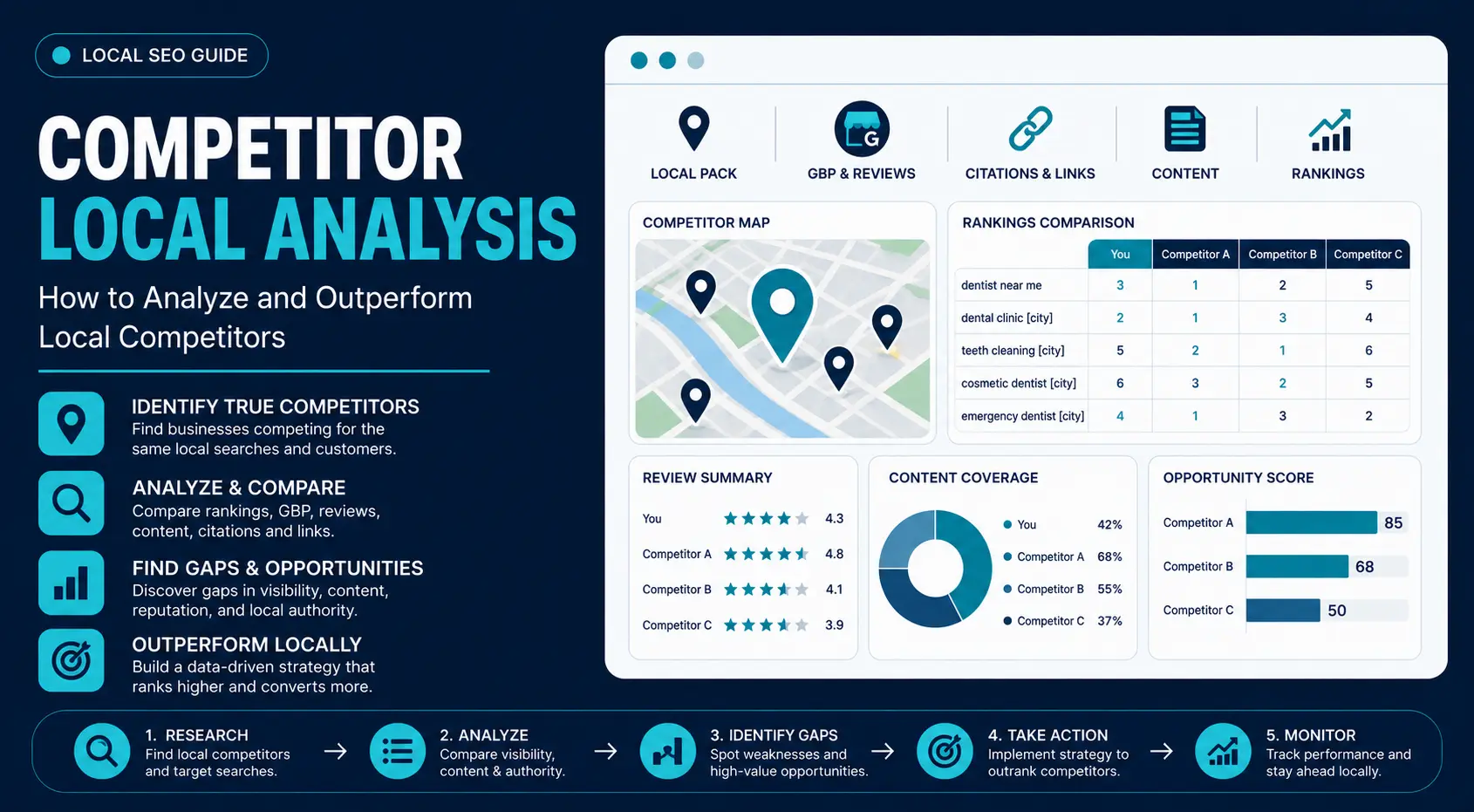
Local search competition is not decided by one ranking factor. A competitor ranks above your business because it has stronger geographic relevance, a better-optimized Google Business Profile, deeper service-location coverage, more authoritative local links, stronger reviews, or simply greater prominence in the areas being searched.
That makes a local competitor analysis more than a search for businesses located nearby. The useful question is not “Who is my closest competitor?” It is “Which businesses compete with me for the same local searches, customers, locations, and intents, and what evidence explains their visibility?”
A structured analysis turns those observations into an actionable gap map.
Key Takeaways
- Local competitor analysis compares businesses across the local search ecosystem, including Google organic results, Local Pack, Google Maps, GBP, reviews, websites, citations, links, content, and conversion paths.
- Your business competitors and SEO competitors are not always the same. A distant brand competes for a high-value query even when it does not compete for customers in the same physical area.
- Proximity matters, but it is not the whole story. Google describes local results primarily through relevance, distance, and prominence.
- Geo-grid tracking reveals local ranking variation that a single citywide or ZIP-code ranking conceal.
- Competitor reviews should be analyzed for themes, recency, velocity, and customer language—not just star ratings.
- The best opportunities usually appear in gaps: missing service-location pages, weak geographic coverage, citation gaps, local link opportunities, unanswered questions, or conversion weaknesses.
- Competitor tactics are evidence, not instructions. A correlation between a competitor’s feature and rankings does not prove that feature caused the ranking advantage.
- The final output should be an action plan, not a spreadsheet full of disconnected metrics.
What Is Competitor Local Analysis?
Competitor local analysis is the systematic study of competing businesses, their local search visibility, and the factors shaping their performance across Google Search, Local Pack, Google Maps, and local discovery surfaces. It reveals who competes for the same customers and searches, why competitors outrank you, and where you gain an advantage.
The analysis connects business + service + location + search intent, rather than evaluating competitors only by physical proximity.
Local Competitor Analysis vs. Traditional Competitor Analysis
Traditional competitor analysis examines factors such as pricing, products, positioning, market share, and customer segments. Local competitor analysis adds the geographic and search layer, examining:
- Service-plus-location visibility
- Local Pack and Maps presence
- GBP optimization
- Service-location content coverage
- Local citations and backlinks
- Review patterns and customer needs
- Visibility differences across neighborhoods
A business be a market competitor without being a major SEO competitor, and vice versa.
Local Business Competitors vs. Local SEO Competitors
Local business competitors serve the same or similar customers in your market. Local SEO competitors compete for visibility in the searches that matter to your business, even if they are not direct commercial rivals.
For example, an accounting firm competes with nearby firms for customers, while a national directory or regional accounting network competes for the same local SERPs. Both matter, but they require different analysis.
How Proximity, Relevance, and Prominence Shape Local Competition
Google identifies local results primarily through relevance, distance, and prominence. Relevance reflects how well a business matches the search; distance reflects the searcher’s location relative to the business; prominence reflects how established or well-known the business appears.
These factors interact rather than functioning as a fixed formula. A competitor have stronger relevance for one service, greater proximity in one neighborhood, or greater prominence across a wider area.
What a Local Competitor Analysis Should Reveal
A useful analysis should identify:
- Competitor visibility: Where competitors appear across organic search, Local Pack, Maps, and other discovery surfaces.
- Competitive strengths and weaknesses: Differences in GBP, reviews, content, citations, links, authority, and conversion paths.
- Local search gaps: Valuable queries, services, locations, and customer questions competitors cover that you do not.
- Opportunities to outperform: Specific actions such as GBP improvements, service-location content, local link acquisition, reputation development, or conversion fixes.
How to Identify Your True Local Competitors
Identifying the right competitors starts with mapping who competes for the same local customers, searches, services, and geographic areas.
Classify Competitors by Search and Market Relationship
Start by separating competitors according to how they overlap with your market and search visibility:
- Direct competitors: Offer similar services to the same local audience.
- Indirect competitors: Solve the same customer problem through a different service, product, or business model.
- SERP competitors: Rank for your target queries, even when they are not direct commercial rivals.
- Geographic competitors: Compete within the same city, neighborhood, or service area.
- Emerging competitors: Are gaining visibility, reviews, content coverage, or geographic reach.
Find Competitors Through Local Search
Use the searches your customers actually perform to build your initial competitor pool:
- Search core services to identify businesses appearing for service queries such as “dentist” or “roof repair.”
- Search target cities and areas to find competitors visible for broader geographic queries.
- Search neighborhoods to uncover hyper-local competitors that do not rank prominently at the city level.
- Check Google organic results to identify websites competing for important local queries.
- Check the Local Pack to identify businesses receiving prominent local visibility.
- Check Google Maps to uncover additional competitors and geographic visibility patterns.
- Repeat searches from different locations because local rankings change based on the searcher’s location.
Build a Representative Competitor Set
Turn the initial list into a focused set of competitors worth analyzing:
- Select consistently visible competitors across commercially important searches.
- Separate primary competitors that repeatedly appear for high-value searches from secondary competitors with narrower or occasional visibility.
- Record each competitor’s services, locations, target queries, GBP presence, website coverage, and major visibility patterns.
- Exclude businesses with only incidental visibility unless they represent an emerging or strategically important competitor.
- Do not rely on physical proximity alone. A local SEO competitor is determined by the overlap between search query, service, location, and intent, not simply by distance.
Establish the Local Competitive Search Baseline
Establish a consistent baseline for search intent, search-surface visibility, and geographic performance before diagnosing competitor advantages.
Compare Search Visibility by Intent
Group your target searches by intent before comparing competitors:
- Service intent: Searches for a specific service.
- Location intent: Searches using cities, areas, or geographic modifiers.
- Commercial intent: Searches involving pricing, comparisons, or provider selection.
- Informational local intent: Questions about local costs, regulations, processes, or services.
- Neighborhood intent: Hyper-local searches focused on specific areas.
This prevents one overall ranking average from hiding competitors that dominate particular intents.
Compare Organic, Local Pack, Maps, and AI Search Visibility
Measure visibility across each relevant search surface:
- Track organic rankings for priority queries and landing pages.
- Record Local Pack presence for relevant local searches.
- Measure Google Maps visibility across multiple locations.
- Compare keyword coverage to identify queries where competitors appear but you do not.
- Audit AI search visibility to see whether competitors are surfaced in AI-assisted or conversational local recommendations.
- Calculate local search visibility share using the same queries, locations, and search surfaces for every competitor.
AI visibility should be measured as an additional discovery layer, not as a replacement for conventional local search tracking.
Map Geographic Visibility With Geo-Grid Analysis
A single ZIP-code or office-based ranking conceal substantial local variation. Geo-grid analysis exposes how visibility changes across the market.
- Create a geographic grid covering your target cities, neighborhoods, or service area.
- Run consistent local queries from each geographic coordinate.
- Record competitor rankings at every grid point.
- Visualize rankings as a heatmap to identify strong and weak areas.
- Compare competitor coverage by area to find locations where rivals consistently outperform.
- Identify proximity patterns to determine whether competitors gain visibility near their locations or maintain strong coverage farther away.
This reveals geographic gaps that citywide rankings miss, including areas where a competitor dominates despite having weaker overall visibility.
Analyze Competitor Google Business Profiles and Reviews
Compare competitors’ Google Business Profiles (GBP) and review profiles to identify differences in local relevance, profile completeness, reputation strength, and customer expectations.
Compare Google Business Profile Optimization
Audit each competitor’s profile systematically:
- Check the primary category to understand how the business is classified and which search contexts it targets.
- Review secondary categories for additional services or business relationships.
- Check business information for completeness and consistency.
- Compare services, products, and attributes where applicable.
- Review the business description for accurate business context rather than keyword stuffing.
- Assess photos and videos for relevance, quality, recency, and local proof.
- Check profile activity to understand how consistently the profile is maintained.
The goal is not to assume every GBP field directly affects rankings. It is to determine how accurately and completely competitors represent their businesses.
Analyze Competitor Reviews and Reputation
Evaluate reviews for both quantitative strength and qualitative customer insight:
- Compare review volume and rating to establish the overall reputation baseline.
- Measure review recency and velocity to identify whether competitors are consistently generating fresh feedback.
- Analyze recurring themes such as service quality, pricing, speed, communication, professionalism, and convenience.
- Review customer language to identify the benefits, services, and experiences customers mention naturally.
- Evaluate review responses for responsiveness, professionalism, and recurring issues addressed by competitors.
- Identify reputation strengths and weaknesses that could influence customer choice.
Do not focus on star ratings alone. A slightly lower-rated competitor with substantially recent reviews presents a stronger and more active reputation profile.
Customer reviews reveal positioning opportunities that competitor websites miss. Use those insights to understand customer expectations, not to manipulate reviews or force keywords into them.
Analyze Competitor Websites and Local Content
Compare competitor websites to identify gaps in local architecture, on-page relevance, search intent coverage, and entity relationships.
Compare Service, Location, and Neighborhood Coverage
Audit each competitor’s local page structure:
- Record service pages covering core and specialized services.
- Identify city and neighborhood pages targeting specific geographic areas.
- Map service-location combinations such as “emergency plumbing in [location].”
- Review local landing pages for distinct services and locations.
- Analyze internal links connecting services, locations, and relevant business entities, especially on multi-location sites.
- Flag thin or near-duplicate location pages rather than treating page count as a competitive advantage.
The goal is to identify meaningful coverage gaps, not simply which competitor has more pages.
Evaluate Local On-Page Relevance
Compare the core local signals on competing pages:
- Title tags
- Headings
- Geographic references
- NAP information
- Internal links
- Embedded maps
Check whether geographic references add useful local context or merely repeat location keywords.
NAP—Name, Address, and Phone number—should be accurate and consistent across relevant business properties. Treat it as part of broader business and entity consistency rather than an isolated ranking formula.
Compare Local Content and Search Intent Coverage
Measure how well each competitor addresses local search demand:
- Identify local topics competitors cover.
- Map customer questions to the pages answering them.
- Compare service-specific and commercial local queries covered by each site.
- Assess content depth using usefulness, specificity, evidence, and intent coverage rather than word count.
- Identify underserved local intents, such as local pricing, regulations, service areas, preparation requirements, or location-specific customer concerns.
These gaps reveal opportunities even when a competitor has stronger overall content.
Evaluate Local Entity Relationships and Structured Signals
Assess how consistently competitors connect their business with relevant entities:
- Services
- Locations
- Relevant local entities
- Organizational relationships
Review structured data where relevant, but do not treat markup as a guaranteed ranking mechanism. The stronger question is whether the website, GBP, citations, and other authoritative references consistently describe the same business-service-location relationships.
This consistency helps establish a clearer local entity footprint and expose gaps in your own business’s digital representation.
Analyze Competitor Citations, Links, and Local Authority
Compare competitor citations, backlinks, local mentions, and community relationships to identify gaps in local authority and prominence.
Compare Citation and Directory Coverage
Audit where competitors are listed and whether those listings are accurate:
- Check major directories relevant to the market.
- Review local directories such as regional business listings and community resources.
- Check industry-specific listings and professional directories.
- Compare citation consistency across business name, address, phone number, website, and other core details.
- Identify missing listings where competitors have legitimate local or industry presence but your business does not.
- Run citation overlap analysis to find authoritative sources that consistently mention competitors but not your business.
Prioritize relevant, trustworthy listings rather than maximizing citation volume.
Analyze Local Backlinks and Authority Sources
Identify the relationships behind competitors’ local backlinks:
- Local publications
- Community organizations
- Sponsorships
- Partnerships
- Professional associations
- Local events
For each important backlink, determine why the competitor earned it. A sponsorship, community partnership, or local news feature reveals a relationship that is valuable to replicate than the backlink itself.
Identify Local Brand Mentions and Co-Citations
Search for:
- Unlinked brand mentions in local publications, organizations, and community resources.
- Local co-citations where competitors are mentioned alongside relevant businesses, services, or locations.
- Community references that establish local involvement or recognition.
- Relevant entity associations connecting competitors with places, organizations, services, or industry topics.
Not every valuable local reference includes a backlink. These mentions provide evidence of a competitor’s local prominence and entity footprint, while also revealing relationships missing from your business.
Compare Competitor Conversion and Trust Signals
Compare how competitors turn local search visibility into trust and customer action.
Evaluate Local Conversion Paths
Audit each competitor’s primary conversion routes:
- Check call options and how users reach the business.
- Check booking paths for unnecessary steps or barriers.
- Review contact forms for accessibility and usability.
- Check directions and location information for ease of access.
- Identify service inquiry options such as quote requests or consultations.
A competitor with weaker rankings outperforms commercially if its conversion path is easier and more persuasive.
Compare Trust and Decision-Making Signals
Review the evidence that helps local customers choose a provider:
- Testimonials
- Offers
- Guarantees
- Certifications
- Reviews as conversion evidence
- Local proof, such as local projects, service areas, community involvement, named team members, or case examples
Prioritize verifiable evidence over decorative trust badges. A certification or claim is useful when its meaning and credibility are clear.
Identify Conversion Friction
Check for factors that prevent a visitor from taking action:
- Difficult contact paths
- Weak or unclear calls to action
- Poor mobile usability
- Booking barriers
- Missing decision-making information, such as pricing expectations, service areas, hours, response times, qualifications, or availability
These findings reveal commercial gaps, not necessarily ranking weaknesses. A competitor has strong local visibility but loses potential customers because its website creates unnecessary friction.
Identify Competitive Gaps and Local SEO Opportunities
Turn the competitor data into a gap map that shows where your business is weaker, where competitors have a meaningful advantage, and where local search opportunities remain underdeveloped.
Build a Cross-Competitor Gap Analysis
Compare your business against competitors across the same criteria:
| Category | What to Compare |
| Search visibility | Rankings, Local Pack, Maps, AI visibility |
| GBP | Categories, services, attributes, activity, media |
| Reviews | Rating, volume, recency, velocity, themes |
| Website | Service, location, neighborhood coverage |
| Local content | Topics, intents, questions, geographic depth |
| Citations | Directories, listings, consistency, missing sources |
| Links | Local and industry-relevant referring domains |
| Brand mentions | Local publications, organizations, co-citations |
| Conversion | CTAs, calls, bookings, trust signals |
This creates a consistent competitive matrix and makes recurring strengths, weaknesses, and gaps easier to identify.
Separate Common Signals From Competitive Advantages
Separate baseline signals from potential differentiators:
- Identify signals shared by most competitors as baseline market expectations.
- Identify signals concentrated among top performers for closer analysis.
- Examine uncommon strengths such as strong neighborhood coverage, authoritative local links, fresh review activity, or robust service-location architecture.
- Flag weak or inconsistent competitor signals as potential opportunities.
- Distinguish correlation from causation before treating any observed pattern as a ranking factor.
For example, if top-ranking competitors have many reviews, that does not prove that reaching the same review count will produce the same ranking outcome.
Find Exploitable Local Search Gaps
Prioritize gaps that combine search demand, commercial value, competitive weakness, and realistic execution:
- Keywords competitors rank for, but you do not
- Missing service-location combinations
- Weak geographic coverage
- Underdeveloped location pages
- Unanswered local questions
- Citation gaps
- Local link opportunities
- Reputation opportunities
- Conversion opportunities
The largest numerical gap is not automatically the best opportunity. A small gap around a high-value commercial query produces more business than hundreds of low-value keywords.
Prioritize Competitor Gaps and Build an Action Plan
Rank identified gaps by business value, competitive opportunity, effort, and expected impact before assigning them to an execution queue.
Score Opportunities by Impact and Effort
Score each opportunity from 1–5 against:
- Search opportunity
- Commercial value
- Competitive weakness
- Customer importance
- Implementation effort
- Expected time to impact
Use the combined score to distinguish high-value opportunities from low-priority findings. The model provides a consistent prioritization framework rather than precise prediction.
Separate Quick Wins From Strategic Initiatives
Quick wins require limited structural work:
- GBP improvements
- Citation corrections
- On-page fixes
- Missing local information
- Review improvements
Strategic initiatives require sustained execution:
- New service and location content
- Local link acquisition
- Digital PR
- Reputation growth
- Local authority building
Prioritize strategic initiatives according to commercial value rather than competitor activity alone.
Convert Findings Into Prioritized Actions
Assign every validated finding to one action category:
- Fix immediately: Errors or high-impact weaknesses requiring prompt correction.
- Build next: Valuable gaps requiring planned implementation.
- Test: Competitive hypotheses that need validation.
- Monitor: Changes worth tracking without immediate action.
- Deprioritize: Low-value findings that do not justify the required resources.
This prevents the competitor analysis from becoming a list of tasks without a clear execution order.
Local Competitor Analysis Workflow and Template
Use a consistent process and comparison matrix to turn competitor research into actionable findings.
Follow the Competitive Analysis Workflow
Collect → Normalize → Compare → Diagnose → Prioritize → Implement → Monitor
- Collect: Gather data from searches, GBP, websites, directories, reviews, links, and locations.
- Normalize: Use consistent queries, locations, dates, and definitions.
- Compare: Measure visibility and competitive assets.
- Diagnose: Identify reasons for competitive differences.
- Prioritize: Rank opportunities by value and feasibility.
- Implement: Execute priority actions.
- Monitor: Track changes and reassess gaps.
Record Competitor Data Consistently
| Category | What to Record |
| Competitor | Business, location, type |
| Visibility | Keywords, rankings, Local Pack, Maps, AI |
| Geography | Cities, neighborhoods, geo-grid |
| Intent | Service, commercial, informational, location |
| GBP | Categories, services, attributes, activity |
| Reputation | Rating, reviews, recency, velocity, themes |
| Website & content | Service, location, neighborhood pages; topics and intents |
| Citations & links | Listings, consistency, local referring domains |
| Conversion | CTAs, calls, bookings, trust |
| Gaps & action | Weaknesses, opportunities, priority |
Use the same criteria across competitors to avoid misleading comparisons.
Tools for Local Competitor Analysis
Use tools to collect and compare evidence across search visibility, GBP, keywords, citations, backlinks, and geographic performance.
- Google Search: SERP and search-intent analysis
- Google Maps: Local visibility and geographic competitor research
- Google Business Profile: Competitor profile auditing
- Google Search Console: Your organic performance and query data
- Google Keyword Planner: Query discovery and demand estimates
- Local rank trackers and geo-grid tools: Local and coordinate-based ranking analysis
- BrightLocal: Local rankings, citations, and competitor research
- Ahrefs: Keywords and backlink analysis
- Semrush: Keyword, competitor, and local SEO research
- Moz Local: Citation and listing management
Use metrics to identify competitive patterns; ranking data alone does not establish why a competitor performs better.
Common Local Competitor Analysis Mistakes
| Mistake | Why It Hurts |
| Choosing competitors based only on proximity | Misses SERP and intent-based competitors. |
| Tracking too many competitors | Creates excessive data without strategic value. |
| Using inconsistent comparison criteria | Makes competitive differences unreliable. |
| Treating rankings as the only signal | Ignores GBP, reviews, content, authority, and conversion. |
| Copying competitor tactics blindly | Imitates outcomes without understanding context. |
| Assuming correlation proves causation | Treats patterns as confirmed ranking factors. |
| Ignoring reviews and customer experience | Misses customer expectations and competitor strengths. |
| Collecting data without taking action | Turns analysis into reporting rather than strategy. |
| Performing the analysis only once | Misses emerging competitors and changing search conditions. |
How to Monitor Local Competitors Over Time
Monitor competitors against a consistent baseline so meaningful changes are distinguishable from normal ranking fluctuations.
Establish a Competitive Baseline
Record:
- Priority queries
- Geographic points
- Competitors
- GBP observations
- Review metrics
- Website and content coverage
- Citations and links
- Conversion signals
Add the measurement date so future comparisons use a clear reference point.
Track Meaningful Competitive Changes
Monitor:
- Rankings and geo-grid visibility
- GBP changes
- Review volume, recency, and velocity
- New content and service/location pages
- Citation changes
- New local links
Focus on structural changes, such as geographic expansion, new service clusters, rapid review growth, authoritative local links, or repositioning—not every ranking fluctuation.
Reassess Competitive Gaps and Priorities
Periodically review:
- Emerging competitors and new competitor strengths
- New weaknesses in your own local strategy
- Changes in local search demand, services, locations, or customer behavior
- New opportunities to outperform
Update priorities when the competitive landscape changes rather than treating the original analysis as permanent.
Frequently Asked Questions About Competitor Local Analysis
What do you include in a local competitor analysis?
Analyze local search visibility, GBP, reviews, website and content coverage, citations, backlinks, local mentions, geographic performance, conversion signals, and competitive gaps.
How do you identify local SEO competitors?
Search your priority services with city and neighborhood modifiers, then compare organic results, Local Pack listings, and Google Maps. Track businesses that appear consistently for valuable local searches.
How do you analyze a competitor’s Google Business Profile?
Compare categories, business information, services, attributes, photos, activity, reviews, and review responses. Focus on recurring differences among consistently visible competitors.
How do you perform a geo-grid competitor analysis?
Run consistent local searches from multiple geographic coordinates, record competitor rankings at each point, and visualize the results as a heatmap to identify neighborhood-level visibility gaps.
What should you do after identifying a competitor gap?
Validate the gap, assess its search and commercial value, estimate implementation effort, prioritize it, and turn it into a measurable SEO action rather than simply copying the competitor.