
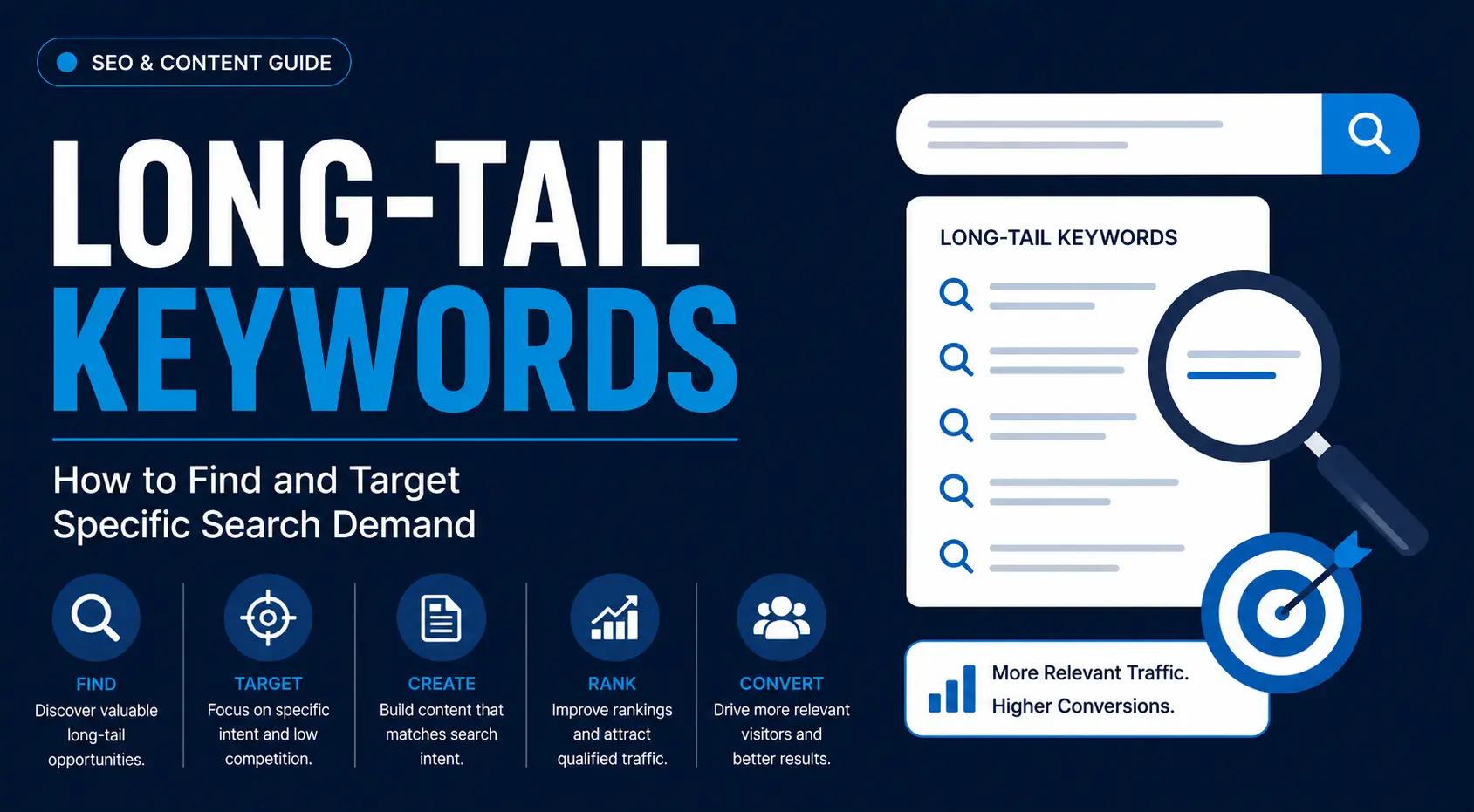
Long-tail keywords are described as long, highly specific search phrases that are easier to rank for. This definition is convenient, but incomplete.
A keyword does not become long-tail because it contains three, four, or five words. The defining characteristic is relatively low individual search demand. A one-word query can sit in the long tail, while a six-word phrase can attract substantial search volume.
That distinction changes how long-tail keyword research should be approached. Besides counting words, you need to determine how much demand exists, what the searcher wants, whether the query represents its own topic, and whether it deserves a dedicated page.
This guide covers that process from discovery through targeting and measurement.
What Are Long-Tail Keywords?
Long-tail keywords are search queries with relatively low individual search volume compared with more frequently searched terms in the same market or topic.
They are long and specific because specificity divides demand across narrower searches. Phrase length, however, is a common characteristic rather than the definition.
Consider:
Broad query:
running shoes
More specific query:
waterproof trail running shoes for winter
The second query provides more information about the searcher’s requirements. It also attracts fewer searches than the broader product category.
That is the pattern associated with long-tail keywords. The mistake is turning it into a word-count rule.
A short query in a niche subject can receive little search demand and sit in the long tail. Conversely, a long phrase can become popular enough to attract substantial recurring search volume.
Ahrefs uses this demand-based definition, describing long-tail keywords as search queries having a small number of searches rather than queries containing a prescribed number of words.
Why Are They Called “Long-Tail” Keywords?
The term comes from the search-demand curve.
If search queries are plotted from highest to lowest search volume, a relatively small collection of highly popular searches forms the head. As volume falls, the curve stretches into a much larger collection of queries with low individual demand. That extended section is the long tail.
The distribution can be simplified as:
Few high-volume queries → many moderate-volume queries → enormous numbers of low-volume queries
Ahrefs reports that keywords receiving fewer than 10 monthly searches account for almost 93% of the keywords in its U.S. database. (ahrefs.com)
There is no universal volume threshold at which a keyword becomes long-tail. A query with 300 monthly searches could sit in the long tail of a market dominated by terms receiving hundreds of thousands of searches, while 300 searches could represent considerable demand in a small niche.
Treat long-tail as a relative position in search demand, not a fixed word-count or volume threshold.
Long-Tail vs. Short-Tail Keywords
Short-tail and long-tail keywords differ most in demand and specificity, not simply phrase length.
| Attribute | Short/Head Keywords | Long-Tail Keywords |
| Search demand | Generally high | Relatively low |
| Specificity | Usually broad | Often more specific |
| Intent clarity | Often ambiguous | Frequently clearer |
| Competition | Often high | Varies |
| Traffic per query | Potentially high | Usually lower |
| Conversion proximity | Varies | Can be stronger when intent is specific |
Take:
CRM
The searcher’s objective is unclear. They could want a definition, software recommendations, a particular company, a login page, or information about CRM implementation.
Compare that with:
CRM for small construction companies
The product category and intended audience are clearer.
The additional words help reveal the information need, but they do not make the query long-tail. Its relatively low search demand does.
This distinction also prevents another common mistake: assuming that every long phrase must be easier to rank for. A highly specific query can still belong to a commercially valuable and competitive topic.
Why Long-Tail Keywords Matter for SEO
Long-tail keywords expose specific search opportunities that broad keywords can conceal. Their value depends on intent, competition, topical fit, business relevance, and the site’s ability to satisfy the query.
They Reveal More Specific Search Intent
Broad searches leave room for several interpretations.
Someone searching:
project management software
could be researching the category, comparing products, or preparing to buy.
Compare that with:
project management software for architecture firms
The audience and use case are explicit.
Specific modifiers also reveal what information matters. A search for email marketing software for nonprofits, for example, places greater emphasis on nonprofit pricing, donor-management integrations, organization size, and ease of use than a broader email marketing software query.
The keyword provides clues about the answer the searcher expects.
Some Long-Tail Keywords Face Lower Competition
Low-demand topics attract less competition because larger publishers prioritize higher-volume opportunities.
That creates openings for smaller or more specialized sites. It does not mean all long-tail keywords are easy to rank for.
A low-volume query can be another formulation of a highly competitive broader topic. In that case, the ranking environment remains difficult.
Competition should therefore be investigated through the actual search results rather than inferred from keyword length or volume.
Specific Queries Can Carry Stronger Conversion Intent
Specificity reveals how far a searcher has progressed toward a decision.
Compare:
laptops
laptops for students
lightweight laptops for engineering students under £800
The final search communicates the product type, audience, use case, attribute, and budget.
Specificity does not make a query transactional. Detailed informational queries exist too. But searches involving price, product requirements, compatibility, alternatives, availability, or comparisons often provide clearer signals about the user’s decision criteria.
Low-Volume Queries Can Create Meaningful Aggregate Traffic
A page’s opportunity is not limited to the reported search volume of one keyword.
A page that satisfies a topic can become relevant to multiple related query variations. A primary term with modest search volume therefore might represent a broader pool of related demand.
This is why traffic potential should be considered alongside individual keyword volume.
The useful question is not only how often people search one exact phrase, but how much relevant search demand exists around the topic that phrase represents.
The Three Types of Long-Tail Keywords
Not all low-demand queries should be treated the same way. A useful distinction is between supporting, topical, and conversational long-tail keywords.
Ahrefs currently uses these three categories, and the distinction has practical consequences for content planning.
Supporting Long-Tail Keywords
A supporting long-tail keyword is a less popular variation of a broader, more frequently searched topic.
Consider:
- healthy dog treats
- best healthy treats for dogs
If searchers using both phrases expect substantially the same information and the same pages consistently satisfy both searches, separate articles add little value.
The lower-demand phrase supports the broader topic.
A supporting long-tail keyword therefore belongs to a page that targets the broader information need rather than having its own URL.
Topical Long-Tail Keywords
A topical long-tail keyword has low search volume but represents a distinct topic in its own right.
Its limited demand is not the result of people preferring another phrase for the same subject. The query requires distinct information to justify independent treatment.
A specialized technical problem, for example, might attract few searches because only a narrow audience experiences it. Those searchers could still need an answer substantially different from anything provided by the broader parent topic.
The distinction is:
Supporting long-tail → lower-volume variation of a broader topic
Topical long-tail → low-demand topic with its own information need
This distinction is more useful for content planning than simply sorting keywords from lowest to highest volume.
Conversational Long-Tail Keywords
A third category has become more relevant as users increasingly express searches in natural language.
Conversational long-tail queries are highly specific natural-language searches whose exact formulations can have very little or no measurable recurring search volume.
For example:
What accounting software would work for a small construction company that doesn’t have a full-time accountant?
Different users express essentially the same need using completely different wording.
Google says users in its AI search experiences are asking longer, specific questions and using follow-up queries. Its AI features also use query fan-out to perform multiple related searches when resolving complex questions.
Conversational long-tail therefore requires a specialized targeting approach compared to conventional keyword research. The dedicated Conversational Long-Tail Targeting guide covers that process in depth.
How to Find Long-Tail Keywords
Effective long-tail research does not start by looking for the longest phrases possible. Start with a relevant topic, expand the available search demand, then evaluate which queries represent worthwhile opportunities.
1. Start With Seed Topics
First, define the broad topics directly connected to your products, services, expertise, and audience.
For an accounting software company, seeds might include:
- invoicing software
- expense tracking
- payroll software
- bookkeeping software
- accounting automation
Then expand each seed by asking:
- Who needs this?
- What problem are they trying to solve?
- What feature matters?
- What use case narrows the need?
- What comparison or decision might they make?
For example:
payroll software
can lead to:
payroll software for small businesses
payroll software for contractors
payroll software with automatic tax filing
Do not treat every variation as a separate page. At this stage, the goal is to establish relevant directions for deeper research.
2. Expand the Seeds With a Keyword Research Tool
Enter each seed into a keyword research platform and open its matching, related, or keyword-ideas report.
Then:
- Set the target country or market.
- Review related and matching queries.
- Apply a low-to-moderate search-volume filter to surface less popular terms.
- Use question or phrase filters where useful.
- Apply a word-count filter to expose more specific formulations.
- Export relevant candidates for further evaluation.
Record at least:
- Keyword
- Search volume
- Keyword difficulty
- Search intent
- Parent/broader topic
- SERP competitors
Do not select keywords solely because they are long or have low difficulty.
Word-count filters help discover specific phrases; they do not define the long tail. A four-word query can have substantial demand, while a two-word query can sit deep in the long tail.
The output is a candidate pool, not a finished content plan.
3. Expand the Topic With Google Autocomplete and Related Searches
Search the seed in Google and deliberately vary the query to expose refinements.
For example, begin with:
project management software
Then test:
project management software for
project management software with
project management software vs
project management software without
These patterns can expose different modifiers:
Audience: for architects
Feature: with time tracking
Constraint: without subscription
Comparison: Asana vs Monday
Next, review the related searches shown for relevant queries and record useful formulations that did not appear in your keyword tool.
Do not target every suggestion. Add promising queries to the candidate pool and evaluate them later for demand, intent, relevance, competition, and overlap.
4. Extract Question-Based Long-Tails From People Also Ask
Search your seed topic and inspect the People Also Ask questions when the feature appears.
Open questions relevant to the topic and review the additional questions Google surfaces.
For each useful question, determine:
- What information is the searcher actually requesting?
- Does the question require a substantial independent answer?
- Does an existing page already address it?
- Would it work better as a section within a broader page?
For example:
What is the best payroll software for contractors?
Could justify a dedicated comparison if the topic requires substantial depth.
A narrower question such as:
Does payroll software calculate overtime?
might belong as a section within an existing payroll-software resource.
The presence of a question does not justify a separate page. The required answer determines the content target.
5. Find Long-Tail Opportunities in Google Search Console
For an established website, start with queries for which Google already shows your pages.
In Search Console:
- Open Performance → Search results.
- Select the appropriate date range.
- Open the Queries report.
- Review queries generating impressions but relatively few clicks.
- Filter for terms relevant to your target topic.
- Identify queries containing meaningful audience, problem, feature, product, or use-case modifiers.
- Click a promising query and inspect which page receives its impressions.
- Check whether that page answers the query adequately.
Then decide what action is required.
Existing relevant page + weak coverage
→ Improve the page or add a focused section.
Existing relevant page + poor ranking
→ Investigate content quality, intent alignment, competition, internal linking, and other ranking factors.
Distinct information need with no suitable page
→ Evaluate it as a potential new content target.
This distinction matters.
Search Console Insights also provides AI-powered query groups for eligible properties with a large volume of queries. Google says these groups organize similar queries around shared user intent to simplify performance analysis; they do not affect rankings.
6. Find Competitor Long-Tail Keywords
Competitor analysis works when you compare ranking queries and pages, rather than copying a competitor’s keyword list.
Start with competitors that rank for the same topics and audience you target.
Then:
- Enter the competitor’s domain into an organic competitor or keyword-gap tool.
- Compare its ranking keywords against your domain.
- Filter for keywords where the competitor ranks, but your site does not.
- Narrow the list by topical relevance and appropriate search demand.
- Open the SERP for promising keywords.
- Inspect the competitor page that ranks.
- Determine whether the query represents a distinct information need or belongs inside a broader topic.
- Compare the ranking page with what your site already covers.
- Keep the opportunity only if you can provide a relevant and materially useful answer.
For every candidate, ask:
Is it relevant to our audience?
Does it fit our topical scope?
What search intent does the SERP show?
Does it require its own page?
Do we already cover the same information need?
Can we provide a better or more complete answer?
7. Combine and Clean the Candidate List
Do not evaluate each discovery source separately.
Combine keywords from:
Seed expansion + keyword tools + Autocomplete + related searches + People Also Ask + Search Console + competitors
Then remove:
- Irrelevant queries
- Obvious duplicates
- Keywords outside your topical scope
- Different wordings of the same query with no meaningful distinction
Do not merge every similar-looking keyword. Two similar phrases can still have different search intent.
The cleaned list should then move into the next stage:
Evaluate → cluster → prioritize → map
That is where search volume, traffic potential, keyword difficulty, search intent, SERP overlap, business relevance, and the required answer determine which long-tail opportunities actually deserve content.
How to Evaluate a Long-Tail Keyword
Finding long-tail keywords is easy. Deciding which ones deserve resources is hard.
Evaluate each opportunity across four core dimensions:
Demand → Intent → Fit → Feasibility
The goal at this stage is to decide whether the opportunity is worth pursuing, not whether it needs a separate page.
Search Volume
Search volume estimates how often a query is searched during a given period. Treat it as an estimate rather than a precise count, especially for low-volume terms.
Low individual volume is expected in long-tail research. Rejecting every keyword below an arbitrary threshold defeats the purpose of examining the tail.
Instead, consider the value of the demand relative to the resources required to target it.
Ten monthly searches for an informational topic with little business relevance may not justify substantial investment. Ten highly qualified searches for a specialized B2B service worth thousands per customer represent a different opportunity.
Do not ask only, “How many people search this?” Ask, “How valuable is this demand to us?”
Search Intent
Search intent describes the outcome the searcher expects. Common categories include:
- Informational
- Commercial investigation
- Transactional
- Navigational
Use these labels for initial classification, then examine the ranking results to understand the specific outcome behind the query. Two commercially oriented keywords, for example, may require different answers. One might indicate that users want a list of suitable products, while another calls for a detailed comparison between two options.
The goal is to determine what the searcher wants to accomplish, not just assign an intent label.
Keyword Difficulty and SERP Competition
Keyword difficulty scores support prioritization, but they don’t replace direct SERP analysis.
Review:
- Authority of ranking domains
- Strength of individual ranking pages
- Backlink profiles where relevant
- Content quality and specificity
- How directly the pages address the query
- SERP features
- Presence of weaker or less relevant competitors
A low-volume keyword dominated by authoritative, highly relevant pages is not an easy opportunity.
The reverse also applies. A SERP filled with broad pages that only partially address a specific query can reveal room for a stronger result, even when the reported difficulty score looks high.
Use difficulty as a comparative signal, not a pass-or-fail rule.
Traffic Potential
Exact search volume represents one part of the opportunity.
A keyword receiving 100 searches per month might belong to a broader topic whose top-ranking pages receive traffic from hundreds of related queries.
Evaluate: Exact keyword demand + wider topic demand
This helps distinguish between a genuinely tiny opportunity and a low-volume keyword that acts as one entry point into a much larger search topic.
Business Relevance
Organic traffic has limited strategic value when it has little connection with the audience or offering.
Assess whether the topic connects with:
- Your product or service
- Your target audience
- Your expertise
- A relevant customer problem
- A meaningful stage of the buying journey
A difficult keyword with strong business relevance can be more valuable than numerous easy keywords attracting visitors who are unlikely to need what the organization provides.
SERP Fit
Once the searcher’s intended outcome is clear, inspect whether the site can realistically produce the type of result the SERP requires.
Ask:
- What page types dominate?
- What information appears consistently?
- What format do the ranking results use?
- Are product pages, category pages, videos, local results, discussions, or guides prominent?
- How strong are the existing results?
- Can you provide a result that satisfies the query at least as directly and completely?
At this stage, SERP analysis is being used for opportunity evaluation, not to determine whether the keyword deserves its own page.
The question is:
Can we realistically compete for and satisfy this search?
The Long-Tail Opportunity Matrix
The four core signals can be summarized as:
| Signal | Decision Question |
| Demand | Is there meaningful exact or wider topical search demand? |
| Intent | Is the required user outcome identifiable? |
| Fit | Is the search relevant to our audience, expertise, or business? |
| Feasibility | Can we produce a result capable of competing with the current SERP? |
Use the combined signals rather than allowing search volume or keyword difficulty to make the decision alone.
High opportunity: strong fit + clear intent + meaningful demand + realistic competitiveness
Potential niche opportunity: low volume + strong fit + high-value intent + realistic competitiveness
Weak opportunity: substantial demand + poor audience or business fit
Reject: low demand + weak fit + little strategic value
The matrix is a content-planning framework, not a Google ranking metric.
How to Tell Whether a Long-Tail Keyword Is a Separate Topic
Once a long-tail keyword passes the opportunity evaluation, a second question remains:
Does it require its own page, or should it be incorporated into an existing resource?
Finding an attractive keyword does not automatically justify another URL.
Run a Long-Tail Topic Test based on intent, SERP overlap, parent topic, modifier significance, and the required answer.
1. Compare the Required Search Intent
Start by asking:
Would someone searching each term be satisfied by substantially the same page?
Compare:
best CRM for freelancers
and:
best CRM software for freelancers
The wording changes, but the required information is same.
Now compare:
best CRM for freelancers
with:
free CRM for freelancers
The second query makes price a central selection condition. Depending on the SERP and available products, that can materially change what the page needs to evaluate.
Focus on changed meaning, not changed wording.
2. Compare SERP Overlap
Search for both terms and compare the pages that rank for each.
Strong overlap suggests that search engines are currently satisfying both searches with similar resources.
Low overlap deserves investigation.
Ask what caused the difference:
- Different intent?
- Different audience?
- Different content type?
- A meaningful modifier?
- A genuinely separate information need?
SERP overlap is evidence, not an absolute rule. Ranking results change, and superficially different SERPs do not automatically prove that two independent pages are required.
Use SERP comparison alongside the required-answer test.
3. Identify the Parent Topic
Determine whether the long-tail keyword represents an independent topic or a narrower way of searching for a broader one.
Automated classification requires manual review.
A keyword can share a parent topic while containing a modifier important enough to change what the user actually needs.
4. Test the Modifier’s Significance
Modifiers deserve separate treatment when they change the required answer.
For example:
Audience:
tax software for freelancers
Location:
payroll software for UK small businesses
Budget:
CRM under £20 per month
Use case:
project management software for construction
Problem:
running shoes for flat feet
For each modifier, ask:
If I removed this modifier, would the broader page still fully satisfy the searcher?
If yes, the term can be incorporated into the broader resource.
If no, the modifier defines a distinct topic.
5. Apply the Required-Answer Test
The final decision should focus on what the content must actually provide.
Ask:
Would substantially the same answer satisfy both keywords?
If the answer, evidence, recommendations, examples, and selection criteria remain largely the same, creating another page risks duplicating existing coverage.
If the query requires materially different information, evidence, recommendations, or decision criteria, independent treatment becomes more reasonable.
The Long-Tail Topic Decision
The Topic Test can be summarized as:
Same intent + strong SERP overlap + same required answer → consolidate
Different wording + same information need → consolidate
Important modifier + materially different required answer → consider separate treatment
Distinct intent + different SERP + different required answer → consider a separate page
This prevents long-tail research from turning minor keyword variations into unnecessary URLs while preserving genuinely distinct search opportunities.
How to Group Long-Tail Keywords
Once genuine topics have been separated from supporting variations, group the remaining keywords around shared search intent.
Group Keywords With the Same Search Intent
Suppose research produces:
- best accounting software for freelancers
- accounting software for self-employed people
- best bookkeeping software for freelancers
- accounting programs for freelancers
These phrases are not identical.
If SERP analysis shows that users expect essentially the same comparison, however, one strong resource may satisfy the cluster.
Separate Keywords With Distinct Intent
Vocabulary overlap does not guarantee shared intent.
Compare:
best accounting software for freelancers
with:
how to use accounting software as a freelancer
The entity overlaps, but the task does not. The first requires evaluation and comparison. The second requires instruction.
They belong in different content groups.
Choose a Primary Topic and Supporting Variations
Each cluster should have a clear central topic.
The primary target helps define:
- Page purpose
- Search intent
- Title
- Main heading
- Content scope
Supporting variations reveal additional terminology, attributes, and questions that belong naturally within the same scope.
The process becomes:
Raw keywords → intent groups → topic clusters → target pages
How to Map Long-Tail Keywords to Pages
Keyword research becomes an information-architecture decision. Every worthwhile cluster needs the right destination.
Match Search Intent to Page Type
Different searches require different resources.
Informational intent may fit:
- Guide
- Tutorial
- Definition
- Educational article
Commercial investigation may fit:
- Comparison page
- Alternatives page
- Category page
- Product-selection guide
Transactional intent may require:
- Product page
- Service page
- Landing page
- Booking or signup page
Not every long-tail opportunity belongs on a blog.
Decide Between a New and Existing Page
Create a new page when the Topic Test shows that the query represents a substantial, distinct information need.
Update an existing page when the query is a supporting variation or when the current resource already addresses the same intent but lacks sufficient coverage.
Creating another URL simply because another keyword exists can produce duplicate intent, thin content, and fragmented topical coverage.
Google’s current guidance advises against producing large numbers of pages for query variations primarily to manipulate search rankings or generative AI responses. Its systems are designed to understand page relevance even when content does not exactly match every query formulation.
How to Optimize a Page for Long-Tail Keywords
Once a keyword cluster has a destination, optimization should make the page clearly relevant and genuinely useful for the intended search need.
Align the Page With Search Intent
Start with the result the user expects.
If the query asks how to complete a task, provide the process. If it asks which product is best, establish comparison criteria and evaluate relevant options. If price is central to the query, make pricing information easy to find.
Keyword presence cannot compensate for answer mismatch.
Use the Primary Topic in Prominent Page Elements
Google recommends using words people search for in prominent locations such as page titles and main headings.
Use the primary topic where it improves clarity, including:
- Title
- H1
- Introductory context
- Relevant H2/H3 headings
- Main body copy
- Appropriate internal-link anchor text
There is no need to force the exact phrase into every element.
Cover Supporting Variations Naturally
A page targeting one topic will encounter multiple ways people describe that topic.
Do not insert every variation from the keyword cluster mechanically. Cover the terminology, attributes, questions, and relationships necessary to satisfy the information need.
The objective is topic satisfaction, not keyword inventory completion.
Strengthen Internal Links
Long-tail pages should have clear relationships with broader and adjacent resources.
For example:
Accounting software
→ Accounting software for freelancers
→ How to choose invoicing software as a freelancer
Broader resources can direct users toward specialized information, while narrower pages can provide paths back to useful foundational material.
How Long-Tail Keywords Fit Into a Content Strategy
Long-tail targeting works best when it expands useful topical coverage rather than producing disconnected articles.
Think in terms of:
Broad topic → distinct long-tail topics → supporting variations
A site covering email marketing, for example, could have a broad strategy resource alongside narrower pages covering substantial topics such as email marketing for nonprofits, abandoned-cart email sequences, or re-engagement campaigns.
Each of those pages can then satisfy supporting variations without requiring a separate URL for every phrase.
This creates depth while keeping the site’s content architecture coherent.
Balance Traffic Potential With Topical and Business Value
Keyword tools produce thousands of low-difficulty terms. That does not mean publishing them will strengthen the site.
Before adding a long-tail topic to the content plan, ask:
- Is our audience interested in this?
- Does it belong within our expertise?
- Does it support a product, service, or strategic topic?
- Can we improve on the current search results?
- Will it connect naturally with our existing content?
Low difficulty alone is not a publishing strategy.
How to Measure Long-Tail Keyword Performance
Long-tail performance should be measured beyond one target keyword’s ranking position.
Useful metrics include:
- Organic impressions
- Organic clicks
- CTR
- Ranking changes
- Organic landing-page traffic
- Number of relevant queries generating visibility
- Conversions
- Cluster-level performance
For eligible properties, Search Console’s query groups provide an additional view of related search demand by grouping similar queries around shared intent. Google explicitly states that these groups are for analysis and do not affect rankings.
A practical measurement model is:
Target topic → related query set → impressions → clicks → landing page → conversion outcome
This prevents one volatile keyword position from becoming the entire definition of success.
Common Long-Tail Keyword Mistakes
Long-tail targeting often goes wrong when a single metric or characteristic is treated as the whole strategy. Word count, low difficulty, or a different keyword variation does not establish whether a query is valuable, achievable, or distinct enough to target separately.
| Mistake | Why It Matters | Better Approach |
| Defining long-tail keywords by word count | Longer phrases are not automatically long-tail | Use search demand; treat word count as a discovery filter |
| Assuming every long-tail keyword is easy | Low-volume queries can still have competitive SERPs | Inspect actual ranking competition |
| Choosing keywords only for low difficulty | Easy keywords can have little strategic value | Balance difficulty with relevance and intent |
| Ignoring search intent | The content may fail to provide the result users expect | Identify the required user outcome before creating content |
| Ignoring SERP overlap | Similar keywords can lead to redundant pages | Compare ranking results and apply the Topic Test |
| Creating thin pages for keyword variations | Different wording does not necessarily represent a different topic | Create separate pages only for distinct information needs |
| Ignoring business relevance | Traffic can consume resources without supporting meaningful goals | Prioritize queries connected to the audience and offering |
A Practical Long-Tail Keyword Research Workflow
A repeatable process keeps keyword discovery from turning into uncontrolled content production.
1. Define the seed topic.
Start with subjects directly connected to the website, audience, product, service, or expertise.
2. Generate long-tail candidates.
Use keyword tools, search features, Search Console, competitor data, and audience research.
3. Remove irrelevant queries.
Discard searches outside the site’s useful topical scope.
4. Identify search intent.
Determine what result each query requires.
5. Evaluate the opportunity.
Use the Opportunity Matrix: demand, intent, fit, and feasibility.
6. Inspect the SERP.
Identify ranking page types, competitors, content expectations, and overlap between related searches.
7. Run the Long-Tail Topic Test.
Check intent, SERP overlap, parent topic, and modifier significance.
8. Separate supporting from topical long-tails.
Determine whether the query belongs to a broader topic or represents an independent information need.
9. Cluster keywords with shared intent.
Group different formulations that can be satisfied by one resource.
10. Map clusters to existing or new pages.
Update existing content where appropriate and create another URL when the information need genuinely warrants one.
11. Optimize and internally connect the content.
Align the page with intent, cover the necessary attributes, and connect it with relevant broader or narrower resources.
12. Measure the wider query set.
Track visibility, traffic, query breadth, and conversions rather than relying on one keyword position.
The process can be reduced to:
Discover → evaluate → classify → cluster → map → optimize → measure
Frequently Asked Questions About Long-Tail Keywords
How Many Long-Tail Keywords Should One Page Target?
There is no fixed number. A page can target multiple long-tail keywords when they share the same search intent and can be satisfied by substantially the same content.
Should Long-Tail Keywords Be Used in Titles and Headings?
Use them when they accurately describe the page or section. Do not force exact-match phrases into headings when a clearer, more natural formulation communicates the same topic.
How Long Does It Take for Long-Tail Keywords to Rank?
There is no standard timeframe. Ranking depends on factors such as competition, content quality, site authority, crawl and indexing conditions, internal linking, and how well the page satisfies the query.
Can Existing Content Rank for New Long-Tail Keywords?
Yes. An existing page can gain visibility for additional relevant long-tail queries when its content already addresses, or is updated to address, those information needs. A new page is not required for every keyword.
Should You Track Long-Tail Keywords Individually?
Track important queries individually where useful, but evaluate broader page and topic performance as well. Long-tail traffic is often distributed across many related searches, so one keyword’s ranking does not show the full organic opportunity.
Final Thoughts
Long-tail keyword strategy starts with a simple correction: long-tail does not mean long phrase.
The useful question is whether a low-demand query represents a distinct search opportunity.
Find the demand, understand the intent, separate genuine topics from supporting variations, group equivalent searches, and map them to the right pages. Performance should then be evaluated across the resulting query set rather than one exact keyword.
That turns the long tail from an endless keyword list into a workable content strategy.