
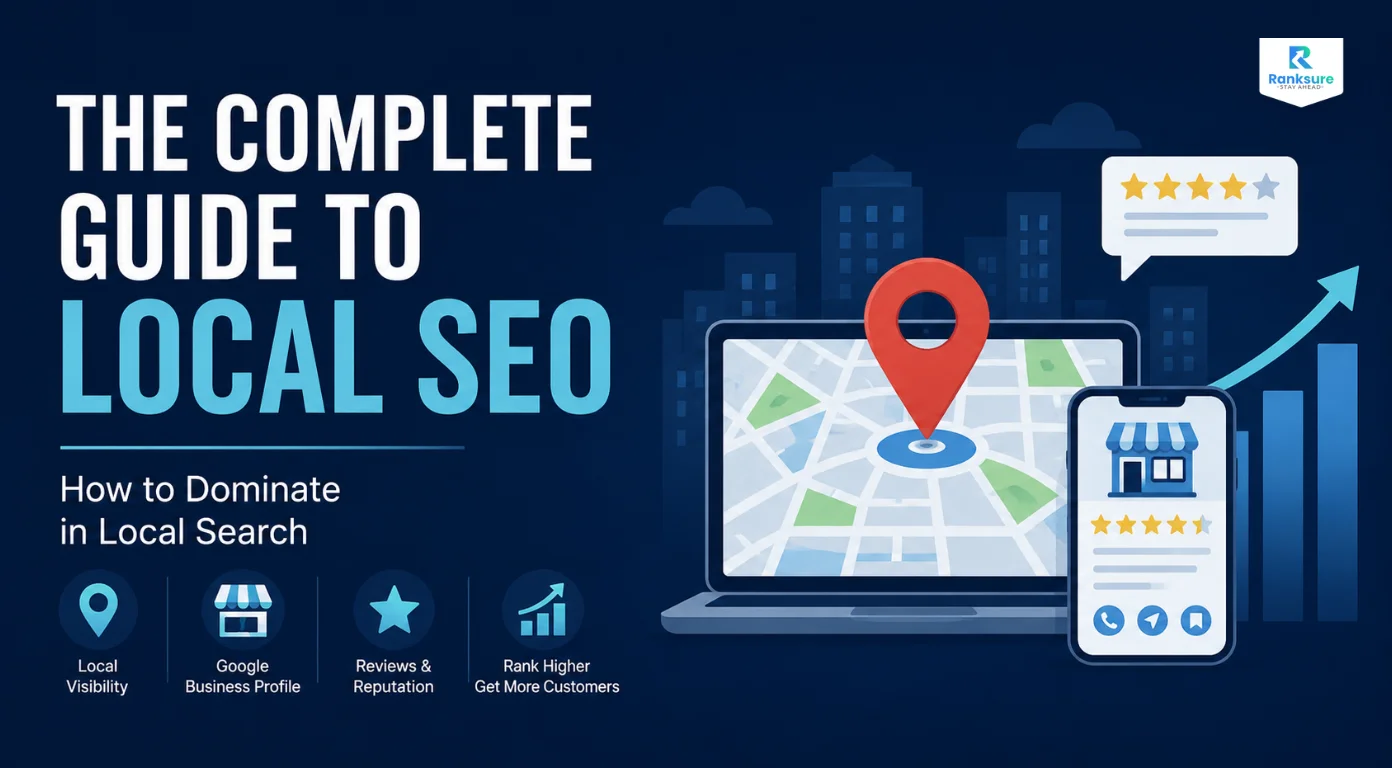
Local SEO is a geo-intent system that helps businesses appear when nearby customers search for services, products, directions, calls, or appointments. Search engines use proximity, trust signals, business data, and user intent to rank local results.
Local SEO is not only about rankings. It is about building local entity visibility that leads to calls, visits, bookings, and direction requests.
What Is Local SEO and How Does It Work?
What Local SEO Is
Local SEO is a search system built around business entities, location entities, service entities, proximity, and immediate customer intent.
Traditional SEO targets broad informational discovery. Local SEO targets micro-moments of decision-making, where users are not browsing—they are acting or about to act.
When someone searches:
- “best tacos near me”
- “emergency locksmith open now”
- “dentist in Scottsdale”
they are not researching. They are executing a decision process that is already halfway complete.
Local SEO focuses on capturing this intent window.
Search engines classify these queries through:
- geo-modifiers (“in London”, “near me”)
- implicit location intent (“open now pharmacy”)
- device-based inference (mobile + GPS)
- behavioral urgency signals (time-sensitive queries)
Local SEO aligns the business entity with nearby users who are ready to call, visit, book, or buy.
Local SEO vs Traditional SEO
Traditional SEO focuses on topical authority. Local SEO focuses on entity relevance, proximity, prominence, reviews, citations, and geographic trust signals.
| Dimension | Traditional SEO | Local SEO |
| Goal | Visibility | Physical conversion |
| Ranking logic | Content + backlinks | Proximity + relevance + prominence |
| SERP format | Organic links | Map Pack + Local Finder |
| User action | Click | Call, visit, navigate |
The fundamental shift: SEO used to answer “what is relevant?”
Local SEO answers “what is closest and trustworthy enough to act on immediately?”
Understanding Local Search Results
Local search is a layered visibility ecosystem. It appears across the Map Pack, Local Finder, organic results, Google Maps, and local platforms.
The most dominant layer is the Local Pack (Map Pack / 3-Pack) powered by Google Business Profile and Google Maps.
It includes:
- top 3 business listings
- star ratings
- location proximity
- operating hours
- call/direction buttons
Below it sits the Local Finder, an expanded interface where users explore more businesses in the same category. Then comes traditional organic SEO results.
Users now:
- read reviews directly in the SERP
- compare ratings visually
- check opening hours instantly
- click “call” without visiting websites
Other ecosystems also influence discovery:
- Apple Inc. (iOS navigation dominance)
- Yelp Inc. (trust validation layer)
- Microsoft Corporation (desktop fallback ecosystem)
Users now compare reviews, ratings, hours, photos, and directions inside search results.
How Google’s Local Algorithm Works
Google’s local ranking system is built on three core pillars:
| Ranking Factor | Meaning |
| Relevance | How well a business matches the customer’s search |
| Proximity | How close the business is to the searcher’s location |
| Prominence | How trusted and established the business appears online |
1. Relevance
How well a business matches search intent and category alignment. This is not only keyword matching. Google classifies the business entity through categories, services, attributes, reviews, citations, website content, and location data.
A “vegan bakery” must be structurally understood as:
- bakery entity
- vegan attribute entity
- food service category cluster
2. Proximity
Distance between user and business coordinates. This is dynamically recalculated based on:
- GPS accuracy
- device type
- query context
- search location override
Two users 500 meters apart see entirely different rankings.
3. Prominence
Prominence is harder to measure because it combines reviews, backlinks, citations, brand mentions, and engagement signals.
Prominence includes:
- review volume and velocity
- backlink authority
- citation consistency
- brand mentions
- behavioral engagement signals
Google increasingly evaluates businesses as entities inside a knowledge graph, not isolated listings.
That means:
- reviews are semantic inputs
- citations are identity validators
- backlinks are authority endorsements
The system is also adaptive:
- mobile search = stronger proximity weighting
- desktop search = stronger prominence weighting
- time-sensitive queries = real-time “open now” boost
Local rankings change based on user location, device, search time, query intent, and business trust signals.
Building Your Local SEO Foundation
Google Business Profile Setup and Optimization
Google Business Profile is the main local entity profile that connects business details, categories, services, reviews, photos, hours, and location data with Google Search and Maps.
Structural Optimization Framework
| Layer | Strategic Function | Execution Priority |
| Primary Category | Core ranking determinant | High precision required |
| Secondary Categories | Expands semantic reach | Align with adjacent services |
| Services & Products | Long-tail query capture | Detail-rich, intent-driven |
| Attributes | Filtering + conversion lift | Completeness is critical |
Primary Category Selection
The primary category is a major local ranking signal. Choose the category that best matches the main service entity.
For example, a dental clinic should choose “Dentist” as the primary category instead of a broad category such as “Health Consultant.”
Secondary Categories
Secondary categories work as semantic expansion signals that connect the business entity with related service entities and adjacent search intents.
For example, a dentist can add secondary categories such as “Cosmetic Dentist,” “Emergency Dental Service,” and “Dental Hygienist.”
Services & Products Layer
This is where search intent becomes operational. Each entry should mirror real-world queries, not internal jargon. Think in terms of how users search, not how businesses describe.
For example, a “Roof Repair in Lahore” page can explain leak causes, inspection steps, repair process, price factors, service areas, and FAQs.
Attributes
These filters influence both algorithmic matching and user-side decision velocity. Missing attributes can reduce relevance for filtered local searches.
Engagement and Activity Signals
| Component | Strategic Role |
| Photos | Trust reinforcement + freshness signal |
| Posts | Activity indexing + relevance updates |
| Q&A | Intent shaping + pre-conversion education |
Visual Infrastructure (Photos)
Authentic imagery outperforms generic stock assets.
Posts
A lightweight but high-signal mechanism. Regular updates reinforce relevance continuity within Google’s indexing cycles.
Q&A Layer
The Q&A section answers common questions before users call, visit, or book.
Systemic Failure Patterns
- Misaligned primary category selection
- Stagnant or outdated media assets
- Incomplete service architecture
- Duplicate or conflicting listings across platforms
- Keyword manipulation in business naming (high risk of suppression)
Inactive profiles reduce entity confidence because search engines and users may not know whether the business information is current.
Local SEO Action Checklist: Google Business Profile
Step 1: Choose Your Primary Category
- Search competitors ranking in the Map Pack
- Identify the category used by top-ranking businesses
- Select the most specific category available
Example:
- Bad: Health Consultant
- Good: Dentist
Step 2: Add Secondary Categories
Choose 3–5 relevant categories.
Example:
Primary Category:
- Dentist
Secondary Categories:
- Cosmetic Dentist
- Emergency Dental Service
- Dental Hygienist
Step 3: Complete Every GBP Field
Checklist:
- Business name
- Address
- Phone number
- Website URL
- Business description
- Hours
- Services
- Attributes
- Photos
- Appointment link
Citations, NAP Consistency, and Business Data
A business entity appears across Google, Apple Maps, Bing, directories, social profiles, and local websites.
NAP means name, address, and phone number. These details should stay consistent across every platform.
Citation Architecture
| Type | Definition | Strategic Role |
| Structured Citations | Directory-based listings | Foundational trust anchors |
| Unstructured Citations | Editorial or contextual mentions | Authority reinforcement |
Structured Citations
These include platforms and aggregators such as major directories and mapping ecosystems. They serve as the baseline validation layer for your business identity.
Unstructured Citations
These emerge organically through digital ecosystems — articles, blogs, forums, and community references. They carry contextual authority and semantic depth.
Identity Consistency Matrix
Search engines perform entity reconciliation across fragmented data sources. Even minor inconsistencies introduce ambiguity:
- “Street” vs “St.” formatting variance
- Legacy phone numbers still indexed online
- Address updates not synchronized across platforms
The system does not penalize errors, it simply reduces certainty. And reduced certainty translates into reduced visibility.
Operational Maintenance Strategy
Citation management is not a one-time deployment. It is continuous infrastructure hygiene.
Recommended approach:
- Conduct periodic audits using citation discovery tools
- Prioritize correction of high-authority platforms first
- Standardize NAP formatting across all ecosystems
- Maintain version control of business identity data
Citation maintenance keeps business data accurate across local platforms.
How to Build Citations (30-Minute Process)
Step 1:
Audit existing citations.Tools used are:
- BrightLocal
- Whitespark
- Semrush
Step 2:
Create a master NAP document.
Example:
- Business Name: ABC Dental Clinic
- Address: 123 Main Road, Lahore
- Phone: +1 (ABC)-XXX-XXXX
Step 3:
Update listings on:
- Google Business Profile
- Apple Maps
- Bing Places
- Yelp
Step 4:
Check consistency monthly.
Reviews and Reputation Management
Reviews are user-generated entity signals that show trust, service quality, recent activity, customer language, and conversion confidence.
They function as:
- Trust amplification signals
- Ranking reinforcement inputs
- Semantic training data for search models
Algorithmic Interpretation of Reviews
Modern systems evaluate reviews across multiple dimensions:
| Signal | Function |
| Volume | Authority baseline |
| Recency | Operational continuity |
| Velocity | Consistency of customer engagement |
| Semantic Content | Keyword and intent reinforcement |
User-generated language now contributes directly to topical relevance modeling.
Acquisition Strategy
Effective review generation is not opportunistic, it is systemized.
High-performance touchpoints:
- Post-service in-person requests (highest conversion efficiency)
- SMS-based automation flows
- QR-enabled feedback loops at point-of-sale
- Follow-up digital prompts with timing optimization
Response Strategy Framework
Engagement with reviews is a dual-channel signal:
- Algorithmic: demonstrates active business responsiveness
- Human: reinforces trust during decision-making moments
Negative reviews, when addressed with composure and specificity, often convert into credibility enhancers rather than liabilities.
A structured response signals operational maturity. Silence signals disengagement.
Example: Edmonton Roofing Company
After completing a roof replacement:
Send this SMS:
Hi Sarah, thank you for choosing ABC Roofing. If you were happy with our service, would you mind leaving us a quick Google review? Here’s the link: [review link]
This is much more practical than simply saying “collect reviews.”
Semantic Value of Review Content
Customer language becomes a distributed SEO asset:
- Service descriptors (“fast turnaround,” “pain-free experience”)
- Product specificity (“vegan options,” “emergency repair”)
- Emotional framing (“professional,” “reliable,” “stress-free”)
This creates a continuously evolving semantic map of your business within search ecosystems, built entirely from external perception.
5-Step Review Generation System
After every completed service:
- Ask in person
- Send SMS within 24 hours
- Include direct review link
- Follow up after 3 days
- Respond to every review
Template:
“Thank you for choosing us. If you had a positive experience, we’d appreciate a quick Google review.”
This instantly increases usefulness.
Researching Your Market and Competitors
Market intelligence identifies competitor entities, keyword clusters, review gaps, citation gaps, backlink gaps, and content opportunities. Before optimization begins, the ecosystem must be mapped, not as a list of competitors, but as a living graph of intent, geography, and digital authority.
Local Keyword Research
Local keyword research identifies service entities, location entities, urgency modifiers, and customer intent patterns inside a specific geographic market.
Search demand fragments into distinct intent clusters shaped by proximity, urgency, and service accessibility.
Core Keyword Clusters
| Cluster Type | Example Pattern | Behavioral Signal |
| Geo-modified | “dentist Lahore” | location-defined intent |
| Service-area | “plumber serving Clifton” | regional coverage intent |
| Urgency-based | “open now pharmacy” | immediate-action demand |
Each cluster represents a different decision velocity. Treating them as interchangeable dilutes ranking precision.
Discovery Infrastructure
Keyword discovery is a layered intelligence process rather than a single tool output.
Primary Signal Sources:
- Google Autocomplete (real-time demand aggregation layer)
- Google Search Console (actual impression data from your entity footprint)
- Google Keyword Planner (volume benchmarking with geo filters)
Autocomplete is strategic, it reflects collective search behavior, not theoretical assumptions.
Supplementary tools such as Semrush, Ahrefs, and BrightLocal introduce competitiveness scoring and SERP structure mapping, allowing prioritization across constrained resources.
Keyword Mapping Architecture
Keyword mapping is where strategy becomes structure.
Each keyword cluster must be assigned a dedicated landing surface:
- One intent cluster → one page entity
- Avoid multi-intent dilution across a single URL
- Prevent internal cannibalization across overlapping services
Local Keyword Research in 15 Minutes
Example: Vancouver Plumbing Company
Step 1: Search your core service.
Type into Google:
plumber vancouver
Autocomplete may reveal:
- plumber vancouver
- emergency plumber vancouver
- best plumber vancouver
- 24 hour plumber vancouver
- drain cleaning vancouver
Step 2: Group by intent.
| Keyword | Intent |
| plumber vancouver | transactional |
| emergency plumber vancouver | high-conversion |
| best plumber vancouver | commercial |
| drain cleaning vancouver | service-specific |
Step 3:
Create separate pages:
- /plumber-vancouver
- /emergency-plumber-vancouver
- /drain-cleaning-vancouver
Understanding Local Search Intent
Local intent is compressed decision logic, where awareness, evaluation, and action converge in a single search moment.
Rather than linear progression, intent operates as a collapsed funnel.
Intent Layers
| Layer | Function | Content Requirement |
| Informational | exploration phase | educational assets |
| Navigational | entity targeting | brand/location clarity |
| Transactional | conversion readiness | direct action pathways |
Intent Compression in Local SEO
In local ecosystems, these layers merge into a single behavioral window.
A query like “best physiotherapist near me” simultaneously:
- signals awareness of need
- triggers comparison behavior
- initiates purchase readiness
This collapse demands content that is both informative and conversion-optimized within the same interface layer.
Competitive Analysis
Competitors in local SEO are not just businesses, they are ranked entities occupying finite SERP real estate.
Competitive Evaluation Matrix
| Dimension | What It Measures | Strategic Insight |
| Review Density | volume + sentiment strength | trust accumulation rate |
| Citation Profile | directory + NAP consistency | entity credibility |
| Backlink Geography | local relevance signals | authority localization |
| GBP Activity | posting + engagement rhythm | operational vitality |
Intelligence Gathering Tools
- Semrush (SERP structure + keyword overlap)
- Ahrefs (backlink topology + authority flow)
- BrightLocal (local visibility + citation audits)
Each tool contributes a different layer of market perception modeling.
Competitive Gap Identification
Strategic advantage emerges from asymmetry detection:
- Review gaps → reputation scaling opportunities
- Citation gaps → trust infrastructure upgrades
- Content gaps → topical authority expansion
- Service gaps → unmet demand capture
Building a Local Content Strategy
Local SEO content reinforces the business entity by connecting service pages, location pages, FAQs, reviews, schema, citations, and internal links.
It expands the machine-readable footprint of your business across geographic and semantic dimensions.
Core Content Architecture
| Asset Type | Strategic Function |
| Service Pages | authority + conversion anchors |
| Location Pages | geographic relevance nodes |
| FAQ Clusters | intent interception layer |
Each asset strengthens a different layer of the ranking model.
Service Pages as Authority Systems
Service pages operate as full-spectrum knowledge nodes, not minimal descriptions.
High-performing structures include:
- service breakdowns
- process explanations
- local regulatory considerations
- pricing logic frameworks
- outcome-based positioning
Location Pages as Geographic Intelligence Nodes
A location page is not a directory entry. It is a localized expertise signal.
Effective pages integrate:
- neighborhood-specific context
- localized pain points
- case-based examples
- service adaptation by region
For example
Weak Page
We offer HVAC services in Calgary.
Strong Page
Our HVAC technicians serve Calgary, Airdrie, Chestermere, Cochrane, and Okotoks. Common issues we solve in Calgary include:
- furnace failures during winter
- thermostat calibration
- duct cleaning
- heat pump installation
Supporting Content Ecosystem
Supporting assets extend authority beyond transactional pages:
- blog intelligence clusters
- FAQ expansion frameworks
- case study narratives
- local guides and resource hubs
These assets:
- capture informational demand upstream
- reinforce topical authority downstream
- generate organic citation potential
They function as distributed ranking multipliers across the content network.
Optimizing Your Website, Content, and Authority
Local SEO maturity begins at the intersection of structure, semantics, and authority signals. This is where your website evolves from a digital brochure into a machine-readable entity system capable of competing in geo-constrained search environments.
On-Page and Technical SEO
On-page optimization is no longer about isolated keywords. It is about constructing a semantic alignment layer between user intent, page architecture, and search engine interpretation.
Geo-Targeted Content Architecture
| Element | Function | Strategic Impact |
| Title Tags | Geo + intent alignment | primary ranking trigger |
| Headings (H1–H3) | topical structuring | semantic clarity layer |
| Internal Links | authority distribution | crawl + relevance flow |
| Metadata | contextual reinforcement | SERP alignment |
Title Strategy
Titles should fuse service + geography + value proposition. This ensures immediate contextual mapping between query and result. The objective is not decoration — it is precision matching.
Semantic Structuring of Content
Headings act as interpretive layers for search systems. When properly structured, they form a hierarchical meaning map of your content.
Internal linking should function as an internal authority circulation system:
- service pages → location pages
- location pages → supporting services
- blogs → conversion pages
This creates a closed-loop relevance ecosystem that strengthens crawl efficiency and topical authority simultaneously.
Technical Performance as Ranking Infrastructure
Technical SEO is no longer backend hygiene — it is a ranking dependency layer.
Core performance signals include:
- page load speed (mobile-first indexing priority)
- visual stability during rendering
- interaction responsiveness
These metrics collectively define user experience integrity, which search systems interpret as quality assurance.
Schema and Structured Data
Structured data transforms human-readable content into machine-interpretable identity signals.
LocalBusiness schema enables:
- entity clarification (who you are)
- service definition (what you offer)
- geographic anchoring (where you operate)
It strengthens your presence in knowledge graphs and enhances eligibility for rich results, improving SERP surface area beyond standard listings.
Location and Multi-Location SEO
Location architecture determines how far your visibility footprint extends and how consistently it performs across geographic zones.
Operational Models
| Model Type | Description | Strategic Complexity |
| Single Location | centralized authority hub | low |
| Service-Area Business (SAB) | non-storefront geographic reach | medium |
| Multi-Location | distributed entity network | high |
Service-Area Business Dynamics
SAB models rely heavily on proximity-based ranking logic combined with digital signal expansion.
Key performance drivers:
- service page depth per geographic zone
- citation distribution consistency
- review velocity across service areas
SAB limitations emerge when geographic signals are too narrow or inconsistent, restricting reach radius.
Multi-Location Architecture Strategy
Multi-location systems require distributed SEO governance:
- multiple GBP entities
- localized citation clusters
- dedicated landing pages per location
- segmented review ecosystems
The challenge is not creation — it is synchronization. Each location must behave as an independent yet brand-consistent entity.
Critical Structural Risks
Avoid system degradation through:
- duplicated city pages with no differentiation
- templated content replication across locations
- inconsistent NAP or service definitions
- overlapping keyword targeting across locations
Search engines interpret repetition without variation as low informational value.
Each location page should function as a distinct location-entity knowledge node with unique local context, services, customer proof, NAP details, reviews, and internal links.
Local Link Building and Authority Development
Backlinks function as geographic authority endorsements.
Sources:
- local newspapers
- sponsorships
- chambers of commerce
- community organizations
Each link strengthens prominence by embedding the business into local digital ecosystems.
Measuring Local SEO Performance
Essential Local SEO Tools
A structured measurement system relies on interconnected platforms that each capture a different layer of performance reality.
Google Business Profile Insights
This is the native visibility layer within Google’s ecosystem. It captures search triggers, profile interactions, calls, direction requests, and engagement with visual assets. While limited in depth, it reflects real user intent at the point of discovery.
Google Analytics 4
GA4 translates traffic into behavioral and commercial outcomes. It maps user journeys after the click — sessions, engagement patterns, conversions, and revenue pathways. Its value lies in connecting visibility to measurable business impact.
Google Search Console
Search Console provides query-level intelligence. It reveals impressions, clicks, CTR, and average position across real search terms. For local SEO, it exposes geographic intent patterns and identifies emerging keyword opportunities.
Specialized Local SEO Tools
Platforms like BrightLocal, Whitespark, Local Falcon, Semrush, and Ahrefs expand measurement into competitive and spatial intelligence. They enable citation tracking, geo-grid ranking visualization, backlink analysis, and reputation monitoring — transforming fragmented signals into structured insights.
Tracking Rankings, Traffic, and Conversions
Local SEO rankings are not fixed positions they are spatially distributed outcomes influenced by proximity, device context, and behavioral history.
Core Performance Metrics
Map Pack position reflects localized visibility strength. Call volume indicates direct commercial intent. Direction requests signal physical purchase readiness. Bookings and form submissions represent conversion execution. Revenue attribution connects visibility to financial impact.
Each metric captures a different stage of intent maturity, from discovery to transaction.
Spatial Ranking Dynamics
Local rankings vary across geography. A business does not hold a single position, it occupies a visibility surface across multiple coordinates.
Conversion Attribution Complexity
Local user journeys are multi-touch by design. A single conversion may involve search discovery, review validation, multiple website visits, and direct GBP interaction before final action.
Attribution models therefore require interpretive flexibility. Conversions should be evaluated as ecosystem outcomes rather than isolated channel wins.
Auditing and Continuous Improvement
Local SEO is a living system that requires continuous recalibration rather than periodic intervention.
Audit Framework
Audits function as diagnostic intelligence cycles across core domains: GBP health, citation consistency, technical performance, content relevance, backlink authority, and competitive positioning.
The objective is not issue accumulation but impact prioritization.
Prioritization Logic
High-impact fixes take precedence over surface-level adjustments. Identity consistency and citation accuracy form the foundation. Technical performance ensures accessibility. Content depth strengthens relevance. Authority signals reinforce trust.
This hierarchy reflects how search systems evaluate credibility and ranking potential.
Continuous Optimization Cycle
Local SEO operates on iterative feedback loops. Weekly monitoring captures behavioral fluctuations. Monthly analysis evaluates trend direction. Quarterly audits recalibrate structural strategy.
This transforms SEO from a campaign-based activity into an adaptive performance system.
Costs, Trends, and Long-Term Success
Local SEO is not a one-time investment. It is an operating model where capital, execution discipline, and system design determine long-term visibility outcomes. Cost structure alone does not define success — execution consistency does.
DIY vs Agency vs Software
Local SEO execution models differ primarily in control depth, scalability, and operational efficiency.
DIY vs Agency vs Software (Local SEO Execution Models)
| Dimension | DIY (Do-It-Yourself) | Agency Model | Software-Driven Infrastructure |
| Core Philosophy | Full operational control and hands-on execution | Delegated expertise with structured scaling | System enablement and performance intelligence |
| Primary Role | Direct execution of all SEO tasks | Strategy + execution managed externally | Measurement, automation, and data visibility |
| Control Level | Very high — complete ownership | Medium — shared control with external team | Indirect — supports decisions, not execution |
| Scalability | Limited by time and skill capacity | High — built for multi-client scaling | High — scales data and monitoring, not actions |
| Speed of Execution | Slow to moderate | Fast due to team workflows | Instant data availability, no execution delay |
| Cost Structure | Low monetary cost, high time investment | High recurring cost, lower time burden | Subscription-based, variable tiers |
| Best Use Case | Early-stage businesses, learning phase, tight budgets | Competitive markets, multi-location brands, aggressive growth | Performance tracking, optimization support, automation layer |
| Key Strength | Maximum control and flexibility | Professional expertise + execution speed | Data-driven decision support and visibility |
| Key Limitation | Bottlenecked by time and expertise | Reduced granular control and dependency risk | No direct strategic execution capability |
| Strategic Value | Skill building + foundational experimentation | Market acceleration + competitive dominance | Operational intelligence + efficiency enhancement |
AI, Zero-Click Search, and the Future of Local SEO
Search is moving from showing results to helping users choose, contact, navigate, book, or buy directly. The goal is no longer to provide information, it is to complete decisions.
Zero-Click Reality
A growing percentage of user interactions are resolved within search interfaces without website visits. Common zero-click actions include:
- direct calls from Google Business Profiles
- navigation via map integrations
- instant booking or appointment flows
- embedded answer extraction in SERPs
In this environment, visibility itself has become the conversion infrastructure. The website is not the destination but optional endpoints.
AI-Driven Discovery Systems
Artificial intelligence is reshaping how local entities are identified and ranked in user-facing systems.
Modern discovery models interpret:
- visual inputs (image recognition tied to business identity)
- urgency signals (time-sensitive intent detection)
- entity relationships (how businesses connect within a local ecosystem)
This shifts search behavior from explicit queries to predictive fulfillment pathways.
Search Evolution Model
Search is moving through three structural phases:
- Retrieval → user searches, system returns results
- Recommendation → system suggests options based on inferred intent
- Fulfillment → system executes or completes actions directly
Local SEO now operates across all three layers simultaneously.
Your Local SEO Action Plan
Sustainable success in local SEO is built on compounding visibility assets. Each layer strengthens the next, creating a self-reinforcing authority structure.
Building a Sustainable Strategy
Core compounding assets include:
- reviews as trust velocity signals
- citations as identity reinforcement layers
- content depth as semantic authority expansion
- backlinks as external validation nodes
Where to Start
Execution order determines early momentum quality.
Phase 1: Foundation
Begin by stabilizing core identity and technical structure:
- Google Business Profile optimization
- NAP consistency correction across platforms
- technical SEO stabilization
This establishes baseline trust and indexability.
Phase 2: Authority Build
Next, expand perceived credibility and relevance:
- structured review acquisition system
- content ecosystem development
- local backlink acquisition
This phase strengthens ranking competitiveness.
Phase 3: Optimization Layer
Finally, refine performance and scale efficiency:
- conversion and ranking tracking systems
- performance audits
- iterative refinement based on data signals
This transforms SEO from setup into adaptive growth.
90-Day Roadmap
- Days 1–30: Foundation Layer
Establish structural integrity through GBP optimization, citation correction, and technical fixes.
- Days 31–60: Authority Layer
Scale credibility through content expansion, review velocity, and initial backlink development.
- Days 61–90: Optimization Layer
Introduce tracking systems, refine performance signals, and optimize based on real-world data feedback.
Conclusion
Local SEO operates as a geo-intent driven system where visibility translates directly into action, not just rankings. Success is determined by relevance, proximity, and prominence working together as a unified signal framework. Google Business Profile acts as the central control hub, while reviews and citations build the trust layer that sustains authority.
As AI and zero-click search reshape user behavior, discovery is increasingly becoming instant execution. Long-term success comes from consistently compounding local signals rather than relying on isolated optimization efforts.
Frequently Asked Questions About Local SEO
How long does local SEO take?
Most businesses see initial improvements within 1–3 months, while competitive markets typically require 6–12 months for significant ranking growth. Consistency in reviews, content, and optimization is key.
Does local SEO work for service-area businesses?
Yes. Businesses without a storefront can rank locally by optimizing their Google Business Profile, defining service areas, and creating location-specific service pages.
How many Google reviews do I need?
There is no fixed number, but businesses with a steady flow of recent, authentic reviews generally outperform competitors with fewer or outdated reviews. Quality and recency matter more than volume alone.
What are local citations?
Local citations are mentions of your business name, address, and phone number across directories, maps, and websites. Consistent citations help search engines verify your business and improve local trust signals.
Can my business rank in multiple cities?
Yes, if you create unique location pages and build local relevance for each area. Simply duplicating the same content across multiple city pages is unlikely to rank well.