
The websites are struggling to achieve consistent rankings while focusing on keywords. As search engines’ understanding of meaning and intent has improved, keyword-focused optimization alone is not enough.
Modern search systems evaluate entities, context, relationships between concepts, and how well content satisfies user intent. This shift has made Semantic SEO a critical part of modern search optimization.
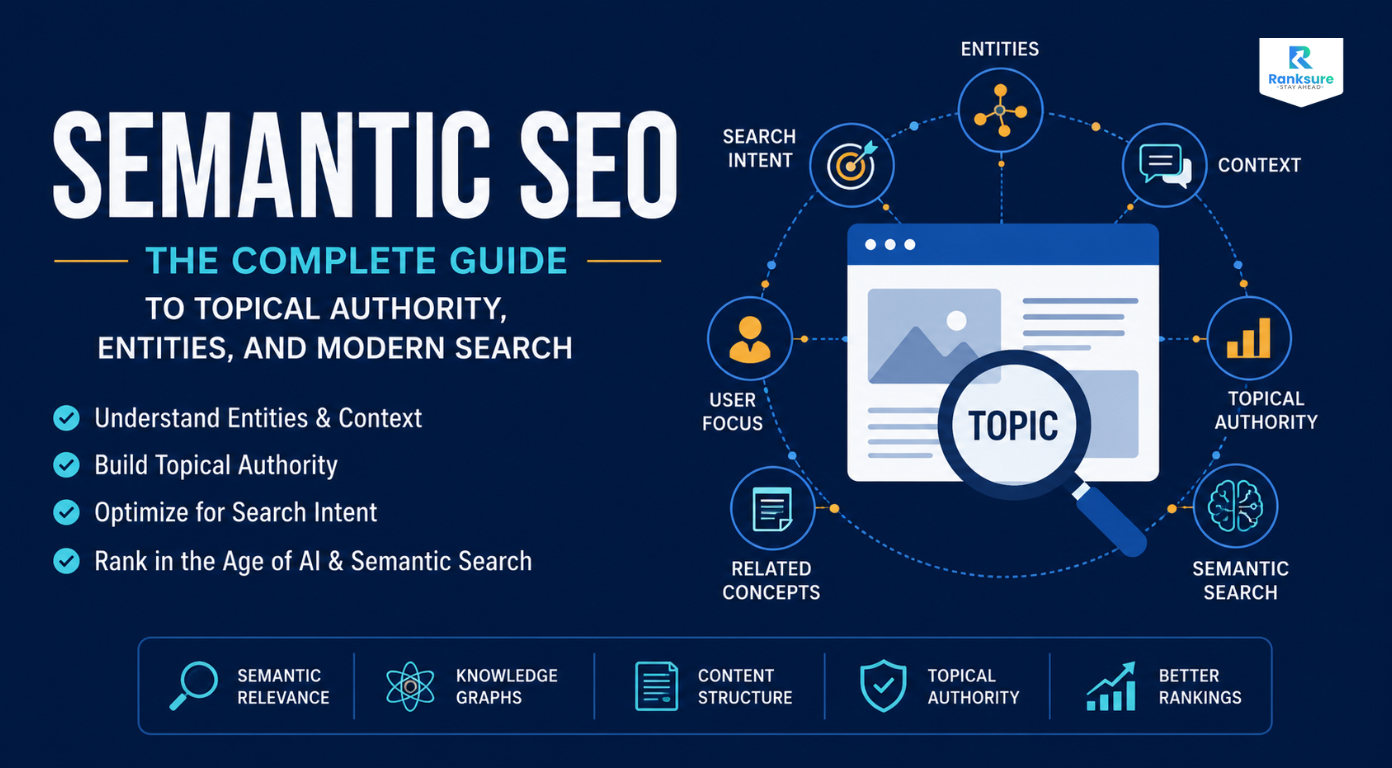
Semantic SEO focuses on topics, entities, and topical authority rather than individual keywords. This guide explains how Semantic SEO works, why it matters, and how to build a strategy that aligns with modern search systems.
What Is Semantic SEO?
Semantic SEO Defined
Semantic SEO is the practice of optimizing content around meaning, context, entities, and user intent rather than relying primarily on exact-match keywords.
The objective is to help search engines understand:
- What a page is about
- Which entities it discusses
- How those entities relate to one another
- Which search intents the content satisfies
- Where the content fits within a broader topical ecosystem
For example, a page about “electric vehicles” should naturally discuss related entities and concepts such as batteries, charging infrastructure, range, manufacturers, sustainability, government incentives, and vehicle performance. Search engines use these relationships to evaluate topical relevance and completeness.
Semantic SEO is about helping search engines understand meaning rather than simply matching words.
Semantic SEO vs Traditional SEO
The difference between traditional SEO and Semantic SEO can be understood as the difference between matching strings and understanding things.
| Traditional SEO | Semantic SEO |
| Focuses heavily on keywords | Focuses on topics and entities |
| Prioritizes exact-match optimization | Prioritizes contextual relevance |
| Often treats pages independently | Connects pages through topical relationships |
| Measures keyword rankings | Measures topical visibility and authority |
| Targets specific search terms | Targets concepts and user needs |
| Limited topic coverage | Comprehensive topic coverage |
Traditional keyword optimization still matters. Search engines use keywords as signals. They function as entry points into larger topical frameworks.
A page optimized for Semantic SEO can rank for many related searches because it demonstrates an understanding of an entire subject rather than a single phrase.
For example, a comprehensive guide about Semantic SEO may rank for:
- entity-based SEO
- topical authority
- knowledge graph SEO
- semantic search optimization
- content clusters
- search entities
- topical maps
Even if those exact phrases are not the primary target keyword.
How Search Engines Understand Meaning
Modern search engines do more than match keywords. They try to understand what content is about, how concepts relate to one another, and whether a page satisfies the user’s intent.
From Keywords to Entities
One of the biggest changes in search has been the shift from keywords to entities. An entity is a uniquely identifiable person, place, company, product, organization, or concept.
For example, Google, Tesla, New York City, and Semantic SEO are all entities. When search engines identify entities within content, they better understand the topic being discussed and the relationships between related concepts.
A page about Semantic SEO may naturally mention search intent, knowledge graphs, NLP, and schema markup. Search engines recognize that these concepts belong to the same topic area, helping them evaluate relevance and depth of coverage.
Understanding Context and Intent
Search engines also analyze context and intent rather than relying solely on exact wording. For example, the following searches use different languages but express a similar need:
- What is Semantic SEO?
- How does Semantic SEO work?
- Explain Semantic SEO
Modern search systems recognize the shared intent behind these queries and return similar results. This allows content to rank for multiple related searches without targeting every keyword variation individually.
Technologies Behind Semantic Search
Several technologies help search engines understand meaning:
| Technology | Role in Search |
| Knowledge Graphs | Connect entities and their relationships |
| NLP | Understand language, context, and meaning |
| Hummingbird | Improved query interpretation and semantic understanding |
| BERT | Helps Google understand words within context |
| MUM | Improves understanding across languages and content formats |
| Vector Search | Identifies semantically similar content, even without exact keyword matches |
Together, these technologies allow search engines to evaluate topics, relationships, and intent rather than relying solely on keyword matching.
Core Components of Semantic SEO
Semantic SEO is built on several foundational pillars. Understanding these components helps explain why some websites consistently dominate entire topic areas rather than individual keywords.
Search Intent
Search intent represents the underlying reason behind a search query. Modern search engines prioritize intent fulfillment over keyword matching. Most searches fall into one or more categories:
| Intent Type | Example Query | Goal |
| Informational | What is Semantic SEO? | Learn |
| Investigative | Best Semantic SEO tools | Compare |
| Transactional | Hire an SEO consultant | Take action |
| Navigational | Google Search Console | Reach a destination |
Many queries contain multiple intent layers.
For example, someone searching “Semantic SEO” may want:
- A definition
- An explanation of entities
- Implementation guidance
- Performance measurement techniques
The most effective content satisfies these layers within a single user journey. This is why comprehensive guides outperform narrowly focused articles.
Entities
Entities are the building blocks of semantic understanding. Search engines use entities to organize information and understand relationships across the web.
For Semantic SEO, entity optimization involves:
- Identifying important entities within a topic
- Covering their attributes
- Explaining their relationships
- Connecting them contextually throughout the content
For example, within the Semantic SEO ecosystem:
| Entity | Attributes | Relationships |
| Semantic SEO | Topic, methodology | Connected to NLP, entities, topical authority |
| Knowledge Graph | Database structure | Stores entities and relationships |
| Schema Markup | Structured data format | Helps define entities |
| Search Intent | User objective | Guides content creation |
| Topical Authority | Expertise signal | Built through comprehensive coverage |
Content becomes stronger when these relationships are explicitly explained rather than merely mentioned.
Topical Authority
Topical authority is one of the most important outcomes of Semantic SEO.
What Topical Authority Means
Topical authority refers to the degree to which a website demonstrates expertise and comprehensive coverage within a subject area.
Search engines evaluate authority not only through backlinks but also through depth of knowledge.
A website that thoroughly covers Semantic SEO, entity optimization, topical mapping, content clusters, schema markup, and AI search sends stronger signals of expertise than a site with only one isolated article.
Topic Coverage vs Content Volume
The publishers confuse topical authority with publishing frequency. In reality, publishing more content does not automatically increase authority. Search engines increasingly reward comprehensive coverage of a topic rather than sheer content volume.
| Topic Coverage | Content Volume |
| Focuses on covering a subject comprehensively | Focuses on publishing more pages |
| Explores entities, subtopics, and relationships | Often creates overlapping or shallow content |
| Builds topical authority | Does not guarantee authority |
| Strengthens contextual relevance | May dilute topical focus |
| Prioritizes content quality and completeness | Prioritizes quantity and publishing frequency |
The goal is not to publish the most content. The goal is to create the most complete and useful resource on a topic.
Entity Relationships and Expertise Signals
Topical authority develops when content explains how related concepts connect rather than discussing them in isolation. For example, Semantic SEO naturally intersects with entities, search intent, knowledge graphs, structured data, internal linking, and topic clusters.
Demonstrating these relationships helps search engines better understand expertise and contextual relevance.
Information Gain
Information gain refers to the unique value a piece of content contributes beyond what already exists. Search engines have access to millions of pages discussing the same subjects. To stand out, content must contribute something useful, original, or more complete.
Information gain can come from:
- Unique frameworks
- Better explanations
- Stronger examples
- New connections between concepts
- Improved organization
- More complete topical coverage
Example
Weak content:
- Defines Semantic SEO
- Lists benefits
Strong content:
- Defines Semantic SEO
- Explains vector search
- Maps entity relationships
- Shows implementation workflows
- Connects Semantic SEO to AI Overviews
The second version provides information users cannot easily find elsewhere, increasing both usefulness and uniqueness.
Semantic Keyword and Entity Research
Effective Semantic SEO begins long before content creation. The research phase determines which entities, topics, relationships, and search intents belong within a subject area.
Traditional keyword research focuses on finding phrases with measurable search volume. Semantic research takes a broader view. The goal is to understand the complete information ecosystem surrounding a topic.
Instead of asking, “Which keyword should I target?” ask:
- Which entities define this topic?
- What questions do users ask?
- What related concepts appear consistently?
- How do search engines connect these ideas?
- Which topical gaps exist within my content?
Semantic Keywords vs Traditional Keywords
Traditional keyword research treats each keyword as a separate ranking opportunity. Semantic keyword research groups related keywords by intent, topic, and meaning.
| Traditional Keyword Research | Semantic Keyword Research |
| Targets individual keywords | Targets topics and entities |
| Focuses on exact-match phrases | Focuses on meaning and context |
| Often creates separate pages for keyword variations | Consolidates related queries into comprehensive content |
| Prioritizes search volume | Prioritizes topical relevance and intent |
| Measures success by keyword rankings | Measures success by topical visibility and authority |
For example, searches such as semantic SEO, semantic search SEO, entity-based SEO, and knowledge graph SEO are closely related. Rather than creating separate pages for each keyword, a semantic approach recognizes their overlap and addresses them within a broader topic ecosystem.
How to Discover Related Topics
Every topic exists within a broader semantic ecosystem. Effective research starts by identifying three layers of coverage:
Core Entities: The primary concepts directly tied to the topic.
Supporting Entities: Concepts that help explain, contextualize, or expand the topic.
Adjacent Topics: Related subjects that users may explore during their learning journey.
For Semantic SEO, the core entities include search intent, entities, knowledge graphs, NLP, and topical authority. Supporting entities include schema markup, vector search, content hubs, and information gain. Adjacent topics include technical SEO, information retrieval, machine learning, and content strategy.
A simple way to uncover these relationships is to ask: What concepts would an expert naturally discuss when explaining this topic?
Using Google SERPs for Entity Research
Search engine results pages provide some of the most valuable semantic research data available.
Examine:
- People Also Ask questions
- Related searches
- AI Overviews
- Autocomplete suggestions
- Knowledge panels
- Featured snippets
These features reveal how search engines organize information around a topic. For example, a search for Semantic SEO often surfaces concepts such as:
- topical authority
- entities
- search intent
- schema markup
- NLP
- content clusters
This provides direct insight into Google’s understanding of the topic.
When certain entities repeatedly appear across SERP features, they are important components of topical coverage.
Leveraging Knowledge Graph Sources
Knowledge graph research helps uncover entity relationships that keyword tools miss. Sources such as Wikipedia, Wikidata, Google Knowledge Panels, authoritative industry publications, and official organization websites reveal important attributes, related entities, and hierarchical relationships.
Studying how these sources connect concepts provides valuable insight into how search engines organize and understand information.
Keyword Clustering and Topic Modeling
Keyword clustering groups related search queries based on shared intent. Instead of creating separate pages for terms such as semantic SEO, semantic search SEO, semantic optimization, and semantic content SEO, a semantic approach recognizes that these queries seek similar information and can be addressed by a single comprehensive page.
Topic modeling expands beyond keyword grouping by identifying the entities, subtopics, questions, and supporting concepts of a topic. For example, a Semantic SEO guide may naturally cover search intent, knowledge graphs, NLP, vector search, schema markup, internal linking, and topical authority not because they are target keywords, but because they are essential components of the subject.
Mapping Topics to Search Intent
Intent mapping ensures content aligns with user needs. Many websites create content around keywords while ignoring why users search. A stronger approach maps topics to specific intent stages.
| Stage | User Goal |
| Awareness | Learn the concept |
| Consideration | Compare approaches |
| Evaluation | Assess benefits |
| Implementation | Apply the strategy |
| Measurement | Track results |
For Semantic SEO:
Awareness
- What is Semantic SEO?
- What is an entity?
Consideration
- Semantic SEO vs traditional SEO
- Benefits of topical authority
Implementation
- Create a topical map
- Build content clusters
- Optimize entities
Measurement
- Track topical authority
- Measure entity coverage
- Monitor AI visibility
Intent mapping helps create content ecosystems that support the entire user journey.
How to Build a Semantic SEO Strategy
Semantic SEO succeeds when content, architecture, entities, and user intent work together as a unified system. The goal is to build authority across an entire topic area.
Create a Topical Map
A topical map is a blueprint that outlines the entities, subtopics, questions, and relationships within a subject. Think of it as a visual representation of a knowledge graph for your website.
A strong topical map identifies:
- Core topics
- Supporting topics
- Related entities
- Search intents
- Content opportunities
Without a topical map, content creation often becomes fragmented and reactive.
With a topical map, every article contributes to a larger authority-building strategy.
What Is a Topical Seed Keyword?
A topical seed keyword is the starting point used to discover an entire topic ecosystem. The result becomes a comprehensive topical map.
Examples:
| Topic | Seed Keyword |
| Semantic SEO | semantic SEO |
| Email Marketing | email marketing |
| Cybersecurity | cybersecurity |
| Nutrition | healthy eating |
Expanding the Topic Universe
Starting with Semantic SEO, expansion may reveal:
Level 1 Topics
- Search intent
- Entities
- NLP
- Schema markup
Level 2 Topics
- BERT
- MUM
- Knowledge Graph
- Vector search
Level 3 Topics
- JSON-LD
- sameAs
- Entity attributes
- Internal linking architecture
This creates a scalable structure for future content.
Build Clusters
Topic clusters organize content around a central pillar page. A pillar page provides broad coverage. Cluster pages provide deeper coverage of individual subtopics.
Example:
Pillar
- Semantic SEO Guide
Clusters
- What Are Search Entities?
- Topical Authority Explained
- Schema Markup Guide
- Vector Search in SEO
- AI Overview Optimization
- Topic Clusters for SEO
Each cluster links back to the pillar. The pillar links to supporting clusters. This architecture helps search engines understand topical relationships. It also improves user navigation and content discovery.
Find Entity Relationships
Semantic SEO identifies how entities connect.
For example:
| Entity | Related Entity | Relationship |
| Semantic SEO | Topical Authority | Supports |
| Semantic SEO | Search Intent | Depends On |
| Knowledge Graph | Entities | Organizes |
| Schema Markup | Knowledge Graph | Clarifies |
| NLP | Semantic Search | Enables |
When content explains these relationships, search engines gain stronger contextual signals.
Expand Coverage
Topical authority is built through coverage expansion. After publishing foundational content, identify missing areas.
Ask:
- Which entities remain uncovered?
- Which user questions remain unanswered?
- Which adjacent topics deserve dedicated content?
For example, many sites publish one Semantic SEO article and stop. A stronger strategy expands into:
- Entity optimization
- Topic clusters
- AI search optimization
- Knowledge graph SEO
- Schema implementation
- Vector search
- Information gain
The result is a scalable authority-driven content strategy rather than a collection of isolated articles.
Example Semantic SEO Workflow
The following workflow provides a practical framework for implementing Semantic SEO:
| Step | Action |
| 1 | Select a topical seed keyword |
| 2 | Identify core entities and related concepts |
| 3 | Build a topical map |
| 4 | Cluster keywords by intent |
| 5 | Create a pillar page |
| 6 | Publish supporting cluster content |
| 7 | Add contextual internal links |
| 8 | Implement schema markup |
| 9 | Audit topical gaps and expand coverage |
| 10 | Measure visibility, entity coverage, and AI presence |
The objective is to create a connected knowledge ecosystem that demonstrates expertise across an entire topic rather than optimizing individual pages in isolation.
Optimizing Content for Semantic Search
Creating semantically relevant content requires more than inserting related keywords. Content should demonstrate expertise, contextual depth, and clear relationships between entities.
Create Content Around Topics, Not Individual Keywords
Modern search engines evaluate topical coverage rather than isolated keyword usage. Instead of optimizing a page around a single phrase, build content around the broader topic and the entities connected to it.
Comprehensive coverage helps search engines understand the topic more completely and enables a page to rank for numerous related queries.
Cover Entities, Attributes, and Relationships
High-quality semantic content explains more than definitions. It explains how concepts connect and interact within a topic ecosystem.
| Entity | Attributes | Relationship |
| Schema Markup | JSON-LD, structured data | Helps define entities |
| Search Intent | Informational, commercial, transactional | Guides content creation |
| Knowledge Graph | Nodes, connections | Stores entity relationships |
| Topical Authority | Expertise, coverage | Built through comprehensive topic coverage |
Search engines use these contextual relationships to better understand depth, relevance, and expertise.
Use Natural Language and Contextual Relevance
Semantic optimization does not require forcing keywords into every paragraph. Modern search engines understand synonyms, related concepts, and contextual relationships.
Focus on answering questions naturally, explaining concepts thoroughly, and using terminology that would be expected within the topic. Relevance comes from context and coverage rather than keyword repetition.
Structure Content for Semantic Comprehension
Search engines must be able to understand how information is organized. Clear structure improves both user experience and machine interpretation.
Headings and Information Hierarchy
Use headings to group related concepts and establish clear relationships between topics and subtopics. A logical hierarchy helps search engines understand how information is connected while making content easier to navigate.
BLUF Formatting
BLUF (Bottom Line Up Front) places the direct answer before supporting details. This structure improves readability and makes content easier for search engines and AI systems to extract and summarize.
Passage-Level Optimization
Search engines can evaluate individual sections of a page. Each section should answer a specific question clearly enough to stand on its own within featured snippets, AI-generated answers, and other search features.
Answer Questions Across the User Journey
Semantic SEO aims to satisfy related questions throughout the user’s journey rather than focusing on a single query.
| Stage | Common Questions |
| Discovery | What is Semantic SEO? |
| Understanding | How do search engines understand entities? |
| Evaluation | Is Semantic SEO better than traditional SEO? |
| Implementation | How do I build a topical map? |
| Optimization | How do I use schema markup? |
| Measurement | How do I track Semantic SEO performance? |
Content that addresses these stages comprehensively satisfies user intent and demonstrates topical expertise.
Optimize for AI Overviews and Answer Engines
AI-powered search experiences generate answers by extracting and synthesizing information from multiple sources. To improve visibility within AI Overviews and answer engines:
- Lead sections with direct answers.
- Use descriptive headings.
- Define entities clearly.
- Explain relationships between concepts.
- Structure content using BLUF formatting.
- Support claims with expertise and original insights where possible.
Content that is clear, entity-rich, and easy to summarize is more likely to be referenced in AI-generated search experiences.
Semantic Site Architecture and Internal Linking
Semantic SEO extends beyond individual pages. Search engines evaluate how content is connected across an entire website.
A well-structured site helps search engines understand topical relationships and expertise at the domain level.
Designing Content Hubs
A content hub is a collection of interconnected resources that cover a topic comprehensively. Rather than publishing isolated articles, content hubs organize related pages around a central subject and connect them through internal links.
For Semantic SEO, a content hub might include guides on search intent, entities, topical authority, schema markup, knowledge graphs, and AI search optimization. This structure helps search engines understand topical relationships while improving navigation for users.
Pillar and Cluster Architecture
The pillar-cluster model is one of the most effective structures for semantic optimization. A pillar page provides broad coverage. Cluster pages explore subtopics in greater depth.
Example:
Pillar Page
Semantic SEO
Cluster Pages
- Search Entities
- Knowledge Graphs
- Structured Data
- Topical Authority
- Internal Linking
- AI Overviews
- Information Gain
Benefits include:
- Better topic organization
- Improved crawl efficiency
- Stronger contextual signals
- Enhanced user navigation
The structure mirrors how knowledge graphs organize information through relationships.
Contextual Internal Linking
Internal links help search engines understand connections between topics. The most valuable links are contextual. Rather than inserting links arbitrarily, connect pages when they genuinely support one another.
Example:
A page discussing schema markup naturally links to:
- Entity optimization
- Knowledge graphs
- Structured data implementation
- Topical authority
These links create semantic pathways that reinforce relationships between concepts.
Strengthening Topic Authority Through Site Structure
Authority is rarely built through a single page. It emerges when an entire section of a website demonstrates expertise.
A strong semantic architecture:
- Covers the topic comprehensively
- Connects related entities
- Supports multiple search intents
- Maintains logical hierarchy
- Expands systematically over time
The result is a scalable entity network that strengthens topical authority across the domain.
Entity Optimization and Structured Data
Entities are central to modern search. The search engines identify many entities automatically, and structured optimization provides clearer signals.
Identifying and Prioritizing Entities
Begin by identifying the most important entities within a topic. For Semantic SEO, high-priority entities include:
- Search Intent
- Knowledge Graph
- Schema Markup
- Structured Data
- NLP
- BERT
- MUM
- Gemini
- Vector Search
- Topical Authority
Focus on entities that are most relevant to user intent and topic understanding.
Schema Markup and JSON-LD
Schema markup is structured data that helps search engines interpret content more accurately. JSON-LD has become the preferred implementation format. Schema does not improve rankings directly. Its value comes from improving clarity.
It helps search engines understand:
- Who created the content
- What the content discusses
- Which entities are referenced
- How concepts relate
Common schema types include:
- Article
- Person
- Organization
- FAQ
- Breadcrumb
- WebPage
Structured data acts as an explicit layer of communication between websites and search engines.
sameAs and Knowledge Graph Connections
The sameAs property helps connect entities to recognized sources across the web.
Examples may include:
- Wikidata
- Wikipedia
- Official company websites
- Author profiles
By referencing authoritative sources, websites help search engines disambiguate entities.
For example, a schema implementation can clarify that a specific entity refers to a particular organization, person, or concept rather than a similarly named alternative.
These connections strengthen entity recognition and knowledge graph alignment.
Author Entities and E-E-A-T Signals
Author entities help search engines associate content with a verifiable expert. Author bios, credentials, and Person schema can strengthen E-E-A-T signals and improve entity recognition.
Strong author signals include:
- Author biography
- Professional credentials
- Published work
- Organization associations
- Structured Person schema
Common Entity Optimization Mistakes
Common errors include:
- Focusing only on keywords
- Ignoring entity relationships
- Using schema without substantive content
- Creating shallow topic coverage
- Over-optimizing structured data
Schema should support content quality, not replace it.
Entity optimization works best when structured data, content depth, and site architecture work together.
Updating Existing Content for Semantic SEO
Updating existing assets produces faster results.
Audit Existing Topic Coverage
Begin by evaluating current content. Create the topical map. This will reveal areas where coverage is incomplete.
Identify:
- Covered entities
- Missing entities
- Thin sections
- Redundant pages
- Internal linking gaps
Identify Missing Entities and Questions
Compare your content against:
- Search results
- People Also Ask questions
- Competitor coverage
- Knowledge graph relationships
Look for concepts users expect but cannot find. Missing entities represent missed ranking opportunities.
Expand Contextual Depth
Depth creates stronger semantic signals than additional keyword usage. Rather than adding more keywords, add more context.
Explain:
- Relationships
- Attributes
- Processes
- Use cases
- Supporting concepts
Improve Internal Linking Relationships
Strategic linking strengthens topical networks. Review how pages connect.
Ask:
- Which pages should reference each other?
- Which topics are isolated?
- Which hubs need stronger support?
Add Structured Data and Entity Signals
Enhance clarity and entity understanding through:
- Article schema
- Person schema
- Organization schema
- FAQ schema
- Breadcrumb schema
Refresh Content for Current Search Intent
Search intent changes over time with new updates and ongoing research. A page ranking five years ago doesn’t satisfy today’s expectations. Regular updates help maintain relevance.
Review:
- SERP changes
- AI Overviews
- New user questions
- Emerging entities
- Industry developments
Measuring Semantic SEO Success
Semantic SEO requires broader measurement than keyword rankings alone.
| Metric Area | What to Measure |
| Organic Visibility | Organic traffic, impressions, click-through rate (CTR), and ranking distribution |
| Entity Coverage & Topical Depth | Number of covered entities, topic completeness, content cluster maturity, and internal linking density |
| AI Search Visibility | Appearances in AI Overviews, AI-generated answers, answer engines, and featured snippets |
| Share of Voice | Visibility across topic clusters, ranking cluster pages, traffic by topic category, and entity-driven visibility |
| Topical Authority Growth | Growth in ranking keywords, organic visibility, cluster performance, entity coverage, and AI search appearances |
Common Semantic SEO Mistakes
| Mistake | Why It’s a Problem | Better Approach |
| Treating Semantic SEO as Keyword Stuffing | Repeating synonyms and related terms does not improve semantic understanding. | Focus on comprehensive topic coverage, entities, and context. |
| Ignoring Search Intent Layers | Content may answer only one aspect of a query while missing related user needs. | Address informational, investigative, and implementation intent where relevant. |
| Building Incomplete Topic Clusters | Isolated articles provide weaker authority signals. | Create interconnected content that covers the topic comprehensively. |
| Overusing Schema Without Content Depth | Structured data cannot compensate for thin or low-quality content. | Use schema to support strong content, not replace it. |
| Failing to Demonstrate Information Gain | Content that repeats existing information offers little unique value. | Add original insights, examples, frameworks, or deeper analysis. |
The Future of Semantic SEO
AI Search, AI Overviews, and Answer Engines
Search is increasingly moving toward answer generation rather than simple document retrieval.
AI systems analyze:
- Entities
- Relationships
- Context
- Authority
- Information quality
Content that is well-structured and semantically rich is more likely to be referenced within these experiences.
Why Topical Authority Will Matter More
As search engines improve their understanding of meaning, expertise becomes increasingly important.
Authority will depend less on isolated keyword optimization and more on:
- Comprehensive topic coverage
- Entity relationships
- Information gain
- Site architecture
- User intent fulfillment
The websites that win in future search environments will be those that build complete knowledge ecosystems rather than collections of keyword-targeted pages.
Conclusion
Semantic SEO is about helping search engines understand meaning, entities, relationships, and user intent—not just keywords. By building topical authority through comprehensive content, entity optimization, strong internal linking, and clear site structure, websites can improve visibility across both traditional and AI-driven search experiences.
Frequently Asked Questions
What Is Semantic Search SEO?
Semantic SEO is the practice of optimizing content around meaning, entities, relationships, and search intent rather than focusing solely on exact-match keywords. The goal is to help search engines understand topics comprehensively so that content can rank for a broader range of relevant searches.
What Is a Semantic SEO Example?
A guide about electric vehicles that covers batteries, charging infrastructure, range, manufacturers, environmental impact, and ownership costs is an example of Semantic SEO. The content addresses the broader topic of the ecosystem rather than targeting a single keyword repeatedly.
What Is the Difference Between Semantic SEO and Traditional SEO?
Traditional SEO primarily focuses on keyword targeting and on-page optimization. Semantic SEO focuses on entities, contextual relevance, topical authority, search intent, and relationships between concepts.
Is Semantic SEO Still Relevant With AI Search?
Yes. Semantic SEO has become even more important because AI-powered search systems rely heavily on entity understanding, contextual relevance, topical authority, and structured information when generating answers.