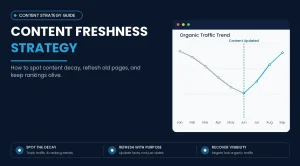

A page can sit on page one for months and then lose half its organic traffic without becoming “bad” content. The problem is that search results, user expectations, statistics, competitors, or the topic itself have moved on.
That’s where a content freshness strategy earns its place. The goal isn’t to change an article every few weeks just to make the date look new. It’s to recognize when a page has lost relevance, make meaningful improvements, and give search engines and readers a better version of the resource.
What Is a Content Freshness Strategy?
A content freshness strategy is a planned process for reviewing, updating, expanding, consolidating, or retiring existing content based on changes in search intent, topic relevance, performance, competition, and factual accuracy.
It treats published content as an asset that needs maintenance, and not as something that’s finished the moment it goes live.
Google has freshness systems designed to show newer content for queries where users reasonably expect current information. That doesn’t mean every older page loses rankings because a newer page exists.
For an evergreen query such as “how to build an internal linking strategy,” a genuinely useful three-year-old guide can outperform a recently published article if the older page satisfies the query.
The objective isn’t newer at all costs. It’s current when current matters, comprehensive when depth matters, and accurate regardless of age.
What a freshness strategy usually includes
A practical system should cover:
- Monitoring organic traffic and keyword trends
- Identifying content decay
- Checking competing pages in the SERPs
- Updating outdated facts, examples, screenshots, and statistics
- Revising sections when search intent changes
- Improving internal links
- Adding useful first-hand insights
- Consolidating overlapping articles
- Reviewing seasonal content before demand returns
- Requesting re-indexing when appropriate
- Recording what changed and when
That last point is easy to overlook. Without an update record, teams eventually lose track of which pages were genuinely improved and which were simply given a new date.
Why Content Freshness Matters for SEO
Freshness matters because relevance changes over time.
A search query can remain the same while the best answer changes over time.
Consider a page called “Best SEO Tools.” If it was last meaningfully reviewed in 2023, several things may have changed:
- Tools may have added or removed features.
- Pricing may have changed.
- New competitors may have appeared.
- Existing products may have introduced AI functionality.
- Google’s search environment may have changed.
- Readers may now expect different capabilities.
The URL can remain technically healthy while the content becomes disconnected from what the searcher wants.
Google describes its freshness systems as responding to queries where fresher information is expected. Its broader guidance emphasizes relevance, helpfulness, originality, and people-first content rather than freshness as a universal ranking shortcut.
A useful rule follows:
Freshness is a requirement for some topics, an advantage for others, and largely irrelevant for some evergreen queries.
Freshness vs. content quality
Freshness and quality aren’t interchangeable.
| Page | Last updated | Quality | Likely outcome |
| A | 2026 | Thin, rewritten information | May still struggle |
| B | 2024 | Detailed, original, accurate | Can continue performing |
Changing Page B’s date to 2026 without improving anything doesn’t make it more useful.
Google’s people-first guidance focuses on whether content provides a satisfying answer, demonstrates relevant expertise, and adds value. That’s why “update the date every year” is poor SEO advice.
When Does Google Actually Reward Fresh Content?
Freshness becomes relevant when the query deserves freshness.
News, current events, product launches, regulations, software releases, current statistics, prices, and rapidly changing recommendations are obvious examples.
If somebody searches for “Google Search Console updates 2026,” an article written two years ago has a disadvantage unless it has been revised.
For “what is an XML sitemap?” the situation is different. The basic concept doesn’t become obsolete every few months.
Google explicitly describes freshness systems as applying to queries where users expect recent information rather than treating freshness as a blanket requirement for all searches.
Changing the date is not a freshness strategy
One persistent piece of SEO advice is:
“Just change the publication date, and Google will rank the article again.”
Don’t build a strategy around that.
Google determines dates shown in search using multiple signals, including prominent dates on the page and publisher-provided structured information. More importantly, changing a date without making meaningful improvements gives you little reason to expect better search performance.
A real update should leave evidence in the content itself.
How to Identify Content Decay Before Rankings Collapse
Content decay identification is based on trends, not a bad week in Analytics.
Content decay happens when a previously useful page loses organic visibility, clicks, rankings, conversions, or engagement because competitors have become relevant, search intent has shifted, or the content has become outdated.
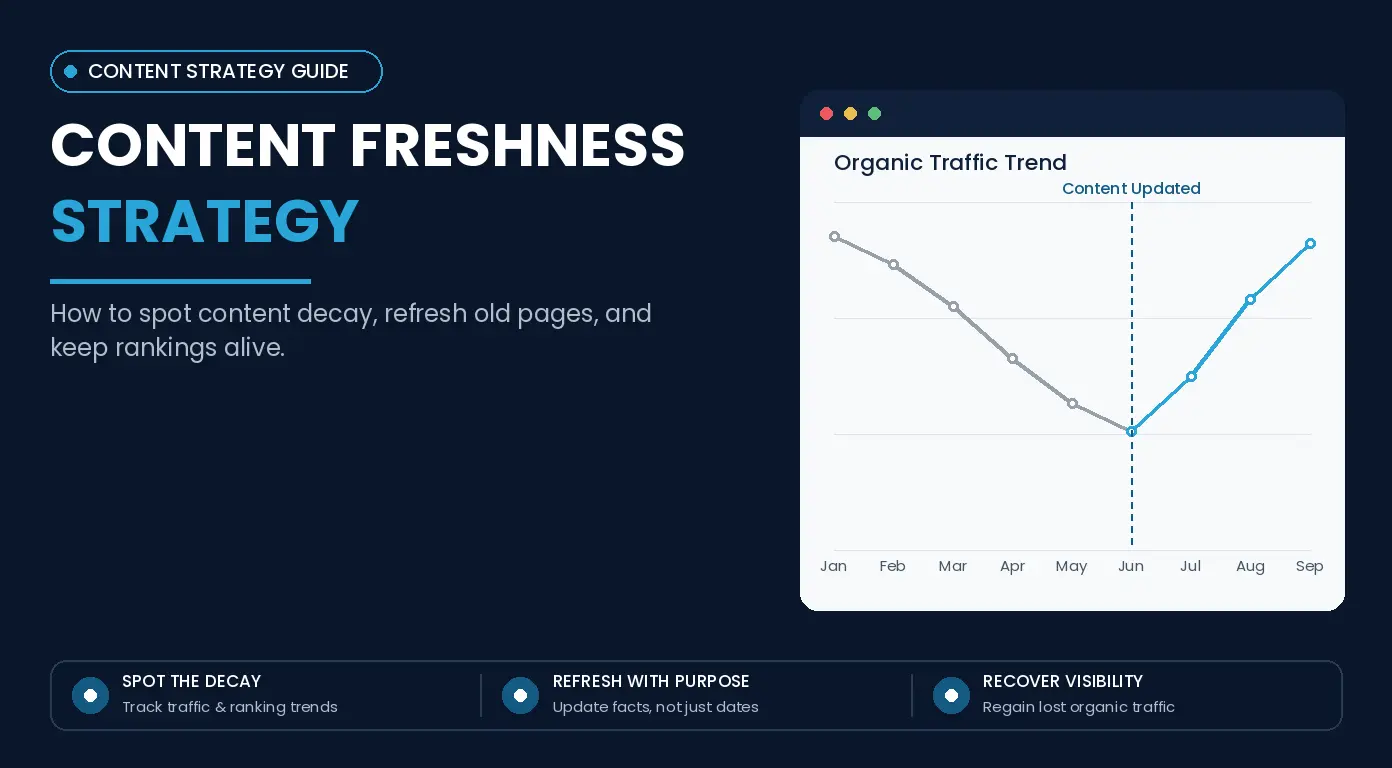
Suppose an article receives around 8,000 organic visits per month for most of 2025:
- January: 8,200
- February: 7,900
- March: 7,300
- April: 6,100
- May: 5,000
- June: 4,200
That’s worth investigating. It doesn’t mean the article has a content freshness problem. You first need to determine why the decline happened.
Look for these decay signals
1. Organic clicks are falling
Check Google Search Console over a meaningful comparison period. A decline becomes more significant when impressions, clicks, and rankings move together.
2. Impressions remain stable but clicks fall
This can indicate a SERP or CTR problem. Competitors may have stronger titles, or the SERP may now include AI features, videos, shopping results, or other elements that change how users interact with organic results.
3. Rankings are slipping
A page moving from position 4 to 11 deserves attention even if total traffic hasn’t collapsed yet.
4. Competitors are covering the topic better
Search the primary query and inspect the pages ranking above yours. Don’t just count words. Identify what they answer that your page doesn’t.
5. Facts are outdated
Old statistics, discontinued products, obsolete screenshots, broken links, expired offers, and outdated recommendations are obvious warning signs.
6. Search intent has changed
This is the bigger problem.
A query that once favored informational guides might now favor comparisons, templates, tools, or hands-on examples. Adding another 1,000 words won’t solve an intent mismatch. The page may simply be answering the wrong version of the query.
How Often Should You Update Content?
There is no universal content update frequency that works for every website.
“Update every 90 days” is a publishing schedule, not an SEO strategy. Review frequency should reflect how quickly the subject changes.
Evergreen content
Topics such as canonical tags, internal linking, keyword intent, or HTTP status codes change relatively slowly.
Review evergreen pages roughly every 6–12 months, but update them sooner when something meaningful changes. A review doesn’t require a rewrite. Sometimes the correct decision is to leave the page alone.
Think of evergreen content as a maintenance schedule.
Seasonal content
Seasonal pages should be reviewed before demand returns, not after.
A guide targeting “Black Friday SEO strategy,” for example, should be reviewed before November for:
- Current dates
- Retail trends
- Search behavior
- Examples
- Internal links
- Current Google guidance
- Competitor coverage
A page that receives 90% of its annual traffic within two months deserves a different maintenance schedule from one receiving steady traffic throughout the year.
Think of seasonal content as a campaign schedule.
Fast-changing topics
Topics involving technology, AI, legislation, pricing, software, finance, or current events require monthly or more frequent monitoring.
Instead of asking:
“Has it been six months?”
Ask:
“Could a reasonable reader be misled if they used this page today?”
If yes, update it.
Historical Optimization: What to Keep, Rewrite, or Consolidate
Historical optimization focuses on improving existing content rather than publishing new URLs.
For an established website, an existing page may already have:
- Backlinks
- Internal links
- Search visibility
- Indexed content
- Keyword rankings
- Brand recognition
That existing foundation makes an update more valuable than starting from zero.
What should you keep?
Keep sections that:
- Still satisfy search intent
- Contain stable and accurate information
- Earn useful traffic
- Have strong backlinks
- Provide original insight
- Support the main topic
Don’t rewrite material simply because you’re doing a refresh.
What should you rewrite?
Rewrite sections when:
- Information is outdated.
- The explanation is weak.
- Search intent has changed.
- New evidence changes the recommendation.
- The section attracts irrelevant queries.
- Readers need a more practical explanation.
When should you consolidate content?
Suppose your site has five articles:
- Best Content Marketing Tools
- Content Marketing Software
- Content Marketing Platforms
- Tools for Content Teams
- Content Marketing Technology
If all five target the same intent, publishing a sixth article isn’t the answer.
Identify the strongest URL, consolidate useful information into it, and handle pages that no longer deserve to exist independently.
Freshness isn’t about adding information. Sometimes removing duplication is the update.
Historical Optimization Tactics That Work
1. Update facts, not just dates
Replace outdated statistics with current sources.
If an article cites a 2022 study and a stronger 2025 or 2026 source now exists, update the evidence. Don’t simply change “2022” to “2026” unless the underlying data actually comes from 2026.
2. Replace outdated examples
Examples age quickly. An old interface screenshot can make an otherwise excellent tutorial look abandoned.
Replace:
- Old screenshots
- Discontinued tools
- Old product names
- Broken examples
- Expired offers
- Outdated workflows
3. Re-check the SERP
Before updating, search the target query again.
Look at:
- Which formats dominate
- Which questions repeatedly appear
- Whether guides, listicles, product pages, or videos are prominent
- Whether search intent has shifted
- What important information current winners provide
Don’t copy their structure mechanically. Use the SERP to diagnose what the query currently requires.
4. Add first-hand information
This is valuable in a search environment crowded with generic summaries.
Google’s guidance emphasizes unique, useful content and relevant first-hand expertise. Instead of adding another generic “best practices” paragraph, add something substantive:
- A test result
- A real workflow
- A before-and-after example
- A screenshot
- A calculation
- A limitation discovered during use
- A practical recommendation based on experience
That gives readers information they can’t get from 10 pages repeating the same source material.
5. Strengthen internal links
A refresh is a good opportunity to inspect the page’s relationship with the rest of your site.
Add links where they help readers reach the next logical topic. Also check whether newer pages should link back to the refreshed article.
Internal linking helps users and search engines discover related and important pages.
6. Remove unnecessary material
If a paragraph no longer contributes to the reader’s goal, delete it.
A focused 2,500-word article is stronger than a 4,500-word article padded with repetitive explanations.
Freshness isn’t measured in word count.
What Are SERP Freshness Signals?
SERP freshness signals are clues that a query or search environment currently values recent information.
Watch for:
- Recent publication or update dates
- News results
- Rapidly changing rankings
- Current-year modifiers in titles
- Recent statistics in top results
- Product or pricing changes
- Current events appearing in SERPs
- Search features emphasizing recent information
If the top results have been published or updated recently, freshness may matter for the query.
Don’t treat visible dates as a guaranteed ranking factor, though. Google determines displayed dates using multiple sources and doesn’t necessarily show a date for every page or query.
How Google’s Search Changes Affect Content Freshness
Content freshness has become more nuanced as Google’s search systems have evolved.
Google’s Helpful Content System was initially introduced as a separate system. In March 2024, it became part of Google’s core ranking systems. Treating the “Helpful Content Update” as a separate filter to optimize around is therefore outdated.
The practical focus remains the content itself: whether it is useful, original, reliable, and created for people.
Google has also expanded its guidance for generative AI features in Search. Its current documentation states that traditional SEO fundamentals remain relevant to AI Overviews and AI Mode and that no special technical markup is required for inclusion.
That reinforces an important point for content maintenance: an outdated or generic page has less distinctive value regardless of whether its visibility comes through traditional results or AI-powered search experiences.
SEO recommendations themselves also have a shelf life. For topics that depend on Google’s systems, a content refresh should include checking current first-party documentation rather than carrying old SEO assumptions forward.
Re-Indexing SEO Strategies After a Content Update
After making a substantial update, you want Google to discover and process the changes.
First, make sure the updated page is internally linked and technically accessible. Check that it isn’t accidentally blocked from crawling or indexing.
Then use Google Search Console’s URL Inspection tool when appropriate to request indexing. Don’t confuse a request for crawling with a ranking request.
You can’t tell Google:
“I updated this article, so please rank it higher.”
You make the updated page accessible and request that Google recrawl it. What happens afterward depends on Google’s systems.
Google explicitly states that meeting technical requirements and following best practices doesn’t guarantee that a page will be crawled, indexed, or served in search.
Don’t request indexing for every tiny edit
Correcting one typo isn’t an SEO event.
For substantial changes, requesting a recrawl can be reasonable. Think of it as discovery and processing, not an SEO boost.
A Practical Content Freshness Checklist
Before marking an article as refreshed:
- Check organic clicks, impressions, and ranking trends.
- Compare the current SERP with the SERP the article was originally built for.
- Identify outdated statistics, examples, screenshots, and recommendations.
- Check whether search intent has changed.
- Review competing pages for important information gaps.
- Add original or first-hand insights where appropriate.
- Remove repetitive or obsolete sections.
- Update internal links.
- Check external links and cited sources.
- Review the title and meta description for current relevance.
- Confirm publication/update information is accurate.
- Check indexing and canonicalization.
- Request re-indexing after a substantial update when appropriate.
- Record what changed and why.
- Reassess performance after enough time has passed to establish a meaningful trend.
A Simple Content Freshness Strategy You Can Run
A workable freshness process doesn’t need to be complicated.
Step 1: Build a content inventory
Create a spreadsheet containing:
- URL
- Topic
- Primary keyword
- Organic traffic
- Current ranking range
- Last meaningful update
- Content type
- Business value
- Update priority
Step 2: Score content by risk and opportunity
A page with declining traffic, strong historical backlinks, commercial intent, and rankings around positions 5–15 may deserve attention before a page receiving almost no impressions.
Prioritize pages where an update has realistic upside.
Step 3: Diagnose before editing
Don’t open the document and immediately start rewriting. Determine why the page is underperforming.
If the problem is search intent, adding statistics won’t fix it. If the problem is outdated evidence, rewriting the introduction won’t solve it. If the problem is cannibalization, publishing another article may make it worse.
Step 4: Make meaningful changes
Update the parts that actually affect usefulness.
One refresh might change 20% of an article. Another may require rewriting 70%. There is no definite percentage.
Step 5: Re-crawl and monitor
After publication, record the update date and what changed.
Then monitor:
- Impressions
- Clicks
- CTR
- Keyword positions
- Conversions
- Indexed status
- Relevant SERP features
Don’t judge the result from one or two days of movement. Rankings naturally fluctuate, and search systems need time to process changes.
How to Prioritize Which Content to Update First
If you have 500 blog posts, updating everything every quarter isn’t practical. Start with pages that combine existing authority with realistic upside.
A useful priority model is:
Update Priority = Traffic Potential × Business Value × Decay Risk
For example:
Page A: 5,000 monthly visits, declining rankings, strong conversion intent
Page B: 100 monthly visits, stable rankings, little business value
Page A is the obvious first candidate.
Pages sitting around positions 6–15 for valuable queries can also be strong candidates. A meaningful improvement there may offer more upside than trying to rescue a page with almost no existing visibility.
The exact scoring formula can be customized. The principle matters more: don’t distribute update effort equally.
Frequently Asked Questions About Content Freshness
Should you update content that is already ranking well?
Only when the page has a genuine reason to change. Stable rankings don’t make information permanently accurate. Review important pages for outdated facts, broken resources, changing intent, or emerging gaps, but avoid rewriting strong content simply to create activity.
Should you change the URL when refreshing old content?
Usually not when the existing URL still represents the same topic and intent. Keeping the established URL preserves continuity and avoids unnecessary migration work. A new URL becomes more appropriate when the page’s purpose or target intent changes substantially.
Is deleting outdated content better than updating it?
It depends on whether the page still has independent value. Update it when the topic remains useful, consolidate it when another page serves the same intent better, and retire it when the content no longer deserves a standalone page.
How do you measure whether a content refresh worked?
Compare post-update performance against a meaningful pre-update baseline. Track impressions, clicks, rankings, CTR, conversions, and relevant SERP visibility while accounting for seasonality and broader site or algorithm changes.
Can refreshing content recover lost traffic?
Yes, when the decline is caused by problems the refresh actually fixes, such as outdated information, weaker coverage, or changed search intent. A refresh won’t automatically recover traffic lost because of lower demand, SERP changes, technical problems, or unrelated ranking factors.
Final Thoughts
A content freshness strategy isn’t about making old content look new. It’s about identifying where existing pages have lost relevance and deciding whether to update, consolidate, or leave them alone.
The strongest opportunities often sit inside content that already has search history, links, visibility, and business value. Diagnose the reason for decline first, improve what genuinely affects usefulness, and measure what happens afterward.
Before adding another URL to your content calendar, check whether an existing page already has the foundation and simply needs to become useful again.