
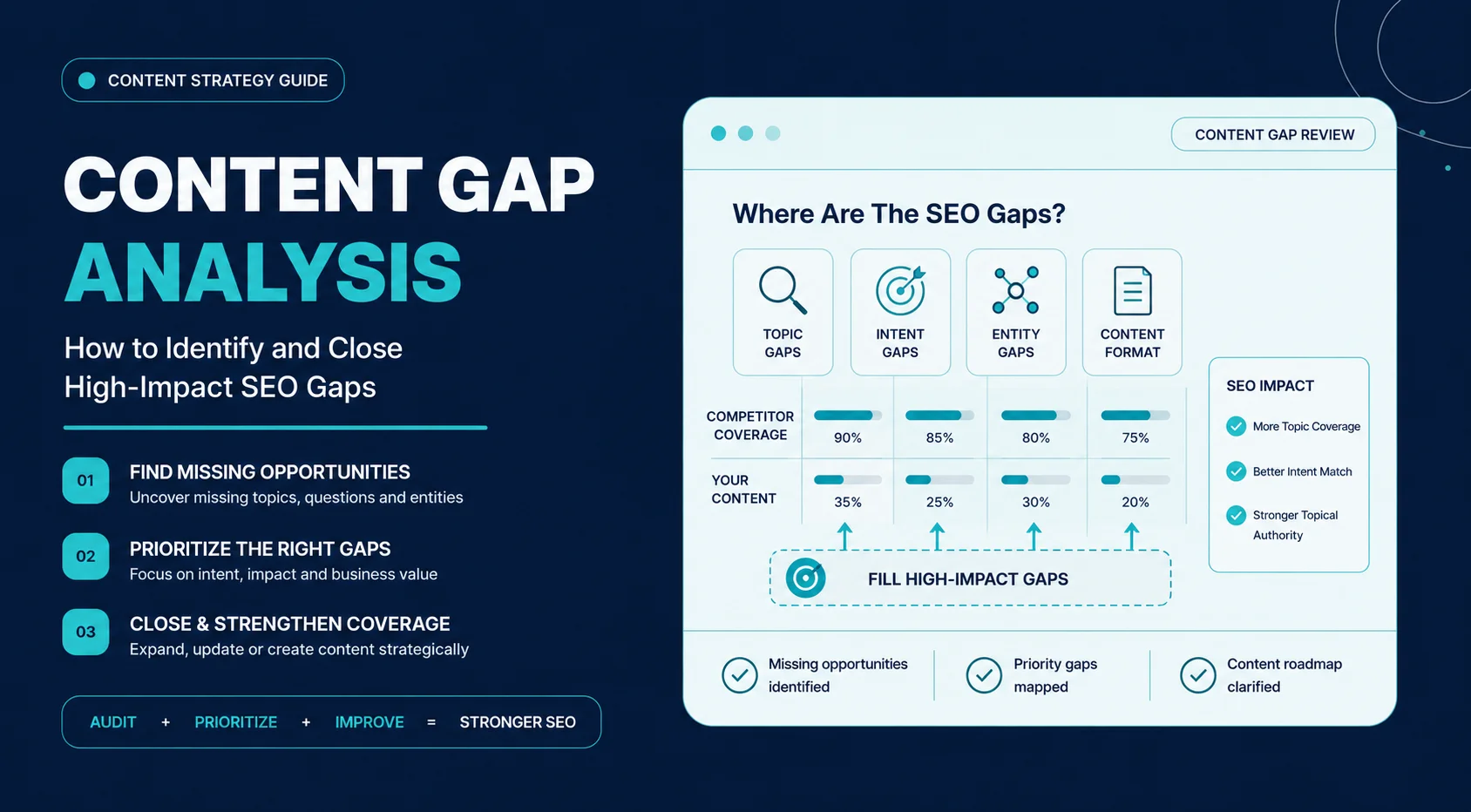
Publishing more content doesn’t automatically grow organic traffic. Many websites already have dozens or hundreds—of indexed pages. The real problem is coverage. Important topics are missing. Existing articles stop short of answering the next logical question. Commercial intent is underserved while informational content dominates. Competitors fill those gaps and earn the visibility.
Content gap analysis is the process of finding those missed opportunities. It combines competitor research, search intent analysis, topical mapping, and content auditing to reveal where your website falls short and which gaps are worth closing first.
Done well, it helps answer practical questions:
- Which topics deserve new pages?
- Which existing articles should be expanded instead of replaced?
- What information do users expect but never find?
- Which entities and concepts are missing from your content ecosystem?
- Where can you gain the greatest organic impact with the least effort?
This guide walks through the entire process—from identifying different types of content gaps to prioritizing opportunities and building an execution roadmap that improves rankings, topical authority, and AI search visibility.
What Is Content Gap Analysis?
What qualifies as a content gap?
A content gap is missing, incomplete, or outdated information that prevents your content from fully satisfying user needs or competing effectively in search results.
A gap isn’t just an unpublished article. It can include:
- Entire topics competitors cover
- Keywords you don’t rank for
- Unanswered user questions
- Missing entities and related concepts
- Weak search intent alignment
- Thin or incomplete explanations
- Missing comparisons, examples, visuals, or tools
- Outdated information
- Missing trust signals such as research, data, or first-hand experience
For example, a CRM software guide may explain core features but omit implementation costs, migration challenges, integrations, or vendor comparisons. The page exists, but important user needs remain unmet.
A simple test is this:
If users need to return to Google to complete their task after reading your page, your content likely has a gap.
How content gap analysis uncovers missed search opportunities
Content gap analysis identifies where your content falls short by comparing:
- your existing content
- competitor coverage
- search demand
- user expectations
Suppose your CRM blog ranks for broad educational keywords but attracts few qualified leads. Competitors may also publish content targeting commercial intent, such as:
- CRM implementation checklists
- CRM migration guides
- Salesforce alternatives
- CRM for nonprofits
- Industry-specific comparison pages
The issue is incomplete coverage of the buyer journey.
Content gap analysis also reveals opportunities that keyword research alone often misses, including:
- unanswered SERP questions
- missing comparison content
- overlooked entities
- weak topical coverage
- preferred content formats
Content gap instead of finding more keywords, identifies where the content fails to meet search intent.
Content gaps vs. keyword gaps vs. topical coverage gaps
These terms are related but measure different aspects of SEO.
| Type | Focus |
| Content gap | Missing or insufficient information users expect |
| Keyword gap | Keywords competitors rank for that you don’t |
| Topical coverage gap | Missing subjects, entities, or subtopics within your content ecosystem |
Think of them as layers:
- Keyword gaps reveal ranking opportunities.
- Content gaps explain why your pages don’t satisfy users.
- Topical coverage gaps show whether your site demonstrates comprehensive expertise.
The role of content gap analysis in topical authority and semantic SEO
Modern search engines reward comprehensive topic coverage rather than keyword repetition.
Building topical authority means covering:
- core and related entities
- relationships between concepts
- common questions
- practical applications
- supporting evidence
Instead of asking, “Which keywords are missing?”, ask:
- Which entities haven’t been covered?
- Which relationships remain unexplained?
- Which user problems are unanswered?
- Which supporting resources are missing?
This approach creates interconnected topic clusters instead of isolated articles.
Common misconceptions
Several misconceptions make content gap analysis less effective.
More pages always solve content gaps
Expanding an existing page often delivers more value than publishing another article.
Every competitor keyword deserves content
Prioritize keywords that match your audience, business goals, and search intent.
High search volume means high priority
Lower-volume topics often attract visitors who are closer to converting.
SEO tools find every opportunity
Tools miss insights from customer conversations, internal site search, support tickets, and product documentation.
Publishing more content builds topical authority
Authority comes from comprehensive, accurate, and well-connected content, not page count.
Why Content Gap Analysis Matters
Expand topical authority
Search engines increasingly reward websites that cover a topic comprehensively rather than targeting isolated keywords.
Filling content gaps strengthens topical authority by connecting core topics with related entities, supporting concepts, comparisons, examples, and practical guidance. This creates stronger topic clusters that improve the visibility of multiple pages.
Capture traffic your competitors already earn
Competitor analysis reveals valuable topics and search intents your site doesn’t address.
Rather than copying competitors, identify why their content performs better—whether through stronger intent alignment, more complete coverage, richer information, or better content formats—and create a more useful resource.
Keep pace with changing search intent
Search intent evolves over time. Queries that once favored educational articles may now prioritize comparisons, templates, calculators, videos, or AI-generated summaries.
Regular content gap analysis helps you identify these shifts and update existing content before rankings decline.
Strengthen the entire customer journey
Many websites focus heavily on awareness-stage content while neglecting decision and post-purchase topics.
Gap analysis highlights missing assets across the funnel, such as:
- comparison pages
- pricing guides
- implementation resources
- case studies
- FAQs
- migration guides
- post-purchase documentation
Covering every stage improves both organic visibility and conversions.
Maximize the value of existing content
Creating a new page isn’t always the best solution. Often, expanding an existing article with missing sections, stronger internal links, additional entities, updated examples, or broader intent coverage delivers greater results while preserving existing rankings, backlinks, and authority.
Improve visibility in AI search
AI-powered search systems favor content that is clear, comprehensive, and well structured.
By identifying missing concepts, relationships, and supporting evidence, content gap analysis makes your pages easier for AI search experiences to understand, retrieve, and reference.
Types of Content Gaps
Not all content gaps are caused by missing pages. Some occur because content is incomplete, misaligned with intent, outdated, or not structured in a way that search engines and users can fully understand. Identifying the exact type of gap helps you apply the right fix instead of simply producing more content.
Content Gap Types
| Gap Type | Description | How to Identify It |
| Topic gap | Entire subjects relevant to your audience are missing from your website. | Competitor analysis, topical maps, customer research |
| Keyword gap | Competitors rank for valuable search queries your site doesn’t target. | Keyword gap tools, Google Search Console, competitor benchmarking |
| Search intent gap | Content targets the keyword but fails to fully satisfy user intent. | SERP analysis, competitor page review, engagement metrics |
| Information gap | Key questions, comparisons, or decision factors are missing. | People Also Ask, related searches, forums, sales/support queries |
| Entity gap | Related entities, attributes, or concepts are underrepresented or missing. | Semantic SEO audits, entity analysis, topical mapping |
| Content format gap | Content exists but not in the format users prefer. | SERP feature analysis, competitor formats, user behavior data |
| Customer journey gap | Content is missing for one or more stages of the funnel. | Content mapping against awareness, consideration, decision stages |
| Freshness gap | Content is outdated or no longer reflects current information. | Content audits, SERP changes, industry updates |
| Trust gap | Content lacks credibility, evidence, or expertise signals. | E-E-A-T review, citation checks, author/expert validation |
| AI retrieval gap | Content is not structured clearly for AI systems to extract or cite. | AI Overview testing, semantic structure review |
How These Gaps Overlap
In practice, content gaps rarely occur in isolation. A single underperforming page may suffer from multiple issues at once—for example, missing key entities, weak search intent alignment, outdated information, and poor content structure.
Because of this overlap, it’s more effective to evaluate content from multiple perspectives rather than treating each gap type independently. This ensures improvements are prioritized based on impact, not just keyword coverage.
When Should You Perform a Content Gap Analysis?
Content gap analysis is not a one-time activity. It should be an ongoing part of your SEO and content strategy to identify missing opportunities, adapt to evolving search behavior, and maintain topical authority.
Key Situations to Run a Content Gap Analysis
| When | Why It Matters |
| Before developing a content strategy | Helps identify missing topics before creating an editorial calendar, ensuring content is built on complete coverage rather than isolated ideas. |
| During a website or content audit | Reveals not only how existing content performs, but also what important topics are missing from your site. |
| Before building a topical cluster | Ensures pillar pages and supporting content fully cover the subject ecosystem without leaving gaps between subtopics. |
| During competitor research | Uncovers missed opportunities by analyzing what competitors cover, how they satisfy intent, and where they fall short. |
| After traffic, ranking, or conversion declines | Helps determine whether performance drops are due to outdated content, incomplete coverage, or shifting user expectations. |
Practical Guidance
Rather than treating content gap analysis as a one-time task, integrate it into your regular content workflow.
Search behavior, competitors, and user expectations constantly evolve. Reassessing your content ensures you maintain relevance, strengthen topical authority, and continuously uncover new opportunities for organic growth.
Preparing for a Content Gap Analysis
A strong content gap analysis begins long before keyword tools or competitor research. The quality of your insights depends on how clearly you define goals, structure your content inventory, and understand your audience and topic landscape. Without this foundation, prioritization becomes inconsistent and conclusions lose strategic value.
1. Define your business goals and success metrics
Start with clear objectives rather than focusing on keywords alone. Every content gap has potential value, but not every gap supports your business priorities.
Your goals may include:
- Increasing qualified organic traffic
- Improving product or service visibility
- Generating more leads
- Expanding topical authority
- Increasing organic conversions
Once defined, these goals determine which gaps matter most. For example, a page optimized for traffic may not be useful if your primary objective is improving conversions or supporting bottom-of-funnel queries.
2. Understand your audience and search intent
Different users search the same topic with different expectations. A beginner needs explanations, while an experienced practitioner looks for implementation details or advanced strategies.
Before analyzing gaps, document:
- Primary audience segments
- Their pain points and goals
- Search behavior patterns
- Stage in the customer journey
- Desired outcomes
This ensures your analysis focuses on attracting the right users—not just increasing traffic volume.
3. Audit and inventory your existing content
You cannot identify what’s missing without first understanding what already exists.
Create a complete inventory of all indexable assets, including:
- Blog posts
- Landing pages
- Resource hubs
- Documentation
- Templates and tools
- Videos and tutorials
- Knowledge base articles
- Case studies
Then map each asset to the customer journey stages (awareness, consideration, decision, retention). This often reveals overlapping content, missing stages, and underdeveloped areas of your funnel.
4. Build a topical map
A topical map defines the full structure of your subject area and shows how concepts connect.
It should include:
- Core topics
- Supporting entities
- Related concepts
- Attributes and subtopics
- Common user questions
- Relationships between ideas
This map becomes your benchmark for evaluating completeness. It helps you see your content ecosystem as a structured knowledge model rather than isolated pages.
5. Identify your search competitors
Your business competitors are not always your search competitors.
In organic search, you may compete with:
- Publishers and media sites
- Educational platforms
- Industry blogs
- Forums and communities
- Review and comparison sites
Focus on the websites that consistently rank for your target queries, not just companies in your industry. This reveals who actually controls visibility in search results.
6. Define the scope of your analysis
A content gap analysis becomes more actionable when its scope is clearly defined. Attempting to analyze everything at once often leads to shallow insights.
Choose a scope based on your objective:
- Entire website — Best for large-scale audits, migrations, or full strategy planning
- Content hub or category — Best for improving a specific business area or section
- Topic cluster — Best for building topical authority around a focused subject
- Individual page — Best for optimizing high-potential or underperforming URLs
Clear scope ensures your findings are focused, measurable, and easier to act on.
How to Perform a Content Gap Analysis
A content gap analysis is a prioritization process, not a keyword collection exercise. The goal is not to identify every missing keyword, but to find the gaps that most directly improve visibility, topical authority, and business outcomes.
A structured approach ensures you don’t waste time chasing irrelevant opportunities and instead focus on high-impact improvements.
Step 1: Audit Your Existing Content
Before identifying gaps, you need a clear understanding of what already exists. Many “gaps” are actually weak or outdated content that can be improved instead of replaced.
Start by building a complete inventory of all indexable pages. Then evaluate how well each one performs and whether it fully satisfies its intended purpose.
What to include in your content inventory
- Blog posts
- Landing pages
- Product and service pages
- Knowledge base articles
- Resource hubs
- Templates and tools
- Case studies
For each page, record:
- Target topic
- Search intent
- Organic traffic
- Conversions
- Backlinks
- Last updated date
Evaluate content quality
Review whether each page:
- Fully answers the primary query
- Reflects up-to-date information
- Demonstrates expertise
- Provides unique value beyond competitors
- Matches user expectations
Thin or generic content rarely competes effectively, even if it ranks temporarily.
Identify performance and structural issues
Look for signals that indicate underlying content gaps:
- Declining traffic or rankings
- Low engagement or conversions
- High bounce rates
- Outdated or inaccurate information
- Duplicate or overlapping pages
Also check for cannibalization, where multiple pages target the same intent and dilute authority.
Step 2: Analyze Competitor Coverage
Competitor analysis is not about copying content. It’s about understanding what complete coverage looks like in your niche and identifying where your site falls short.
Focus on search competitors, not just business competitors. These are the sites that consistently rank for your target queries.
Identify search competitors
Include:
- Blogs and publishers
- Educational websites
- Forums and communities
- Review and comparison sites
- Industry resources
These often dominate search results even in commercial topics.
Find keyword and topic gaps
Use keyword intersection analysis to identify missing opportunities:
- Keywords competitors rank for that you don’t
- Long-tail variations
- Commercial and transactional queries
- Comparison and alternative searches
- Problem-based queries
Then go beyond keywords and look for topic-level gaps such as missing subtopics or entire content clusters.
Evaluate content depth and information gain
Strong pages win not because they are longer, but because they provide more useful information.
Compare whether competitors include:
- Real-world examples
- Frameworks and templates
- Case studies
- Expert insights
- Visual explanations
- Tools or calculators
This is called information gain—content that adds something new or more useful than existing results.
Analyze SERP intent and format
Search results reveal what users expect.
Check whether top-ranking pages use:
- Videos
- Comparison tables
- Featured snippets
- AI Overviews
- Tools or calculators
- FAQs or structured answers
If your format doesn’t match SERP expectations, rankings will be limited even with strong content.
Step 3: Discover High-Value Opportunities
Once gaps are identified, the next step is prioritization. Not every gap deserves new content.
Focus on opportunities that align with business goals and strengthen topical authority.
Prioritize topic-level opportunities
Think in topics, not keywords. Each topic includes multiple intents, questions, and subtopics.
Strong opportunities typically:
- Support core business goals
- Strengthen topic clusters
- Address recurring user problems
- Connect naturally with existing content
A single strong topic often outperforms dozens of isolated keywords.
Map search intent variations
Search intent is rarely single-dimensional. A user may want:
- Definitions
- Examples
- Tools
- Comparisons
- Workflows
- Templates
If your content only satisfies one intent, the opportunity is only partially captured.
Identify missing entities and concepts
Strong semantic coverage requires clear relationships between ideas.
Ensure your content includes:
- Core entities
- Related entities
- Attributes and characteristics
- Processes and workflows
- Comparisons and limitations
If users must leave your site to understand related concepts, your coverage is incomplete.
Identify format gaps
Some topics are better served outside traditional articles.
Consider whether users would benefit from:
- Templates
- Checklists
- Decision trees
- Calculators
- Comparison matrices
- Interactive tools
Format alignment can significantly impact rankings and engagement.
Detect customer journey gaps
Content should support every stage of the buyer journey:
Awareness
- Educational guides
- Definitions
- Industry explanations
Consideration
- Comparisons
- Use cases
- Feature breakdowns
Decision
- Pricing pages
- Case studies
- Demos
Retention
- Tutorials
- Troubleshooting
- Best practices
Missing stages create conversion leakage even when traffic is strong.
Use internal and customer insights
Some of the highest-value opportunities come from non-SEO sources:
- Customer support tickets
- Sales calls
- Live chat logs
- Onboarding questions
- Internal site search
These reveal real user problems that often don’t appear in keyword tools.
Step 4: Evaluate Content Completeness
At this stage, the focus shifts from identifying gaps to deciding whether existing content can be improved instead of replaced.
A key question is whether users can fully complete their task without returning to search. If they cannot, the content is incomplete.
Measure semantic completeness
A complete page should:
- Fully answer the primary question
- Cover key subtopics
- Address follow-up questions
- Explain relationships between ideas
Incomplete content forces users to seek additional sources.
Evaluate entity and topic coverage
Modern search engines understand content through connected entities.
Strong content includes:
- Definitions
- Use cases
- Comparisons
- Dependencies
- Relationships between concepts
This strengthens topical authority and clarity.
Measure information gain
Ask a simple question:
Why should someone read this instead of the top-ranking page?
Information gain may come from:
- Original frameworks
- First-hand experience
- Proprietary insights
- Real examples
- Better explanations or structure
Validate search intent alignment
Even strong content fails if format and intent are misaligned.
Check whether SERPs favor:
- Guides
- Tools
- Comparison pages
- Videos
- Product or landing pages
If your format does not match intent, rankings will be limited.
Step 5: Evaluate AI Search Readiness
Content now needs to perform in AI-driven search environments, not just traditional rankings.
Improve clarity for AI systems
Content should be easy to interpret by both humans and machines. This means:
- Clear headings
- Direct definitions
- Logical structure
- Concise explanations
Strengthen credibility signals
AI systems prioritize content that demonstrates trust and expertise:
- Original research
- Expert insights
- Transparent methodology
- Real-world examples
Improve entity clarity
Avoid ambiguity. Clearly define key entities and maintain consistent terminology throughout the page.
Optimize for retrieval and extraction
Content is more likely to be surfaced when it includes:
- Structured sections
- Lists and tables
- Direct answers before explanations
- Logical hierarchy
Add original experience
AI can summarize information, but it cannot replicate real experience.
Differentiate your content with:
- Case studies
- Experiments
- Lessons learned
- Practical implementation insights
- Measurable outcomes
Content Gap Analysis Tools
No single tool can fully identify content gaps on its own. Effective analysis combines SEO platforms, performance data, SERP research, and editorial judgment.
Different tools serve different stages of the process—from discovery to validation to optimization.
Keyword and Competitive Intelligence Tools
These tools help you identify what competitors rank for and where your keyword or topic coverage is missing.
| Tool | Primary Use | Best For |
| Ahrefs | Keyword gap + competitor analysis | Finding keywords competitors rank for that you don’t |
| Semrush | Competitive intelligence + keyword research | Market overview and topic discovery |
| SimilarWeb (optional) | Traffic benchmarking | Understanding competitor traffic sources and channels |
These tools are most useful in the discovery phase, where you are identifying missing topics, keywords, and competitor gaps.
Content Auditing and Performance Tools
These tools help you understand what you already have before deciding what needs improvement or replacement.
| Tool | Primary Use | Best For |
| Google Search Console | Search performance data | Identifying declining pages and keyword opportunities |
| Google Analytics | User behavior analysis | Understanding engagement and conversion performance |
| Screaming Frog | Technical content audit | Finding duplicates, thin pages, and structural issues |
These tools help you separate true content gaps from underperforming content that can be improved.
Content Optimization and Semantic Analysis Tools
These tools help refine content after gaps are identified by improving topical depth and semantic relevance.
| Tool | Primary Use | Best For |
| Surfer SEO | On-page optimization | Aligning content with SERP content patterns |
| Clearscope | Semantic keyword coverage | Improving topical completeness |
| Frase | SERP-based content briefs | Faster content planning and question research |
| MarketMuse | Content strategy + authority mapping | Large-scale topical gap analysis |
These tools are most effective in the optimization phase, not initial strategy discovery.
AI-Powered Research and Workflow Tools
AI tools help speed up research, clustering, and content structuring, but should not replace SEO validation or strategic decision-making.
| Tool | Primary Use | Best For |
| ChatGPT | Research + structuring | Topical maps, briefs, clustering, summaries |
| Claude / other LLMs | Content ideation | Expanding outlines and identifying missing angles |
AI tools are most useful for organizing insights, not validating them.
Free Content Gap Analysis Tools
These tools are especially useful for smaller teams or early-stage audits.
| Source | What It Provides | Best For |
| Google Search Console | Query-level data | Identifying real search demand |
| Google Analytics | Behavior insights | Tracking engagement and conversions |
| Google Trends | Search interest changes | Identifying rising or declining topics |
| SERP (Google Search) | Real-time intent signals | Manual gap discovery |
| People Also Ask | Related questions | Expanding topical coverage |
| Internal site search | User intent signals | Finding missing content opportunities |
| Customer support/sales data | Real user problems | High-conversion content ideas |
These sources often reveal the highest-value gaps, even without paid tools.
Content Gap Analysis Example (SaaS)
To understand how content gap analysis works in practice, imagine a SaaS company that offers project management software.
The company has an established blog that ranks for general productivity topics, but it generates very few product-qualified leads. The issue is not content volume—it’s uneven coverage across the customer journey and missing commercial intent content.
1. Auditing the Existing Content Library
The first step is reviewing the existing content ecosystem to understand what is already covered.
The audit reveals that the site has strong awareness-stage content, particularly general productivity and work management articles. However, deeper funnel content is limited.
Key findings include:
- Strong top-of-funnel blog content
- Very few comparison or decision-stage pages
- No implementation or onboarding guides
- Limited integration or technical documentation
- Several outdated articles
- Multiple overlapping posts targeting similar productivity topics
This shows a clear imbalance: traffic is being generated, but not effectively converted into product interest.
2. Identifying Missed Opportunities
Next, competitor analysis and SERP research highlight what the site is missing.
The most important gaps are not individual keywords, but entire content types and intent clusters that competitors already cover:
- Software comparison pages (e.g., alternatives, “vs” content)
- Migration and onboarding guides
- ROI and value calculators
- Industry-specific use cases
- Team setup and workflow templates
- Integration tutorials and technical walkthroughs
In addition, customer support data reveals recurring questions about implementation timelines, permissions, and onboarding steps. These are high-intent topics that are currently not addressed in content at all.
This combination of SEO data and customer insights reveals both visibility gaps and conversion gaps.
3. Prioritizing Opportunities by Impact
Not every gap is equally valuable, so opportunities are evaluated based on business impact rather than keyword volume alone.
Each opportunity is scored using factors such as:
- Business relevance
- Search demand and opportunity size
- Ranking difficulty
- Content production effort
This shifts the focus from “what is missing” to “what will actually move revenue.”
In this case, comparison pages and implementation guides rank higher than broad informational content because they directly support purchase decisions.
4. Building the Editorial Roadmap
Once priorities are defined, they are translated into a structured content plan.
The roadmap includes:
- Updating outdated high-traffic articles
- Merging overlapping or cannibalized posts
- Creating comparison and “alternatives” pages
- Publishing implementation and onboarding guides
- Expanding the core topic cluster around project management
- Strengthening internal linking between related assets
Each item is assigned ownership, timelines, and a clear objective, ensuring the strategy is execution-ready rather than theoretical.
5. Measuring Results After Implementation
After execution, performance is evaluated using both SEO and business metrics—not just rankings.
Key success indicators include:
- Organic traffic growth
- Expansion of ranking keywords
- Higher conversion rates from organic traffic
- Increased internal link engagement
- Visibility in commercial-intent queries
- Appearances in AI Overviews or answer engines
- Assisted revenue from organic content
The focus shifts from publishing more content to improving the effectiveness of existing and new assets across the funnel.
This example shows that content gap analysis is not a keyword exercise. It is a revenue alignment exercise.
The biggest wins rarely come from creating more content—they come from fixing missing stages in the customer journey, improving intent coverage, and restructuring content into a connected system rather than isolated articles.
Best Practices
Good content gap analysis is deliberate. These principles help separate meaningful opportunities from noise.
- Prioritize search intent over keyword volume
A keyword with 500 monthly searches that attracts buyers is usually more valuable than an informational keyword generating ten times the traffic.
- Build comprehensive topic coverage around entities
Think in topics—not isolated keywords.
Strong content ecosystems explain concepts, relationships, attributes, and supporting ideas together.
- Add unique information instead of replicating competitors
Competitor analysis identifies gaps. It shouldn’t dictate your content. Always ask:
What can we contribute that others haven’t?
- Update valuable content before publishing new pages
Existing authority is difficult to replace. Whenever possible, strengthen successful pages before expanding your content library.
- Strengthen topic clusters with strategic internal linking
Internal links should reinforce topical relationships—not simply distribute authority. Help readers discover the next logical resource.
- Make content gap analysis part of your editorial workflow
Treat it as a recurring process rather than an annual audit. Small improvements made consistently usually outperform occasional large-scale overhauls.
Common Mistakes in Content Gap Analysis
| Mistake | What Goes Wrong | Better Approach |
| Confusing keyword gaps with content gaps | Treating missing keywords as missing content opportunities, even when the topic is already partially covered. | Evaluate full content coverage including intent, entities, and depth—not just keywords. |
| Ignoring search intent | Creating content based on keywords without matching user expectations. | Align content format, depth, and angle with SERP intent signals. |
| Chasing competitor keywords without business value | Targeting all competitor keywords regardless of relevance or ROI. | Prioritize keywords that align with your audience, product, and goals. |
| Mistaking content volume for authority | Publishing more articles without improving coverage quality or structure. | Focus on topical depth and interconnected content clusters. |
| Creating overlapping pages | Producing multiple pages for similar topics, leading to cannibalization. | Consolidate and strengthen existing pages instead of duplicating intent. |
| Not measuring results | Running gap analysis without tracking impact on traffic, rankings, or conversions. | Continuously measure performance and refine strategy based on outcomes. |
Most mistakes in content gap analysis stem from treating it as a keyword exercise rather than a content-system strategy.
Real performance comes from improving coverage, intent alignment, and topical structure—not content volume.
Measuring Success in Content Gap Analysis
Effective content gap analysis should lead to measurable improvements in both search performance and business outcomes. Success is not defined by activity but by quantifiable growth across visibility, relevance, and conversions.
Growth in organic visibility
Track whether your site is expanding its presence in search results over time.
Key benchmarks:
- 10–30% increase in impressions within 3–6 months
- 20–50% growth in ranking pages for target topics
- Improved average position for priority keywords (e.g., moving from positions 11–30 into top 10)
This reflects whether your content is covering a wider and more relevant search footprint.
Expansion of topical and entity coverage
Measure how completely your content now covers a topic compared to your baseline audit.
Practical indicators:
- 25–60% increase in covered subtopics within a topic cluster
- 15–40% growth in supporting entity coverage (tools, concepts, use cases)
- Reduced number of “missing intent clusters” per topic
Stronger coverage typically correlates with improved topical authority.
Improvement in keyword footprint
Evaluate whether you are ranking for more valuable and relevant search terms.
Typical targets:
- 20–70% increase in total ranking keywords
- 15–40% growth in commercial-intent keyword visibility
- Steady increase in long-tail keyword coverage (especially 3–6 word queries)
Focus less on volume and more on relevance and intent quality.
AI and answer engine visibility
Modern SEO performance increasingly includes AI-generated surfaces.
Track improvements such as:
- 5–20% of priority pages appearing in AI Overviews (where available)
- Increased citation frequency in AI-generated answers
- Growth in featured snippets or zero-click visibility
These signals indicate strong structural clarity and retrieval readiness.
Growth in qualified traffic and conversions
Traffic is only meaningful when it leads to action.
Benchmark improvements:
- 15–40% increase in qualified organic traffic
- 10–30% improvement in conversion rate from organic visitors
- Higher volume of bottom-funnel actions (demo requests, sign-ups, purchases)
This is the clearest indicator of business impact.
Return on content investment (ROI)
Finally, evaluate whether improvements justify the resources spent.
Simple evaluation framework:
- 2–5x return on content investment over 6–12 months (typical strong-performing SEO programs)
- Lower customer acquisition cost (CAC) from organic channel over time
- Increased revenue contribution from organic search (measured monthly or quarterly)
A successful content gap analysis is not defined by how many gaps are identified, but by how many measurable improvements are achieved across visibility, authority, and revenue.
Conclusion
Content gap analysis is not about finding more keywords—it’s about finding what your content is missing in terms of topics, intent, entities, and user needs. When you focus on gaps in coverage rather than just rankings, you move from producing isolated pages to building a complete topical system.
The biggest gains usually come from prioritization: fixing missing intent stages, improving weak pages, and expanding high-value topics rather than publishing more content.
Ultimately, strong SEO performance comes from completeness, not volume. The sites that win are those that answer more of the user’s journey with fewer gaps left behind.
Frequently Asked Questions
What is a content gap analysis?
Content gap analysis is the process of identifying missing or underdeveloped topics, search intents, entities, and content formats that prevent a website from fully meeting user needs and competing effectively in search results.
How is content gap analysis different from keyword gap analysis?
Keyword gap analysis focuses on keywords competitors rank for that your site does not. Content gap analysis is broader—it evaluates topical coverage, search intent alignment, entity coverage, content depth, and how well your pages satisfy the full user journey.
What are the main types of content gaps?
Common content gaps include missing topics, incomplete search intent coverage, weak entity and concept coverage, missing information, poor content formats, gaps across the customer journey, outdated content, weak trust signals, and lack of AI-friendly structure.
What tools are used for content gap analysis?
Common tools include Ahrefs or Semrush for competitor research, Google Search Console for performance data, Google Analytics for behavior insights, Screaming Frog for content audits, and AI tools for clustering, research, and structuring insights.
How do you prioritize content gaps?
Prioritization is based on business impact, search demand, ranking difficulty, content effort, and how strongly a gap strengthens topical authority or supports conversions.
How often should you run a content gap analysis?
Most websites should review core content at least twice a year. Competitive or fast-changing industries may require quarterly analysis to stay aligned with search trends and intent shifts.
Should you update existing content or create new content?
Update existing pages when they already target the right intent but lack depth, freshness, or completeness. Create new content only when the gap represents a clearly distinct topic or search intent.
How do you measure success?
Success is measured through improved rankings, expanded topical coverage, increased qualified organic traffic, higher conversions, stronger entity coverage, and improved visibility in both traditional and AI-driven search results.