
Search engines now evaluate content by understanding entities, context, relationships, and search intent, not just matching keywords. AI-powered search goes a step further by extracting passages and generating direct answers from authoritative sources.
That shift has made definition-style content blocks essential for modern SEO. A well-crafted definition block clearly explains a concept, establishes its context, and connects it to related entities, making it easier for both users and search engines to understand.
This guide explains what definition-style content blocks are, why they matter for semantic SEO and AI search, and how to create definition sections that improve visibility, comprehension, and topical authority.
What Is a Definition-Style Content Block?
Definition and Core Purpose
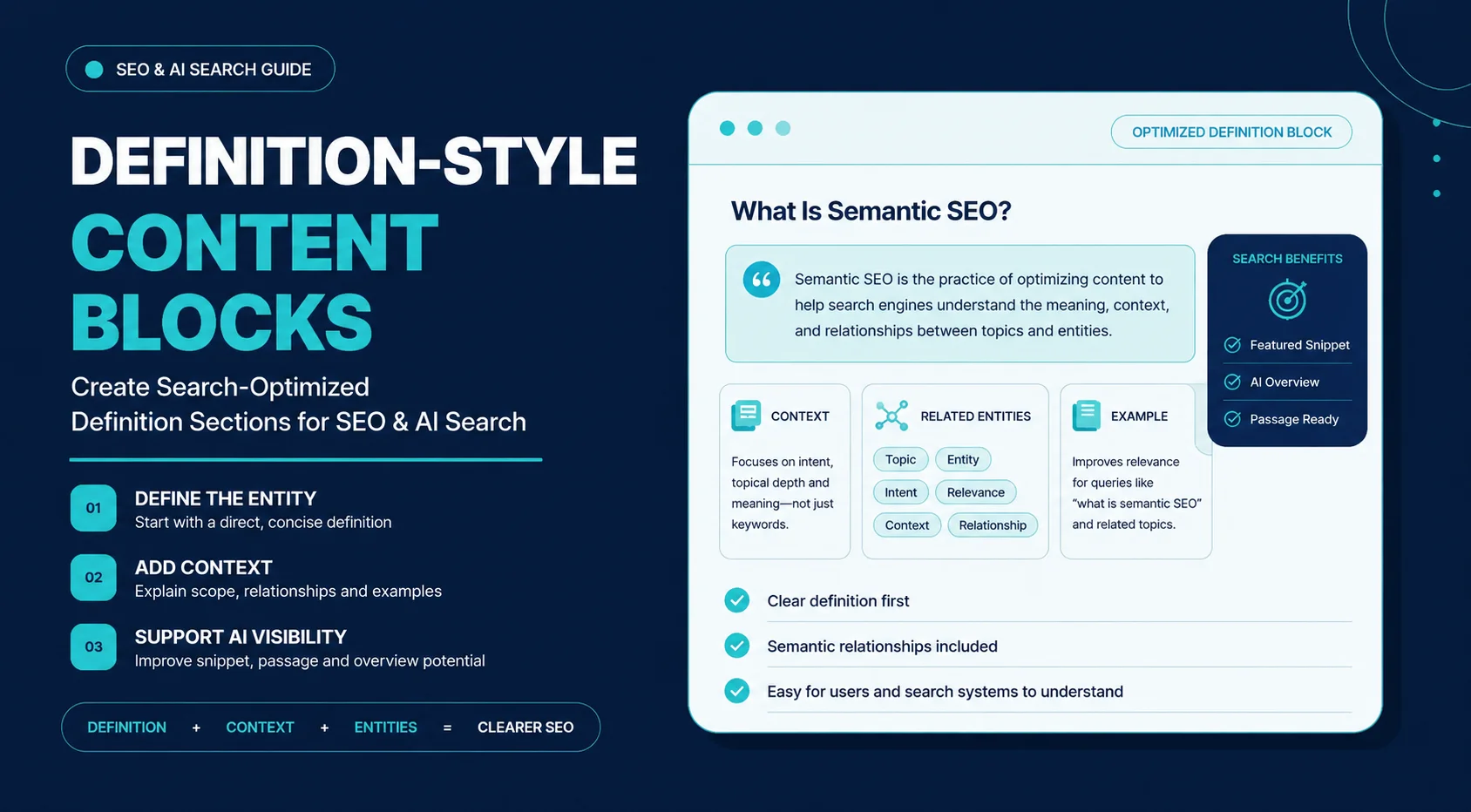
A definition-style content block is a dedicated section that introduces a concept with a concise definition before expanding it through context, distinguishing characteristics, examples, related entities, and practical applications.
Unlike a dictionary definition, its goal extends beyond explaining meaning. It helps search engines establish the identity of an entity while helping readers understand how that entity functions within a broader topic.
For example, instead of writing:
Content blocks are sections of content on a webpage.
A search-optimized definition block would explain:
A definition-style content block is a structured content section that introduces an entity or concept with a concise explanation followed by contextual details, distinguishing characteristics, related concepts, and practical applications. Its purpose is to improve semantic understanding for both readers and search engines while increasing eligibility for Featured Snippets, AI-generated answers, and passage-level retrieval.
The second version defines the concept, introduces semantic relationships, establishes search context, and immediately signals topical relevance.
Every strong definition block answers four questions:
| Question | Purpose |
| What is it? | Defines the entity clearly. |
| Why does it matter? | Explains its role or value. |
| How is it different? | Removes ambiguity. |
| Where is it used? | Adds real-world context. |
Those four answers create a complete semantic unit rather than an isolated sentence.
How It Differs from Traditional Content Sections
Many blog articles explain concepts gradually. Readers must sift through multiple paragraphs before discovering the actual definition.
Definition-style blocks reverse that approach.
The definition comes first.
Everything else expands it.
Traditional introductions often contain storytelling, industry statistics, background information, or opinions before introducing the primary topic. While those elements may improve engagement, they also delay semantic clarity.
Compare the approaches.
Traditional content
- Long introduction
- Background information
- Multiple paragraphs
- Definition appears later
- Context built gradually
Definition-style block
- Immediate definition
- Clear scope
- Supporting explanation
- Examples
- Related entities
- Practical application
That structure mirrors how modern retrieval systems process information.
Large language models frequently extract individual passages instead of evaluating an entire article. Google also indexes passages independently when determining answers for highly specific queries.
Each definition block therefore functions as a self-contained knowledge unit capable of ranking independently.
When to Use Definition Blocks
Definition blocks are useful whenever readers need conceptual clarity before moving deeper into a subject.
They work especially well for:
- Technical SEO concepts
- Industry terminology
- Software documentation
- Medical information
- Financial terminology
- Educational resources
- Product documentation
- B2B knowledge bases
- SaaS feature explanations
- Glossaries that require additional context
They also perform well for search queries beginning with:
- What is…
- Define…
- Meaning of…
- Explain…
- Difference between…
- How does… work?
Even articles targeting transactional or commercial intent benefit from definition blocks.
Someone researching “schema markup services” still wants a concise explanation of schema markup before evaluating service providers.
Readers feel oriented. Search engines gain semantic certainty.
Why Definition-Style Content Blocks Matter
Matching Informational Search Intent
Informational searches dominate the early stages of the customer journey.
Users ask questions because they lack understanding rather than because they’re ready to purchase.
Examples include:
- What is semantic SEO?
- What are content entities?
- What is topical authority?
- What is vector search?
- How do AI Overviews work?
Those searches require direct answers.
Pages that immediately satisfy informational intent often outperform pages that prioritize marketing language or excessive introductions.
A strong definition block reduces friction by answering the user’s primary question before expanding into implementation details.
Search engines reward that behavior because it aligns with user satisfaction signals.
Improving Semantic Understanding
Semantic search depends on understanding entities rather than matching exact phrases.
Instead of asking whether a page contains the keyword definition-style content blocks, modern search systems attempt to understand:
- What entity is being discussed?
- Which concepts relate to it?
- Which broader topic contains it?
- Which narrower concepts belong beneath it?
Definition blocks provide those answers naturally.
For example, a definition block about content blocks might mention:
- semantic SEO
- information architecture
- entities
- passage indexing
- AI Overviews
- internal linking
- topical authority
- structured content
Those entity relationships strengthen topical relevance without forcing keywords into every sentence.
Rather than repeating one phrase twenty times, the article expands the surrounding semantic network.
Supporting Featured Snippets, PAA & AI Overviews
Search features increasingly depend on concise, trustworthy passages.
Google often extracts one section—not an entire article—to populate:
- Featured Snippets
- People Also Ask
- AI Overviews
- Knowledge panels
- Voice search responses
Definition blocks naturally satisfy the formatting these systems prefer.
Characteristics include:
- concise opening definition
- direct answer
- supporting explanation
- clear formatting
- semantic completeness
- logical hierarchy
Many successful snippets begin with a paragraph between 40 and 70 words before expanding through examples or lists.
Length alone doesn’t determine eligibility.
Clarity does.
A vague 40-word definition rarely wins.
A complete 60-word explanation often does.
Building Topical Authority
Topical authority develops when a website consistently explains related entities with depth and accuracy.
Imagine a website covering semantic SEO.
Instead of publishing one broad article, it creates dedicated definition blocks for:
- Entity SEO
- Knowledge Graphs
- Topic Clusters
- Passage Ranking
- Information Gain
- Search Intent
- Internal Linking
- Content Blocks
- Semantic HTML
- Vector Embeddings
Each page defines one concept while connecting naturally to related topics.
Together they form a knowledge graph that mirrors how search engines organize information.
That interconnected structure strengthens authority far more effectively than isolated keyword-focused articles.
Anatomy of a High-Quality Definition Block
Strong definition blocks follow a recognizable structure.
Readers may never notice it consciously, yet every successful definition typically contains the same building blocks.
Executive Definition
Begin with one concise paragraph that defines the concept without unnecessary background.
A useful framework looks like this:
Entity + Classification + Purpose + Context
Example:
A definition-style content block is a structured section of content that explains an entity or concept using a concise definition followed by contextual information, distinguishing characteristics, related concepts, and practical applications. It helps readers understand unfamiliar topics while improving semantic interpretation by search engines and AI retrieval systems.
Everything important appears immediately.
Context and Scope
After defining the concept, explain where it belongs.
Readers ask:
- Where is this used?
- What problems does it solve?
- Who benefits?
- What doesn’t it cover?
Scope prevents confusion.
For instance, content blocks are not limited to glossary pages.
They’re equally useful in:
- blog articles
- documentation
- SaaS knowledge bases
- product pages
- educational content
- technical guides
Clarifying boundaries prevents readers from making incorrect assumptions.
Defining Characteristics
Once readers know what something is, identify the attributes that distinguish it from similar concepts.
A high-quality definition block usually highlights characteristics such as:
| Characteristic | Why It Matters |
| Precise wording | Removes ambiguity. |
| Clear entity identification | Helps semantic indexing. |
| Contextual explanation | Improves comprehension. |
| Supporting examples | Reinforces understanding. |
| Related concepts | Strengthens topical connections. |
| Practical relevance | Demonstrates real-world value. |
These characteristics separate authoritative explanations from shallow definitions copied from dictionaries.
Examples and Non-Examples
Examples translate abstraction into understanding.
Suppose you’re defining entity-first writing.
A weak explanation says:
Entity-first writing focuses on entities.
Readers gain almost nothing.
A stronger block adds examples.
Example
A page about “Technical SEO” naturally references crawlability, indexing, robots.txt, XML sitemaps, canonical tags, and Core Web Vitals because those entities define the topic.
Non-example
A page repeatedly inserting the phrase “technical SEO” without discussing related concepts demonstrates keyword repetition rather than entity-based optimization.
Showing both examples and non-examples sharpens conceptual boundaries.
Readers quickly understand not only what the concept is, but also what it isn’t.
Related Concepts and Entity Relationships
Definition blocks shouldn’t exist in isolation.
Every concept belongs to a larger knowledge network.
For example, a definition of definition-style content blocks naturally connects with:
- semantic SEO
- entities
- structured data
- topical authority
- information architecture
- internal linking
- passage indexing
- AI Overviews
- featured snippets
- search intent
These relationships accomplish two things simultaneously.
Readers discover adjacent topics worth exploring.
Search engines build stronger semantic associations between pages.
Internal linking becomes more meaningful because connected concepts already exist inside the content.
Practical Applications
Theory alone rarely satisfies search intent.
Readers also want implementation.
A strong definition block therefore ends by showing where the concept creates measurable value.
Examples include:
| Industry | Practical Use |
| SEO | Improve Featured Snippet eligibility and semantic relevance. |
| SaaS | Explain product features with consistent terminology. |
| Healthcare | Define medical procedures using patient-friendly language. |
| Finance | Clarify technical financial concepts without oversimplifying them. |
| Education | Help learners understand foundational concepts before advanced instruction. |
| E-commerce | Explain product technologies, materials, or specifications. |
Applications bridge the gap between understanding and execution.
That transition prepares readers for implementation—the next stage of effective definition writing.
How to Write Effective Definition-Style Content Blocks
Research Search Intent and Entities
Writing begins long before the first sentence.
The highest-performing definition blocks are built from search intent research, not assumptions.
Analyze the search results for your target query and identify:
- The dominant user intent.
- Common entities appearing across top-ranking pages.
- Frequently asked follow-up questions.
- Missing explanations competitors overlook.
- AI Overview summaries.
- People Also Ask questions.
- Related Searches.
Patterns emerge within the first page of results.
If every top-ranking page defines an entity but none explain its relationship to adjacent concepts, that becomes your opportunity for information gain.
Avoid writing definitions in isolation. Build them around the complete semantic landscape of the topic.
Write a Precise Definition First
The opening sentence carries the greatest weight.
Readers decide within seconds whether the explanation answers their question, and retrieval systems often evaluate only the first few lines when selecting passages for snippets or AI-generated responses.
A strong opening definition should:
- Identify the entity immediately.
- Classify it correctly.
- State its primary purpose.
- Avoid unnecessary qualifiers.
- Use natural language instead of keyword stuffing.
Weak definitions force readers to interpret vague wording. Strong definitions remove ambiguity before the article moves into context, characteristics, examples, and implementation.
Expand Without Losing Clarity
The biggest mistake after writing a solid definition is diluting it with unnecessary explanation. A definition block should expand understanding, not bury the original meaning beneath paragraphs of filler.
Treat the opening definition as the foundation. Every sentence that follows should answer a new question instead of repeating the first one.
A practical progression looks like this:
- Define the concept.
- Explain why it exists.
- Describe how it works.
- Identify distinguishing characteristics.
- Connect related concepts.
- Show practical applications.
Notice what’s missing, history, lengthy opinions, keyword repetition, and generic introductions.
For example, if you’re defining passage-level optimization, readers don’t need three paragraphs explaining Google’s evolution. They need to understand how optimizing individual content sections improves the discoverability of specific answers within a page.
Every additional sentence should increase information value.
Add Supporting Examples
Examples transform abstract definitions into usable knowledge.
Many readers understand a concept only after seeing it applied. Search engines also benefit because examples introduce supporting entities that reinforce topical relevance.
Instead of writing:
Definition blocks improve SEO.
Show how.
Weak example
A content block defines a topic.
Better example
A page about canonical tags begins with a concise definition, then explains duplicate content, preferred URLs, crawl efficiency, indexing signals, implementation examples, and common configuration errors. That single section can satisfy both users searching “What is a canonical tag?” and those looking for implementation guidance.
Industry-specific examples perform even better because they establish topical expertise.
Answer Related User Questions
Definition blocks shouldn’t stop after the first answer.
Users naturally ask follow-up questions, and search engines understand those relationships.
Someone searching:
What is semantic SEO?
often continues with:
- Why is semantic SEO important?
- How does it differ from traditional SEO?
- Does Google use entities?
- What tools support semantic SEO?
- How do I implement it?
Anticipating those questions creates semantic completeness.
Rather than scattering answers throughout the article, keep related questions close to the definition where they make the most contextual sense.
This structure improves readability while increasing the likelihood that individual sections rank for long-tail searches.
Connect Related Topics with Internal Links
Internal links should reinforce meaning, not simply distribute PageRank.
Every definition introduces concepts that deserve further exploration.
For example, a definition block about AI Overviews can naturally reference articles covering:
- Semantic SEO
- Entity SEO
- Structured Data
- Topical Authority
- Information Gain
- Passage Ranking
- Search Intent
The anchor text should describe the destination accurately.
Instead of:
Click here
use:
Learn how entity-first SEO strengthens semantic relevance.
Readers discover additional resources, while search engines receive stronger contextual signals about the relationship between pages.
Optimizing Definition Blocks for SEO & AI Search
Entity-First Writing
Modern search systems organize knowledge around entities rather than isolated keywords.
An entity is a uniquely identifiable person, place, organization, concept, product, technology, or event.
Instead of forcing the phrase definition-style content blocks into every paragraph, write naturally around related entities such as:
- Semantic search
- Search intent
- Knowledge Graph
- Information retrieval
- Topical authority
- Structured data
- Passage indexing
- AI Overviews
- Featured Snippets
The richer the entity relationships, the easier it becomes for search engines to understand the topic’s context.
Keyword density becomes far less important than semantic completeness.
Passage-Level Optimization
Google increasingly ranks individual passages rather than entire pages for highly specific queries.
That changes how definition sections should be written.
Each definition block should function independently.
A reader, or an AI system, should understand the section without reading the rest of the article.
Effective passage optimization includes:
- A descriptive heading
- A concise opening definition
- Supporting context
- Relevant entities
- Practical examples
- Clear formatting
Think of every definition block as a miniature article nested inside a larger guide.
Semantic HTML and Structured Data
Content structure matters as much as content quality.
Semantic HTML helps search engines distinguish headings, definitions, supporting explanations, and related content.
Best practices include:
- One H1 per page
- Logical H2 and H3 hierarchy
- Ordered and unordered lists where appropriate
- Tables for comparisons
- Meaningful anchor text
- Descriptive image alt text
Structured data provides another layer of context.
Depending on the page, useful schema types include:
| Content Type | Recommended Schema |
| Educational guide | Article |
| FAQ section | FAQPage |
| Glossary | DefinedTerm |
| How-to explanation | HowTo |
| Organization content | Organization |
| Author information | Person |
| Website navigation | BreadcrumbList |
Schema doesn’t guarantee rankings, but it helps search engines interpret content more accurately.
Information Gain Beyond Dictionary Definitions
A dictionary explains what something means.
Authoritative content explains why it matters.
That’s the difference between average content and content that earns citations, links, and AI references.
Information gain comes from adding insights competitors ignore.
Examples include:
- Common misconceptions
- Industry-specific applications
- Implementation advice
- Decision frameworks
- Comparisons
- Limitations
- Best practices
- Real-world scenarios
If every competing page defines “entity SEO” in one paragraph, a stronger resource expands the concept through relationships, examples, implementation guidance, and measurable outcomes.
Depth creates information gain.
Retrieval-Friendly Formatting
AI retrieval systems prefer content that is easy to parse.
Formatting influences retrieval more than many writers realize.
Definition blocks should include:
- Short introductory paragraphs
- Descriptive headings
- Bulleted lists
- Comparison tables
- Numbered processes
- Consistent terminology
- Clear spacing
Dense walls of text force both readers and retrieval systems to work harder.
Well-structured passages reduce cognitive load while increasing extractability.
Best Practices
| Best Practice | Why It Matters | How to Apply It |
| Keep Definitions Accurate and Concise | Clear, technically correct definitions build trust and satisfy search intent better than keyword-heavy explanations. | Define the concept precisely, avoid unnecessary wording, and prioritize accuracy over keyword optimization. |
| Maintain Semantic Consistency | Consistent terminology reduces ambiguity and strengthens semantic signals for both readers and search engines. | Use the primary term consistently throughout the article while naturally incorporating closely related entities and synonyms. |
| Use Clear, Scannable Formatting | Well-structured content is easier to read, index, and extract for Featured Snippets and AI-generated answers. | Use short paragraphs, logical H2/H3 hierarchy, bullet lists, comparison tables, and descriptive subheadings. |
| Refresh Definitions as Topics Evolve | Search behavior, AI search, and industry terminology change over time, making outdated definitions less useful. | Regularly update terminology, examples, related entities, search features, and answers to emerging user questions. |
Common Mistakes to Avoid
| Mistake | Why It Hurts Content Performance | How to Avoid It |
| Thin or Dictionary-Only Definitions | Basic definitions often fail to satisfy search intent because they lack context, examples, and practical value. | Expand definitions with scope, characteristics, examples, related concepts, and real-world applications. |
| Ignoring Search Intent | Different users need different levels of information, from simple explanations to implementation guidance or comparisons. | Identify the primary intent behind the query and structure the definition block around the audience’s actual needs. |
| Weak Context and Entity Coverage | Isolated definitions provide limited semantic value and make it harder for search engines to understand topic relationships. | Connect concepts with relevant entities, related topics, and supporting information to strengthen topical relevance. |
| Missing Examples | Abstract explanations leave readers to interpret meaning themselves, reducing clarity and usefulness. | Include practical examples, use cases, and non-examples to show how the concept works in real situations. |
| Overusing AI-Generated Definitions | AI-generated definitions can sound generic, miss important context, contain inaccuracies, or lack unique insights. | Use AI for drafting assistance, then add expert review, original analysis, accurate examples, and topic-specific details. |
Measuring Performance
Creating definition blocks is only the first step. Measuring performance shows whether they improve visibility, rankings, and user engagement.
| Performance Area | What to Track | What It Reveals |
| Featured Snippet Visibility | Snippet ownership, ranking changes, CTR, query variations | Shows whether your definitions provide clearer answers than competing pages. |
| AI Overview Presence | Pages cited in AI summaries, referenced definition sections, triggering queries | Indicates whether search systems recognize your content as a reliable source. |
| Organic Rankings & Search Queries | Long-tail queries, question searches, impressions, CTR, average position | Helps identify ranking opportunities and content gaps. |
| User Engagement | Engagement time, scroll depth, internal link clicks, bounce rate, returning visitors | Measures content usefulness, readability, and ability to satisfy intent. |
Tools for Creating Better Definition Blocks
| Purpose | Useful Tools | Main Use |
| Entity & Topic Research | Google Knowledge Graph, Wikidata, InLinks, Ahrefs, Semrush | Identify entities, relationships, and topic gaps instead of focusing only on keywords. |
| SERP & Question Research | Google Autocomplete, People Also Ask, Related Searches, Search Console, AlsoAsked, AnswerThePublic | Discover user questions and missing explanations. |
| Content Optimization | Clearscope, Surfer SEO, MarketMuse, Frase, Content Harmony | Find semantic gaps and improve topic coverage. |
| Performance Monitoring | Google Search Console, GA4, Ahrefs, Semrush, Bing Webmaster Tools | Track visibility, rankings, traffic, and long-term improvements. |
Key Takeaways
- Definition-style content blocks explain concepts clearly before expanding with context, examples, relationships, and applications.
- Entity-first writing improves semantic understanding more effectively than keyword repetition.
- Structured definitions improve opportunities for Featured Snippets, People Also Ask, AI Overviews, and passage retrieval.
- Strong definition blocks combine clarity, examples, related entities, and practical guidance.
- Information gain separates authoritative definitions from basic dictionary explanations.
- Regular updates keep definitions accurate as search behavior and AI search evolve.
Frequently Asked Questions
What is a definition-style content block?
A definition-style content block is a structured section that introduces a concept with a concise definition and expands it through context, characteristics, examples, related entities, and practical applications to improve user understanding and semantic search visibility.
Why do definition blocks rank well in Google?
They align with informational search intent, answer questions directly, and use clear formatting that makes them easier for Google to extract for Featured Snippets, People Also Ask results, and AI-generated summaries.
How long should a definition block be?
The opening definition is typically 40–70 words. The complete block usually ranges from 150–300 words, depending on the complexity of the topic and the depth of explanation required.
How are definition blocks different from glossary entries?
Glossary entries generally provide brief meanings in isolation. Definition-style content blocks expand those meanings with context, examples, entity relationships, and practical applications, making them more useful for readers and search engines.
Can definition blocks appear in AI Overviews?
Yes. AI systems often retrieve concise, well-structured passages that clearly define concepts while providing supporting context and demonstrating topical authority.
What schema markup works best for definition content?
There isn’t a dedicated schema for every definition block, but Article, DefinedTerm, FAQPage, and HowTo schema can provide additional semantic context when they accurately reflect the page’s content.
How do entity relationships improve definition blocks?
Entity relationships help search engines understand how concepts connect within a topic, strengthening semantic relevance, improving topical authority, and making content easier to retrieve for related searches.
How often should definition blocks be updated?
Review them at least every 6–12 months or whenever significant industry changes, search behavior shifts, or new AI search features affect how the topic is understood or presented.