
Readers want answers immediately, but traditional copywriting delays them. As search engines and AI systems prioritize concise, high-confidence information, writers need to balance clarity with persuasion.
Direct answer copywriting solves this challenge by combining answer-first content with proven conversion principles. This guide explains how to create content that ranks, engages, and converts.
Key Takeaways
- Direct answer copywriting delivers the answer before presenting supporting details.
- BLUF (Bottom Line Up Front) and inverted pyramid structures help readers find information faster.
- Search intent, audience awareness, and customer psychology shape effective answer-first copy.
- Headlines, opening paragraphs, supporting evidence, and calls to action determine how well content performs.
- Featured snippets, AI Overviews, voice search, and conversational search reward clarity and relevance.
- Strong direct answer copy balances readability, credibility, persuasion, and conversion.
- The most effective answer-first content satisfies users immediately while encouraging them to keep reading.
What Is Direct Answer Copywriting and Why Does It Matter?
Direct answer copywriting is an answer-first writing approach that gives a clear and useful answer and engages the readers. Traditional copywriting, on the other hand, builds curiosity before revealing information; direct answer copywriting prioritizes clarity, relevance, and value from the beginning.
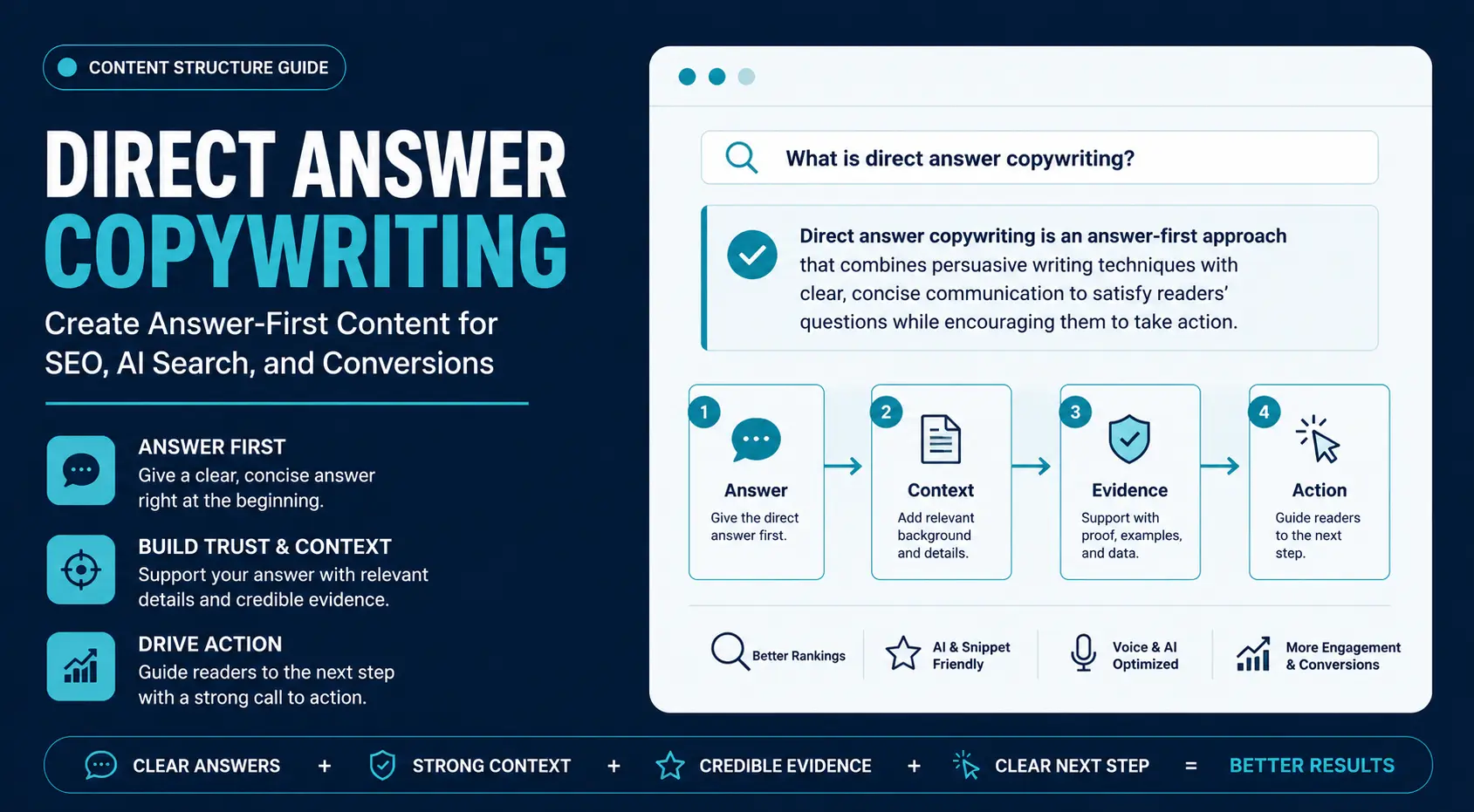
An effective direct answer consists of four elements:
- A concise answer
- Supporting context
- Credible evidence
- A clear next step
For example:
Question: What is direct answer copywriting?
Answer: Direct answer copywriting is an answer-first approach that combines persuasive writing techniques with clear, concise communication to satisfy readers’ questions while encouraging them to take action.
How answer-first copywriting evolved from direct-response copywriting
Traditional direct-response copywriting was built around one objective: generating action. Writers focused on attracting attention, creating interest, increasing desire, and encouraging readers to act.
Changes in search behavior have transformed this approach. Readers became accustomed to receiving immediate answers, which forced copywriters to deliver information at the start but not at the cost of failed persuasion.
Modern copywriters therefore balance two objectives simultaneously: providing immediate value and encouraging readers to continue engaging with the content.
| Traditional copywriting | Direct answer copywriting |
| Builds curiosity first | Delivers the answer first |
| Focuses on persuasion | Balances persuasion and information |
| Emphasizes sales | Emphasizes value and trust |
| Uses long narratives | Uses concise structures |
| Prioritizes action | Prioritizes understanding and action |
How direct answer copywriting differs from SEO writing, content writing, and conversion copywriting
These disciplines overlap, but they have different goals.
| Discipline | Primary objective |
| SEO writing | Improve visibility |
| Content writing | Educate readers |
| Conversion copywriting | Encourage action |
| Direct answer copywriting | Inform, persuade, and convert |
Direct answer copywriting combines elements of all three disciplines while maintaining an answer-first structure. Instead of forcing readers to search for information, it presents the answer and then supports it with context, evidence, and persuasive messaging.
Why changing search behavior has increased the demand for direct answer copywriting
Search behavior has changed over the past decade. Readers expect immediate answers, and search engines prioritize concise, well-structured information.
As a result, traditional curiosity-based copywriting is becoming less effective in many situations. Readers engage with content that answers their questions, establishes credibility, and provides a clear path forward.
Direct answer copywriting addresses these expectations by combining concise communication, audience psychology, persuasive writing, and search intent optimization.
How Search Intent, User Psychology, and Audience Research Influence Direct Answer Copywriting
Search intent, customer psychology, and audience research are the foundation of direct answer copywriting. Understanding what readers want, why they want it, and how they make decisions allows copywriters to deliver answers that inform, persuade, and convert.
Understanding the search intent
Search intent determines how copy should be written. The same topic requires different language, structures, and calls to action depending on what readers want to achieve.
For example, someone searching for “What is direct answer copywriting?” expects a clear explanation, while someone searching for “Best direct answer copywriting course” expects comparisons and recommendations.
Intent falls into four categories.
| Intent | User objective |
| Informational | Learn something |
| Navigational | Find a specific page or brand |
| Commercial | Evaluate available options |
| Transactional | Complete an action |
The pieces of copy don’t perform well when they try to satisfy multiple intentions and not focus on one primary objective.
Identifying customer pain points, motivations, and objections
Every search query reflects a problem, a need, or a desired outcome. Effective copy identifies these motivations and then persuades readers.
For example, someone searching for information about direct answer copywriting might be trying to:
- Increase engagement
- Improve conversions
- Reduce bounce rates
- Increase visibility in search results
- Strengthen brand authority
Strong copy acknowledges these concerns and addresses them immediately.
Matching copy to different awareness stages
All readers are not at the same level of knowledge. Some are discovering a problem, while others are searching for a solution.
| Awareness stage | Recommended approach |
| Unaware | Introduce the problem |
| Problem aware | Explain the solution |
| Solution aware | Compare available options |
| Product aware | Present examples and case studies |
| Most aware | Encourage action |
Building trust, authority, credibility, and urgency
Readers act when they trust the information they are reading. Credibility is built through evidence rather than claims.
Strong trust signals include:
- Practical examples
- Case studies
- Original insights
- Expert opinions
- Testimonials
- Statistics
The Principles That Make Direct Answer Copywriting More Effective
Direct answer copywriting is built on a simple idea: deliver the answer and use persuasive writing techniques to maintain attention, build trust, address objections, and encourage action. The following principles distinguish effective direct answer copy from ordinary informational writing.
| Principle | Application |
| Lead with the answer. | Present the most important information immediately instead of building unnecessary suspense. |
| Focus on benefits rather than features. | Emphasize the value readers will gain rather than describing characteristics. |
| Anticipate questions and objections. | Address concerns before they interrupt the reader’s decision-making process. |
| Use clear and specific language. | Replace broad claims with precise statements, examples, and measurable outcomes. |
| Support claims with evidence. | Strengthen credibility with case studies, testimonials, statistics, and demonstrations. |
| Create a logical flow. | Arrange information so that each section is linked to the next one. |
| Write clear calls to action. | Guide readers toward the next step instead of expecting them to decide independently. |
Weak versus strong direct answer copy
| Weak copy | Strong copy |
| Our framework improves results. | Our framework helps readers find answers faster while increasing trust and engagement. |
| We offer advanced features. | We simplify complex information so readers can make better decisions more quickly. |
| This strategy is effective. | This approach reduces confusion, improves clarity, and encourages readers to take action. |
| Our process saves time. | Our process eliminates unnecessary steps so readers can focus on what matters most. |
The Essential Elements of a High-Converting Direct Answer
Effective direct answer copywriting captures attention, establishes credibility, addresses concerns, and guides readers toward being ready to take action. Every element should contribute to clarity, engagement, and conversion.
Writing headlines that capture attention immediately
A strong headline communicates three things:
- Relevance
- Value
- Specificity
Strong examples
- How to Train for Your First Marathon
- Seven Ways to Reduce Household Energy Costs
- A Beginner’s Guide to Investing in Index Funds
Weak examples
- Everything You Need to Know
- Incredible Secrets Revealed
- The Ultimate Guide to Success
Creating opening paragraphs that deliver immediate value
The opening paragraph reassures readers that they have found the information they need.
A practical framework is:
- Identify the problem.
- Present the answer.
- Explain why it matters.
- Introduce supporting information.
Example
Weak opening
Buying a home can be an exciting experience. Many factors contribute to making the right decision.
Strong opening
Choosing the right mortgage depends on your budget, credit score, and long-term financial goals. Understanding these factors can help you avoid costly mistakes.
Writing concise answer blocks
Present the important information first and then provide additional context.
Question
How often should houseplants be watered?
Answer
Most houseplants should be watered when the top layer of soil becomes dry. The exact frequency depends on the plant species, temperature, humidity, and amount of sunlight.
Using evidence to strengthen credibility
Persuasive copy relies on evidence. The specific the information makes the content trustworthy.
Strong forms of evidence include:
- Research findings
- Original data
- Case studies
- Expert opinions
- Testimonials
- Practical examples
Weak statement
Our program helps people sleep better.
Stronger statement
Participants reported falling asleep at a faster rate and experiencing fewer interruptions after following the program for four weeks.
Addressing objections before readers leave
Effective copywriters identify and address concerns before readers abandon the page.
Product: Fitness application
Common objections
- Will the workouts fit my schedule?
- Do I need special equipment?
- Is the program suitable for beginners?
- How long will it take to see results?
Removing uncertainty increases confidence and encourages action.
Writing calls to action that encourage engagement
Weak calls to action fail because they lack direction and specificity.
| Weak call to action | Strong call to action |
| Learn more. | Download the guide. |
| Click here. | Compare the available options. |
| Contact us. | Schedule a free consultation. |
| Continue reading. | Explore the complete tutorial. |
Readers act when they know what comes next.
Choosing the right format for your answer
Different questions require different structures.
| Format | Best use case |
| Short paragraph | Definitions and explanations |
| Numbered list | Processes and instructions |
| Table | Comparisons |
| FAQ | Objections and common questions |
| Checklist | Action-oriented content |
Selecting the right format helps readers locate information while improving clarity and engagement.
Determining the ideal answer length, depth, and information density
There is no universal formula for effective direct answer copywriting. The ideal length depends on the audience, the complexity of the topic, and the desired outcome.
| Content type | Recommended length |
| Definitions | 40–60 words |
| Explanations | 50–100 words |
| Lists | Five to eight items |
| FAQ answers | 50–100 words |
| Comprehensive guides | 2,000–4,000 words |
Advanced Direct Answer Copywriting Concepts
The direct answer copywriting guides focus on structure and formatting. Experienced copywriters, however, understand that high-performing copy depends on psychology, specificity, and reader behavior.
The Value-Hook Cascade
The challenge in answer-first copywriting is preventing readers from leaving the page after receiving the information they need.
An effective solution is the Value-Hook Cascade:
| Stage | Purpose |
| Answer | Address the reader’s question immediately. |
| Expansion | Provide context and supporting information. |
| Hook | Introduce a new insight, question, or benefit. |
| Action | Encourage the next step. |
Context-Rich Copywriting
Strong copy relies on precise language and meaningful details rather than broad statements.
Weak example
Artificial intelligence is changing customer service.
Stronger example
Artificial intelligence tools now help businesses answer customer questions, personalize recommendations, and provide support around the clock.
Specificity creates clarity, and clarity builds trust.
Brand Recall Through Valuable Answers
The readers don’t take action on the spot. They first gather information, compare alternatives, and return later. That is why effective direct answers establish credibility and conversions.
The objective is simple:
- Deliver value immediately.
- Build trust consistently.
- Remain memorable.
- Encourage future engagement.
Writing for AI-Assisted Search Environments
Copywriters write for readers who discover information through search engines, voice assistants, and artificial intelligence tools.
The elements that have become important with AI-assisted searches are:
- Clear language
- Consistent terminology
- Logical organization
- Credible evidence
- Natural phrasing
- Contextual relevance
Technology keeps on changing, but the fundamental objective remains to communicate ideas as clearly and persuasively as possible.
Copywriting Frameworks That Help Readers Find Answers Faster
Frameworks provide a consistent structure that helps writers communicate information more clearly. Copywriters can use proven models and not start from the basics each time to organize information, address objections, and guide readers toward action.
| Framework | Best use case | Structure |
| AIDA | Product pages, advertisements, and landing pages | Attention → Interest → Desire → Action |
| PAS | Problem-solving content | Problem → Agitation → Solution |
| BAB | Transformation-focused copy | Before → After → Bridge |
| Answer–Explanation–Evidence–Action | Answer-first content | Answer → Explanation → Evidence → Action |
| Problem–Answer–Benefit–Action | Conversion-focused copy | Problem → Answer → Benefit → Action |
| Question-based framework | Articles, FAQs, and guides | What → Why → How → Next step |
Example: Applying the Answer–Explanation–Evidence–Action framework
Answer: Drinking enough water improves concentration and energy levels.
Explanation: Proper hydration helps the body regulate temperature, transport nutrients, and maintain normal cognitive function.
Evidence: Research has shown that even mild dehydration can affect mood, memory, and attention.
Action: Begin by tracking your daily water intake for one week.
Each framework serves a different purpose, but the underlying principle remains the same: provide the answer quickly, support it with relevant information, and encourage readers to take the next step.
How to Write Effective Direct Answer Copy: A Step-by-Step Process
Direct answer copywriting isn’t about putting an answer at the beginning of a paragraph. The process requires audience research, persuasive writing, logical organization, and continuous refinement.
1. Identify the audience and their primary question
Every piece of copy should address a specific question, problem, or objective.
Instead of asking, “What should I write?”, ask:
- What does the reader want to know?
- Why are they searching for this information?
- What action should they take afterward?
2. Understand the reader’s motivation
Readers are not searching for information alone. They are trying to solve a problem, reduce uncertainty, save time, or make a decision.
Consider the following examples.
| Question | Underlying motivation |
| How can I save money? | Financial security |
| How can I lose weight? | Better health |
| How can I improve productivity? | Greater efficiency |
| How can I learn a new language? | Personal or professional growth |
Understanding these motivations allows copywriters to create messages accordingly.
3. Write the answer before the explanation
The answer should appear before supporting details.
A simple structure looks like this:
- Question
- Answer
- Explanation
- Evidence
- Action
4. Use examples to strengthen understanding
Examples transform abstract ideas into practical information.
Weak statement
Regular exercise improves health.
Stronger statement
Walking for thirty minutes each day can improve cardiovascular health, increase energy levels, and reduce stress.
5. Address concerns and objections
Readers hesitate because they still have unanswered questions.
The concerns include:
- Is this approach right for me?
- How long will the process take?
- What risks should I consider?
- What results can I expect?
6. End with a clear next step
Every answer should lead to another action.
That action might involve:
- Downloading a guide
- Scheduling a consultation
- Purchasing a product
- Requesting additional information
- Reading another article
How to Optimize Direct Answer Copywriting for SEO, AI Search, Voice Search, and Conversions
Effective direct answer copywriting balances clarity, readability, credibility, and persuasion. The objective is not to answer a question but to provide value while encouraging readers to continue engaging with the content.
| Optimization action | Purpose | Conversion strategy | Example |
| Lead with the answer. | Reduce friction and deliver immediate value. | Capture attention immediately. | Present the answer within the opening sentences. |
| Use question-based headings. | Make information easier to locate and understand. | Reinforce relevance. | How Much Water Should You Drink Each Day? |
| Write stronger headlines and subheadings. | Increase engagement and improve clarity. | Emphasize value and specificity. | Five Practical Ways to Reduce Monthly Expenses |
| Use concise paragraphs. | Improve readability and comprehension. | Keep readers engaged. | Limit paragraphs to two or three sentences whenever possible. |
| Organize information logically. | Create a smoother reading experience. | Guide readers toward the next step. | Answer → Explanation → Evidence → Action |
| Use numbered lists and tables. | Simplify complex information. | Reduce cognitive effort. | Present processes as step-by-step instructions. |
| Write conversationally. | Improve accessibility and align the copy with natural language patterns. | Strengthen the connection with readers. | Replace technical language with simple, direct wording. |
| Replace generic statements with precise language. | Increase credibility and strengthen authority. | Demonstrate expertise. | Replace Save money more effectively with Reduce unnecessary monthly expenses. |
| Support claims with evidence. | Strengthen trust and credibility. | Reduce uncertainty. | Include case studies, statistics, testimonials, and expert opinions. |
| Address objections proactively. | Eliminate hesitation and build confidence. | Increase engagement. | Answer common concerns before readers raise them. |
| Maintain consistent terminology. | Prevent confusion and strengthen clarity. | Improve recognition and recall. | Use the same terms throughout the copy. |
| Strengthen E-E-A-T signals. | Demonstrate experience, expertise, authority, and trustworthiness. | Reinforce credibility. | Include practical experience, research, and expert commentary. |
| Optimize for voice search. | Align the copy with conversational search patterns. | Increase accessibility. | Write the way people naturally speak and ask questions. |
| Structure content for featured snippets and AI Overviews. | Improve readability and information retrieval. | Increase visibility. | Use concise definitions, lists, tables, and question-based headings. |
| Include a clear call to action. | Encourage readers to take the next step. | Increase conversions. | Replace Learn more with Download the guide. |
Quick optimization checklist
✔ Deliver the answer immediately.
✔ Remove unnecessary information.
✔ Replace vague language with precise wording.
✔ Write descriptive headings and subheadings.
✔ Organize information logically.
✔ Support important claims with evidence.
✔ Address common objections.
✔ Improve readability.
✔ Optimize the copy for AI search, voice search, and featured snippets.
✔ Include a clear and specific call to action.
The direct answer copywriting’s objective is to transform clarity into trust, trust into engagement, and engagement into action.
Common Direct Answer Copywriting Mistakes That Reduce Visibility and Conversions
Even well-written copy can fail when clarity, relevance, and user experience are overlooked. Most problems arise not because the information is inaccurate but because it is presented ineffectively.
| Mistake | Why it hurts performance | Better approach |
| Delaying the answer | Readers lose interest when they search for information. | Present the answer immediately and add context afterward. |
| Ignoring search intent | The content fails to address the reader’s objective. | Align the structure, tone, and depth of information with user expectations. |
| Adding unnecessary information | Excessive detail increases cognitive load and reduces engagement. | Include information that improves understanding. |
| Focusing on features instead of benefits | Readers care more about outcomes than characteristics. | Explain how the information, product, or service improves the reader’s situation. |
| Overusing keywords | Excessive repetition reduces readability and damages credibility. | Write naturally and use clear, descriptive language. |
| Creating vague headlines | Readers cannot determine the value of the content. | Write clear, specific, and benefit-oriented headings. |
| Ignoring objections | Unanswered questions create uncertainty and hesitation. | Address common concerns before readers encounter them. |
| Writing robotic copy | Mechanical language reduces trust and engagement. | Use a natural tone and conversational language. |
| Providing the answer without direction | Readers receive information but take no action. | Include a logical next step or a clear call to action. |
Metrics and Tools Used to Measure and Improve Direct Answer Copywriting Performance
Writing effective direct answer copy requires continuous testing and refinement. Measuring performance helps writers understand how readers interact with the content and identify opportunities for improvement.
Key metrics to monitor
| Metric | What it measures |
| Click-through rate (CTR) | The percentage of users who click after seeing the content. |
| Engagement time | The amount of time readers spend interacting with the page. |
| Scroll depth | How far readers move through the content. |
| Conversion rate | The percentage of visitors who complete a desired action. |
| Bounce rate | The percentage of visitors who leave without interacting further. |
| Citation frequency | How often content appears in search features and AI-generated responses. |
Essential tools
| Tool | Primary purpose |
| Google Search Console | Search performance analysis |
| Google Trends | Topic and trend research |
| Ahrefs | Keyword and competitor analysis |
| Semrush | Content and performance research |
| Hotjar | User behavior analysis |
| Microsoft Clarity | Heat maps and session recordings |
Using artificial intelligence tools effectively
Artificial intelligence tools help copywriters:
- generate ideas;
- organize information;
- identify patterns;
- create outlines;
- summarize research.
How AI, Personalization, and Conversational Search Are Changing Direct Answer Copywriting
Search behavior continues to evolve as people interact with search engines, voice assistants, and AI-powered platforms through natural language.
Conversational search is changing writing patterns
Readers now ask complete questions and expect immediate answers. As a result, copywriters are required to create content that sounds natural while remaining clear and concise.
Artificial intelligence systems evaluate context as well as keywords
Modern search systems consider multiple signals, including:
- contextual relevance;
- topical relationships;
- supporting evidence;
- credibility;
- consistency.
Retrieval systems favor accessible information
Content that is organized is easier to interpret, reference, and cite.
The following elements are important:
- descriptive headings;
- concise paragraphs;
- question-based structures;
- lists and tables;
- logical organization.
Human expertise remains indispensable
Artificial intelligence processes information, but experience provides perspective, judgment, and originality.
Trust is created through:
- first-hand experience;
- practical examples;
- expert knowledge;
- research and evidence;
- authentic insights.
Frequently Asked Questions
What is direct answer copywriting?
Direct answer copywriting is an answer-first writing approach that provides clear information immediately while encouraging readers to continue engaging with the content.
How is direct answer copywriting different from SEO copywriting?
SEO copywriting focuses on improving search visibility, while direct answer copywriting combines visibility, readability, credibility, and conversion into a single strategy.
How long should a direct answer be?
There is no universal rule, but concise answers perform best. Most short answers contain enough information to answer the question before expanding on the topic.
Can direct answer copywriting improve conversions?
Yes. Delivering information quickly reduces friction, builds trust, and encourages readers to take the next step.
How can writers optimize content for AI search?
Writers should focus on clear structure, descriptive headings, conversational language, supporting evidence, and concise answers that are easy to understand and retrieve.