
Managing SEO across 30, 50, or 100 franchise locations requires more than a standard search strategy. Each location competes in a different local market, while the franchisor must maintain brand consistency, accurate business information, and measurable network performance. Effective franchise SEO services combine corporate website optimisation, local visibility, Google Business Profile management, and scalable execution.
This guide explains how Canadian franchise businesses can evaluate a multi-location SEO provider based on operational capability, location-level performance, and scalable processes.
Your Franchise Has 30 Locations. Why Are Only Some Showing Up in Google?
Imagine a Canadian franchise operating 30 locations across Ontario. Its Toronto locations consistently attract website visitors and customer enquiries through Google Search. Several Mississauga locations perform reasonably well, while branches in Brampton and Vaughan struggle to appear for relevant local searches.
All locations share the same brand, offer similar services, and operate under the same corporate marketing strategy. So why do their search results differ?
The answer lies in location-specific SEO performance.
Search engines evaluate multiple signals when determining which businesses appear for geographically relevant searches. These include website relevance, local competition, business information, prominence, and the searcher’s location. A strong national brand does not guarantee visibility in every local market.
For example, a franchise may rank well for its brand name while remaining difficult to find when customers search for non-branded services such as “commercial cleaning services in Vaughan” or “dental clinic near me.”
This distinction matters because potential customers may not already know the franchise brand. Effective SEO for franchises must therefore address two objectives simultaneously:
- Strengthening the corporate website’s overall search presence and
- Improving the discoverability of individual franchise locations.
A capable multi-location SEO provider should understand how these objectives interact and demonstrate how it will improve performance without sacrificing brand consistency.
The First Test: Can an SEO Provider Diagnose Problems Across Your Franchise Network?
A reliable SEO agency should assess your franchise network’s technical health, local visibility, Google Business Profiles, competition, and conversions. The key question is: Can they explain why some locations outperform others?
Can They Identify Underperforming Locations Rather Than Just Report Network Averages?
Network-wide traffic can hide underperforming branches. Even with 40,000 monthly organic visits, some locations may receive few enquiries. A qualified provider should analyse:
- Google Search Console: Clicks, impressions, queries, and landing pages.
- Google Analytics 4: Organic traffic, engagement, and conversions.
- Google Business Profile: Local customer interactions.
- CRM Data: Qualified enquiries and customer acquisition.
- Local Rankings: Visibility for non-branded searches.
Evaluate these sources together, accounting for tracking and attribution limitations.
Can They Distinguish Corporate Website Problems From Local SEO Problems?
Different SEO problems require different solutions. Indexing issues affect technical visibility, inaccurate business details affect local discovery, and generic location pages might lack geographic relevance. A provider should assess:
- Website architecture, indexing, and internal linking.
- Location-page content and local relevance.
- Google Business Profile accuracy and eligibility.
- Local competition, mobile usability, and conversions.
Accurate diagnosis helps prioritise effective improvements and avoid unnecessary spending.
Can They Prioritise Locations Based on Opportunity and Business Impact?
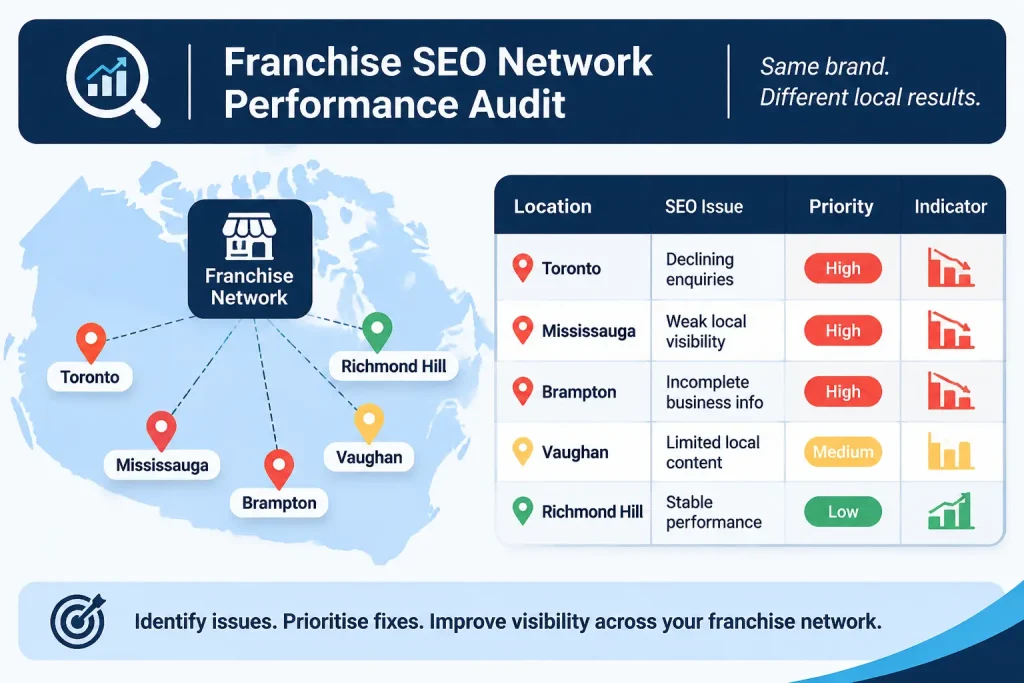
Franchise locations face different competitive conditions and growth opportunities. SEO investment should reflect each market’s needs. For example;
| Location | Main SEO Concern | Priority |
| Toronto | Declining enquiries | High |
| Mississauga | Weak local visibility | High |
| Brampton | Incomplete business information | High |
| Vaughan | Limited local content | Medium |
| Richmond Hill | Stable performance | Low |
Actual priorities depend on verified performance and business objectives. An effective franchise SEO strategy considers search demand, competition, implementation effort, and potential customer value to prioritise locations with the greatest business impact.
The Location Page Test: Can Their SEO Strategy Scale Without Creating Duplicate Content?
Location pages help search engines identify franchise branches and customers find relevant local services. However, creating identical pages with different city names offers limited value. A reliable franchise SEO provider should scale location pages while maintaining local relevance, accuracy, and quality.
What Should a High-Quality Franchise Location Page Contain?
A good location page should provide accurate, branch-specific information that helps customers make decisions. Essential elements include:
- Business Details: Location name, address, phone number, and opening hours.
- Local Services: Available products, services, and service areas.
- Visitor Information: Directions, parking, and accessibility details.
- Local Content: Genuine branch photos, staff details, and relevant reviews.
- Conversion Options: Clear booking, enquiry, and contact buttons.
- Structured Data: Appropriate LocalBusiness schema markup.
For service-area businesses, pages should reflect actual operations without implying nonexistent physical locations.
How Should Location Pages Connect With the Corporate Website?
A central corporate website with dedicated location pages often simplifies franchise SEO management. Example URL structure:
- example.ca/locations/ontario/toronto/
- example.ca/locations/ontario/mississauga/
- example.ca/locations/ontario/brampton/
A provider should ensure:
- Logical location directories and navigation.
- Relevant internal linking between corporate and location pages.
- Crawlable, indexable URLs with appropriate canonical tags.
- Mobile-friendly pages and location-specific conversion paths.
Separate websites might suit certain franchise models but require additional governance, technical maintenance, and SEO resources.
What Happens When an Agency Uses the Same Content Across Every City?
Standardised templates improve efficiency, but changing only city names creates thin, interchangeable pages with limited local value.
| Generic Location Page | Locally Useful Franchise Page |
| Repeated corporate descriptions | Branch-specific services |
| Only city names changed | Accurate local operating details |
| Generic contact information | Direct branch contact options |
| Identical promotional content | Relevant local information |
| Limited customer value | Useful branch-specific guidance |
Duplicate wording alone does not automatically trigger a search penalty. However, thin location pages weaken the relevance, indexing, and user experience. An effective franchise SEO strategy combines scalable templates with accurate, unique, and useful local information.
The Google Business Profile Test: Who Controls Your Franchise’s Local Search Presence?
Google Business Profiles play an important role in how eligible franchise locations appear across Google Search and Maps. For a franchise network, managing these profiles requires more than updating business descriptions. It involves account access, verification, accurate business information, review workflows, and continuity when locations change.
Who Should Own and Manage Individual Franchise Business Profiles?
A franchise should establish clear account ownership and access arrangements before outsourcing profile management. Depending on the network’s operating structure, the franchisor or authorised franchise operator may retain primary ownership, while the SEO agency receives the permissions necessary to perform approved work.
The exact arrangement should reflect legitimate business ownership and Google’s applicable policies. For larger networks, location groups and appropriate account permissions can help organise management. Before hiring an agency, ask:
Will our franchise retain appropriate administrative control over its business profiles if the agency relationship ends?
The provider should explain its process for access management, verification, permission changes, and account handover. An agency that cannot clearly explain these responsibilities may create unnecessary operational risk.
How Should an Agency Handle Reviews, Hours, and Location Information?
Customer-facing information must remain accurate across locations. A reliable management process should cover business names, categories, addresses, phone numbers, operating hours, and relevant listing information.
For franchise chains, business names and categories should follow Google’s applicable consistency and representation requirements. Review management also requires coordination. Corporate marketing may establish response guidelines, while individual franchisees provide context about customer experiences.
The SEO provider can support monitoring, response coordination, and escalation without manufacturing reviews or encouraging prohibited review practices. A useful operational test is to ask how the agency would update holiday hours across 50 locations while ensuring that each branch’s actual schedule remains accurate.
What Happens When a Franchise Location Moves or Closes?
Relocations and closures are important in franchise networks. When a branch moves, its website information, Google Business Profile, relevant citations, and customer-facing directions may need updating. When a location closes, the appropriate treatment depends on whether the closure is temporary, permanent, or part of a relocation.
Website redirects should be determined by the relationship between the old page and the most useful replacement destination. Redirecting every closed location to the homepage is not the best approach. A qualified franchise SEO company should maintain a documented process for these changes. This reduces customer confusion and helps preserve useful search visibility where appropriate.
The Coordination Test: Can Corporate Marketing and Franchisees Work With the Same SEO Agency?
Franchise SEO involves multiple decision-makers. Corporate marketing teams protect brand standards, franchisees manage local operations, and SEO agencies implement search optimisation activities. Without clear responsibilities, even technically sound recommendations can remain unfinished.
Which SEO Decisions Should Remain With Corporate Marketing?
Corporate marketing should retain authority over network-wide brand positioning, major website architecture decisions, approved messaging, and overarching marketing priorities. The central team also establishes policies for location-page templates, promotional claims, and brand-related communications.
These responsibilities create consistency across the franchise network. However, centralised governance should not prevent individual locations from supplying accurate local information.
What Information Should Individual Franchisees Provide?
Franchisees are the most reliable source of information about their day-to-day operations. Their contributions include:
- Current operating hours and contact details.
- Location-specific services and availability.
- Approved local promotions.
- Changes in staffing or operational capacity.
- Relevant customer questions.
- Updates concerning relocation or temporary closure.
How Should an SEO Agency Coordinate Updates Without Delaying Implementation?
A practical franchise SEO workflow assigns responsibilities before work begins. Illustrative responsibility matrix.
| SEO responsibility | Corporate marketing | Franchisee | SEO provider |
| Brand messaging | Approves standards | Follows standards | Implements approved messaging |
| Location information | Defines requirements | Supplies and verifies details | Updates approved assets |
| Website architecture | Approves major decisions | Provides operational input | Recommends and implements changes |
| Local content | Reviews brand compliance | Confirms local accuracy | Researches, writes, and optimises |
| Business profile management | Oversees access policies | Confirms business information | Performs authorised updates |
| SEO reporting | Reviews network performance | Reviews local outcomes | Prepares and interprets reports |
Actual authority depends on franchise agreements and operating policies. The provider should also establish approval timelines, escalation procedures, and communication channels. This allows routine updates while ensuring that sensitive changes receive appropriate review.
The Expansion Test: Can the Provider Launch SEO for 20 New Locations Without Starting From Scratch?
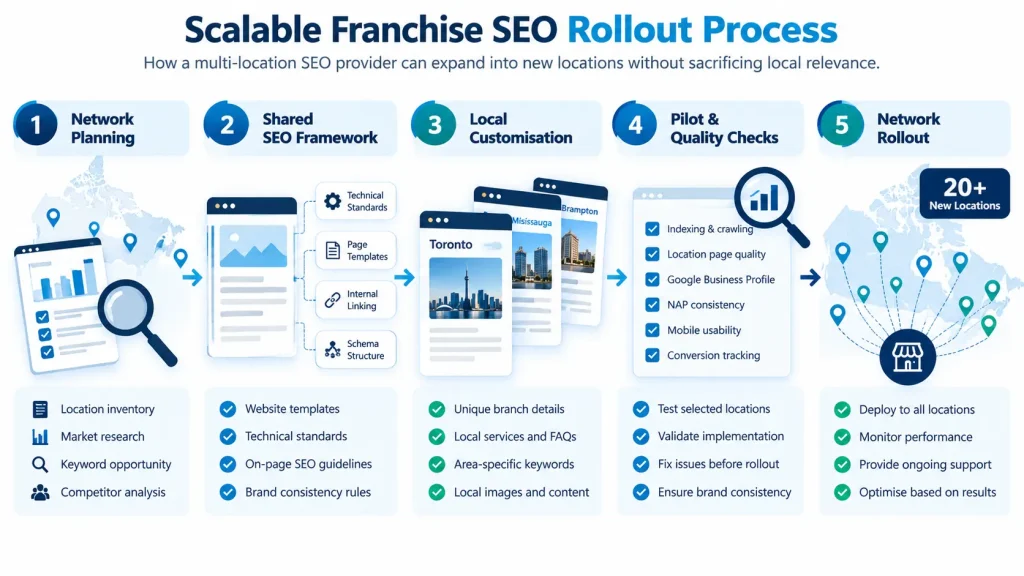
Expanding from five to 20 additional franchise locations requires scalable processes, consistent quality, and local relevance. A reliable multi-location SEO provider should demonstrate its ability to manage new openings through structured workflows rather than starting from scratch.
What Should Be Prepared Before a New Franchise Location Opens?
A scalable provider should follow a repeatable launch process covering local research, location pages, business information, technical SEO, and performance tracking.
| Stage | Required Activities |
| Planning | Confirm locations, timelines, and responsibilities |
| Research | Analyse local search demand and competition |
| Website Preparation | Develop and optimise location pages |
| Profile Preparation | Verify eligibility and prepare accurate business details |
| Quality Assurance | Check URLs, content, links, and tracking |
| Launch | Publish approved pages and complete eligible profile activities |
| Monitoring | Track indexing, visibility, enquiries, and accuracy |
Google Business Profile verification follows Google’s eligibility requirements and cannot be guaranteed before opening. A documented workflow ensures consistent implementation across multiple locations.
How Can Agencies Use Templates Without Sacrificing Local Relevance?
Standardised templates simplify location-page development, metadata, structured data, and conversion elements. However, each location must retain accurate, locally relevant information, including:
- Unique addresses and contact details.
- Correct operating hours and available services.
- Relevant local content and service areas.
- Verified business information before publication.
Why Should Franchise SEO Changes Be Tested Before a Network-Wide Rollout?
Applying untested changes across 100 location pages can multiply technical errors. A reliable provider should first test substantial changes across a representative group of locations, validating:
- Page functionality and mobile usability.
- Indexing, internal links, and structured data.
- Conversion tracking and technical accuracy.
- Search performance after implementation.
Once validated, improvements can be expanded across the network. Pilot testing reduces implementation risks, although successful results in one market do not guarantee identical outcomes elsewhere.
The Performance Test: What If Your Franchise Network Grows but Individual Locations Decline?
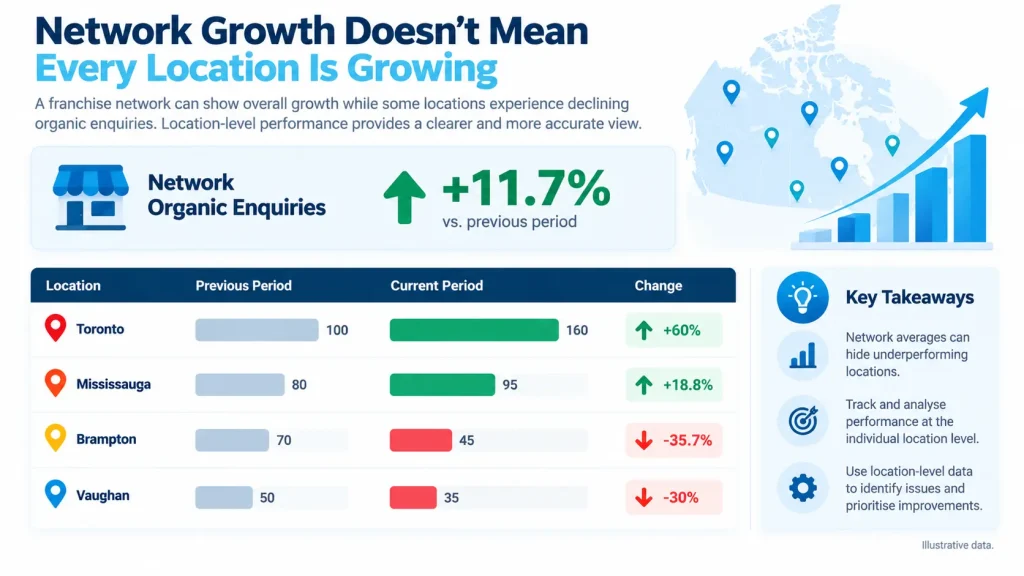
Franchise SEO reporting should help corporate teams understand both network performance and individual location outcomes. A positive network-wide traffic trend does not necessarily mean every branch is improving.
How Can Network-Wide Growth Hide Poor Local Performance?
Consider a hypothetical franchise operating four locations.
| Location | Previous monthly organic enquiries | Current monthly organic enquiries | Change |
| Toronto | 100 | 160 | +60% |
| Mississauga | 80 | 95 | +18.8% |
| Brampton | 70 | 45 | -35.7% |
| Vaughan | 50 | 35 | -30% |
| Network total | 300 | 335 | +11.7% |
The network has increased organic enquiries by approximately 11.7%. However, Brampton and Vaughan have experienced substantial declines. If corporate marketing reviews only the combined result, these problems may remain hidden.
A useful reporting system highlights the network’s overall growth while identifying locations that require investigation.
Which KPIs Should Corporate Teams and Franchisees See Separately?
Different stakeholders need different levels of information.
| Reporting level | Relevant KPIs | Primary purpose |
| Individual location | Organic enquiries, calls, bookings, landing-page performance | Evaluate local customer acquisition |
| Regional | Location comparisons, visibility trends, market opportunities | Identify geographic performance differences |
| Corporate network | Total organic conversions, overall visibility, acquisition trends | Evaluate network-wide SEO investment |
Google Search Console, GA4, Google Business Profile performance information, and CRM records can contribute to this reporting. However, the agency should explain attribution limitations, tracking gaps, and differences between data sources.
How Should Reporting Influence Future SEO Investment?
SEO reports should guide decisions rather than simply display numbers. If one location receives substantial traffic but few enquiries, conversion-path improvements may deserve attention. If another location has strong conversion performance but limited organic visibility, expanding relevant search exposure may be valuable.
Locations with declining performance may require technical investigation, competitive analysis, or updated local content. The provider should connect findings with recommended actions, responsible parties, and measurable objectives. This turns multi-location SEO reporting into a practical resource for franchise growth.
The Budget Test: Does Franchise SEO Pricing Reflect the Work Required Across Locations?
Franchise SEO pricing depends on network size, local competition, website condition, service requirements, and implementation complexity. Even franchises with the same number of locations may require different resources. The scope of work matters more than location count alone.
Centralised Retainers vs Per-Location SEO Fees
Franchise SEO agencies offer three pricing models:
- Centralised Retainer: Covers corporate SEO strategy, technical optimisation, shared reporting, and network coordination.
- Per-Location Fees: Covers local keyword research, location-page optimisation, Google Business Profile management, and market-specific reporting.
- Hybrid Model: Combines centralised services with variable location-level charges.
Franchises should compare pricing models based on deliverables, service coverage, and actual business requirements rather than cost alone.
Which Costs Can Increase as Your Franchise Network Expands?
Network expansion may increase expenses for:
- New location pages and local content development.
- Technical SEO implementation and website maintenance.
- Google Business Profile administration and reporting.
- Website migrations, specialised content, and additional software.
Before signing, confirm included services, additional charges, and pricing adjustments when locations open, close, or leave the network. Transparent pricing helps franchises manage budgets and forecast SEO investment as their networks expand.
Put Your Franchise SEO Provider Through a Practical Five-Scenario Test
Agency presentations and service descriptions can explain what a provider offers. However, practical operational scenarios can reveal whether the provider has a reliable system for managing a franchise network. Ask shortlisted agencies to explain how they would respond to the following situations.
| Franchise scenario | What the SEO provider should demonstrate |
| Five locations experience declining enquiries | Location-specific analysis, likely causes, and corrective priorities |
| A new franchise location opens next month | A documented launch process covering website content, eligible profiles, and quality checks |
| A franchisee changes business hours | A clear approval and update workflow for relevant customer-facing information |
| Corporate marketing introduces a new service | A scalable content rollout that reflects actual service availability at each location |
| A franchisee leaves the network | Defined access, ownership, data management, and location transition procedures |
These scenarios test five important capabilities: diagnosis, expansion readiness, information accuracy, scalable implementation, and operational continuity. A provider should be able to describe the people, processes, tools, and approvals involved.
The strongest answer is not simply that the agency can complete the task. It is an explanation of how the work will be completed, verified, and reported.
What Should You Request as Evidence?
During provider evaluation, request examples of relevant deliverables. These include a sample multi-location audit, location-page quality checklist, reporting dashboard, onboarding workflow, and documented responsibilities. Comparable case studies can provide additional context, especially when they identify the number of locations involved, implementation scope, and measurable outcomes.
Where client confidentiality limits disclosure, the agency should still be able to explain its general methodology. Avoid relying solely on ranking screenshots or broad traffic-growth claims without sufficient context.
What Are the Warning Signs of an Unprepared Franchise SEO Agency?
Certain practices deserve closer scrutiny. These include guaranteed rankings, identical content plans for every location, unclear business profile access arrangements, and proposals that do not distinguish corporate responsibilities from local execution.
Other concerns include vague monthly deliverables, unexplained backlink strategies, and reporting that focuses exclusively on network-wide traffic. A reliable agency should acknowledge that local SEO outcomes vary according to competition, implementation, market conditions, and search engine changes.
What Should Your Franchise SEO Provider Deliver in the First 60 Days?
The first 60 days should establish a clear understanding of the franchise network and begin a prioritised implementation process. The exact schedule depends on network size, access availability, approval requirements, and existing website conditions.
Establishing a Reliable Location Inventory and Performance Baseline
During the initial stage, the provider should identify active locations, relevant website URLs, business profiles, and available analytics information. The assessment should document major technical issues, business information inconsistencies, and location-level performance differences.
Corporate marketing and franchisees should also understand their responsibilities. A useful early deliverable is a prioritised network audit that explains what needs attention, why it matters, and who must approve or implement the recommended work.
Building and Testing a Prioritised Multi-Location SEO Plan
After establishing the baseline, the provider can begin implementing approved improvements. These might include technical fixes, location-page updates, profile information corrections, internal linking improvements, or conversion tracking adjustments.
For substantial network-wide changes, a pilot rollout may be appropriate. The agency should validate completed work and document remaining priorities.
By the end of the initial 60-day period, the franchise should have a clearer operational plan, an agreed reporting framework, and evidence of initial implementation. Significant ranking or revenue improvements should not be treated as guaranteed outcomes within this period.
Build a Franchise SEO Strategy That Supports Every Location
Successful franchise SEO requires coordinated corporate strategy, local optimisation, accurate business information, and measurable performance across locations. A reliable SEO provider should identify underperforming branches, maintain brand consistency, support network expansion, and deliver location-level reporting that guides business decisions. At RankSure, we combine structured SEO planning, technical optimisation, and local search strategies to help businesses improve their online visibility.
Discuss Your Multi-Location SEO Goals With RankSure to explore an SEO strategy tailored to your Canadian franchise network.
Frequently Asked Questions About Franchise SEO Services
What are franchise SEO services?
Franchise SEO services improve organic search visibility across multiple locations through corporate SEO, location-page optimisation, Google Business Profile management, technical SEO, and performance reporting.
How is franchise SEO different from regular local SEO?
Regular local SEO focuses on individual businesses, while franchise SEO manages multiple locations through coordinated strategies, consistent branding, local optimisation, and location-level reporting.
Should franchise locations use separate websites or one corporate domain?
A central corporate website with dedicated location pages often simplifies SEO management, branding, and maintenance. Separate websites may suit certain franchise structures but require additional resources and governance.
Who should control Google Business Profiles for franchise locations?
Franchisors or authorised franchise operators should retain appropriate ownership and administrative control. SEO agencies can receive permissions for approved management activities under Google’s policies.
How much do franchise SEO services cost in Canada?
Franchise SEO pricing in Canada varies by location count, competition, technical requirements, and service scope. Agencies may charge centralised retainers, per-location fees, or hybrid pricing.
How should a franchise prioritise locations for SEO investment?
Prioritise locations based on organic visibility, customer enquiries, competition, market demand, and growth potential. Focus resources where improvements can deliver the greatest business impact.
Can one SEO agency manage hundreds of franchise locations?
Yes. An experienced agency with scalable workflows, technical expertise, quality controls, and location-level reporting can manage hundreds of franchise locations while maintaining accuracy and brand consistency.