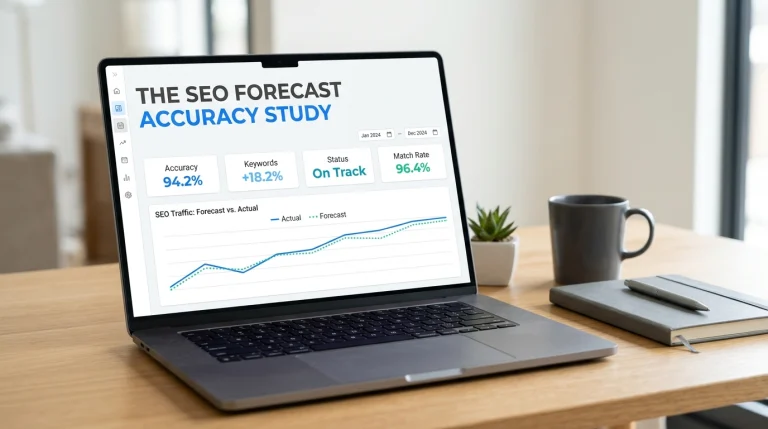

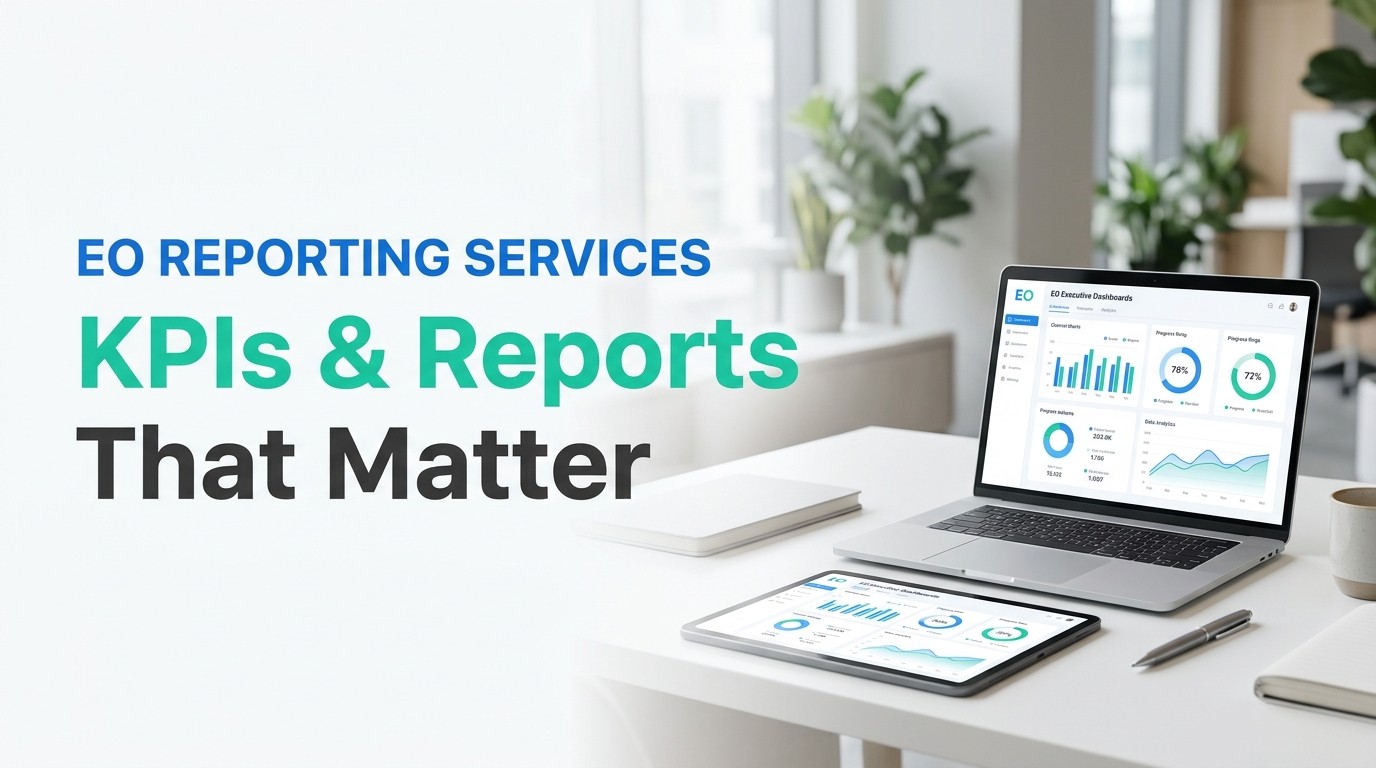
A monthly SEO report should show whether organic search is producing meaningful business progress. Useful SEO reporting services go beyond rankings, traffic, and backlink counts. They connect SEO work with search visibility, relevant traffic, qualified enquiries, revenue where measurable, and clear next steps.
For Canadian businesses, strong reporting also creates accountability. A useful report should explain what changed, what work was completed, why results matter, and what decisions should follow.
Your SEO Agency Sends a Monthly Report. How Do You Know Whether It Is Actually Useful?
An SEO report explains performance rather than just displaying it. A dashboard shows organic clicks, sessions, rankings, conversions, and other metrics automatically. SEO reporting adds interpretation. It explains which changes matter, what caused them, how they relate to business objectives, and what actions need to be followed.
This distinction matters because improving one metric does not automatically improve business performance. A page may receive more impressions without attracting more clicks. Traffic might increase because informational articles gained visibility while commercial service pages remained unchanged. Keyword rankings may improve for search terms that rarely produce qualified customers.
Professional SEO performance reporting therefore connects three areas:
- SEO activity, including technical changes, content improvements, internal linking, and other completed work.
- Search and website performance, including visibility, clicks, landing page traffic, engagement, and conversions.
- Commercial outcomes, including qualified leads, sales opportunities, booked appointments, purchases, and revenue where reliable tracking exists.
Businesses should be able to move from activity to performance to commercial impact without guessing what the numbers mean.
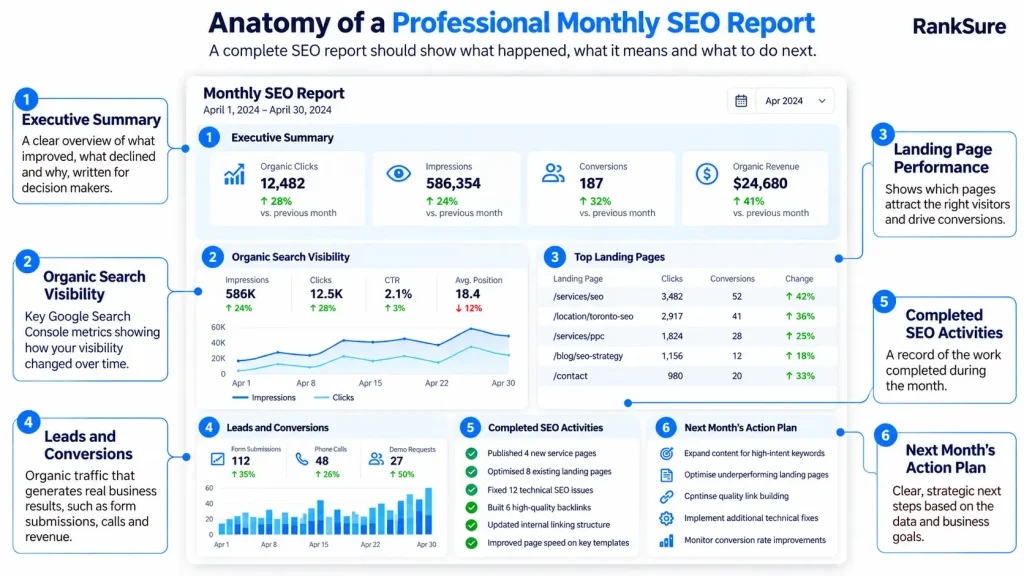
Inside a Professional SEO Report: Six Things Every Business Should Expect
A monthly SEO report should show what changed, why it changed, what work was completed, and what should happen next.
1. A Clear Summary of What Improved, Declined, and Why
The report should open with an executive summary focused on material changes. It should explain changes in organic clicks, qualified enquiries, important landing pages, or technical performance without repeating every dashboard metric.
Results should be compared with a useful baseline, such as the previous month, the same period last year, or the campaign starting point. A 15 percent traffic increase has limited value unless the report explains where that traffic came from and whether it contributed to business goals.
2. Evidence of Organic Search Visibility Changes
Google Search Console should be a primary source for measuring Google Search performance. Useful metrics include impressions, clicks, click-through rate, and average position. Reporting should break these down by relevant queries, important landing pages, commercial topics, geographic markets, and comparison periods.
Businesses should not judge progress from average rankings alone. The stronger question is whether visibility is improving for searches that matter to the business.
3. Organic Traffic That Reaches the Right Website Pages
Traffic growth should be evaluated by page type and search intent. Google Analytics 4 can show which landing pages receive organic visits and how users interact with them. For example, more visits to a tax glossary may increase awareness for an accounting firm, but traffic to corporate tax, bookkeeping, or advisory pages may carry greater commercial value.
A useful report should show which pages gained or lost traffic, which topics drove growth, and which landing pages contributed to meaningful actions.
4. Leads, Enquiries, and Revenue Generated Through Organic Search
SEO reporting becomes valuable when website activity is connected with business outcomes. GA4 key events may include enquiry forms, bookings, demo requests, purchases, or other important actions. Conversion totals should not be viewed in isolation. A B2B company may receive 40 organic forms but find through its CRM that only six qualify as genuine opportunities.
CRM data can connect enquiries with qualified leads, sales opportunities, customers, and revenue where suitable tracking exists. SEO ROI should also explain the attribution method and assumptions used in the calculation.
5. Proof of SEO Work Completed During the Month
Businesses should receive evidence of completed SEO work. This includes technical fixes, page updates, new content, internal linking improvements, metadata changes, indexing work, structured data updates, or redirect corrections. Reports should identify the affected pages or systems and provide implementation evidence where appropriate.
Completed work and performance results should remain separate. Finishing an SEO task does not prove that it caused a ranking, traffic, or revenue increase.
6. A Clear Action Plan for the Following Month
Reporting should guide future SEO decisions. Each important recommendation should identify the issue, proposed action, intended outcome, and responsible party.
For example, if a high-value service page gains impressions but loses click-through rate, the agency may review the page title, search intent alignment, search result position, and competing listings. A monthly report that only describes past performance offers limited strategic value. Strong SEO reporting turns findings into clear priorities for the next reporting period.
What Do SEO Metrics Tell You About Business Growth?
SEO KPIs become useful when they answer specific business questions. A company should not treat every increase as success or every decline as failure.
When Higher Keyword Rankings Do Not Mean Better Results
A ranking improvement matters when the keyword is relevant to the target audience and business objective. Moving from position 18 to position 7 for a valuable service query may indicate improved commercial visibility. Moving from position 18 to position 2 for an irrelevant informational phrase may contribute little to revenue.
Average position requires careful interpretation because Search Console calculates it across impressions and search contexts. A business should examine query relevance, clicks, landing pages, conversions, and trends alongside ranking changes.
Keyword reporting should answer two questions:
- Are we becoming more visible for relevant searches?
- Is that visibility producing meaningful user actions?
Why Organic Traffic Growth Can Be Misleading
Traffic is an input, not the final business outcome. An ecommerce retailer could increase organic sessions by 30 percent while organic purchases remain unchanged. A local service provider could attract thousands of informational visitors without receiving additional service enquiries.
Traffic reports should therefore segment growth by landing page purpose. Commercial pages, product pages, service pages, location pages, educational resources, and branded searches can play different roles in the customer journey.
A reporting provider should explain which segment created the increase and how that traffic relates to the business objective.
How to Connect SEO Performance With Leads and Sales
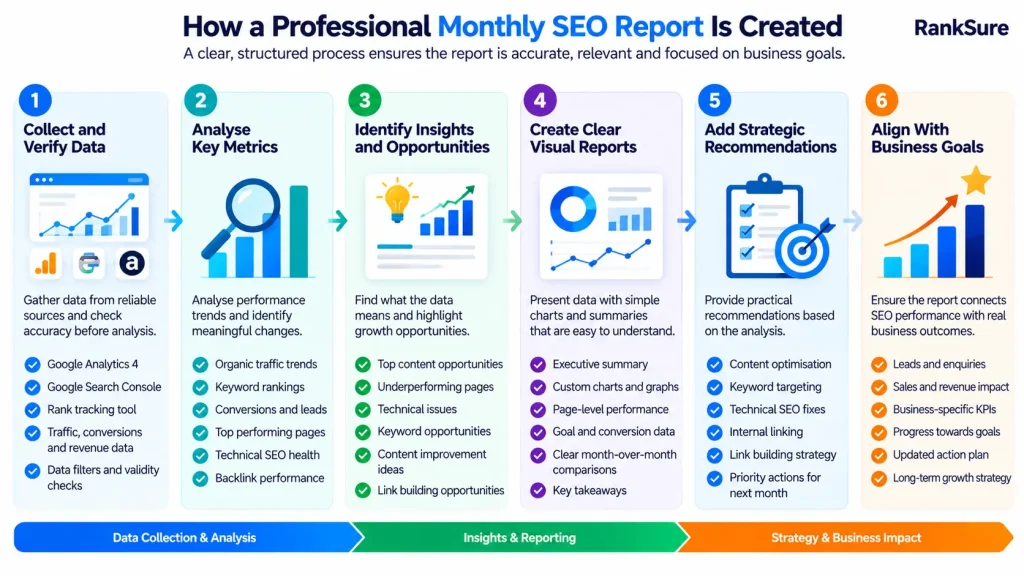
The strongest measurement framework connects Search Console, website analytics, and business records.
- Search Console explains how the website performs within Google Search.
- GA4 records website interactions and configured key events.
- A CRM can record what happens after a lead enters the sales process.
Together, these systems can help answer progressively more valuable questions.
- Did organic visibility increase?
- Did users visit the website?
- Did they complete an important action?
- Did those enquiries become qualified opportunities?
- Did those opportunities generate customers or revenue?
Not every business will have complete data across the entire journey. A professional report should identify those gaps rather than claim precision that the tracking system cannot support.
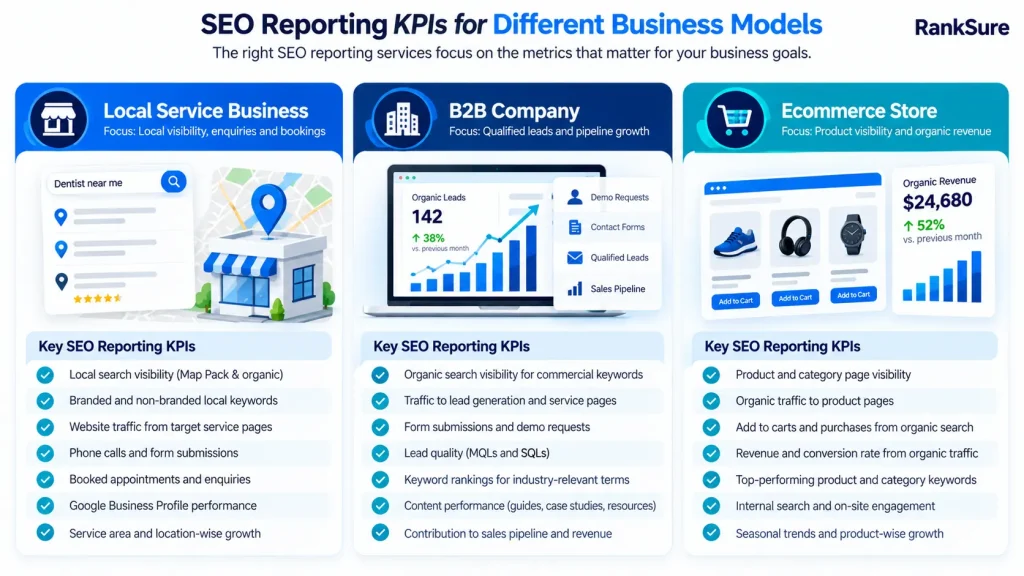
Three Businesses, Three Different SEO Reports: What Should Each Measure?
SEO reporting should reflect how a business generates revenue. Local services, B2B companies, and ecommerce stores need different KPIs.
Local Service Business: From Google Visibility to Booked Appointments
Local SEO reporting should connect search visibility with customer actions. Useful KPIs include:
- Local search visibility
- Google Business Profile interactions
- Website clicks
- Calls
- Service enquiries
- Appointment requests
- Booked jobs where tracking allows
Google Business Profile report metrics such as views, searches, calls, website clicks, directions, messages, and bookings where available. For a dental clinic, plumber, law firm, or home services company, qualified enquiries and booked appointments matter more than raw profile views.
B2B Company: From Organic Visitors to Sales Opportunities
B2B reporting should measure progress across a longer sales journey. Useful KPIs include:
- Organic visits to commercial pages
- Demo requests
- Contact forms
- Marketing qualified leads
- Sales qualified leads
- Sales opportunities
- Pipeline value
- Closed revenue where attribution is reliable
Lead volume alone can be misleading. Twenty qualified enquiries may be more valuable than one hundred low-quality leads. A strong report should connect organic lead generation with CRM outcomes wherever suitable tracking exists.
Ecommerce Store: From Product Discovery to Organic Revenue
Ecommerce SEO reporting can connect search performance more directly with transactions. Useful KPIs include:
- Product and category page visibility
- Organic clicks
- Product landing page sessions
- Purchases
- Organic conversion rate
- Transaction revenue
- Average order value
- Revenue by page or product category
Revenue should still be interpreted in context. Inventory, pricing, promotions, seasonality, brand demand, merchandising, and website usability can all influence ecommerce performance.
Five SEO Reporting Claims That Deserve a Closer Look
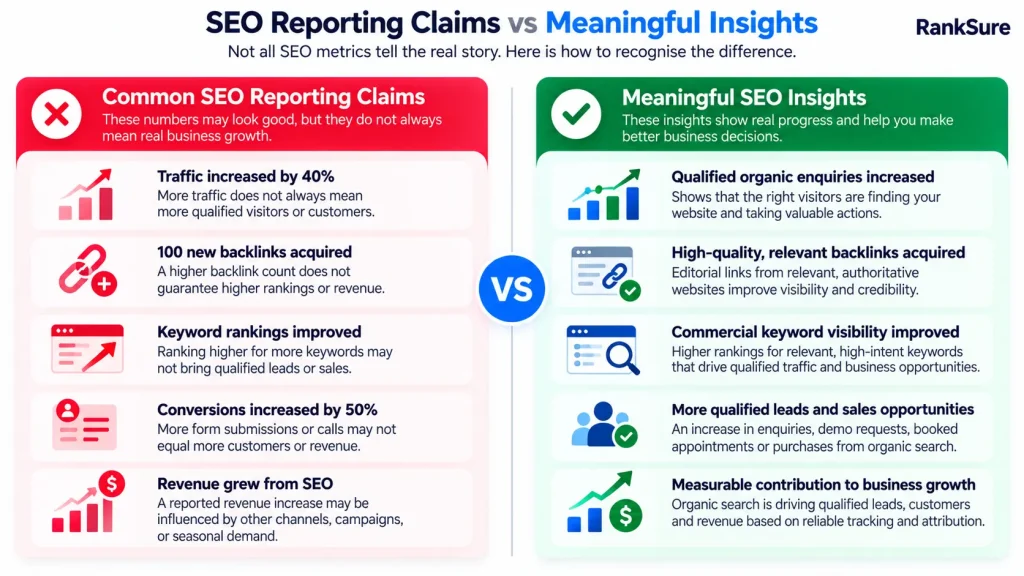
Positive SEO metrics do not always reflect meaningful business growth. Here are five common reporting claims businesses should examine carefully.
Claim 1: Organic Traffic Increased Significantly
Higher traffic does not guarantee more customers. Focus on relevant landing pages, visitor quality, and conversions rather than traffic volume alone.
Claim 2: We Improved Rankings for Hundreds of Keywords
Ranking improvements matter when keywords match commercial search intent and generate qualified traffic, enquiries, or sales.
Claim 3: We Built 100 New Backlinks
Backlink quantity alone does not indicate SEO value. Prioritise relevant, editorially earned links from credible websites that support important pages.
Claim 4: SEO Generated a Specific Amount of ROI
SEO ROI claims should be supported by verified revenue data, transparent attribution methods, campaign costs, and clearly stated measurement limitations.
Claim 5: Performance Is Up Compared With Last Month
Monthly growth may reflect seasonality, promotions, or tracking changes. Review consistent reporting periods and year-over-year trends for better context.
Can You Independently Verify the Numbers in Your SEO Report?
Businesses should retain access to the systems behind their SEO reporting. Trust improves when the reported numbers can be checked directly.
Check Search Performance Directly in Google Search Console
Businesses should have access to their own Google Search Console property. Reported clicks, impressions, queries, pages, countries, devices, and search types can be compared with Search Console using the same reporting period.
Aggregation settings can affect metrics such as click-through rate and average position, so the report should clearly explain how figures were calculated.
Compare Website Conversions With GA4 and CRM Records
Businesses should verify which GA4 events are marked as key events and whether they still represent meaningful actions. Tracking errors can distort results. A form event may fire twice, a booking event may stop working, or spam enquiries may be counted as conversions.
CRM records provide another validation layer by showing whether reported leads became qualified opportunities or customers. A reliable reporting provider should explain discrepancies rather than treat every analytics number as exact.
Understand Why SEO Data Sometimes Does Not Match Across Platforms
Search Console, GA4, and CRM platforms measure different stages of the customer journey. Search Console measures Google Search interactions. GA4 measures activity on tracked digital properties. CRM systems record lead and sales outcomes.
Consent settings, attribution rules, filters, tracking configuration, and reporting windows can create differences between platforms. Good SEO reporting explains these differences instead of forcing unrelated numbers to match.
Should Your SEO Report Include AI Search Visibility?
AI search visibility can add useful context, but it should complement traditional SEO and business metrics rather than replace them. Businesses may want to track whether their brand or website appears in AI-generated answers across Google, ChatGPT, Perplexity, and similar platforms.
What Can Be Measured Across AI Search Platforms?
Depending on the platform and monitoring method, AI SEO reporting may track:
- Brand appearances
- Citations and referenced pages
- Competitor mentions
- Referral traffic
- Repeated prompt results
- Visibility by topic or question
Google Search Console can include eligible AI Overview links within broader search performance reporting. However, this does not provide complete measurement across every AI platform or every possible AI answer.
Which AI Visibility Claims Should Businesses Question?
A single AI visibility score is only useful when its methodology is clear. Results vary by prompt wording, location, personalisation, platform changes, and testing frequency.
Businesses should ask which prompts and platforms are monitored, how often tests are run, how mentions and citations are counted, and what limitations apply. Strong AI reporting explains the measurement method and underlying evidence instead of presenting one score as a universal ranking.
What Happens When an SEO Report Shows Poor Results?
A useful SEO report should identify where performance is breaking down and recommend corrective action. Poor results are information.
Identifying Whether the Problem Is Visibility, Traffic, or Conversions
The reporting process should isolate the stage of the funnel that is underperforming. Low impressions indicate limited search visibility. Strong impressions with weak clicks may point toward rankings, search result presentation, intent mismatch, or competitive SERP conditions.
Strong organic traffic with poor conversions may indicate landing page relevance, user experience, offer quality, tracking problems, or traffic that does not match commercial intent. Strong conversions with weak sales outcomes may indicate lead quality or downstream sales issues. The report should locate the problem before recommending a solution.
What Your SEO Agency Should Recommend Next
Corrective recommendations should follow the evidence. Possible actions may include:
- Resolving crawl or indexing problems
- Improving content around relevant search intent
- Updating commercial landing pages
- Strengthening internal linking
- Reviewing declining queries
- Improving conversion paths
- Correcting analytics configuration
- Reassessing keyword priorities
- Investigating competitive changes
The recommendation should identify the reason for the action and who is responsible for completing it.
When Is Paying for Dedicated SEO Reporting Services Worth It?
Dedicated SEO reporting services become more valuable as measurement complexity increases. A small business with one website, a limited service area, and a few conversion actions may need a relatively simple reporting framework.
A company operating multiple websites, locations, ecommerce stores, CRM systems, sales teams, or complex customer journeys may require considerably more analysis.
Automated Dashboards vs Analyst-Led SEO Reporting
An automated dashboard is useful for ongoing data access. Tools such as Looker Studio can combine information from several sources into a repeatable visual format. Automation is valuable for displaying metrics. It does not automatically explain why performance changed or what the business should do about it. Analyst-led reporting adds:
- Performance interpretation
- Business context
- Anomaly investigation
- Data quality review
- Prioritised recommendations
- Stakeholder discussion
A business choosing between these options should decide whether it needs access to numbers or support making decisions from those numbers.
Reporting Included in an SEO Retainer vs Standalone Reporting
Many SEO agencies include reporting within broader campaign management. Standalone reporting suits businesses that already have internal SEO teams, multiple agencies, complex analytics systems, or a need for independent performance evaluation. Pricing depends on scope rather than one universal reporting rate. Factors include:
- Number of websites
- Number of locations
- Reporting frequency
- Number of data sources
- Custom dashboard requirements
- CRM integration
- Conversion tracking complexity
- Stakeholder reporting requirements
- Analysis depth
- Review meetings
Businesses should therefore compare deliverables and responsibilities before comparing prices.
A Practical Checklist for Evaluating Your Current SEO Reporting Service
A reliable SEO reporting service should provide accurate data, meaningful insights, and clear recommendations. Use these five criteria to evaluate your current reports.
Business Relevance
Does your report connect SEO performance with business goals, prioritise commercially relevant keywords, and measure qualified leads or revenue instead of traffic alone?
Data Transparency
Are data sources, KPI definitions, and reporting periods clearly documented? Can you independently verify results through Google Search Console and GA4?
Campaign Accountability
Does your agency document completed SEO activities, provide implementation evidence, distinguish actions from results, and highlight unresolved issues?
Analysis Quality
Does the report explain performance changes, identify positive and negative trends, and account for seasonality, attribution limitations, and misleading metrics?
Actionability
Does each major finding lead to practical recommendations, defined priorities, assigned responsibilities, and measurable follow-up actions?
A professional SEO report should go beyond attractive dashboards by delivering transparent evidence, meaningful analysis, and actionable insights that support business growth.
Turn SEO Reporting Into Better Growth Decisions With RankSure
SEO reporting services should make organic performance easier to understand, verify, and act upon. The strongest reports combine search visibility, website behaviour, business outcomes, completed SEO work, measurement limitations, and clear priorities. They let owners and marketing teams see what is improving, identify what isn’t working, and challenge claims unsupported by evidence.
For Canadian businesses, this level of transparency can make SEO reporting a management tool rather than another monthly document.
RankSure helps businesses think more clearly about SEO performance, strategy, and measurable organic growth.
Discuss Your SEO Reporting Goals With RankSure.
Frequently Asked Questions About SEO Reporting Services
What should an SEO report include every month?
It should include key performance changes, search visibility, landing page results, conversions, completed SEO work, major issues, and next priorities.
How often should SEO performance be reviewed?
Monthly reviews suit most ongoing SEO campaigns. Larger or faster moving campaigns may also use live dashboards and more frequent checks.
What is the difference between an SEO dashboard and an SEO report?
A dashboard displays data. An SEO report explains what changed, why it matters, and what actions should follow.
Can SEO reporting show which leads came from organic search?
Yes, where GA4, CRM, and conversion tracking are properly configured. Attribution limitations should still be explained.
What if SEO traffic increases but sales do not?
Review traffic quality, landing page relevance, conversion tracking, lead quality, and CRM outcomes. More traffic does not always mean more revenue.
Do SEO reporting services include AI search visibility?
Some do. AI reporting may track brand mentions, citations, referral traffic, and monitored prompts, but it should clearly state its methodology and limitations.