
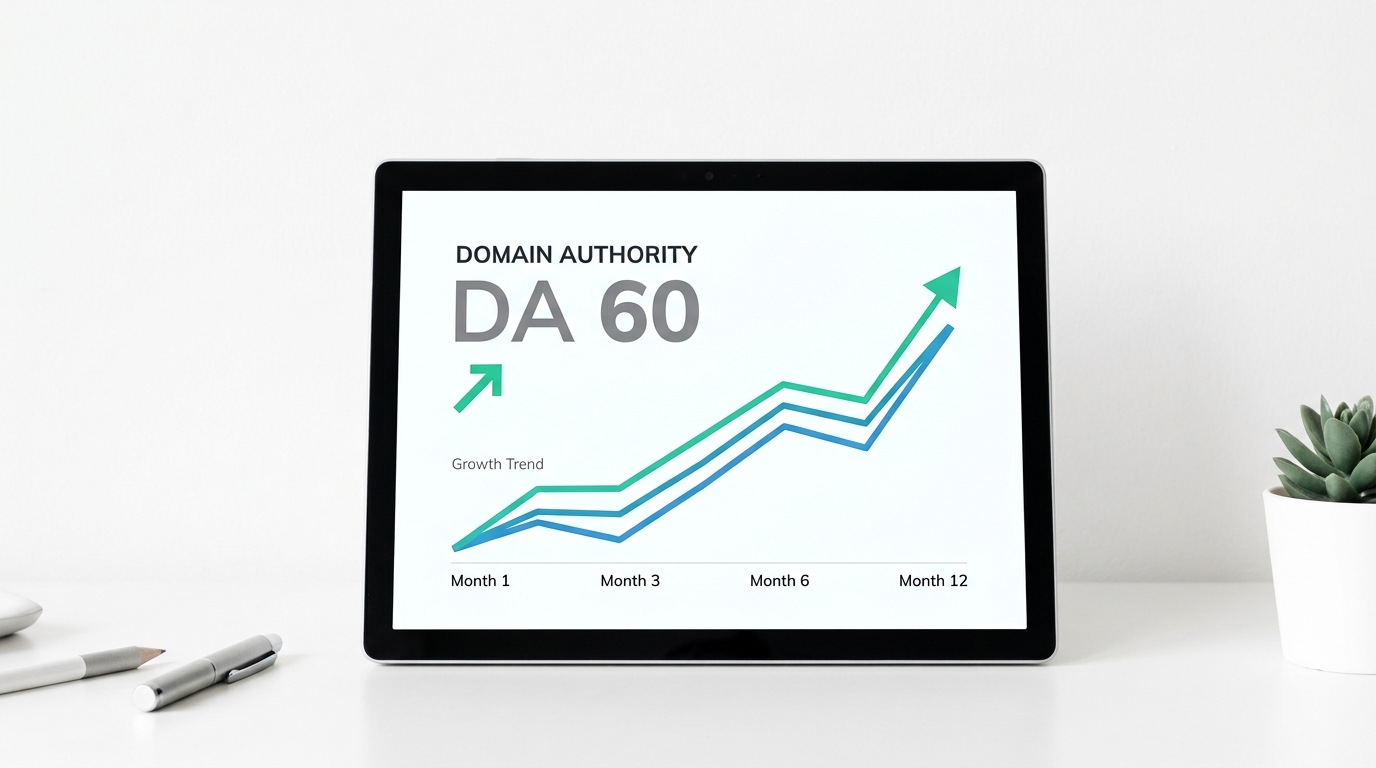
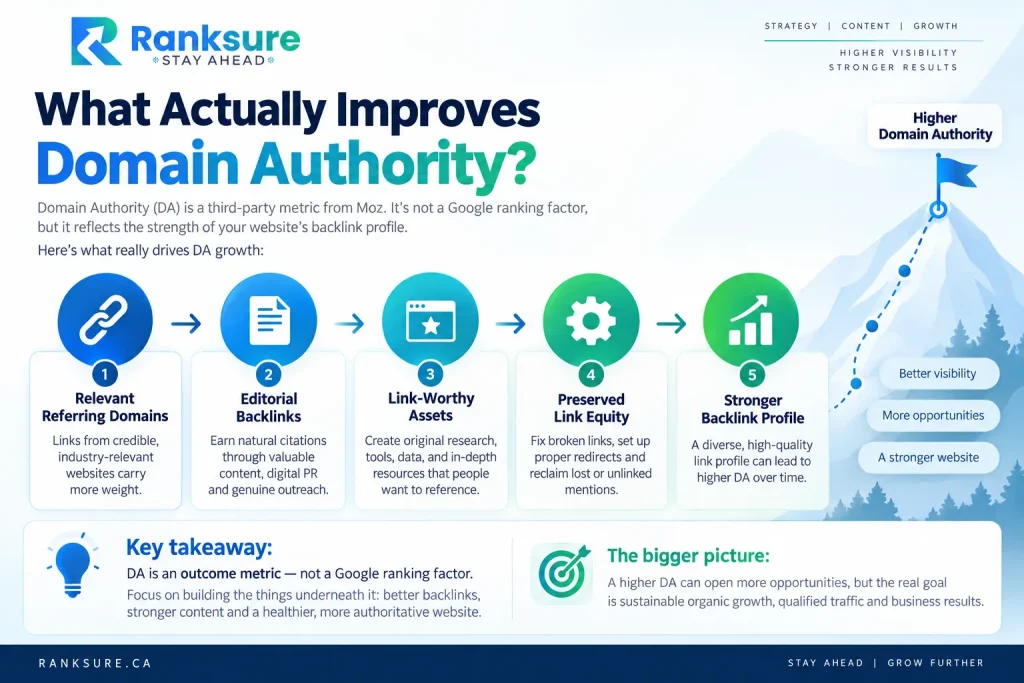
Domain Authority (DA) is a third-party SEO metric developed by Moz. It is not a Google ranking factor. Therefore, improving DA shouldn’t become a numbers game where the objective is simply moving a score from 28 to 40. The useful work happens underneath the metric: earning relevant backlinks, expanding the diversity of credible referring domains, creating resources people want to reference, and preserving the link equity your site has already earned.
A sensible process looks like this:
Benchmark → earn relevant links → create link-worthy assets → strengthen site structure → preserve existing link value → measure progress.
Get those pieces right, and authority metrics will rise as a consequence, and the site itself will become harder to compete with.
What Is Domain Authority?
Domain Authority is Moz’s predictive domain-level metric for estimating a website’s relative ability to compete in search. The score runs from 1 to 100, with higher values representing stronger predicted authority.
DA works best as a comparison metric. A score of 45 isn’t good or bad in itself. If competing domains in the same search landscape sit around 20 to 30, it represents a strong backlink profile. Against established publishers sitting at higher positions, the same score tells a different story.
How Is Domain Authority Calculated?
Moz calculates Domain Authority using multiple signals associated with a site’s link profile and a machine-learning model. For practical SEO work, the important variables are the strength and diversity of the backlink profile, including the domains linking to the site.
Authority metrics use scaled scoring systems, so improvement doesn’t behave like a simple checklist where ten new backlinks equal five more points.
Ahrefs, for instance, describes Domain Rating as a logarithmic 0 to 100 metric influenced by referring domains, their strength, and their outbound linking patterns.
Is Domain Authority a Google Ranking Factor?
No. Google does not use Moz Domain Authority as a ranking signal.
The metric, however, is helpful in comparing your backlink profile with search competitors, spotting substantial authority gaps, monitoring relative link-profile growth, and evaluating broader changes in your competitive position.
The mistake is confusing correlation with causation.
A website with strong DA has characteristics that matter in organic search, i.e., credible backlinks, established content, strong pages, brand recognition, but Google isn’t checking the Moz score before deciding where a page ranks.
What Is a Good Domain Authority Score?
There isn’t a universal threshold.
A “good” DA is judged against websites competing for the same searches, audience, and topical space.
Suppose your DA is 32. If most direct search competitors range from 20 to 35, chasing DA 70 makes little strategic sense. If the domains beating you sit between 55 and 70 and have stronger relevant backlink profiles, there’s a genuine authority gap worth investigating.
Even then, DA doesn’t determine the SERP. A lower-authority domain can outrank a stronger domain when its individual page better satisfies search intent, carries stronger page-level signals, or is simply a better result.
Assess DA alongside relevant backlinks, organic rankings, search visibility, traffic, and conversions.
Domain Authority vs. Domain Rating vs. Authority Score
These metrics sound interchangeable. They aren’t.
| Metric | Provider | Primary Purpose |
| Domain Authority (DA) | Moz | Predictive domain-level authority |
| Domain Rating (DR) | Ahrefs | Relative backlink-profile strength |
| Authority Score (AS) | Semrush | Overall domain/page authority and quality assessment |
Ahrefs defines DR around the relative strength of a site’s backlink profile, while Semrush’s Authority Score combines link power with estimated organic traffic and indicators associated with a natural or potentially manipulated backlink profile.
So don’t compare a DA 50 with a DR 50 and assume they mean the same thing. They don’t.
How to Improve Domain Authority
The strongest DA growth strategies are authority-building tactics that improve the signals these third-party systems attempt to measure.
1. Benchmark Your Authority Against Search Competitors
Start with the SERP, not an arbitrary target.
Identify the domains competing with you for commercially or topically important queries. Compare their authority metrics, relevant referring domains, backlink diversity, strongest linked pages, organic visibility, and domains linking to them but not you.
The objective is to quantify the competitive authority gap.
Say you have 400 referring domains and your competitor has 1,500. That sounds intimidating until you discover that hundreds of theirs come from irrelevant directories and syndicated junk, while the pages outranking you rely on 30–40 relevant editorial domains.
Now you have a much sharper target. Raw backlink counts hide the useful bit.
2. Earn High-Quality Backlinks From Relevant Websites
Five strong links are more valuable strategically than a spreadsheet stuffed with hundreds of mediocre ones.
Evaluate backlink opportunities by relevance, source legitimacy, linking-page quality, editorial context, placement, destination relevance, and referring-domain uniqueness.
This is link-graph quality, not link hoarding. A backlink from an unrelated website shouldn’t become attractive because its third-party authority score happens to be 80.
Use Digital PR and Relevant Outreach
Once you have something worth referencing, put it in front of the right people.
Guest posting itself isn’t problematic; scale and intent matter. Large-scale article campaigns, paid links intended to manipulate rankings, automated link creation, excessive exchanges, and low-quality directory links can cross into link-spam territory. The question isn’t:
Can I get a backlink here?
It’s:
Why should this publication reference this page?
That filter kills a lot of bad link-building ideas early.
Avoid Manipulative Link Acquisition
Buying “DA 70+ dofollow links” from a marketplace might move a third-party graph metric.
That doesn’t make it good SEO.
Be wary of PBNs, automated link packages, irrelevant directories, mass low-quality guest posting, excessive reciprocal linking, paid links designed to pass ranking credit, and opportunities selected because the domain has a high DA.
Chasing the metric produces the ugliest backlink profile.
3. Create Link-Worthy Content Assets
“Publish high-quality content” isn’t a link-building strategy. Publish something worth citing.
The two are different.
A generic article explaining a subject covered by hundreds of websites gives publishers little reason to reference your version. Original research, first-party data, useful tools, benchmark reports, templates, definitive resources, and original visual assets create a stronger reason to cite.
Existing assets deserve attention too.
Find pages already earning backlinks and ask whether they can be refreshed, expanded, or made easier to reference. An outdated statistics page with 60 referring domains will provide a bigger opportunity than another brand-new blog post.
Overlapping resources should be consolidated into a stronger definitive asset. Preserve existing backlinks with appropriate redirects where consolidation makes sense.
4. Find and Close Competitor Backlink Gaps
Competitor backlink analysis isn’t about cloning somebody else’s link profile. It’s reconnaissance.
Start with actual organic competitors, the domains appearing repeatedly for your priority searches.
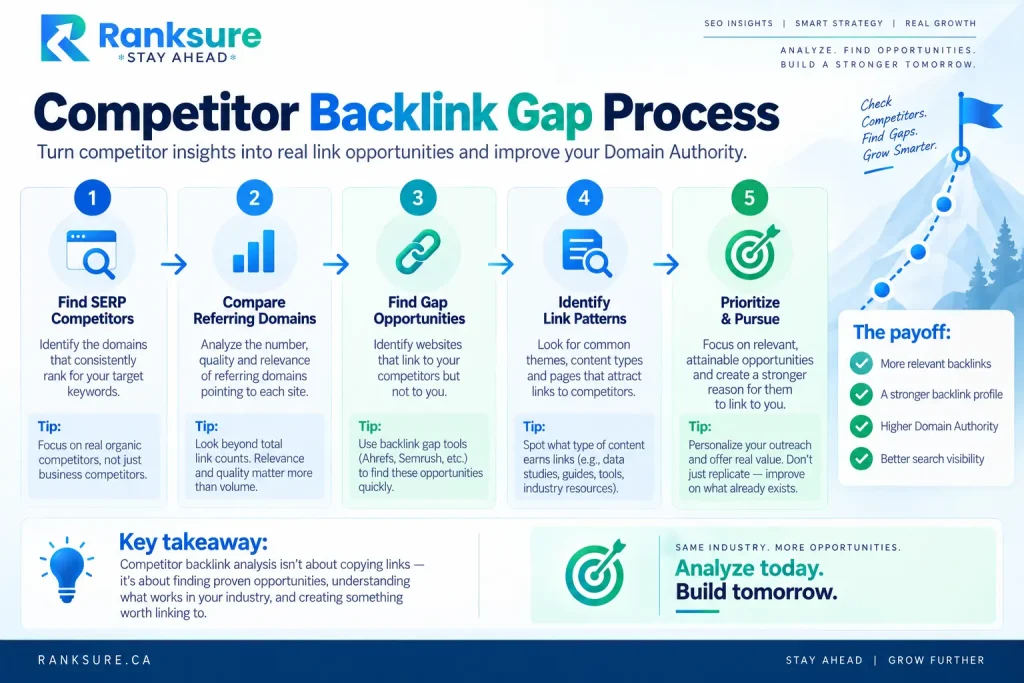
A site linking independently to four of your competitors deserves attention.
Maybe it maintains an industry resource page. Perhaps it regularly cites original research. Maybe competitors keep earning coverage because they release proprietary datasets.
That’s actionable intelligence.
5. Reclaim Existing Link Opportunities
New backlinks get all the attention. Existing equity quietly leaks away in the background. Fix that first.
Recover Lost and Broken Backlinks
Audit recently lost backlinks, deleted linked pages, URLs changed during redesigns or migrations, broken inbound links, and valuable legacy resources with external citations.
A strong page might have accumulated links for five years, then disappeared during a migration.
If an equivalent resource exists, an appropriate permanent redirect preserves signals associated with the old URL rather than leaving backlinks pointing into a dead end.
Sometimes restoration is better. If the deleted resource still has search demand and quality backlinks, bringing it back makes more sense than redirecting everything somewhere unrelated.
Convert Unlinked Brand Mentions Into Links
Search for references to your brand, products, proprietary research, statistics, executives, subject-matter experts, and original resources. Some publishers already know you. They simply didn’t link.
Prioritize situations where the link improves the source. A journalist citing your proprietary dataset without linking to the methodology page is a strong candidate. A passing brand mention in an unrelated story isn’t.
6. Build Topical Authority and Strengthen Internal Linking
External backlinks get authority onto the site. Your internal structure determines what happens next.
A useful model is:
Pillar → Cluster → Supporting Content → Internal Links
Build comprehensive coverage around strategically important subjects, then connect related pages based on genuine semantic relationships.
A technical SEO pillar, for example, connects naturally to resources covering crawl budget, JavaScript rendering, canonicalization, XML sitemaps, faceted navigation, and internal linking.
Fix orphan pages. Reduce unnecessary crawl depth. Give cornerstone resources clear structural prominence.
Don’t force exact-match anchors everywhere. And don’t claim this raises Moz DA.
Internal linking strengthens discovery, contextual relationships, architecture, and internal authority distribution. Those improvements support SEO even when the DA number doesn’t budge.
7. Fix Technical Issues That Waste Existing Authority
Technical SEO won’t manufacture Domain Authority. It stops you wasting what you’ve already earned.
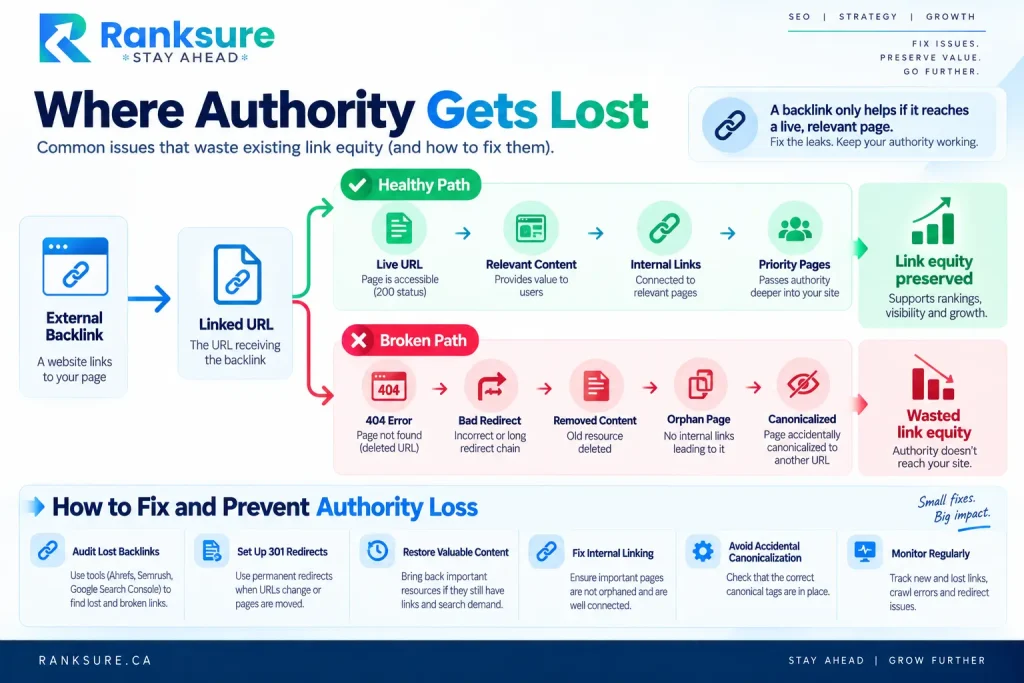
The objective isn’t to acquire new authority. It’s to ensure existing link equity still reaches accessible, relevant URLs.
A backlink pointing into a broken URL, unnecessary redirect chain, removed resource, orphan page, or incorrectly canonicalized page prevents earned value from reaching the content that matters.
Technical hygiene keeps that value connected.
8. Monitor and Maintain Your Backlink Profile
Monitor new and lost backlinks, referring-domain changes, incoming-link relevance, unusual acquisition spikes or losses, suspicious patterns, anchor-text distribution, and evidence of historical manipulative link building.
Patterns matter more than isolated weird links.
A random scraper linking to you isn’t a crisis. Thousands of artificial domains appearing after a previous SEO provider ran a questionable campaign require inspection.
Monitor Natural Anchor-Text Distribution
A natural backlink profile contains a mixture of branded anchors, naked URLs, contextual phrases, and occasional exact-match anchors. Don’t engineer a mathematically perfect ratio.
The goal is to spot obvious manipulation, not make your backlink graph look suspiciously tidy.
Why Does Domain Authority Drop?
Possible causes include losing authoritative backlinks or unique referring domains, moving or deleting linked pages, redirect or migration errors, competitors strengthening their backlink profiles, or changes to the metric provider’s index or calculation model.
Relative authority metrics can move even when your own link count remains stable. So don’t see a two-point decline and start deleting links.
Check rankings, visibility, traffic, and the underlying backlink profile first.
When Should You Consider Google’s Disavow Tool?
Google says websites don’t need the Disavow Links tool because its systems can determine which links to trust. It recommends considering disavowal when a site has a considerable number of spammy, artificial, or low-quality backlinks and those links have caused a manual action.
That makes the disavow tool a risk-management mechanism, not a DA booster.
Don’t disavow a backlink because a third-party tool labels it “toxic,” its DA is low, it looks unfamiliar, or your own DA dropped.
Investigate context and history first, as an incorrectly used tool can hurt search performance.
What Doesn’t Improve Domain Authority by Itself?
Plenty of useful SEO work gets mistakenly sold as a direct DA tactic.
| Tactic | Reality |
| Publishing more pages | Content volume alone doesn’t create authority |
| Repeating keywords | Doesn’t directly increase DA |
| Schema markup | Useful for other SEO purposes, but not a direct DA lever |
| Getting hundreds of weak backlinks | Volume doesn’t equal meaningful authority |
| Buying “high-DA” backlinks | DA alone doesn’t determine link quality |
| Increasing social followers | Not a direct DA mechanism |
| Improving Core Web Vitals | Valuable for UX and broader SEO, but not a direct DA lever |
Schema, performance improvements, content expansion, and technical SEO can matter.
How Long Does It Take to Increase Domain Authority?
How quickly the score moves depends on your starting authority, existing backlink profile, quality and diversity of new referring domains, acquisition rate, competitive environment, historical link profile, and changes to the metric provider’s index or model.
Lower-authority domains sometimes show noticeable movement after modest backlink-profile growth. Moving an already strong domain demands substantially more.
New links also aren’t guaranteed to appear instantly in third-party metrics. Avoid promises like:
“We’ll take your DA from 20 to 40 in 90 days.”
That target encourages teams to optimize for the scoreboard rather than the business.
A better question is whether your relevant referring-domain footprint and organic competitiveness are improving over time.
How to Measure Domain Authority Progress
Don’t build a dashboard with one giant DA number in the middle. Track the surrounding evidence.
Moz, Ahrefs, and Semrush monitor their respective authority and backlink metrics. Google Search Console examines Google’s search-performance data rather than treating third-party scores as Google’s view of your domain.
Watch trends over meaningful periods. Daily DA checking is not advised.
If DA rises eight points while rankings, qualified traffic, and conversions remain flat, celebrate carefully. If DA barely changes while valuable keywords, links, and organic revenue climb, the campaign isn’t failing.
The metric serves the analysis. Not the other way around.
Conclusion: Build Authority, Not Just DA
Domain Authority works best as a comparative metric, not the finish line.
Build the things underneath it: relevant and diverse referring domains, resources worth citing, strong topical relationships, sensible internal architecture, and clean preservation of existing link equity.
Then measure the bigger picture.
DA + backlink quality + organic visibility + traffic + business outcomes tells you far more than an authority score ever could.
FAQs About Improving Domain Authority
How Many Backlinks Do I Need to Increase Domain Authority?
There is no fixed number. One relevant editorial backlink from a strong, legitimate source may be more meaningful than dozens of weak links. Existing authority, referring-domain diversity, link quality, and competition all affect how authority metrics move.
Can Internal Links Increase Domain Authority?
Not directly. Internal links help distribute internal authority, establish contextual relationships, improve discovery, and create a clearer site architecture. They shouldn’t be treated as a direct Moz DA lever.
Can You Increase Domain Authority Without Backlinks?
You can improve content, architecture, crawlability, UX, and organic performance without earning new backlinks. But because domain-authority metrics are heavily influenced by external link profiles, meaningful DA growth generally depends on improving the quality and diversity of referring domains.
Is a High-DA Backlink Always Valuable?
No.
Domain-level authority is only one clue. Evaluate the source’s legitimacy, topical relevance, linking-page quality, editorial context, placement, and relevance to the destination page.
A relevant editorial citation from a respected niche publication can make far more strategic sense than an awkward backlink from an unrelated high-authority domain.