
A post, despite being excellent, can be invisible to the people who would care about it. The problem isn’t reach only. Sometimes Instagram doesn’t have clear signals to understand what your content is about.
That’s where Instagram search optimization comes in.
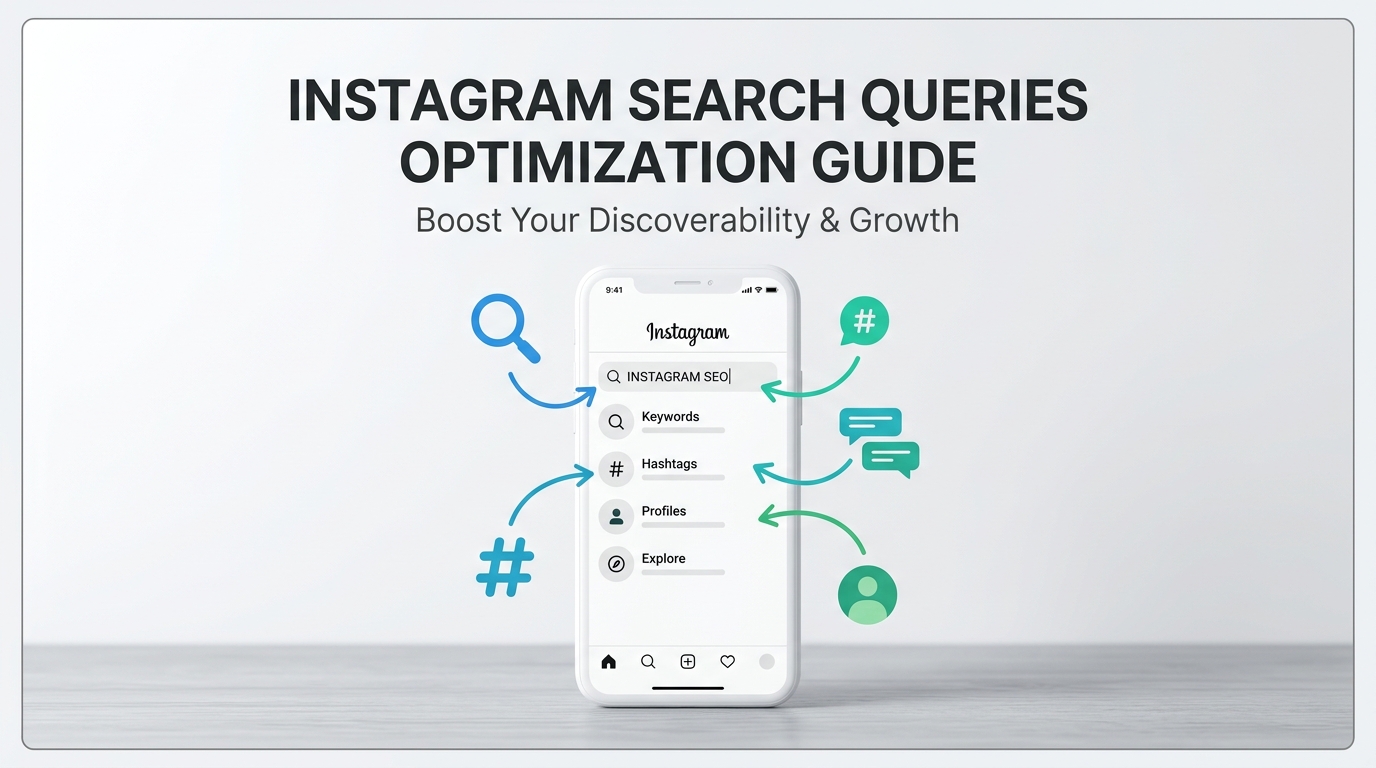
Instead of treating Instagram like a smaller version of Google, optimize the signals Instagram can use to understand your account and content: profile information, captions, hashtags, alt text, locations, content context, user activity, and engagement.
The objective isn’t to cram keywords everywhere. It’s simpler: make the topic unmistakable.
What Is Instagram Search Optimization?
Instagram search optimization is the process of structuring your profile and content so Instagram can understand the subject and match it with relevant searches.
Suppose someone searches:
“beginner strength workout”
Instagram needs to determine which accounts, posts, Reels, hashtags, places, and other results are relevant.
It doesn’t rely on one keyword field. Search text matters, but usernames, display names, bios, captions, hashtags, places, user activity, and popularity signals can also provide context.
So repeating “beginner strength workout” ten times isn’t the goal.
Compare these profiles:
Weak:
Fitness | Lifestyle | Motivation
#fitness #gym #workout
Stronger:
Beginner Strength Coach
Helping women build strength with simple home workouts
Dumbbell workouts | Home strength training
The second version gives both users and Instagram considerably more context.
Instagram SEO vs. Google SEO
Calling it “Instagram SEO” can create the wrong mental model.
Google deals with websites, crawling, indexing, links, technical architecture, structured data, page content, and external authority. Instagram operates within its own ecosystem of profiles, posts, Reels, captions, interactions, and recommendations.
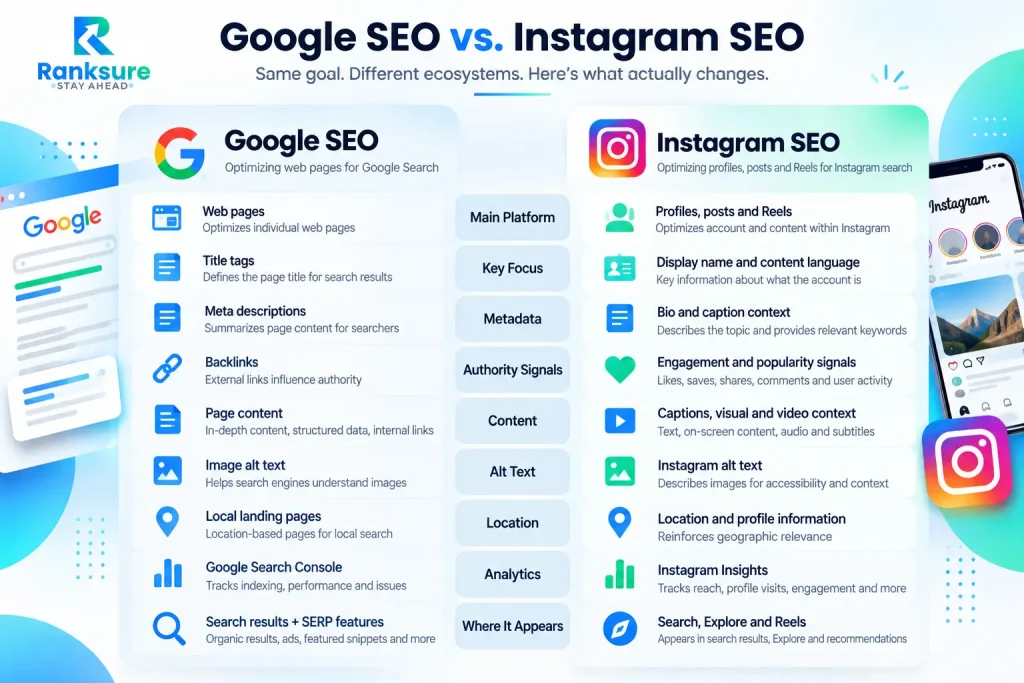
Building backlinks to an Instagram profile isn’t an Instagram search strategy. Neither is writing a “meta title” for a Reel.
Optimization needs to happen inside Instagram’s native information environment.
How Instagram Understands Keywords and Relevance
Instagram search isn’t an exact-match database. Imagine your account focuses on local SEO for small businesses. Across relevant content, Instagram might encounter terms such as:
- local SEO
- Google Business Profile
- Google Maps ranking
- local search
- citations
- map pack
- local keywords
- small business SEO
You don’t need every variation in every post. You need a coherent topical footprint. Exact matching can help clarify relevance. If a post is about Instagram SEO, using that phrase does make sense.
Context matters just as much.
Weak:
Instagram SEO Instagram SEO Instagram SEO.
Stronger:
Here’s how to optimize an Instagram bio for local SEO consultants, including the display name, service keywords, and location terms.
The second version connects several relevant concepts without stuffing the primary phrase.
A useful mental model is:
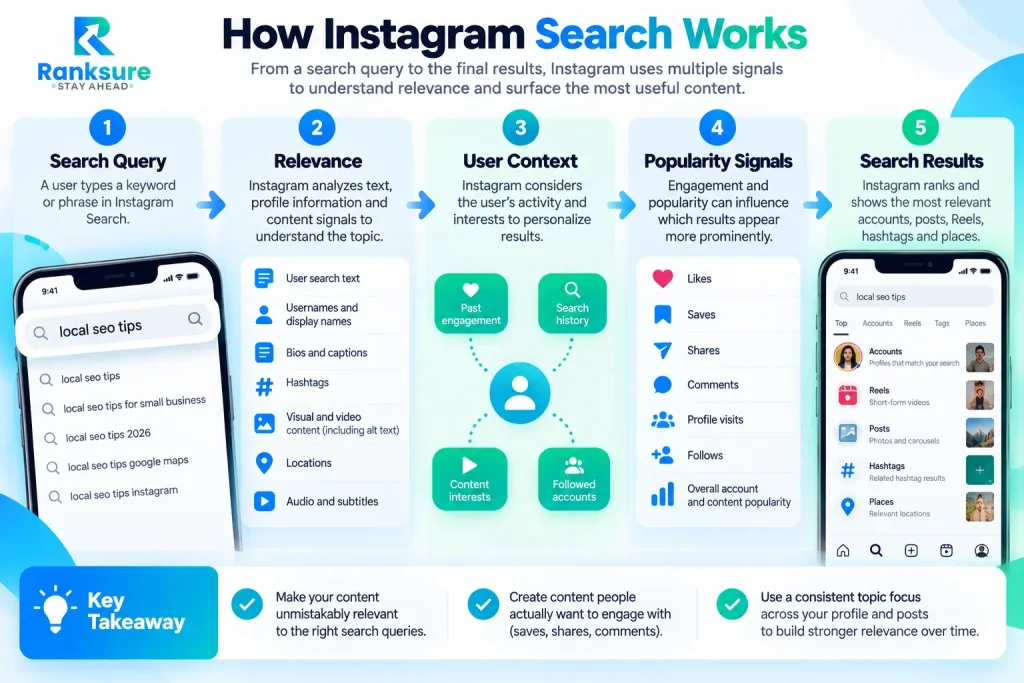
You therefore need to answer two questions:
What is this content about?
and
Is it useful enough for people to engage with?
Profile-Level Signals That Influence Instagram Search
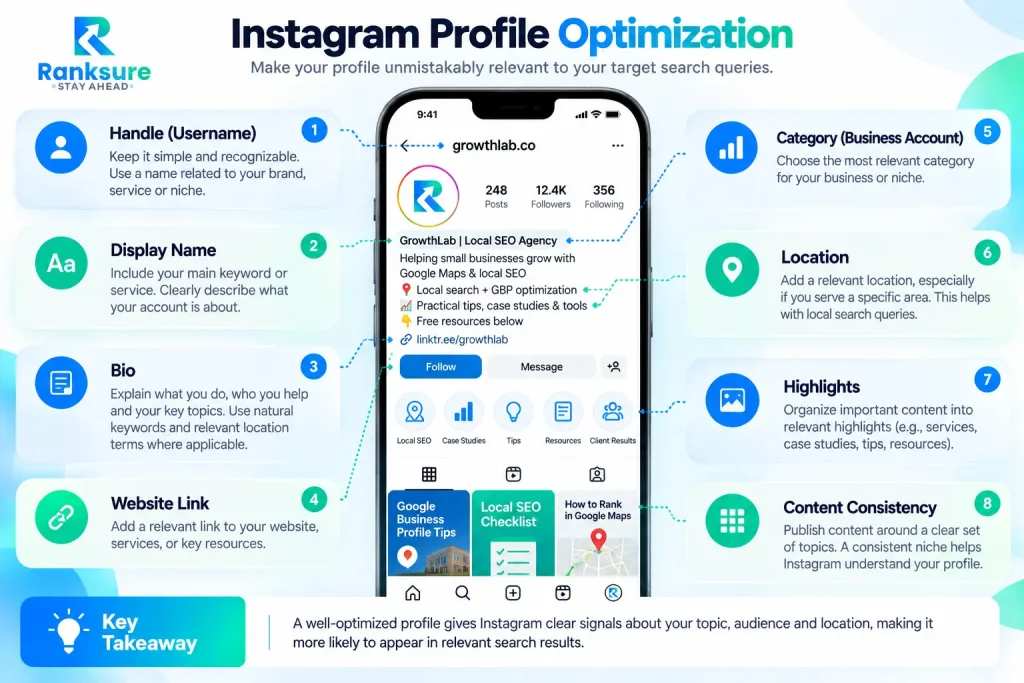
Your profile establishes account-level context. Before optimizing individual posts or hashtags, make sure both users and Instagram can quickly understand who you are, what you offer, and where you operate.
Display Name and Handle
Your handle identifies the account. Your display name gives you more room to communicate your niche, service, or location.
For example:
Handle:
@sarahchenphoto
Display name:
Sarah Chen | Toronto Wedding Photographer
For a business:
GrowthLab | Toronto Local SEO Agency
For a creator:
Ahmed | WordPress SEO Tips
Don’t turn the display name into a keyword dump. It should still read like a genuine brand or identity.
Optimize the Bio for Context
A useful bio quickly answers three questions:
- What do you do?
- Who do you help?
- What service, topic, or location should people associate with you?
A simple structure is:
[What you are] + [main topic/service] + [audience/location]
For example:
- Local SEO Consultant
- Helping Canadian small businesses improve Google Maps visibility
- Local search + GBP optimization
For a local business:
- Toronto Wedding Photographer
- Candid wedding photography & films
- Toronto + GTA
Clarity beats clever but vague branding. Your overall content should reinforce the same positioning; consistent subject matter creates a clearer topical footprint than an account jumping between unrelated themes.
How to Optimize Instagram Posts for Search
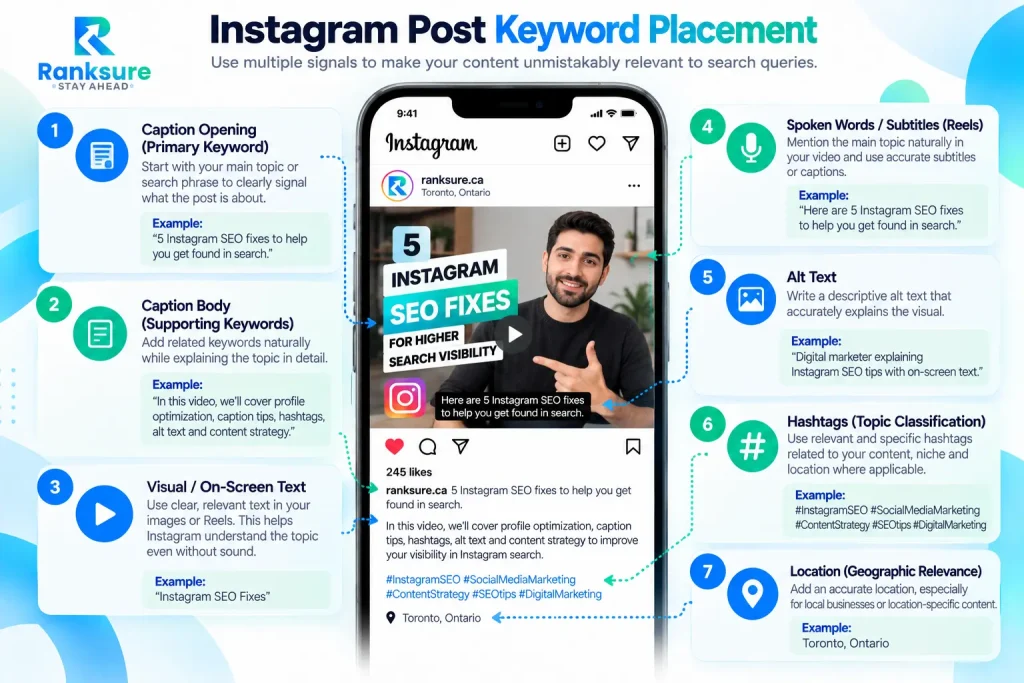
Once the profile establishes the broader topic, individual posts should reinforce it. Think about keyword placement, not keyword density.
Put the Topic Early in the Caption
Your opening line needs to capture attention while establishing the subject.
Weak:
You won’t believe what happened today…
Better:
Struggling to rank your Google Business Profile? Start with these five local SEO fixes.
The second immediately tells the reader what they’re getting.
A practical structure is:
Primary query → problem → answer → supporting concepts → action
Use the main phrase naturally. Don’t force multiple keyword variations into the caption just because they’re related.
Reinforce the Topic Inside Reels
Reels shouldn’t depend entirely on captions.
If your video is about Instagram bio optimization, an opening overlay could say:
3 Instagram Bio SEO Fixes
Then discuss the topic naturally in the video and use accurate subtitles or captions.
This reinforces the subject across multiple content signals while making the Reel easier to understand without sound.
Write Useful Alt Text
Alt text exists primarily for accessibility. Keep it that way.
Descriptive:
Graphic showing five steps for optimizing a Google Business Profile for local search.
Keyword stuffed:
Best local SEO Google Maps ranking SEO consultant local SEO.
The second treats alt text like a hidden keyword field instead of an accessibility feature.
A practical formula is:
Subject + action/context + relevant topic
Include a target phrase only when it genuinely describes what’s visible.
Use Accurate Location Context
Location matters when the content has genuine geographic intent.
A restaurant in Toronto shouldn’t tag Vancouver simply because Vancouver has a large potential audience. Use the actual location associated with the business or content.
Local businesses can also reinforce geographic relevance naturally through their profile, captions, hashtags, and other relevant content signals.
Instagram Hashtag Strategy: Relevance Over Volume
Hashtags work better as classification signals than as a pile of generic popularity terms. For a wedding photographer, compare:
Generic:
#wedding #love #photography #beautiful
Specific:
#TorontoWeddingPhotographer
#OntarioWeddingPhotographer
#TorontoWeddings
#CandidWeddingPhotography
The second group provides much clearer context about the service, niche, and location.
A useful framework is:
primary topic + niche + audience/location + specific content
For a Toronto dentist posting about teeth whitening, that could include:
#TeethWhitening
#TorontoDentist
#CosmeticDentistry
#DentalCareToronto
#TeethWhiteningTips
Don’t follow the formula mechanically. Relevance should always win.
Old hashtag lists deserve regular audits too. Remove tags that are irrelevant, restricted, spam-heavy, or no longer accurately describe the content.
How Engagement and Explore Affect Discovery
Keywords establish relevance. They don’t guarantee visibility. Instagram also considers user activity and popularity signals, meaning two people searching the same phrase may not receive identical results.
Don’t obsess over likes alone. For search-oriented content, watch signals such as:
- saves
- shares
- comments
- profile visits
- follows
- clicks
- non-follower reach
- Reel watch time or retention
A tutorial receiving 500 likes and 150 saves is strategically more useful than a photo receiving 1,500 likes but generating no profile visits.
Search and Explore Aren’t the Same
Search begins with an explicit query.
Someone types:
local SEO tips
That’s direct search intent.
Explore is recommendation-driven. Someone might see a local SEO Reel because they’ve already interacted with similar content.
Your content therefore needs two layers:
- Understandability: Make the subject obvious.
- Satisfaction: Give people a reason to watch, save, share, comment, or follow.
How to Find Instagram Keywords People Actually Use
Don’t start with a 5,000-row keyword spreadsheet. Start with audience language.
Use Instagram Search Suggestions
Type part of your topic into Instagram Search and examine the suggestions and related terminology shown within the platform.
These reveal how topics are phrased inside Instagram’s own search environment.
Mine Audience Language
Look at:
- comments
- DMs
- FAQs
- reviews
- customer questions
- competitor content
- your own analytics
If customers ask:
How do I rank my business on Google Maps?
Don’t rewrite it as:
Local search visibility enhancement.
Use the language people understand and search.
Use External Tools Carefully
Google Trends, Semrush, and social listening platforms help uncover topics and vocabulary. But Google search volume is not Instagram search volume.
Use external tools for topic discovery, then validate the terminology inside Instagram.
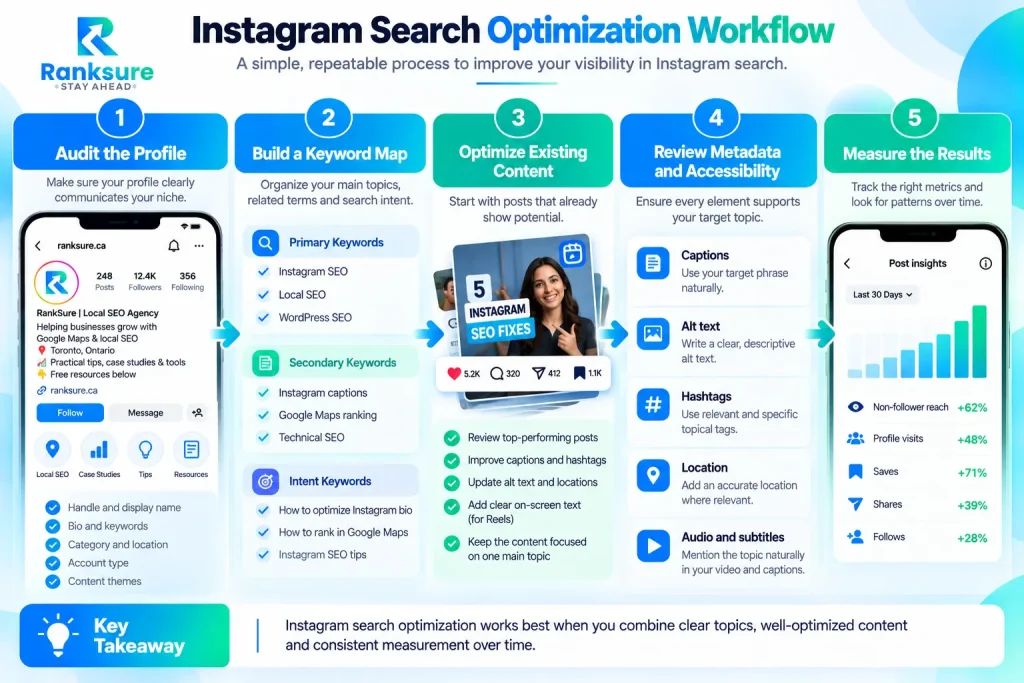
Step-by-Step Instagram Search Optimization Workflow
Randomly editing captions isn’t a strategy. Use a repeatable process.
Step 1: Audit the Profile
Review your:
- handle
- display name
- bio
- category
- location
- account type
- primary content themes
Ask:
Could a stranger understand this account’s niche in five seconds?
Step 2: Build a Small Keyword Map
Organize your topics into three groups:
| Primary | Secondary | Intent |
| Local SEO | Google Maps ranking | How to rank in Google Maps |
| Instagram SEO | Instagram captions | How to optimize Instagram captions |
| WordPress SEO | Technical SEO | How to fix WordPress SEO |
Primary queries define the main subject. Secondary terms expand its context. Intent queries reflect specific problems people want solved.
Step 3: Optimize Content That Already Shows Potential
Start with posts already generating:
- saves
- shares
- non-follower reach
- profile visits
- meaningful comments
Don’t delete everything and start again. Improve assets already showing signs of audience interest.
Step 4: Review Accessibility and Metadata
Check whether alt text describes each visual. Then review hashtags, locations, captions, subtitles, and audio. Every element should support the actual subject rather than being added purely for visibility.
Step 5: Measure the Results
Track performance over several posts and weeks rather than judging one Reel. The objective is to identify patterns, not celebrate or panic over isolated spikes.
How to Measure Instagram Search Optimization
“Check Instagram Insights” isn’t a good measurement strategy. You need to know what changed.
Track discovery-oriented metrics separately from ordinary follower engagement. Depending on the Insights available to your account, useful measures can include:
| Metric | What It Helps You Evaluate |
| Non-follower reach | Discovery outside your existing audience |
| Profile visits | Whether content creates account interest |
| Saves | Long-term usefulness |
| Shares | Content worth distributing |
| Follows | Audience conversion |
| Watch time/retention | Reel satisfaction |
| Discovery/search data | Search-oriented visibility where available |
Don’t attribute a reach increase to one keyword change. Compare several similar posts.
You can test related query variations. For example:
Group A: Instagram bio optimization
Group B: Instagram profile SEO
After several comparable posts, compare non-follower reach, saves, shares, profile visits, and follows. For educational content, simple ratios can add context:
Save rate = saves ÷ reach × 100
Share rate = shares ÷ reach × 100
One viral post proves very little. Patterns across multiple posts are far more useful.
Instagram SEO: Before and After
Consider a vague creator profile:
Before
Sarah | Creator
Helping you live your best life ✨
DM for collabs
It looks polished, but the subject is unclear.
After
Sarah | Home Workout Coach
Beginner strength workouts for busy women
Dumbbell workouts | Home fitness tips
Now the topical context is obvious. The same principle applies to captions.
Before:
New video is live! Let me know what you think ❤️
After:
3 Instagram SEO mistakes that can reduce your search visibility.
If you’re using broad hashtags, hiding your main topic deep inside the caption, or leaving your profile vague, start here…
Ambiguity was removed.
Common Instagram SEO Mistakes
| Mistake | Why It Fails | Better Approach |
| Using only popular hashtags | Popularity doesn’t guarantee relevance | Choose specific topical tags |
| Stuffing captions with keywords | Repetition doesn’t create stronger context | Use the phrase naturally and explain the topic |
| Treating alt text as a keyword field | Damages accessibility and readability | Describe the actual visual |
| Ignoring the profile | Posts lack strong account-level context | Clarify the display name, bio and niche |
| Copying Google SEO tactics | Instagram is a different search ecosystem | Optimize native Instagram signals |
| Relying only on posting frequency | Consistency alone doesn’t create relevance | Combine consistency with clear topics and useful content |
| Optimizing for algorithms instead of people | Search visibility has little value without satisfaction | Create content worth watching, saving and sharing |
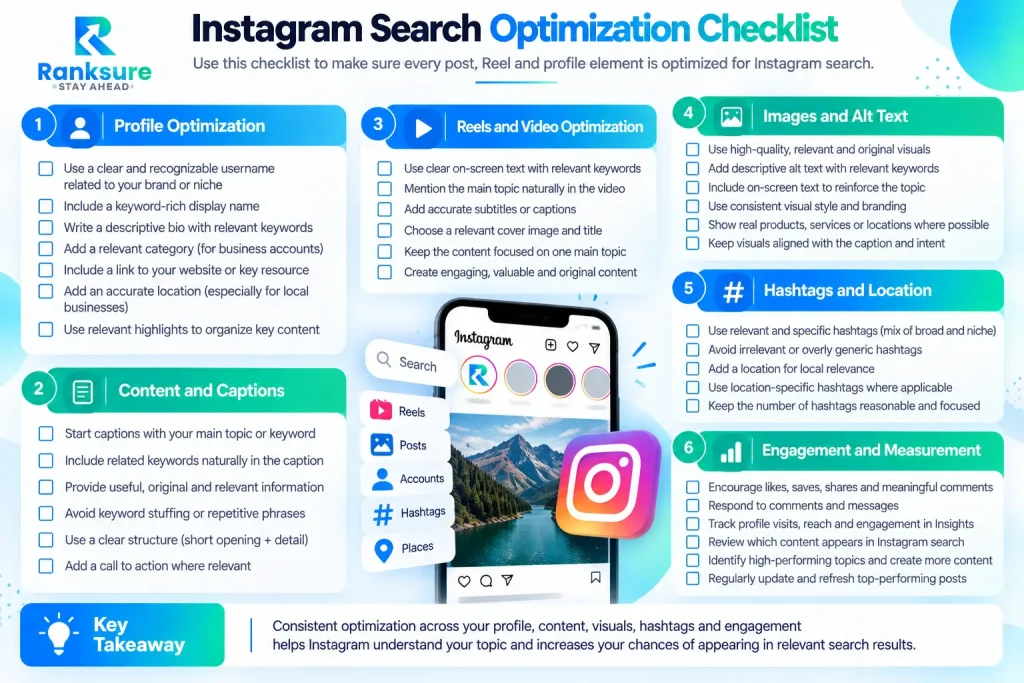
Practical Takeaway: Instagram Search Optimization Checklist
Conclusion: Build for the Query, Not Just the Feed
Instagram search optimization works best when clarity and usefulness align. The platform needs enough context to understand your content, while the person searching needs a reason to engage with it.
Treat optimization as an ongoing testing process rather than a one-time setup. Track how relevant content performs, identify patterns across multiple posts, and refine your approach as search behaviour and platform features evolve.
The goal isn’t to use more keywords. It’s to make the right content easier for the right audience to find.
Frequently Asked Questions
Can Instagram Captions Appear in Search Results?
Yes. Caption text can help Instagram understand what a post is about and its relevance to a search. Use clear topical language naturally rather than repeating the same phrase multiple times.
Should I Optimize Old Instagram Posts for Search?
It can be worthwhile, particularly for evergreen posts that already generate saves, shares, profile visits, or non-follower reach. Prioritize content with proven audience interest instead of updating every old post indiscriminately.
Can Instagram SEO Help Local Businesses?
Yes. Local businesses can strengthen geographic context through relevant location information, service terminology, profile details, captions, and location-specific content. A Toronto business, for example, should make its actual service area clear rather than targeting unrelated cities for additional exposure.
Can Reels Rank in Instagram Search?
Reels can appear in Instagram search and discovery surfaces. Make the subject clear through the content itself, including relevant spoken language, on-screen text, captions or subtitles, and supporting post information.
How Do I Know If My Instagram SEO Is Working?
Look for patterns across multiple posts rather than one ranking or viral result. Monitor available Instagram Insights data such as non-follower reach, profile visits, follows, saves, shares, and discovery information, then compare performance across content targeting similar topics.