
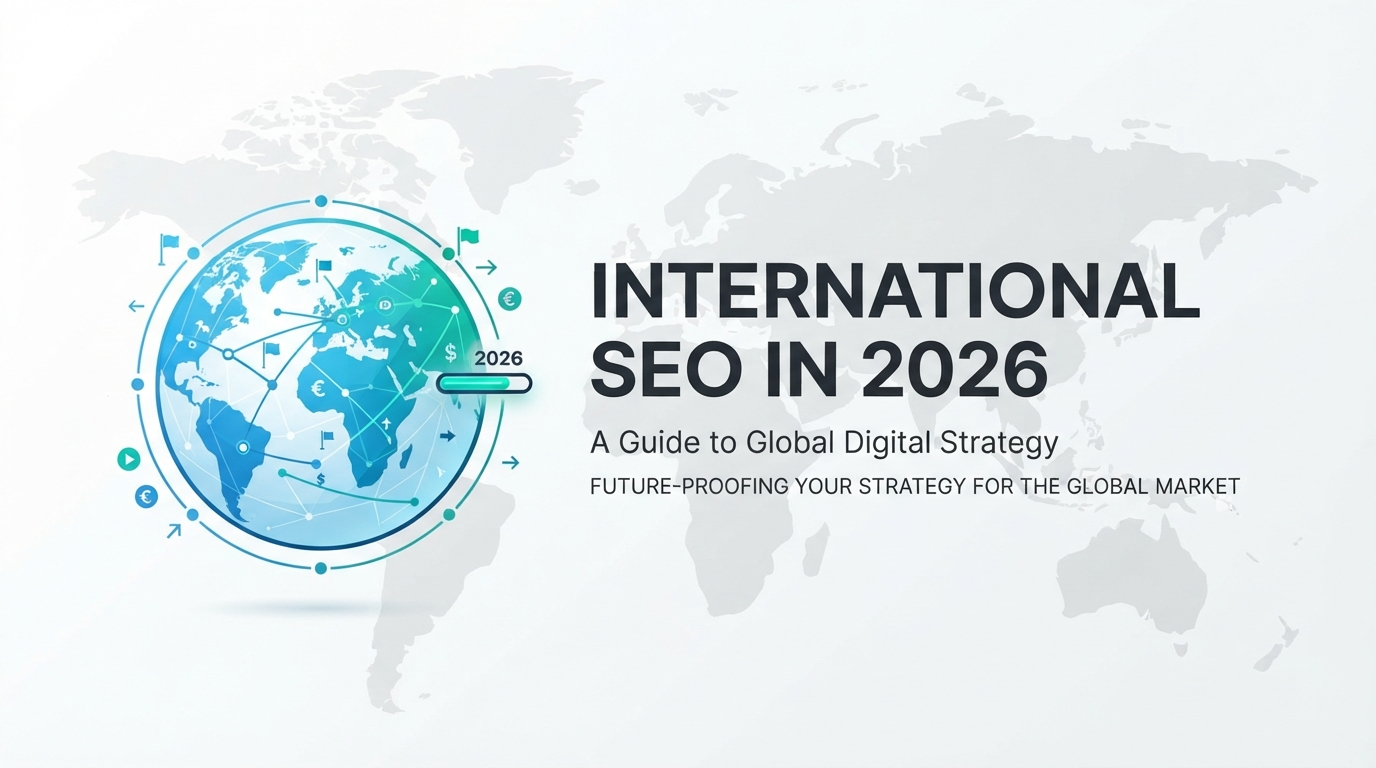
A website can rank first in one country and barely appear in another, even when the pages look almost identical. That is the problem international SEO is designed to solve.
But international SEO in 2026 is not “translate the site, add hreflang, and build a few local links.” Google evaluates language, location, local relevance, and search intent independently. AI-driven search experiences add another layer of international visibility that SEO teams need to monitor.
The challenge is not going global. It is making it clear that each version of your site is the right result for a specific audience.
What International SEO Means in 2026, and What’s Changed
International SEO is the process of optimizing a website so search engines can identify which countries, regions, and languages its pages are intended to serve.
That definition has not changed much. The environment around it has. Three developments in 2026 deserve attention.
First, Google launched dedicated Search Generative AI performance reports in Search Console in June 2026. The reports cover visibility in features such as AI Overviews and AI Mode and include a country dimension, allowing eligible site owners to see where their URLs appear geographically within generative search experiences. The reports were initially rolled out to a subset of websites.
For international SEO, that means country-level visibility is no longer limited to traditional blue-link impressions and clicks.
Second, Google published guidance in May 2026 on optimizing for generative AI search experiences. The message was notably familiar: Google emphasized unique, valuable content and existing SEO fundamentals rather than introducing a separate formula for “GEO” or “AEO.”
Third, Google clarified in March 2026 that Googlebot fetches only the first 2 MB of an individual HTML resource, excluding PDFs. Content, markup, or important link elements beyond that limit may not be fetched. Google recommends keeping HTML lightweight and placing critical elements near the top of the document.
For most websites, 2 MB of raw HTML is substantial. For large ecommerce platforms with extensive navigation, inline scripts, personalization logic, and international elements, however, it can become relevant.
There was also a notable Discover development in February 2026. Google said a Discover core update would show more locally relevant content from websites based in a user’s country, alongside more original and in-depth content. The initial release targeted English-language users in the US, with plans for wider expansion.
One distinction matters: this was a Discover update, not evidence that local websites automatically outrank foreign sites in normal Google Search. Treating it as a universal ranking rule would go beyond what Google stated.
Being globally available and being locally relevant are not the same thing.
How Does International SEO Actually Work?
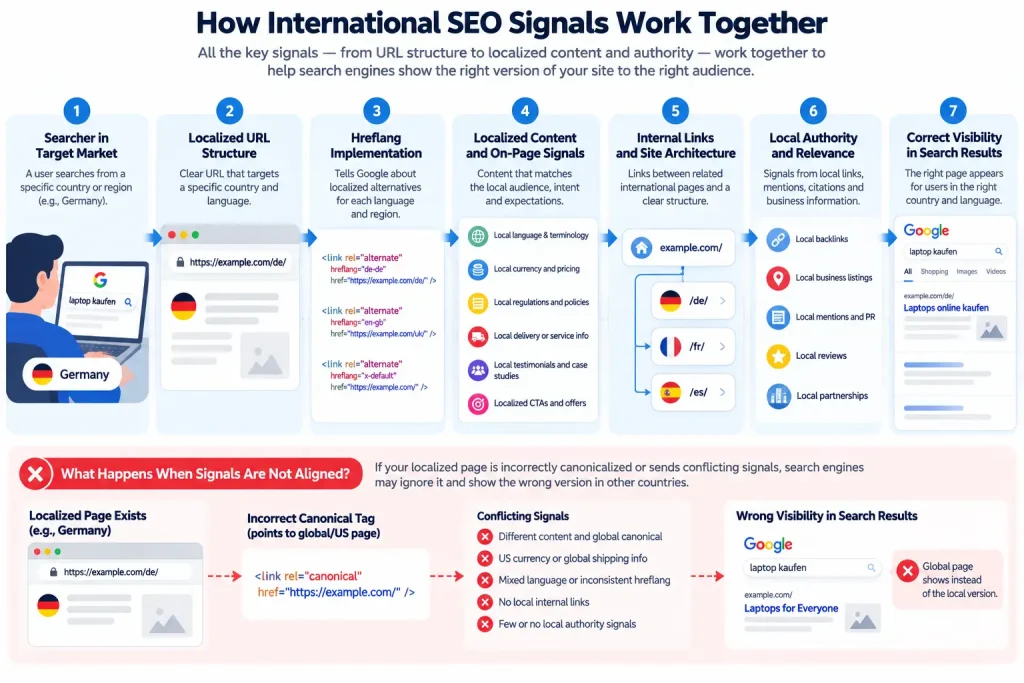
When Google encounters an international website, it needs to determine several things.
What language is the page written in? Which geographic audience is it intended for? Is another URL a localized equivalent? Which version should appear for a searcher in London, Toronto, Sydney, Berlin, or Dubai?
Your job is to reduce that ambiguity.
Multilingual SEO vs Multi-Regional SEO
A Canadian website serving English- and French-speaking audiences is a straightforward example of multilingual SEO, particularly when its pages target different regional search needs.
A multi-regional website targets different geographic markets. Many international websites are both multilingual and multi-regional. That distinction affects everything from keyword research to hreflang implementation.
For example, en-gb and en-us are not different translations of English. They identify regional versions that may use different terminology, pricing, search behavior, and conversion expectations.
How Google Determines Which Country and Language Version to Rank
Google says it determines a page’s language from its visible content. It does not rely on the HTML lang attribute or hreflang to determine what language a page is written in. Hreflang helps Google understand relationships between localized alternatives; it is not a substitute for creating content in the target language.
Geographic signals include URL structure, hreflang configuration, localized content, business information, internal architecture, and other indications that a page serves a particular market.
Think of international SEO as signal alignment.
When your URL indicates Germany, hreflang indicates Germany, prices use euros, delivery information covers Germany, examples make sense to German customers, and relevant German websites link to the page, Google has less ambiguity to resolve.
Start With Markets, Not Translation
One of the most expensive international SEO mistakes happens before a single hreflang tag is written. A company sees traffic from ten countries and decides it needs ten localized websites. It probably doesn’t.
Search demand, commercial potential, competition, localization cost, fulfilment capability, and existing brand awareness should influence where you expand. A country producing 4% of your current traffic is a stronger SEO opportunity than one producing 10% if it has stronger transactional demand and weaker competition.
One Language Doesn’t Mean One Search Market
US English, British English, Australian English, and Canadian English are understandable. Search behavior, however, differs.
A US user searches for “vacation rentals,” while a UK audience uses “holiday rentals.” Someone looking for athletic footwear in one market searches for “sneakers,” while another audience may use “trainers.”
The differences matter even more in regulated industries like finance, healthcare, education, property, ecommerce, and B2B services. That is why international keyword research shouldn’t start with an English keyword list and a translation tool.
Begin with the market. Then research its language and search behavior.
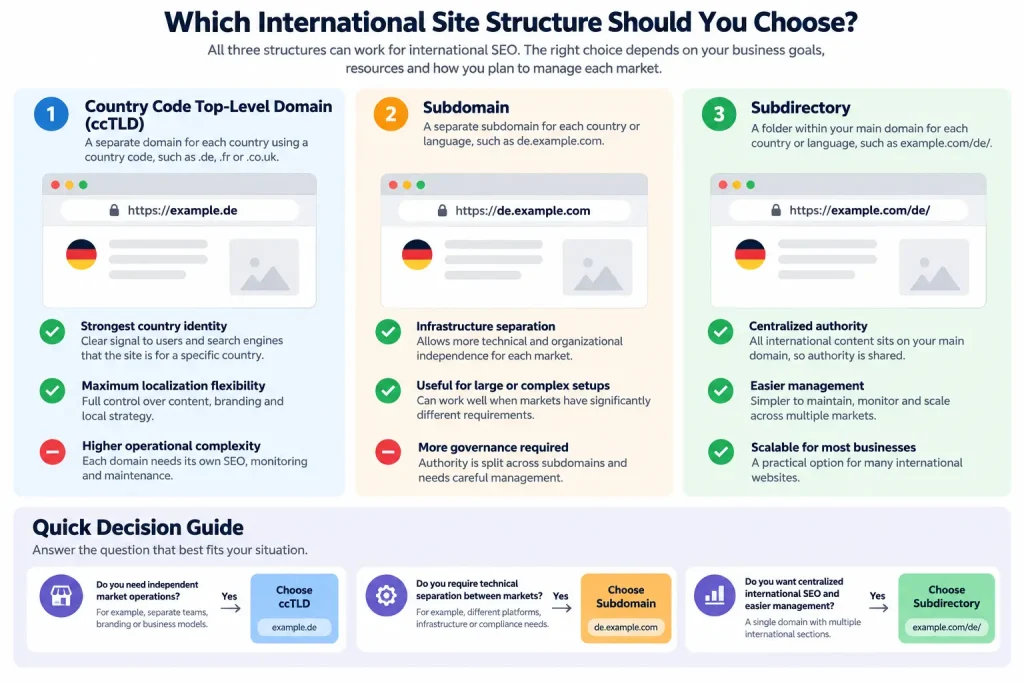
ccTLD vs Subdomain vs Subdirectory: Which International SEO Structure Is Best?
There is no superior international URL structure. There is, however, a more practical structure for a particular business.
When a ccTLD Makes Sense
A country-code top-level domain such as .de, .fr, or .co.uk provides a strong geographic signal to users. It makes sense when each market operates almost like an independent business, with separate inventory, teams, pricing, legal requirements, branding, marketing, and link acquisition.
The trade-off is operational.
Instead of maintaining one web property, you are managing several. Technical fixes, migrations, analytics, content governance, digital PR, and authority building can become fragmented.
When International Subdomains Make Sense
Subdomains such as fr.example.com work well. They are useful when infrastructure or organizational requirements demand separation between regions. But subdomains should not be chosen because someone claims Google “prefers” them for international SEO. That is not a sound basis for the decision.
Choose them when your technology or business structure benefits.
Why Subdirectories Are the Practical Choice
For many companies, structures such as example.com/uk/, example.com/de/, and example.com/fr/ are a practical starting point. Content remains under a single root domain, implementation can be centralized, and the SEO team has fewer properties to manage.
That does not mean every link benefits every international directory equally. It means the international operation is less fragmented. For a mid-sized SaaS company expanding from the US into three new countries, subdirectories are often worth considering first unless there is a strong business or technical reason to choose another structure.
Hreflang Tag Implementation: How to Get It Right
Hreflang is simple in concept and messy in implementation. It tells Google that multiple URLs represent localized versions of equivalent content. A basic setup could look like this:
- <link rel=”alternate” hreflang=”en-ca”
- href=”https://example.com/ca/software/” />
- <link rel=”alternate” hreflang=”en-us”
- href=”https://example.com/us/software/” />
- <link rel=”alternate” hreflang=”en-gb”
- href=”https://example.com/uk/software/” />
- <link rel=”alternate” hreflang=”fr-ca”
- href=”https://example.com/ca/fr/software/” />
- <link rel=”alternate” hreflang=”x-default”
- href=”https://example.com/software/” />
Google supports hreflang through HTML, HTTP headers, or XML sitemaps and treats the methods as equivalent. Using all three does not provide an automatic SEO advantage and can make maintenance harder.
Self-Referencing and Return Hreflang Tags
Each localized page should include itself in its hreflang set. Alternate pages should reference each other appropriately. If two pages do not point to each other, Google will ignore the relationship.
For example:
example.com/us/crm/ references example.com/uk/crm/.
But the UK page does not reference the US page. The relationship is incomplete.
This is why large hreflang implementations break after migrations, discontinued products, or regional CMS changes.
When to Use x-default
x-default is useful when you have a fallback page that is not targeted to one language-region combination. That could be a global selector, international homepage, or default product page.
Do not treat x-default as the “most important” version. It is the fallback.
Hreflang and Canonical Tags: The Combination That Causes Problems
Here is a common failure. A company launches:
- example.com/us/product/
- example.com/uk/product/
- example.com/de/produkt/
Then every international page uses a canonical pointing to the US URL. The site is sending conflicting signals:
- “Hreflang says these are legitimate localized alternatives.”
- “Canonical says the US page is the preferred version.”
Google’s canonical guidance indicates that pages using hreflang should specify a canonical in the same language where possible. Self-referencing canonicals are the cleaner configuration for genuine localized pages that you want indexed independently.
Do not canonicalize international pages back to your original market because the products are similar.
Are Geo-Targeting Settings Still Relevant for International SEO?
This is one area where international SEO guides are outdated. Google deprecated Search Console’s International Targeting report and removed the ability to target search results toward a particular country through that setting. Google says country targeting through Search Console is no longer supported, while hreflang remains supported.
So if an international SEO guide tells you to open Search Console and select a target country, check when it was written.
What Should You Use Instead?
Google’s current documentation points site owners toward locale-specific URLs and hreflang or sitemap annotations for page-level international targeting.
The broader strategy should reinforce those technical signals with genuine localization.
A /fr-fr/ folder containing US prices, US delivery information, mechanically translated copy, and testimonials from American customers does not become a convincing French experience simply because the hreflang value says fr-fr.
Technical targeting gets Google to the right version. Local relevance helps that version compete.
How to Build a Multilingual Content Strategy That Can Rank
Translation converts words. Localization adapts meaning. That distinction should shape your multilingual content strategy.
A strong international content workflow asks whether search intent, examples, terminology, proof points, product availability, currency, measurements, legal context, and calls to action make sense in the target market.
Translation vs Localization
Suppose a US cybersecurity company has an article ranking for:
“HIPAA compliance checklist.”
Translating it into German does not create a meaningful German search asset. The underlying regulation, terminology, audience needs, and competing results may be completely different.
The better approach could be creating an entirely different page targeting a German compliance topic rather than translating the US article.
That is an important distinction. Not every successful domestic URL deserves an international equivalent.
Should You Use AI Translation for SEO Content in 2026?
AI makes translation workflows faster. Google’s 2026 generative AI guidance continues to emphasize useful, unique content rather than introducing a separate ranking formula for AI-generated pages.
Use AI to accelerate first drafts, terminology mapping, metadata variations, and repetitive localization tasks where appropriate. Then apply local editorial judgment. For priority pages, native-market review remains valuable because the risk is not limited to awkward phrasing. Search intent itself can be translated incorrectly.
International Keyword Research: Don’t Translate Your Keyword List
A translated keyword is not a searched keyword. That is one of the simplest rules in international SEO, and one of the easiest to ignore. Start each market with local SERPs and local keyword data.
Look at which page types rank. Is Google favoring guides, category pages, product pages, comparison pages, directories, or local businesses? Then investigate vocabulary.
Two phrases mean almost the same thing linguistically while producing different SERPs because users employ them at different stages of the buying journey.
This is where local SEO knowledge matters more than translation quality.
Map Keywords to International URLs Before Publishing
Each market should have a keyword-to-URL map. Without one, localized teams can publish several pages targeting nearly identical topics. Over time, you can create cannibalization within individual markets as well as confusion between regional versions.
The map does not need to be complicated.
For each priority URL, define the primary market, language, main query family, search intent, equivalent URLs in other locales, canonical, and hreflang relationship. That document becomes valuable several months later.
International Link Building: Build Authority Market by Market
International link building is treated as collecting backlinks with the correct country-domain extension. That is too simplistic.
A .de link is not valuable because it is German. A highly relevant industry publication on a generic domain may be far more useful. What matters is whether the link comes from a relevant, credible source and strengthens your presence with the audience you are trying to reach.
Local links still have strategic value because they create market-level relevance, referral traffic, brand visibility, and relationships that a purely global link strategy misses. Think local trade publications, universities, professional organizations, journalists, suppliers, partners, research projects, events, associations, and genuinely useful local resources.
Do not simply clone the US digital PR calendar and translate the press release. A story journalists care about in New York may get nowhere in Munich.
Technical International SEO: Crawling, Indexing, Canonicals, and Internal Links
International SEO becomes hard as the number of URLs grows. Ten thousand pages across six locales do not feel like a 60,000-URL operation, until something breaks.
Use Separate URLs for Different Language Versions
Google recommends separate URLs for each language version rather than relying on cookies or browser settings to change content. Google also warns that automatic language redirects prevent users and search engines from reaching every version.
Give users a visible language or country selector. Do not trap them in the version your IP detection thinks they should use.
Keep Critical International Signals Crawlable
The March 2026 Googlebot clarification gives technical teams reason to keep international templates lean.
Googlebot currently fetches up to 2 MB of an individual HTML resource. Google warns that massive inline CSS, JavaScript, base64 content, or oversized menus push meaningful content or important elements beyond that point.
Most websites will never reach the limit. Large international ecommerce templates are likely to come close because country selectors, personalization logic, tracking scripts, navigation systems, and other elements can accumulate.
Keep important metadata and link elements where they belong. Keep the <head> clean. Do not bury essential signals in unnecessary markup.
Internal Linking Matters More Than People Give It Credit For
Your German pages should be discoverable through the German site experience. Your French category pages should link naturally to French products and guides. A country selector is not a replacement for coherent internal architecture.
When each localized site behaves like a real website rather than a collection of translated URLs connected through hreflang, crawling and usability both become easier.
International SEO Example: A Canadian SaaS Company Expands Into the UK, Germany, and France
Consider a hypothetical CRM company with strong Canadian rankings. Its original site uses:
example.com/ca/crm/
The company plans three new markets. Instead of purchasing three domains immediately, it chooses:
- example.com/uk/crm/
- example.com/de/crm/
- example.com/fr/crm/
The UK team discovers that search terminology differs despite the shared language, so it adapts titles, copy, pricing information, customer stories, and comparison content rather than copying the Canadian page.
Germany begins with German keyword research. Some US content is localized; other topics are discarded because they do not match German search demand. France follows the same process.
Each indexable localized page uses a self-referencing canonical. Equivalent pages are connected using hreflang. A global page provides the x-default fallback. The company then earns market-specific authority through local software publications, partner integrations, regional research, and customer case studies.
That is an international SEO strategy. Simply sending the original page through a translator would have been a translation project.
How to Measure International SEO Performance in 2026
Stop looking only at total organic traffic. An international program grows while an important market quietly loses visibility. Segment performance by country, directory or hostname, language, page type, and conversion outcome.
Pay particular attention to cases where the wrong regional URL receives impressions.
If your US page consistently appears for UK searches while the UK version barely surfaces, investigate hreflang relationships, canonicalization, internal links, content differentiation, crawlability, and whether the UK page actually provides a distinct local experience.
AI Search Adds Another Country-Level View
Google’s June 2026 Search Generative AI reports make this more interesting. For sites with access, the reports provide visibility into impressions, pages, countries, devices for Search, and date-based performance for appearances within Google’s generative AI features.
For international teams, this creates another useful question:
Your German pages may rank conventionally, but are they also appearing when Google generates AI-powered answers for German users?
Those visibility patterns may not always move together.
International SEO Mistakes That Quietly Kill Growth
Most international SEO failures are not dramatic. They are small inconsistencies repeated across thousands of URLs.
| Common mistake | What it looks like |
| Expanding too quickly | Launching six country sites when there are only enough resources to localize two properly. |
| Translating instead of researching | Translating keywords directly instead of researching how people actually search in each market. |
| Creating duplicate regional pages | Country pages use the same products, pricing, offers, and commercial details with little meaningful localization. |
| Misusing canonicals | Regional pages point their canonical tags back to the home market. |
| Letting hreflang decay | Hreflang references remain active after products or regional URLs are removed or changed. |
| Building links only to the home market | International backlinks continue pointing primarily to the US homepage instead of relevant regional pages. |
The underlying pattern is simple: companies often invest heavily in creating regional URLs while changing very little about what is actually on those URLs.
Google does not need another URL simply wearing a country code. Users do not either.
Practical Takeaway: International SEO Launch Checklist
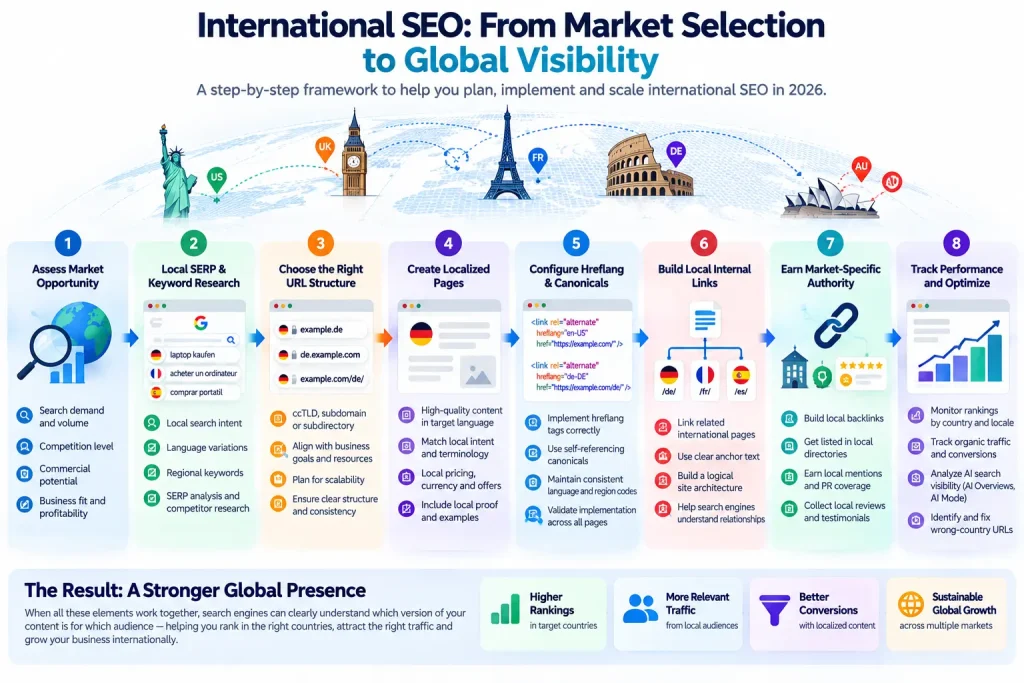
Before launching another country or language version, check the fundamentals:
- Confirm that local search demand and commercial opportunity justify the market.
- Perform native-market keyword and SERP research instead of translating your domestic keyword list.
- Choose a scalable structure, ccTLD, subdomain, or subdirectory, based on business needs, not SEO folklore.
- Give each language or regional version its own crawlable URL.
- Implement hreflang consistently, including self-references and reciprocal relationships.
- Use x-default where a genuine global fallback exists.
- Use self-referencing canonicals for localized pages unless there is a legitimate reason not to.
- Localize terminology, examples, offers, proof points, and calls to action.
- Make country and language switching available through crawlable links.
- Avoid forced redirects that prevent users or crawlers from accessing alternative versions.
- Check HTML size and ensure critical SEO elements are not buried in bloated templates.
- Build relevant authority within priority markets instead of sending every backlink to the global homepage.
- Track rankings, impressions, conversions, and wrong-country URLs by market.
- Where available, review country visibility in Search Console’s generative AI reports.
International SEO Is Less About Going Global Than Becoming Local at Scale
International SEO is not about making every market look identical. It is about creating a technically consistent website that still feels genuinely relevant to each audience.
Get the architecture and hreflang right, but go further with local keyword research, meaningful localization, relevant content, and market-specific authority.
The goal is simple: don’t just translate your site. Make it useful to the people you’re trying to reach.
Frequently Asked Questions About International SEO
How should international SEO handle currencies and pricing?
Localized pages should display the appropriate currency, pricing, taxes, shipping costs, and payment information for the target market where applicable.
Can I target a country where I do not have a physical office?
Yes. A physical office is not always necessary, but the website should clearly communicate where products or services are available and avoid creating pages for markets you do not genuinely serve.
Should countries that speak the same language have separate pages?
Not always. Separate regional pages are useful when countries differ in terminology, pricing, products, regulations, or search behavior. Otherwise, one well-localized version may be sufficient.
What should I do with an international page for a discontinued market?
If the market is permanently unsupported, remove or redirect the page to a relevant alternative when one exists. Avoid leaving obsolete localized pages indexed without a clear purpose.
Can a small website benefit from international SEO?
Yes, but expansion should be focused. Targeting a small number of well-researched markets is generally easier to maintain than creating many thin localized versions.