
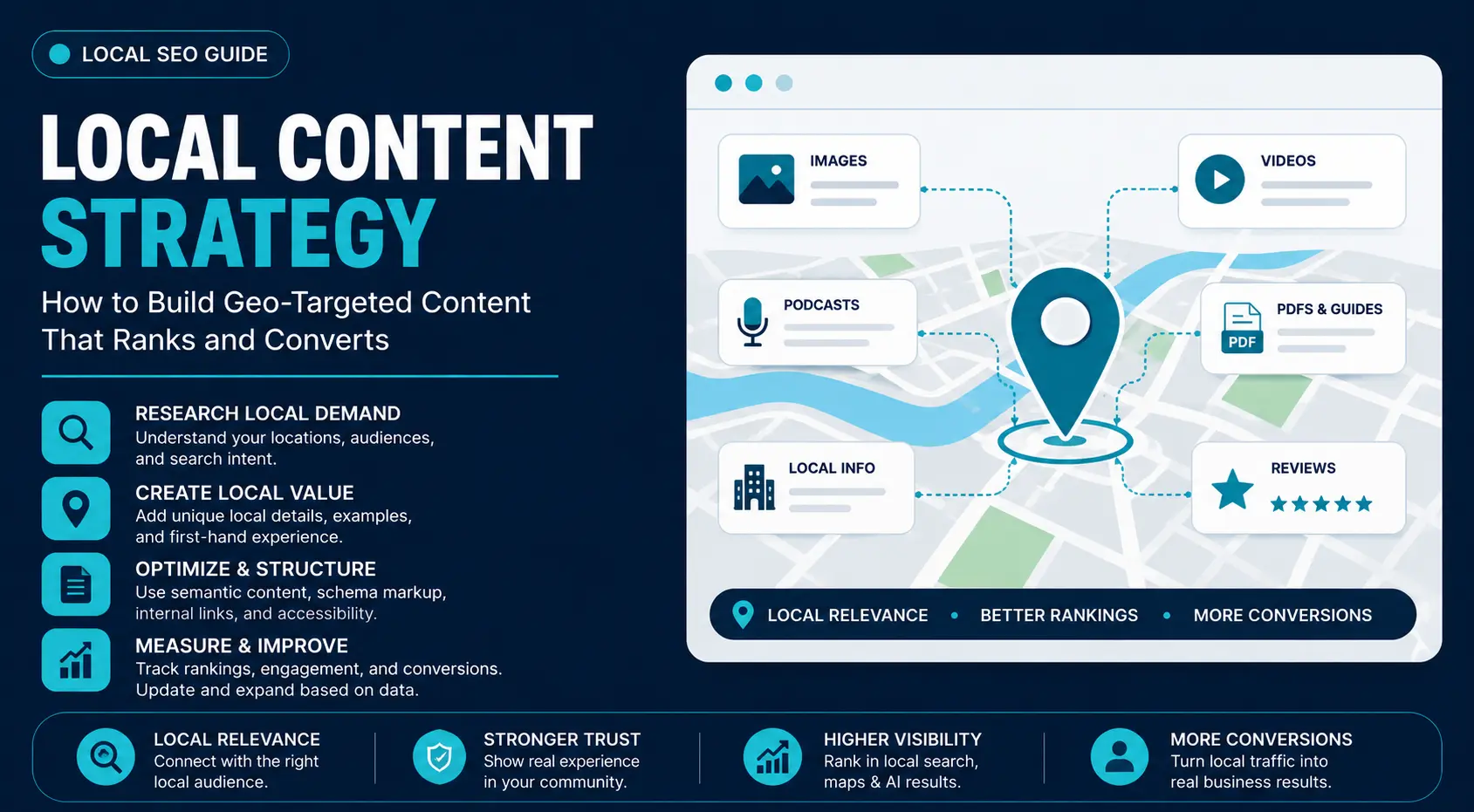
Generic content brings traffic without bringing customers from the areas the business serves. City-name stuffing and duplicate location pages create the appearance of local relevance but do not add genuine value.
A strong local content strategy resolves this issue by aligning services, locations, audience needs, and search intent with useful geographic information. This results in content that earns local visibility and gives local customers a clear reason to take action.
What Is a Local Content Strategy?
A local content strategy is a system for researching, creating, organizing, and optimizing content around specific locations, audiences, services, and local search intent. Its goal is to capture local search demand while turning relevant visitors into calls, bookings, leads, or visits.
Local Content Strategy vs. General Content Strategy and Local SEO
Local content strategy is the content component of local search marketing. It differs from both general content marketing and broader Local SEO.
What makes content local
Content is local when the location changes the information, not just the wording. This includes:
- Local customer needs and problems
- Neighborhood or regional differences
- Service availability and coverage
- Local terminology
- Regulations or conditions
- Relevant landmarks, organizations, and institutions
- Local examples, case studies, and customer experiences
- Location-specific proof
Replacing one city name with another does not mean the content is localized. A useful local page explains information that matters specifically to customers in that area.
How it differs from general content marketing
General content follows:
Topic → Audience → Content → Business goal
Local content adds geographic context:
Service → Location → Audience → Search intent → Content → Business goal
How it differs from broader Local SEO
- Local SEO includes the wider optimization system: Google Business Profile, reviews, citations, local links, on-page signals, technical factors, and geographic relevance.
- Local content strategy focuses on the content and information layer within that system.
Why location names alone are not enough
City-name substitutions and near-identical location pages provide little additional value. Each local page should have a distinct reason to exist based on its location, audience, service, search intent, or local evidence.
The Core Local Content Relationship
Every local content asset should connect:
- Business/service: What the business offers.
- Location: Where it operates or serves customers.
- Local audience: Who needs the service.
- Search intent: What they want to know, compare, solve, or buy.
- Content type: The format that best satisfies the intent.
- Business objective: The action the content should drive.
This prevents businesses from creating pages simply because a location keyword exists.
What a Local Content Strategy Should Achieve
A strong strategy should improve:
- Local visibility for relevant geographic searches.
- Geographic relevance through useful local context.
- Local trust and authority through evidence and experience.
- Qualified traffic from customers within the service area.
- Business conversions such as leads, calls, bookings, and visits.
Research Local Demand Before Creating Content
Local content planning starts with real market demand and service coverage, not a list of cities to target.
Identify the Locations and Audiences You Actually Serve
Map the business’s actual geographic footprint:
- Cities
- Neighborhoods
- Districts
- Service areas
- Individual branches
- Local customer segments
- Location-specific needs and problems
A service-area business might be serving several municipalities without a physical location in each one. A multi-location business may have different staff, services, inventory, events, or customer needs at each branch. The geographic structure reflects the business, not an arbitrary SEO taxonomy.
Research Local Search Intent and Keywords
Local keyword research identifies what people want to accomplish in a specific location, not which location terms have search volume.
Research:
- Service + location queries: “family dentist in Vaughan”
- Location-based informational queries: “best neighborhoods for [specific need].”
- Implicit local intent: “dentist near me”
- Informational, commercial, and transactional intent
- People Also Ask and related searches
- Questions from reviews, customer conversations, forums, and support interactions
Search volume should not be the only prioritization metric. A lower-volume query from a tightly matched service area is more valuable than a high-volume query from people the business cannot serve.
Identify Local Entities and Context
A city name provides basic geographic context. Relevant local entities strengthen the relationship between the topic, place, and local audience.
Research:
- Neighborhoods
- Landmarks
- Organizations and institutions
- Local events
- Regional terminology
- Local conditions and regulations
- Transportation patterns
- Other geographic entities relevant to the topic
Use entities to clarify the local subject or customer problem.
For example, a local plumber needs to address housing characteristics, municipal requirements, infrastructure issues, or service conditions that affect customers in that area.
Find Competitor and Content Gaps
Analyze competing local pages to identify information they failed to provide:
- Missing service-location combinations
- Weak location pages
- Unanswered local questions
- Missing local resources
- Generic content without local evidence
- Underserved local topics
- Missing first-hand proof
- Weak connections between informational and commercial content
A content gap is the missing information gain.
Build the Local Content Architecture
Local content scaling is hard when every page is planned separately. A clear architecture is needed to connect services, locations, audiences, search intent, and conversion paths.
Map Services, Locations, and Search Intent to Content
Use this planning sequence:
Service → Location → Audience Need → Search Intent → Content → Conversion Goal
For example:
HVAC repair → Mississauga → homeowners with heating problems → transactional → Mississauga HVAC repair page → service inquiry
The content format needs to match the intent. An informational query requires a local guide, while a branch-specific query requires a location page.
Build Local Topic Clusters
A local content cluster includes:
- Local pillar content: Broad regional resources establishing topical and geographic context.
- Service content: Pages covering individual services in depth.
- Location content: Pages for genuine branches or locations.
- Service + location content: High-intent pages targeting a specific service in a specific area.
- Supporting informational content: Local guides addressing early-stage questions.
- Local FAQ/problem content: Focused answers to recurring customer concerns.
- Community/resource content: Useful local resources or activities relevant to the business.
Each cluster is for a clear user or business need. Publishing unrelated local articles won’t create topical authority.
Structure Multi-Location and Service-Area Content
Choose page types as per the business’s actual geographic relationships:
- Location pages: Describe a real branch, office, store, or operating location.
- City and neighborhood pages: Target meaningful local demand where the business genuinely serves the area.
- Service-area pages: Explain coverage for businesses serving customers across a defined territory.
- Service + location pages: Target a specific service within a specific geographic market.
Create a dedicated location page when there is local demand, service relevance, unique information, and conversion value. Do not create just because another city has a different name.
Connect Related Local Content
Internal links reflect the real geographic and topical relationships of the site:
- Service pages → relevant location pages
- Location pages → supporting local resources
- Informational pages → relevant commercial pages
- Regional pages → relevant neighborhood pages
- Neighborhood pages → broader regional or service hubs
- Local guides → relevant conversion pages
Use contextual anchor text to explain the relationship. Internal linking helps users move from local information to relevant services or from geographic context to a specific local option.
Create Content With Genuine Local Value
Local content provides information that changes because of the location, not just repeat the generic information with geographic modifiers.
Choose the Content Type Based on Local Intent
Match the format to the search need:
- Location pages: Business-location searches
- Service + location pages: High-intent local service searches
- Local guides: Regional informational searches
- Local FAQs: Recurring customer questions
- Case studies: Local proof of results
- Local research/data: Original geographic information
- Community content: Relevant local activities, events, and partnerships
Add Information That Is Specific to the Location
Include information such as:
- Local problems and customer needs
- Neighborhood-specific details
- Local examples
- Regional terminology
- Relevant regulations or conditions
- Genuine service-area information
- Useful local resources
Incorporate First-Hand Local Experience
Use evidence that reflects real local experience:
- Customer experiences and case studies
- Interviews and original observations
- Local photos or video
- Proprietary local data
- Community participation
- Relevant first-party business data
Customer service insights, project records, appointment patterns, inventory, and local event data add authentic context when used.
Use Local Entities to Add Context
Use relevant entities to explain the local context or customer need:
- Landmarks and neighborhoods
- Organizations and institutions
- Events
- Regional businesses or partners
- Other relevant geographic entities
Avoid keyword stuffing.
Optimize Local Content Without Creating Thin or Duplicate Pages
A local content page needs strong, distinct local value to justify its existence; otherwise, it is difficult to scale.
Make Location Pages Meaningfully Different
Differentiate pages through:
- Location-specific services
- Distinct customer needs
- Unique local examples
- Relevant local entities
- Local FAQs
- Location-specific proof
- Appropriate conversion paths
For example, a downtown branch needs information about accessibility, parking, transit, or branch-specific services, while a suburban service area requires different coverage or travel information. Differences should be factual and useful.
Prevent Duplicate Content and Cannibalization
Avoid:
- City-name substitutions
- Near-identical mass-produced pages
- Overlapping service pages targeting the same intent
- Multiple URLs competing for the same geographic query
- Pages without meaningful standalone value
Duplicate local pages are primarily a content quality and site architecture problem
Audit pages targeting the same service, location, and intent. Consolidate URLs when they provide no distinct value. Keep them separate when the audience need, service, or geographic relationship is actually different.
Optimize the Page for Local Intent
Use:
- Accurate titles and headings
- Relevant metadata
- Natural geographic modifiers
- Appropriate local terminology
- Contextual internal links
- Original images or media
- Clear conversion elements
Describe images in alt text and avoid adding city names only for SEO. Localized structured data reinforces accurate business and geographic information, but it should support the page’s actual content.
Strengthen Trust and Evidence
Support local claims with:
- First-hand experience
- Customer proof, reviews, and testimonials
- Local case studies
- Local credentials
- Author or business expertise
- Real team information
- Original local media
Local expertise should be demonstrated. Show who performed the work, what was observed, which local problem was addressed, and what evidence supports the claim.
How to Extend and Amplify Local Content
Local business activity generates, distributes, and strengthens the website content through relevant external channels.
Use Google Business Profile to Distribute Relevant Content
Google Business Profile supports local content through:
- Services
- Posts and updates
- Photos
- Q&A
- Links to relevant website content where appropriate
The website and Business Profile should present consistent information about the business, services, locations, and customer experience.
Turn Local Activities Into Content
Real-world activity provides local material or activity as the evidence that generic competitors cannot replicate.
Turn relevant activities such as these into content:
- Community events
- Partnerships and sponsorships
- Interviews
- Customer projects
- Local developments
- Community involvement
A business sponsoring a neighborhood event can document the activity, interview participants, and create a useful local story around it.
Create Content Worth Earning Local Mentions and Links
Create useful assets locally that relevant organizations and publications have a reason to reference:
- Original local research and statistics
- Community resources
- Useful local guides
- Newsworthy projects
- Collaborations with local publications and organizations
How to Implement and Manage a Local Content Strategy
A local content strategy needs a defined workflow for prioritization, production, publication, and maintenance.
Prioritize Content Opportunities
Evaluate opportunities using:
Local relevance × search intent × business value × competition × content gap
Prioritize pages that serve a real local market, match meaningful search demand, support business goals, address a competitive gap, and offer an opportunity to provide better information than existing results.
Build the Local Content Calendar
Track:
- Location
- Service or topic
- Search intent
- Content type
- Primary keyword
- Supporting entities
- Conversion goal
- Internal links
- Publication or update date
For multi-location businesses, also track content ownership and approval status so local information is verified before publication.
Create, Publish, and Maintain Content
Use a repeatable workflow:
- Research local information and verify geographic facts.
- Create original content that matches the search intent.
- Add local evidence such as examples, experiences, data, or media.
- Optimize the page for search and usability.
- Publish supporting assets when they add distribution or proof.
- Connect relevant GBP activity to the content.
- Update outdated information as services, regulations, locations, or local conditions change.
- Expand or consolidate pages based on performance and demand.
Programmatic generation supports large location sets. The templates should provide structure for the content.
Measure and Evaluate Local Content Performance
Local content’s quality after creation is measured by visibility, engagement, and business outcomes, not traffic. Compare performance by location, service, search intent, and content type to understand what is working.
Measure Local Search Visibility
Track:
- Local keyword rankings
- Organic impressions and clicks
- Local Pack visibility
- Google Search Console performance
- Relevant Google Business Profile interactions
Use Google Search Console to compare impressions, clicks, queries, and pages, filtering where possible by location-related queries.
Track local rankings separately for target markets rather than relying on a single national position. Monitor Local Pack visibility and Business Profile interactions alongside organic performance.
The visibility is to be evaluated against the intended service area and search intent so as to determine if a page gaining impressions is not attracting users from the wrong geographic market.
Measure Engagement and Conversions
Track business actions such as:
- Calls
- Form submissions
- Bookings
- Qualified leads
- Website actions
- Direction requests
- Store or location visits where measurable
Connect these actions to individual landing pages, locations, and campaigns through analytics, conversion tracking, call tracking, booking systems, or CRM data. Compare conversion rates and lead quality rather than judging content by traffic volume alone.
An informational page do generate direct leads and still support the customer journey. Measure it according to its intended role rather than expecting every page to convert.
Evaluate Performance by Location, Service, and Intent
Segment performance to identify:
- Best-performing locations
- Best-performing services
- Highest-converting content
- Underperforming topics
- Emerging local demand
- Content gaps revealed by performance data
Compare traffic → engagement → conversion across locations and content types. A location receiving more impressions but few conversions indicates weak intent alignment, insufficient local value, or a poor conversion path.
Use these findings to decide what to create, improve, expand, update, or consolidate..
Diagnose and Fix Local Content Problems
Audit local content for quality, duplication, intent alignment, and freshness. Diagnose the underlying problem before creating or rewriting more pages.
| Problem | What to check | How to fix it |
| Thin or generic location content | City-name substitutions, little local information, weak original evidence | Add local context, customer needs, service details, first-hand evidence, relevant entities, and local proof. Remove the page if it cannot be meaningfully differentiated. |
| Duplicate or cannibalizing pages | Similar locations, overlapping services, competing intent, same page purpose | Compare service, location, audience, and intent. Consolidate pages with essentially the same purpose instead of forcing superficial differences. |
| Traffic without business results | Wrong intent, weak service alignment, poor conversion path, audience-offer mismatch | Align the page with the intended audience, search intent, service, and next action. Informational pages may support discovery without direct conversions. |
| Outdated or misaligned content | Changed local information, services, locations, customer needs, or competitors | Update, expand, reposition, or consolidate pages when their information or purpose no longer matches current demand. |
Local content requires ongoing diagnosis because visibility does not indicate quality, relevance, or business value.
Local Content Strategy Examples
The same local content framework changes depending on the business model, geographic footprint, and conversion goal.
| Business model | Example | Locations & intent | Content architecture | Content types | Conversion goal |
| Service-area business | HVAC company | Several cities within a service territory; “HVAC repair [city],” emergency repair, replacement research | Regional hub → city/service pages → local HVAC guides → case studies | Service pages, local guides, project stories, FAQs | Calls and service requests |
| Multi-location business | Healthcare organization | Multiple clinics; service, provider, location, and appointment searches | Organization hub → service hubs → location pages → provider/service resources | Location pages, service pages, FAQs, provider information, patient resources | Appointments and calls |
| Local professional practice | Law firm | Several markets; practice-area + location searches and local legal questions | Practice-area hub → location/service pages → legal guides → case-related resources | Service pages, local legal guides, FAQs, case studies where appropriate | Consultation requests |
The architecture should be based on the real differences between locations. An HVAC page may need local service coverage and customer problems; a healthcare location may differ by providers, services, accessibility, and hours; a law page may require jurisdiction-specific information.
The key principle is consistent: Business → Location → Search Intent → Content Architecture → Content Type → Conversion Goal.
Key Takeaways
- Connect service, location, audience, and search intent when planning local content.
- Provide genuine geographic value instead of adding city names to generic content.
- Build architecture around real service-location relationships and search intent.
- Create location pages only when they offer distinct local value.
- Use first-hand experience, local evidence, and relevant entities to strengthen local relevance and trust.
- Use GBP, community activity, mentions, and links to amplify content, not replace it.
- Continuously measure and refine local content by updating, expanding, consolidating, or creating pages based on performance and demand.
FAQS
How do I scale local content across hundreds of locations?
Use a shared framework, but add verified local data, services, customer needs, proof, and location-specific information to each page.
What local content strategy tools should I use?
Use Google Search Console, Google Business Profile, keyword research tools, Google Trends, analytics, and crawling tools to research, monitor, and audit local content.
How much does a local content strategy cost?
Cost depends on the number of locations, content volume, research depth, and whether production is handled internally, by freelancers, or by an agency.
How do I measure the ROI of local content beyond rankings?
Track qualified leads, calls, bookings, quote requests, direction requests, and revenue alongside organic traffic and local visibility.
Does local schema markup help local content rank?
Schema helps search engines understand local entities and relationships, but it does not guarantee rankings and cannot replace genuinely useful local content.