
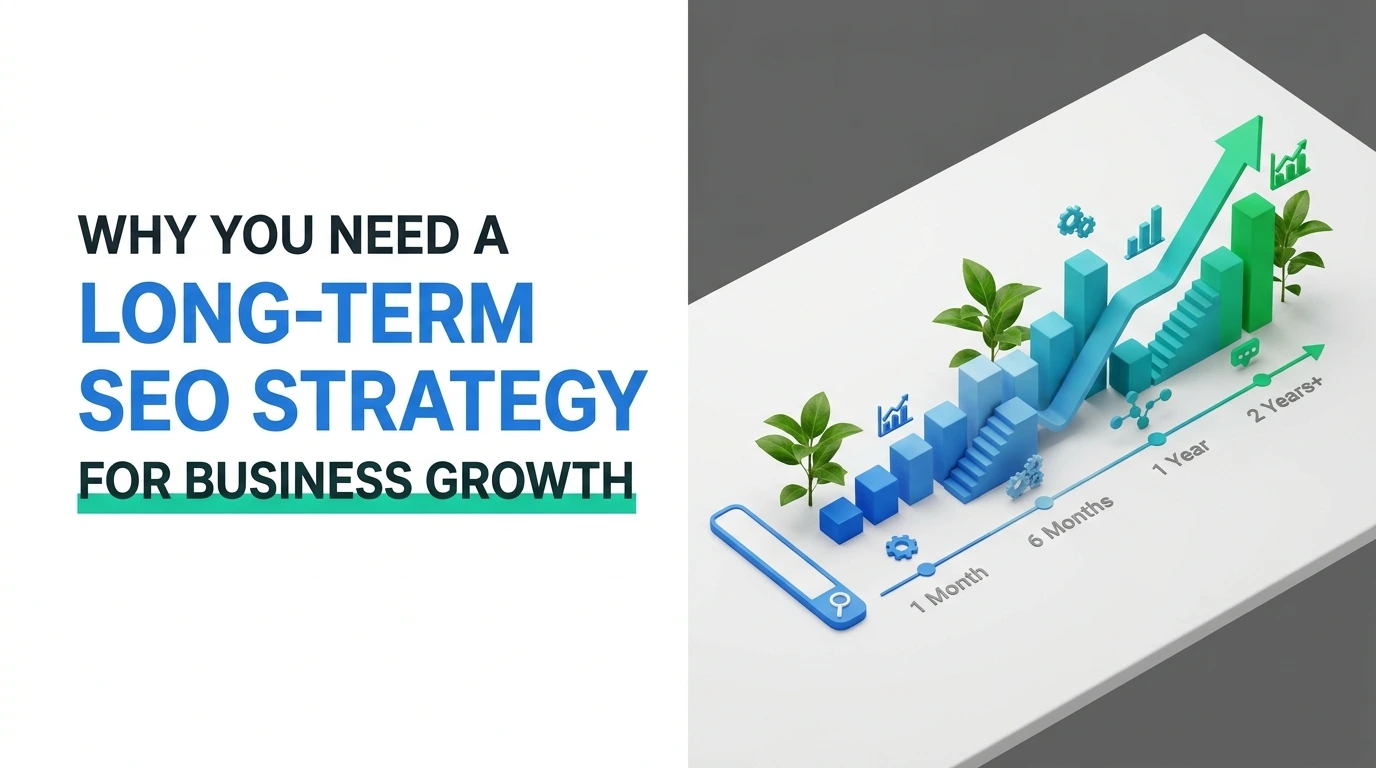
A long-term SEO strategy turns organic search into a sustainable customer acquisition channel. It connects technical SEO, search demand, useful content, internal linking, credibility, conversion, and measurement to clear business goals.
The aim is not simply to rank for more keywords. It is to attract relevant searchers, convert them into leads or customers, and improve performance as competitors, search behavior, and search systems change.
SEO requires sustained work because organic visibility develops through technical accessibility, content quality, market relevance, and continuous improvement.
What Is a Long-Term SEO Strategy?
A long-term SEO strategy is a coordinated plan for improving organic visibility and business results over time.
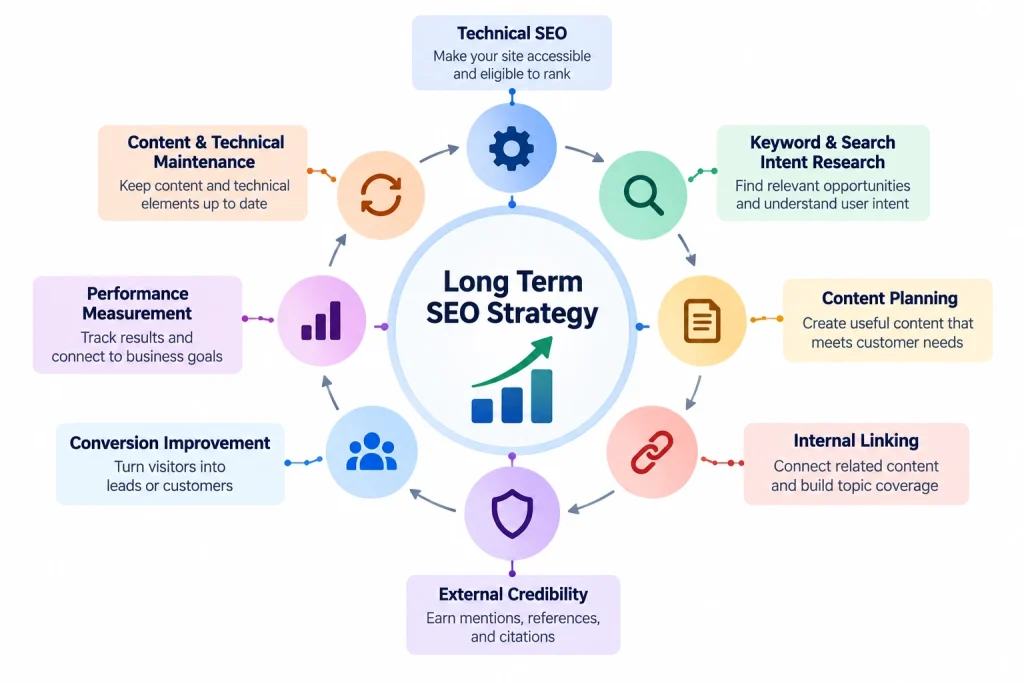
Long-term SEO does not mean waiting passively for results. It means improving the website now while building assets that can continue producing value.
How Is Long-Term SEO Different From One-Time SEO?
| Aspect | One-Time SEO | Long Term SEO |
| Purpose | Fixes specific SEO problems | Supports continuous organic growth |
| Typical work | Indexing fixes, title updates, redirects, page optimization | Ongoing content improvement, technical monitoring, internal linking, and strategic updates |
| Time frame | Limited project | Continuous process |
| Response to change | Addresses current issues | Adapts to competitors, search demand, content decay, and technical changes |
| Main outcome | Solves immediate problems | Determines what the business should improve next |
An SEO audit identifies what needs attention now. A long-term SEO strategy provides the ongoing framework for improving performance after those immediate issues are resolved.
Why Is SEO a Long-Term Investment?
SEO is a long-term investment because search performance depends on several changing factors.
Search engines must discover and process pages. Businesses must create useful content. Competitors continue improving. Search intent changes. Ranking systems and search features evolve. This makes SEO an ongoing process rather than a single marketing fix.
Search Engines Need Time to Process Content
A page normally needs to be discovered, crawled, and processed before it can appear in search results. Google Search Central explains that crawling, indexing, and serving are separate processes.
An XML sitemap can help search engines discover pages, but it does not guarantee indexing or rankings. Technical accessibility makes a page eligible to compete. It does not guarantee visibility.
Useful Topic Coverage Takes Time to Build
Strong organic visibility usually comes from connected coverage of important customer needs. A software company may need product pages, use case pages, comparisons, implementation guides, and educational resources.
Internal links connect these pages. Useful resources may also earn editorial references, brand mentions, or citations from other websites. Over time, this creates a stronger content portfolio.
Competition and Search Behavior Keep Changing
A page can lose visibility even when nothing on the page changes. Competitors may publish better resources. Customer expectations may shift. Google may change how results are ranked or displayed.
A long-term strategy allows the business to respond instead of relying on past performance.
What Are the Long-Term Benefits of SEO?
Long-term SEO supports sustainable visibility, qualified acquisition, stronger brand recognition, and lower dependence on a single marketing channel.
| Benefit | What It Means | Business Value |
| Broader organic visibility | A business can appear across product searches, comparisons, integrations, use cases, implementation questions, and related customer problems | Creates more discovery opportunities and reduces dependence on one keyword |
| Content assets that continue creating value | Product pages, guides, templates, calculators, research, and evergreen resources can keep attracting relevant visitors after publication | Extends the value of content investments over time |
| More qualified leads | SEO can attract visitors with stronger relevance and purchase intent rather than focusing on traffic volume alone | Supports demo requests, sales opportunities, customers, and contribution profit |
| Stronger brand recognition | Repeated visibility across educational, comparison, and commercial searches increases familiarity | Supports both customer acquisition and brand discovery |
| Less dependence on paid traffic | Organic assets can continue generating visibility without paying for every visit | Improves channel diversification and reduces excessive reliance on paid media |
Content still requires maintenance. Evergreen resources remain valuable only while they stay accurate, useful, relevant, and competitive.
SEO performance is measured through qualified leads, sales opportunities, customers, conversion rates, acquisition costs, and contribution profit rather than traffic alone.
Does SEO Create Compounding Returns?
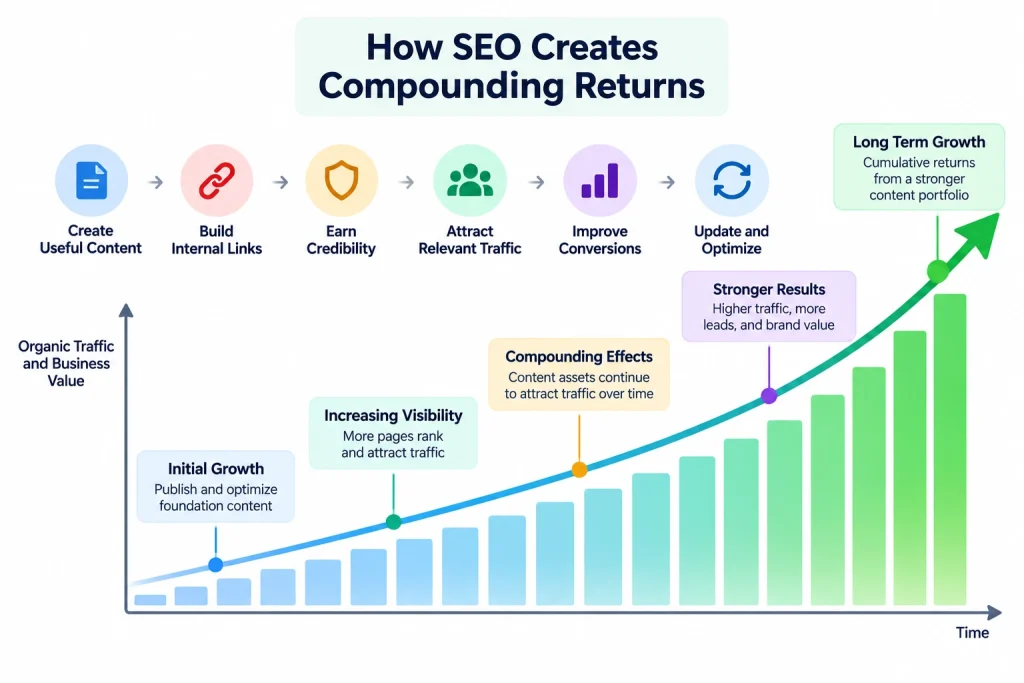
SEO creates cumulative returns, but compounding is not automatic.
- Existing content can support new content.
- Internal links can strengthen relationships between pages.
- Useful resources can attract editorial mentions.
- Performance data can improve future decisions.
These effects make later SEO investments more productive.
SEO Compounding Conditions
| Area | Supports growth | Creates risk |
| Content | Accurate, useful, differentiated | Outdated or generic |
| Topic coverage | Connected customer-focused content | Random publishing |
| Internal links | Relevant pages support each other | Important pages remain isolated |
| Technical health | Pages remain accessible | Technical debt grows |
| Search demand | Customer interest stays strong | Demand declines |
| Competition | Continuous improvement | Competitors improve faster |
| Maintenance | Regular review and updates | Content decay continues |
SEO compounds only while the conditions supporting performance remain strong.
Long-Term SEO vs Short-Term SEO vs PPC
Each approach serves a different purpose.
| Approach | Main purpose | Speed | Sustainability |
| Short-term SEO | Capture immediate opportunities | Faster | Limited without continued work |
| Long-term SEO | Build organic acquisition | Gradual | Stronger with maintenance |
| PPC | Buy immediate search visibility | Fast | Depends on continued spending |
- Short-term SEO fixes obvious issues and improves existing opportunities.
- Long-term SEO creates a system for continuous improvement.
- PPC can capture immediate demand while SEO assets are still developing.
Many businesses benefit from using both SEO and PPC. Paid campaigns can provide fast demand and conversion data.
What Makes a Long-Term SEO Strategy Sustainable?
A sustainable strategy combines several connected activities.
Technical SEO
Priority pages must be accessible, indexable, and logically organized. Technical SEO should focus on issues that affect discovery, user experience, and important business pages.
Search Intent and Topical Mapping
Keyword research should connect search demand to customer needs and business relevance. Search volume alone does not make a keyword valuable.
Topic mapping helps organize related content around products, problems, industries, comparisons, and use cases.
Helpful Content
Useful content should follow a simple lifecycle:
- Create accurate and relevant content.
- Measure its performance.
- Improve pages with potential.
- Consolidate or remove content that no longer serves a purpose.
Publishing more content is not automatically better.
Internal Links and External Credibility
Internal links connect related pages and help users navigate the website.
External credibility can come from useful research, expert contributions, legitimate editorial references, industry partnerships, and strong resources. Manipulative backlinks are not a sustainable substitute for genuine credibility.
Measurement and Maintenance
- Google Search Console can show organic queries, impressions, clicks, pages, and indexing information.
- GA4 can measure website activity and conversions.
- CRM data can show which leads become customers.
Together, these systems help businesses measure organic acquisition rather than rankings alone.
How to Build a Long-Term SEO Strategy
A practical strategy should follow a clear sequence.
Step 1: Define Business Goals
Start with outcomes such as leads, purchases, demos, subscriptions, or revenue. Rankings should support these goals rather than replace them.
Step 2: Audit Current Performance
Review technical health, organic visibility, conversions, important landing pages, internal links, and existing content. Identify what should be improved before creating more pages.
Step 3: Analyze Search Demand
Study customer searches, competitors, search intent, topic gaps, and opportunities for differentiation. Focus on topics that support real customer and business needs.
Step 4: Prioritize Opportunities
Evaluate opportunities using:
- Business relevance
- Potential impact
- Required effort
- Competition
- Dependencies
- Available resources
Step 5: Execute
Fix important technical issues.
- Improve valuable existing pages.
- Create new content where real gaps exist.
- Strengthen internal links.
- Improve conversion paths.
Step 6: Measure and Reprioritize
Review what gains visibility, traffic, leads, and customers. Invest more where evidence supports growth. Refresh, consolidate, or reduce investment where performance remains weak.
A Practical 12 Month SEO Roadmap
A 12 month roadmap helps businesses organize work without treating the timeline as a ranking guarantee.
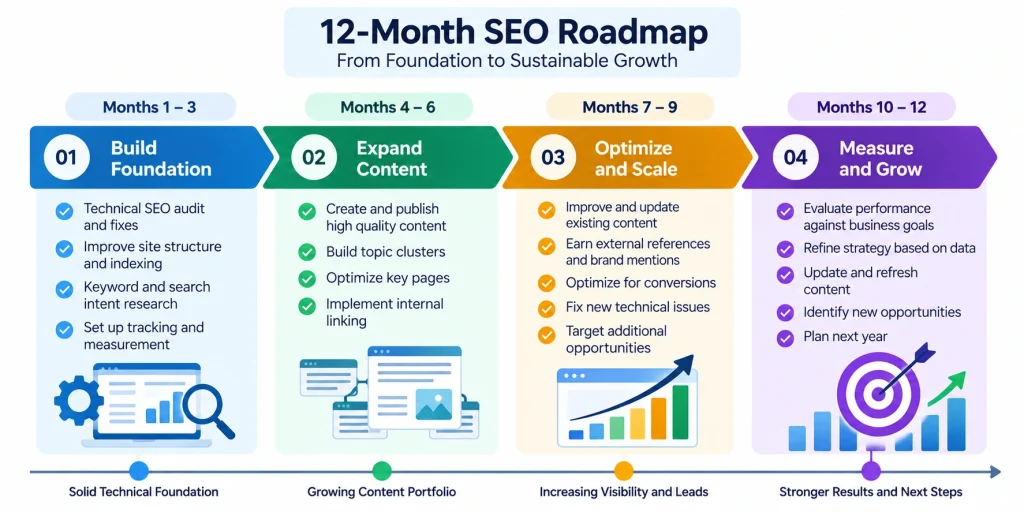
| Period | Main focus | Key outcome |
| Months 1 to 3 | Audit, research, tracking, technical fixes | Strong foundation and clear priorities |
| Months 4 to 6 | Content improvements and topic expansion | Better coverage of important customer needs |
| Months 7 to 9 | Optimization, credibility, conversion | Stronger visibility and lead quality |
| Months 10 to 12 | ROI review and planning | Better resource allocation for the next cycle |
How Long Does SEO Take to Show Results?
There is no universal SEO timeline. Results depend on:
- Website maturity
- Competition
- Search demand
- Technical condition
- Content quality
- Available resources
- Implementation speed
Businesses should separate early progress from final business outcomes. Relevant impressions, indexed priority pages, broader query coverage, and qualified clicks can appear before significant lead or revenue growth.
How to Measure SEO ROI
SEO ROI measures whether organic acquisition creates enough business value to justify its cost. Include real costs such as:
- Personnel
- Agency support
- Content
- SEO tools
- Development
- Design
- Research
- Credibility initiatives
Leading vs Lagging SEO KPIs
- Leading indicators show whether the strategy is progressing.
- Lagging indicators show whether that progress creates commercial value.
| Leading indicators | Lagging indicators |
| Technical health | Qualified leads |
| Indexed priority pages | Sales opportunities |
| Relevant impressions | Customers |
| Query coverage | Attributed contribution profit |
| Organic clicks | Customer acquisition cost |
| Landing page activity | SEO ROI |
Example SEO ROI Calculation
Assume a B2B software company spends $120,000 annually on SEO. It generates:
- 300 qualified organic leads
- 30 customers
- $6,000 average contribution profit per customer
- $180,000 total attributable contribution profit
SEO cost per lead equals $120,000 divided by 300. SEO cost per lead equals $400. Net contribution equals $180,000 minus $120,000.
Net contribution equals $60,000. SEO ROI equals $60,000 divided by $120,000, multiplied by 100.
SEO ROI equals 50 percent.
Revenue should not be treated as profit. Contribution profit provides a more useful measure of economic value.
What Happens If a Business Stops Investing in SEO?
Stopping SEO does not remove existing rankings or traffic. Strong pages may continue performing while they remain accurate, relevant, competitive, and technically accessible. Performance can decline over time because of:
- Content decay
- Competitor improvements
- Changing search intent
- Technical problems
- Declining search demand
- Website changes
SEO maintenance protects existing organic assets as well as supporting future growth.
Common Long-Term SEO Mistakes
| Mistake | Better approach |
| Expecting guaranteed rankings | Use realistic scenarios and business KPIs |
| Targeting traffic without relevance | Prioritize qualified demand |
| Publishing disconnected content | Build coherent topic coverage |
| Ignoring existing pages | Refresh and consolidate valuable assets |
| Ignoring technical maintenance | Monitor important website changes |
| Using manipulative backlinks | Build legitimate editorial credibility |
| Measuring traffic only | Track leads, customers, and profit |
| Depending only on SEO | Maintain a diversified marketing mix |
Frequently Asked Questions
Is Long-Term SEO Worth the Investment?
It can be when relevant search demand exists, and the business can convert that demand profitably. The decision should consider competition, website condition, customer economics, resources, and business goals.
How Much Should a Small Business Budget for SEO?
The budget should reflect the work required. Consider costs for technical work, content, tools, internal staff, specialist support, design, development, and credibility building.
Scope should determine budget rather than choosing an arbitrary monthly amount.
Can Small Businesses Compete With Established Websites?
Yes.
Small businesses can focus on specialized customer problems, local relevance, niche services, industries, detailed use cases, and searches where they can provide stronger expertise. Focused relevance is often more practical than copying the full keyword portfolio of a large competitor.
How Often Should You Review Your SEO Strategy?
Monitor important performance data monthly and conduct deeper strategic reviews quarterly. Websites with technical or content changes require regular monitoring.
Does AI Search Change the Value of SEO?
AI search changes how information appears, but it does not remove the need for foundational SEO.
Google Search Central states that established SEO practices remain relevant to AI Overviews and AI Mode. Useful content, technical accessibility, clear site structure, credibility, and measurement remain important for search visibility.
Conclusion
A long-term SEO strategy builds sustainable organic acquisition through technical health, relevant content, internal linking, credibility, conversion, and measurement. The strongest strategies do not chase rankings in isolation.
They connect organic visibility to qualified leads, customers, profitability, and business growth. SEO also requires continued maintenance because competitors improve, content ages, search behavior changes, and websites develop technical problems.
A practical starting point is a strategic SEO audit. Establish the current position, identify the highest value opportunities, and build a 12-month roadmap around measurable business outcomes.