
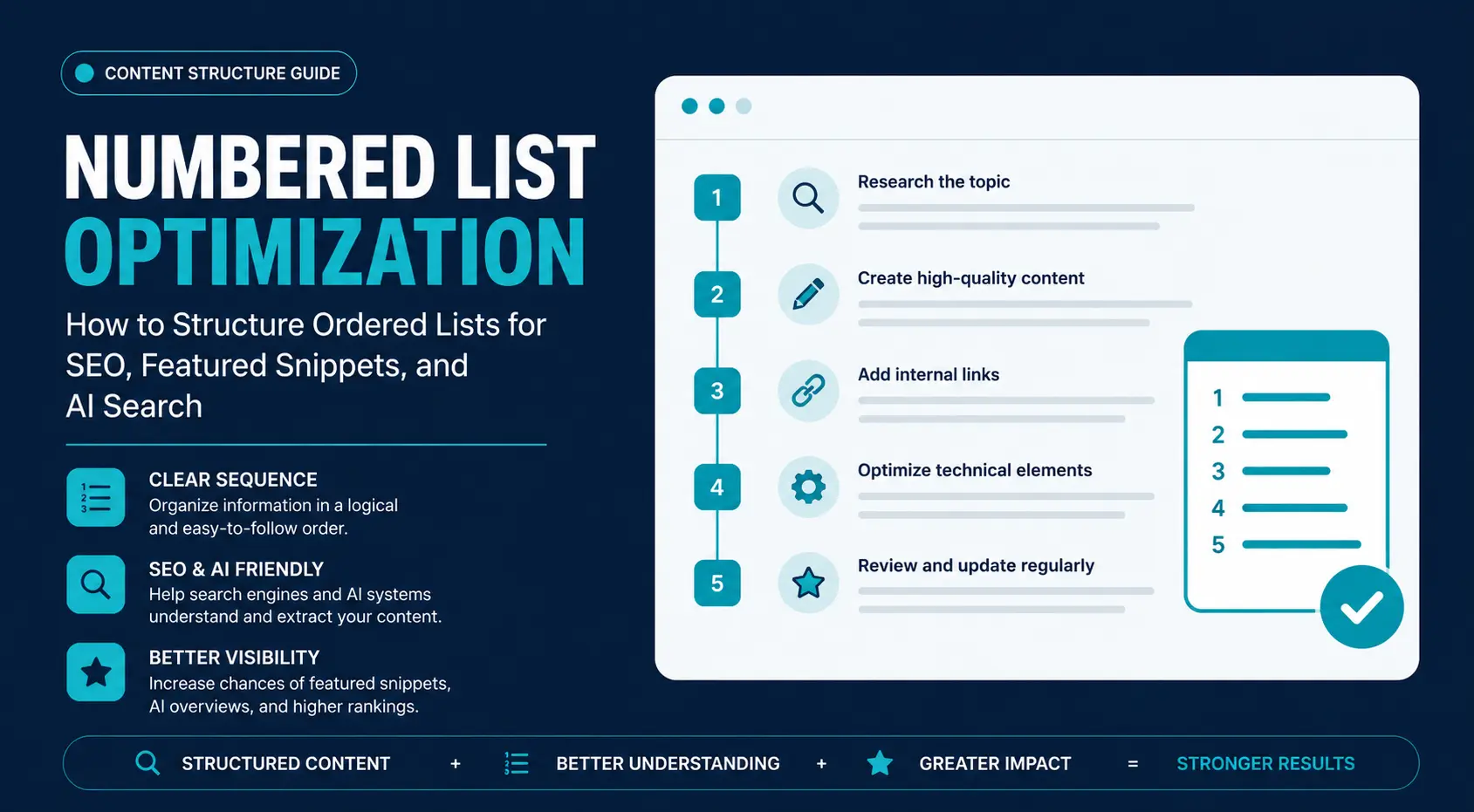
Understanding the available information is the concern of the readers and search engines. Poorly organized content limits search visibility, decreases engagement, and reduces the accuracy of AI-generated answers.
Numbered lists solve this problem by establishing sequence, hierarchy, and context. They communicate progression, priority, ranking, chronology, or dependency. Search engines, AI systems, and accessibility tools all rely on these signals to interpret information correctly. That’s why optimizing numbered lists has become an important part of modern SEO.
What Is Numbered List Optimization?
Numbered list optimization is the practice of organizing ordered information so that it is interpreted correctly by users, search engines, screen readers, and AI systems.
A properly optimized list includes the following elements:
- A clear objective
- A logical sequence
- Parallel sentence construction
- Consistent formatting
- Descriptive headings
- Supporting context
- Semantic HTML implementation
Each element reinforces the others. Examples:
Poor structure
- Keyword research
- Optimizing content
- Internal links were added.
- Technical SEO improvements
Improved structure
- Conduct keyword research.
- Optimize page content.
- Build internal links.
- Resolve technical issues.
The difference is clear. Readers process the second example quickly because every item follows the same pattern.
How Search Engines and AI Systems Interpret Numbered Lists
Search engines analyze both the structure and the purpose of a numbered list. A heading such as “Five Ways to Reduce Page Load Time” signals explanatory intent, while “Five Steps to Improve Core Web Vitals” indicates a process-oriented query. Those signals influence how information is interpreted, indexed, extracted, and displayed.
Search engines and AI systems evaluate the following signals:
| Element | What search engines evaluate | Why it matters |
| Semantic HTML structure | <ol> and <li> elements | Defines sequence, hierarchy, and relationships between items. |
| Passage extraction and featured snippets | Individual steps, headings, and surrounding context | Improves the chances of appearing in featured snippets and passage-level results. |
| AI overviews and answer engines | Relationships among entities, actions, and outcomes | Makes information easier to extract, summarize, and cite. |
| User engagement and accessibility signals | Readability, scannability, navigation, and screen-reader compatibility | Improves usability and helps search engines understand content structure. |
The following example illustrates how semantic HTML communicates sequence:
<ol>
<li>Audit the existing content.</li>
<li>Identify content gaps.</li>
<li>Implement improvements.</li>
</ol>
The <ol> element establishes sequence, while <li> tags identify individual items within that sequence
Search engines can interpret visually styled content, but native HTML elements provide much stronger semantic signals. Clear structure benefits readers, crawlers, AI systems, and accessibility tools.
Numbered Lists vs. Bulleted Lists
Many writers treat numbered lists and bulleted lists as interchangeable formatting elements. Search engines, AI systems, and accessibility tools interpret them differently. A numbered list establishes sequence, hierarchy, priority, or progression, while a bulleted list groups related ideas without assigning any particular order.
Choosing the correct structure helps readers process information more quickly and enables search engines to understand the purpose of the content more accurately.
Use cases for numbered lists
Numbered lists are used when the position of an item contributes to its meaning.
| Use case | Why numbering matters | Example |
| Processes | Each action depends on the previous one. | Keyword research → Content creation → Publication |
| Rankings | Position indicates relative importance. | Best SEO tools |
| Timelines | Events occur in chronological order. | Research → Development → Testing |
| Checklists | Tasks follow a defined workflow. | Technical SEO audits |
A process-oriented list looks like:
- Analyze search intent.
- Conduct keyword research.
- Create the content structure.
- Publish the page.
- Measure performance.
A ranking-based list follows this structure:
- Google Search Console
- Ahrefs
- Semrush
- Screaming Frog
Situations where bulleted lists work better
Bulleted lists work best when the order of the information has little or no significance. Readers are able to move from one point to another without changing the overall meaning.
Common examples include the following:
| Content type | Example |
| Features | Schema support, mobile responsiveness, and faster indexing |
| Benefits | Better readability, easier navigation, and improved accessibility |
| Collections | Tools, resources, references, and recommendations |
| Non-sequential information | Independent ideas that do not require a specific order |
For example:
- Faster page scanning
- Improved readability
- Better accessibility
- Simpler navigation
Sequential versus non-sequential information
A simple test provides the answer.
Ask yourself the following question:
Would changing the order alter the meaning of the content?
If the answer is yes, use a numbered list.
If the answer is no, a bulleted list is the better choice.
A framework for selecting the appropriate format
| Question | Numbered list | Bulleted list |
| Does sequence matter? | ✓ | |
| Does priority matter? | ✓ | |
| Is the information procedural? | ✓ | |
| Is the information descriptive? | ✓ | |
| Are the items independent of one another? | ✓ |
Selecting the correct structure is not only a formatting decision, but it also influences readability, search visibility, accessibility, passage extraction, and AI interpretation.
Types of Numbered Lists and Their Search Intent
Different search queries require different list structures. A process-oriented query, for example, should not be organized in the same way as a ranking or comparison query.
Matching the format to user intent improves readability and helps search engines interpret the relationship between individual items. The following table outlines the numbered-list formats and the search intent they address.
| List type | Primary search intent | Common examples | Why it works |
| Step-by-step lists | Informational and procedural intent | How to conduct a content audit, optimize metadata, or implement schema markup | Establishes a clear sequence of actions. |
| Ranking lists | Comparative and commercial intent | Best keyword research tools, top content management systems, and ranking factors | Highlights priority and relative value. |
| Reason lists | Explanatory intent | Reasons pages fail to rank, factors affecting crawlability, and benefits of internal linking | Clarifies the relationship between causes and outcomes. |
| Checklist lists | Transactional and implementation-focused intent | Technical audits, publishing workflows, and optimization reviews | Creates a repeatable process. |
| Timeline lists | Historical and chronological intent | Product launches, project milestones, and industry developments | Presents information in chronological order. |
Each format communicates a different type of relationship, whether that relationship involves sequence, priority, causation, completion, or chronology. Selecting the correct structure helps both readers and search systems interpret the information more efficiently.
How to Structure and Optimize Numbered Lists
A numbered list is effective based on the structure behind it. Adding numbers to a series of sentences does not create clarity, improve rankings, or increase the likelihood of appearing in featured snippets.
Optimization focuses on two objectives. Readers should be able to understand the information quickly, and search engines should be able to interpret the relationships among individual items without difficulty.
The following practices provide a reliable framework for building effective ordered lists.
Determine whether content should become a list
Lists improve readability, but excessive use produces the opposite effect. Some topics benefit from a clearly defined sequence, while others require paragraphs, examples, or more detailed explanations.
The following framework helps determine the appropriate format.
| Situation | Recommended format | Reason |
| Step-by-step instructions | Numbered list | Order determines meaning. |
| Timelines and rankings | Numbered list | Sequence establishes context and priority. |
| Independent ideas and descriptions | Bulleted list | Items can be read in any order. |
| Complex concepts requiring extensive explanation | Paragraphs | Context is more important than sequence. |
Procedural content answers “how” questions, while sequential content focuses on rankings, timelines, instructions, and checklists.
Match list structure to search intent
Search intent determines the structure of every list. Readers searching for instructions expect a different format from readers searching for comparisons, explanations, or rankings.
| Search intent | Recommended structure | Example |
| Procedural intent | Step-by-step list | How to create an XML sitemap |
| Comparative intent | Rankings, tables, or categorized lists | Best SEO auditing tools |
| Ranking intent | Ordered lists with supporting explanations | Most important ranking factors |
| Explanatory intent | Reason-based lists | Causes of indexing failures |
A mismatch between structure and intent reduces readability and weakens the semantic signals sent to search engines.
Create descriptive headings and lead-in statements
Headings provide context for both readers and search engines. Without the context, a list becomes a collection of disconnected points. The following elements contribute to a stronger structure.
| Element | Best practice | Example |
| Headings | Describe the purpose of the list clearly. | Seven Ways to Optimize Numbered Lists for Featured Snippets |
| Trigger phrases | Introduce the sequence naturally. | Follow these steps. |
| Supporting context | Explain the purpose of the list before presenting it. | One or two sentences are usually enough. |
The headings’ specificity plays an important role. Compare the following examples:
Less effective
SEO Tips
More effective
Seven Ways to Optimize Numbered Lists for Featured Snippets
The second heading establishes context, clarifies intent, and creates stronger semantic signals.
Build parallel list structures
Consistency improves comprehension of the context. Readers don’t want to interpret a different pattern when they move from one item to another.
The following 4 principles contribute to a stronger structure.
| Principle | Purpose |
| Grammatical consistency | Creates a predictable reading experience. |
| Verb-first construction | Emphasizes action and improves clarity. |
| Single-focus items | Prevents information overload. |
| Appropriate length | Balances detail and readability. |
Consider the following example.
Inconsistent structure
- Analyze keywords.
- Competitor research.
- Creating title tags.
Improved structure
- Analyze keywords.
- Research competitors.
- Create title tags.
The second example reduces friction as each item follows the same grammatical pattern.
Verb-first construction strengthens clarity.
- Identify target entities.
- Review internal links.
- Validate structured data.
- Analyze page performance.
The list items must be concise and avoid unnecessary explanation.
Maintain hierarchy and logical progression
The order of information influences the way readers interpret it. Rearranging a list changes its meaning entirely.
The following 4 organizational models are used.
| Structure | Purpose |
| Chronological order | Presents information according to time. |
| Priority-based order | Arranges items according to importance. |
| Problem-to-solution order | Introduces a challenge before presenting the solution. |
| Simple-to-complex progression | Builds understanding gradually. |
Choosing the wrong sequence creates confusion despite the accuracy of information.
Use nested lists effectively
Nested lists introduce additional levels of organization and make complex subjects easier to navigate. They are to be used carefully, because deeply layered structures become difficult to read.
This example illustrates the basic structure:
- Perform a technical audit.
- Review crawling directives.
- Identify indexing problems.
- Optimize the content.
- Improve headings.
- Strengthen internal links.
Two levels of hierarchy are enough. Additional layers indicate that the content should be reorganized into separate sections.
Add supporting examples and evidence
Lists don’t perform well in isolation. Readers need context, and search engines require information to understand the relationships between individual items.
The following supporting elements strengthen the overall structure:
- Brief introductory statements
- Supporting explanations
- Statistics and research findings
- Real-world examples
- Comparisons and case studies
A numbered list should simplify information rather than remove essential details. The strongest lists strike a balance between brevity and completeness.
Numbered List Optimization for SEO and AI Search
Search engines use numbered lists to understand hierarchy, identify relationships between concepts, extract passages, and determine how information appears within search results. AI search platforms rely on these same signals while generating summaries, citations, and answers.
The factors that contribute to successful list optimization include featured snippet eligibility, passage-level relevance, semantic relationships, readability, accessibility, and AI extractability. The following sections explain how each of these elements affects search performance.
Optimize lists for featured snippets and passage-level relevance
Search engines evaluate individual passages more than entire pages. Clear structure makes that process easier because each item functions as a distinct informational unit.
Lists selected for featured snippets share several characteristics:
- Descriptive headings
- Concise explanations
- Logical sequencing
- Consistent formatting
- Strong contextual signals
Strengthen semantic relationships between entities
Lists naturally establish relationships among concepts, attributes, and actions.
An SEO checklist, for example, might connect entities such as:
- Title tags
- Meta descriptions
- Canonical tags
- Structured data
- Internal links
Those connections help search engines understand how individual concepts contribute to the broader topic.
Improve scannability, accessibility, and engagement
Readers don’t consume content line by line. People scan a page before reading it in depth. Numbered lists reduce cognitive load by organizing information into smaller sections that are easier to process.
Accessibility also improves with the numbered list, because screen readers rely on semantic HTML to identify order, hierarchy, and relationships between items.
Optimize content for AI overviews and answer engines
AI systems favor content that is organized, contextually rich, and easy to interpret. The practices that contribute to stronger results:
- Maintain a logical sequence.
- Use descriptive headings.
- Apply semantic markup.
- Include supporting context.
- Establish clear relationships between concepts.
Strong structure does not guarantee visibility, but it improves the likelihood that search engines and AI systems will understand the content correctly.
Technical Implementation and Structured Data
Search engines interpret the meaning of a list through content, structure, and code. Proper implementation ensures that crawlers, AI systems, browsers, and accessibility tools interpret information consistently.
The following sections focus on the technical elements that influence indexing, extractability, accessibility, and search visibility.
Implement semantic HTML correctly
Semantic HTML provides signals about hierarchy, sequence, and relationships between items. Ordered lists should always rely on native HTML elements rather than purely visual formatting.
Several factors contribute to proper implementation.
Proper <ol> and <li> implementation
A basic ordered list structure looks like this:
<ol>
<li>Analyze search intent.</li>
<li>Create the content outline.</li>
<li>Optimize headings.</li>
<li>Review performance metrics.</li>
</ol>
Each <li> element should represent a single action, concept, or category.
Common implementation mistakes include the following:
- Placing content outside list elements
- Combining multiple actions within a single item
- Using inconsistent sentence structures
- Relying entirely on visual styling
HTML nesting practices
Nested lists provide additional layers of organization.
<ol>
<li>Conduct keyword research.
<ol>
<li>Identify primary keywords.</li>
<li>Analyze competitors.</li>
</ol>
</li>
</ol>
Multiple levels of nesting reduce readability, so most lists should remain limited to one or two levels.
Mobile optimization considerations
Visitors skim content from mobile devices. Large paragraphs become difficult to scan, while properly formatted lists remain easy to follow.
Consider these practices:
- Keep spacing consistent.
- Break long items into smaller units.
- Maintain adequate font size.
- Avoid excessive indentation.
- Test responsiveness on multiple devices.
Implement ItemList schema
ItemList schema provides additional context about the relationship between list items and is useful for rankings, collections, and grouped resources.
The applications include:
- Top-ten lists
- Product rankings
- Resource directories
- Best-practice collections
Structured data does not guarantee enhanced search results, but it helps search engines interpret content accurately.
Implement HowTo schema
HowTo schema is intended for instructional content in which a sequence of actions is to be completed to achieve a specific outcome.
A standard implementation includes the following components:
- The task title
- Individual steps
- Required tools
- Estimated completion time
- Images and supporting resources
Validate structured data
Validation should be part of the publication process. Even minor errors during implementation affect indexing and reduce the reliability of structured information.
The following elements should be reviewed carefully:
| Validation area | Potential issue |
| Required properties | Missing attributes or values |
| Syntax | Invalid code structures |
| Nesting | Incorrect hierarchical relationships |
| Rendering | Inaccessible content |
| Duplication | Redundant schema elements |
Avoid common implementation errors
Technical errors reduce visibility even when the content itself is well written.
| Error | Why it creates problems | Recommended solution |
| CSS-generated numbering | Search engines may fail to recognize the underlying sequence. | Use native <ol> and <li> elements. |
| JavaScript-rendered content | Delayed rendering can affect crawling and indexing. | Ensure essential content remains accessible within the page source. |
| Duplicate schema markup | Multiple schema types can produce conflicting signals. | Apply only the most relevant schema implementation. |
Technical implementation does not attract much attention, but it plays a central role in determining how content is interpreted, indexed, and extracted. Strong structure, semantic markup, and properly implemented schema work together to strengthen visibility across traditional search results and AI-powered search platforms.
Practical Numbered List Optimization Examples
The following examples illustrate how optimized lists differ from poorly organized ones.
- Step-by-step examples
Weak example
- Keywords
- Content
- Internal links
- Schema
Improved example
- Conduct keyword research.
- Optimize content structure.
- Add internal links.
- Validate schema markup.
The second version communicates actions rather than topics.
- Ranking examples
Ten Most Important On-Page Ranking Factors
- Search intent
- Content quality
- Internal linking
- User experience
- Page speed
- Structured data
- Mobile usability
- Accessibility
- Metadata
- Crawlability
Readers immediately understand the relationship between each item.
- Checklist examples
Technical SEO checklist
- Verify indexability.
- Validate canonical tags.
- Review redirect chains.
- Analyze page speed.
- Test structured data.
Checklists work because completion is measurable.
- Multilevel list examples
- Perform technical analysis.
- Review crawling directives.
- Identify indexing problems.
- Optimize content.
- Update headings.
- Improve internal links.
Nested structures add clarity when used sparingly.
Before-and-after optimization examples
Parallel construction creates a predictable pattern, allowing readers and search engines to process information efficiently.
The example below illustrates the difference.
| Before | After |
| Content strategy | Develop a content strategy. |
| Researching competitors | Analyze competitor content. |
| Links | Build internal links. |
| Meta descriptions | Optimize meta descriptions. |
The revised version is stronger for three reasons:
- Every item begins with an action verb.
- Each entry focuses on a single idea.
- The grammatical structure remains consistent throughout the list.
Readers move through the information quickly, and search engines can interpret the relationship of the individual steps easily.
Common Numbered List Optimization Mistakes
Strong content still performs poorly when the underlying structure is weak. In many cases, the problem is in the way that information is organized. Search engines, AI systems, and readers all rely on structure to understand relationships between ideas, so even minor mistakes reduce clarity and visibility.
The following issues appear most of the time.
| Mistake | Why it creates problems | Recommended approach |
| Choosing the wrong list format | Sequence and hierarchy become unclear. | Match the format to the underlying search intent. |
| Ignoring search intent | The structure fails to align with user expectations. | Select a format that reflects the purpose of the query. |
| Breaking parallel structure | Readers encounter inconsistent patterns and phrasing. | Maintain grammatical consistency throughout the list. |
| Creating excessively long items | Large blocks of text reduce readability and increase cognitive load. | Limit each item to a single idea whenever possible. |
| Mixing formatting styles | Inconsistent formatting weakens clarity and organization. | Use a uniform structure across the entire list. |
| Overusing nested lists | Excessive hierarchy makes navigation more difficult. | Limit nesting and divide complex sections when necessary. |
| Over-optimizing keywords | Excessive repetition reduces readability and weakens semantic relevance. | Focus on context, entities, and relationships rather than keyword density. |
Parallel construction deserves special attention because it affects readability almost immediately.
Auditing and Measuring List Performance
High-performing content is reviewed, measured, tested, and refined continuously.
Review search-intent alignment
Ask the questions during the audit process.
- Does the structure match user expectations?
- Does the order make sense?
- Does each item contribute value?
- Does the list answer the query directly?
Evaluate structure and readability
Review the following elements:
- Parallel construction
- Sentence length
- Hierarchy
- Formatting consistency
- Contextual relevance
Reading the content aloud is an effective strategy.
Measure search visibility and engagement
Performance metrics reveal structural problems.
Pay close attention to:
- Click-through rate
- Bounce rate
- Scroll depth
- Average engagement time
- Featured snippet visibility
Track AI citations and mentions
AI search platforms cite specific sections instead of entire articles.
The factors that influence visibility:
- Clear organization
- Concise language
- Entity relationships
- Consistent formatting
- Strong contextual signals
Test and refine list structures
Optimization is not linear.
A slight change in wording, hierarchy, or order alters the performance.
Experimentation remains essential.
Recommended tools
| Tool | Primary use |
| Google Search Console | Performance monitoring |
| Ahrefs | Keyword and competitor analysis |
| Semrush | Visibility tracking |
| Screaming Frog | Technical analysis |
| Google Lighthouse | Performance auditing |
Numbered List Templates and Optimization Checklists
Creating a numbered list from scratch every time leads to inconsistencies in formatting, hierarchy, and structure. Templates provide a repeatable framework that simplifies implementation while ensuring that readers, search engines, and AI systems interpret information consistently.
The following examples can be adapted to different content types.
Simple ordered-list template
This structure works well for tutorials, workflows, and instructional content.
1. Introduce the objective.
2. Explain the first step.
3. Explain the second step.
4. Explain the third step.
5. Summarize the outcome.
Multilevel list template
Nested lists should be reserved for situations that require additional levels of organization.
1. Main topic
1. Supporting point
2. Supporting point
2. Main topic
1. Supporting point
2. Supporting point
SEO checklist
The following checklist focuses on readability, structure, and search visibility.
| Task | Status |
| Match the structure to search intent. | □ |
| Write descriptive headings. | □ |
| Maintain parallel sentence construction. | □ |
| Add supporting context. | □ |
| Strengthen semantic relevance. | □ |
Technical checklist
Technical implementation plays an important role in accessibility, indexing, and content extraction.
| Task | Status |
| Validate HTML markup. | □ |
| Test mobile responsiveness. | □ |
| Review structured data implementation. | □ |
| Verify accessibility standards. | □ |
| Resolve rendering issues. | □ |
AI search checklist
AI systems rely heavily on structure, context, and semantic relationships.
| Task | Status |
| Create concise answer blocks. | □ |
| Establish clear relationships between entities. | □ |
| Maintain consistent formatting. | □ |
| Preserve logical hierarchy. | □ |
| Improve content extractability. | □ |
These templates are not rigid rules. They are starting points that can be adapted according to search intent, content complexity, and the needs of the audience.
Key Takeaways
- Use numbered lists whenever sequence, priority, chronology, or dependency influences meaning.
- Match the structure of the list to the underlying search intent rather than the topic itself.
- Maintain parallel sentence construction to improve readability and information processing.
- Write descriptive headings and provide enough context for search engines and readers to understand the purpose of the list.
- Use semantic HTML elements such as <ol> and <li> to establish hierarchy and improve accessibility.
- Keep list items concise and focused on a single action, concept, or idea.
- Limit the use of nested lists to preserve readability and maintain a clear structure.
- Review list performance regularly to identify opportunities for improvement.
Frequently Asked Questions
Does Google prefer numbered lists or bulleted lists?
Google does not inherently favor one format over the other. The most effective structure depends on the purpose of the content. Numbered lists work best when sequence matters, while bulleted lists are better suited to independent ideas.
How many levels of nested lists should you use?
Most content benefits from no more than two levels of hierarchy. Additional layers make content difficult to scan and interpret.
Should every item in a numbered list have the same length?
No. Consistency in structure matters more than consistency in length. Each item should contain enough information to communicate its purpose clearly without introducing unnecessary detail.
Can search engines understand lists created with CSS?
Search engines can interpret visually formatted content, but native HTML elements provide stronger semantic signals. Semantic markup should be the preferred option.
Do numbered lists increase the chances of appearing in featured snippets?
Well-structured lists improve eligibility for featured snippets as they provide clear organization, concise answers, and strong contextual signals.
Are numbered lists important for accessibility?
Yes. Screen readers rely on semantic markup to interpret order, hierarchy, and relationships between items.
How often should list performance be audited?
Performance should be reviewed regularly, especially after changes to content, search algorithms, or page structure. Metrics such as engagement, click-through rate, and search visibility reveal the opportunities for improvement.