
Google’s People Also Ask (PAA) feature reveals related questions connected to a user’s search. Unlike a static FAQ, PAA expands dynamically as users interact with questions, exposing different paths through a topic.
A strong PAA strategy goes beyond adding questions to a page. It involves researching real questions, understanding search intent, clustering related topics, creating extractable answers, strengthening semantic relationships, and maintaining the technical foundation that allows Google to crawl and understand the content.
What Is Google People Also Ask?
People Also Ask (PAA) is an interactive Google SERP feature that displays related questions with expandable answers extracted from webpages. When a user opens a question, Google shows an answer excerpt and may reveal additional related questions.
Unlike Featured Snippets, which generally answer the primary query with one result, PAA presents a network of related questions that users can explore.
Why Does PAA Matter for SEO?
PAA can help websites:
- Increase visibility beyond traditional organic rankings
- Capture long-tail and conversational searches
- Discover questions associated with a topic
- Identify content gaps and new topic branches
- Strengthen topical coverage
- Improve eligibility for other answer-focused search experiences
PAA research is also useful for content planning. Questions appearing together can reveal how Google connects related concepts and how users move from basic definitions to practical, comparative, and troubleshooting queries.
PAA vs. Featured Snippets and AI Overviews
| Feature | Purpose | Source | Interaction |
| People Also Ask | Answers related questions | Webpage passages | Expandable |
| Featured Snippet | Answers the primary query | Single webpage | Usually static |
| AI Overview | Generates a synthesized response | Multiple sources | Conversational |
| People Also Search For | Suggests related searches | Search relationships | Click-through |
| Knowledge Panel | Provides entity information | Knowledge Graph and other sources | Static |
These features serve different purposes, but a well-structured page may qualify for multiple search experiences.
How Google Selects PAA Questions and Answers
Google does not simply select random questions. PAA reflects relationships between search intent, topics, entities, user behavior, and available content.
Search Intent and Question Relationships
Each PAA question represents a particular information need. A search for technical SEO, for example, may generate questions about its definition, benefits, audits, implementation, tools, or troubleshooting.
These questions can form a progression:
What is technical SEO? → Why does it matter? → How do you perform it? → Which tools should you use?
This relationship can be viewed as a question graph, where broad parent questions lead to more specific child questions.
For example:
Technical SEO → Crawlability → Robots.txt → Crawl Budget
Understanding these relationships helps you build content around the user’s information journey rather than treating every PAA question as an isolated keyword.
Dynamic Question Expansion
PAA can reveal additional questions as users expand existing ones. This creates a network of related searches that can expose:
- Parent topics
- Supporting concepts
- Practical questions
- Comparative searches
- Troubleshooting queries
The expanding question graph can therefore reveal both content opportunities and the relationships Google associates with a topic.
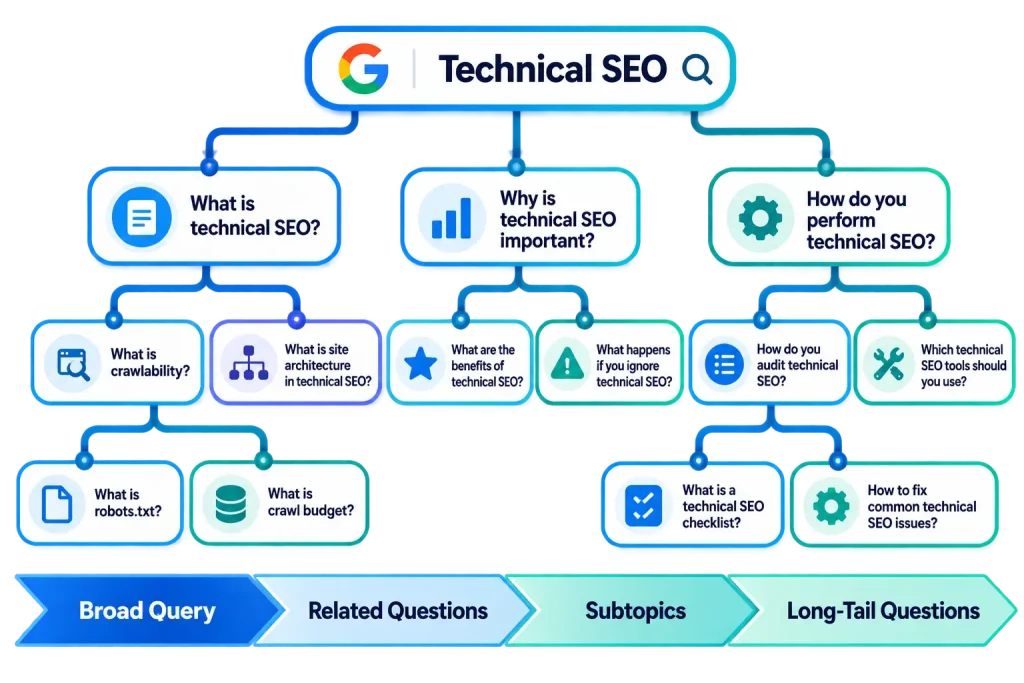
FIGURE 1: How a broad search query expands into related PAA questions, subtopics, and long-tail information needs.
User Behavior Signals
PAA questions can change as Google responds to aggregated search behavior and changing information needs. Questions that users commonly explore can influence the relationships displayed for future searches.
For SEO professionals, this means PAA research should be treated as a changing SERP signal rather than a permanent list of questions.
Passage-Level Answer Extraction
Google can evaluate individual passages within a page. A page does not necessarily need to rank first for the original query for one of its passages to satisfy a specific question. A strong PAA answer block should:
- Use a descriptive heading.
- Answer the question immediately.
- Add relevant supporting context.
- Use bullets, tables, examples, or other formats when they improve clarity.
- Remain understandable when extracted from the surrounding page.
A concise answer is easier to extract, but there is no need to force every response into an arbitrary word count. Answer length should depend on the complexity of the question.
Entity Relationships and Semantic Relevance
PAA questions connect to broader entities and concepts rather than existing independently. For a PAA strategy article, relevant entities may include:
- Search intent
- Semantic search
- Passage ranking
- Featured Snippets
- AI Overviews
- Knowledge Graph
- Natural language processing
- Structured data
- Internal linking
- SERP features
- Information retrieval
Mentioning the related entities does not establish topical authority. Explain meaningful relationships between them. For example, search intent helps explain why certain questions appear, passage ranking relates to answer extraction, and internal linking connects related resources within a broader content ecosystem.
Information Gain and Answer Quality
Useful PAA content adds information rather than reproducing generic advice found across competing pages. Information gain can come from:
- Original workflows
- Implementation examples
- Comparisons
- Decision frameworks
- Troubleshooting guidance
- Practical checklists
- Real-world scenarios
A useful editing test is:
If this paragraph were removed, would the reader lose meaningful information?
If not, it may be unnecessary.
How to Research PAA Opportunities
Effective PAA optimization starts with research. The objective is not to collect every question Google displays but to identify questions that fit the topic, audience, search intent, and content architecture.
Manual PAA Research
Google Search is the most direct source for current PAA questions.
Search your target keyword and expand relevant PAA questions. Record the questions that appear and note how new questions emerge as you interact with the results.
Look for patterns such as:
- Definitions before implementation
- Process questions after fundamentals
- Tool comparisons during evaluation
- Troubleshooting after implementation
Repeat the process for related keywords to uncover overlapping questions and additional topic branches.
Organize the findings by topic, intent, and target page rather than maintaining a flat list of keywords.
PAA Research Tools
Different tools support different stages of research.
| Tool | Primary Use |
| Google Search | Discover live PAA questions and intent paths |
| Google Search Console | Find question-based queries already generating impressions |
| AlsoAsked | Visualize parent-child question relationships |
| Ahrefs | Evaluate demand, competitors, and SERP features |
| Semrush | Analyze competitors and question opportunities |
| AnswerThePublic | Generate conversational question variations |
Google provides live SERP data, while third-party tools help scale discovery and analysis.
Competitor PAA Gap Analysis
Review competing pages to identify questions they answer well, questions they answer poorly, and questions they do not address.
Evaluate:
- PAA questions covered
- Missing questions
- Answer clarity
- Heading structure
- Entity coverage
- Internal linking
- Depth and practical usefulness
The objective is not to copy competitors. Look for opportunities to provide a clearer answer, stronger explanation, better structure, or useful information they have missed.
Cluster Questions by Intent and Entities
Do not automatically create a separate page for every PAA question. Group questions when they share:
- The same search intent
- The same core entity
- The same user journey
- Closely related information needs
For example, a Crawl Budget cluster could include:
- What is crawl budget?
- How does crawl budget work?
- Why is crawl budget important?
- Does crawl budget matter for small websites?
- How do you optimize crawl budget?
These questions can be addressed within one comprehensive resource.
Create a separate page when the underlying search intent changes. This approach reduces unnecessary content fragmentation and keyword cannibalization.
Prioritize High-Value Questions
Not every PAA question deserves equal attention. Prioritize questions according to:
| Factor | Consideration |
| Search intent | Does it match the audience’s information need? |
| Business relevance | Does it support a relevant product or service? |
| Topic relevance | Does it strengthen the main subject? |
| Ranking potential | Can the page realistically compete? |
| Information value | Can you provide something genuinely useful? |
The objective is useful topical coverage, not maximum question volume.
How to Build PAA-Optimized Content
Research identifies the questions. Content architecture determines how effectively you answer them.
Build a Question Hierarchy
Organize questions from foundational concepts to practical and advanced information. This structure follows a natural learning journey and prevents unrelated questions from being grouped simply because they contain similar keywords. A useful hierarchy is:
Core topic → Definition → Importance → Process → Implementation → Troubleshooting → Advanced questions
Turn Questions Into Optimized Headings
When a real question matches the user’s intent, use it as the heading.
- Weak:
Benefits - Better:
Why Is People Also Ask Important for SEO?
Question-based headings improve:
- Search intent alignment
- Semantic relevance
- Passage extraction
- Readability
- Accessibility
Write Extractable Answer Blocks
A practical PAA answer block follows this structure:
- Question-based heading
- Direct answer
- Supporting explanation
- Relevant format, such as bullets, tables, comparisons, or examples
- Internal link, when a related resource adds value
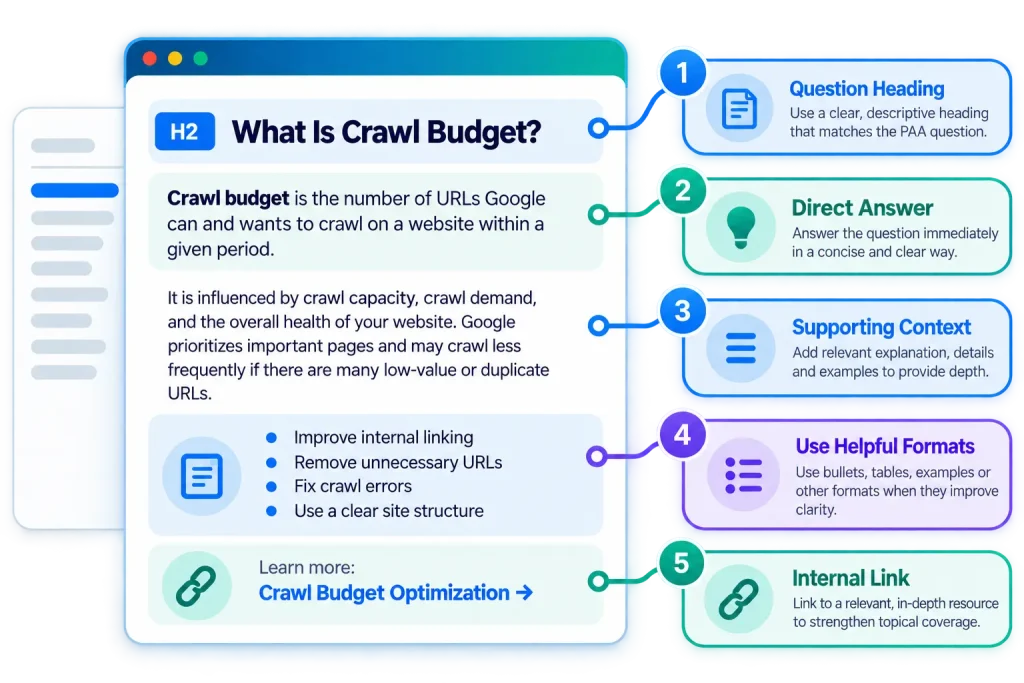
FIGURE 2: Anatomy of a PAA-optimized answer block, from a question-based heading and direct answer to supporting context, scannable formatting, and internal linking.
The answer should appear immediately after the heading rather than following a long introduction.
For example, if answering “Does FAQ Schema help PAA?”, begin by explaining that FAQ Schema does not directly trigger PAA visibility. Then explain what structured data does and how visible page content contributes to answer extraction.
Choose the Right Answer Format
Different questions require different formats.
| Format | Best For |
| Paragraph | Definitions and explanations |
| Bullets | Best practices and checklists |
| Numbered list | Processes and procedures |
| Table | Comparisons and structured differences |
| Diagram | Relationships and workflows |
| Code | Technical implementation |
Use the format that best matches the information need instead of forcing every answer into a paragraph.
Prevent Keyword Cannibalization
Closely related questions do not always require separate pages.
| Question Pair | Same Page? |
| What is crawl budget? / Crawl budget explained | Usually yes |
| Technical SEO checklist / Technical SEO audit service | Usually no |
| Canonical tags / Noindex | Depends on intent |
| XML sitemap / HTML sitemap | Often separate |
Search intent, and not keyword similarity, should determine page boundaries.
Build Relevant Internal Links
Internal links reinforce relationships between pages and help users move through related information. A useful topic-cluster structure:
- Link supporting pages back to the pillar page
- Connect closely related cluster pages
- Link broader content to specialized resources
Use descriptive anchor text and link when the destination adds value.
Technical SEO for PAA
Content quality determines whether Google has a useful answer to extract. Technical SEO helps ensure the content can be crawled, rendered, indexed, and interpreted.
Semantic HTML for Answer Extraction
Place answers close to their descriptive headings and use appropriate HTML elements:
- H2: Question
- Paragraph: Direct answer
- H3: Supporting topic
- Paragraph: Supporting explanation
- Bullets or table
Avoid inserting unrelated banners, advertisements, pop-ups, or interactive elements between a question heading and its answer when they interfere with the content structure.
Crawlability, Indexing, and Internal Linking
Google cannot extract content it cannot access or process. Check:
| Area | Check |
| Robots.txt | Does not unnecessarily block crawling |
| Meta robots | Page is indexable when appropriate |
| Canonical | Points to the intended URL |
| XML sitemap | Includes the target page when appropriate |
| HTTP status | Returns the expected status |
| Internal links | Page is discoverable |
| Orphan pages | Important content is not isolated |
Internal linking also helps establish relationships between related pages and content clusters.
Structured Data: What Helps and What Doesn’t
Schema markup help search engines understand page content, but it does not trigger PAA visibility.
| Schema | Direct PAA Benefit |
| FAQ | No direct trigger |
| QAPage | No direct trigger |
| Article | No direct trigger |
| Organization | No direct trigger |
| Person | No direct trigger |
FAQ Schema supports eligible search experiences, while QAPage is intended for pages where users submit questions and receive answers, such as community platforms.
For PAA, accessible and well-structured visible content remains central.
Technical Issues That Can Reduce Answer Accessibility
| Technical issue | What to check |
| JavaScript rendering | If important answers depend entirely on client-side rendering, verify that the content is available in the rendered page and can be processed correctly. |
| Incorrect canonicals | Verify that canonical tags point to the intended URLs and that duplicate URL handling is correct. |
| Hidden content | Content inside accordions can be acceptable, but important answers should not require login or unnecessary interaction to access. |
| Slow-loading content | Monitor Core Web Vitals, including LCP, INP, and CLS, and keep important answer content accessible and stable. |
Build Topical Authority Around PAA
PAA visibility across related questions requires more than optimizing individual answer blocks. Strong topical coverage connects related questions, entities, supporting pages, and user intents into a coherent content ecosystem.
Strengthen Entity and Semantic Coverage
A PAA-focused content cluster should naturally connect entities that help explain the topic. For example:
People Also Ask → Search Intent → Semantic Search → Passage Ranking → Featured Snippets → AI Overviews → Structured Data → Internal Linking
The objective is not to mention every related entity. It is to explain the relationships that make the topic complete.
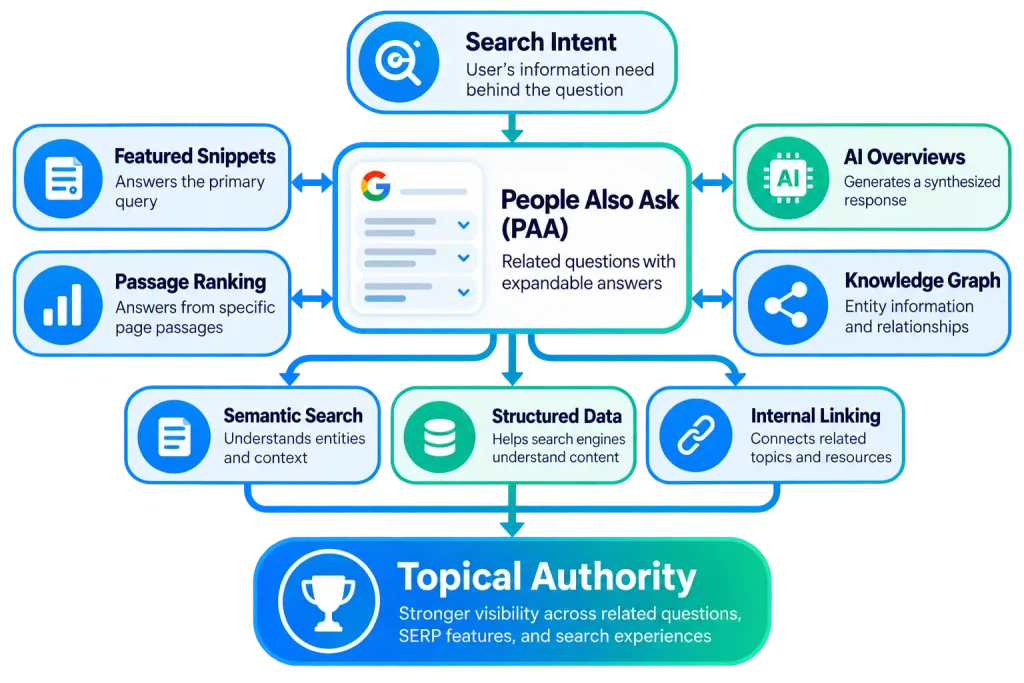
Figure 3: How PAA connects search intent, semantic search, passage ranking, SERP features, structured data, and internal linking within a broader topical authority ecosystem.
Fill Question Gaps
Even comprehensive pages can miss useful questions. The gap types include:
| Gap Type | Example |
| Foundational | What is PAA? |
| Comparative | PAA vs. Featured Snippets |
| Process | How do you optimize for PAA? |
| Troubleshooting | Why did my PAA visibility disappear? |
A practical gap-analysis workflow is:
- Export PAA questions from Google or a research tool.
- Group them by topic and search intent.
- Compare them with your existing headings.
- Add missing questions only where they improve topical completeness.
Increase Information Gain
Topical authority is not created by adding more words or more questions. The content needs to contribute useful information.
Examples include:
- Original workflows
- Decision trees
- Comparison matrices
- Technical diagrams
- Implementation examples
- Real-world scenarios
- Common failure cases
Explain not only what to do, but also why a particular approach is useful.
Scale Question Coverage Across a Topic
PAA optimization works best as part of a connected content ecosystem.
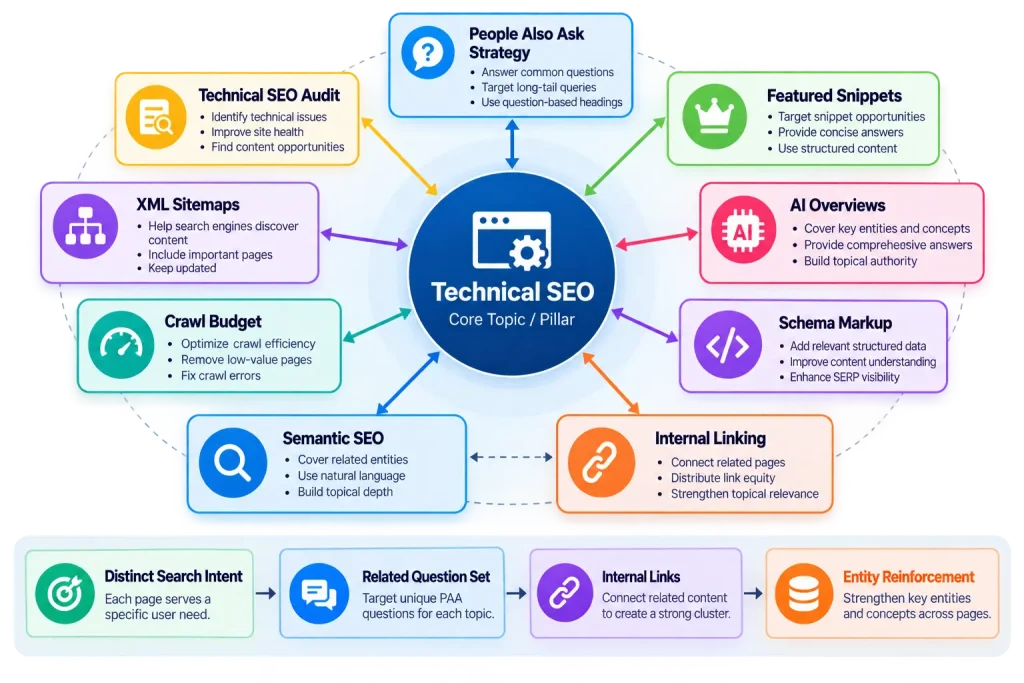
FIGURE 4: A Technical SEO topic cluster distributes related PAA questions across intent-specific supporting pages while connecting them through internal links and shared entities.
This creates broader topical coverage without forcing every question onto one page.
Measure and Maintain PAA Performance
PAA visibility can change as search behavior, competitors, and Google’s SERPs evolve.
Track PAA-Related Visibility
Google Search Console does not directly identify every PAA placement, but it provides useful indicators. Monitor:
- Question-based queries
- Organic impressions
- CTR
- Average position
- Landing pages
- Newly appearing long-tail queries
Third-party SEO platforms can provide additional SERP feature tracking.
Monitor Competitors and Question Volatility
Review important questions periodically and compare your visibility with competing pages. Ask:
- Has Google changed the question wording?
- Has another website replaced your answer?
- Has search intent changed?
- Has your information become outdated?
- Has another SERP feature changed the search experience?
PAA questions can fluctuate because of changing search behavior, seasonality, freshness requirements, and SERP experimentation.
Refresh Existing Content
You do not need to rewrite an entire page whenever new questions appear. Instead:
- Re-run PAA research.
- Compare new questions with existing coverage.
- Update outdated information and examples.
- Improve weak answer blocks.
- Add useful gaps where they naturally fit.
- Refresh relevant internal links.
Do not add every newly discovered question. Maintain the page’s topical focus.
Complete PAA Audit Workflow
| Stage | Key Tasks |
| Research | Discover PAA questions and analyze search intent |
| Content | Improve answer blocks and fill useful gaps |
| Architecture | Cluster questions and prevent cannibalization |
| Technical SEO | Check crawling, indexing, HTML, performance, and schema |
| Entity optimization | Strengthen meaningful entity relationships |
| Monitoring | Track visibility, competitors, and question changes |
For evergreen topics, a comprehensive PAA audit every three to six months help maintain accuracy and relevance.
PAA Research and Optimization Tools
No single tool covers the entire PAA workflow.
| Tool | Best Use |
| Google Search | Live PAA discovery |
| Google Search Console | Query and performance data |
| AlsoAsked | Question relationships |
| Ahrefs | Keyword and SERP research |
| Semrush | Competitor and SERP analysis |
| AnswerThePublic | Conversational question discovery |
| Screaming Frog | Technical SEO auditing |
| InLinks | Entity and topical analysis |
| Kalicube | Entity and Knowledge Graph analysis |
A practical workflow is:
Discover → Validate → Cluster → Optimize → Audit → Monitor
Real-World PAA Optimization Example
Consider this weak answer:
Technical SEO includes many optimization activities that improve websites and help search engines crawl pages better.
The answer is broad but does not clearly define the topic or explain its main components. A stronger version is:
Technical SEO is the process of improving a website’s infrastructure so search engines can crawl, index, and understand pages efficiently. It includes areas such as crawlability, site architecture, structured data, and performance optimization.
The improved answer:
- Answers immediately
- Defines the topic clearly
- Includes relevant entities
- Provides useful context
- Remains concise enough to work as a standalone passage
The same principle applies across PAA content: answer the question first, then add information that improves understanding.
Key Takeaways
- PAA is a dynamic SERP feature built around related questions and answer passages.
- Search intent and question relationships help explain which questions belong together.
- Direct, self-contained answer blocks make content easier to understand and extract.
- Question clustering helps cover related searches without creating unnecessary pages or keyword cannibalization.
- Semantic entities and internal links strengthen relationships across a content cluster.
- Information gain comes from useful examples, workflows, comparisons, and original practical guidance.
- Technical SEO ensures important answer content can be crawled, rendered, indexed, and interpreted.
- Schema does not directly trigger PAA; visible, accessible content remains central to answer extraction.
- Topical authority requires connected coverage, not simply more keywords or more pages.
- Regular monitoring and refreshing help maintain visibility as questions, competitors, and search results change.
Frequently Asked Questions
Can PAA questions help identify content gaps?
Yes. Unanswered or weakly covered PAA questions can reveal useful gaps in your existing content.
Should every PAA question have its own webpage?
No. Group closely related questions on one page when they share the same search intent. Create a separate page when the intent is substantially different.
Can PAA optimization support topical authority?
Yes. Connecting related questions, entities, and supporting resources can strengthen topical coverage without creating unnecessary pages.
Can PAA questions reveal changes in search intent?
Yes. Changes in the questions Google surfaces can indicate shifts in what users want to know, compare, or accomplish.
When should you update an existing page for a PAA question?
Update an existing page when the question fits its intent and topic. Create new content when the question requires a distinct search intent or deeper coverage.