
Search behavior has shifted toward highly specific queries. Instead of searching for broad terms like “CRM software,” users search for “CRM software for nonprofits” or “CRM with HubSpot integration.” These long-tail patterns create thousands of search opportunities that are impractical to target manually.
Programmatic SEO solves this by combining structured data, reusable templates, and automation to generate high-quality pages at scale. When built around unique search intent rather than page volume, it enables websites to cover entire topic spaces efficiently.
This guide explains how programmatic SEO works, when to use it, how to build scalable content systems, and the best practices for creating pages that rank in both traditional and AI-powered search.
What Is Programmatic SEO?
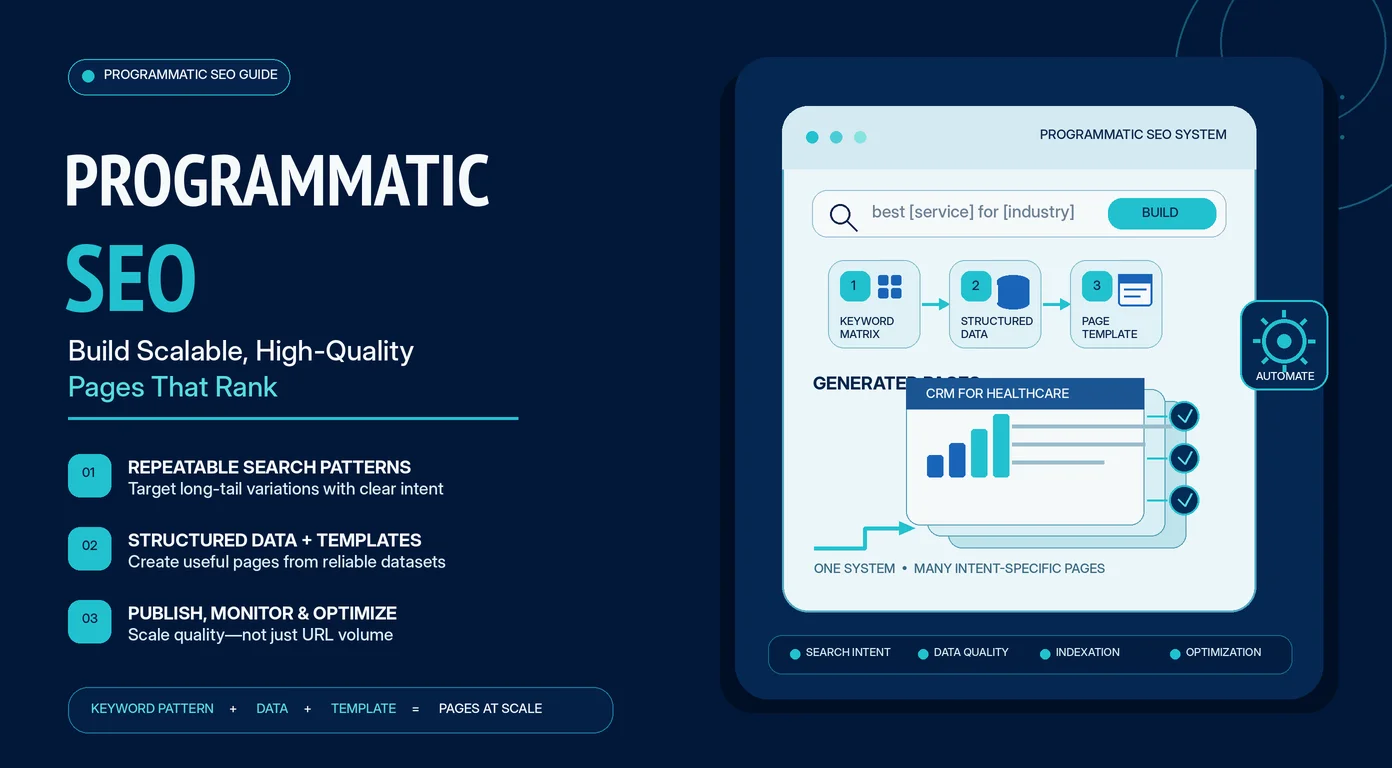
Programmatic SEO is the practice of generating large numbers of search-optimized pages using structured datasets and reusable templates. Instead of creating every page manually, a template is populated with different variables to target repeatable search patterns while tailoring content to each query’s intent.
For example, a SaaS company might create pages for:
- CRM for healthcare
- CRM for law firms
- CRM for construction
- CRM for nonprofits
The layout remains consistent, while the recommendations, use cases, integrations, FAQs, and supporting content change to match each audience.
Rather than a content production technique, programmatic SEO is a publishing system that combines keyword research, structured data, templates, automation, and technical SEO to scale high-quality content efficiently.
How Programmatic SEO Works
Every successful implementation follows the same workflow:
- Identify a repeatable keyword pattern.
- Build a structured dataset.
- Design reusable page templates.
- Populate templates with dynamic variables.
- Enrich pages with editorial content.
- Publish, monitor, and optimize.
Workflow
Keyword Pattern → Structured Data → Template → Generated Page → Indexation → Optimization
Content generation is only one step. The quality of the underlying data, templates, and optimization determines how well the system performs.
Programmatic SEO vs. Traditional SEO
Traditional SEO and programmatic SEO address different use cases.
| Traditional SEO | Programmatic SEO |
| Individual page creation | System-based publishing |
| Manual writing | Template-driven generation |
| Targets individual keywords | Targets repeatable keyword patterns |
| Limited scalability | Scales through structured data |
| Manual updates | Dataset-driven updates |
Editorial content is best for original research, tutorials, and thought leadership. Programmatic SEO is ideal for repeatable search patterns such as locations, industries, products, integrations, or categories. Most successful websites use both: editorial content builds topical authority, while programmatic pages capture long-tail search demand.
The Three Foundations of Programmatic SEO
Every programmatic SEO system relies on three elements.
Structured Data
Structured data provides the information that populates each page, such as products, locations, software integrations, pricing, specifications, or business listings.
Templates
Templates define the page structure, metadata, schema, internal linking, and reusable content blocks.
Templates create consistency. Data creates uniqueness.
Search Intent
Search intent determines the value of every page. Two pages can share the same template but require completely different content.
For example, “CRM for nonprofits” should focus on donor management, fundraising, and grant reporting, while “CRM for healthcare” should address compliance, patient communication, and healthcare integrations.
Changing only the keyword creates thin content. High-performing programmatic pages combine structured data with intent-specific information that answers the user’s query.
Common Misconceptions
- “Programmatic SEO is just AI-generated content.”
AI can generate summaries, FAQs, or supporting explanations, but it isn’t what makes a site programmatic. Structured data, reusable templates, and scalable architecture are the foundation. AI is simply an enrichment layer.
- “More pages automatically generate more traffic.”
Publishing thousands of pages doesn’t create demand. Every page still needs unique intent, useful information, and sufficient quality to earn indexation and rankings.
- “Templates create duplicate content.”
Templates naturally introduce structural consistency, which search engines expect. Duplicate content becomes a problem only when the primary information changes very little between pages.
- “Programmatic SEO works for every website.”
It doesn’t. If users search for only a small number of specialized topics, manually written content performs better. Automation should follow search behavior—not attempt to manufacture it.
When Programmatic SEO Makes Sense
Programmatic SEO works when three conditions exist:
- Repeatable search demand
- Structured, maintainable data
- Enough variation to create useful pages
Without all three, automation produces thin or redundant content.
Businesses That Benefit Most
Programmatic SEO is effective for businesses that manage structured information at scale, including:
- E-commerce websites with large product catalogs
- SaaS companies targeting industries, integrations, and use cases
- Travel platforms
- Real estate marketplaces
- Business directories
- Job boards
- Educational course catalogs
- Financial comparison websites
- Marketplace platforms
The defining factor isn’t company size; it’s having structured data that can answer thousands of related searches.
Identifying Scalable Search Opportunities
Successful programmatic SEO starts with repeatable search patterns rather than individual keywords.
| Pattern | Variable |
| CRM for [Industry] | Industry |
| Hotels in [City] | City |
| Flights from [Origin] to [Destination] | Route |
| Payroll software for [Company Size] | Business size |
| Universities in [Country] | Country |
The objective is to target combinations with real search demand, not every possible permutation.
Can Your Data Scale?
Evaluate your dataset before building templates.
- Coverage: Can it support hundreds or thousands of meaningful pages?
- Accuracy: Is the information reliable and regularly updated?
- Uniqueness: Does each record provide enough distinct information?
- Maintainability: Can updates be managed centrally through the dataset?
Strong templates cannot compensate for weak data.
When Manual Content Is the Better Choice
Manual content is the better choice when value depends on expertise, interpretation, or original insight, such as:
- Original research
- Industry analysis
- Technical tutorials
- Migration guides
- Opinion pieces
- Case studies
- Strategic frameworks
A simple test is this:
If removing the variable leaves the page the same, it shouldn’t be generated programmatically.
Before investing in programmatic SEO, confirm that:
- A repeatable search pattern exists,
- Each page solves a distinct user need;
- Your dataset can support unique, accurate content over time.
Building a Programmatic SEO System
Programmatic SEO succeeds by combining keyword research, structured data, templates, and automation into a scalable publishing workflow. Each component should make content easier to create, maintain, and expand while preserving quality.
How a Programmatic SEO Workflow Comes Together
Most successful implementations follow the same process:
Search Pattern
↓
Keyword Research
↓
Structured Dataset
↓
Page Template
↓
Generate Pages
↓
Quality Assurance
↓
Publish
↓
Indexation & Crawling
↓
Monitor Performance
↓
Update Data & Improve Templates
Each stage builds on the previous one. Weak keyword research, incomplete datasets, or poorly designed templates reduce the quality of every generated page. Sustainable programmatic SEO depends on strengthening the entire workflow and not on publishing more URLs.
Finding Keyword Opportunities That Scale
Programmatic keyword research focuses on identifying repeatable search patterns that can generate hundreds or thousands of valuable pages without creating duplication.
Identify Repeatable Keyword Patterns
Most programmatic opportunities follow a predictable query structure.
| Pattern | Variable |
| Best CRM for [Industry] | Industry |
| Hotels in [City] | City |
| Flights from [Origin] to [Destination] | Route |
| Restaurants near [Landmark] | Landmark |
| Project management software with [Feature] | Feature |
The fixed portion defines the search intent, while the variable creates a unique page.
Build a Keyword Matrix
Organize variables into a keyword matrix before generating pages.
| Industry | Company Size | Country |
| Healthcare | Enterprise | USA |
| Healthcare | SMB | Canada |
| Legal | Enterprise | UK |
| Construction | Mid-market | Australia |
A keyword matrix helps you:
- identify content gaps,
- prevent overlapping pages,
- standardize URL structures,
- Estimate page volume before development.
Validate Search Intent
Every variation of a keyword doesn’t deserve its own page. Scale a pattern when each variation has a distinct search intent and enough information to create unique content.
For example, CRM for dentists, CRM for law firms, and CRM for manufacturers require different workflows, integrations, and decision criteria. In contrast, Best CRM, Top CRM, and CRM software serve the same purpose and are better consolidated on a single page.
Prevent Keyword Cannibalization
Before publishing, assign one primary search intent to every URL and maintain a central keyword inventory. Planning keyword coverage upfront is far easier than consolidating overlapping pages later.
Building a Scalable Dataset
Templates determine presentation. Data determines quality.
The more complete and structured the dataset, the more useful every generated page becomes.
Design Data Around Attributes
Store information in reusable fields rather than long descriptions.
A software dataset might include:
- Product name
- Category
- Industry
- Pricing
- Features
- Integrations
- Ratings
- Last updated
- Related products
Structured fields can power comparison tables, FAQs, recommendations, metadata, schema markup, and internal links while making updates easier to manage centrally.
Choose Reliable Data Sources
Prefer:
- Internal databases
- Verified APIs
- Official documentation
- Licensed datasets
- First-party research
Avoid publishing unverified, scraped, or outdated data.
Validate Before Publishing
Check for:
- Duplicate records
- Inconsistent formatting
- Missing fields
- Invalid values
- Broken relationships
- Outdated information
Automated validation helps prevent errors from affecting thousands of pages.
Handle Missing Data Gracefully
Instead of showing placeholders such as “Information coming soon”:
- Remove incomplete sections
- Use conditional rendering
- Flag records for review
Empty or broken sections reduce trust and weaken page quality.
Keep Data Updated
Programmatic SEO is an ongoing data operation, not a one-time migration.
| Data Type | Review Frequency |
| Product inventory | Daily |
| Pricing | Weekly |
| Business listings | Weekly |
| Industry statistics | Monthly |
| Evergreen reference data | Quarterly |
A well-maintained dataset extends the lifespan and reliability of every generated page.
Designing High-Quality Templates
Templates should eliminate repetitive work, not editorial value. Their purpose is to create a consistent structure while allowing every page to provide information that is useful for its audience. The goal isn’t to generate identical pages faster; it’s to scale unique pages efficiently.
Separate Static and Dynamic Content
Every template should include both static and dynamic content.
Static elements such as navigation, page layout, trust signals, methodology, and calls to action remain consistent across the site. Dynamic sections adapt to the underlying data and should contain the information users came to find, including comparison tables, recommendations, statistics, FAQs, examples, and location- or industry-specific insights.
The more meaningful variation these dynamic sections contain, the more valuable each generated page becomes.
Combine Data With Editorial Content
Structured data tells users what something is. Editorial content explains why it matters.
A page that only lists software features doesn’t help someone much to make a decision. Instead;
- Explain who the product is best suited for,
- Highlight implementation challenges,
- Discuss buying considerations, and
- Provide practical recommendations.
This context transforms structured data into content users can act on.
Use AI as an Enrichment Layer
AI is most effective after the page has a reliable data foundation. It can draft introductions, summarize structured datasets, expand FAQs, explain feature differences, and improve readability. It enhances existing content and doesn’t replace editorial judgment or trustworthy data.
Write Introductions That Add Context
Avoid introductions that repeat the target keyword. Explain why the audience has unique requirements before presenting recommendations.
For example, a page targeting “CRM for healthcare” should address compliance, patient communication, and healthcare workflows rather than opening with a generic definition of CRM software. Context creates differentiation more effectively than keyword variation.
Measure Template Quality
One practical way to evaluate a template is the Template Uniqueness Ratio.
Template Uniqueness Ratio = Unique Data Fields ÷ Total Template Fields
Use the ratio to evaluate how much of each page is unique. Templates dominated by repeated sections should be enriched with additional data, comparisons, contextual insights, or editorial content before they are scaled.
Prevent Thin Pages
Thin pages are created by limited information rather than limited words.
A dedicated URL should exist when it delivers unique answers, supporting data, or contextual insights that users cannot find elsewhere on the site. Strengthen the template before expanding page production whenever that standard cannot be met.
Anatomy of a High-Quality Programmatic Page
A strong programmatic page combines structured data with editorial context. While the layout remains consistent, the content within key sections should adapt to the underlying dataset and search intent.
H1
│
├── Introduction
├── Quick Summary or Key Facts
├── Comparison Table
├── Industry or Location Insights
├── Recommendations
├── Frequently Asked Questions
├── Related Resources
├── Internal Links
└── Call to Action
Technical SEO for Programmatic Websites
Programmatic SEO scales technical mistakes just as it scales content. A single issue in a template or dataset affects thousands of pages, making technical SEO a core part of the publishing workflow.
Build Scalable URL Structures
URL structures should be descriptive, hierarchical, and consistent. Clear URLs help users navigate the site and make large-scale content easier to manage over time.
Examples include:
- /crm/healthcare/
- /crm/nonprofits/
- /hotels/london/
- /universities/canada/
Establish URL conventions before publishing at scale. Large structural changes become difficult after thousands of pages are indexed.
Strengthen Internal Linking
Manual internal linking doesn’t scale well. Build links from existing relationships in your dataset so they update automatically as new pages are published.
Common relationships include:
- Category → Product
- Country → City
- Software → Integration
- University → Degree
- Product → Compatible Accessory
These connections improve navigation while helping search engines understand how topics relate to one another.
Use Schema to Reinforce Entities
Generate a schema from the same structured dataset that powers the page. Doing so keeps the visible content and structured data aligned while reducing maintenance.
Common schema types include Product, Organization, FAQ, Course, JobPosting, LocalBusiness, and BreadcrumbList.
Schema should describe the page in an accurate manner rather than attempt to trigger search features.
Monitor Crawl Budget and Indexation
Publishing pages doesn’t guarantee they’ll be indexed. Monitor key signals regularly, including:
- Indexed pages
- Excluded pages
- Crawl frequency
- Duplicate clusters
- Orphan pages
Large gaps between published and indexed pages point to quality or site architecture issues that deserve investigation.
Validate Before Scaling
Roll out a representative sample before publishing thousands of pages. Review how the pages are crawled, indexed, and rendered, resolve template or data issues, then expand gradually. Incremental releases make problems easier to identify and fix.
Quality Assurance Before Publishing
Review a representative sample before scaling.
- Unique title tag and meta description
- Unique H1 and introduction
- Complete structured data
- Working internal links and breadcrumbs
- Valid schema markup
- Correct canonical tags
- No empty or placeholder sections
- Mobile-friendly layout
- Fast page performance
- Crawlable and indexable pages
Resolving template issues before scaling is far easier than correcting the same problem across thousands of published pages.
Programmatic SEO in Modern Search
Programmatic SEO has evolved beyond ranking individual pages for long-tail keywords. Search engines evaluate content through entities, topical relationships, and information quality rather than keyword matching alone. At the same time, AI-powered search experiences reward pages that deliver clear, structured, and trustworthy answers.
A scalable website is no longer enough. It also needs to function as a well-organized knowledge base.
Build Around Entities, Not Keywords
Keywords describe searches. Entities describe concepts.
For example, a page about CRM for healthcare is connected to entities such as healthcare providers, patient management, HIPAA compliance, electronic health records, and medical billing. These relationships help search engines understand the page beyond the exact keyword.
Instead of optimizing pages around isolated phrases, build content around the complete topic.
Every generated page should connect related entities through:
- contextual explanations
- internal links
- comparisons
- FAQs
- schema markup
This strengthens topical authority while reducing dependence on exact-match keywords.
Optimize for AI-Powered Search
AI Overviews and answer engines prioritize pages that are easy to interpret and grounded in reliable information.
Rather than chasing AI-specific tricks, focus on creating content that machines can summarize.
Improve AI Visibility
- Answer the primary question immediately.
- Use descriptive headings that reflect user intent.
- Support claims with accurate, verifiable data.
- Explain relationships between entities instead of repeating keywords.
- Keep datasets updated.
- Include original insights, comparisons, or analysis whenever possible.
These practices improve visibility across traditional search, AI-generated summaries, and conversational search experiences.
Build Topical Authority Through Coverage
Publishing thousands of pages doesn’t establish authority. Comprehensive coverage does. A strong programmatic site combines broad coverage with supporting editorial resources.
For example, a CRM website might include:
Programmatic Pages
- CRM for healthcare
- CRM for law firms
- CRM for manufacturing
- CRM with Salesforce integration
Editorial Content
- CRM implementation guide
- Choosing a CRM
- CRM migration checklist
- Customer onboarding best practices
Editorial articles provide depth. Programmatic pages provide breadth.
Together, they create a connected topic ecosystem that serves users throughout the buying journey.
Measuring Performance
Traffic alone doesn’t reflect the health of a programmatic SEO project.
The metrics described below indicate whether pages are being discovered, indexed, and delivering value.
Key Metrics to Monitor
| Metric | Why It Matters |
| Indexed Pages | Confirms search engines accept your content |
| Organic Traffic | Measures search visibility |
| Impressions | Identifies emerging opportunities |
| Click-Through Rate | Evaluates titles and descriptions |
| Conversion Rate | Measures business impact |
| Average Engagement Time | Indicates content usefulness |
Evaluate Performance by Template
A particularly useful metric is Indexation Rate:
Indexed Pages ÷ Published Pages × 100
Low indexation signals quality issues, duplicate content, or weak internal linking rather than insufficient page volume.
Track performance by page template instead of evaluating individual URLs in isolation. Similar pages succeed or fail for the same reasons.
Maintaining a Programmatic Website
Launching a programmatic website marks the start of an ongoing optimization cycle. Search demand changes, products evolve, prices fluctuate, and datasets become outdated. Regular maintenance keeps pages accurate, useful, and competitive over time.
A simple lifecycle helps organize that work:
Launch → Grow → Maintain → Prune
Launch
Validate templates, confirm data quality, and monitor crawling and indexation before expanding.
Grow
Introduce new keyword patterns and datasets only after existing templates demonstrate consistent performance.
Maintain
Refresh structured data, update editorial content, repair broken links, and monitor technical health to preserve page quality.
Prune
Merge, redirect, or remove pages that no longer generate traffic, provide unique value, or reflect current information.
Programmatic SEO scales best through continuous improvement. Strengthening existing pages delivers greater long-term value than publishing new ones.
Common Programmatic SEO Mistakes
The common programmatic SEO problems rarely stem from automation itself. Weak data, poor planning, and inadequate validation become harder to fix once they affect thousands of pages.
| Mistake | Why It Hurts |
| Scaling before validating | Publishing thousands of pages before testing templates multiplies technical and content issues. Validate a representative sample before expanding. |
| Using weak or incomplete data | Missing attributes, inconsistent formatting, broken relationships, or outdated information reduce page quality and user trust. Reliable data is the foundation of every generated page. |
| Creating pages without unique value | Changing only a keyword or location rarely justifies a separate URL. Every page should satisfy a distinct search intent and contribute unique information. |
| Ignoring internal linking | Isolated pages are harder for users and search engines to discover. Generate internal links from logical relationships between products, locations, industries, features, or categories. |
| Treating AI as a content factory | AI improves efficiency but cannot replace reliable data, editorial judgment, or subject expertise. Use it to enrich content rather than generate unsupported information. |
Addressing these issues early prevents small problems from becoming site-wide quality and maintenance challenges as the website grows.
Conclusion
Programmatic SEO is not a shortcut for publishing massive amounts of content. It’s a scalable publishing framework that combines structured data, reusable templates, editorial expertise, and technical SEO to serve recurring search intent efficiently.
The strongest programmatic websites behave less like automated content factories and more like structured knowledge bases. Every page contributes unique value, every dataset remains actively maintained, and every template exists to answer a distinct user need.
When built on accurate data, thoughtful architecture, and continuous maintenance, programmatic SEO becomes one of the most effective ways to capture long-tail search demand while building lasting topical authority.
Frequently Asked Questions
Is programmatic SEO only for large websites?
No. Smaller businesses can benefit if they have structured data and repeatable search opportunities. The determining factor is scalable search demand, not company size.
Does programmatic SEO create duplicate content?
Not inherently. Templates create structural consistency, but duplicate content becomes a problem only when pages offer nearly identical information. Strong datasets and meaningful variation prevent this.
Can AI replace structured datasets?
No. AI can improve explanations, summaries, and supporting content, but structured data remains the foundation of reliable programmatic pages.
How many pages should you generate?
There is no ideal number. Publish only the pages that satisfy unique search intent and provide sufficient information. A few hundred valuable pages outperform thousands of thin ones.
What is the biggest success factor?
Data quality. Reliable datasets, well-designed templates, and clear search intent outperform larger but lower-quality implementations.