
Artificial intelligence has transformed content creation. From blog posts and product descriptions to emails and social media content, AI tools such as ChatGPT, Gemini, and Claude are now part of many marketers’ workflows.
This rapid adoption has sparked an important question: Does Google detect AI-generated content?
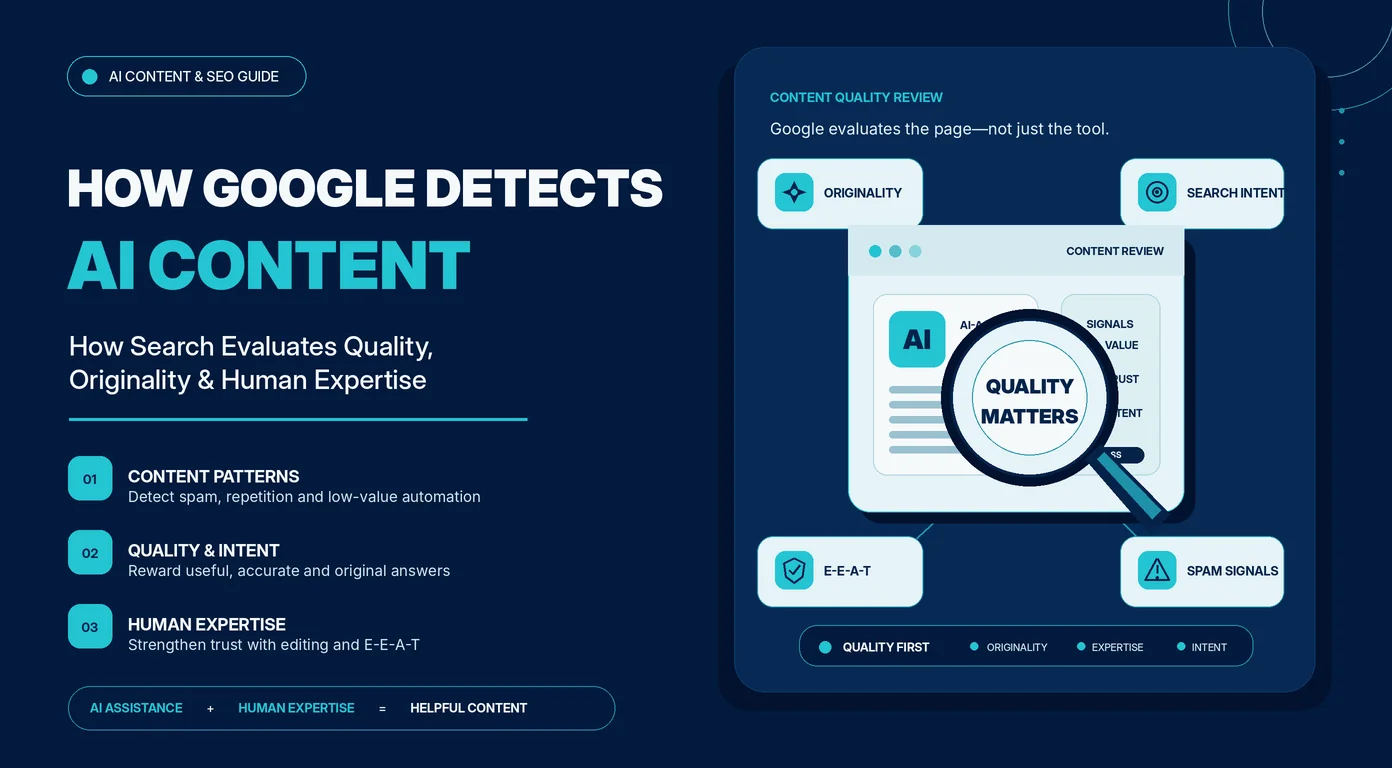
The short answer is yes. Google can identify patterns associated with automated content, but its ranking systems are not designed to penalize pages simply because AI was involved in the writing process. Google evaluates content based on quality, usefulness, originality, expertise, and the ability to satisfy search intent.
In this guide, you’ll learn how Google evaluates AI-generated content, the role of systems such as SpamBrain, how E-E-A-T influences rankings, and what content creators can do to build AI-assisted content that performs well in search results.
Google’s Official Policy: Quality Over Production Method
According to Google’s official policies, the quality of content is far more important than the production method. But people may think that Google might view AI content as illegal or against the rules; this is not true. Google believes that if the content or posts are useful for the reader, contain accurate facts and figures, and solve the specific problem, it doesn’t matter whether it is human-written or AI-generated. It only penalizes low-quality automation that causes ranking manipulation. The following are some approaches to deal with this scenario.
The Agnostic Approach
Google never demands 100 percent perfection, but it precisely requires high-value content. Therefore, it is not a problem to write with AI or generate with different language models, long before the rise of AI, such as ChatGPT and Gemini. Google has already trained its algorithm, so no junk, spammy, or low-value content can run. Google always rewards high-value content, and its main core goal is to give users high-value and accurate results or content.
Historical Context
Mass content production is a very old problem faced by Google because, before the AI models were introduced, Google already started to solve this problem. Google understands that banning specific tools or systems is not a permanent solution. Instead, they focused on making sure their algorithm is well-trained so no low-quality content can ever pass or rank on Search engine results pages (SERPs).
Google’s Core Goal
Basically, Google wants to help users by providing them the most accurate and trustworthy results or sources. This is the end goal of the Google search engine. Any helpful, content-rich content that offers high value and passes through Google’s different algorithms, which we will discuss further in the section below, will definitely rank that content and provide it a higher ranking. If you write useful, helpful content, it does not matter whether the content is AI- or human-written; it will always rank because this helps Google to fulfill its end goal.
How Does Google Actually Detect AI Content?
The fact is, Google checks all content using different methods and algorithms or by the system, and then decides whether this content is useful or not. Now, let’s discuss the techniques and systems, or algorithms, because google not rely on a single method.
SpamBrain and Machine Learning Systems
SpamBrain is an AI-based spam detection system, one of the most powerful weapons against low-quality content or spam links. Initially, this system was for spam links. Over time, SpamBrain evolved into a more advanced system capable of detecting various forms of spam and low-quality content. It generally works by analyzing numerous signals and patterns because AI models use the signature words or symbols in writing. It also checks keyword stuffing and rewritten or spun articles.
Linguistic Patterns and Writing Signals
Google has not officially announced the parameters to check the linguistic patterns or the AI detection system. But experts believe that there are some common characteristics in AI-generated content.
Predictability (Perplexity)
AI is more likely to use words and phrases that come next; on the other hand, human writers have different sentence structures, unique vocabulary, or unexpected phrases. So that’s why it is easy to find or detect AI-generated content.
Lack of Burstiness
“Burstiness” means variation in sentence structure, such as some long sentences and some short; on the other hand, AI is written in a uniform structure and rhythm. It is not necessary that all uniform-structure content is AI-generated, but there is a high chance that more uniform structure is AI-generated.
Commodity Regurgitation
AI models are trained on already existing data, so they either change or use the same data for content generation. Whereas humans have their own thinking, Google also prefers valuable, helpful, and unique data.
User Satisfaction and Content Quality Signals
Google’s ranking systems are designed to identify content that satisfies users’ needs. While Google has repeatedly stated that metrics such as bounce rate and time on page are not direct ranking factors.
Pages that provide clear answers, demonstrate expertise, maintain accuracy, and offer a positive user experience are likely to perform well in search results. Content that frustrates users, lacks depth, or fails to satisfy search intent struggles to maintain rankings over time.
Does Google Use AI Watermarks Like SynthID?
As we discuss different things, the most important question that arises is: Does Google use an AI watermark like SynthID? To answer this question, I would like you to know about SynthID.
What is SynthID?
SynthID is an invisible watermark technology developed by Google DeepMind. It embeds hidden watermarks in AI content like text, images, and videos without destroying their quality
Google currently uses SynthID in several of its AI products, including:
- Gemini for text generation
- Imagen for image generation
- Veo for video generation
- Lyria for music and audio generation
It helps to check whether the content is AI-generated or not, which promotes transparency in the AI ecosystem.
How Does SynthID Work?
It embeds different patterns in texts, images, or videos that can be easily identified by systems. This causes the difference between AI– and human-generated content.
Does Google Search Use SynthID for Rankings?
As of now, Google has not officially stated or claimed that search ranking depends on SynthID or any other watermarking systems. Besides that, Google relies on helpful or high-quality content, which is the main cause of the ranking going up and down.
Content Credentials and the C2PA Coalition
As AI grows rapidly, companies are looking for ways to make it transparent where the digital content comes from. One of the most important areas in this initiative is C2PA (Coalition for Content Provenance and Authenticity).
What is C2PA?
C2PA is an industry standard designed to record the history of digital content. It creates credentials, which are attached to images, videos, audio, and other forms of media.
Companies Supporting Content Credentials
Many leading technology companies and organizations support the C2PA standard, including:
- OpenAI
- Microsoft
- Adobe
- Meta
- Amazon
- BBC
Does C2PA Affect Google Rankings?
At this stage, Google has not officially announced any update regarding content credentials on ranking. Furthermore, this technology improves Google’s goals regarding transparency, trust, and content authenticity. It also really helps platforms to understand the origin of digital content.
Google’s Evaluation Framework: The Who, How, and Why
Google does not only evaluate whether the content is human-written or AI-generated. It uses a broader framework to determine whether a page is capable of ranking or not. One of the important concepts is Who, How, and Why. These are factors Google encourages content creators to consider while publishing content.
Who Created the Content?
Google wants to know who is responsible for the content read by the user. This is more important in topics such as health and finance because these fields require expertise to write.
To establish credibility, Google recommends:
- Clear author bylines
- Author biographies
- Relevant credentials and expertise
- Links to professional profiles or other publications
How Was the Content Created?
Google also wants to know how the content is produced. Google does not prohibit AI content; the main purpose is to ensure transparency in the reader’s mind. Google just needs accurate, helpful, trustworthy content.
Why Was the Content Created?
The most important question is: Why does the content exist?. If content is written to help users, answer questions, and share expertise, then it aligns with Google’s People First philosophy. However, if the content is for manipulation or mass production of pages, it may violate Google’s spam policies and struggle to rank.
The Role of E-E-A-T
E-E-A-T is an evaluation framework that stands for the following:
- Experience
- Expertise
- Authoritativeness
- Trustworthiness
This framework demonstrates that content should have real experience, expert knowledge, authority, and trustworthy information. It is not about AI content but about rewarding content to users that is helpful, reliable, and genuine to readers.
What SEO Professionals Commonly Observe in Practice
In real-world SEO campaigns, several patterns appear consistently:
- AI-generated content with little editing often lacks original insights and struggles to earn backlinks.
- Pages that include first-hand experience, case studies, original research, or expert commentary tend to outperform generic AI-generated articles.
- Human-edited AI content can rank extremely well when it provides accurate information and satisfies search intent.
- Content that simply rewrites existing information without adding value rarely achieves long-term ranking success.
These observations align closely with Google’s broader goal of rewarding content that demonstrates genuine expertise, experience, and usefulness.
How to Create Non-Commodity Content That Ranks
In this era of AI, thousands of articles are generated every day on the same topics and using identical information. This type of content is called “commodity content” because it often gives the same information, nothing unique or valuable.
Whereas Google and AI-powered systems prefer non-commodity content that provides original insights, real experiences, and authority that can’t be replicated by AI.
Commodity vs Non-Commodity Content
| Commodity Content | Non-Commodity Content |
| Generic tips and advice | Original insights, experiences, or research |
| Information already exists on hundreds of websites | Information that is difficult to find elsewhere |
| Rewritten, summarized, or paraphrased content | First-hand expertise, data, or unique perspectives |
| Little differentiation from competing content | Distinct value that competitors cannot easily replicate |
| Often created without real-world experience | Demonstrates practical experience and expertise |
| Easier for AI to generate at scale | Requires human knowledge, testing, or analysis |
Example
| Commodity Content | Non-Commodity Content |
| “7 Tips to Generate AI Content” | “How I Created AI-Generated Articles That Ranked on Google: A Detailed Case Study” |
The second example is more specific and includes real-world experience, original observations, and unique insights that are difficult to replicate. As a result, it provides greater value to readers and is more likely to demonstrate experience and expertise.
Shift from Writer to Editor
AI is not a complete replacement for human creativity, but should be used as an assistant.
You can use AI for:
- Keyword research
- Topic clustering
- Content outlines
- Research assistance
- Grammar and proofreading
However, humans should remain responsible for:
- Strategy
- Brand voice
- Fact-checking
- Final editing
- Adding original insights
This approach allows creators to do work fast and more efficiently while also maintaining quality and authenticity.
Add First-Hand Experience
This point needs expertise in the content that makes it unique and valuable.
Examples include:
- Personal experiences
- Case studies
- Original research
- Expert interviews
- Statistics and data
- Screenshots and real examples
The E-E-A-T framework strongly emphasizes content that demonstrates real-world experience and expertise.
Example: AI-Assisted Content That Can Rank
Imagine two websites publishing articles about local SEO.
The first website generates a 2,000-word article entirely with AI and publishes it without editing. The article summarizes information already available on hundreds of websites.
The second website uses AI to create an outline but enhances the article with screenshots, campaign data, client results, expert insights, and original observations.
Although both articles cover the same topic, the second page provides more value because it contains information that cannot be replicated easily. This is the type of content that aligns closely with Google’s E-E-A-T principles and helpful content guidelines.
Optimize for AI Search and RAG
RAG, which means Retrieval-Augmented Generation, is often used by modern AI systems that retrieve information from webpages before generating responses.
To improve visibility:
- Use clear headings and subheadings.
- Structure content logically.
- Keep important information accessible in HTML.
- Avoid hiding critical content behind JavaScript.
- Include facts, examples, and unique insights.
This means generating content that is easy to understand for humans as well as for AI systems. Furthermore, non- commodity content is difficult to copy because it consists of original thinking, real experiences, and genuine expertise.
Mythbusting AI Content and SEO
As we discussed above, many facts about Google ranking algorithms and systems. There are many misconceptions about AI-generated content and how Google treats it. Some people believe AI-generated content is best and vice versa.
Let’s separate facts from myths.
Myth 1: Google Automatically Penalizes AI Content
The simple answer is NO. Reality and fact are that Google needs useful content that satisfies search intent. It ranks well in search results.
However, spammy content and low-quality content that causes manipulation may violate Google’s spam policies.
Myth 2: You Need an llms.txt File to Rank in AI Search
The answer for this myth is NO. Many website owners think that the llms.txt file will improve their search results in ranking, as well as their suggestions in AI results. This is totally a myth. This file does nothing regarding ranking.
Myth 3: Content Chunking Is Required for AI Search
Some SEO experts suggest that breaking a whole topic or content into small chunks can increase AEO, but in reality, Google has explained that its system analyses whole pages, context, and semantic relations and, based on these conditions, increases AI search results.
Myth 4: AI Detectors Are Always Accurate
Google has not stated the use of public AI detector scores as a ranking factor. Because sometimes AI-generated content is flagged as human-written and vice versa.
Myth 5: AI Humanizer Tools Guarantee Rankings
AI humanizer tools that replace words and change sentence structure to appear human-like in an AI detector, but they do not guarantee better ranking.
Google primarily cares about:
- Originality
- Helpfulness
- User satisfaction
- Experience and expertise
- Genuine value
Future of AI Content and SEO
The future of SEO is not a competition between human-written content and AI-generated content. Instead, it is a competition between valuable content and low-value content.
As AI tools become more accessible, producing content will become easier than ever. As a result, originality, expertise, first-hand experience, and trustworthiness will become increasingly important ranking differentiators.
Google’s systems continue to evolve toward identifying content that demonstrates genuine value rather than rewarding content based on production volume. Websites that combine AI efficiency with human expertise, original insights, and strong editorial standards will be best positioned for long-term success.
The sustainable strategy is to use AI as a productivity tool while ensuring that every piece of content includes meaningful expertise, accurate information, and unique value for readers.
Conclusion
Google does not penalize content simply because it was created with AI. Instead, its systems evaluate content based on quality, usefulness, originality, expertise, and user satisfaction.
While technologies like SpamBrain help identify low-quality and spammy content, Google’s focus remains on rewarding helpful content regardless of how it was produced. AI can streamline content creation, but strong rankings typically come from combining AI efficiency with human expertise, original insights, and real-world experience.
Ultimately, success in SEO depends less on whether content is AI-generated and more on whether it genuinely helps users.
Frequently Asked Questions
Does Google consider AI content spam?
No. Google does not automatically classify AI-generated content as spam. Content is evaluated based on quality, usefulness, originality, and compliance with spam policies.
Can AI-generated content rank in AI Overviews?
Yes. AI-generated content can appear in AI Overviews if it provides accurate, helpful, and authoritative information that Google’s systems consider valuable.
How much human editing should AI content receive?
There is no required amount. The goal is to ensure the final content is accurate, helpful, fact-checked, and contains unique value beyond what AI can generate on its own.
Is AI-generated content safe for YMYL topics?
AI can assist with drafting, but content involving health, finance, legal, or safety topics should be reviewed by qualified experts to ensure accuracy and trustworthiness.
Can Google detect AI-humanized content?
Google’s systems evaluate overall content quality and patterns rather than relying solely on AI detectors. Humanizing text alone does not guarantee better rankings.
Will AI replace human writers in SEO?
AI is becoming a powerful productivity tool, but human expertise, original research, strategic thinking, and first-hand experience remain major ranking advantages.