
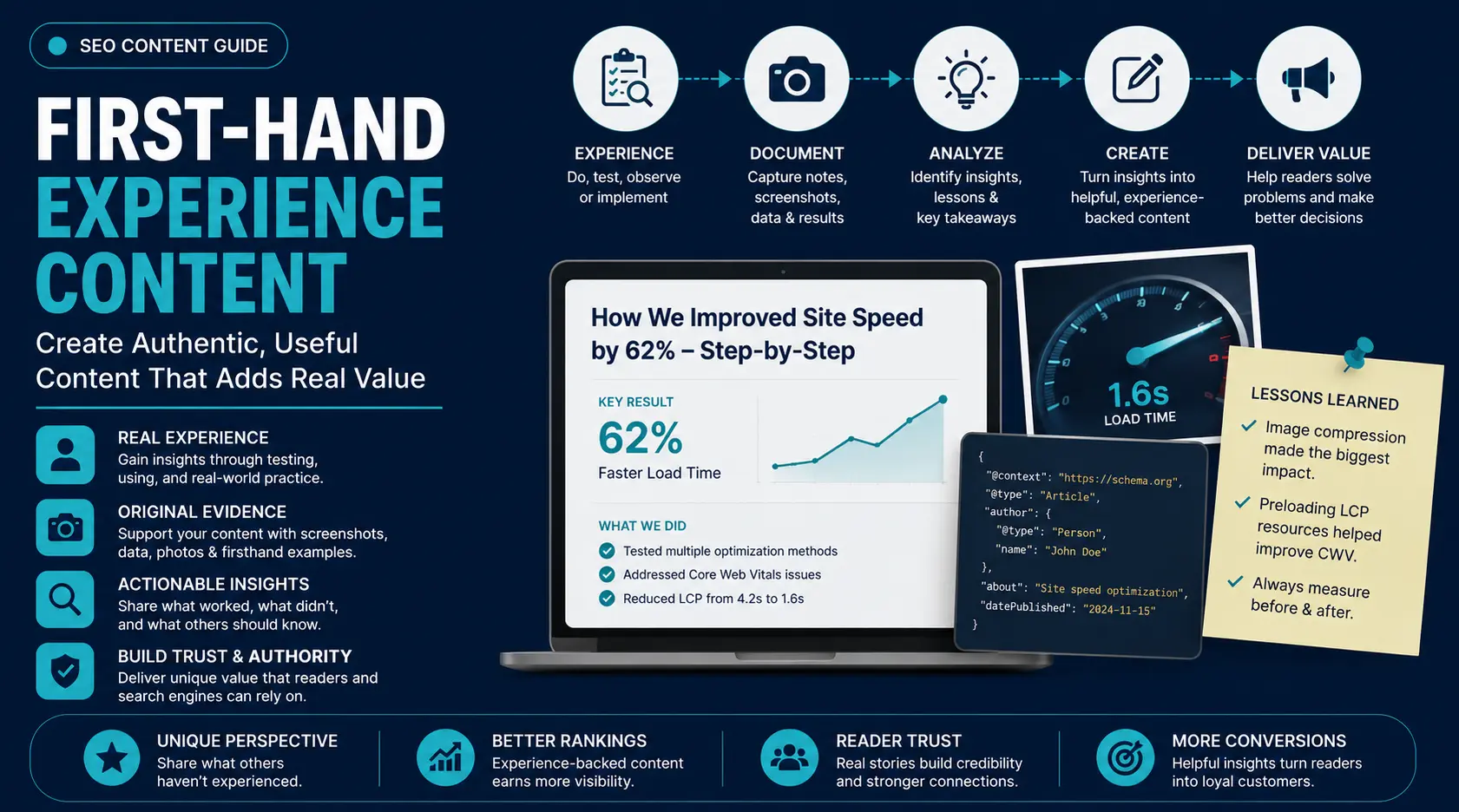
Most content obtained by search engines tells readers what works, how it works, or what are the requirements, but doesn’t show what actually happens in practice.
That gap leaves product reviews, tutorials, and guides filled with repeated same advice, generic claims, and little or no original insight. Content with first-hand experience closes that gap by providing useful evidence through real use, testing, implementation, and observations.
This guide explains how to create content supported by experience that adds genuine information instead of another rewritten summary.
What Is First-Hand Experience Content?
First-hand experience content is built from knowledge gained through direct involvement with the subject, i.e., using, testing, implementing, observing, investigating, or practicing it.
A software guide written by someone who configured the software, encountered an API error, tested workflows, and documented the workaround contains first-hand information. A product review based on three months of actual use contains first-hand observations. A case study based on implementing a marketing campaign contains first-hand findings. A location guide written after visiting the location include observations unavailable from directories or databases.
The key distinction is acquiring knowledge versus retrieving existing knowledge.
| First-hand knowledge | Researched knowledge |
| Personally testing a product | Reading product specifications |
| Implementing a process | Reading implementation guides |
| Running an experiment | Summarizing published experiments |
| Visiting a location | Using directory information |
| Analyzing original data | Citing someone else’s analysis |
| Directly interviewing a participant | Quoting an existing interview |
What Qualifies as First-Hand Experience?
The authentic first-hand experience comes from:
- Product or service use: purchasing, configuring, operating, or evaluating something.
- Testing and experimentation: testing variables, alternatives, workflows, or outcomes.
- Professional implementation: applying a strategy, system, procedure, or methodology in a real working environment.
- Direct observation: personally observing a process, environment, event, behavior, or outcome.
- Real-world problem solving: diagnosing an issue and documenting how it was resolved.
- Original research: collecting and analyzing self-generated data.
- Direct interviews or investigations: obtaining information directly from people involved in the subject.
A well-documented small test can provide useful information than a 3,000-word article based on information from competing sources.
First-Hand vs. Second-Hand Experience
First-hand experience comes from direct involvement. Second-hand experience comes from another person’s involvement.
For example, interviewing a software consultant about a 50-website CMS migration gives the writer first-hand information from the consultant, but not personal experience of performing the migration.
The distinction needs to be clear:
“The consultant reported that the migration initially failed because…”
not:
“I migrated 50 websites and found…”
unless the writer himself performed the migration.
Accurate attribution preserves the documented origin and authenticity of the experience and prevents another person’s experience from being presented as the writer’s own.
First-Hand Experience vs. Rewritten or Synthesized Content
Rewriting or synthesizing of the existing information doesn’t create first-hand experience. A writer can analyze 20 articles, combine their recommendations, rewrite them in their original language, and produce useful content, but the information is researched and not directly experienced.
Examples include:
- Rephrasing existing sources.
- Combining competitor information.
- Repeating consensus recommendations.
- Summarizing published research.
- Reworking an existing tutorial.
Google’s people-first guidance encourages creators to provide original information, research, or analysis.
First-Hand Experience vs. E-E-A-T
First-hand experience strengthens the E-E-A-T, but it represents only one dimension of the broader framework.
Experience Is One Component of E-E-A-T
First-hand experience and E-E-A-T are related, but cannot be used interchangeably.
First-hand experience describes how knowledge was acquired.
E-E-A-T describes four qualities:
- Experience
- Expertise
- Authoritativeness
- Trustworthiness
Google incorporated the second “E” to E-A-T to mention the experience, i.e., of using a product, visiting a place, or communicating what was actually experienced.
Experience vs. Expertise
Direct experience doesn’t make someone an expert, and expertise doesn’t prove direct experience with a specific subject.
For example, someone who uses a camera for six months has experience with that camera but is not necessarily a professional photographer.The distinction is:
| Experience | Expertise |
| Directly encountered or performed something | Possesses substantial knowledge or skill |
| Demonstrates involvement | Demonstrates competence |
| “Have you actually done this?” | “Do you understand this subject deeply?” |
Experience, Authority, and Trust Are Not Interchangeable
Each E-E-A-T dimension represents a different quality:
- Experience: Direct involvement with the subject.
- Expertise: Knowledge and competence.
- Authoritativeness: Recognition, reputation, or standing in a subject area.
- Trustworthiness: Accuracy, transparency, and reliability.
Google states that E-E-A-T is a framework for evaluating qualities associated with helpful, reliable content, and not a ranking scale. This prevents an SEO error of treating first-person language as an E-E-A-T optimization tactic.
What Makes First-Hand Experience Credible and How Do You Demonstrate It?
First-hand experience becomes credible when readers understand who performed it, what happened, under which conditions, and what evidence supports the findings.
| Credibility dimension | What to demonstrate | Examples |
| Direct involvement and context | Who performed the experience, what was tested or implemented, when, where, for how long, and under what conditions | Product use, software implementation, field visit |
| Genuine experience | Actual involvement and not first-person wording alone | Case study, contributor experience, organization-level testing |
| Testing methodology | What was tested, how it was tested, conditions, comparison criteria, tools, and evaluation method | Comparing three tools using the same dataset and criteria |
| Original observations | Findings that are not from generic sources or documentation | Unexpected behavior, implementation problems, operational constraints |
| Original evidence | Documentation that supports the experience and findings | Screenshots, photographs, measurements, test results, datasets, logs |
| Results and failures | What worked, what failed, unexpected outcomes, and factors that changed the result | Performance differences, failed workflows, edge cases |
| Limitations | Conditions under which the findings may not apply | Dataset size, test environment, duration, specific use case |
| Experience vs. evidence | Distinction between performing the experience and documenting it | A screenshot supports a software-use claim but does not create the experience |
The key distinction is simple: direct involvement creates the experience; evidence supports its credibility and verifiability. First-person language alone doesn’t satisfy the experience and credibility.
First-Hand Experience Content Workflow
Turning experience into useful content requires connecting the original experience to evidence, reader needs, search intent, and actionable insights, along with the documentation.
The Experience-to-Content Process
Turn genuine experience into useful content through this sequence:
- Identify the reader’s problem
Define the question, decision, or task the content needs to solve.
- Identify the experience gap
Find what generic content can’t answer:
- What becomes clear after doing this?
- What fails in practice?
- What takes longer than expected?
- Which limitations are missing from documentation?
- What changes the outcome?
- What would you warn others about?
- Perform or collect the experience
Generate or obtain relevant experience through product use, implementation, testing, experimentation, location visits, original data analysis, or direct interviews. Properly attribute experience that belongs to someone else.
- Document the methodology and evidence
Record actions, conditions, variables, observations, results, problems, costs, time, measurements, and supporting evidence during the experience.
- Capture failures, limitations, and edge cases
Record what worked, what failed, what changed the outcome, and where the findings can’t be generalized.
- Convert experience into insight
Use:
Experience → Observation → Insight → Recommendation
For example:
- Experience: A website migration was performed.
- Observation: Parameterized URLs were unintentionally duplicated.
- Insight: Parameter handling needed to be addressed before indexing problems appeared.
- Recommendation: Audit parameterized URLs during the pre-migration crawl.
- Create information gain
Add findings that existing content does not provide:
- Original observations.
- Practical constraints.
- Real-world results.
- Unexpected behavior.
- Edge cases.
- Implementation details.
- Findings that change a decision.
- Map findings to search intent
Connect each original finding to the reader’s question, problem, comparison, or decision so experience contributes to the content’s purpose.
- Separate experience from broader claims
Distinguish:
- Personal observations: what happened during the experience.
- Research findings: what published research demonstrates.
- Expert interpretation: what a qualified specialist concludes.
- Established facts: claims supported by authoritative sources.
- Uncertain conclusions: interpretations that remain unverified.
- Support broader claims with authoritative sources
Use external sources for definitions, statistics, regulations, industry standards, scientific findings, historical facts, technical specifications, and claims extending beyond direct experience.
- Verify experience claims
Confirm that every statement describing something as tested, implemented, observed, measured, visited, or experienced has a source.
- Build and update the content around the findings
Lead with the original evidence and insights and not the generic background information, then revisit the content when the product, process, conditions, or findings change.
Google’s guidance also highlights first-hand reviews and unique perspectives as examples of content that provide value beyond simply summarizing existing information.
Where First-Hand Experience Fits Different Content Types
First-hand experience has a different purpose in each content format. The writer needs to match the type of experience and evidence to what the reader needs from that format.
Product Reviews and Comparisons
Experience allows the writer to evaluate products beyond specifications and marketing claims.
Include:
- Actual usage and testing conditions.
- Performance differences.
- Problems and usability issues.
- Measured results.
- Long-term reliability.
- Conditions that affected performance.
The value comes from showing how the products performed in real use and why one is preferable under specific conditions.
How-To Guides and Tutorials
Experience validates whether a process works outside the documentation.
Include:
- Real implementation.
- Errors and failed steps.
- Troubleshooting.
- Practical workarounds.
- Process limitations.
- Differences between documented and actual workflows.
The tutorials answer the practical question: What happens when the expected process does not work?
Case Studies and Customer Stories
Experience provides the real-world context beside the outcome, and answers how the outcome was produced.
Document:
- Original situation and objectives.
- Actions and decisions.
- Obstacles encountered.
- Changes made during implementation.
- Outcomes and measurable results.
- Lessons learned.
Software and Professional Guides
Professional experience reveals operational details that product documentation doesn’t include.
It includes:
- Actual workflows.
- Implementation and configuration.
- Feature and integration testing.
- Operational problems.
- Workarounds.
- Practitioner insights.
- Maintenance requirements.
The value is added by showing how the tool or process behaves in a real professional environment, including constraints that are not visible in product documentation.
Experiments and Original Research
Experience is the basis for generating original evidence.
Document:
- Research question.
- Methodology.
- Variables and testing conditions.
- Data collection.
- Findings.
- Interpretation.
- Limitations.
The methodology needs to be such that the readers understand how the finding was produced, what it demonstrates, and where it should not be generalized.
How to Add First-Hand Experience to Existing Content
Existing content doesn’t need to be rebuilt. It is strengthened by identifying where direct experience, evidence, and practical findings are missing.
Identify Experience Gaps
Audit the content for:
- Generic recommendations.
- Repeated competitor information.
- Unsupported claims.
- Generic tutorials.
- Conclusions without practical evidence.
- Advice that ignores implementation constraints.
Ask:
Where does this article explain what should happen without showing what actually happened?
Replace Generic Claims With Direct Findings
Replace broad claims with findings from actual use, testing, or implementation.
Weak:
“This tool is easy to use.”
Stronger:
“During setup, the basic workflow took about 20 minutes, but importing the existing dataset required manual cleanup because…”
Turn generic statements into:
- Specific observations.
- Test results.
- Implementation findings.
- Practical lessons.
The goal is to give the reader actionable information.
Add Evidence Where It Changes the Answer
Prioritize evidence to help readers evaluate an important claim:
- Original screenshots.
- Photographs.
- Measurements.
- Test results.
- Before-and-after findings.
- Implementation notes.
Evidence is used to clarify or substantiate the finding. Adding screenshots without informational value won’t create meaningful experience content.
Remove Experience That Adds No Information
Experience earns its place by contributing:
- A new observation.
- Evidence.
- A practical lesson.
- A decision-making insight.
Weak:
“Last Tuesday, I sat down with my laptop and tried the tool.”
Useful:
“I tested the workflow on 500 URLs and found that…”
Adding experience doesn’t mean personal storytelling. It must be focused on the reader’s need.
First-Hand Experience, AI, and Content Authenticity
AI does generate convincing language about an experience, but it does not constitute lived experience. The key distinction is whether the underlying experience has a real source.
What AI Cannot Truthfully Provide
AI cannot personally:
- Use a product.
- Visit a location.
- Run a physical experiment.
- Implement a strategy in the real world.
- Experience an outcome.
- Observe a physical environment firsthand.
A statement such as “I tested the software for three weeks” is false if nobody performed that test.
How AI Can Process Genuine Experience
AI becomes useful after genuine experience exists. It helps:
- Organizing research notes.
- Structure findings.
- Group observations.
- Identify unanswered questions.
- Build outlines from raw notes.
- Draft explanations.
- Improve readability.
- Compare observations with existing claims.
How to Prevent Fabricated Experience
Do not present generated material as lived experience, including:
- Fake first-person stories.
- Invented testing or product usage.
- Simulated experiences presented as real.
- False “I tested…” claims.
- Fabricated measurements.
- Invented customer results.
- AI-generated personal anecdotes presented as authentic.
Asking AI to “write a review as if you used the product” creates convincing prose without factual provenance. That is fabricated experience, not experience-backed content.
Human Verification of Experience Claims
Use this workflow:
Real experience → Evidence → Notes → AI assistance → Human verification → Final content
Every claim describing something as tested, observed, implemented, measured, visited, or experienced should be traceable to a genuine source.
What If You Don’t Have First-Hand Experience?
The writers can source genuine experience and preserve its provenance in case of not having first-hand experience.
Don’t Present Research as Personal Experience
Research produces strong content when represented accurately.
Use language such as:
“Published studies indicate…”
or:
“According to practitioners interviewed for this article…”
Do not write:
“We found…”
when the work was not performed by “we.”
The source of the experience needs to be attributed correctly.
Work With People Who Have Relevant Experience
Collaborate with people who possess the experience. Their experience becomes legitimate source material when accurately reported and attributed. For example;
- Practitioners.
- Customers.
- Product users.
- Researchers.
- Industry professionals.
- Subject-matter contributors.
Use Interviews and Primary Research
Writers generate original information without personally performing the underlying work through:
- Direct interviews.
- Original surveys.
- Customer interviews.
- Case studies.
- Practitioner questionnaires.
- Original data collection.
- Primary research projects.
This establishes the writer’s role as investigator and synthesizer.
Attribute the Experience Correctly
Keep the source of each experience explicit.
“According to Sarah Khan, a technical SEO consultant who implemented the migration…”
is different from:
“We implemented the migration…”
The first preserves the source and the authority of the experience. The second claims ownership.
Accurate attribution protects both credibility and factual accuracy.
Common First-Hand Experience Content Mistakes
First-hand experience content loses its credibility when exaggerated, poorly documented, or presented without context. The common mistakes include:
| Common mistake | What it looks like | Why it weakens the content | Better approach |
| Rewriting existing information | Rephrasing competitor articles and presenting them as experience | Adds no original experiential value | Add testing, observations, research, or implementation findings |
| Making vague experience claims | “We tested several tools” | Readers cannot assess the experience | Specify what, how, when, and under what conditions |
| Using first-person language without experience | “I tested this product” without actually testing it | Creates a false credibility signal | Use first person only for genuine experience |
| Turning experience into a personal diary | Describing every step chronologically | Buries useful insights in unnecessary storytelling | Extract observations, lessons, and decision-making insights |
| Giving conclusions without context | “Product A performed better” | The result cannot be evaluated or reproduced | Explain criteria, conditions, comparison method, and results |
| Hiding failures and limitations | Reporting only successful outcomes | Makes the experience appear selective or promotional | Include relevant failures, constraints, and edge cases |
| Generalizing one experience | Treating one test as universally applicable | A single experience cannot establish a universal rule | State the specific conditions and scope of the finding |
| Fabricating experience with AI | AI-generated claims such as “I tested…” | Creates false first-hand evidence and damages trust | Use AI to organize genuine experience, never invent it |
Key Takeaways
- First-hand experience comes from direct involvement, not rewriting or synthesizing existing information.
- First-hand experience is not synonymous with E-E-A-T; it primarily contributes to the Experience component.
- First-person language does not prove experience. Context, methodology, evidence, and attribution matter.
- Credible experience content documents what was tested, observed, implemented, or measured, including results, failures, limitations, and edge cases.
- The value of experience lies in information gain, findings, constraints, observations, and insights that existing content does not adequately provide.
- Experience should become reader-focused information, not unnecessary personal storytelling.
- AI can organize and explain genuine experience but cannot truthfully fabricate it.
- When direct experience is unavailable, contributors, interviews, and primary research provide legitimate experience when properly attributed.
Frequently Asked Questions About First-Hand Experience Content
How do you verify whether content is based on first-hand experience?
Check for specific testing details, original observations, supporting evidence, and clear information about who performed the work.
How much first-hand experience is enough for an article?
Enough to support the article’s specific claims reliably. The required depth depends on the topic, complexity, and conclusions being presented.
Can multiple people’s experiences be combined into one piece of content?
Yes. Combine them with clear attribution so readers can distinguish each person’s observations and avoid treating them as one person’s experience.
How should first-hand experience be cited or attributed in content?
Identify who had the experience and their relationship to the subject. Clearly distinguish personal testing, interviews, customer experiences, and original research.
How can you measure the value of first-hand experience in an article?
Assess whether it adds original findings, practical details, decision-making insights, or information that competing content does not provide.