
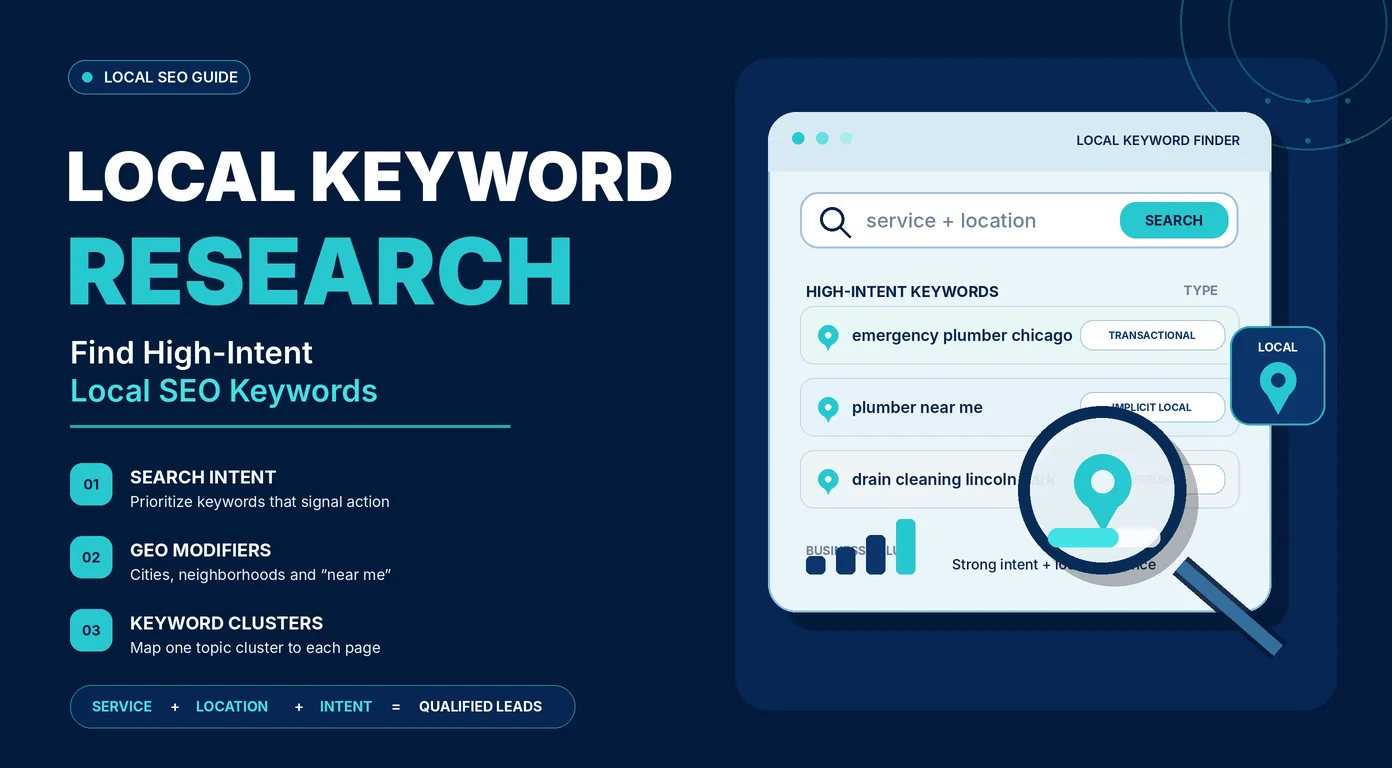
Local keyword research is the process of identifying the search terms people use to find products or services in a specific location. It forms the foundation of local SEO by helping businesses improve visibility in local search results, Google Maps, and location-specific searches.
Effective local keyword research goes beyond search volume. It identifies keywords with strong local intent, reflects how customers actually search, and uncovers opportunities at the city, neighborhood, and service levels.
This guide explains how to find high-intent local keywords, organize them into clusters, map them to the right pages, and measure their performance to attract qualified local traffic.
Key Takeaways
- Local keyword research identifies the terms people use to find nearby businesses, products, and services.
- Prioritize search intent and business relevance over search volume.
- Target a mix of service, location, and long-tail keywords based on how customers actually search.
- Use geographic modifiers such as cities, neighborhoods, ZIP codes, landmarks, and service areas where relevant.
- Group related keywords into topical clusters and map each cluster to a dedicated page to avoid keyword cannibalization.
- Optimize both your website and Google Business Profile to maximize local search visibility.
- Monitor keyword performance regularly and update your strategy as search behavior, competition, and local demand change.
What Is Local Keyword Research?
Definition and Purpose
Local keyword research is the process of discovering, evaluating, and organizing the search queries people use to find businesses, products, or services within a specific geographic area. Unlike traditional keyword research, it focuses on local search intent, including both explicit searches (e.g., roof repair in Austin) and implicit searches (e.g., roof repair, where Google determines location from the user’s device).
The goal is to identify the keywords that connect your business with nearby customers who are ready to take action. A strong local keyword strategy helps you:
- Improve local organic rankings
- Increase visibility in Google Maps and the Local Pack
- Drive qualified traffic, calls, bookings, and direction requests
- Build location-specific topical authority
These insights guide everything from website architecture and location pages to Google Business Profile optimization.
Why Local Keyword Research Matters
People rarely search using only a service name. Instead, they combine services with geographic modifiers, proximity signals, and local context, such as:
- Cities and suburbs
- Neighborhoods and districts
- ZIP or postal codes
- Landmarks and major intersections
- Near me, open now, and emergency modifiers
- Service-specific questions
Each variation reflects a different level of search intent. For example, best pediatric dentist downtown indicates commercial intent, while when should a child visit a dentist is informational.
Local keyword research helps you identify these intent variations, target high-converting searches, and uncover valuable long-tail and hyperlocal opportunities that generic keyword research often misses.
Local Keyword Research vs. Traditional Keyword Research
| Local Keyword Research | Traditional Keyword Research |
| Targets customers within a defined geographic area | Targets national or global audiences |
| Focuses on local search intent | Focuses on broader search intent |
| Optimizes for Google Maps, the Local Pack, and organic search | Primarily targets organic rankings |
| Uses geographic modifiers, proximity signals, and local entities | Targets broader topic-based keywords |
| Emphasizes proximity, relevance, and local authority | Emphasizes content depth and domain authority |
| Supports location pages and Google Business Profile | Supports blogs, guides, and national landing pages |
Examples
| Traditional Keyword | Local Keyword |
| HVAC repair | HVAC repair Chicago |
| Family dentist | Family dentist Brooklyn Heights |
| Car detailing | Mobile car detailing near me |
| Immigration lawyer | Immigration lawyer Mississauga |
Anatomy of a Local Keyword
Most local keywords consist of four components that work together to communicate what the user needs, where they need it, and how Google interprets the query.
Service Keyword
The service keyword describes the product or service the user is looking for, such as HVAC repair, family dentist, or personal injury lawyer. It forms the foundation of every local search.
Geographic Modifier
A geographic modifier explicitly identifies the location where the service is needed. Common modifiers include:
- Cities and towns
- Neighborhoods and districts
- Suburbs and counties
- ZIP or postal codes
- Service areas and regions
- Local abbreviations
These modifiers help businesses target location-specific searches with greater precision.
Implicit Proximity Signal
Not every local search includes a location. Queries such as plumber, pizza delivery, or urgent care often have implicit local intent, where Google infers the user’s location from signals like their device, IP address, and search context. Optimizing for both explicit and implicit local searches helps capture a broader share of local demand.
Hyperlocal Entity
Hyperlocal entities are recognizable places that define a location, such as neighborhoods, shopping centers, universities, hospitals, airports, transit stations, stadiums, or major intersections. People often use these landmarks instead of city names, making them valuable signals for improving local relevance and helping Google understand the areas your business serves.
Understanding Local Search Intent
Local search intent explains why someone performs a location-based search. Two users may enter similar keywords but expect different results. Understanding that intent helps businesses target searches that generate qualified traffic and conversions rather than vanity rankings.
Google determines local intent using a combination of the search query, user location, search behavior, and contextual signals. The closer your content aligns with user intent, the greater your chances of appearing in local organic results, the Local Pack, and Google Maps. While intent determines whether local results appear, rankings are also influenced by Google’s core local ranking factors: relevance, distance (proximity), and prominence.
Explicit vs. Implicit Local Keywords
Local keywords generally fall into two categories:
Explicit local keywords include a geographic modifier, such as a city, neighborhood, or region. Because the searcher specifies the location, Google knows exactly where they want the service.
Examples include:
- Dentist in Miami
- Toronto tax accountant
- HVAC repair Brooklyn
- Seattle coffee shop
Implicit local keywords don’t mention a location, yet Google still understands the user wants nearby results. Searches like plumber, urgent care, grocery store, near me, nearby, and closest rely on signals such as device location, GPS, IP address, Maps activity, and search context to return relevant local businesses.
Optimizing for both explicit and implicit local keywords helps businesses capture a broader range of local searches, particularly on mobile devices.
Types of Local Search Intent
Not every local search represents the same stage of the customer journey. Grouping keywords by intent helps you create pages that satisfy user expectations and improve conversion potential.
| Search Intent | User Goal | Best Content |
| Informational | Learn or research | Blog posts, guides, FAQs |
| Navigational | Find a specific business | Google Business Profile, location pages |
| Commercial | Compare local providers | Service pages, reviews, pricing, testimonials |
| Transactional | Book, call, buy, or visit | Service pages, booking pages, contact pages |
Informational Intent
Users are researching a problem or looking for answers before choosing a provider. Blog posts, buying guides, FAQs, and educational resources are ideal for these searches.
Navigational Intent
The searcher already knows the business or destination they want and is looking for information such as business hours, directions, contact details, or parking. Google often displays Google Business Profiles, Knowledge Panels, and branded search results for these queries.
Commercial Intent
Users are evaluating and comparing multiple businesses before making a decision. Service pages, customer reviews, testimonials, pricing information, and other trust signals help businesses compete for these high-value searches.
Transactional Intent
Transactional searches indicate the user is ready to take action, such as booking an appointment, requesting a quote, calling a business, or making a purchase. These keywords should lead to optimized service pages with clear calls to action, local trust signals, and an up-to-date Google Business Profile.
Mixed Intent
Some local keywords satisfy more than one type of intent. For example, a search for HVAC repair Chicago may indicate that the user wants to compare providers, read reviews, or book a service immediately. Before targeting a keyword, analyze the search results to understand the mix of informational, commercial, and transactional content that Google prioritizes.
How Google Determines Local Intent
Google evaluates more than keywords when deciding whether a search deserves local results. It considers multiple contextual signals to understand what the searcher wants and which businesses are most relevant.
Near Me and Proximity Searches
Queries containing phrases such as near me, nearby, or closest clearly signal local intent. Google prioritizes businesses based on proximity, relevance, and prominence.
User Location Signals
Google uses location signals beyond GPS, including IP address, device settings, Maps activity, recent travel patterns, and search history, to determine which nearby businesses best match the query.
Local SERP Features
If a query consistently triggers the Local Pack, Google Maps listings, business profiles, reviews, and location-based pages, Google recognizes it as having local intent—even when no geographic modifier is included.
Voice and AI-Powered Search
Voice searches are typically longer and more conversational than typed queries. AI-powered search experiences also evaluate entities, business attributes, reviews, contextual relevance, and natural language to identify businesses that best satisfy local intent. Optimizing for conversational queries, local entities, and complete business information helps improve visibility across both traditional and AI-driven search experiences.
Understanding how users search and how Google interprets local intent provides the foundation for effective keyword research. The next step is discovering the keywords, geographic variations, and customer language that create the best local SEO opportunities.
Evaluate, Cluster & Prioritize Local Keywords
Finding keyword opportunities is only the first step. To build an effective local SEO strategy, you must evaluate each keyword’s value, group related searches into topical clusters, and prioritize the opportunities that deliver the greatest business impact. This process helps prevent keyword cannibalization, improves site architecture, and ensures every page targets a distinct search intent.
Validate Search Intent
Before evaluating keyword metrics, confirm that Google interprets the keyword the same way you do. Search the keyword and analyze the search results to identify the dominant intent.
Look for signals such as:
- Service pages or location pages
- Blog articles and guides
- The Local Pack and Google Maps listings
- Directory websites
- AI Overviews
- Featured snippets and other SERP features
If Google consistently ranks local businesses, your page should satisfy the same commercial or transactional intent. Aligning content with search intent is often more important than targeting higher-volume keywords.
Evaluate Keyword Value
Search volume alone doesn’t determine a keyword’s value. Evaluate each keyword using multiple factors to identify opportunities that are both attainable and commercially valuable.
| Evaluation Factor | Why It Matters |
| Search Volume | Indicates overall demand but shouldn’t be the only deciding factor. |
| Business Value | Measures how closely the keyword aligns with your products or services. |
| Search Intent | Prioritize keywords with commercial or transactional intent. |
| Keyword Difficulty | Estimates how competitive the keyword is. |
| Cost Per Click (CPC) | High CPC often indicates strong commercial value. |
| Local Competition | Assess competitors’ reviews, authority, content quality, and Google Business Profile optimization. |
| Seasonality | Identifies keywords with recurring or seasonal demand. |
A lower-volume keyword with strong purchase intent often delivers better ROI than a high-volume informational query.
Build Semantic Keyword Clusters
Google ranks topics rather than individual keywords. Instead of creating separate pages for every variation, group closely related keywords that satisfy the same search intent into a single semantic cluster.
A typical cluster may include:
- Primary keyword
- Secondary keyword variations
- Synonyms
- Long-tail keywords
- Question-based queries
- Related entities
- Supporting concepts
For example, a water heater repair service page can naturally target variations such as hot water heater repair, emergency water heater repair, water heater service, and fix broken water heater. Consolidating these variations into one comprehensive page strengthens topical relevance while avoiding thin content and keyword cannibalization.
Prioritize Keyword Opportunities
Once keywords are clustered, prioritize them based on business impact and ranking potential. Focus on opportunities that offer the best balance between commercial value and achievable rankings.
| Priority Factor | High-Priority Keywords |
| Business value | High |
| Search intent | Commercial or transactional |
| Conversion potential | High |
| Ranking difficulty | Moderate or low |
| Existing topical authority | Strong |
| Content gap | Significant |
Start with keywords that combine high business value, clear local intent, moderate competition, and strong conversion potential. These opportunities typically generate faster SEO results before moving on to more competitive terms.
Map Keywords to Your Website
Once keywords are grouped into clusters, map each cluster to a dedicated page. Every important page should target one primary keyword cluster, one dominant search intent, and one audience. A clear keyword map prevents keyword cannibalization, improves site architecture, and helps Google understand how your content is organized.
Homepage Keyword Strategy
Your homepage should target your primary service and primary location, representing the broadest commercial keyword for your business.
For example:
- Family Dentist in Calgary
- HVAC Company in Dallas
Avoid targeting multiple cities on the homepage. Reserve location-specific optimization for dedicated location pages.
Service Pages
Create a dedicated page for each core service, with every page targeting a unique service keyword cluster and related semantic variations.
Examples include:
- Roof repair
- Drain cleaning
- Cosmetic dentistry
- Personal injury law
- Pest control
This structure improves topical relevance while preventing overlap between services.
Location Pages
If your business serves multiple cities or neighborhoods, create a unique location page for each service area. Avoid duplicate templates by adding localized information such as:
- Services offered
- Neighborhoods and landmarks
- Customer testimonials
- Area-specific FAQs
- Driving directions
- Relevant internal links
Unique, localized content improves relevance and reduces duplicate content issues.
Service-Area Business (SAB) Pages
Businesses without a public storefront can still target local searches by creating pages for the cities and regions they serve.
Examples include:
- Mobile locksmith
- Cleaning company
- Landscaping contractor
- Home remodeling business
Only create pages for areas where you genuinely provide services.
Multi-Location SEO Strategy
Businesses with multiple physical locations should give each location its own page containing:
- Unique contact information
- Location-specific services
- Customer reviews
- Google Business Profile
- Internal links to related locations
Maintain a consistent structure while ensuring each page provides unique local value.
Prevent Keyword Cannibalization
Keyword cannibalization occurs when multiple pages compete for the same search intent. Common causes include duplicate service pages, overlapping location pages, or blog posts targeting commercial keywords.
To avoid this, assign one primary keyword cluster to one URL. Support related pages through internal linking rather than creating competing content.
Create a Local Keyword Map
| URL | Primary Keyword | Secondary Keywords | Search Intent |
| Homepage | HVAC Company Dallas | HVAC Services Dallas | Commercial |
| /ac-repair | AC Repair Dallas | Emergency AC Repair | Transactional |
| /plano | HVAC Plano | Air Conditioning Plano | Commercial |
Implement Local Keywords
Finding the right keywords is only the first step. They must be integrated naturally across your website and business assets to reinforce topical relevance. Modern local SEO rewards comprehensive topic coverage, strong entity relationships, and a positive user experience—not keyword repetition.
Optimize Website Content
Each page should target one primary keyword cluster supported by related semantic variations.
Place the primary keyword naturally in:
- Title tag
- Meta description
- URL (when appropriate)
- H1 heading
- Introduction
- Subheadings
- Body content
- Image alt text
Rather than focusing on keyword density, write naturally while covering the topic comprehensively. Strengthen pages with supporting elements such as:
- Local case studies
- Customer testimonials
- Service-specific FAQs
- Pricing information (where appropriate)
- Clear calls to action
- Internal links to related services and locations
Optimize Your Google Business Profile
Your Google Business Profile (GBP) plays a critical role in Google Maps and Local Pack visibility. Optimize it by:
- Choosing accurate primary and secondary categories
- Writing a complete business description using natural service and location terminology
- Completing all service fields
- Publishing regular updates
- Uploading high-quality photos
- Responding to customer reviews
- Keeping business hours, contact details, and service areas accurate
A fully optimized profile reinforces your website’s local relevance and improves local discoverability.
Build Topical and Entity Relevance
Google evaluates relationships between businesses, services, locations, and recognized entities—not just individual keywords. Strengthen these connections by creating content that naturally links related topics, including:
- Service pages connected to location pages
- Neighborhood or area guides
- Local FAQs
- Customer case studies
- Seasonal or region-specific blog content
Maintain consistent business information across citations, directories, and social profiles to reinforce local authority and entity recognition.
Optimize for AI Overviews and Voice Search
AI-powered search and voice assistants increasingly prioritize concise, context-rich answers over exact-match keywords. Improve visibility by:
- Answering common customer questions directly
- Using descriptive heading structures
- Including concise definitions and summaries
- Writing in natural, conversational language
- Implementing structured data where appropriate
- Covering related entities and supporting concepts
Optimizing for conversational queries helps your content perform across traditional search, AI Overviews, voice search, and other emerging search experiences.
Tools for Local Keyword Research
No single tool uncovers every local keyword opportunity. The most effective workflows combine Google’s first-party data, third-party SEO platforms, and AI-assisted research to validate search demand, analyze competitors, identify trends, and uncover customer language.
Free Tools
Free tools provide enough data for many local businesses to build an effective keyword strategy.
| Tool | Best For |
| Google Keyword Planner | Keyword ideas, search volume, commercial intent, and geographic filtering. |
| Google Search Console | Impression and click data, page-two keywords, emerging location-specific queries, and CTR optimization opportunities. |
| Google Trends | Seasonal demand, regional interest, rising searches, and topic comparisons. |
| Google Autocomplete & Google Search | Long-tail keyword ideas through Autocomplete, People Also Ask, People Also Search For, Related Searches, Google Maps, and the Local Pack. |
Paid Tools
Paid platforms provide deeper keyword data, competitor insights, and local performance tracking.
| Tool | Best For |
| Semrush | Local keyword research, Keyword Gap analysis, Position Tracking, competitor research, and multi-location SEO. |
| Ahrefs | Keyword research, content gap analysis, competitor analysis, backlink intelligence, and semantic keyword discovery. |
| BrightLocal | Local rank tracking, citation management, Google Business Profile audits, reputation management, and local reporting. |
| Moz Local | Citation management, directory consistency, and multi-location business management. |
| Mangools | Keyword research, SERP analysis, rank tracking, and competitor evaluation for freelancers and small businesses. |
AI-Assisted Research
AI tools accelerate brainstorming and content planning but should complement—not replace—keyword research.
Popular tools include:
- ChatGPT
- Gemini
- Claude
- Perplexity
Common use cases include:
- Expanding seed keyword lists
- Generating semantic keyword variations
- Discovering customer questions
- Building topical clusters
- Creating content briefs
- Identifying related entities
- Grouping keywords by search intent
Always validate AI-generated keyword ideas using real search results, Google Search Console, or keyword research tools before incorporating them into your SEO strategy.
Measure Local Keyword Performance
Local keyword research doesn’t end after publishing optimized pages. Search behavior evolves, competitors refine their strategies, and Google’s algorithms continue to change. Regular performance tracking helps identify what’s working, uncover new opportunities, and prioritize optimization efforts.
Monitor both search visibility and business outcomes to measure the real impact of your local SEO strategy.
Track Organic Rankings
Monitor rankings for your primary keyword clusters across the locations you serve. Rather than focusing on a single keyword, evaluate visibility across related topics and pages.
Key metrics to monitor include:
- First-page rankings
- Keyword impressions
- Ranking changes by location
- Visibility of service and location pages
- Growth across keyword clusters
Consistent improvements across related keywords usually indicate stronger topical authority than a single high-ranking keyword.
Monitor Google Maps & Local Pack Visibility
Many local searches end in Google Maps or the Local Pack without users ever visiting a website. Tracking local visibility is therefore just as important as monitoring organic rankings.
Track performance for:
- Core service keywords
- Primary service areas
- Neighborhood-specific searches
- Mobile search results
Because Local Pack rankings vary based on proximity, monitor performance from different geographic locations whenever possible.
Measure AI Overview Visibility
As AI-powered search becomes more common, monitor whether your content appears as a cited source or contributes to AI-generated answers.
Visibility is more likely when your content:
- Answers questions clearly
- Covers related entities and topics comprehensively
- Demonstrates expertise and trustworthiness
- Uses logical headings and page structure
AI visibility should complement—not replace—traditional SEO performance tracking.
Analyze Google Business Profile Performance
Google Business Profile Insights show how customers discover and interact with your business listing.
Monitor metrics such as:
- Search queries
- Website clicks
- Phone calls
- Direction requests
- Photo views
- Messages (if enabled)
Growing engagement often indicates that your local keyword strategy is attracting more qualified local searchers.
Track Traffic, Leads & Conversions
Rankings are valuable only if they contribute to business growth. Measure the metrics that directly reflect customer acquisition and revenue.
Key performance indicators include:
- Organic sessions
- Phone calls
- Contact form submissions
- Appointment bookings
- Quote requests
- Revenue from organic search
High-intent local keywords often generate fewer visits than broad national terms but typically deliver stronger conversion rates and a higher return on investment.
Review & Refine Your Keyword Strategy
Regularly review keyword performance to identify emerging opportunities, declining rankings, and changes in local search behavior. Update existing pages, expand keyword clusters, and optimize underperforming content to maintain long-term local search visibility.
Common Local Keyword Research Mistakes
Even a well-researched keyword strategy underperforms if it’s implemented incorrectly. The following mistakes commonly limit local visibility, rankings, and conversions.
| Mistake | Why It Hurts | Best Practice |
| Ignoring search intent | Content doesn’t match what users or Google expect. | Align each page with the dominant search intent shown in the SERP. |
| Prioritizing search volume over business value | High-volume keywords don’t always generate leads or sales. | Focus on keywords with strong commercial relevance and conversion potential. |
| Overlooking implicit and hyperlocal keywords | Misses valuable local searches that don’t include a city name. | Target implicit searches, neighborhoods, landmarks, ZIP codes, and other local entities. |
| Poor keyword clustering and mapping | Causes keyword cannibalization and weak topical authority. | Group related keywords into semantic clusters and assign one cluster to one page. |
| Creating duplicate location pages | Thin, repetitive pages rarely perform well and may create duplicate content issues. | Create unique, localized pages with original content, FAQs, testimonials, and local references. |
| Keyword stuffing | Reduces readability and provides little SEO value. | Use natural language, semantic variations, and related entities instead of repeating exact-match keywords. |
| Skipping competitor analysis | Misses keyword opportunities, content gaps, and competitive insights. | Analyze competitors’ keywords, location pages, Google Business Profiles, and content strategies. |
| Neglecting Google Business Profile | Limits visibility in Google Maps and the Local Pack. | Keep categories, services, business information, reviews, photos, and hours fully optimized. |
| Failing to update keyword research | Search behavior, competition, and local demand change over time. | Review and refresh your keyword strategy every 6–12 months or whenever you expand into new services or locations. |
Local Keyword Research Template
Organizing research inside a spreadsheet keeps your strategy scalable and prevents keyword overlap.
A simple template might include the following columns:
| Keyword | Search Intent | Location | Search Volume | Keyword Difficulty | Business Value | CPC | Target URL | Ranking | Priority | Status |
| emergency plumber Chicago | Transactional | Chicago | 900 | Medium | High | High | /emergency-plumber-chicago | 8 | High | Optimized |
| drain cleaning Lincoln Park | Transactional | Lincoln Park | 120 | Low | High | Medium | /drain-cleaning-lincoln-park | 21 | Medium | In Progress |
| water heater repair near me | Transactional | Implicit | 450 | Medium | High | High | /water-heater-repair | 11 | High | Needs Update |
Review and update this sheet regularly so it reflects current rankings, priorities, and content opportunities.
Conclusion
Effective local keyword research goes beyond finding popular search terms. It helps you understand how local customers search, what they expect, and how to connect them with the right pages at the right stage of their journey. By focusing on search intent, geographic relevance, semantic keyword clusters, and real customer language, you can build a local SEO strategy that attracts qualified traffic and drives meaningful business results.
The process doesn’t end after publishing optimized pages. Regularly review your keyword data, monitor local search performance, refine your content, and adapt to changes in customer behavior and Google’s evolving search algorithms. Businesses that continuously improve their local keyword strategy are better positioned to maintain visibility, outperform competitors, and generate sustainable long-term growth.
FAQs
1. What is local keyword research?
Local keyword research is the process of identifying the search terms people use to find businesses, products, or services within a specific geographic area. It helps improve visibility in local organic search, Google Maps, and the Local Pack.
2. How is local keyword research different from traditional keyword research?
Traditional keyword research targets broad audiences, while local keyword research focuses on geographically relevant searches. It also considers proximity, local intent, and location-specific ranking signals.
3. How do I find local SEO keywords?
Start with your core services, then expand them using geographic modifiers, Google Autocomplete, People Also Ask, Google Maps, competitor analysis, customer reviews, and keyword research tools.
4. What are explicit and implicit local keywords?
Explicit keywords include a location, such as dentist in Boston. Implicit keywords, such as dentist near me or simply dentist, rely on Google to determine the user’s location and return nearby businesses.
5. How do I target “near me” searches?
Rather than adding the phrase near me repeatedly, strengthen local relevance through optimized location pages, an accurate Google Business Profile, consistent business information, local citations, and helpful localized content. Google determines proximity automatically.
6. What are the best local keyword research tools?
Popular options include Google Keyword Planner, Google Search Console, Semrush, Ahrefs, BrightLocal, Moz Local, Mangools, and AI tools like ChatGPT and Gemini for brainstorming and keyword clustering.
7. Can AI help with local keyword research?
Yes. AI can generate keyword ideas, discover semantic variations, organize keyword clusters, and create content briefs. However, every suggestion should be validated using real search data and search results.
8. How often should I update my local keyword research?
Review your keyword strategy every 6–12 months, or whenever you launch new services, expand into new locations, or notice significant changes in rankings or customer search behavior.