
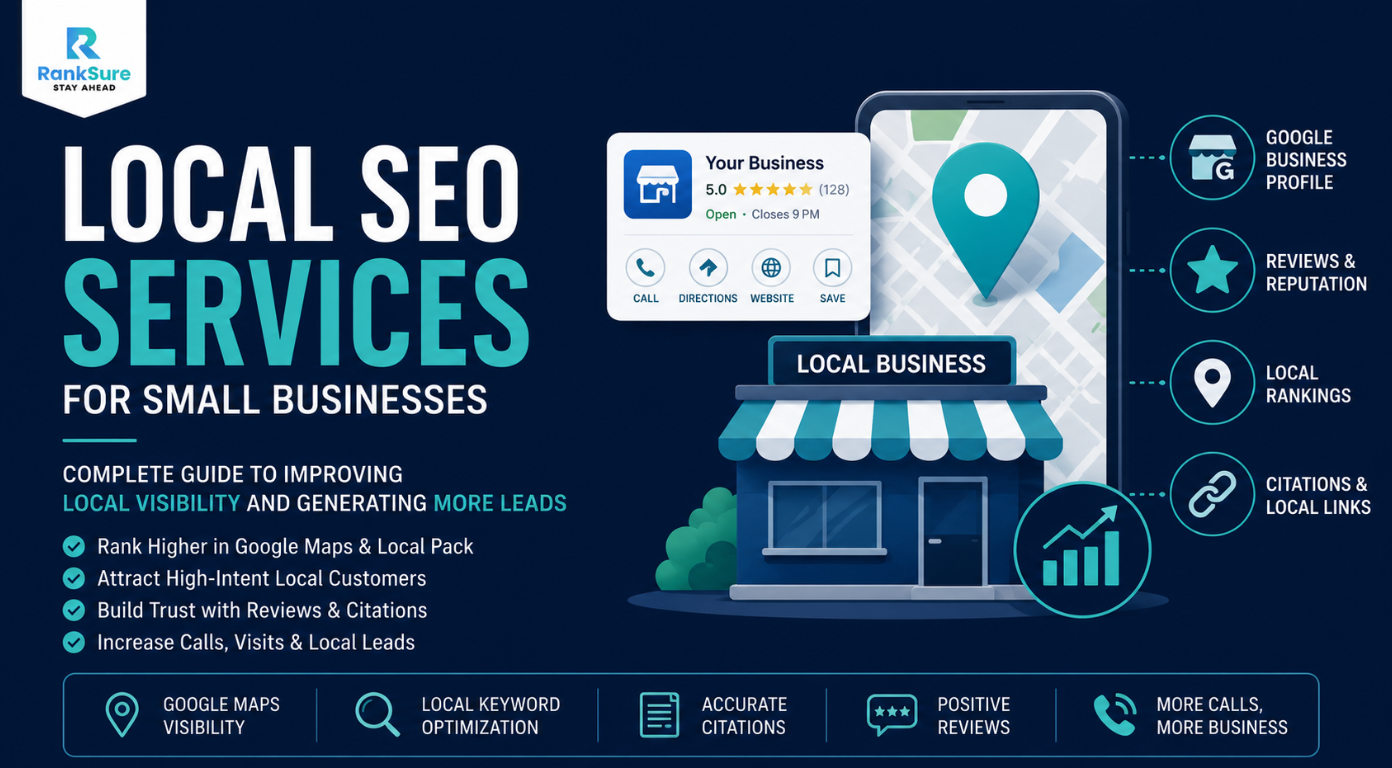
Local SEO services improve a small business’s visibility in Google Maps, the Local Pack, and location-based organic results. Local rankings depend on five connected elements: Google Business Profile optimization, website relevance, citations, reviews, and local authority.
Stronger local visibility connects businesses with customers searching for services such as “dentist near me” or “HVAC repair in Dallas.” This guide explains the services, optimization process, pricing factors, performance metrics, and provider-selection criteria involved in local SEO.
What Are Local SEO Services for Small Businesses?
Local SEO services are specialized optimization services designed to improve a small business’s visibility in location-based search results, including Google Maps, the Local Pack, and localized organic listings.
Local SEO connects businesses with customers in defined geographic areas. Traditional SEO targets broader national, international, or informational searches. A roofing company in Phoenix, a law firm in Chicago, or a restaurant in Vancouver competes mainly for searches where location, proximity, and service relevance influence the result.
A local SEO campaign optimizes six areas:
| Area | Purpose |
| Google Business Profile | Improve Maps visibility and local search appearance |
| Local keywords | Match services with location-based search intent |
| Website optimization | Build geographic relevance for search engines |
| Citations | Maintain accurate business information across directories |
| Reviews | Strengthen trust and reputation signals |
| Local links and mentions | Increase authority within a specific market |
How Local SEO Services Help Businesses Get Found Locally
Local SEO services improve visibility by strengthening relevance and prominence while clarifying the business’s location. Google evaluates these signals through three local ranking factors: relevance, proximity, and prominence.
Local SEO services improve each area by aligning business information with how customers search.
Relevance improves when a business profile, website, and content clearly match customer queries. A plumbing company should not only list “plumbing services” but also optimize for specific services such as water heater repair, drain cleaning, or emergency plumbing in its target locations.
Proximity is influenced by the searcher’s location and the business’s service area. Businesses cannot control a searcher’s location. They can strengthen location signals through accurate addresses, defined service areas, localized pages, and consistent business data.
Prominence reflects how established and trusted a business appears online. Reviews, local backlinks, citations, and brand mentions contribute to this signal.
Local SEO improves visibility across five search surfaces:
- Google Maps results
- Google Local Pack (the three business listings shown above organic results)
- Location-based organic search results
- “Near me” searches
- Voice and conversational searches
A customer searching “emergency electrician near me” has not been researching for months. They are looking for a provider they can call immediately. Local SEO connects businesses with these high-intent moments.
Local SEO Services vs Traditional SEO Services
Traditional SEO focuses on improving website rankings across broader search results. Local SEO adds geographic signals that help search engines understand where a business operates and which customers it serves.
| Traditional SEO | Local SEO |
| Targets broad keywords | Targets location-based queries |
| Focuses heavily on website authority | Uses GBP, citations, reviews, and local signals |
| Competes nationally or globally | Competes within specific markets |
| Measures traffic and rankings | Measures calls, visits, bookings, and leads |
A small business does not need to outrank a national brand for broad keywords. A local bakery does not need to rank above global recipe websites for “birthday cake ideas.” It needs visibility when someone searches for “birthday cakes near me” or “custom cakes in [city].”
Local SEO services are built around that difference.
Why Small Businesses Need Local SEO Services
Capture Customers With High Local Purchase Intent
Local SEO captures customers searching for a specific service in a defined location. These searches commonly lead to calls, bookings, direction requests, or visits.
Searches containing location modifiers indicate stronger commercial intent:
- “roof repair company near me”
- “best chiropractor in Austin”
- “emergency plumber downtown”
- “coffee shop open now”
These searches indicate immediate actions such as calling, booking, requesting directions, or visiting a location.
Local SEO services help businesses capture this demand by optimizing for:
- Service + city keywords
- Neighborhood searches
- “Near me” queries
- Google Maps discovery
- Local service pages
Visibility during a high-intent search creates opportunities for calls, bookings, direction requests, and store visits.
Compete With Larger Businesses in Local Markets
Small businesses compete with larger brands by building stronger geographic relevance and local trust. Domain authority and advertising budgets carry less weight when the search depends on service relevance, location, reviews, and proximity.
Local SEO changes the competition model.
A small business competes locally by strengthening five geographic signals:
- A complete and optimized Google Business Profile
- More authentic customer reviews
- Better local landing pages
- Stronger community connections
- More accurate business information
A family-owned dental clinic competes with larger healthcare networks by building stronger relevance, reviews, citations, and location-specific content within its city.
Local authority matters more than overall website size in location-based results.
Generate Consistent Leads Beyond Paid Advertising
Local SEO generates calls, bookings, direction requests, and website inquiries without charging for each organic click. Paid advertisements stop producing traffic when campaign spending ends.
An optimized local presence generates six measurable customer actions:
- Phone calls from Google Maps
- Website visits from local searches
- Direction requests
- Appointment bookings
- Quote requests
- Store visits
Measure calls, forms, bookings, direction requests, and revenue alongside rankings. A first-position ranking has limited business value if it produces no customer inquiries.
Local SEO campaigns track revenue-related actions such as:
- Calls from Google Business Profile
- Form submissions
- Bookings
- Customer inquiries
- Conversion rates
What Is Included in Local SEO Services?
Local SEO services are not a single optimization task. They combine multiple systems that influence how Google understands, ranks, and displays a local business.
Google Business Profile Optimization
Google Business Profile (GBP) is the foundation of local search visibility. It directly influences how businesses appear in Google Maps and the Local Pack.
Professional Google Business Profile optimization covers four areas: setup, category selection, business information, and profile content.
Profile Setup and Verification
Businesses need accurate ownership verification, correct business details, and proper address settings. Incorrect verification or duplicate profiles can limit visibility.
Category Selection
Primary and secondary categories influence which searches trigger a business listing.
For example:
A restaurant choosing “Italian Restaurant” as its primary category sends a different relevance signal than selecting only “Restaurant.”
Business Information Optimization
Important profile elements include:
- Business name
- Address
- Phone number
- Website URL
- Business hours
- Service areas
- Attributes
- Services/products
Photos, Videos, Posts, and Q&A
Fresh visual content helps maintain profile activity and improves customer confidence.
Businesses should regularly add:
- Publishing team photos
- Adding service photos
- Uploading location images
- Sharing short videos
- Creating Google Posts
- Answering common customer questions
Customer-uploaded photos and real project images provide direct evidence of completed work. Generic stock visuals provide no evidence of local experience.
Local Keyword Research and Location-Based Content Strategy
Local keyword research identifies how customers describe services in specific markets.
The process goes beyond adding city names to every page.
A local keyword strategy maps five search types:
| Search Type | Example |
| Service keyword | HVAC repair |
| Location keyword | HVAC repair Dallas |
| Neighborhood keyword | HVAC repair Uptown Dallas |
| Problem-based search | AC not cooling near me |
| Customer question | How much does AC repair cost? |
Local SEO services use these keywords to create:
- Service pages
- Location pages
- FAQ sections
- Google Business Profile content
- Supporting local articles
Each page should satisfy a specific search intent instead of creating multiple near-identical location pages with minimal information.
Local Website Optimization
A website supports local rankings by providing stronger relevance signals than a business profile alone.
Local website optimization includes:
Service Pages
Each core service should have a dedicated page explaining:
- Service details
- Areas served
- Customer problems solved
- Local expertise
- Conversion options
Location Pages
Location pages target separate markets through unique service information, customer examples, local references, and location-specific FAQs.
Useful elements include:
- Local service information
- Customer examples
- Service availability
- Local references
- Location-specific FAQs
Local Schema Markup
LocalBusiness schema helps search engines understand structured information such as:
- Business type
- Address
- Phone number
- Operating hours
- Service areas
Technical factors also matter. Mobile usability, page speed, internal linking, and crawlability affect how efficiently search engines access local content.
Citation Management and Business Information Accuracy
Business information should be identical everywhere customers and search engines find it. Business information must remain consistent across platforms. An old phone number, shortened business name, or outdated address creates conflicting information.
Citation management focuses on maintaining accurate NAP (Name, Address, Phone Number) data across directories, maps, social profiles, and industry platforms.
A citation campaign follows six steps:
- Auditing existing listings
- Correcting inaccurate business information
- Removing duplicate listings
- Creating listings on trusted directories
- Adding industry-specific citations
- Monitoring citation consistency over time
Quality matters more than volume. A few authoritative local and niche directories provide far more value than hundreds of low-quality submissions.
Review and Reputation Management
Reviews influence both customer decisions and Google’s understanding of business prominence.
A consistent review strategy isn’t about collecting hundreds of ratings overnight. It’s about creating a repeatable process that generates authentic feedback from satisfied customers.
Effective review management includes:
- Sending automated review requests
- Following up by email or SMS after completed services
- Responding to positive and negative reviews
- Monitoring reviews across multiple platforms
- Identifying recurring customer issues
Responses should address customers naturally instead of using identical templates.
Poor response:
“Thank you for your feedback.”
Better response:
“Thanks for trusting us with your kitchen remodel. We’re glad the project finished ahead of schedule and appreciate your recommendation.”
Specific responses reinforce relevance while demonstrating genuine customer engagement.
Local Authority Building Through Links and Mentions
Google evaluates whether a business is recognized within its local community.
Authority grows through relevant local references rather than random backlinks.
Common authority-building opportunities include:
- Local Chamber of Commerce websites
- Community sponsorships
- Charity partnerships
- Local business associations
- Neighborhood organizations
- Local news coverage
- Community event participation
- Industry directories
Digital PR also plays a role. Local newspaper coverage connects the business with a specific city, event, and community. Generic directory links provide less geographic context.
Unlinked brand mentions still contribute to overall brand recognition, especially when they appear consistently across trusted local websites.
How Local SEO Services Improve Search Visibility
Optimizing Google Business Profile Signals
Google Business Profile remains the strongest local ranking asset for most small businesses.
Google Business Profile optimization focuses on four signals: relevance, completeness, engagement, and freshness.
| Signal | Optimization Focus |
| Relevance | Accurate categories, services, keywords |
| Completeness | Photos, hours, services, attributes, products |
| Engagement | Calls, clicks, direction requests, messages |
| Freshness | Posts, reviews, updated business information |
Businesses should also optimize for zero-click searches. Many customers never visit the website—they call directly, request directions, send messages, or book appointments from the Business Profile itself.
Features such as online booking, messaging, product catalogs, FAQs, and service listings help convert customers directly inside Google Search and Maps.
Strengthening Local Website Relevance
A Google Business Profile alone rarely achieves long-term local dominance.
The website reinforces local relevance by helping search engines understand:
- Services offered
- Locations served
- Business expertise
- Geographic coverage
- Relationships between services and locations
Strong local websites include:
- Individual service pages
- Unique location pages
- Internal links connecting related services
- Embedded Google Maps where appropriate
- LocalBusiness schema
- FAQs answering service, price, timing, availability, and location questions
Every page should satisfy a distinct search intent. Creating dozens of nearly identical city pages with only the location name changed offers little value and underperforms.
Building Trust and Authority Signals
Google wants confidence that a business is legitimate, established, and recommended by real customers.
Those trust signals come from multiple sources rather than one ranking factor.
The strongest include:
- High-quality customer reviews
- Consistent business information
- Local backlinks
- Brand mentions
- Community involvement
- Accurate business details
- Positive user engagement
These combined signals strengthen business prominence and local search eligibility.
Improving Local Ranking Factors: Relevance, Proximity, and Prominence
Google evaluates local businesses using three primary ranking factors.
| Ranking Factor | What Google Evaluates |
| Relevance | How well the business matches the search query |
| Proximity | Distance between the searcher and the business or service area |
| Prominence | Overall authority, reputation, and online recognition |
Businesses cannot control where a customer searches from, so proximity has natural limits.
Relevance and prominence, however, can be strengthened through ongoing optimization.
That’s why local SEO focuses less on “gaming” Google’s algorithm and more on building a complete, trustworthy local presence.
Local SEO Services Process: How Agencies Optimize Small Businesses
Local SEO Audit and Opportunity Analysis
An effective campaign begins with identifying what’s limiting visibility.
A comprehensive local SEO audit evaluates eight areas:
- Google Business Profile health
- Local ranking positions
- Competitor visibility
- Keyword opportunities
- Citation consistency
- Website optimization
- Technical issues
- Online reputation
Gap analysis reveals overlooked opportunities, such as missing service categories, duplicate listings, weak location pages, or competitors ranking for valuable local keywords.
Local SEO Strategy and Implementation
Audit findings determine which improvements receive priority based on business goals, ranking gaps, and competitive difficulty.
Local SEO implementation covers eight actions:
- Keyword mapping
- Google Business Profile optimization
- Website improvements
- Location page creation
- Citation cleanup
- Review generation campaigns
- Local content development
- Local authority building
A coordinated strategy connects profile optimization, website improvements, citations, reviews, content, and local authority building.
Monitoring Local SEO Performance and ROI
Local SEO performance is measured through visibility, calls, bookings, forms, store visits, and revenue. Rankings provide context but do not measure customer acquisition alone.
Track seven local SEO performance metrics:
| KPI | Why It Matters |
| Local keyword visibility | Measures search presence |
| Google Business Profile views | Indicates profile discovery |
| Calls | Tracks direct lead generation |
| Direction requests | Reflects offline purchase intent |
| Website conversions | Measures inquiry quality |
| Form submissions | Tracks qualified leads |
| Organic traffic | Shows overall search growth |
Call tracking, Google Analytics, Google Search Console, and Google Business Profile Insights provide a clearer picture of ROI than rankings alone.
Local SEO Strategies Based on Business Type
Local SEO for Storefront Businesses
Businesses with physical locations depend heavily on Google Maps visibility.
Priority areas include:
- Accurate address information
- Walk-in optimization
- Local Pack visibility
- Store-specific photos
- Customer reviews
- Nearby landmark references
Retail stores, restaurants, salons, gyms, and medical clinics benefit most from strong map visibility.
Local SEO for Service Area Businesses
Service Area Businesses (SABs) visit customers instead of serving them at a physical storefront.
Examples include:
- Plumbers
- Electricians
- Landscapers
- Cleaning companies
- Pest control services
Their strategy differs in several ways:
- Service areas replace public storefront addresses where appropriate.
- Location pages target cities and service regions.
- Google Business Profile settings prioritize service coverage instead of walk-in traffic.
- Reviews reference completed projects across different locations.
Trying to optimize an SAB like a retail store weakens local relevance.
Local SEO for Multi-Location Businesses
Multi-location businesses require a separate optimization system for each branch.
A multi-location strategy requires five elements:
- Separate Google Business Profiles
- Dedicated location pages
- Location-specific reviews
- Independent citation management
- Unique local content for each branch
Each location should build authority independently while remaining part of a consistent brand structure.
How Much Do Local SEO Services Cost for Small Businesses?
Local SEO Pricing Models
Pricing varies depending on the scope of work.
| Pricing Model | Best For |
| One-time audit | Businesses needing a roadmap before implementation |
| Monthly retainer | Ongoing optimization and growth |
| Freelancer | Smaller budgets with limited requirements |
| Agency package | Full-service local SEO management |
Monthly retainers are the most common because local SEO requires ongoing optimization rather than one-time setup.
Factors That Affect Local SEO Pricing
Seven variables influence local SEO campaign costs:
- Market competition
- Number of business locations
- Number of services
- Existing website quality
- Citation cleanup requirements
- Reputation management needs
- Content creation volume
- Technical SEO issues
A business operating in a highly competitive legal or healthcare market will typically require more resources than one serving a niche local audience.
Is Investing in Local SEO Worth It?
Local SEO is worth the investment when qualified local leads produce revenue above the campaign cost. Measure that return through calls, bookings, store visits, conversion rates, and customer acquisition costs.
Organic local visibility continues after an advertising campaign ends when the business maintains its profile, website, citations, reviews, and content.
Local SEO return appears through six business outcomes:
- More qualified leads
- Higher call volume
- Increased direction requests
- Better conversion rates
- Stronger brand recognition
- Sustainable organic growth
Success should be measured by revenue and customer acquisition—not rankings alone.
How to Choose the Right Local SEO Service Provider
Evaluate Local SEO Experience and Strategy
Choose a provider with experience in your industry, service area, and business model. Request evidence of its Google Business Profile, citation, content, review, and reporting processes.
Ask whether the provider has experience with:
- Businesses similar to yours
- Your industry
- Your service area
- Google Business Profile optimization
- Local content strategies
- Citation management
- Review systems
The strategy should explain how results will be achieved, not simply promise higher rankings.
Check Reporting, Transparency, and Results
Providers should report local rankings, profile activity, website traffic, calls, leads, and conversions.
Treat guaranteed #1 rankings or guaranteed Local Pack placement as warning signs. Google does not allow anyone to guarantee specific organic or local ranking positions.
Local SEO Tools Used by Small Businesses and Agencies
Essential Free Local SEO Tools
| Tool | Primary Use |
| Google Business Profile | Business profile management |
| Google Search Console | Search visibility and indexing |
| Google Analytics | Traffic and conversions |
| Google Keyword Planner | Local keyword research |
Professional Local SEO Platforms
| Platform | Primary Strength |
| BrightLocal | Citation management and local rank tracking |
| Whitespark | Citation building and local search tools |
| Semrush | Keyword research and competitor analysis |
| Ahrefs | Backlink analysis and content opportunities |
| Moz Local | Listing distribution and business data management |
Agencies combine several platforms because each tool covers a separate task, such as rank tracking, citation management, keyword research, or backlink analysis.
Common Local SEO Mistakes Small Businesses Should Avoid
Several recurring mistakes limit local visibility even when businesses invest in SEO.
Avoid these 10 local SEO mistakes:
- Leaving Google Business Profiles incomplete
- Publishing inconsistent business information
- Ignoring customer reviews
- Building low-quality citations
- Creating duplicate location pages
- Publishing identical content across cities
- Targeting broad keywords instead of local intent
- Measuring rankings instead of leads
- Neglecting mobile performance
- Failing to update business hours, services, and photos
Consistency produces better results than aggressive optimization.
The Future of Local SEO Services
AI Search and Local Business Discovery
Local search is becoming increasingly entity-driven.
AI-powered search experiences rely on structured business information, reviews, citations, and trusted sources to generate recommendations.
Businesses should maintain five assets for AI-powered local discovery:
- Complete Google Business Profiles
- Structured data
- Consistent business information
- Strong review profiles
- Helpful location-specific content
Voice search follows similar patterns. Queries such as “Find an emergency electrician open near me” favor businesses with accurate local data and clear service information.
Reputation and Multi-Platform Visibility
Customers no longer rely on a single platform before making a decision.
They compare:
- Google reviews
- Facebook recommendations
- Industry review websites
- Local directories
- Social media profiles
Consistent branding, accurate business information, and positive customer experiences across these platforms reinforce trust while improving overall local authority.
Key Takeaways
- Local SEO services help small businesses reach customers actively searching within their service area.
- Google Business Profile optimization forms the foundation of local visibility and zero-click conversions.
- Reviews, citations, localized content, and local authority signals collectively influence Google Maps and Local Pack rankings.
- Different business models—storefront, service area, and multi-location—require different optimization strategies.
- Success should be measured through qualified leads, calls, bookings, and revenue rather than keyword rankings alone.
- AI-powered search is increasing the value of structured business data, reputation signals, and entity-based optimization.
FAQs About Local SEO Services for Small Businesses
What are local SEO services for small businesses?
Local SEO services improve a business’s visibility in Google Maps, the Local Pack, and localized organic search through Google Business Profile optimization, local website improvements, citation management, review strategies, and local authority building.
What is included in local SEO services?
Most campaigns include Google Business Profile optimization, local keyword research, website optimization, citation management, review management, local content creation, technical improvements, and local link building.
How much do local SEO services cost?
Pricing varies by competition, location count, and campaign scope. Businesses can choose one-time audits, monthly retainers, freelancer support, or full-service agency packages.
Are local SEO services worth it?
Yes. Businesses that rely on nearby customers see long-term benefits through increased calls, bookings, store visits, and qualified leads while reducing dependence on paid advertising.
How long does local SEO take to show results?
Local SEO timelines depend on competition, website condition, profile quality, citation accuracy, and review activity. Agencies commonly evaluate initial progress over a three-to-six-month period rather than guaranteeing a fixed completion date.
Can small businesses do local SEO themselves?
Yes, but maintaining Google Business Profiles, citations, reviews, website optimization, and ongoing content becomes increasingly time-consuming as competition grows. Many businesses handle the basics internally and outsource advanced optimization.
What does a local SEO company do?
A local SEO company audits existing performance, develops a location-focused strategy, optimizes Google Business Profile and website assets, manages citations and reviews, builds local authority, and tracks lead generation performance.
Does Google Business Profile help local rankings?
Yes. A complete, accurate, and actively managed Google Business Profile is one of the strongest signals influencing visibility in Google Maps and the Local Pack.
What businesses need local SEO services?
Any business serving customers within a defined geographic area benefits from local SEO, including medical practices, contractors, restaurants, law firms, retailers, salons, home service providers, and professional service businesses.
What is the difference between local SEO and traditional SEO?
Traditional SEO targets broader organic visibility, while local SEO focuses on geographic relevance through Google Business Profile optimization, citations, reviews, local content, and proximity-based ranking signals.