
Search has now become question-driven.
People don’t search with a keyword. They ask complete questions, and search engines, voice assistants, and AI systems understand them and answer accordingly. Like for example;
- Which CRM is best for a small business?
- How do I choose running shoes for flat feet?
- What is the difference between FAQ schema and Q&A schema?
Modern Q&A pages help businesses organize information, answer user questions quickly, and improve visibility across search results and AI-powered search platforms.
This guide explains how to plan, structure, optimize, and maintain Q&A pages that serve both people and machines.
What Is a Q&A Page?
A Q&A page is a collection of questions and answers that are structured and organized around a specific topic, product, service, or business process.
Question-based content is designed based on the way people naturally search for information. Every question addresses a specific intent, and each answer is a direct, concise, and authoritative response.
A well-designed Q&A page serves these purposes::
- Organizes information logically
- Improves information retrieval
- Reduces user friction
- Supports search visibility
- Helps AI systems understand context
From a technical perspective, every question becomes a semantic entity connected to related concepts, products, services, and supporting content throughout the site.
FAQ Pages vs. Q&A Pages vs. Knowledge Bases
Although these terms are used interchangeably, they represent different content models.
| Element | FAQ page | Q&A page | Knowledge base |
| Primary purpose | Quick answers | Comprehensive guidance | Extensive documentation |
| Content ownership | Company-controlled | Company or community-generated | Organization-controlled |
| Structure | Simple list | Interconnected topics | Multiple categories |
| Search intent | Narrow | Broad | Deep research |
| Scalability | Moderate | High | Very high |
An FAQ page focuses on a limited set of recurring questions.
A Q&A page expands that model by grouping related questions into topic clusters.
A knowledge base operates at a larger scale and includes tutorials, troubleshooting guides, manuals, videos, and technical documentation.
How Search Engines and AI Systems Process Question-Based Content
Modern search systems depend on natural language processing (NLP).
Algorithms evaluate:
- User intent
- Contextual meaning
- Entity relationships
- Topical relevance
- Semantic similarity
Consider the following question:
“How do I optimize FAQ pages for AI search?”
Google’s systems identify the central entity (“FAQ pages”), connect it to related entities (“schema markup,” “structured data,” “AI search”), and retrieve content with the highest degree of topical relevance.
Large language models work similarly. They extract passages, identify relationships, rank evidence, and generate responses.
Why Q&A Pages Matter for SEO, AEO, and User Experience
Q&A pages help users find answers quickly while giving search engines and AI systems a clearer understanding of your content. They also strengthen topical authority and reduce the workload placed on customer support teams.
| Benefit | Why it matters |
| Improved user experience | Questions, categories, filters, and accordion menus help visitors locate information faster. |
| Increased search visibility | Each question creates an opportunity to rank for specific searches and build topical authority. |
| Reduced support costs | Common questions can be transformed into self-service resources, reducing repetitive support requests. |
| Better AI and voice search performance | Clearly structured answers are easier for search engines, voice assistants, and AI systems to retrieve and cite. |
| Stronger trust signals | Accurate, regularly updated content reinforces experience, expertise, authority, and trustworthiness (E-E-A-T). |
Organizations also create a continuous feedback loop that turns customer interactions into searchable content:
Customer questions → Support tickets → Content creation → Q&A pages → Reduced support requests
Planning Your Q&A Content Strategy
Research, organization, and intent analysis determine whether your content becomes a valuable resource or simply another page that struggles to attract visitors.
The goal is to understand what people want to know, why they are searching for that information, and how each question contributes to broader business objectives. This process ensures that every question serves a purpose.
Defining Goals and Performance Metrics
Clearly define the objectives. Organizations create Q&A pages to attract organic traffic, while some also focus on reducing support requests, improving conversions, or strengthening customer relationships. Most pursue several goals at the same time.
Each objective should be paired with a measurable indicator.
| Objective | Measurement |
| Organic growth | Impressions, clicks, and rankings |
| User engagement | Scroll depth, time on page, and interactions |
| Conversion optimization | Leads, purchases, and sign-ups |
| Support reduction | Ticket volume and response time |
| Visibility improvement | Featured snippets and AI citations |
Mapping Questions to Search Intent
Every question reveals an underlying need. Understanding that need allows you to create more accurate and useful answers.
Search intent falls into four categories.
| Search intent | User objective | Example |
| Informational | Learning | What is FAQ schema? |
| Commercial | Comparing solutions | Which Q&A platform should I choose? |
| Transactional | Taking action | Download an FAQ template. |
| Navigational | Finding a destination | Google Search Console documentation |
A balanced Q&A strategy addresses all four intent types.
Mapping Questions to the Customer Journey
User questions evolve as people move through different stages of the customer journey. Aligning content with those stages creates a cohesive experience.
Awareness stage
Visitors recognize a problem and begin collecting information.
Consideration stage
Potential customers compare alternatives, evaluate features, and explore available solutions.
Decision stage
Users look for pricing information, implementation details, reviews, and purchasing guidance.
Retention stage
Existing customers seek troubleshooting assistance, onboarding resources, and advanced recommendations.
This approach transforms a simple collection of questions into a structured knowledge ecosystem that supports users throughout the entire journey.
How to Find Questions Users Are Asking
Customer Support Data and Internal Site Searches
The audience tells you what matters and what they need.
Look closely at:
- Support tickets
- Chat transcripts
- Email conversations
- Sales calls
- Internal search logs
Patterns emerge that help in designing the content. Questions repeated dozens of times deserve dedicated content.
Google Search Features
Google provides free data through the following sources:
- Autocomplete suggestions
- People Also Ask boxes
- People Also Search For recommendations
- Related searches
These features reveal the language real people use.
Competitor Analysis and Content Gap Research
Competitor research uncovers overlooked opportunities.
Analyze:
- Frequently used headings
- Internal linking structures
- Schema implementation
- Content depth
- Missing topics
Tools such as Ahrefs, Semrush, and Screaming Frog simplify this process.
Communities, Forums, Reviews, and Social Platforms
Communities expose problems long before keyword tools detect them.
Popular sources include:
- Quora
- Facebook groups
- Product review platforms
People speak naturally in these environments.
AI-Powered Question Research Tools
AI tools accelerate large-scale analysis. They identify:
- Semantic patterns
- Entity relationships
- Emerging topics
- Conversational search trends
Organizing Questions Into a Logical Structure
Creating Question Categories and Topic Clusters
Question organization influences the usability of the content.
The successful structures follow a hierarchy that is:
- Primary category
- Subcategory
- Individual question
- Subcategory
This model improves navigation as well as strengthens the internal linking.
Building Entity Relationships Between Questions
Questions don’t exist in isolation. Like for example, a question about schema markup connects to:
- Structured data
- Rich results
- Semantic search
- AI Overviews
- Internal linking
Search engines analyze these relationships.
Eliminating Duplicate and Overlapping Questions
Duplicate content creates confusion for users and search engines alike.
Consolidate the multiple versions of the same question into a single authoritative resource of information for the audience.
For example:
- How do I build an FAQ page?
- How do I create a Q&A page?
- What is the best way to build a help center?
These topics overlap substantially. One comprehensive answer performs better than multiple weaker ones.
Choosing the Right Structure
- Single-page FAQs: For smaller websites with limited content.
- Category-based knowledge hubs: For businesses managing hundreds of questions across multiple topics.
- Product and support pages: For individual products that require dedicated support resources.
Writing Effective Questions and Answers
The success of a Q&A page depends on presentation along with accuracy. The users expect immediate answers, and search engines and AI systems look for clear structure, context, and semantic relationships. The question should reflect the language people naturally use, and the answer should provide information to satisfy the user’s intent without overwhelming them.
| Element | Purpose | Recommendation | Example |
| Question format | Align content with natural search behavior. | Write questions in natural language rather than using internal terminology. | Instead of: “Subscription billing policy details” → Use: “How does subscription billing work?” |
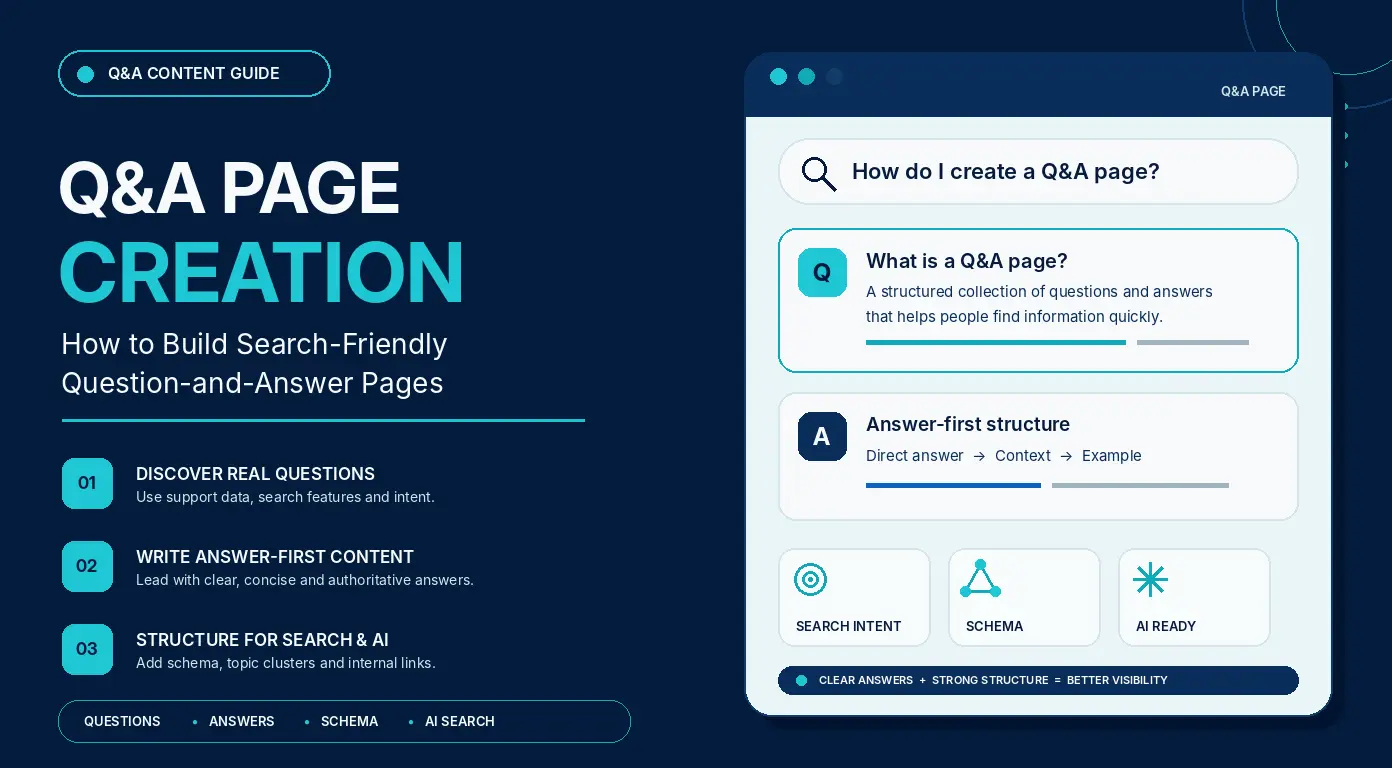
| Answer structure | Deliver information quickly and improve answer extraction. | Follow an answer-first approach that begins with a direct response and then provides additional context. | Direct answer → Explanation → Example → Related resources |
| Readability | Reduce cognitive load and improve engagement. | Make content easy to scan. | Use short paragraphs, tables, lists, headings, images, and illustrations. |
| Featured snippet and AI optimization | Increase visibility across search engines and answer engines. | Create answers that retrieval systems can process easily. | Use concise definitions, descriptive headings, supporting context, and clear entity relationships. |
| Internal linking | Strengthen topical authority and improve navigation. | Connect related questions and resources. | Link billing questions to pricing pages, documentation, or troubleshooting guides. |
Many organizations refer to this approach as dual-engine optimization (DEO) because the content is designed for both human readers and retrieval systems. The goal is simple: deliver the right answer, provide enough context, and guide users toward the next relevant piece of information.
Optimizing User Experience and Navigation
A Q&A page should help users locate information with as little effort as possible. Clear navigation, responsive design, and accessible layouts reduce friction and encourage visitors to explore related content.
Implementing Accordions, Jump Links, and Filters
Long pages can be overwhelming for the readers. Accordion menus, category filters, and jump links allow users to move directly to the information they need without scrolling through dozens of questions. This simplifies the navigation.
Optimizing for Mobile Devices
The question-based searches now take place on mobile devices. Responsive layouts, readable text, appropriately sized buttons, and fast-loading pages create a smoother experience across different screen sizes.
Following Accessibility Standards (WCAG)
Accessibility improves both usability and search performance. Important considerations include logical heading structures, keyboard navigation, alternative text for images, sufficient color contrast, and compatibility with screen readers.
Users should never have to struggle to find answers. The easier your content is to access, the more valuable it becomes.
Implementing Technical SEO and Structured Data
Search engines and AI systems need clear signals that explain how content is organized, how different entities are connected, and which information should be retrieved. Structured data, semantic HTML, and strong technical foundations make that possible.
Choosing Between FAQPage and QAPage Schema
Selecting the correct schema type is essential because each one serves a different purpose.
| Schema type | Best use case |
| FAQPage | Questions and answers created and maintained by the organization |
| QAPage | Questions that allow user-generated answers and discussions |
FAQPage markup is selected when the organization controls the content. QAPage markup is appropriate when users contribute answers.
Implementing JSON-LD Markup
JSON-LD is Google’s preferred structured data format because it separates structured information from visible page content.
A typical implementation includes the following components:
- @context
- @type
- Questions and answers
- Entity properties
- Relationships between entities
Accuracy matters more than complexity. Incorrect markup leads to indexing problems and validation errors.
Building Semantic HTML Structures
Search engines rely on semantic HTML elements to understand page structure and relationships.
The elements include:
- Heading tags (H1–H6)
- Navigation sections
- Lists
- Tables
- <article> and <section> elements
Improving Crawlability and Indexability
Search engines cannot rank content that they cannot discover. The following 5 technical elements influence visibility:
- XML sitemaps
- Canonical tags
- Internal links
- Descriptive URLs
- Robots directives
Strong technical foundations allow crawlers to understand, categorize, and index information more efficiently.
Validating Structured Data
Structured data is tested before publication and reviewed regularly afterward.
The tools that help identify errors:
- Google Search Console
- Rich Results Test
- Schema Markup Validator
Even minor implementation errors affects visibility, so routine monitoring is essential.
Optimizing Q&A Pages for AI Search
Large language models, retrieval engines, voice assistants, and answer engines along with the search engines now analyze pages differently. Instead of simply matching keywords, these systems identify entities, evaluate relationships, retrieve relevant passages, and synthesize responses.
That shift has changed the way Q&A content should be written.
Optimizing for Google AI Overviews
Google AI Overviews prioritize concise, trustworthy, and highly structured content.
The following characteristics appear repeatedly in pages cited by AI systems:
- Clear question-and-answer formatting
- Descriptive headings
- Concise opening definitions
- Strong internal linking
- Reliable sources
- Comprehensive topical coverage
Consider the difference between these two answers.
Weak example
“There are many things to consider when creating a Q&A page, and businesses often use various approaches depending on their circumstances.”
Stronger example
“Create a Q&A page by identifying user questions, organizing them into categories, writing concise answers, implementing structured data, and monitoring performance.”
The second example is easier for both people and retrieval systems to process.
Optimizing for ChatGPT, Gemini, and Perplexity
Large language models rely on retrieval mechanisms. Their goal is to locate authoritative information and present the most relevant answer.
The practices that improve the likelihood of citation:
- Use clear definitions.
- Write descriptive headings.
- Build strong entity relationships.
- Include factual statements early in each section.
- Link related resources together.
- Update information regularly.
Pages that wander from one subject to another perform poorly because retrieval systems struggle to establish contextual relationships.
Entity Optimization and Semantic Search
Entities sit at the center of modern search. A Q&A page about email marketing, for example, might contain relationships among the following entities:
- Email campaigns
- Segmentation
- Deliverability
- Automation
- Open rates
- Click-through rates
Search engines analyze how concepts connect, therefore, topical clusters have become so effective.
Citation and E-E-A-T Optimization
Google’s E-E-A-T framework focuses on four elements:
- Experience
- Expertise
- Authoritativeness
- Trustworthiness
The 5 practical steps that strengthen these signals:
- Cite reliable sources.
- Display author information.
- Include first-hand experience when appropriate.
- Update outdated information.
- Maintain factual accuracy.
Common Q&A Page Mistakes
Creating a Q&A page is simple. Building a Q&A page that attracts traffic, supports users, and performs well in search results is difficult. The problems arise from weak planning, poor organization, or technical oversights.
| Mistake | Why it happens | How to fix it |
| Targeting questions without search demand | Teams focus exclusively on internal assumptions instead of analyzing user behavior. | Balance customer feedback, search demand, business objectives, and revenue opportunities. |
| Creating thin or incomplete answers | Questions receive brief responses that fail to provide enough context. | Use an answer-first structure supported by explanations, examples, and related resources. |
| Publishing duplicate content | Different departments create multiple versions of the same answer. | Consolidate overlapping content into a single authoritative resource. |
| Prioritizing keywords over user intent | Content is written around search terms instead of real questions. | Focus on user needs, search intent, and problem-solving. |
| Neglecting user experience and mobile optimization | Navigation becomes difficult, pages load slowly, and content becomes harder to read. | Improve page speed, navigation, responsiveness, and visual hierarchy. |
| Ignoring structured data | Search engines and AI systems receive limited contextual information. | Implement and validate the appropriate schema markup. |
As content grows, technical errors, duplicate questions, and weak organization become harder to manage. Regular audits prevent these problems from accumulating.
Measuring and Maintaining Q&A Page Performance
After publishing, performance data reveals what users need, what search engines understand, and where gaps still exist.
Tracking Search Visibility Metrics
The following indicators deserve regular attention.
| Metric | Purpose |
| Rankings | Measure search visibility |
| Impressions | Identify exposure levels |
| Click-through rate (CTR) | Evaluate search performance |
| Featured snippets | Monitor answer extraction |
| AI citations | Measure retrieval visibility |
These measurements identify patterns that otherwise go unnoticed.
Monitoring User Engagement Metrics
Search rankings don’t give the whole story. User behavior reveals more information.
Monitor the following indicators:
- Time on page
- Engagement rate
- Scroll depth
- Conversion rate
- Support ticket volume
Suppose visitors consistently leave the page after reading one question. That behavior indicate unclear navigation, weak content organization, or poor answer quality.
Updating Existing Questions and Answers
Review existing content regularly to identify:
- Broken links
- Outdated information
- Obsolete products
- Emerging questions
- Changing search behavior
The successful organizations follow quarterly review cycles, and highly competitive industries require frequent updates.
Expanding Content Based on Emerging Queries
A structured workflow helps teams adapt quickly to the changing search engines:
Support requests → Question identification → Content creation → Optimization → Measurement
This process creates a continuous feedback loop between customers and content teams.
Q&A Page Creation Checklist
Research
✓ Analyze support tickets and chat logs.
✓ Review competitor content.
✓ Study People Also Ask results.
✓ Identify search intent.
✓ Build entity lists.
Organization
✓ Group related questions into clusters.
✓ Remove duplicate topics.
✓ Create logical categories.
✓ Develop an internal linking strategy.
✓ Establish content ownership.
Content Creation
✓ Write conversational questions.
✓ Lead with direct answers.
✓ Add examples and supporting information.
✓ Improve readability.
✓ Optimize headings.
Technical Implementation
✓ Choose the correct schema type.
✓ Implement JSON-LD markup.
✓ Improve mobile responsiveness.
✓ Test page speed.
✓ Validate structured data.
Performance Monitoring
✓ Measure rankings.
✓ Track engagement.
✓ Monitor conversions.
✓ Identify new opportunities.
✓ Update content regularly.
Key Takeaways
A high-performing Q&A page is is a carefully structured system that combines information architecture, user experience design, search optimization, entity relationships, and structured data implementation.
The process is summarized in five steps:
- Discover the questions people ask.
- Group related questions into logical categories.
- Write concise, authoritative answers.
- Implement structured data and technical optimizations.
- Measure performance and refine continuously.
The organizations that perform best don’t treat Q&A content as a one-time project. They build an ongoing process that transforms customer conversations into searchable knowledge assets.
Frequently Asked Questions
What is a Q&A page?
A Q&A page is a structured collection of questions and answers designed to help users locate information quickly while improving search visibility and knowledge organization.
How do I create a Q&A page?
Start by collecting questions from customer interactions, keyword research, internal search data, and competitor analysis. Organize those questions into categories, write concise answers, implement structured data, and monitor performance continuously.
What is the difference between an FAQ page and a Q&A page?
FAQ pages contain a limited collection of company-created questions and answers. Q&A pages cover broader topics, create stronger semantic relationships, and scale effectively.
Which schema type should I use?
FAQPage schema is appropriate when an organization creates the content itself. QAPage schema is suitable when users contribute questions and answers.
How many questions should a Q&A page contain?
The ideal quantity depends on user intent, content depth, and the complexity of the subject matter. Quality always matters more than volume.
Are Q&A pages useful for AI search?
Yes. Well-structured Q&A pages improve information retrieval, strengthen entity relationships, and increase the chances of appearing in AI-generated search results.