
Users now look for immediate answers; however, brands rely on keyword-heavy content built for an older version of search.
This gap between what is provided and what is needed creates a problem. The pages rank well, but lose visibility inside Featured Snippets, AI Overviews, People Also Ask boxes, and voice search results. The objective now is not ranking higher than competitors but to become the source from which search engines and AI systems retrieve answers.
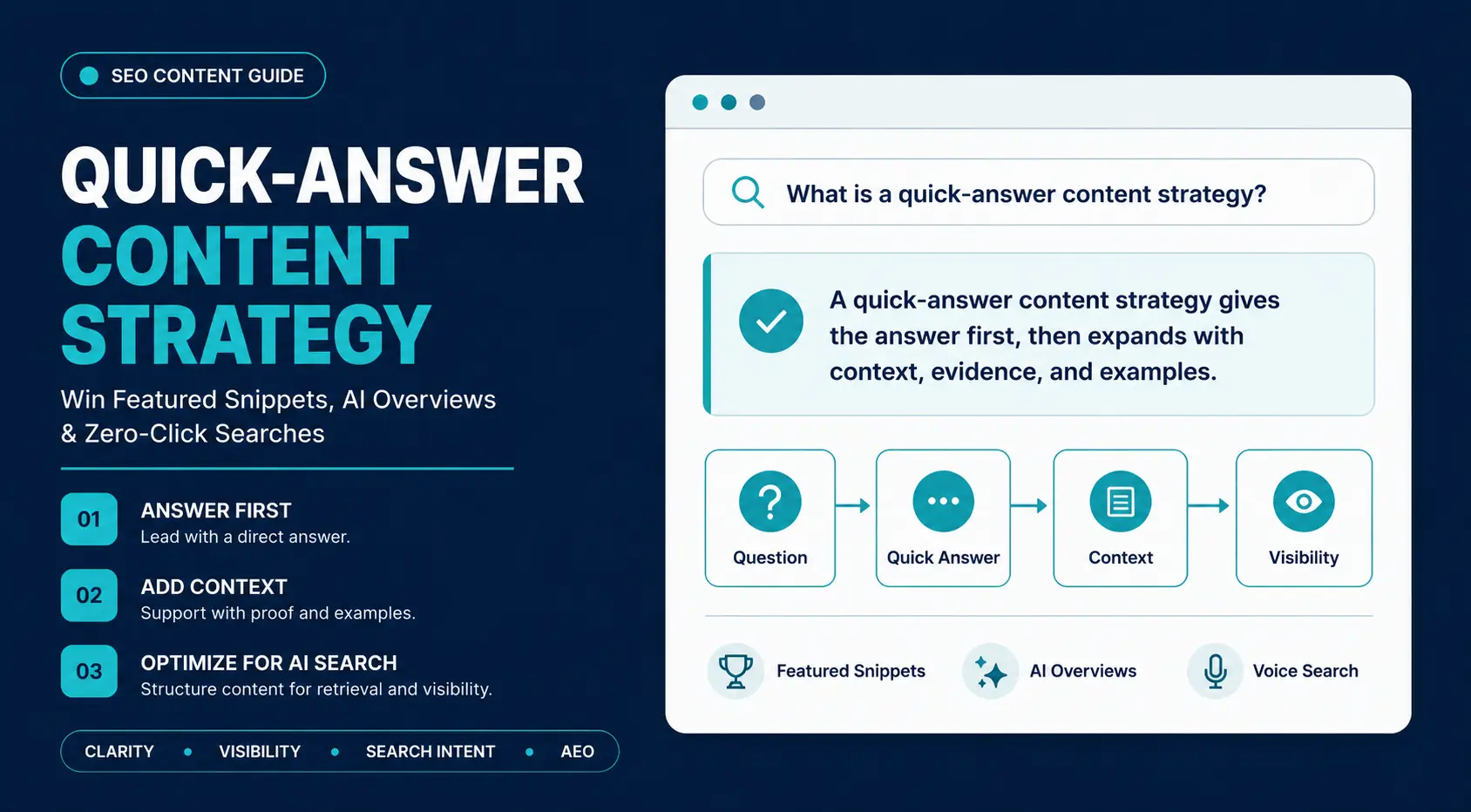
A quick-answer content strategy solves this problem by delivering concise answers first and expanding them with context, evidence, and deeper insights later on.
What Is a Quick-Answer Content Strategy?
A quick-answer content strategy is a method of creating and structuring content so search engines, AI systems, and voice assistants extract, understand, and display information instantly.
In practice, that means organizing information into clear sections, using explicit language, building strong semantic relationships, and presenting concise answers, then explaining through supporting context, examples, and evidence.
Core Principles of Quick-Answer Content
Several principles define an effective quick-answer strategy.
Answer-first content creation
Traditionally, writers follow an outdated formula:
- Introduction
- Background information
- Explanation
- Conclusion
- Answer
Modern search engines, however, prefer the opposite sequence. A well-optimized page follows the following structure:
- Question
- Direct answer
- Supporting evidence
- Examples
- Additional resources
This format reduces cognitive load, improves readability, and allows search engines to identify the valuable information immediately.
The inverted pyramid model
The inverted pyramid model places the most important information at the beginning of the page and adds supporting details afterward. Journalists have used this model for decades.
The same principle applies to answer-focused content.
The structure looks like this:
| Section | Purpose |
| Question | Defines the topic |
| Quick answer | Provides an immediate solution |
| Context | Explains the answer |
| Supporting evidence | Builds credibility |
| Examples | Improves comprehension |
This approach aligns naturally with featured snippets, voice search, and passage indexing.
Information gain and contextual depth
Answering a question is no longer enough.
Thousands of websites define “technical SEO” or “content strategy.” Search engines now reward pages that have a unique aspect to offer. Such as:
- Original research
- Industry statistics
- Case studies
- Expert commentary
- Proprietary frameworks
- Comparative analyses
The unique insight builds authority when direct answer is able to capture the readers’ attention.
Quick-Answer Content Versus Traditional SEO Content
Answer-first content isn’t designed to replace long-form content. It changes the order in which information is delivered.
| Traditional SEO | Quick-answer content |
| Optimizes pages | Optimizes passages |
| Targets keywords | Targets questions |
| Focuses on rankings | Focuses on visibility |
| Emphasizes volume | Emphasizes precision |
| Measures clicks | Measures exposure |
Organizations now use a hybrid approach. They present concise answers at the beginning of each section and follow them with more detailed explanations, examples, and supporting information.
This model is called the answer-and-expand framework.
Why Quick-Answer Content Matters in SEO, AEO, and AI Search
Search engines are no longer only indexing webpages. They’re interpreting information, understanding relationships between entities, and generating answers based on context.
That shift has increased the importance of several search features:
- Featured Snippets
- AI Overviews
- Voice search
- People Also Ask boxes
- Conversational search interfaces
A query such as best running shoes may evolve into a much more detailed question, such as which running shoes are best for flat feet and marathon training.
Search engines understand the difference.
Content built around isolated keywords struggles in this indexing and ranking. Content built around entities, context, and search intent performs better.
That’s why quick-answer content has become one of the foundations of modern SEO, answer engine optimization (AEO), and AI search optimization.
Why Quick-Answer Content Matters
Visibility in the modern search itself has become an asset. Featured Snippets, AI Overviews, knowledge panels, and voice assistants deliver answers directly within search results. As a result, brand awareness, authority, and assisted conversions have become just as important as traffic.
Organizations that adapt to the shift towards answer-first gain more exposure, while those that continue hiding answers beneath long introductions lose visibility.
The Rise of Zero-Click Search
A growing number of searches now end without a traditional click because search engines have become answer engines and provide answers immediately through:
- AI-generated summaries
- Featured Snippets
- Knowledge panels
- People Also Ask (PAA) sections
- Voice assistants
- Local search results
How Search Engines Evaluate Quick Answers
Modern search systems examine more than keywords.
Search intent
Search engines determine what users actually want to know and the intent behind the specific search.
For example, the search term apple could refer to:
- The company
- The fruit
- Stock information
- Nutritional information
Intent determines which answer appears.
Semantic relationships and entities
Search engines now analyze relationships among entities, attributes, and concepts, rather than evaluating individual words.
A page about AI Overviews, for example, might include related concepts such as:
- Featured Snippets
- Structured data
- Passage indexing
- Voice search
- Search intent
These semantic connections strengthen topical relevance and contextual understanding.
Passage indexing and citation selection
Search engines evaluate individual sections of a page independently. A well-structured paragraph can appear in search results even when the entire page doesn’t rank in the top position.
The search systems prioritize content that demonstrates:
- Accuracy
- Authority
- Context
- Clarity
- Logical organization
Business impact of Answer-First Content
The benefits of quick-answer content extend well beyond rankings.
| Benefit | Business impact |
| Greater visibility | Increased brand awareness |
| Improved authority | Stronger trust signals |
| Better engagement | Longer session durations |
| Higher conversion rates | More qualified leads |
| Greater scalability | More efficient content production |
Companies that dominate search results don’t publish the content regularly; they simply publish the clearest answers.
Core Components of a Quick-Answer Strategy
The successful quick-answer strategy relies on three foundations:
- Search intent analysis
- Entity and semantic optimization
- Information gain
These three elements work together. Search intent tells you what users need, semantic optimization helps search engines understand how concepts relate to one another, and information gain explains why your content deserves visibility.
Search Intent and Question Research
Question research should extend beyond keyword databases, as now users don’t search the way marketers expect them to. Valuable insights are found in places such as:
- Google Search Console
- People Also Ask (PAA) results
- Reddit discussions
- Quora threads
- Industry forums
- Customer support tickets
- Sales conversations
- Keyword research platforms
The questions fall into four categories.
| Intent type | Example |
| Informational | What is passage indexing? |
| Comparative | Ahrefs versus Semrush |
| Transactional | Best SEO audit tools |
| Problem-solving | Why isn’t Google indexing my pages? |
Each section of an article should answer a specific question. Trying to answer too many questions at once weakens the quality of every answer.
Entity Optimization and Semantic Relationships
Entities provide context. Supposedly, for the content about quick-answer strategies, relevant entities include:
- Featured Snippets
- AI Overviews
- Schema markup
- Voice search
- Knowledge graphs
- Natural language processing (NLP)
- People Also Ask results
Search engines use these relationships to understand meaning, context, and topical relevance.
Information Gain and Topical Authority
Search engines now reward content that contributes something new. Thousands of websites provide the same explanation, use the same keywords, and follow the same structure.
The added value comes from:
- Original research
- Surveys and case studies
- Industry benchmarks
- Expert interviews
- Proprietary frameworks
- Performance data
One useful model is the Answer + Hook Framework.
- Provide a concise answer.
- Add supporting evidence.
- Introduce original insights.
- Expand the explanation.
- Encourage the next action.
The answer earns attention. The insight builds authority.
Formatting Content for Answer Retrieval
Search engines don’t interpret content the way people do. Algorithms analyze entities, relationships, context, and structure.
Formatting plays a direct role in search visibility. A valuable answer buried inside a long block of text performs worse than a shorter answer that is clearly organized.
Several content formats perform well in Featured Snippets, AI Overviews, voice search results, and People Also Ask sections.
Paragraph-Based Answers
Paragraph snippets are ideal for definitions, explanations, and conceptual questions.
A well-structured answer contains:
- A direct question
- A concise answer
- Supporting context
Most paragraph snippets contain approximately 40 to 60 words.
Example
What is a quick-answer content strategy?
A quick-answer content strategy is an answer-first approach to content creation that provides concise responses to user questions before expanding into supporting information, examples, research, and implementation guidance. This structure improves visibility across Featured Snippets, AI Overviews, and voice search results.
Lists, Tables, and Question-Based Formatting
Different questions require different formats.
| Format | Best use case |
| Numbered lists | Processes, tutorials, and step-by-step guides |
| Bullet lists | Features, benefits, and characteristics |
| Tables | Comparisons and data presentation |
| Question-and-answer sections | Conversational and voice searches |
For example, a process-based query is structured as follows:
How do you optimize quick-answer content?
- Identify search intent.
- Create a concise answer.
- Add supporting evidence.
- Strengthen semantic relationships.
- Implement structured data.
- Measure performance.
Comparison tables also help search engines understand relationships between concepts.
| Element | Traditional content | Answer-first content |
| Primary focus | Keywords | User questions |
| Structure | Page-based | Passage-based |
| Optimization target | Rankings | Visibility |
| User experience | Exploratory | Immediate |
Question-based headings are important; they align the heading with the way users naturally search.
Instead of using a heading such as Featured Snippets, consider writing What are Featured Snippets?
Step-by-Step Frameworks
Search engines favor logical and predictable structures.
One of the simplest frameworks looks like this:
| Stage | Purpose |
| Answer | Provide an immediate response. |
| Context | Explain why the answer matters. |
| Evidence | Support the claim. |
| Example | Improve clarity and understanding. |
| Action | Guide the next step. |
This framework works well for tutorials, troubleshooting guides, product comparisons, and instructional content.
Quick-Answer Content Templates
Templates create consistency, and consistency creates scalability. The objective isn’t to force every article into an identical structure. The goal is to build repeatable frameworks that search engines can easily interpret, and readers can quickly understand.
The following templates cover most answer-focused content formats.
Definition and Question-Based Templates
Definition-style content works particularly well for Featured Snippets, voice search, and AI-generated responses because it delivers an immediate answer before expanding into supporting information.
A simple framework looks like this:
- What is [topic]?
- Direct answer
- Why it matters
- Supporting context
- Example
Question-and-answer sections follow a similar pattern:
- Question
- Answer (40–60 words)
- Supporting information
- Related resources
List, Comparison, and Problem-Solving Templates
Lists and comparison tables help search engines understand relationships between concepts.
A list-based structure looks like this:
- Question
- Brief introduction
- Step 1
- Step 2
- Step 3
- Key considerations
Comparison content is organized using a simple table.
| Element | Option A | Option B |
| Purpose | ||
| Benefits | ||
| Limitations | ||
| Best use case |
Problem-solving content follows a similarly structured approach:
- Problem
- Cause
- Solution
- Implementation process
- Expected outcome
Because the format remains predictable, search engines retrieve information efficiently.
Step-by-Step Templates
Instructional content usually performs best when each stage follows a logical sequence.
- Step 1: Identify the problem.
- Step 2: Gather information.
- Step 3: Implement the solution.
- Step 4: Measure the results.
- Step 5: Refine the process.
Keep one principle in mind throughout the process: provide enough information to answer the question completely, but avoid overwhelming readers with unnecessary details.
Building a Quick-Answer Content Workflow
Many organizations publish content and hope visibility follows. That approach doesn’t produce consistent results.
A repeatable workflow is more effective because it transforms answer optimization from a one-time task into an ongoing process.
Step 1: Discover High-Value Questions
Keyword research is only one part of the process. The valuable insights come from the audience.
Useful sources include:
- Google Search Console
- People Also Ask (PAA) results
- Reddit discussions
- Quora communities
- Customer support tickets
- Sales conversations
- Competitor websites
- Industry forums
These sources reveal emerging questions before traditional keyword tools detect them.
Step 2: Analyze Search Results and Search Intent
Study the search results before creating content.
Pay attention to patterns such as:
- Search intent
- Featured Snippets
- AI Overviews
- Heading structures
- Entity relationships
- Content depth
Pages occupying Position Zero provide a useful blueprint for structure, formatting, and information hierarchy.
Step 3: Create Answer-First Content Blocks
Each section should function as an independent unit of information.
A strong answer block follows this structure:
| Component | Purpose |
| Direct answer | Provides an immediate response. |
| Context | Expands the explanation. |
| Evidence | Strengthens credibility. |
| Example | Improves understanding. |
| Call to action | Encourages the next step. |
This framework aligns naturally with passage indexing because each section is evaluated independently.
Step 4: Build Topic Clusters and Internal Links
Search engines evaluate relationships between concepts rather than individual pages.
A typical content cluster includes the following elements:
Quick-Answer Content Strategy
│
├── Search intent
├── Structured data
├── Passage indexing
├── Voice search
├── Semantic SEO
└── AI Overviews
This structure strengthens topical authority and helps search engines understand contextual relationships.
Step 5: Publish, Measure, and Refine
Publishing is the beginning of the optimization process.
Review and update the content regularly by evaluating:
- Statistics and references
- Examples and case studies
- Internal links
- Structured data
- Emerging entities
- Changes in search behavior
Search environments evolve continuously. Content should evolve with them.
Technical Foundations for Quick-Answer Content
The useful answer also fail if search engines cannot properly interpret, retrieve, and present it.
Technical optimization bridges the gap between human-readable content and machine-readable content. Structure, semantics, and usability all contribute to that process.
Schema Markup and Semantic HTML
Structured data provides explicit signals that help search engines understand different types of information.
Several schema types are useful for answer-focused content.
| Schema type | Primary purpose |
| FAQ schema | Question-and-answer sections |
| HowTo schema | Instructional content |
| Speakable schema | Voice search optimization |
Proper HTML structure is also important because it creates a clear hierarchy that search engines can easily interpret.
<h1>Main topic</h1>
<h2>Question</h2>
<p>Direct answer</p>
<h3>Supporting information</h3>
<ul>
<li>Key point</li>
</ul>
Schema markup doesn’t guarantee visibility, but it improves the likelihood that search engines will understand the content correctly.
Passage Indexing and Content Structure
Modern search engines evaluate individual sections of a page instead of analyzing the page as a single document.
Several practices improve the retrieval efficiency:
- Use descriptive headings.
- Place answers directly beneath headings.
- Maintain a clear hierarchy.
- Keep paragraphs concise.
- Separate unrelated topics.
- Strengthen semantic relationships.
Page Experience and Accessibility
Search visibility also relies on user experience.
Pay attention to the following factors:
- Mobile responsiveness
- Accessibility
- Site speed
- Readability
- Core Web Vitals
- Internal navigation
Fast-loading pages, clear layouts, and accessible designs reduce friction and improve engagement.
Measuring Quick-Answer Content Performance
Traditional SEO metrics no longer provide a complete picture of performance. Quick-answer content increases impressions and brand visibility even when click-through rates remain unchanged.
Search Visibility Metrics
These metrics indicate how effectively the content is being surfaced across search features.
| Metric | Purpose |
| Featured Snippet ownership | Measures Position Zero visibility. |
| AI Overview appearances | Tracks visibility in AI-generated results. |
| People Also Ask appearances | Measures topical coverage. |
| Organic impressions | Indicates search exposure. |
| Keyword rankings | Monitors search performance. |
Individual metrics should never be analyzed in isolation. Increased visibility accompanied by lower click-through rates still indicates positive results.
Engagement Metrics
Monitor the following indicators:
- Click-through rate (CTR)
- Average engagement time
- Scroll depth
- Bounce rate
- Conversion rate
- Assisted conversions
Micro-conversions such as email subscriptions, demo requests, and branded searches are important in zero-click environments.
Essential Tools
| Tool | Primary purpose |
| Google Search Console | Visibility and indexing analysis |
| Google Analytics | User behavior analysis |
| Ahrefs | Competitor and keyword research |
| Semrush | Content and ranking analysis |
| Screaming Frog | Technical SEO audits |
Multiple tools are used together because no single platform provides a complete picture of performance.
Common Quick-Answer Content Mistakes
The websites focus on search engines and not on the people using them. The result is: weak visibility, poor engagement, and missed opportunities.
The following mistakes appear commonly..
| Mistake | Effect | Solution |
| Focusing on keywords instead of search intent | Content fails to satisfy user expectations. | Identify the intent behind every query before creating content. |
| Providing answers that are too short or too long | Search engines struggle to identify the most useful information. | Deliver concise answers and then expand with context and examples. |
| Ignoring semantic relationships | Search engines fail to understand topical connections. | Strengthen entity relationships and contextual relevance. |
| Overlooking technical optimization | Crawling, indexing, and retrieval become less efficient. | Improve page speed, structured data, internal links, and site architecture. |
| Neglecting content updates | Information gradually loses accuracy and relevance. | Review and update content regularly. |
The Future of Quick-Answer Content
Search engines are evolving from information retrieval systems into reasoning systems. This shift is reshaping the way content is created.
AI-Driven Retrieval and Generative Search
Large language models and generative search systems do more than rank webpages. They collect information from multiple sources, identify patterns, evaluate contextual relationships, and generate responses in real time.
As a result, content creators focus on:
- Clear language
- Logical organization
- Entity relationships
- Verifiable information
- Strong contextual signals
The modern search journey increasingly follows this pattern:
Visibility → Authority → Trust → Conversion
Voice and Conversational Search
Search behavior is becoming increasingly conversational. A traditional search query might look like this:
best CRM software
A voice search query looks like this:
Which CRM platform is best for a small business with fewer than twenty employees?
Question-based headings, natural language, and concise answers will continue gaining importance as conversational search evolves.
Continuous Optimization
Search optimization is not a one-time process.
Successful teams repeat the same cycle every time:
- Identify questions.
- Create answer-first content.
- Measure visibility.
- Update information.
- Strengthen internal relationships.
Conclusion
Search visibility is no longer determined solely by rankings. Clarity, structure, context, and accessibility now play equally important roles.
Quick-answer content reflects this shift by placing the most valuable information where both readers and search systems can find it immediately. The strongest strategies balance brevity with depth, deliver answers without sacrificing context, and continuously adapt to changing search behavior.
Frequently Asked Questions
Will giving away the answer reduce website traffic?
No. Quick answers increase visibility across Featured Snippets, AI Overviews, and voice search results, strengthening brand recognition and improving assisted conversions. The goal is to provide enough information to satisfy the immediate question while offering enough value to encourage further engagement.
What is the ideal length of a featured snippet answer?
Although there is no universal standard, many paragraph-based snippets contain approximately 40 to 60 words. Lists, tables, and step-by-step instructions may require additional space depending on the complexity of the topic.
Can long-form content still rank in zero-click search environments?
Absolutely. Long-form content remains valuable because search engines frequently extract answers from individual sections rather than evaluating an entire article as a single document. Many successful pages combine concise answers with more comprehensive explanations.
How can businesses benefit from zero-click searches if users don’t visit their websites?
Greater visibility often leads to stronger brand recognition, increased trust, more branded searches, improved newsletter subscriptions, and higher conversion rates. In many cases, the first interaction with a potential customer occurs directly within search results.
Does AI-generated content perform well in Featured Snippets and AI Overviews?
AI tools can accelerate research and content production, but accuracy, originality, expertise, and information gain remain essential. Content that simply reproduces existing information often struggles to maintain visibility over time.