

Finding the right answer quickly is the main concern of the readers. Readers scan headings, compare lists, skip paragraphs, and look for clear answers. Poorly organized information, despite accurate content, becomes difficult to understand and use.
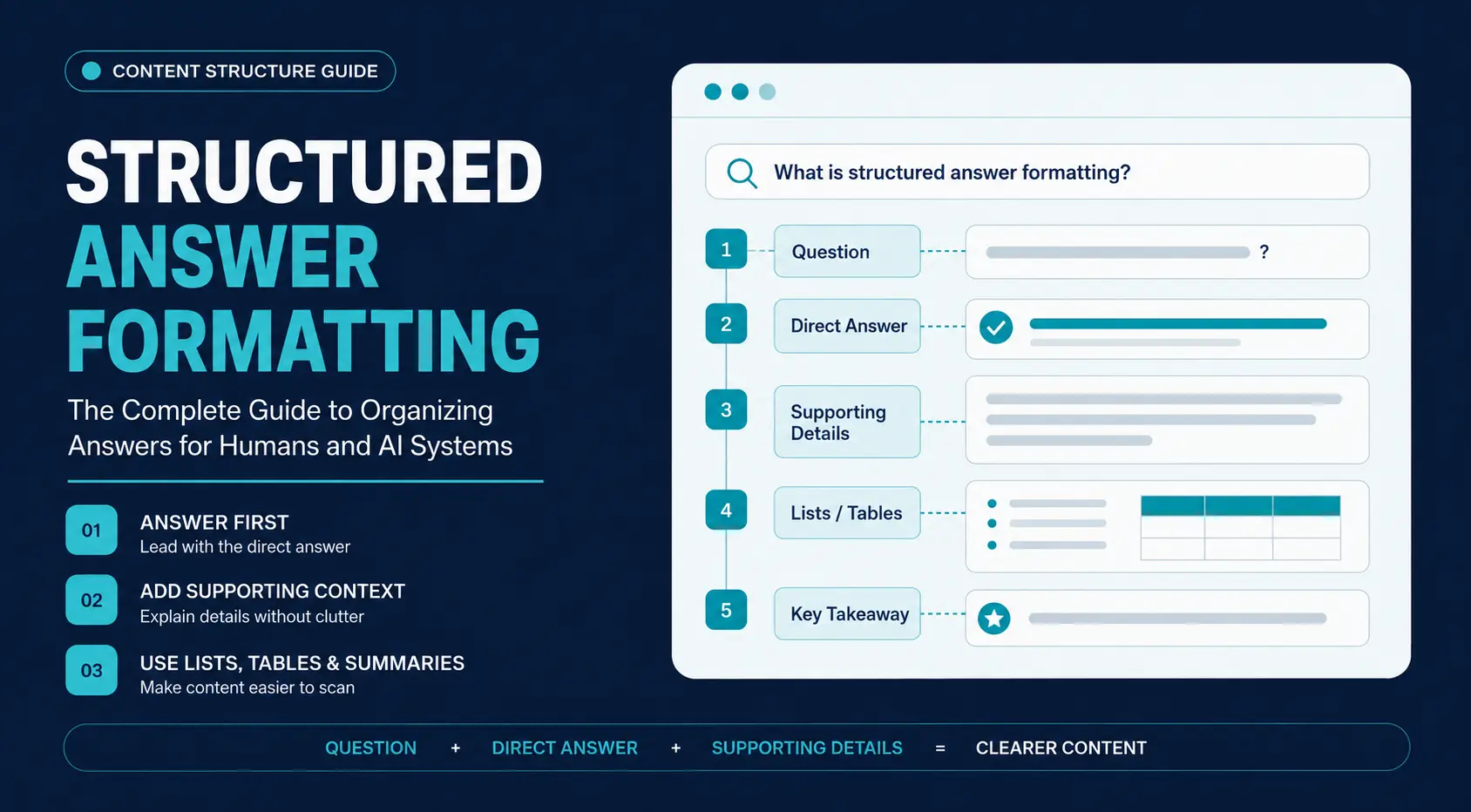
Structured answer formatting resolves this issue by organizing information into logical sections, direct answers, supporting details, tables, lists, and summaries. This makes the content easier to read, easier to navigate, and easier to interpret.
This guide explains the principles, frameworks, examples, and best practices behind effective structured answer formatting.
What Is Structured Answer Formatting?
Structured answer formatting is the practice of organizing information into clear, logically connected sections so readers can find, understand, and use information.
The structure includes:
- A question or heading
- A direct answer
- Supporting information
- Lists, tables, or examples
- A summary or key takeaway
Why Structured Answer Formatting Matters
A well-organized answer reduces the effort required to locate important information. Readers identify the information they need, and clearly defined sections make complex topics easier to understand.
Effective formatting helps maintain consistency, eliminate unnecessary repetition, and create a logical relationship between ideas.
| Objective | Purpose |
| Readability | Improve comprehension |
| Clarity | Reduce ambiguity |
| Organization | Establish logical relationships |
| Accessibility | Simplify navigation |
| Consistency | Improve information flow |
Structured Answers Versus Traditional Writing
| Traditional writing | Structured answer formatting |
| Narrative structure | Answer-first structure |
| Long paragraphs | Smaller information blocks |
| Sequential reading | Scannable sections |
| Broad discussion | Focused responses |
| Context before conclusions | Conclusions before context |
One approach is designed for continuous reading.
The other is designed for quick understanding and easy navigation.
Core Components of a Structured Answer
A structured answer follows a recognizable pattern. The format varies according to the subject, but answers have the same fundamental components. Understanding how these elements work together makes it easier to create content that is clear, organized, and easy to navigate.
Question-based headings
Question-based headings establish context and tell readers what information to expect. Examples include:
- What is it?
- How does it work?
- Why does it matter?
- Which option should you choose?
- How can you solve the problem?
Direct answer blocks
The placement of the answer after the question allows readers to find the information they need first, then move on to additional details.
A simple structure is:
- Present the question.
- Provide the answer.
- Add supporting information.
- Include examples when necessary.
- End with a concise summary.
Supporting context
The supporting information after the answer provides depth. Depending on the topic, this section includes explanations, definitions, comparisons, instructions, or additional details. The supporting context must not overwhelm the reader.
Definition blocks
Definition blocks explain a concept quickly and consistently. They contain three elements:
- The term or concept
- The definition
- Essential context
These blocks work well in glossaries, documentation, educational resources, and technical guides.
Bulleted and numbered lists
Lists improve readability by organizing information into smaller sections.
Bulleted lists work best when the order of information is unimportant, while numbered lists are for step-by-step instructions, processes, and workflows.
| Structure | Best use case |
| Bulleted lists | Features, characteristics, and recommendations |
| Numbered lists | Instructions, processes, and checklists |
Tables and comparison grids
Tables help readers identify similarities, differences, and relationships. They are useful when multiple attributes of 2 or more different aspects are to be presented simultaneously.
Callout boxes
Callout boxes draw attention to information that should stand apart from the surrounding text.
They are used for:
- Important notes
- Recommendations
- Warnings
- Best practices
- Key findings
Summaries and key takeaways
A concise summary reinforces the central idea of the section and highlights the important points. This allows readers to review essential information.
Core Principles of Structured Answer Formatting
The effective structured answer follows a recognizable pattern. The format varies according to the subject, but the answers rely on the same fundamental components. Understanding how these elements work together makes it easier to create content that is clear, organized, and easy to navigate.
Maintain a logical heading hierarchy
Headings create relationships between ideas and guide readers through the content. Each section should naturally build upon the one before it.
A simple hierarchy:
- H2: Main section
- H3: Supporting topic
- H4: Supporting detail
- H3: Supporting topic
Skipping levels or placing unrelated ideas together creates confusion and weakens the overall structure.
Create self-contained sections
Each section should communicate a complete idea. Readers sometimes move directly to the information they need rather than reading an article from beginning to end.
A self-contained section includes:
- A heading or question
- A direct answer
- Supporting information
- Examples, when necessary
- A summary
Match the format to the purpose
Different information types are presented through different structures.
| Content type | Recommended format |
| Definitions | Answer blocks |
| Instructions | Numbered lists |
| Comparisons | Tables |
| Troubleshooting | Problem-and-solution format |
| Frequently asked questions | Question-and-answer format |
Move from general ideas to specific details
Begin with the core concept, provide supporting information, and then introduce examples, recommendations, or implementation details. The progression creates a natural flow and prevents information overload.
Maintain consistency
Consistent formatting creates predictable reading patterns and improves clarity.
Consistency should apply to:
- Headings
- Paragraph structure
- Lists
- Tables
- Terminology
Remove unnecessary information
Every sentence should contribute something valuable. Repetition, unrelated details, and excessive explanations distract readers from the main idea and reduce clarity.
Common Structured Answer Formats
Different questions require different structures. Choosing the appropriate format improves clarity, reduces unnecessary complexity, and helps readers find information more quickly.
Definition-based answers
Definition-based answers explain a concept clearly and directly.
Structure
Question → Definition → Context → Example
Example
What is encryption?
Encryption is the process of converting information into a coded format to prevent unauthorized access.
Step-by-step answers
Instructional content should present information in the order in which actions occur.
Structure
Question → Steps → Example → Summary
This format is used for tutorials, guides, workflows, and checklists.
Comparison answers
Tables present similarities and differences.
| Attribute | Option A | Option B |
| Cost | Lower | Higher |
| Complexity | Moderate | Advanced |
| Setup time | Short | Long |
Problem-and-solution answers
This structure is useful when readers need to identify a possible problem and determine the appropriate response.
Structure
Problem → Cause → Solution → Prevention
Cause-and-effect answers
Cause-and-effect structures highlight the relationship between an action and its outcome.
| Cause | Result |
| Unclear headings | Reduced readability |
| Long paragraphs | Lower engagement |
| Inconsistent formatting | Greater confusion |
Decision-making answers
Decision-oriented content simplifies the evaluation process. These sections include:
- Selection criteria
- Advantages
- Disadvantages
- Recommendations
Frequently asked questions (FAQ) answers
FAQ sections are designed to answer questions quickly and consistently.
A typical format includes:
- The question
- The answer
- Supporting information, if necessary
How to Create a Structured Answer Step by Step
Creating a structured answer doesn’t require a complicated framework. The objective is simply to organize information so that readers can find, understand, and use it with minimal effort.
Step 1: Identify the primary question
Every structured answer begins with a clearly defined question. The more precise the question is, the easier it becomes to organize the answer.
Step 2: Determine the purpose of the answer
Define the objective of the answer.
Ask yourself the following questions:
- Are you defining a concept?
- Are you explaining a process?
- Are you comparing multiple options?
- Are you solving a problem?
Step 3: Organize the main ideas
Identify the information readers need first and arrange supporting details in a logical order. Place essential information at the beginning and add context subsequently.
Step 4: Build a clear hierarchy
A logical structure guides readers through the content and creates clear relationships between ideas.
A simple hierarchy is:
- Heading
- Subheading
- Supporting details
- Subheading
Step 5: Write the answer first
Present the answer immediately after the question. Once the main point has been established, add explanations, examples, comparisons, or recommendations as needed.
Step 6: Review the structure
Before publishing, ask yourself the following questions:
- Is the answer easy to find?
- Does each section focus on a single idea?
- Are the headings clear and descriptive?
- Is the information organized logically?
Revise the structure before moving forward if any of the questions have NO as the answer.
Structured Answer Formatting Examples
The following examples illustrate how different structures can be used to present information more effectively.
Definition answer example
Question
What is compound interest?
Answer
Compound interest is interest calculated on both the original amount and the accumulated interest from previous periods.
Step-by-step answer example
Question
How do you back up important files?
Steps
- Identify the files you want to protect.
- Copy them to a secure location.
- Verify that the backup is complete.
- Repeat the process regularly.
Comparison answer example
| Attribute | Online learning | Classroom learning |
| Flexibility | High | Moderate |
| Travel requirements | None | Required |
| Learning pace | Self-directed | Instructor-led |
Problem-and-solution example
| Element | Description |
| Problem | Customers abandon the checkout process. |
| Cause | The payment process is unnecessarily complex. |
| Solution | Simplify the checkout process and reduce the number of steps. |
FAQ example
Question
How often should passwords be changed?
Answer
Passwords should be updated whenever a security risk is identified and should always be strong, unique, and stored securely.
Guidelines for Effective Structured Answer Formatting
Strong answers depend as much on structure as they do on information. A clear format helps readers locate important details quickly and understand them with less effort.
Place the answer near the beginning
Present the answer first, and then provide supporting details.
A simple structure that works best:
- Heading
- Direct answer
- Supporting information
- Examples
- Summary
Keep paragraphs concise
Long paragraphs make the simple ideas difficult to follow. Divide complex information into smaller sections.
Use consistent formatting
Consistency across a blog post, article, or any piece of writing improves readability and creates a predictable structure.
Maintain consistency in the following areas:
- Headings
- Lists
- Tables
- Terminology
- Spacing
Focus on one idea at a time
Each section should have a clear purpose. Trying to explain multiple concepts simultaneously creates confusion and weakens the overall structure.
Support important statements
Examples, data, research findings, and expert opinions strengthen explanations and increase credibility. Supporting information is to be used to clarify the main idea.
Write descriptive headings
Headings should explain exactly what the section contains.
Compare the following examples:
Important Information (NO)
How to organize a structured answer (YES)
When to use a table instead of a list (YES)
Review and update the structure
The organization of the content should be reviewed when information is changed or revised. Regular revisions help maintain clarity, consistency, and accuracy.
How to Audit and Evaluate Structured Answers
Reviewing the content after it has been written helps identify gaps in organization, consistency, and clarity.
Review readability
Begin by looking at the content from a reader’s perspective.
Ask yourself the following questions:
- Is the answer easy to find?
- Are the headings clear and descriptive?
- Are the paragraphs too long?
- Is the information arranged logically?
Evaluate the heading hierarchy
Headings establish the relationship between ideas and create a logical flow throughout the document.
A simple structure follows this pattern:
- H1
- H2
- H3
- H4
- H3
- H2
Skipping levels or grouping unrelated ideas makes the content difficult to follow.
Examine information blocks
Every section should have the information to communicate a complete idea.
| Element | Purpose |
| Heading | Introduces the topic |
| Direct answer | Addresses the question |
| Supporting information | Provides additional context |
| Examples | Clarifies complex ideas |
| Summary | Reinforces key points |
Review completeness
An answer should be concise without omitting essential information.
During the review process, ask the following questions:
- Does the answer fully address the question?
- Is important information missing?
- Are examples necessary?
- Can readers understand the information without additional explanation?
Check for consistency
Finally, review the formatting of the entire document.
Pay particular attention to the following elements:
- Headings
- Lists
- Tables
- Terminology
- Spacing
A manual review is the most effective way to evaluate a structured answer. Reading the content from a reader’s perspective reveals problems related to organization, clarity, consistency, and completeness that automated tools overlook.
Common Structured Answer Formatting Mistakes
The accurate information loses value when it is poorly organized or difficult to navigate. So avoid the following mistakes when structuring the answers.
| Mistake | Why It Creates Problems | Better Approach |
| Hiding the answer within long introductions | Readers must search for the main point. | Present the answer first and provide supporting details afterward. |
| Combining multiple topics in one section | The content becomes difficult to follow and understand. | Limit each section to a single idea. |
| Using vague headings | Readers cannot quickly identify the information they need. | Write clear, descriptive headings. |
| Writing overly long paragraphs | Large blocks of text reduce readability and make scanning difficult. | Break complex ideas into smaller sections. |
| Applying inconsistent formatting | Frequent changes in structure interrupt the flow of information. | Use consistent headings, lists, tables, and terminology. |
| Omitting examples or supporting information | Complex concepts become more difficult to understand. | Add examples, comparisons, or evidence when necessary. |
Key Takeaways
Structured answer formatting helps transform information into a format that is easier to read, understand, and navigate. The following principles form the foundation of effective structured answer formatting:
- Present the answer near the beginning of the section.
- Use a clear and consistent heading hierarchy.
- Choose a structure that matches the type of information being presented.
- Break complex ideas into smaller sections.
- Use lists, tables, and examples where they improve clarity.
- Focus each section on a single idea.
- Review the content for consistency, completeness, and readability.
Ultimately, good writing communicates ideas, while good formatting makes those ideas easier to understand and apply.
Frequently Asked Questions About Structured Answer Formatting
What is structured answer formatting?
Structured answer formatting is the practice of organizing information into clear sections, headings, lists, tables, examples, and summaries. The objective is to make information easier to read, understand, and navigate.
How do you write a structured answer?
Start with a clear question and provide the answer. Then add supporting information, examples, comparisons, or summaries in a logical order.
What are the most common structured answer formats?
Definition blocks, step-by-step instructions, comparison tables, problem-and-solution frameworks, and FAQ sections are among the most widely used formats.
When should you use a table instead of a list?
Lists are useful when presenting related items, while tables are better suited to situations that involve comparisons between multiple features, attributes, or categories.
Why is structured answer formatting important?
Structured answer formatting improves readability, reduces confusion, and helps readers locate important information more quickly. It also creates a more consistent and organized reading experience.