

Synonyms in SEO are alternative words or phrases that express the same or a closely similar meaning within a specific context. Related keywords are different. They represent connected concepts, entities, attributes, processes, or questions that support the main topic.
Synonyms help writers express the same idea without repeating one phrase. Related terms improve topic coverage by explaining concepts users need to understand the subject. Neither should be added simply to increase keyword variety. Effective use depends on search intent, contextual accuracy, semantic relationships, and value to the reader.
This guide explains how to identify, classify, map, use, and measure synonyms and related keywords without keyword stuffing or semantic drift.
What Are Synonyms and Related Keywords in SEO?
Synonyms are words or phrases with the same or similar meaning in a particular context. Related keywords are terms connected to the same topic but representing different concepts.
For example, “dental SEO” and “SEO for dentists” can express a similar service and user need. “Patient reviews,” “Google Business Profile,” and “local search visibility” relate to dental SEO, but they are not synonyms for it.
Semantic similarity does not mean two terms are interchangeable.
Synonyms vs. Related Keywords vs. Keyword Variations
Synonyms, related keywords, and keyword variations serve different purposes in SEO.
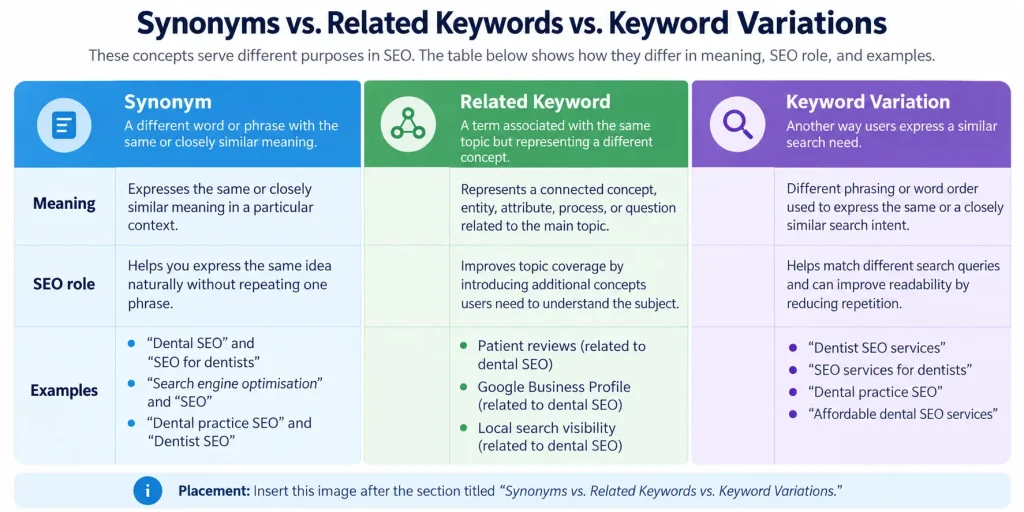
Synonyms may substitute for each other in suitable contexts. Related keywords introduce another concept that needs explanation. Keyword variations reflect alternative search phrasing rather than strict linguistic equivalence.
How Are Semantic Keywords, Entities, and Attributes Different?
An entity is a distinct person, place, organization, object, service, or concept. An attribute describes a property or characteristic of that entity. Semantic keywords are words and phrases that help communicate the topic and its relationships.
Google Business Profile provides a simple example.
| Element | Meaning | Example |
| Entity | The main thing or concept being discussed | Google Business Profile |
| Attribute | A property or characteristic of the entity | Business category, address, opening hours, phone number, photos, reviews |
| Related vocabulary | Terms that connect the entity with the wider topic | Local search, business listing, map visibility, customer reviews |
The entity identifies what is being discussed. Attributes describe its properties. Related vocabulary connects the entity with other relevant concepts.
Are LSI Keywords the Same as Semantic Keywords?
No. LSI keywords and semantic keywords should not be treated as the same SEO concept.
Latent semantic analysis originated in information retrieval research. Scott Deerwester, Susan Dumais, George Furnas, Thomas Landauer, and Richard Harshman described the method in research published in 1990.
Modern Google documentation discusses systems such as BERT, neural matching, RankBrain, and passage understanding. Google does not document a requirement for publishers to identify or insert LSI keywords into pages. For SEO work, focus on search intent, query variations, relevant entities, attributes, and supporting concepts rather than an LSI keyword checklist.
Why Do Synonyms and Related Terms Matter for SEO?
Synonyms and related terms matter because users can express similar needs with different language, while useful pages often need several connected concepts to explain a topic completely.
Their value comes from clarity, relevance, and topic coverage rather than keyword count.
How Synonyms Help Match Different Search Queries
Different search expressions can represent the same underlying need. A business owner might search for:
- “SEO for dentists”
- “Dental SEO services”
- “SEO services for dental practices”
The wording changes, but the intended service can remain similar.
Google Search Central explains that systems such as RankBrain and neural matching help Google understand relationships among words and concepts. A relevant page therefore does not always need to contain every exact phrase a searcher uses.
How Related Terms Strengthen Contextual Relevance and Topic Coverage
Related terms strengthen content when they introduce information needed to understand the topic. A useful section about local dental SEO may explain:
- Google Business Profile
- Local citations
- Patient reviews
- Location pages
- Business information accuracy
- Local search visibility
These concepts improve coverage because each contributes useful information. A term should not be added just because a keyword tool labels it as related.
How Natural Keyword Variations Improve Readability
Keyword variations can reduce unnecessary repetition while preserving meaning.
Repetitive version:
“Dental SEO services help dentists improve dental SEO because dental SEO services increase dental SEO visibility.”
Improved version:
“Dental SEO services help practices improve search visibility through stronger service pages, local listings, relevant content, and technical improvements.”
The second version explains the service rather than repeating the same phrase.
How Google Understands Synonyms, Context, and Search Intent
Google uses multiple ranking and language understanding systems when interpreting queries and finding relevant results. Exact words remain useful, but search retrieval is not limited to literal phrase matching.
Exact Keyword Matching vs. Semantic Understanding
Lexical matching compares words directly. Semantic understanding considers meaning, relationships, and context. Consider the query:
“How to increase dentist visibility on Google”
A relevant page does not need to repeat that exact sentence. A useful resource about dental SEO may explain:
- Local search optimization
- Google Business Profile
- Patient reviews
- Dental service pages
- Internal links
- Search visibility
These concepts can satisfy the same underlying need. Writers should still use terminology their audience recognizes, especially in titles, headings, and important explanatory sections.
How NLP and Language Models Interpret Word Meaning
Natural language processing systems use context to distinguish between different meanings of the same word. Consider the word “position.”
In SEO reporting, position can refer to placement in search results. In recruitment, position can mean a job role. In product instructions, position can describe physical placement.
Surrounding words and entities clarify which meaning applies. Google describes BERT as one system that helps interpret how combinations of words express meaning and intent.
How Entity Relationships Establish Semantic Context
Entity relationships help clarify what a passage discusses. Consider these entities:
- Dental practice
- Google Business Profile
- Patient review
- Local search
- Appointment
Explaining how a dental practice maintains accurate business information, earns patient reviews, and improves local search visibility creates meaningful relationships among the entities.
That is more useful than placing unrelated dental marketing terms in the same paragraph.
Types of Semantic Relationships in SEO
SEO writers should distinguish between equivalent terms, hierarchical relationships, part relationships, and topical associations. These relationships help determine whether terms can replace each other or should be used as supporting concepts.
| Relationship | Meaning | SEO Example |
| Synonymy | Terms express the same or closely similar meaning | Dental SEO and SEO for dentists |
| Hypernymy | One concept represents a broader category | Digital marketing is broader than SEO |
| Hyponymy | One concept represents a narrower category | Local SEO is a narrower type of SEO |
| Meronymy | One concept forms part of another | A webpage is part of a website |
| Semantic association | Concepts are related but not equivalent | Patient reviews are related to local SEO |
Exact, Near, and Contextual Synonyms
Exact synonyms can replace each other in most relevant contexts without materially changing meaning, although truly exact synonyms are uncommon. Near synonyms share much of their meaning but can differ in scope or implication.
Contextual synonyms function similarly only within a particular topic or sentence.
For example, “SEO agency” and “SEO company” may express similar commercial meaning. “SEO consultant” is related but can describe an individual professional rather than an agency.
The correct choice depends on whether substitution preserves meaning and context.
Broader, Narrower, and Related Concepts
Broader and narrower concepts create a hierarchy. For example:
- Marketing is broader than digital marketing.
- Digital marketing is broader than SEO.
- Local SEO is narrower than SEO.
Related concepts work differently because they support the topic without representing broader or narrower versions of it. For local SEO, related concepts can include:
- Business listings
- Reviews
- Citations
- Location pages
- Map visibility
These terms add useful context, but they are not synonyms for local SEO.
How to Find Relevant Synonyms and Related Keywords for SEO
Finding useful synonyms and related keywords starts with search intent, continues through real query data and competitor analysis, and ends with contextual validation. Keyword tools should generate candidates, but they should not decide automatically what belongs on the page.
Step 1: Identify the Primary Keyword and Search Intent
Define the page topic before collecting keyword variations. Start by identifying the primary keyword, target audience, user objective, and page purpose. These elements establish the contextual boundary for research.
For this article, the primary topic is synonyms in SEO. The target audience includes SEO specialists, content writers, and content strategists. The user objective is to understand how to identify and use synonyms and related terms correctly, while the page serves a practical informational purpose.
Defining this scope early prevents unrelated semantic SEO topics from expanding the page unnecessarily.
Step 2: Analyze Google SERPs, Related Searches, and People Also Ask
Google search results can reveal how a query is interpreted and what information users commonly expect. Review the types of pages ranking for the query, recurring concepts, common question formats, terminology, and overall search intent.
Related Searches and People Also Ask reveal additional query language and supporting questions. These suggestions should be classified because not every query represents a synonym. Some describe a broader topic, narrower topic, supporting question, or separate search intent.
Step 3: Discover Keyword Variations Using GSC, Ahrefs, and Semrush
Google Search Console is especially useful for pages that already receive search impressions. Its Performance report shows search queries, clicks, impressions, click-through rate, average position, and landing page performance.
Group queries that express the same user need instead of treating every wording difference as a separate keyword target. Ahrefs and Semrush can expand this research through keyword databases, ranking data, search result analysis, and competitor keyword discovery.
Search volume alone should not determine whether a term belongs on the page. The term must also match the topic, intent, and information the page is designed to provide.
Step 4: Extract Relevant Entities and Attributes From Competitor Content
Competitor analysis should identify missing information rather than produce a list of phrases to copy. Review the important entities competitors explain, the attributes connected with those entities, the processes they describe, the questions they answer, and the examples they use.
Look for concepts that appear consistently across useful competing pages but are missing from your content. Prioritize conceptual gaps over keyword frequency because a missing idea usually matters more than a missing phrase.
Step 5: Validate and Filter Terms by Meaning, Intent, and Relevance
Validate every candidate before adding it to the content plan. Check whether the term relates accurately to the topic, supports the intended search intent, and helps the reader understand or complete the task.
Keep terms that improve meaning, relevance, or topic coverage. Remove terms that only share vocabulary with the topic but add little contextual value.
How to Classify and Map Synonyms and Related Terms
Classification turns an unstructured keyword list into a semantic content map. The goal is to separate equivalent expressions from supporting concepts and identify terms that may require their own pages.
Group Equivalent Keywords by Meaning and Search Intent
Group terms that represent substantially the same information need rather than treating every wording difference as a separate keyword target.
For a dental SEO service page, one cluster might include “dental SEO,” “SEO for dentists,” “dental practice SEO,” and “dentist SEO services.” These phrases are not linguistically identical, but they can serve the same commercial intent when users are looking for search optimization services for dental practices.
Intent should guide the grouping decision. Similar wording alone is not enough if the queries lead to different user expectations.
Separate Synonyms, Related Entities, and Supporting Attributes
A semantic matrix helps distinguish primary terms from equivalent expressions, related entities, and concepts that require separate coverage.
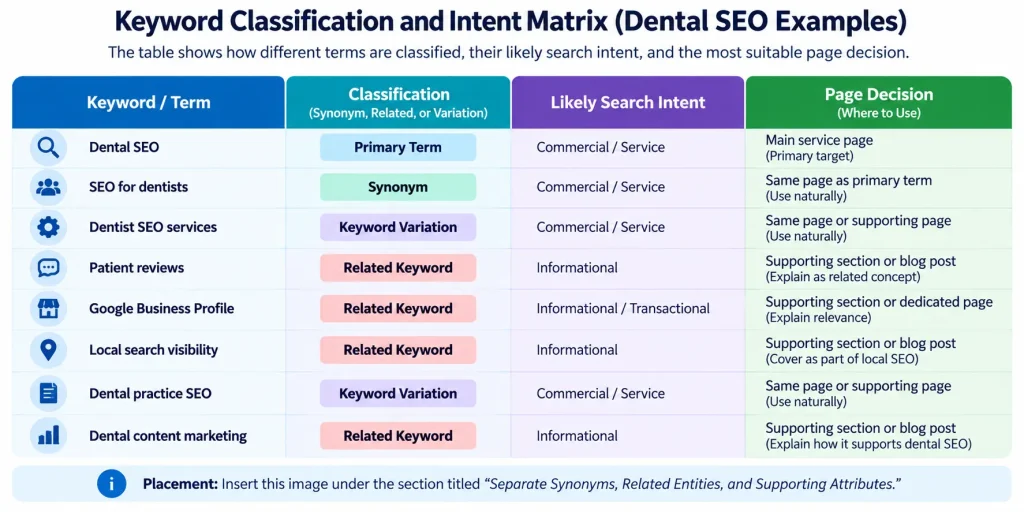
This classification prevents every associated phrase from entering one keyword group. Equivalent expressions can support the same page, while related entities should appear only where they contribute useful context.
Apply a Contextual Substitution Test
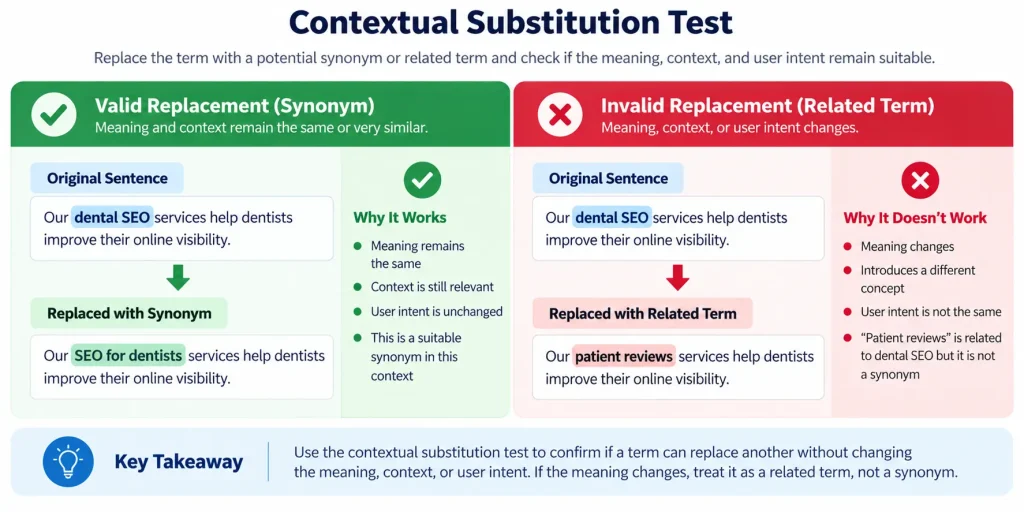
A contextual substitution test helps determine whether two terms can function as alternatives.
- Consider this sentence:
“Our dental SEO service helps practices improve local search visibility.”
- Replace the main term with “SEO for dentists”:
“Our SEO for dentists service helps practices improve local search visibility.”
The meaning remains substantially the same, so the phrases can function as contextual alternatives.
- Now replace the main term with “patient reviews”:
“Our patient reviews help practices improve local search visibility.”
The sentence now refers to a different concept. Patient reviews relate to dental SEO, but they are not a synonym for it. A valid contextual synonym should preserve the original meaning, search intent, and factual accuracy.
Decide When Related Keywords Need Separate Pages
Related keywords need separate pages when they represent different user needs or require substantially different content. Evaluate three factors:
- Search intent,
- Search result overlap, and
- Content purpose.
Queries remain on the same page when users expect a similar answer, similar pages appear for both searches, and one page can cover both topics without losing focus. Separate pages become appropriate when the queries reflect different objectives or require deeper treatment.
For example, a dental SEO service page can mention local SEO as part of the broader service. A detailed guide to local SEO for dentists may deserve its own page because it addresses a narrower information need in greater depth.
How to Use Synonyms and Related Keywords Naturally in SEO Content
Use synonyms and related terms where they improve meaning, clarity, and topic coverage. Primary terms establish the page focus, natural variations reduce repetition, and related concepts should appear only where their functions are actually explained.
Use Primary Keywords and Natural Variations in Titles and Headings
Titles and headings should identify the topic clearly. Use the primary keyword where it naturally describes the page, and use alternative wording only when it accurately represents the section.
A clear title such as “How to Use Synonyms and Related Keywords in SEO” communicates the topic directly. A title such as “SEO Synonyms, Semantic Keywords, Related SEO Keywords, Keyword Synonyms Guide” repeats similar phrases without adding useful meaning.
Clarity should take priority over inserting multiple keyword variations into the same heading.
Integrate Related Terms Where Their Concepts Are Explained
Related terms should appear in sections where their concepts contribute directly to the explanation.
A section about local dental visibility can naturally discuss Google Business Profile, patient reviews, business information, local citations, and location relevance because each concept supports local search visibility.
Those same terms would add little value in a section about title writing unless they were directly relevant to the point being explained. Use related vocabulary to add information, not simply to increase semantic variety.
Use Entity Attribute Relationships to Improve Content Depth
Content becomes useful when it explains the important properties and relationships of an entity instead of merely mentioning its name.
For example, mentioning Google Search Console provides limited information by itself. Explaining that its Performance report can show queries, clicks, impressions, click-through rate, average position, and landing page data connects the entity with attributes that matter to SEO analysis.
A useful entity explanation clarifies what the entity is, which properties matter, how it relates to the main topic, and what the reader can do with that information.
Use Descriptive Variations in Internal Links and Image Alt Text
Internal link anchor text should describe the destination. A website does not need to use identical anchor text every time it links to the same resource. Natural variations are appropriate when they still communicate the destination clearly.
Image alt text should describe the image accurately for accessibility and understanding. Keywords belong in alt text only when they genuinely describe what the image contains. The goal in both cases is descriptive accuracy rather than keyword variation for its own sake.
How Many Synonyms and Related Keywords Should You Use?
There is no universal number of synonyms or related keywords that a page must contain.
Use a term when it improves accuracy, clarity, natural expression, topic coverage, or reader understanding. A short section needs no variation, while a longer article may use several alternatives because the same concept appears repeatedly.
Do not optimize toward a fixed synonym density. The correct amount depends on the topic, context, and information the page needs to communicate.
Practical Example: Optimizing a Page With Synonyms and Related Terms
Consider a hypothetical page targeting dental SEO services. The page needs one clear commercial topic, natural query variations, and supporting entities that explain what the service actually includes.
Build a Synonym and Entity Attribute Map
A simple semantic map can separate equivalent expressions from related concepts, supporting attributes, and topics that may deserve separate coverage.
| Category | Terms |
| Primary concept | Dental SEO services |
| Near equivalent expressions | SEO for dentists, dental practice SEO, dentist SEO services |
| Related service concepts | Local SEO, content optimization, technical SEO |
| Related entities | Google Business Profile, dental website, Google Search, patient reviews |
| Supporting attributes | Local visibility, business information accuracy, service page relevance, review quality, location relevance |
| Topics that may need separate pages | Dental local SEO, dental website SEO, dental content strategy |
This structure prevents all related vocabulary from being treated as one keyword cluster.
Map Related Terms to the Right Content Sections
Each related term should appear where its concept is actually explained.
A local SEO section can cover Google Business Profile, patient reviews, local citations, business information accuracy, and geographic relevance. A dental service page optimization section can explain treatment pages, page titles, internal links, content relevance, and patient search intent. A technical SEO section can cover crawlability, indexing, mobile usability, site architecture, and page performance.
This placement keeps the page focused while giving each concept enough context to be useful.
Before and After: Rewrite an Overoptimized Paragraph
Before
“Our dental SEO services provide dental SEO for dentists that need dental SEO services. Our dentist SEO services use dental practice SEO methods to improve dental SEO rankings for dental practices.”
The paragraph repeats similar phrases without explaining what the service includes.
After
“Our dental SEO services help practices improve visibility for relevant patient searches. The strategy can include treatment page optimization, local search improvements, accurate business information, internal linking, technical fixes, and content aligned with questions prospective patients ask before choosing a dentist.”
The revised version keeps the primary topic clear while replacing repetition with useful supporting concepts and stronger semantic coverage.
Common Mistakes When Using Synonyms and Related Keywords
The problems occur when related terms are treated as interchangeable, keyword variations are forced into the copy, or tools are allowed to determine relevance without editorial judgment.
| Mistake | Consequence | Correction |
| Treating related terms as synonyms | Associated concepts are substituted for the main entity, which can make sentences inaccurate | Apply the contextual substitution test before treating terms as interchangeable |
| Forcing keyword variations into every paragraph | Content becomes repetitive and unnatural | Use variations only where they fit the sentence and preserve meaning |
| Relying on keyword density or LSI scores | Writers focus on term counts instead of usefulness, context, and intent | Evaluate whether each term improves the explanation |
| Adding every AI generated keyword suggestion | Irrelevant entities and weak associations can reduce topic focus | Validate suggestions against search intent, search results, authoritative sources, and subject knowledge |
| Creating separate pages for equivalent queries | Multiple pages may compete for the same purpose or repeat substantially similar information | Combine terms that serve the same user need and separate them only when intent or content purpose changes meaningfully |
The core rule is simple: classify terms by meaning and intent before using them. A keyword belongs in the content only when it improves accuracy, context, or reader value.
How to Measure the Effectiveness of Synonym and Related Term Optimization
Measure synonym and related term optimization by tracking whether the page gains visibility for relevant queries, attracts qualified organic traffic, and covers the topic more completely.
Avoid attributing every ranking change to vocabulary updates. Search performance can also change because of competition, content quality, links, technical issues, search demand, and other factors.
Track Search Query Variations in Google Search Console
Google Search Console can show whether a page appears for a broader or more relevant set of search queries after optimization.
Compare relevant query groups before and after substantial content changes. Review impressions, clicks, click through rate, average position, and landing page performance together rather than relying on one metric.
Pay particular attention to new query variations that match the page intent. An increase in relevant impressions can indicate broader query visibility, while clicks and landing page data help show whether those searches are reaching the intended content.
Focus on patterns across related queries rather than one isolated ranking position.
Perform a Lexical Gap and Entity Coverage Audit
A lexical gap exists when users search with relevant expressions that the page does not address clearly. An entity coverage gap occurs when the content omits an important concept, attribute, process, or relationship needed to explain the topic.
Use this workflow:
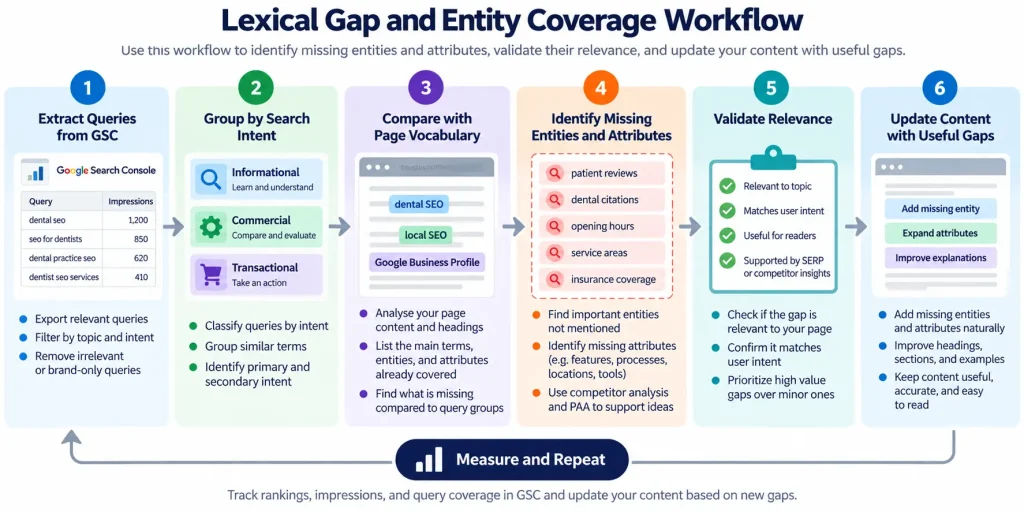
The objective is not to insert every missing phrase. A useful audit identifies missing meaning and information first, then determines whether additional vocabulary is needed to express it.
Evaluate Content Performance and Prioritize Updates
Combine search visibility data with user behavior and conversion data to determine whether the page is becoming more useful.
Review whether major updates correspond with more impressions from relevant searches, more qualified organic clicks, stronger conversion activity, broader coverage of appropriate query variations, and better alignment between search queries and the landing page.
Use these signals to prioritize future updates, but interpret changes in context. Improved or declining performance cannot usually be attributed to synonym usage alone.
Frequently Asked Questions About Synonyms in SEO
Does Google Recognize Synonyms Without Exact Keyword Matches?
Yes. Google can return relevant pages even when they do not contain every exact word used in a query.
Google Search Central documents systems such as RankBrain, neural matching, and BERT that help interpret relationships among words, concepts, context, and intent.
Are Synonyms a Direct Google Ranking Factor?
Google does not document a standalone synonym ranking factor that publishers can optimize through a specific count or density.
Synonyms are useful because they can improve natural language, meaning, readability, and coverage of appropriate query variations.
Can AI Tools Generate Useful SEO Synonyms?
Yes. AI tools can generate candidate synonyms, keyword variations, entities, attributes, and related concepts.
Their output still requires validation.
Use AI for discovery and organization. Validate final terms against meaning, intent, search results, authoritative sources, and subject knowledge.
Can a Page Rank for Multiple Related Keywords?
Yes. One page can appear for multiple queries when those searches align with its content and purpose.
The page should still maintain one clear topic and intent rather than targeting unrelated searches simply because they share vocabulary.
Final Checklist for Using Synonyms and Related Terms in SEO
- Define the primary topic, audience, search intent, and page purpose.
- Collect real query language from search results, Google Search Console, and keyword research tools.
- Separate synonyms and keyword variations from related entities and supporting attributes.
- Group terms that represent the same user need.
- Apply the contextual substitution test before treating terms as interchangeable.
- Map related concepts to the sections where they are actually explained.
- Use primary terms and natural variations without targeting a fixed density.
- Create separate pages only when intent or content purpose changes meaningfully.
- Audit lexical gaps, entity coverage, search performance, and conversions after major updates.
Synonyms and related keywords work best as tools for expressing meaning rather than words inserted for ranking purposes.
A strong page establishes the main topic clearly, uses alternative expressions where they remain accurate, explains related concepts where readers need them, and measures whether the resulting content attracts relevant searches.