
Search engines no longer reward pages simply because they exist or contain a certain number of words. They reward pages that satisfy intent, answer questions comprehensively, and contribute something useful that competing pages do not. That’s why thin content has evolved from a simple SEO concern into a broader content quality issue.
A page can be 2,000 words long and still qualify as thin if it repeats common information, lacks original insights, or fails to solve the user’s problem. Conversely, a concise page can perform exceptionally well if it delivers exactly what users need without unnecessary detail. The defining factor is value, not length.
Thin content affects more than individual rankings. Large volumes of low-value pages can weaken a site’s topical authority, waste crawl resources, create index bloat, and make it harder for search engines to identify the pages that genuinely deserve visibility. As websites scale through templates, AI-assisted workflows, e-commerce catalogs, and programmatic publishing, maintaining content quality becomes increasingly difficult.
This guide explains how modern search engines evaluate thin content, why it impacts SEO, and how to distinguish it from related quality issues. In the following sections, you’ll learn how to identify low-value pages, understand their causes, and build a stronger foundation for content that consistently satisfies both users and search engines.
Understanding Thin Content
What Is Thin Content?
Thin content is any page that provides insufficient value for its intended audience. Rather than helping users accomplish a task, answer a question, or make a decision, it offers limited, repetitive, outdated, or generic information that can easily be found elsewhere.
Search engines don’t measure content quality through a single signal. Instead, they evaluate whether a page adequately satisfies the searcher’s intent compared with competing results. A page becomes “thin” when it fails to meet that expectation.
Thin Content Definition
A practical definition is:
Thin content is content that delivers too little original, useful, or relevant information to justify its presence in search results.
That lack of value can appear in different ways:
- Minimal topic coverage
- Generic explanations with no unique perspective
- Template-driven pages containing only minor variations
- Auto-generated pages with little editorial review
- Pages created primarily for search engines rather than users
The issue isn’t simply that information is missing. It’s that users leave without having their questions fully answered.
What Google Considers Thin Content
Google doesn’t publish a fixed checklist that automatically labels pages as thin. Instead, its quality systems evaluate whether content is genuinely helpful and demonstrates clear value.
Pages are more likely to be considered low quality when they:
- Add little beyond information already available elsewhere
- Exist mainly to target keywords
- Offer shallow or incomplete answers
- Rely heavily on duplicated or boilerplate text
- Scale across hundreds or thousands of similar URLs with minimal differentiation
This is why two pages targeting the same keyword can produce very different results. One may comprehensively address the topic while the other simply paraphrases existing articles without adding meaningful information.
Why Word Count Doesn’t Define Thin Content
One of the most persistent SEO myths is that every page needs a minimum number of words to rank.
There is no universal word-count threshold.
A 250-word support article can satisfy users completely if the question is straightforward. On the other hand, a 2,500-word article filled with repetitive explanations, generic advice, and unnecessary sections may still provide little value.
Instead of measuring length, evaluate whether the page:
- Fully answers the primary query
- Covers important subtopics naturally
- Addresses likely follow-up questions
- Includes original information or expertise
- Helps users complete their objective
Content depth should match the complexity of the topic—not an arbitrary word target.
Thin Content vs Similar Content Issues
Not every underperforming page is thin content. Several content quality issues share similar symptoms, but each has a different cause and requires a different solution.
| Content Issue | Primary Problem | How It Differs from Thin Content |
| Thin Content | The page provides insufficient value or depth to satisfy user intent. | Focuses on missing or incomplete information rather than writing quality or duplication. |
| Low-Quality Content | The content is poorly written, inaccurate, outdated, misleading, or difficult to use. | A page can be comprehensive but still be low quality, while thin content may be well written but incomplete. |
| Duplicate Content | The same or substantially similar content exists across multiple URLs. | Duplicate pages may still be valuable individually, whereas thin content lacks sufficient value regardless of originality. |
| Helpful Content | Created to fully satisfy users with useful, trustworthy, and experience-driven information. | Thin content answers only part of the user’s question, while helpful content provides complete, practical guidance. |
Understanding these distinctions helps you diagnose content problems accurately and choose the right remediation strategy instead of treating every underperforming page as thin content.
Why Thin Content Happens
Thin content develops through publishing workflows, technical decisions, or scaling strategies that prioritize quantity over usefulness.
Search Intent Mismatch
Many pages fail because they answer the wrong question.
For example, a page targeting “best CRM software” may spend most of its content defining customer relationship management instead of comparing products. Even if the writing is accurate, it doesn’t satisfy the commercial intent behind the search.
When intent and content diverge, users leave quickly because the page doesn’t solve the problem they came to address.
Lack of Original Value
Many websites simply restate what already exists.
Readers gain little from another article that repeats the same introductory definitions, recycled best practices, or generic advice without adding:
- Practical experience
- Original examples
- Expert interpretation
- Updated information
- Unique research
- Better organization
Modern search engines increasingly reward information gain rather than information repetition.
Scaled Content Production Without Quality Control
Publishing at scale isn’t inherently problematic. The risk emerges when quality assurance fails to keep pace with production.
Common examples include:
- AI-generated articles published without human review
- Thousands of template-based location pages
- Automatically generated product descriptions
- Mass-produced glossary entries
- Programmatic pages with only minor variable changes
Scaling magnifies existing weaknesses. If the underlying template lacks value, every new page inherits the same limitations.
Technical Duplication
Some thin pages are created unintentionally.
Content management systems can generate large numbers of low-value URLs through:
- Tag archives
- Filter combinations
- Pagination
- Session parameters
- Printer-friendly versions
- Search result pages
Although they are technically different URLs, these pages often contribute little unique information while consuming crawl resources and increasing index size.
Poor Content Maintenance
Content quality declines over time.
Pages that once ranked well may gradually become thin because:
- Industry information changes
- Competitors publish more comprehensive resources
- Statistics become outdated
- Broken links accumulate
- Products or services evolve
- User expectations increase
Without regular updates, previously valuable content can lose relevance even if nothing about the original writing was inherently poor.
Why Thin Content Hurts SEO
Thin content affects more than individual page rankings. Because search engines evaluate websites as collections of pages, a large number of low-value URLs can weaken overall site quality, waste resources, and reduce user engagement.
Search Performance Impact
Reduced Rankings & Organic Visibility
Pages that don’t fully satisfy search intent struggle to compete with more comprehensive content. As competing resources provide better coverage and greater information gain, thin pages often experience declining rankings, impressions, and organic traffic.
Weakened Topical Authority
Publishing many shallow pages fragments topic coverage instead of demonstrating expertise. A smaller collection of comprehensive, well-connected resources typically builds stronger topical authority than dozens of overlapping articles.
Lower Keyword Coverage
Thin pages cover only part of a topic, limiting their ability to rank for related and long-tail queries. Expanding content with relevant concepts, supporting entities, and user questions improves topical completeness and search visibility.
Technical SEO Impact
Crawl Budget Waste
Low-value pages consume crawl resources that could be spent discovering or refreshing more important content. This is especially problematic for large websites with thousands of URLs.
Index Bloat
Thin category pages, archives, parameter URLs, and other low-value pages can clutter the search index, making it harder for search engines to identify a site’s most valuable content.
Duplicate URL & Canonical Issues
Near-duplicate pages divide ranking signals and create uncertainty about which URL should rank. Proper consolidation and canonicalization help concentrate authority on the preferred page.
User & Business Impact
Reduced Conversions
Whether the goal is generating leads, sales, or signups, thin content rarely provides enough information for users to make confident decisions.
Loss of Trust & Credibility
Outdated, repetitive, or incomplete content can undermine confidence in the rest of the website. Consistently useful, high-quality content strengthens credibility and supports long-term business performance.
How Google Evaluates Thin Content
Search engines don’t assign a “thin content score.” Instead, they evaluate multiple signals that collectively indicate whether a page deserves prominent visibility.
Originality & Information Gain
Publishing information that already exists isn’t enough.
High-performing pages typically contribute something additional, such as:
- First-hand experience
- Better analysis
- Clearer explanations
- Unique examples
- Updated guidance
- Practical frameworks
Information gain helps distinguish valuable resources from pages that merely restate existing knowledge.
Semantic Completeness & Entity Coverage
Google evaluates how completely a page covers the subject users expect—not simply whether it repeats the target keyword.
Thin pages often omit entities, related concepts, and supporting topics that naturally belong together. For example, a comprehensive article about thin content should also address crawl budget, duplicate pages, index bloat, content pruning, search intent, Helpful Content, and information gain. Ignoring these relationships leaves semantic gaps that reduce topical depth.
A page becomes stronger when it explains the topic as an interconnected subject rather than a collection of isolated keywords.
Helpful Content System & E-E-A-T
Google’s Helpful Content System doesn’t evaluate thin content by length. Instead, it looks for signals that a page genuinely helps users accomplish their goal.
Pages are less likely to be viewed as thin when they answer questions thoroughly, include practical guidance, demonstrate subject expertise, and provide information that goes beyond what’s already available elsewhere. Experience, expertise, authoritativeness, and trustworthiness strengthen content by increasing its usefulness—not simply by adding author credentials.
The more completely a page satisfies user intent without forcing visitors to continue searching, the less likely it is to be perceived as thin.
Spam Policies & Scaled Content Abuse
Scaling content isn’t inherently problematic.
Problems arise when automation is used primarily to generate large volumes of pages that add little or no original value.
Whether content is produced by AI, templates, or human writers, the same principle applies: if thousands of pages exist solely to capture search traffic without meaningfully helping users, they become increasingly difficult to sustain in organic search.
Common Types of Thin Content
Thin content isn’t limited to short articles. It can appear anywhere on a website when pages exist primarily to increase URL count rather than satisfy user intent. The following are the most common types of thin content and how to address them.
Low-Value Content Pages
These pages contain original content but don’t provide enough depth or usefulness to justify indexing.
| Type | Why It Becomes Thin | How to Improve |
| Short informational pages | Answer only the basic question without sufficient detail, context, or practical guidance. | Expand the content with examples, comparisons, implementation steps, and related questions. |
| Placeholder pages | Published before meaningful content exists, such as “Coming Soon” pages or unfinished service and product pages. | Keep unpublished until they contain useful, complete content. |
| Empty category pages | Contain few or no products, posts, or resources, providing little navigation value. | Merge, remove, or populate them with enough relevant content. |
Duplicate & Near-Duplicate Pages
Different URLs don’t necessarily mean unique content. These pages often compete against each other instead of adding value.
| Type | Why It Becomes Thin | How to Improve |
| Duplicate articles | The same or substantially similar content exists across multiple URLs. | Consolidate duplicate pages and implement canonical tags where appropriate. |
| Near-duplicate landing pages | Pages differ only by location names or keyword variations while using the same template. | Add genuinely unique, location- or audience-specific information. |
| Tag & archive pages | Automatically generated pages simply list existing content without adding context. | Noindex low-value archives or enrich them with useful summaries and navigation. |
Automatically Generated Content
Automation isn’t inherently harmful. Thin content occurs when generated pages provide little original value.
| Type | Why It Becomes Thin | How to Improve |
| AI-generated content | Published with minimal editing, resulting in generic, repetitive, or unoriginal information. | Add expert insights, real examples, updated information, and editorial refinement. |
| Programmatic pages | Large numbers of template-based pages differ only by variables such as city names or products. | Include unique datasets, localized information, comparisons, or page-specific insights. |
| Auto-generated location pages | Replace only the location name while keeping the rest of the content identical. | Add local service details, testimonials, regulations, and operational information. |
Ecommerce Thin Content
Large ecommerce websites generate thousands of pages, making thin content a common SEO issue.
| Type | Why It Becomes Thin | How to Improve |
| Manufacturer product descriptions | Identical descriptions appear across many retailers. | Write original descriptions with buying guidance, comparisons, and use cases. |
| Thin product pages | Include only basic details such as title, price, and a short description. | Add specifications, images, videos, FAQs, reviews, shipping, and compatibility information. |
| Variant pages | Separate URLs exist for colors, sizes, or materials with almost identical content. | Consolidate variants where possible or provide unique information for each variation. |
| Faceted navigation pages | Filter combinations generate thousands of low-value URLs. | Manage crawling and indexing to prevent unnecessary pages from entering the index. |
Local SEO Thin Content
Location pages should provide meaningful local information instead of repeating the same template.
| Type | Why It Becomes Thin | How to Improve |
| Doorway pages | Created primarily to rank for multiple locations while directing users to the same destination. | Replace them with genuinely useful location-specific pages. |
| Thin city pages | Only the city name changes while the rest of the content remains identical. | Include localized services, response times, testimonials, pricing, or regional information. |
| Franchise location pages | Every location page uses nearly identical content. | Add unique business details such as staff, hours, reviews, services, parking, and accessibility information. |
Other Common Thin Content Patterns
Several additional page types contribute to low-value indexes.
| Type | Why It Becomes Thin | How to Improve |
| Scraped or syndicated content | Republishes content from other sources without adding original value. | Include unique commentary, analysis, research, or updated context. |
| Low-value affiliate pages | Focus primarily on affiliate links rather than on helping users make informed decisions. | Add independent reviews, comparisons, buying advice, and real-world insights. |
| Ad-heavy pages | Advertisements dominate the page and overshadow the primary content. | Ensure the main content remains the primary focus of the page. |
| Outdated content | Information becomes incomplete or inaccurate as products, standards, and best practices change. | Regularly update content to maintain accuracy, relevance, and search value. |
Thin Content Examples
The difference between thin and high-quality content is based on the value it provides—not its length.
Thin Content vs. High-Quality Content
| Thin Content | High-Quality Content |
| Provides basic information only | Covers the topic in depth with context and practical guidance |
| Repeats existing information | Adds original insights, examples, or expertise |
| Focuses narrowly on one keyword | Covers related concepts and user questions |
| Offers limited evidence of expertise | Demonstrates experience and subject knowledge |
| Leaves questions unanswered | Satisfies the primary intent and likely follow-up questions |
Blog Post Example
Thin Version
A blog on “How to Improve Website Speed” lists basic tips such as compressing images, enabling caching, and minifying CSS with little or no explanation.
High-Quality Version
The article explains how each optimization works, when to use it, common mistakes to avoid, and which improvements deliver the greatest impact.
Ecommerce Product Page Example
Thin Version
A product page includes only the product name, price, manufacturer description, and a single image.
High-Quality Version
The page adds original product insights, performance expectations, comparisons, FAQs, customer reviews, warranty details, and multiple high-quality images to help buyers make informed decisions.
Affiliate Review Page Example
Thin Version
An affiliate article lists products using copied manufacturer specifications with little analysis or comparison.
High-Quality Version
The review compares products based on factors such as performance, usability, value, durability, ideal use cases, and limitations, explaining why each recommendation is suitable.
Local Business Page Example
Thin Version
Multiple location pages use the same content with only the city name changed.
High-Quality Version
Each page includes location-specific services, customer testimonials, business information, local FAQs, and other details relevant to users in that area.
How to Identify Thin Content
Identifying thin content requires more than checking word count. Evaluate pages using a combination of performance data, content quality, and technical SEO signals to determine whether they provide enough value for users and search engines.
Performance Signals
Performance data helps identify pages that consistently underperform.
Low Organic Traffic
Pages with little or no organic traffic over time may be thin, especially if they aren’t new, targeting low-volume keywords, or limited by strong competition.
Low Search Impressions
Consistently low impressions can indicate weak topical relevance, poor search intent alignment, internal competition, or indexing issues.
Low Click-Through Rate (CTR)
If titles and meta descriptions accurately reflect the page but CTR remains low, users may perceive competing results as more valuable.
Low Engagement
Short engagement time, minimal scrolling, rapid exits, and few follow-up page views often indicate that visitors aren’t finding enough value. Always interpret these metrics alongside search intent.
Low Conversion Rate
For commercial pages, poor conversions despite qualified traffic may indicate missing decision-making information such as pricing, comparisons, trust signals, or FAQs.
Few or No Ranking Keywords
Pages that rank for very few relevant search queries despite being indexed often lack the topical depth or relevance needed to compete in search results.
Content Quality Signals
These signals reveal whether the content itself lacks depth, originality, or usefulness.
Incomplete Topic Coverage
Pages that answer only the primary question while ignoring related subtopics often leave important informational gaps.
Missing Relevant Entities
Comprehensive content naturally includes related concepts, terminology, tools, and entities that demonstrate topical completeness.
Lack of Original Value
Pages that simply summarize existing information without unique insights, practical guidance, examples, or expert perspectives rarely stand out from competing content.
Duplicate or Near-Duplicate Content
Pages with substantially similar content provide little unique value and may compete with one another. Compare URLs for repeated copy, templated content, or minimal differentiation.
Excessive Boilerplate Content
When navigation, templates, legal text, or repeated site elements make up most of a page while unique content is minimal, the page may offer limited standalone value.
Programmatically Generated Pages
Automatically created pages with only minor variations—such as location, product, tag, or filter pages—can become thin if they lack unique, useful information.
Outdated Content
Obsolete recommendations, outdated statistics, broken references, discontinued products, and old screenshots can gradually reduce a page’s quality and usefulness.
Technical SEO Signals
Technical issues can also reveal or contribute to thin content problems.
Orphan Pages
Pages with few or no internal links receive less visibility from both users and search engines, making them harder to discover and evaluate.
Deep Crawl Depth
Important content buried several clicks from the homepage often receives less internal authority and may be crawled less efficiently.
“Crawled – Currently Not Indexed”
A recurring “Crawled – Currently Not Indexed” status in Google Search Console can indicate pages with limited value, duplication, weak internal linking, or other quality concerns.
Content Cannibalization
Multiple pages targeting the same search intent can split topical relevance, causing competing URLs to underperform instead of strengthening overall authority.
Excess Indexed Low-Value Pages
Large numbers of indexed low-value URLs—such as filtered pages, empty categories, outdated campaign pages, or expired product listings—can dilute overall site quality and waste crawl resources.
How to Audit Thin Content
A thin content audit identifies which pages should be kept, improved, consolidated, or removed based on content quality, SEO performance, and business value.
1. Inventory All Indexable URLs
Start by creating a list of every indexable page on your site, including blog posts, product pages, categories, archives, and automatically generated URLs.
Collect key metrics such as:
- Organic traffic
- Search impressions
- Backlinks
- Internal links
- Indexability
- Last updated date
Reviewing these metrics together helps identify pages that contribute little to users or search performance.
2. Categorize Pages by Search Intent
Evaluate each page according to the intent it serves.
| Search Intent | Common Thin Content Issue |
| Informational | Covers only basic definitions or lacks supporting explanations. |
| Commercial | Provides little comparison, evaluation, or buying guidance. |
| Transactional | Omits product details, trust signals, or decision-making information. |
Understanding search intent makes it easier to identify missing information and prioritize improvements.
3. Evaluate Content Quality
Assess whether each page fully satisfies its intended purpose.
| Check | Questions to Ask |
| Depth & Coverage | Does the page answer the main question and cover important subtopics? |
| Accuracy | Is the information current, accurate, and up to date? |
| Originality | Does the page offer unique insights, expertise, examples, or practical guidance? |
| Intent Fulfillment | Can users accomplish what they came to do without needing another resource? |
Focus on completeness and usefulness rather than word count.
4. Review Technical SEO Signals
Strong content still depends on sound technical SEO.
| Signal | What to Review |
| Indexability | Should the page appear in search results? |
| Crawlability | Is the page easy for search engines to discover? |
| Internal Linking | Does it receive contextual links from relevant pages? |
| Canonicalization | Are duplicate or near-duplicate URLs properly consolidated? |
5. Prioritize Optimization
Not every thin page deserves the same level of investment.
Prioritize pages based on:
- Search traffic potential
- Conversion potential
- Business importance
- Existing backlinks or authority
Focus resources where improvements are most likely to deliver SEO and business value.
How to Fix Thin Content
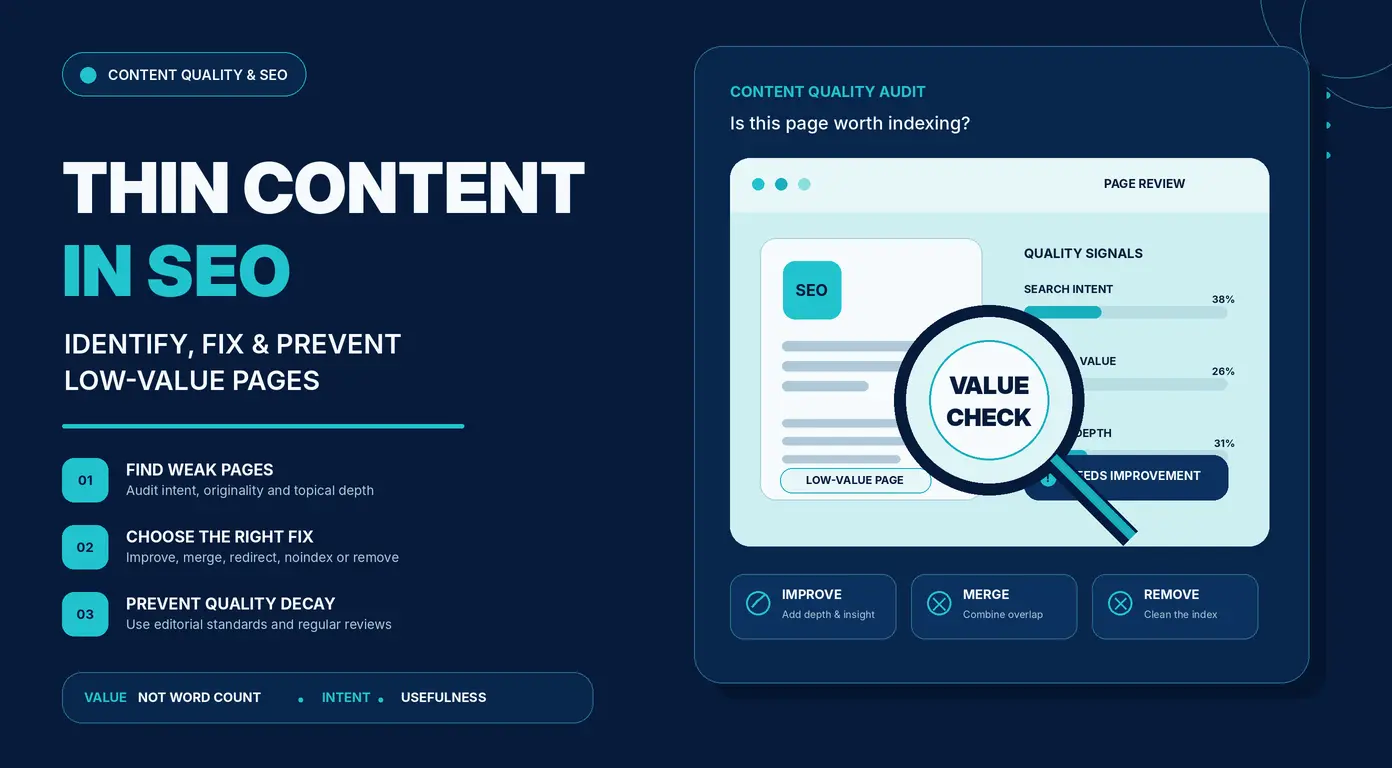
The right solution depends on why the page is thin. Some pages should be expanded, while others are better merged, redirected, noindexed, or removed.
Improve Existing Content
Expand pages that target valuable topics or support important business goals.
Focus on:
- Filling information gaps
- Matching current search intent
- Adding original insights, examples, or first-hand experience
- Strengthening E-E-A-T through accurate, trustworthy content
- Improving readability with clear headings, concise paragraphs, and logical structure
The goal is to make the page more useful—not simply longer.
Consolidate Similar Pages
Merge pages that target the same search intent or cover overlapping topics.
After consolidation:
- Preserve the strongest content
- Remove duplicated information
- Redirect old URLs to the new page
Fewer comprehensive resources generally perform better than multiple incomplete ones.
Apply Technical SEO Solutions
Some thin content issues require technical fixes instead of editorial updates.
| Solution | Best Used When |
| Canonical Tag | Multiple similar URLs should share ranking signals. |
| 301 Redirect | A stronger page already satisfies the same search intent. |
| Noindex | The page is useful for users but shouldn’t appear in search results. |
| Delete | The page has no SEO or business value and cannot be improved. |
Choose the option that best improves the overall quality of your indexed content rather than preserving every URL.
Preventing Thin Content
Preventing thin content is more effective than fixing it later. A consistent content process helps maintain site quality and reduces the need for large-scale cleanup.
| Best Practice | How It Prevents Thin Content |
| Establish editorial standards | Define minimum quality requirements for every page, including complete search intent coverage, original insights, and sufficient supporting information before publication. |
| Create comprehensive content briefs | Give writers clear guidance on search intent, key topics, entities, content gaps, and the unique value each page should provide. |
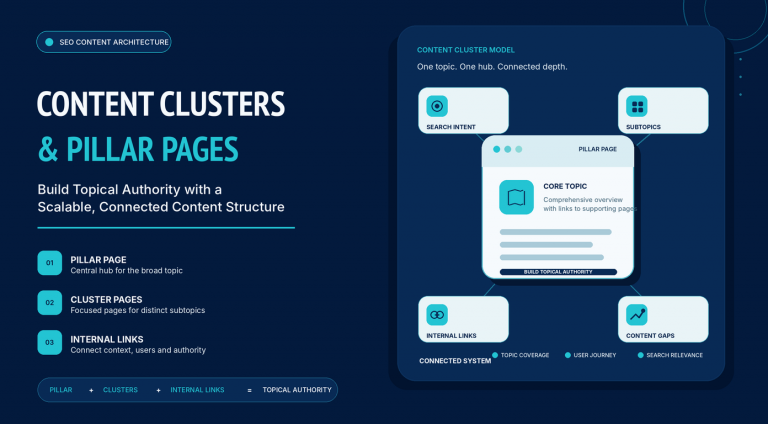
| Build topic clusters | Organize content around pillar pages and supporting articles to reduce overlap, strengthen internal linking, and ensure each page has a distinct purpose. |
| Review AI-generated content | Edit AI-assisted drafts for accuracy, originality, search intent alignment, usefulness, and brand consistency before publishing. |
| Conduct regular content audits | Periodically identify outdated, duplicate, underperforming, or cannibalizing pages before they affect overall site quality. |
| Monitor content performance | Track metrics such as impressions, rankings, engagement, conversions, and index growth to identify pages that need updating or consolidation. |
Following these practices helps ensure new content consistently delivers value while keeping your website lean, relevant, and easy for search engines to evaluate.
Thin Content Decision Framework
Every thin page should lead to one of six actions.
| Decision | When to Choose It |
| Keep | The page satisfies search intent, performs well, remains accurate, and supports business goals. |
| Improve | The page has ranking potential, valuable backlinks, business importance, or quality issues that can be fixed. |
| Merge | Multiple pages target the same search intent and would provide more value as a single, comprehensive resource. |
| Redirect | The page has been replaced, consolidated, or is no longer needed. Redirect users to the most relevant alternative—not the homepage. |
| Noindex | The page is useful for users but shouldn’t appear in search results, such as utility or administrative pages. |
| Delete | The page has no SEO or business value and isn’t worth improving. Removing it helps maintain a healthier website. |
Conclusion
Thin content is fundamentally a value problem, not a word-count problem. Pages succeed when they satisfy user intent, contribute original insights, and help visitors accomplish their goals better than competing resources. They fail when they exist merely to occupy search results.
Improving a website’s content quality rarely means expanding every page. It means making deliberate decisions—improve what has value, consolidate what overlaps, exclude what doesn’t belong in search, and remove what no longer serves users or the business. This disciplined approach creates a smaller, stronger index that’s easier for search engines to understand and more useful for your audience.
Treat thin content remediation as an ongoing quality management process rather than a one-time cleanup. Regular audits, thoughtful editorial standards, and continuous performance monitoring will help your content remain relevant, authoritative, and resilient as search expectations continue to evolve.
Frequently Asked Questions
What is thin content?
Thin content refers to pages that provide insufficient value for users. The issue isn’t simply having fewer words but failing to satisfy search intent, answer questions comprehensively, or offer meaningful original information.
What does Google consider thin content?
Google evaluates overall usefulness rather than word count. Pages that add little value, rely heavily on duplication, or exist primarily to attract search traffic without helping users are more likely to perform poorly.
Is thin content based on word count?
No. A concise page can rank well if it fully satisfies user intent, while a lengthy article can still be thin if it contains repetitive, generic, or incomplete information.
What are common examples of thin content?
Examples include placeholder pages, empty category pages, duplicate location pages, manufacturer product descriptions, low-value affiliate content, doorway pages, and outdated articles that no longer meet user expectations.
How do I identify thin content on my website?
Combine performance data, content evaluation, and technical SEO analysis. Review low-traffic pages, indexing reports, internal linking, topic coverage, and search intent alignment rather than relying on word count alone.
Which SEO tools can detect thin content?
Useful tools include Google Search Console, Google Analytics 4, Screaming Frog, Ahrefs, Semrush, and Sitebulb. Together, they help uncover indexing issues, weak performance, duplicate pages, and structural inefficiencies.
How do I fix thin content?
The right solution depends on the page. Improve valuable content, merge overlapping resources, redirect obsolete URLs, apply noindex where appropriate, or delete pages that no longer provide SEO or business value.
Should I improve, merge, redirect, noindex, or delete thin pages?
Evaluate each page based on search intent, traffic, backlinks, business importance, and uniqueness. The goal is to maximize the value of your indexed content rather than preserve every URL.
Is duplicate content always considered thin content?
No. Duplicate content concerns similarity across URLs, while thin content concerns insufficient value. The two issues often overlap but require different remediation strategies.
Can AI-generated content be considered thin?
Yes, if it simply reproduces existing information without editorial review or original contribution. AI-assisted content can perform well when it is accurate, well-structured, and enhanced with human expertise and unique insights.
How long does it take to recover after fixing thin content?
Recovery timelines vary based on crawl frequency, site authority, and the scale of improvements. Noticeable changes often appear after search engines recrawl and re-evaluate the updated pages, which may take several weeks to a few months.