
A website can gain traffic quickly. The hard part is keeping it.
That distinction explains why a long term SEO strategy is fundamentally different from chasing a few rankings, publishing a burst of articles, or buying links to force short-term growth. Sustainable organic visibility is built through accumulated signals: technically accessible pages, useful content, topical depth, earned authority, and a history of satisfying search intent.
Why SEO Is a Compounding Investment, Not a Quick Fix
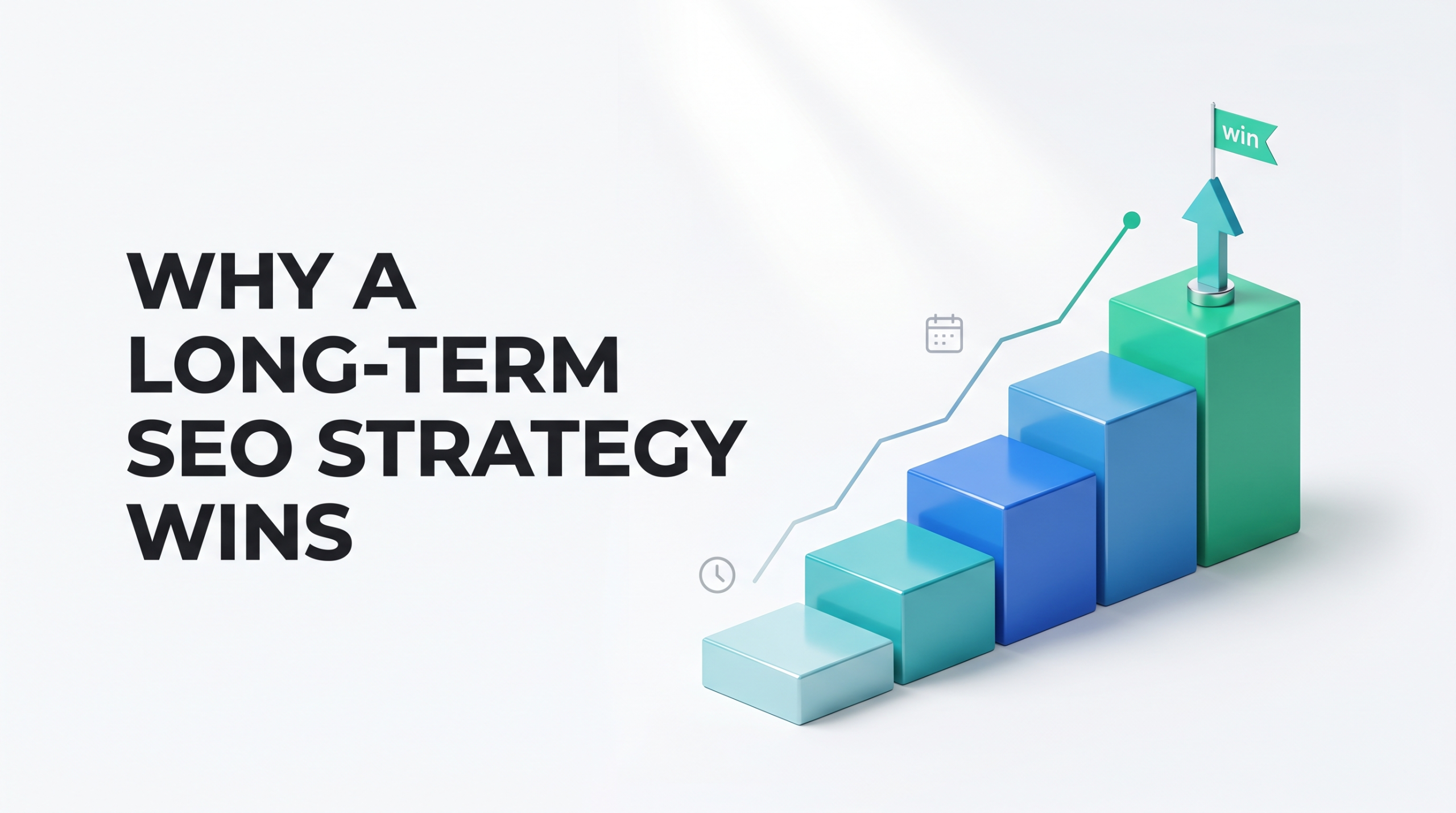
SEO behaves like building an asset rather than renting attention.
With paid advertising, traffic stops when spending stops. SEO doesn’t work that way. A well-optimized page continue to attract impressions, clicks, links, mentions, and conversions long after it is published. That doesn’t mean SEO is “free” after the initial investment, maintenance is essential, but the economics improve as the content library and authority base grow.
Think about two businesses:
- Business A spends heavily on PPC for 12 months but creates little organic content or technical infrastructure.
- Business B combines technical SEO, search-intent research, content development, internal linking, and authority building over the same period.
At the start, Business A may have more immediate traffic. By month 12 or 24, however, Business B may have dozens or hundreds of pages capable of generating organic demand without paying for every individual click.
That’s the core benefit of long-term SEO: each successful improvement supports future growth.
A strong technical fix improves crawlability across many pages. One authoritative guide can rank for dozens of related queries. A useful piece of content earns backlinks that strengthen the broader site. Internal links distribute that value to commercial pages.
I’ve seen this pattern over many times in SEO work: companies become frustrated because they judge SEO after three months, then lose momentum just before the earlier work has enough time to compound.
What Actually Takes Time in SEO?
“SEO takes time” is true, but it’s also an incomplete explanation.
The delay isn’t caused by Google simply making website owners wait. Multiple processes need to happen before a new or improved page can consistently compete.
Crawling, Indexing, and Trust Development
First, search engines need to discover and process your pages.
Googlebot has to crawl accessible URLs, understand the rendered content, process canonicalization signals, and decide whether a page should be indexed. Indexing still doesn’t guarantee competitive rankings.
A page targeting a competitive query then enters a much harder environment: it must demonstrate relevance and usefulness against pages that have years of content history, links, brand recognition, and accumulated engagement.
Technical problems slow or weaken this entire process. The issues include:
- Poor internal linking that leaves important pages difficult to discover
- Incorrect canonical tags
- JavaScript rendering problems
- Redirect chains and broken internal links
- Thin or near-duplicate pages
- Slow or unstable page experiences
- Important content blocked from crawling or indexing
This is why publishing more content isn’t always the answer. If the underlying site architecture is weak, scaling content can scale the problem.
Building Topical Authority Around Search Intent
A single excellent article does not create topical authority by itself.
Suppose a website wants to compete for “email marketing software.” Publishing one commercial page won’t establish deep expertise. A stronger approach include supporting coverage around:
- Email automation
- Deliverability
- List segmentation
- Welcome sequences
- A/B testing
- Email analytics
- Transactional email
- Compliance requirements
These pages should not exist only to create keyword count. Each is required to solve a distinct search need while strengthening the site’s overall understanding of the topic.
This matters more as search becomes more entity- and topic-driven. Google’s ranking systems are not only counting how often a keyword appears on a page. Relevance involves understanding the query, the content, the context, and whether the result satisfies the searcher.
Why Backlinks and Brand Signals Compound
Authority building also works over time.
A useful page can earn its first few natural links. Those links improve the page’s ability to compete, which increases visibility. More visibility creates more opportunities for journalists, bloggers, researchers, and industry professionals to discover and reference it.
That doesn’t mean every ranking improvement creates a perfect snowball effect. SEO is not that clean. But assets that continue earning visibility do create additional opportunities for authority.
One important correction to outdated SEO advice: “Domain Authority” is not a Google ranking metric. Metrics such as Moz’s Domain Authority or Ahrefs’ Domain Rating can be useful third-party indicators, but they shouldn’t be confused with a score Google directly uses to rank websites.
The real goal is broader: build a credible site with useful content, strong internal relationships between pages, relevant external references, and a reputation that isn’t dependent on one shortcut.
Short-Term vs. Long-Term SEO: What’s the Real Difference?
The difference isn’t simply about how long you wait for results.
Short-term SEO focuses on isolated wins: ranking one page, fixing one technical issue, or targeting a temporary keyword opportunity. Those activities aren’t bad. The problem begins when there is no system connecting them.
A sustainable SEO strategy connects individual actions to long-term business goals.
| Short-Term Approach | Long-Term SEO Strategy |
| Targets isolated keyword opportunities | Builds topic clusters around business priorities |
| Focuses heavily on immediate ranking movement | Measures qualified traffic, conversions, and cumulative growth |
| Publishes content inconsistently | Maintains a structured content roadmap |
| Treats links as individual ranking boosts | Builds ongoing authority and digital PR opportunities |
| Reacts after traffic drops | Uses regular technical and content monitoring |
| Often chases algorithm-specific tactics | Focuses on durable quality and relevance |
Short-term wins do matter. A quick technical fix can recover lost traffic. A new landing page can capture an immediate opportunity.
The mistake is treating those wins as a complete strategy.
The Benefits of Long-Term SEO for Sustainable Growth
A well-executed long-term strategy creates advantages that are difficult to reproduce quickly.
| Benefit | How It Works | Long-Term Value |
| Less Dependence on Individual Pages | A mature SEO program spreads organic visibility across a larger content ecosystem instead of relying on a handful of rankings. | If one page loses visibility, other pages can continue generating traffic, reducing dependence on individual rankings. |
| Content Assets Continue Producing Value | Properly maintained content can keep attracting traffic and leads over time. Evergreen pages still need updates as search intent, competitors, statistics, and search results change. | Existing content can continue contributing to organic growth instead of requiring a completely new investment for every visit. |
| Improved Customer Acquisition Economics | SEO requires upfront investment in research, content, technical work, editing, design, and promotion, but successful pages can generate traffic repeatedly without paying for every individual click. | SEO ROI can improve cumulatively as useful organic assets continue producing qualified traffic and conversions. |
| Brand Familiarity Builds Alongside Rankings | Users may first encounter a brand through informational content, see it again during comparison, and later search for it directly. | Organic visibility can support both demand generation and demand capture, even when every interaction is not visible in a single attribution report. |
Why SEO Takes Time to Deliver Meaningful ROI
The question shouldn’t be, “How fast can SEO rank this keyword?”
A better question is, “How long will it take to build an asset that can keep producing value?”
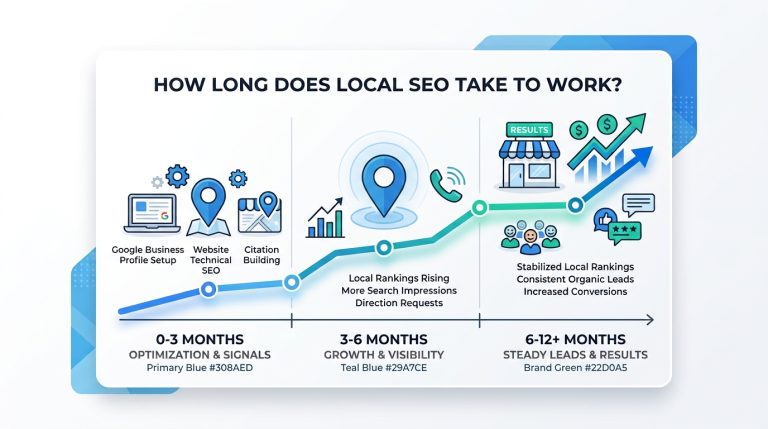
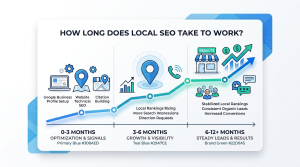
The answer depends on competition, website history, technical condition, resources, content quality, and the starting authority of the domain. A realistic timeline looks like this:
Months 1-3: Foundation and Discovery
This period is less exciting than clients expect.
The work includes:
- Technical SEO auditing and fixes
- Keyword and search intent mapping
- Content gap analysis
- Information architecture improvements
- Internal linking strategy
- Updating or consolidating weak content
- Establishing measurement and conversion tracking
Some low-competition improvements may produce early movement. But expecting broad, stable growth across a competitive market within a few weeks is unrealistic.
Months 3-6: Early Signals and Content Expansion
Search engines take more time to process improvements.
You may begin seeing:
- More indexed and visible pages
- Growth in impressions
- Long-tail keyword rankings
- Improved rankings for existing pages
- Early organic conversions
- More opportunities for relevant backlinks
This stage reveals whether the strategy is correctly aligned with search intent.
Months 6-12: Compounding Starts Becoming Visible
For many businesses, this is where the value of consistent work becomes easier to measure.
The site now has enough optimized content and supporting pages for topical relationships to strengthen. Internal linking is meaningful when there are more relevant assets to connect.
Rankings can fluctuate, as growth is not always a straight line.
Months 12+: Optimization Becomes More Strategic
At this point, the conversation should shift from “Should we do SEO?” to questions such as:
- Which content produces the highest conversion value?
- Where are competitors gaining topical coverage?
- Which pages need refreshing?
- Which topic clusters deserve expansion?
- Where is technical friction limiting growth?
- How can organic visibility support broader brand goals?
This is where a long-term investment becomes efficient.
Long-Term SEO vs. Paid Ads: How the Economics Change Over Time
Paid search and SEO shouldn’t be treated as enemies. The strongest marketing programs use both.
PPC is excellent for immediate visibility, testing commercial intent, launching offers, and generating traffic while organic pages mature. SEO becomes valuable when the same relevant demand exists month after month.
A Simplified Example
Imagine a business spends $10,000 per month on paid search.
Over 12 months:
$10,000 × 12 = $120,000
Now imagine the business invests part of that budget into building a content and SEO system. The first six months produce limited direct return. But by month 18, the accumulated content generates substantial organic traffic while requiring ongoing optimization rather than payment for every visit.
The comparison is not “free SEO versus expensive PPC.” That’s outdated thinking.
It’s owned organic assets versus rented traffic, with different timelines and risk profiles.
How a Sustainable SEO Strategy Handles Google Algorithm Updates
Google’s ranking systems change constantly, but major changes can expose weak strategies.
Recent years have reinforced several themes. The 2024 core and spam-related changes targeted manipulative practices and low-value scaled content, while Google’s continued work around AI-generated search experiences has changed how websites think about visibility, clicks, and informational queries.
The practical lesson isn’t to optimize for the wording of a specific update. It’s to avoid building a strategy that works because of a temporary loophole.
What Recent Google Changes Have Made Clear
Three developments are relevant to a long-term approach:
- Google’s March 2024 core update and spam policy changes reinforced the risks of scaled, low-value content and manipulative practices.
- AI Overviews and broader AI-assisted search experiences have increased the importance of providing genuinely useful information that can stand out as a source, not just rank as another similar page.
- Search Console and modern SEO platforms make it easier to monitor query patterns, indexing, page performance, and changes following updates, but tools provide signals, not guaranteed explanations.
A sustainable strategy doesn’t panic every time rankings move. It investigates.
If a page loses visibility, check whether the issue is technical, intent-related, competitive, seasonal, or connected to broader search changes. Blindly rewriting everything after every update destroys pages that were actually performing well.
Why Chasing Ranking Shortcuts Creates Long-Term Risk
Shortcuts have a delayed cost.
Examples include mass-producing near-identical pages, buying obviously manipulative links, stuffing keywords, or publishing AI-generated content without meaningful editing or original value.
These tactics create temporary movement, and not build an underlying asset. When the tactic stops working, the business is left with cleanup work instead of a durable content foundation.
Building Search Intent and Topical Authority That Competitors Can’t Easily Copy
The strongest SEO strategies begin with the business and audience, then connect those needs to search demand.
Keyword volume alone is not enough.
For example, a software company may find that a broad keyword has 20,000 monthly searches. That sounds attractive until the team discovers that most ranking pages are beginner tutorials while the company needs qualified enterprise buyers.
Ranking for the wrong intent produces impressive traffic and disappointing revenue.
A better approach maps queries across the customer journey:
- Informational: What is X?
- Problem-aware: How do I solve X?
- Comparative: X vs. Y
- Commercial: Best X software
- Transactional: Buy X or request a demo
Then create content that matches each stage.
Topical authority emerges when this coverage becomes coherent. The site demonstrates depth, not through repetition, but through useful answers to connected questions.
How Technical SEO Creates the Foundation for Long-Term Growth
Technical SEO is treated as a one-time audit. That’s a mistake.
Websites change constantly. New templates are launched, products are removed, developers update JavaScript, CMS plugins change behavior, and internal links break.
A long-term strategy treats technical SEO as ongoing quality control.
Crawlability and Indexability
Important pages should be discoverable through logical internal links and accessible to search engines.
XML sitemaps help discovery, but they don’t replace strong site architecture.
Canonicalization
Duplicate or substantially similar URLs send confusing signals.
Canonical tags should reflect a deliberate strategy, not be added automatically without checking whether the canonical page is actually the correct representative version.
Page Experience and Performance
Core Web Vitals remain useful diagnostic signals, but passing a specific metric threshold doesn’t guarantee rankings.
A technically fast page with poor content can lose to a slower page that answers the searcher’s question better. Performance matters because it reduces friction, not because a green score alone creates authority.
Internal Linking
Internal links are the scalable long-term SEO tool because you control them.
A strong internal linking structure helps search engines discover pages, understand relationships between topics, and identify which pages matter most within the site.
The Compounding Effect of Content, Links, and Historical Performance
The real strength of a long term SEO strategy appears when individual improvements start supporting one another.
Imagine publishing a detailed guide that begins ranking for a cluster of long-tail keywords. That guide earns relevant links and attracts users searching for the topic. Supporting articles answer related questions and internally link back to the guide and relevant commercial pages.
Over time, you don’t just have one ranking page. You have a connected system:
Technical foundation → Better crawlability → More pages discovered and indexed → Useful content earns visibility → Visibility creates link and brand opportunities → Stronger topical coverage supports more rankings → More organic traffic creates more conversion opportunities
Not every website follows this sequence perfectly, and Google doesn’t publish a simple formula that guarantees this outcome. But strategically, this is how sustainable growth is built.
Common Short-Term SEO Tactics That Create Long-Term Problems
Not every fast tactic is bad. The problem is using tactics that create temporary metrics while weakening the website’s future.
| Short-Term Tactic | Why It Creates Problems | Better Long-Term Approach |
| Publishing hundreds of pages with minimal differentiation | Near-identical pages that simply swap a city, product, or keyword add little value and can create large amounts of repetitive content. More URLs are not an advantage if they do not meaningfully answer different needs. | Use programmatic SEO only when each page provides distinct, useful information for its specific search intent. |
| Buying links based on quantity | Hundreds of irrelevant or obviously manipulated backlinks do not automatically create sustainable authority and can leave the site dependent on artificial signals. | Prioritize relevance, editorial value, useful assets, digital PR, partnerships, and content worth referencing naturally. |
| Updating content without understanding why it lost visibility | Automatically rewriting declining pages can waste resources or damage content when the real cause is seasonality, changed intent, technical issues, lost internal links, stronger competitors, or keyword cannibalization. | Diagnose the cause first, then update content only when the evidence supports it. Content freshness should be based on need, not an arbitrary calendar. |
| Treating rankings as the only KPI | A position-one ranking can still deliver little business value if it attracts the wrong audience, while a lower ranking for a high-intent query may generate more qualified leads or sales. | Measure the full path: Visibility → Qualified traffic → Engagement → Leads or sales → Revenue → SEO ROI. |
How to Measure SEO ROI Over the Long Term
SEO reporting becomes misleading when every month is judged independently.
A new content investment may show a negative return during the first quarter because production costs happen immediately while traffic grows gradually. A better model tracks cumulative performance.
Start With the Business Value
Depending on the business model, measure:
- Organic conversions
- Qualified leads
- Assisted conversions
- Revenue from organic traffic
- Customer acquisition cost
- Customer lifetime value where available
- Growth in non-branded organic visibility
- Share of important keyword or topic coverage
For a lead-generation business, a simplified calculation might be:
SEO ROI = (Revenue attributed to organic search − SEO investment) ÷ SEO investment × 100
The attribution model should be chosen carefully. SEO often influences users before they convert through another channel, so relying only on last-click attribution can understate its value.
Look at Page-Level and Cluster-Level Performance
Don’t evaluate a 12-month strategy solely through total website traffic. Break performance into:
- Topic clusters
- Commercial versus informational pages
- New versus existing content
- Branded versus non-branded queries
- Organic landing pages
- Conversion paths
This makes it easier to identify what is actually working.
A site might show flat total traffic while its highest-value commercial pages are growing significantly. Another site might report a 50% traffic increase driven almost entirely by low-value informational keywords.
Those are very different outcomes.
A Practical Example: The Difference a 12-Month Strategy Can Make
Consider a hypothetical B2B software company with 30 existing blog posts and a small number of commercial landing pages. The company wants more demo requests from organic search.
The Short-Term Approach
The team identifies 20 high-volume keywords and publishes articles as quickly as possible. Most topics are chosen based on search volume alone.
After several months, traffic increases. But:
- Many visitors are students or early-stage researchers.
- Articles don’t connect clearly to product pages.
- Several posts overlap and compete with one another.
- Important commercial topics still have weak coverage.
- There is little authority-building activity.
Traffic looks better. The pipeline barely moves.
The Long-Term Approach
Instead, the company maps its product, audience problems, and search journey. It identifies core topic clusters, audits technical issues, consolidates overlapping content, improves internal linking, and creates content around informational, comparison, and commercial intent.
It also develops original resources that can support outreach and digital PR.
By months 9-18, the company has a stronger system:
- More relevant pages are ranking.
- Informational content supports commercial discovery.
- Internal links guide users toward high-value pages.
- Updated content protects earlier gains.
- Authority grows around the company’s core expertise.
That’s a more realistic model of sustainable SEO strategy.
The goal isn’t simply “more traffic.” It’s building an organic acquisition channel that becomes increasingly useful to the business.
What Should a Long-Term SEO Strategy Include?
A durable strategy needs more than a content calendar. It should include five connected areas:
1. Technical Maintenance
Monitor crawl errors, indexation, redirects, canonicalization, structured data where relevant, internal links, and performance issues.
2. Search Intent and Keyword Strategy
Map keywords to real user needs and business goals. Avoid targeting keywords solely because they have high search volume.
3. Topical Content Development
Build connected coverage around the subjects your business needs to own.
Not every article needs to be 3,000 words. Depth means answering the query properly, not stretching every topic to an arbitrary word count.
4. Authority Development
Create content, research, tools, data, or insights that deserve citations. Support this with thoughtful outreach and digital PR rather than artificial link schemes.
5. Measurement and Iteration
Review what is growing, declining, converting, or underperforming. Then adjust based on evidence.
The strategy should evolve. The underlying principles should remain stable.
Long-Term SEO Strategy Checklist
Before treating SEO as a long-term growth channel, make sure these foundations are in place:
- Define the business outcomes SEO is expected to support.
- Audit technical crawlability, indexability, and site architecture.
- Map primary topics to search intent rather than keyword volume alone.
- Build content clusters around commercially relevant areas of expertise.
- Improve internal linking between informational and commercial pages.
- Consolidate or improve thin, duplicate, and overlapping content.
- Create a realistic content refresh process based on performance and SERP changes.
- Develop authority through useful assets, relevant coverage, and earned links.
- Track organic conversions and revenue alongside rankings and traffic.
- Review progress across 6-, 12-, and 18-month periods instead of expecting instant results.
- Investigate ranking changes before making large-scale content rewrites.
- Keep monitoring Google Search Central guidance and major changes in search features.
The checklist is deliberately less glamorous than most SEO growth hacks. Sustainable growth comes from doing the unexciting work consistently.
Conclusion: A Long Term SEO Strategy Is an Asset-Building Decision
The biggest misunderstanding about SEO is that slow results mean the strategy isn’t working.
Sometimes that is true. Poor strategy, weak content, technical problems, and unrealistic keyword targeting can waste months of effort. But time is also part of how SEO creates value.
A long term SEO strategy gives technical improvements time to stabilize, content time to build visibility, and the business time to understand which search opportunities actually produce revenue.
The companies that struggle most with SEO are often the ones that repeatedly stop, restart, and change direction before the previous investment has had a chance to mature.
My view is simple: don’t invest in SEO because you want rankings next month. Invest because you want to build an organic acquisition asset that is stronger 12, 24, and 36 months from now than it is today.
Frequently Asked Questions
What makes an SEO strategy sustainable long term?
A sustainable SEO strategy combines technical maintenance, useful content, search-intent alignment, internal linking, authority building, and ongoing measurement. It focuses on creating assets that continue supporting organic visibility rather than relying on temporary ranking tactics.
Should you update old content or keep publishing new content?
Both matter, but the decision should depend on performance. Update existing pages when information becomes outdated, search intent changes, rankings decline, or competitors provide better answers. Publish new content when there is a genuine gap that existing pages cannot adequately cover.
Does long-term SEO require continuous link building?
Not necessarily in the form of constant manual outreach. Long-term authority can also grow through original research, useful resources, digital PR, partnerships, brand mentions, and content that naturally earns relevant links.
How do you know if a long-term SEO strategy is working?
Look beyond individual keyword rankings. Growth in qualified organic traffic, non-branded visibility, conversions, revenue, valuable landing pages, and topic-level performance provides a stronger picture of whether SEO is contributing to business growth.
Can a website lose the SEO value it has built over time?
Yes. Technical problems, outdated content, stronger competitors, site migrations, changing search intent, poor redesigns, or algorithm changes can reduce organic visibility. Long-term SEO therefore requires maintenance rather than a publish-and-forget approach.