
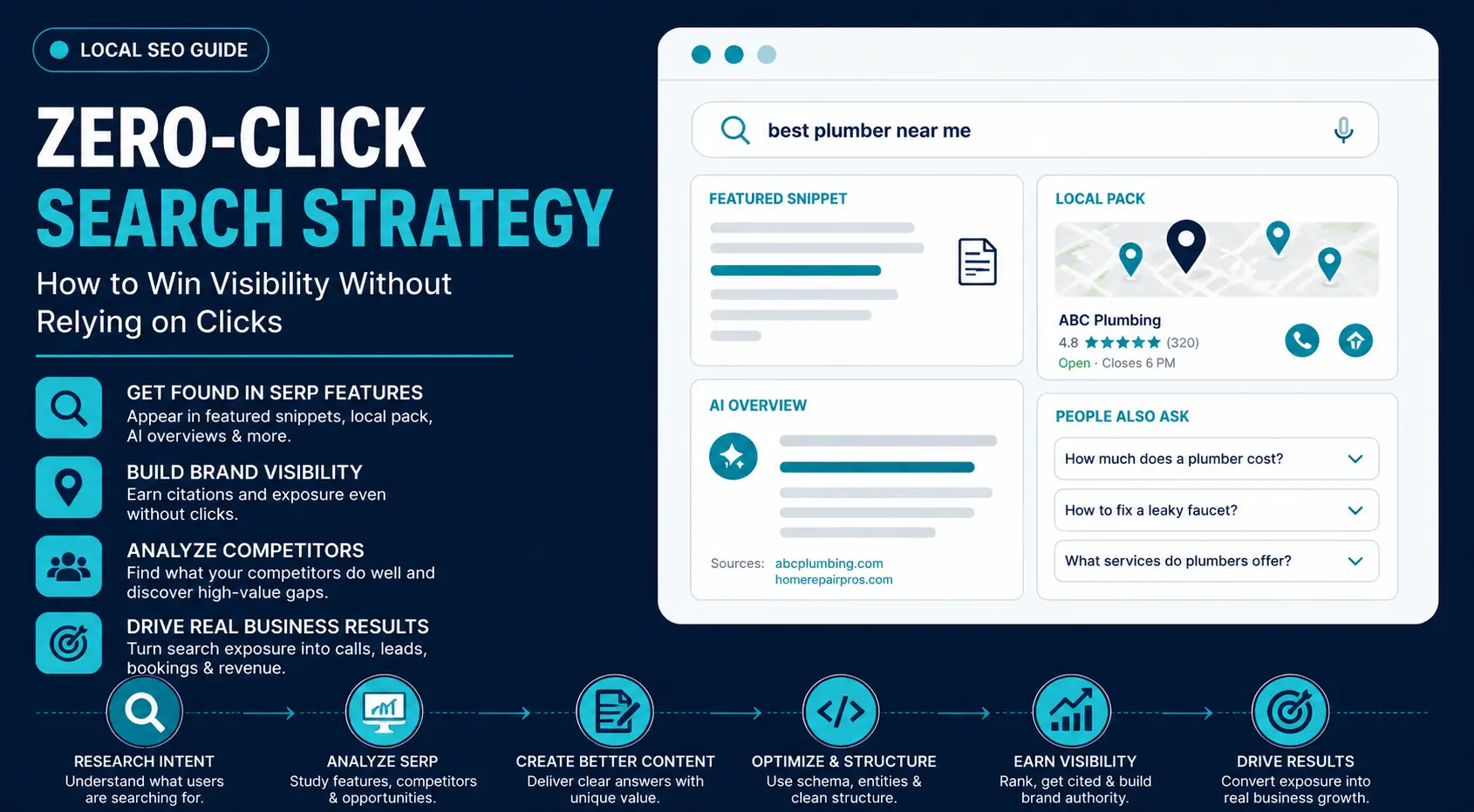
Your rankings might stay stable, but organic clicks decline because Google and AI-driven search answer queries directly through featured snippets, local results, Knowledge Panels, and AI summaries.
This makes click-only SEO difficult to evaluate. A page can earn visibility, citations, and brand exposure without generating a website visit.
A zero-click search strategy treats the SERP as a marketing surface, helps you decide when to win visibility, earn a citation, drive a click, or combine these outcomes based on search intent and business value.
What Is Zero-Click Search?
Zero-click search occurs when a search engine satisfies a user’s intent on the results interface, minimizing or eliminating the need for a website visit. The concept is further clarified by looking at how these searches work, why they are growing, and what they mean for SEO.
How Zero-Click Search Works
A zero-click search happens when the SERP provides enough information or functionality for the user to complete their immediate task without visiting an external website.
Common zero-click experiences include:
- Featured snippets: Extract a concise answer from a webpage.
- Direct answers: Provide straightforward information directly in the SERP.
- Knowledge Panels: Summarize information about identifiable entities.
- Local results: Show business details, reviews, hours, directions, or call options.
- Calculators: Let users perform calculations without opening another page.
- AI-generated answers: Synthesize information from multiple sources into a direct response.
Zero-click doesn’t mean zero visibility. A brand does appear in the search experience, influences the user’s decision, or receives a citation without generating a traditional organic session.
Traditional SEO focuses on rankings and website visits. Zero-click SEO, on the other hand, adds visibility within the search interface as a strategic outcome. Zero-click marketing has gone further by asking whether that exposure contributes to brand recognition, demand, consideration, or conversion later.
Why Zero-Click Searches Are Increasing
Search engines deliver answers and actions on the same page instead of sending the user to a webpage. The developments now are driving this shift:
- Queries have straightforward, answerable intent.
- SERPs contain specialized search features.
- Local results expose business information directly.
- Conversational search supports follow-up questions without repeated query reformulation.
- AI systems synthesize information from multiple sources.
- Users expect immediate answers and actions within search.
AI Overviews and other search experiences accelerate this trend by combining information from different sources into a single response. A source therefore gains visibility or a citation even when the user never clicks through.
Why Zero-Click Visibility Does Not Mean SEO Is Dead
The search interface has expanded; this doesn’t mean SEO is dead.
Organic content still:
- Rank in traditional results.
- Earn SERP features.
- Become a cited source in AI-generated answers.
- Strengthen associations between a brand and its topics.
- Generate clicks when deeper information is needed.
The strategic question is therefore not, “Will this query generate a click?”
but:
“What search outcome creates the most value for this query?”
A definition primarily serves brand awareness. A service query requires a website visit. A comparison query needs both SERP visibility and deeper engagement.
The goal is to optimize the search journey, i.e., to choose visibility, clicks, or both according to search intent and business value.
Where Zero-Click Search Opportunities Exist
Zero-click visibility occurs across several search surfaces, but each presents a different opportunity for earning answers, brand exposure, citations, or direct actions.
Traditional Answer-Focused SERP Features
Traditional zero-click opportunities include:
- Featured snippets: paragraph, list, and table formats that extract information from a webpage.
- Direct answer boxes: concise answers presented directly for straightforward questions.
- People Also Ask: related questions that expose additional answer opportunities.
- Knowledge Panels: entity-oriented information assembled around people, organizations, places, products, and other identifiable entities.
These surfaces have different mechanics, and each serves a different purpose. A featured snippet draws a concise passage from one source. A Knowledge Panel is entity-centric. PAA creates a cluster of related informational opportunities.
Local, Transactional, and Specialized Search Features
Zero-click behavior extends beyond informational queries.
Local Pack and Maps results expose:
- Business names
- Ratings and reviews
- Opening hours
- Phone numbers
- Directions
- Services
- Location information
Specialized searches produce dedicated result experiences for products, jobs, flights, events, images, videos, calculations, and other verticals.
The commercial implication is important. A user makes a preliminary decision before visiting a website. A restaurant may be shortlisted based on its local results. A retailer is evaluated from product information. A service provider is called directly.
AI-Powered Search Experiences
AI Overviews, AI Mode, conversational search, and other generative interfaces create another category of zero-click opportunity.
These systems:
- Interpret the query and its context.
- Retrieve relevant information.
- Synthesize information from multiple sources.
- Generate an answer.
- Attribute or cite supporting sources where applicable.
- Allow the user to continue the conversation with follow-up questions.
That makes generative search different from a conventional featured snippet.
A snippet extracts a passage. A generative system synthesizes multiple pieces of information and determines which sources are useful in supporting the resulting answer.
For brands, this creates a new visibility layer: being present as a cited source, mentioned entity, or trusted information provider even when the user has not visited the website.
What Determines Whether a Source Gets Selected?
Zero-click visibility is successful when search systems understand what the content says, whether it satisfies the query, and whether the source provides enough value to use.
Match the Query’s Underlying Intent
Keyword matching alone doesn’t reveal the search opportunity.
Consider these queries:
- “What is technical SEO?”
- “Best technical SEO agency”
- “technical SEO audit service”
- “technical SEO agency near me”
The topics overlap, but each has different intent.
The first is informational. The second is commercial investigation. The third has transactional implications. The fourth has local intent.
Each query produces a different SERP and hence a different zero-click strategy.
Search intent needs to be mapped before deciding whether to pursue an answer, citation, click, local exposure, or some combination.
Conversational and follow-up queries add another layer. A user begins with a broad question and then narrows it through subsequent searches. Content that establishes the underlying entities, relationships, and concepts remains useful across that journey.
Make the Answer Easy to Extract
Search systems use an answer they readily identify across the complete content page.
Content intended for direct-answer visibility requires making important information explicit. A strong structure includes:
- Question-aligned headings
- Concise definition blocks
- Direct opening answers
- Short explanatory paragraphs
- Lists where sequential or categorical information is appropriate
- Tables for comparisons
- Explicit relationships between concepts
- Self-contained factual passages
The inverse-pyramid approach works well here: give the essential answer first, then explain the reasoning, exceptions, evidence, and implementation details.
A useful page is the one that answers the immediate query and then provide depth that the SERP can’t reproduce.
Give Search Systems a Reason to Select Your Source
This is where information gain becomes strategically useful.
In the presence of ten pages that repeat the same generic definition, the eleventh page needs to contribute something distinctive to become the preferred source.
Information gain comes from:
- First-hand experience
- Original research
- Proprietary data
- Expert interpretation
- Unique examples
- Original testing
- Industry-specific observations
- Detailed comparisons
- Evidence-backed conclusions
- New relationships between established concepts
A generic paragraph saying “SEO improves visibility” adds little value. A documented comparison showing how zero-click exposure changed branded searches for a specific type of query provides much stronger informational differentiation.
Establish Source and Entity Credibility
Search systems need to understand what a page says as well as who or what stands behind the information.
Entity-based SEO establishes relationships among:
- Organizations
- Authors
- Products
- Services
- Locations
- Topics
- Publications
- Industry concepts
Brand information should be consistent across major authoritative sources. Authors should be identifiable where authorship matters. Organizational relationships should be clear.
External corroboration can reinforce those associations through relevant mentions, publications, digital PR, reviews, references, and other credible sources.
Authority is the part of the evidence ecosystem surrounding the entity and its claims.
Use Technical Signals as Support, Not the Strategy
Important information needs to be accessible to search systems. Pages should be crawlable and indexable where appropriate. Structured data helps machines interpret eligible content and entities. Preview controls influence how content is displayed in search. This all makes technical SEO important.
A valid implementation does not guarantee a search feature. Structured data supports understanding and eligibility where applicable; source selection is a broader relevance, quality, and retrieval issue.
How to Build a Zero-Click Search Strategy
The following steps are followed to formulate a strategy optimal for getting zero-click searches.
Step 1: Find Existing Zero-Click Opportunities
Start with the SERP, build a keyword set, and record:
- Search intent
- Current SERP features
- Featured snippets
- PAA results
- Local results
- AI-generated results where visible
- Branded versus non-branded status
- Existing organic rankings
- Click potential
- Commercial value
Don’t begin by creating the content calendar. A query already generating a direct answer is a different optimization target from a query dominated by conventional organic listings.
The SERP tells you what search systems consider useful in current times.
Step 2: Analyze Competitors Already Winning the SERP
Competitor analysis needs to go farther than checking who ranks first.
Study the sources that are currently receiving visibility.
Ask:
- What format does the extracted answer use?
- How directly does the competitor answer the question?
- What evidence supports the answer?
- Does the page contain first-hand information?
- Which related questions does it cover?
- Which entities and relationships are clearly established?
- What information is missing?
- Where does the competitor remain generic?
- What does the competitor provide that your page does not?
This creates a source-selection gap analysis.
You are not only asking, “How can we outrank this page?”
You are asking, “Why is this source useful to the search system, and what can our source contribute that will be better, clearer, authoritative, or distinctive?”
Step 3: Prioritize Opportunities by Business Value
Search volume doesn’t dictate the strategy. Score opportunities using factors such as:
| Factor | Strategic question |
| Search intent | What does the user actually want? |
| Zero-click likelihood | Can the SERP satisfy the query directly? |
| Visibility potential | Is there a meaningful SERP surface to win? |
| Demand | How often does the opportunity occur? |
| Brand value | Would repeated exposure strengthen recognition? |
| Traffic potential | Is a click commercially useful? |
| Conversion potential | Can the query influence a valuable action? |
| Competition | How difficult is source selection? |
| Existing authority | Does the site have credibility in this topic? |
| Information gain | Can the brand provide something genuinely distinctive? |
A low-volume query with strong commercial intent is worth more than a high-volume definition that generates no meaningful downstream action.
Step 4: Choose the Right Search Objective
Assign one primary objective to each opportunity:
- Win the answer.
Useful when immediate information delivery is the main value. - Win the citation.
Useful when being recognized as a source strengthens authority and brand visibility. - Win the click.
Best when the website experience contains substantial commercial or informational value. - Win visibility and the click.
Useful for high-consideration searches where the answer builds trust and the website completes the journey. - Build branded demand.
Useful when repeated exposure can cause users to search for the brand later.
This classification prevents a strategic error: treating every zero-click result as something that should be maximized.
Step 5: Optimize or Create the Content
After establishing the objective, optimize the page around the actual SERP opportunity.
A useful content structure includes:
- Direct answer to the primary query.
- Supporting explanation.
- Related questions and entities.
- Original evidence or examples.
- Deeper context.
- Relevant next step.
The content satisfies the immediate intent without becoming a shallow answer farm.
Semantic relationships are important here. If a page discusses zero-click search, for example, it should naturally establish relationships among SERPs, featured snippets, AI search, organic CTR, search intent, entities, citations, and business outcomes.
Step 6: Create a Reason to Continue Beyond the Answer
The answer should not be crippled just to obtain a click. That approach produces poor user experience and weak content.
First provide the answer. Then provide something the SERP cannot deliver completely. That could be:
- An interactive calculator
- Original research
- A downloadable template
- A detailed comparison
- Proprietary data
- A diagnostic tool
- A worked example
- An implementation framework
- A personalized assessment
- Expert interpretation
The click is ensured when the website offers additional utility, not because the initial answer was withheld.
Step 7: Build Visibility Beyond a Single SERP Feature
Winning one featured snippet is not a beneficial strategy.
Build broader topical and entity associations. Strengthen the branded search demand. Earn relevant external mentions. Cover connected questions. Improve visibility across traditional SERPs, local results, and generative search surfaces.
The strategic asset is recognition as a useful source within a topic, besides earning SERP.
When Should You Optimize for Zero-Click Visibility?
The right objective behind optimizing a query for the outcome depends on the user’s intent, how much the SERP satisfies directly, and where the business creates value.
Queries Where Zero-Click Visibility Is the Primary Opportunity
Prioritize visibility when the immediate intent is satisfied within search and exposure itself has value.
The opportunities include:
- Definitions and basic explanations
- Simple informational questions
- Early-stage research
- Brand-awareness searches
- Local discovery
- Low-complexity informational queries
For these searches, a website visit adds little value to the immediate task. Earning the answer or being associated with the topic is the stronger outcome.
Queries Where the Click Should Remain the Primary Goal
Prioritize clicks when the website experience contains substantial value that cannot be delivered in the SERP.
Examples include:
- Product and service pages
- High-intent commercial queries
- Complex comparisons
- Interactive tools
- Original research requiring full context
- Transactional searches
A software buyer needs pricing, integrations, demonstrations, implementation details, and case studies. A short SERP answer cannot replace that experience.
Queries Where Visibility and Clicks Should Work Together
Use a hybrid objective when the SERP establishes relevance or expertise, but the user still needs deeper information before acting.
This applies to:
- “Best” queries
- Comparison searches
- Local service research
- B2B research
- High-consideration purchases
- Complex problem-solving queries
The SERP earns attention; the website provides the depth needed for consideration and conversion.
Apply the Click-vs-Visibility Decision
Use this sequence:
Query intent → zero-click likelihood → business value of visibility → value of the website experience → primary objective
The resulting objective can be:
- Win the answer
- Win the citation
- Win the click
- Win visibility and the click
- Build branded demand
The point is to choose the search outcome that creates the most value for each query.
How to Turn Zero-Click Visibility Into Business Value
Zero-click visibility becomes commercially useful when search exposure contributes to recognition, demand, or action, even without a website visit. This shifts the focus from counting clicks to understanding what the exposure influences next.
Build Brand Recognition Before the Click
Repeated exposure associates a brand with a specific problem, topic, or category. This plays a role when users conduct several searches before making a decision.
A brand that appears in relevant answers consistently becomes part of the user’s consideration set before a branded search or direct visit.
Turn Search Visibility Into Demand
Zero-click exposure contributes to later branded behavior. A user encounters a brand in an answer, remembers it, and then searches for the company later.
Track signals that indicate this effect:
- Branded search growth
- Direct traffic
- Returning visitors
- Brand mentions
- Share of voice
- Assisted conversions
These signals are to be interpreted together rather than treated as proof that a specific zero-click impression caused a conversion.
Preserve the Click Where It Creates Value
When the website experience is important from a commercial point of view, connect search visibility to the relevant destination.
- Service queries → relevant service page
- Comparison queries → detailed comparison
- Local searches → relevant location or service page
- High-intent searches → focused conversion path
The goal is to give the useful answer, then make the deeper experience worth continuing into.
How to Measure Zero-Click Search Performance
Zero-click performance is not evaluated solely through organic traffic alone. Measure the full path from search visibility to user behavior and business outcomes, while recognizing that some exposure will not produce a directly attributable click.
Measure Search Visibility
Rankings are the one layer of zero-click performance. Track where and how the brand appears across search surfaces:
- SERP feature presence
- Impressions
- Featured snippet visibility
- PAA visibility
- Local visibility
- AI search citations, where measurable
- Brand mentions
- Share of voice
AI search reporting varies by platform, so citation data might be directional where complete visibility data is unavailable.
Measure Search Behavior
Track what happens after search exposure:
- Organic CTR
- Branded search volume
- Direct traffic
- Returning visitors
- Qualified organic traffic
- Changes in query patterns
A lower CTR alongside rising branded demand indicates a different outcome from falling CTR combined with declining visibility and conversions.
Measure Business Impact
Connect search visibility to outcomes that affect the business:
- Leads
- Conversion rate
- Assisted conversions
- Pipeline influence
- Revenue
- Customer acquisition efficiency
Separate exposure metrics from outcome metrics. Zero-click impressions can’t be tied to a conversion, but they do contribute to the wider search journey.
Measure Zero-Click ROI
Establish a baseline before optimization and compare changes across the search journey:
Visibility → branded demand → traffic → engagement → conversions → revenue
Evaluate these changes over time and don’t attribute every outcome to a single SERP interaction.
A decline in clicks doesn’t indicate failure, just as deeper impressions do not indicate success. The relevant question is whether search visibility is producing meaningful business value.
Zero-Click Search Strategy Example
A useful zero-click strategy changes with the query’s intent, SERP behavior, and business value. The workflow is:
Query → intent → current SERP → competitor → business value → objective → content gap → optimization → measurement
Example Workflow: From Query to Strategy
Consider a B2B SEO agency targeting “What is technical SEO?”
The query is primarily informational, and the SERP already provides a concise definition. Competing solely for a click would therefore be less useful than earning visibility and establishing topical authority.
Primary objective: Win the answer and build brand association.
The content should:
- Define technical SEO clearly.
- Explain relevant areas such as crawlability, indexability, rendering, and performance.
- Add an original audit framework or documented example.
- Provide deeper guidance that cannot fit into a short SERP answer.
The direct answer earns visibility; the original framework creates a reason to continue.
Informational Query Example
For “What is zero-click search?”, a generic definition offers less differentiation if the SERP already has answers to it.
A stronger page would:
- Answer the definition immediately.
- Explain different zero-click SERP surfaces.
- Distinguish visibility from traffic.
- Explain when zero-click visibility is strategically valuable.
- Provide a decision framework.
- Show how performance can be measured.
The objective is not to capture the answer, but to use that answer as an entry point to distinctive, useful information.
Commercial Query Example
Consider “Best SEO agency for SaaS companies.”
Here, the click has greater commercial value. A page should therefore combine SERP visibility with reasons to evaluate the full website experience.
Useful content includes:
- Evidence and case studies
- Comparison criteria
- SaaS-specific expertise
- Methodology
- Relevant pricing context
- A focused conversion path
Primary objective: Win visibility, earn the click, and convert qualified intent.
Local Query Example
For “SEO agency near me,” the search interface already exposes the business name, reviews, location, hours, directions, and contact options.
A website visit is not necessarily the desired outcome.
Measure local actions such as:
- Calls
- Direction requests
- Website visits
- Branded searches
- Bookings
- Other local conversions
Here, zero-click visibility supports a real-world action from the search experience, making local exposure valuable even without a traditional organic session.
Common Zero-Click SEO Mistakes
The zero-click failures come from optimizing the wrong search outcome, producing undifferentiated answers, or measuring visibility without connecting it to business value.
Strategic Mistakes
| Mistake | Why it hurts | Better approach |
| Optimizing every keyword for zero-click visibility | Some queries need a website visit to create value. | Match the objective to search intent and business value. |
| Treating zero-click as a replacement for traditional SEO | Commercial and transactional queries can still depend heavily on organic traffic. | Use zero-click visibility alongside traditional SEO. |
| Chasing search volume instead of business value | High-volume informational queries may produce little commercial value. | Prioritize queries based on intent, opportunity, and business impact. |
| Maximizing impressions without considering intent | Exposure without relevance becomes a vanity metric. | Measure visibility in relation to qualified demand and outcomes. |
| Giving up valuable clicks unnecessarily | Some website experiences contain the information, proof, or functionality needed for conversion. | Protect the click when deeper engagement creates value. |
| Ignoring branded vs. non-branded visibility | Repeated branded exposure can influence later searches and consideration differently from generic visibility. | Track branded demand separately from broader search visibility. |
Content and Optimization Mistakes
Generic answers are easy to produce and difficult to differentiate. Common failures include:
- Burying the primary answer.
- Producing shallow explanations.
- Adding no original evidence or insight.
- Ignoring competitor information gaps.
- Optimizing exclusively for featured snippets.
- Treating entities and authority as checkbox exercises.
- Assuming schema guarantees visibility.
- Answering the immediate query without providing deeper value.
Keep the direct answer concise. Keep the page useful. A zero-click-optimized page does not need to become thin content.
Measurement Mistakes
Zero-click performance can’t be judged through rankings or sessions alone. Avoid:
- Measuring rankings or organic traffic only.
- Treating impressions as conversions.
- Ignoring branded search growth.
- Ignoring local actions such as calls or direction requests.
- Failing to track assisted business outcomes.
- Assuming every traffic decline represents strategic failure.
Measurement should connect visibility → behavior → business outcomes, rather than treating the website session as the meaningful result.
This section needs moderate tightening (~20–25%). The main repetition is around “search is becoming conversational,” “clicks matter less,” and “source visibility matters.” Those ideas are important, but they only need to be established once.
The source-selection and distinctive-information concepts should stay because they connect directly to the article’s information-gain theme.
Final revised section
The Future of Zero-Click Search
Search is moving toward retrieving, synthesizing, and completing tasks from the presentation of documents followed previously. That shift changes what brands need to optimize for.
From SERP Features to AI-Mediated Answers
AI Overviews, AI Mode, and conversational search can synthesize information from multiple sources and support follow-up exploration. Users now interact with an answer rather than selecting a document first.
For brands, this shifts the question from:
“Where does my page rank?”
to:
“Does the system use my information when constructing the answer?”
From Search Results to Task Completion
Search also became action-oriented. Users increasingly:
- Compare options
- Plan activities
- Find local providers
- Evaluate products or services
- Move from research toward transactions
The click becomes one possible interaction rather than the only measure of success. Entity accuracy, structured information, source credibility, and useful first-hand data become important as systems take on more of the user’s task.
Why Source Selection Will Matter More
AI systems need information they can interpret, retrieve, and rely on. Distinctive evidence hence becomes a competitive asset.
Useful source signals include:
- Original evidence and proprietary research
- First-hand experience
- Clear authorship and expertise
- Consistent entity information
- External corroboration
- Specific, verifiable claims
Distinctive, verifiable information is harder to replace.
The New SEO Objective
Rankings and traffic still matter. Zero-click search adds another objective: becoming the information, entity, brand, or source that appears before the click, or satisfies the query without one.
SEO, entity-based optimization, answer optimization, and Generative Engine Optimization converge around one requirement:
Can search systems understand, trust, retrieve, and use your information for the user’s task?
Key Takeaways
- Zero-click search changes what successful search visibility looks like; it does not eliminate SEO.
- Identify the SERP or AI surface before choosing an optimization tactic.
- Analyze competitors to understand why particular sources are being selected.
- Prioritize opportunities according to intent and business value, not search volume alone.
- Decide whether the objective is to win the answer, citation, click, visibility-plus-click, or branded demand.
- Make important answers easy to extract while adding original value beyond the SERP.
- Protect clicks when the website experience creates meaningful commercial value.
- Measure SERP visibility, branded demand, traffic, conversions, and revenue together.
- Treat zero-click visibility as a strategic search outcome, not merely a traffic problem.
FAQS
Can a zero-click search still generate a conversion?
Yes. A user can call a business, request directions, book an appointment, or take another action directly from the SERP without visiting the website. For these searches, measure the action rather than treating a missing session as a failed conversion.
How can you optimize content for AI citations without giving away everything?
Provide a clear, verifiable answer to the immediate query, then add original analysis, evidence, examples, tools, or proprietary insights that require deeper engagement. The goal is not to hide useful information but to make the full resource more valuable than its extracted summary.
What is the difference between a featured snippet and an AI Overview?
A featured snippet generally extracts a concise passage or structured section from a single webpage. An AI Overview can synthesize information from multiple sources into a generated response, creating a broader source-selection and citation challenge.
How do you prioritize zero-click opportunities across a large website?
Score queries using factors such as search intent, SERP feature presence, business value, zero-click likelihood, competitive difficulty, and existing visibility. Prioritize opportunities where improved SERP exposure can create meaningful brand or commercial impact.
Can zero-click optimization reduce organic traffic?
It can reduce clicks for queries where the SERP fully satisfies the user’s immediate intent. That is not automatically negative. The strategic test is whether lost clicks are offset by stronger visibility, branded demand, direct actions, qualified traffic, or other business outcomes.