
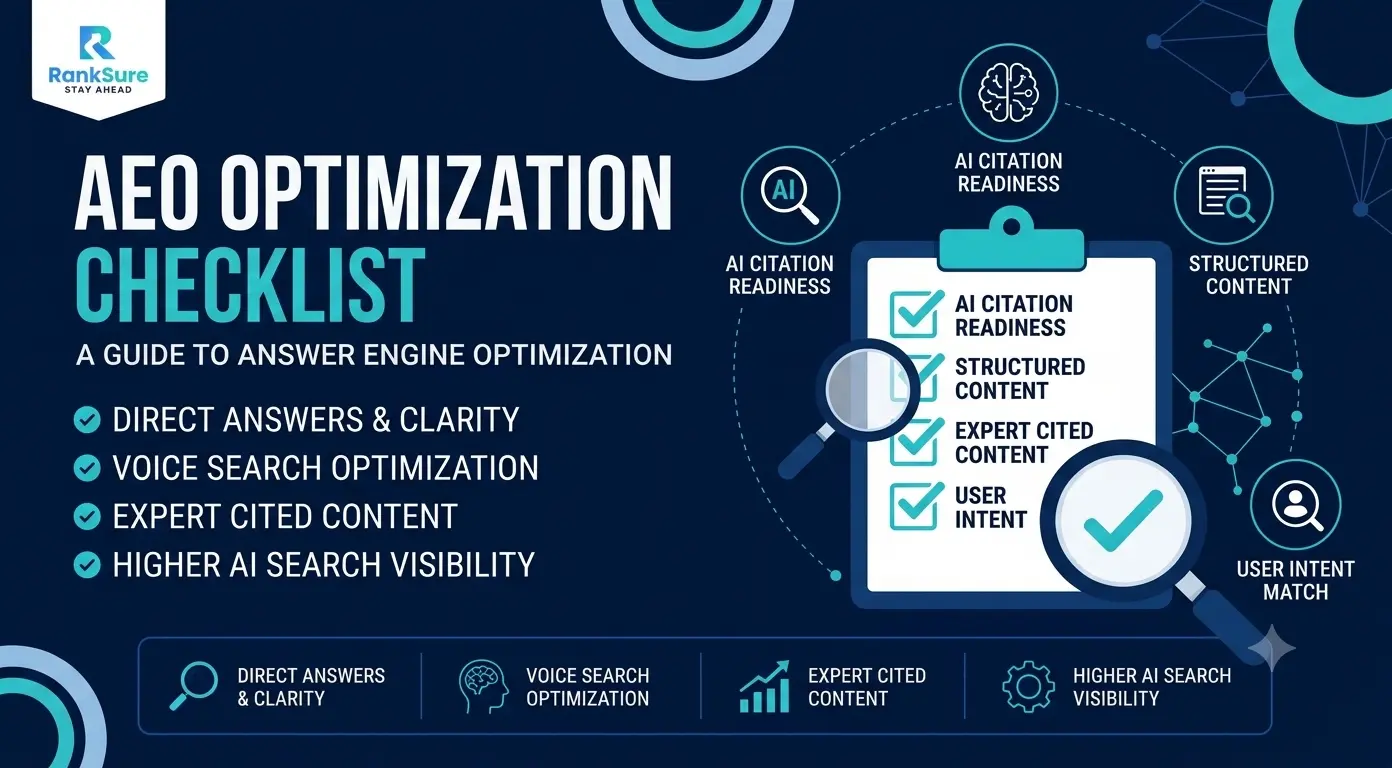
Answer Engine Optimization (AEO) focuses on helping AI-powered search engines, chatbots, voice assistants, and traditional search engines understand, retrieve, and present your content as direct answers to users. Unlike traditional SEO, which primarily targets rankings, AEO emphasizes creating clear, trustworthy, and structured content that AI systems can confidently cite and recommend.
As search behavior continues to evolve, users increasingly expect instant, accurate answers instead of browsing multiple pages. Platforms such as Google AI Overviews, ChatGPT, Gemini, Perplexity, Microsoft Copilot, and voice assistants prioritize content that directly satisfies user intent, answers questions clearly, and demonstrates expertise.
The checklist below covers the most important AEO optimization factors that influence whether your content is easy for answer engines to understand, extract, and reference. Each parameter focuses on a specific aspect of answer readiness, including content structure, question coverage, semantic relevance, authority, readability, and AI-friendly formatting.
Use this checklist during content creation, optimization, or content audits to identify improvement opportunities and ensure every page is prepared for modern AI-driven search experiences.
| # | AEO Optimization Checklist Parameter | Detail of Parameter |
| 1 | Primary User Intent Match | The page directly answers the main question users ask without unnecessary introductions. |
| 2 | Answer-First Introduction | The first paragraph provides a clear, concise answer before expanding into details. |
| 3 | Question-Based H2 Headings | Major headings are written as real user questions commonly searched in Google, AI Search, and voice assistants. |
| 4 | Featured Snippet Optimization | Important answers are written in 40–60 words for better featured snippet and AI citation potential. |
| 5 | Conversational Language | Content uses natural, human language that AI assistants can easily understand and quote. |
| 6 | One Question, One Answer | Each section focuses on answering a single question completely without mixing multiple topics. |
| 7 | FAQ Coverage | Includes FAQs covering common, related, and follow-up user questions. |
| 8 | Semantic Entity Coverage | Important entities (brands, products, people, tools, standards, locations, etc.) are naturally included. |
| 9 | Topic Completeness | Covers all major subtopics users expect without leaving important knowledge gaps. |
| 10 | Direct Definitions | Key terms are clearly defined in one or two simple sentences. |
| 11 | Step-by-Step Instructions | Processes are explained in logical numbered steps whenever applicable. |
| 12 | List-Based Answers | Uses bullets, numbered lists, and tables where AI systems can easily extract structured information. |
| 13 | Comparison Sections | Includes comparisons (vs., differences, pros/cons, alternatives) where relevant. |
| 14 | Statistics & Evidence | Supports important claims with verified statistics, studies, or official references. |
| 15 | Experience Signals | Demonstrates practical expertise through examples, workflows, or real-world insights. |
| 16 | E-E-A-T Signals | Clearly establishes expertise, experience, authority, and trustworthiness throughout the content. |
| 17 | Author Information | Displays qualified author details or credentials to strengthen trust. |
| 18 | Freshness Indicators | Content reflects current practices, regulations, versions, or recent updates. |
| 19 | Schema Eligibility | Content structure supports FAQ, HowTo, Q&A, Article, or other relevant structured data. |
| 20 | Internal Question Linking | Links to pages that answer related questions users commonly ask next. |
| 21 | External Authority References | References trusted industry or government sources where appropriate. |
| 22 | Voice Search Optimization | Questions and answers are written naturally for spoken-language queries. |
| 23 | Long-Tail Question Coverage | Covers specific, conversational, long-tail search queries users commonly ask AI assistants. |
| 24 | Context Preservation | Every answer contains enough context to make sense even when quoted independently by an AI model. |
| 25 | Clear Answer Formatting | Uses short paragraphs, bold key points, lists, and tables for easier AI extraction. |
| 26 | Content Chunking | Information is divided into logical sections with descriptive headings for better retrieval. |
| 27 | Duplicate Answer Prevention | Avoids repeating the same answer in multiple sections, reducing ambiguity for AI systems. |
| 28 | Consistent Terminology | Uses the same terminology consistently across the page to improve entity recognition. |
| 29 | Follow-Up Question Coverage | Anticipates and answers logical follow-up questions after each primary topic. |
| 30 | AI Citation Readiness | Every important claim is clear, self-contained, accurate, and easy for AI systems to quote or reference confidently. |
How to Use This Checklist
This checklist is designed to evaluate how effectively a webpage is optimized for Answer Engine Optimization (AEO). Review each parameter individually and verify whether the page fully satisfies the requirement. If a parameter is missing or only partially implemented, mark it for improvement and update the content accordingly.
A strong AEO score is achieved when the page provides direct answers, covers user intent comprehensively, uses logical content organization, includes trustworthy information, and presents information in a format that AI systems can easily understand and reference.
For the best results, combine this AEO checklist with technical SEO, on-page SEO, structured data, Core Web Vitals, and E-E-A-T best practices. Together, these optimization areas improve the likelihood of earning visibility in AI-generated answers, featured snippets, voice search results, and traditional search rankings while delivering a better experience for users.